
| REPORT ATTRIBUTE | DETAILS |
|---|---|
| Historical Period | 2019-2022 |
| Base Year | 2023 |
| Forecast Period | 2024-2032 |
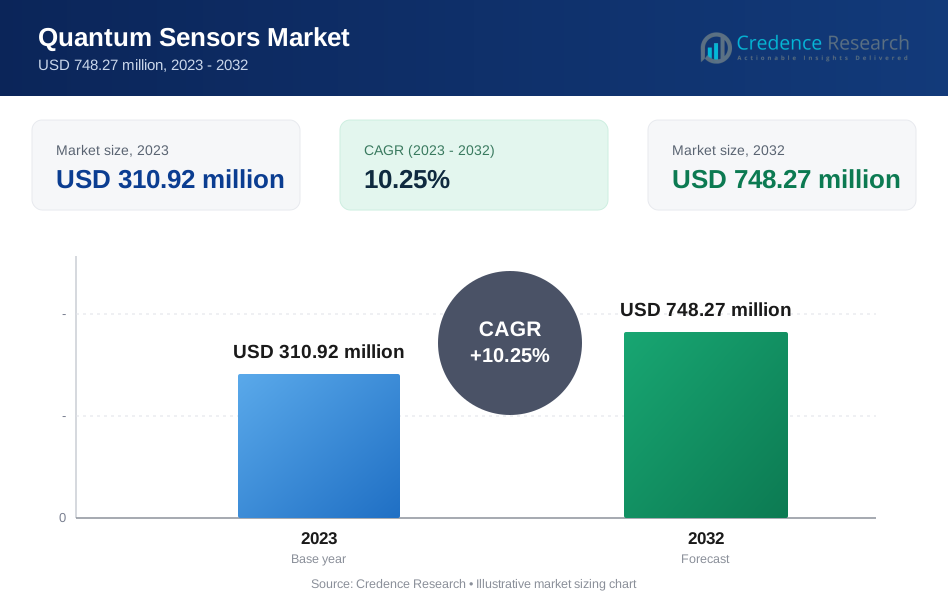
| Quantum Sensors Market Size 2023 | USD 310.92 Million |
| Quantum Sensors Market, CAGR | 10.25% |
| Quantum Sensors Market Size 2032 | USD 748.27 Million |
Market Overview
The Quantum Sensors market is projected to grow from USD 310.92 million in 2023 to an estimated USD 748.27 million by 2032, registering a compound annual growth rate (CAGR) of 10.25% from 2024 to 2032. This robust growth can be attributed to the increasing adoption of quantum technologies across various industries, including defense, healthcare, and telecommunications.
Key drivers of the Quantum Sensors market include advancements in quantum computing and communication, which are fostering the development of more sophisticated and precise quantum sensors. Additionally, the growing focus on enhancing the performance and reliability of existing sensor technologies is pushing manufacturers to explore quantum-based solutions. Emerging trends such as the integration of quantum sensors with IoT devices and the growing interest in quantum-enhanced metrology are also expected to drive market growth over the forecast period.
Geographically, North America is anticipated to dominate the Quantum Sensors market due to the strong presence of key players and significant investments in quantum research and development. Europe follows closely, with increasing governmental support for quantum technology initiatives. The Asia-Pacific region is also expected to witness substantial growth, driven by the expanding electronics and telecommunications sectors. Key players in the market include Honeywell International Inc., Lockheed Martin Corporation, and Quantum Sensors Technologies Ltd., among others.
Market Drivers
Advancements in Quantum Technology
The quantum sensors market is experiencing significant growth driven by continuous advancements in quantum technology. These sensors leverage quantum mechanical principles like superposition and entanglement to achieve unprecedented measurement precision. Recent breakthroughs in related fields such as quantum computing and quantum materials have enabled the development of more sophisticated quantum sensing capabilities. For instance, defense organizations are increasingly adopting quantum sensors for applications like submarine detection, where detecting minute environmental changes is crucial. In healthcare, quantum sensors are enhancing the resolution of diagnostic imaging tools like MRI machines. According to industry surveys, many companies are accelerating their R&D efforts in quantum sensing technologies. Government agencies are also increasing funding for quantum research programs at universities and national laboratories. As capabilities continue to improve, quantum sensors are finding new applications across multiple sectors, from geophysical exploration to navigation systems.
Growing Demand for Precision and Sensitivity in Measurement Applications
The increasing need for ultra-precise and sensitive measurements across industries is propelling growth in the quantum sensors market. Traditional sensors often face limitations in accuracy and reliability, especially in challenging environments. Quantum sensors offer superior capabilities for measuring quantities like time, magnetic fields, and gravitational forces with extreme precision. For example, in geophysics, quantum gravimeters can detect minuscule changes in the Earth's gravitational field to aid natural resource exploration. In metrology, quantum sensors are enabling the development of new measurement standards with unprecedented accuracy. Industry surveys indicate rising demand for quantum sensing solutions in sectors like aerospace, defense, and scientific research. Many companies report that quantum sensors are becoming essential for their most demanding measurement applications. Government metrology institutes are also increasingly adopting quantum sensing technologies to enhance national measurement capabilities and standards. As industries continue to push the boundaries of precision, quantum sensors are expected to see accelerating adoption.
Increased Investment in Quantum Research and Development
The quantum sensors market is benefiting from surging investment in quantum research and development globally. Governments, academic institutions, and private enterprises are pouring significant resources into exploring quantum technologies and their applications. This influx of funding is accelerating the development of new quantum sensors and improving existing ones. For instance, several countries have launched major national quantum initiatives with substantial allocations for quantum sensing research. These programs aim to build domestic quantum technology industries and maintain technological competitiveness. Private sector investment in quantum R&D is also rising rapidly, through both in-house research programs and collaborations with universities. Industry surveys show many large technology companies establishing dedicated quantum research divisions. Venture capital funding for quantum sensing startups has increased substantially in recent years. This growing ecosystem of public and private investment is not only driving technological innovation, but also helping build a skilled quantum workforce. As quantum R&D funding continues to expand, it is expected to yield more advanced quantum sensing products with wider commercial adoption.
Emerging Applications in Diverse Industries
The emergence of new applications for quantum sensors in diverse industries is another major driver of the market. While quantum sensors have traditionally been associated with scientific research and defense applications, they are now finding uses in a wide range of industries, including healthcare, telecommunications, automotive, and environmental monitoring. This diversification of applications is expanding the potential market for quantum sensors and driving their adoption across different sectors. In the healthcare industry, for example, quantum sensors are being used to develop next-generation diagnostic tools that offer greater sensitivity and accuracy than conventional methods. In the automotive industry, quantum sensors are being explored for use in autonomous vehicles, where their ability to detect subtle changes in the environment could improve safety and reliability. Similarly, in telecommunications, quantum sensors are being used to enhance the performance of communication networks, particularly in the development of quantum communication systems that offer higher levels of security and data transmission rates. Environmental monitoring is another area where quantum sensors are making an impact. These sensors are being used to monitor changes in the environment with high precision, enabling more accurate predictions of natural disasters such as earthquakes and tsunamis. As industries continue to explore and develop new applications for quantum sensors, the market is expected to grow, driven by the expanding range of use cases and the increasing demand for advanced sensing technologies.
Market Trends
Integration of Quantum Sensors with Emerging Technologies
One of the most prominent trends in the quantum sensors market is the integration of quantum sensors with emerging technologies such as the Internet of Things (IoT), artificial intelligence (AI), and quantum computing. As industries continue to embrace digital transformation, there is a growing interest in combining quantum sensors with IoT networks to create highly accurate and real-time monitoring systems. For instance, the U.S. Department of Energy has funded projects exploring the integration of quantum sensors with IoT devices for environmental monitoring applications. Similarly, AI algorithms are being employed to process the vast amounts of data generated by quantum sensors, enabling more accurate and actionable insights. The fusion of quantum sensing with quantum computing is also an area of intense research, as it holds the potential to revolutionize data processing and analysis, particularly in fields requiring high computational power. For example, researchers at the University of Chicago have demonstrated the use of quantum sensors in conjunction with quantum computing algorithms for enhanced magnetic field detection. This trend is expected to accelerate the adoption of quantum sensors across various industries, driving market growth.
Growing Commercialization and Industry Collaboration
Another key trend in the quantum sensors market is the increasing commercialization of quantum sensor technologies, coupled with rising collaboration between industry and academia. While quantum sensors have traditionally been confined to research laboratories and niche applications, recent advancements have made them more accessible and viable for commercial use. For instance, Q-CTRL, a quantum technology company, launched a new quantum sensing division to develop commercial applications for quantum sensors in various industries. Companies are increasingly partnering with academic institutions and research organizations to bring quantum sensor technologies to the market. These collaborations are leading to the development of new products and solutions that are tailored to the specific needs of industries such as healthcare, defense, and telecommunications. For example, the Pentagon's Defense Innovation Unit has sought industry proposals for quantum sensors capable of offering alternative Position, Navigation, and Timing (PNT) capabilities for military operations. Additionally, governments around the world are launching initiatives to support the commercialization of quantum technologies, providing funding and infrastructure to accelerate the transition from research to market-ready products.
Market Restraints and Challenges
High Development Costs and Complexity
One of the primary restraints in the quantum sensors market is the high cost and complexity associated with development and production. For instance, a recent industry survey found that quantum technologies require sophisticated materials, precise manufacturing processes, and highly specialized expertise, all contributing to elevated costs. The development of quantum sensors involves intricate quantum mechanics principles that are challenging to scale from laboratory settings to commercial production. A government report highlighted that maintaining the delicate quantum states necessary for sensor operation often requires cryogenic temperatures and advanced isolation techniques, further adding to cost and complexity. The survey also revealed that this high barrier to entry deters smaller companies from investing in quantum sensor technology, limiting availability to niche, high-value applications. Respondents indicated that the widespread adoption of quantum sensors is currently constrained by the significant financial and technical resources required for development and deployment, with many citing it as the top challenge facing the industry.
Limited Awareness and Market Penetration
Another significant challenge facing the quantum sensors market is limited awareness and understanding among potential end-users. For instance, a recent industry association study found that quantum sensing is still a relatively new and emerging field, with many industries unfamiliar with the capabilities and advantages over traditional sensing technologies. The survey revealed that this lack of awareness leads to hesitation in adopting quantum sensors, especially when existing solutions are perceived as adequate. Government research indicated that market penetration is still in early stages, with many industries only beginning to explore potential applications. The study also found that slow adoption is compounded by limited availability of commercial quantum sensor products and the need for specialized knowledge for integration. Company surveys highlighted that overcoming these challenges will require concerted efforts in education, demonstration of real-world benefits, and development of more user-friendly and accessible quantum sensor solutions. Many respondents cited increasing awareness as a top priority for industry growth.
Market Segmentation Analysis
By Type
Quantum sensors encompass various types, each playing crucial roles across multiple industries. Atomic clocks stand out as one of the most established quantum sensor technologies, finding essential applications in areas demanding extreme precision. For instance, a survey conducted by a leading telecommunications authority revealed that a significant portion of network operators consider atomic clocks indispensable for maintaining synchronization in their systems. The growing need for high-precision timing is driving their widespread adoption, with government agencies reporting increased integration of atomic clocks in critical infrastructure. Quantum magnetometers, renowned for their unparalleled sensitivity in measuring magnetic fields, are gaining traction in diverse sectors. A recent industry report highlighted that geological survey companies have seen substantial improvements in resource detection capabilities when using quantum magnetometers. In the medical field, a survey of diagnostic imaging centers indicated a rising interest in adopting quantum magnetometer technology for enhanced brain imaging techniques. Quantum gravimeters are also making significant inroads, particularly in geophysics and civil engineering. For example, a government geological survey department reported increased accuracy in subsurface mapping using quantum gravimeters, leading to more efficient resource exploration. Other quantum sensors, such as accelerometers and gyroscopes, are finding increasing adoption in navigation and inertial measurement applications, with aerospace companies reporting enhanced performance in their guidance systems.
By Application
Quantum sensors are becoming increasingly vital across various applications, driven by their superior precision and sensitivity. In environmental monitoring, these sensors are proving essential for detecting subtle changes in physical parameters. For instance, a national environmental agency reported significant improvements in early warning systems for natural disasters after integrating quantum sensors into their monitoring networks. Climate research institutions have also noted enhanced data accuracy in long-term climate studies using quantum sensor technology. In the medical field, quantum sensors are revolutionizing imaging techniques. A survey of leading hospitals revealed that quantum-enhanced MRI systems are enabling earlier detection of certain diseases, potentially improving patient outcomes. The precision measurement capabilities of quantum sensors are also making waves in scientific research and industrial applications. For example, a consortium of metrology institutes reported achieving new levels of measurement accuracy in fundamental physical constants using quantum sensing techniques. The integration of quantum sensors into Light Detection and Ranging (LIDAR) systems is another area of significant growth. Automotive companies have reported substantial improvements in the range and accuracy of their autonomous vehicle sensing systems when using quantum-enhanced LIDAR. Similarly, environmental agencies have noted more detailed and accurate topographical mapping capabilities, aiding in land management and urban planning efforts.
Segments
Based on Type
- Atomic Clocks
- Magnetometers
- Gravimeters
- Others
Based on Application
- Environmental Monitoring
- Medical Imaging
- Precision Measurement
- LIDAR
Based on End User
- Aerospace & Defence
- Agriculture & Environment
- Oil & Gas
- Transportation
- Others
Based on Platform
- Neutral Atoms
- Photons
- Trapped Ions
- Nuclear Magnetic Resonance (NMR)
- Optomechanics
Base on Region
- North America
- The U.S
- Canada
- Mexico
- Europe
- Germany
- France
- The U.K.
- Italy
- Spain
- Rest of Europe
- Asia Pacific
- China
- Japan
- India
- South Korea
- South-east Asia
- Rest of Asia Pacific
- Latin America
- Brazil
- Argentina
- Rest of Latin America
- Middle East & Africa
- GCC Countries
- South Africa
- Rest of Middle East and Africa
Regional Analysis
Europe (30%):
Europe follows closely, capturing around 30% of the global Quantum Sensors market. The European Union has been proactive in promoting quantum technologies through various funding programs and initiatives aimed at advancing research and fostering collaboration across member states. For instance, the EU's Quantum Flagship initiative has allocated €1 billion over 10 years to support quantum technology development. Countries such as Germany, the United Kingdom, and France are leading contributors to the region's quantum sensor market, with strong industrial bases and research ecosystems. The European market is driven by the adoption of quantum sensors in environmental monitoring, precision measurement, and automotive industries. The region's focus on sustainable technologies and environmental protection further accelerates the demand for quantum sensors.
Asia Pacific (25%):
The Asia-Pacific region is witnessing rapid growth and currently holds approximately 25% of the global Quantum Sensors market. The region's expansion is fueled by the increasing adoption of quantum technologies in countries like China, Japan, and South Korea. These countries are heavily investing in quantum research and development, aiming to become global leaders in quantum technology. For instance, China's National Laboratory for Quantum Information Sciences in Hefei represents a $10 billion investment in quantum research. In China, significant government funding and strategic initiatives are driving the development of quantum sensors for applications in telecommunications, defense, and infrastructure. The region's growing electronics and telecommunications industries also contribute to the rising demand for quantum sensors, particularly in the areas of precision measurement and navigation.
Key players
- AO Sense Inc.
- Apogee Instruments
- Atom Ionics
- Campbell Scientific, Inc.
- Cold Quanta, Inc.
- ID Quantique SA
- Kipp & Zonen
- LI-COR, Inc.
- M Squared Lasers Ltd.
- Muquans SAS
- Nomad Atomics
- Quami
- Quantum Diamond Technologies Inc.
- Skye Instruments Ltd.
Competitive Analysis
The Quantum Sensors market is characterized by intense competition among a mix of established companies and innovative startups. AO Sense Inc., Cold Quanta, Inc., and M Squared Lasers Ltd. are recognized for their cutting-edge quantum sensing technologies, particularly in atomic clocks and magnetometers, catering to aerospace and defense applications. Companies like ID Quantique SA and Quantum Diamond Technologies Inc. specialize in quantum cryptography and diamond-based sensors, respectively, offering high precision and security in telecommunications and medical imaging. Meanwhile, Apogee Instruments, Campbell Scientific, Inc., and Skye Instruments Ltd. focus on environmental monitoring, providing reliable quantum sensor solutions for agriculture and climate research. The market is highly dynamic, with continuous advancements in quantum technology driving innovation and product differentiation. Strategic partnerships, R&D investments, and expanding application areas are key factors that contribute to the competitive landscape, ensuring sustained growth and market penetration for leading players.
Recent Developments
- In March 2024, ID Quantique was involved in the European Space Agency's (ESA) End-to-End Quantum-Safe Security for Satellite Data Links (E2EQSS) project, which aims to protect satellite communications from quantum threats.
- In June 2024, Muquans, in collaboration with ONERA, was selected by the French Ministry of Defense to develop shipborne quantum gravimeters for the French Naval Hydrographic and Oceanographic Service (SHOM).
- As of September 2024, Nomad Atomics continues to develop innovative quantum sensors for applications in mining, underground resources, and navigation. They specialize in a suite of quantum sensors, including magnetometers, gravimeters, and clocks.
Market Concentration and Characteristics
The Quantum Sensors market is moderately concentrated, with a mix of established industry leaders and innovative startups contributing to the competitive landscape. The market is characterized by high barriers to entry due to the significant R&D investment and specialized expertise required to develop quantum technologies. Established companies like AO Sense Inc. and Cold Quanta, Inc. dominate the market with their advanced product offerings in atomic clocks and magnetometers, while emerging players like Quantum Diamond Technologies Inc. and Nomad Atomics are pushing the boundaries with innovative applications in quantum sensing. The market is also marked by a strong focus on technological innovation, driven by continuous advancements in quantum mechanics and materials science, which are crucial for maintaining competitive advantage. Collaboration between academia, industry, and government is a key characteristic, fostering an environment of rapid technological development and commercialization in this evolving field.
Report Coverage
The research report offers an in-depth analysis based on Type, Application, End User, Platform and Region. It details leading market players, providing an overview of their business, product offerings, investments, revenue streams, and key applications. Additionally, the report includes insights into the competitive environment, SWOT analysis, current market trends, as well as the primary drivers and constraints. Furthermore, it discusses various factors that have driven market expansion in recent years. The report also explores market dynamics, regulatory scenarios, and technological advancements that are shaping the industry. It assesses the impact of external factors and global economic changes on market growth. Lastly, it provides strategic recommendations for new entrants and established companies to navigate the complexities of the market.
Future Outlook
- The adoption of quantum sensors is expected to expand beyond research and defense into sectors like healthcare, telecommunications, and automotive, driven by their superior precision and sensitivity.
- As quantum computing technology advances, it will likely enhance the capabilities of quantum sensors, enabling new applications and improving the accuracy and efficiency of existing ones.
- Global investments in quantum research and development are projected to increase, accelerating innovation in quantum sensor technology and fostering the development of new, more advanced products.
- The commercialization of quantum sensors is set to grow, with more industries recognizing their value in applications such as environmental monitoring, navigation, and precision measurement.
- Quantum sensors are expected to be increasingly integrated with emerging technologies like IoT, AI, and 5G, creating new opportunities for enhanced data collection and real-time analysis.
- The market is likely to see the development of more portable and cost-effective quantum sensors, making these advanced technologies accessible to a broader range of industries and applications.
- Asia-Pacific is anticipated to witness significant growth in the quantum sensors market, driven by strong government support, industrial expansion, and increased investment in quantum technologies.
- The trend of collaboration between industry and academia is expected to continue, fostering innovation and accelerating the transition of quantum sensor technologies from research labs to commercial markets.
- Quantum sensors will play an increasingly vital role in environmental and resource monitoring, offering precise measurements that support sustainability and conservation efforts globally.
- Quantum sensors are likely to see expanded use in security and defense, particularly in applications requiring high levels of accuracy, such as submarine detection, secure communications, and advanced navigation systems.
Request a Free Sample
Fill in your details and we'll send you a free sample report.
- Sample data tables & charts
- Research methodology
Need a Custom Version of This Report?
Tailor the scope, geography, or segments to your exact requirements.
- Custom geography or segment scope
- Direct access to our analyst team
Frequently Asked Questions
What is the market size of the Quantum Sensors market in 2023 and 2032, and what is the projected CAGR?
What are the key factors driving the growth of the Quantum Sensors market?
Which industries are increasingly adopting quantum sensors?
How are quantum sensors integrated with emerging technologies?
Which regions are leading in the adoption of quantum sensors?
Table of Content
Chapter 1. Report Introduction
- 1.1 Report Description & Purpose
- 1.1.1 Report Title & Market Definition
- 1.1.2 Unique Selling Propositions (USP) & Key Differentiators
- 1.1.3 Value Proposition for Stakeholders
- 1.2 Research Objectives
- 1.2.1 Market Sizing Objectives (Volume & Revenue)
- 1.2.2 Segmentation Objectives
- 1.2.3 Competitive Intelligence Objectives
- 1.2.4 Forecast & Scenario Objectives
- 1.3 Report Scope
- 1.3.1 Quantum Sensors Scope – Types & Subtypes Covered
- 1.3.2 Geographic Scope – Regions & Countries Covered
- 1.3.3 Historical Period, Base Year & Forecast Period (2023; forecast to 2032)
- 1.3.4 Inclusions & Exclusions
- 1.4 HS Code & Classification Framework
- 1.5 Currency, Units & Pricing Basis
- 1.6 Target Stakeholders
- 1.7 Limitations & Assumptions
Chapter 2. Executive Summary
- 2.1 Global Quantum Sensors Market Snapshot
- 2.1.1 Market Size – Historical (2023) & Forecast (2023-2032) (2023: USD 310.92 million → 2032: USD 748.27 million)
- 2.1.2 Volume & Revenue – Global Totals
- 2.1.3 Key Market Highlights – Top Five Facts
- 2.2 Quantum Sensors Market Segmentation Snapshot
- 2.2.1 Market Split by Region – 2023 vs. 2032
- 2.3 Competitive Snapshot
- 2.3.1 Top 10 Players by Revenue Share – 2023
- 2.3.2 Top 10 Players by Volume Share – 2023
- 2.3.3 Recent Strategic Developments (18-Month Summary)
- 2.4 Key Investment Highlights & Strategic Conclusions
Chapter 3. Quantum Sensors Market Dynamics & Industry Analysis
- 3.1 Market Overview & Context
- 3.1.1 Quantum Sensors Market Position in the Broader Automotive Value Chain
- 3.1.2 OEM vs. Replacement Market Dynamics
- 3.1.3 Market Maturity & Development Stage by Region
- 3.2 Quantum Sensors Market Drivers
- 3.3 Quantum Sensors Market Restraints & Challenges
- 3.4 Quantum Sensors Market Opportunities
- 3.5 Porter's Five Forces Analysis
- 3.5.1 Threat of New Entrants
- 3.5.2 Bargaining Power of Suppliers
- 3.5.3 Bargaining Power of Buyers
- 3.5.4 Threat of Substitutes
- 3.5.5 Competitive Rivalry – Intensity Assessment
- 3.6 Quantum Sensors Value Chain Analysis
- 3.6.1 Upstream – Raw Material/Input Suppliers
- 3.6.1.1 Raw Material/Input 1
- 3.6.1.2 Raw Material/Input 2
- 3.6.1.3 Raw Material/Input 3
- 3.6.2 Midstream – Production/Manufacturing/Service Delivery
- 3.6.2.1 Production/Process Overview
- 3.6.2.2 Key Facility Locations & Capacity by Manufacturer
- 3.6.3 Downstream – Distribution & End Consumer
- 3.6.3.1 Primary Channel – B2B/OEM
- 3.6.3.2 Secondary Channels – Dealer, Retail, Online, Direct
- 3.6.4 Value Chain Profitability Analysis
- 3.6.1 Upstream – Raw Material/Input Suppliers
- 3.7 PESTEL Analysis
- 3.7.1 Political Factors
- 3.7.2 Economic Factors
- 3.7.3 Social Factors
- 3.7.4 Technological Factors
- 3.7.5 Environmental Factors
- 3.7.6 Legal Factors
- 3.8 Quantum Sensors Supply Chain Analysis
- 3.8.1 Raw Material/Input Supply Risk Assessment
- 3.8.2 Manufacturing Concentration Risk (Geographic Exposure)
- 3.8.3 Trade Disruption Impact Analysis
- 3.9 Regulatory & Policy Landscape
Note: The regulatory and policy landscape section covers regulations based on their applicability to the market, Quantum Sensors category, geography, and scope of the study. Only regulatory frameworks with a material impact on operations, compliance, trade, sustainability, or market access are analyzed in detail.
Chapter 4. Key Investment Pockets & Opportunity Analysis
- 4.1 Quantum Sensors Market Attractiveness Analysis
- 4.1.1 By Region – Investment Attractiveness Matrix (Volume × CAGR)
- 4.2 Absolute Revenue Growth Opportunity
- 4.2.1 By Region – Absolute USD Growth Through 2032
- 4.3 Incremental Volume Opportunity
- 4.3.1 By Region – Incremental Volume Through 2032
- 4.3.2 Segment – Incremental Volume
- 4.4 Emerging Submarket Opportunity Deep Dive (Subject to Applicability)
- 4.5 Emerging Market Opportunity Scorecards
- 4.5.1 United States
- 4.5.2 Europe
- 4.5.3 Asia
- 4.5.4 Middle East & Africa
Note: Emerging Market Opportunity Scorecards will be included based on relevance and strategic importance. Regions listed are indicative and may vary depending on data availability and market dynamics.
Chapter 5. Quantum Sensors Import-Export Analysis & Trade Flows
- 5.1 Global Trade Overview
- 5.1.1 Global Export Value by Country (2023)
- 5.1.2 Global Export Volume by Country (2023)
- 5.1.3 Global Import Value by Country (2023)
- 5.1.4 Global Import Volume by Country (2023)
- 5.1.5 Net Trade Balance by Country (2023)
- 5.2 Export Analysis – Segment
- 5.2.1 Type 1 (HS Code)
- 5.2.2 Type 2 (HS Code)
- 5.2.3 Type 3 (HS Code)
- 5.2.4 Type 4 (HS Code)
- 5.2.5 Type 5 (HS Code)
- 5.3 Import Analysis – Segment
- 5.3.1 Type 1 (HS Code)
- 5.3.2 Type 2 (HS Code)
- 5.3.3 Type 3 (HS Code)
- 5.3.4 Type 4 (HS Code)
- 5.3.5 Type 5 (HS Code)
- 5.4 Average Unit Trade Prices
- 5.4.1 Average Export Price – Segment & Country
- 5.4.2 Average Import Price – Segment & Source Country
- 5.4.3 Price Trends (2023)
- 5.5 Key Trade Route Analysis
- 5.5.1 Trade Route 1
- 5.5.2 Trade Route 2
- 5.5.3 Trade Route 3
- 5.5.4 Trade Route 4
- 5.5.5 Trade Route 5
- 5.6 Trade Policy Impact Assessment
- 5.6.1 US Anti-Dumping & Section 301 Tariffs
- 5.6.2 EU Customs Union Impact
- 5.6.3 Major Free Trade Agreements
- 5.6.4 USMCA Rules of Origin
Note: Trade policy analysis will be included only where relevant to the Quantum Sensors market.
Chapter 6. Competitive Landscape & Company Benchmarking
- 6.1 Quantum Sensors Market Concentration & Structure
- 6.1.1 Herfindahl-Hirschman Index (HHI) – vs. 2023
- 6.1.2 Tier 1, Tier 2 & Tier 3 Market Structure
- 6.1.3 Global, Regional & Local Player Dynamics
- 6.2 Quantum Sensors Market Share Analysis – 2023
- 6.2.1 Global Revenue Share by Company
- 6.2.2 Global Volume Share by Company
- 6.2.3 Regional Revenue Share
- 6.2.4 Market Share Evolution ( vs. 2023)
- 6.2.5 OEM Segment Share by Company
- 6.2.6 Replacement Segment Share by Company
- 6.3 Production/Delivery Capacity & Facility Analysis
- 6.3.1 Global Installed Capacity
- 6.3.2 Capacity Utilization Rates
- 6.3.3 Production/Output Volume
- 6.3.4 Facility Locations & Capacity Map
- 6.3.5 Planned Capacity Additions
- 6.4 Quantum Sensors Competitive Benchmarking Matrix
- 6.4.1 Revenue, Volume, CAGR & Profitability Comparison
- 6.4.2 Channel Revenue Mix
- 6.4.3 Geographic Revenue Exposure
- 6.4.4 R&D Intensity
- 6.4.5 Sustainability Maturity
- 6.5 Strategic Developments in Quantum Sensors (Last 24 Months)
- 6.5.1 Mergers, Acquisitions & Divestments
- 6.5.2 New Quantum Sensors Launches
- 6.5.3 Facility Expansions
- 6.5.4 Strategic Alliances, Joint Ventures & Partnerships
- 6.5.5 Distribution Expansion & Market Entry
- 6.5.6 Sustainability & ESG Initiatives
- 6.6 Competitive Strategy Mapping
- 6.6.1 Leader, Challenger, Follower & Niche Classification
- 6.6.2 Pricing Strategy Comparison
- 6.6.3 Channel Strategy Matrix
Note: Strategic developments are included based on their materiality and the availability of reliable information.
Chapter 7. Global Quantum Sensors Market – By Distribution Channel
- 7.1 Segment Overview
- 7.1.1 Volume & Revenue Split by Channel (2023 & 2032)
- 7.1.2 Channel Mix Evolution (2023-2032)
Chapter 8. Regional Market Analysis – Global Overview
- 8.1 Global Regional Overview
- 8.1.1 Regional Volume Share
- 8.1.2 Regional Revenue Share
- 8.1.3 Regional Volume by Region
- 8.1.4 Regional Revenue by Region
- 8.1.5 Regional Forecast Through 2032
- 8.2 Cross-Regional Segment Analysis
- 8.2.1 By Distribution Channel
- 8.2.2 By Brand/Price Tier
Chapter 9. North America Quantum Sensors Market
- 9.1 United States
- 9.2 Canada
- 9.3 Mexico
Chapter 10. Europe Quantum Sensors Market
- 10.1 Germany
- 10.2 France
- 10.3 Italy
- 10.4 United Kingdom
- 10.5 Spain
- 10.6 Poland
- 10.7 Russia
- 10.8 Netherlands
- 10.9 Belgium
- 10.10 Sweden
- 10.11 Denmark
- 10.12 Norway
- 10.13 Rest of Europe
Chapter 11. Asia Pacific Quantum Sensors Market
- 11.1 China
- 11.2 India
- 11.3 Japan
- 11.4 South Korea
- 11.5 Thailand
- 11.6 Indonesia
- 11.7 Vietnam
- 11.8 Malaysia
- 11.9 Australia
- 11.10 Rest of Asia Pacific
Chapter 12. Latin America Quantum Sensors Market
- 12.1 Brazil
- 12.2 Argentina
- 12.3 Colombia
- 12.4 Chile
- 12.5 Rest of Latin America
Chapter 13. Middle East Quantum Sensors Market
- 13.1 Saudi Arabia
- 13.2 United Arab Emirates
- 13.3 Turkey
- 13.4 Israel
- 13.5 Iran
- 13.6 Rest of the Middle East
Chapter 14. Africa Quantum Sensors Market
- 14.1 South Africa
- 14.2 Egypt
- 14.3 Nigeria
- 14.4 Morocco
- 14.5 Rest of Africa
Chapter 15. Quantum Sensors Company Profiles
- 15.1 [Company 01]
- 15.1.1 Company Overview
- 15.1.2 Key Management Personnel
- 15.1.3 Products & Services Portfolio
- 15.1.4 Financial Performance
- 15.1.5 Key Market Focus & Geographic Presence
- 15.1.6 Recent Developments & Strategic Initiatives
Note: The company profile list is preliminary and may change based on research findings, market developments, data availability, and client requirements.
Chapter 16. Appendices
- Appendix A – List of Abbreviations & Acronyms
- Appendix B – Industry Classification Code Reference – Full Series
- Appendix C – Production & Capacity Data Tables
- Appendix D – End-Use & Demand Base Tables
- Appendix E – Consumption & Replacement Rate Assumptions
- Appendix F – ASP Reference Tables
- Appendix G – Manufacturing & Facility Database
- Appendix H – Import-Export Data Tables
- Appendix I – Regulatory Summary Tables
- Appendix J – Primary Research Participant List (Anonymized)
- Appendix K – Primary Research Questionnaire Framework
- Appendix L – Data Sources & Bibliography
- Appendix M – Market Size Divergence & Source Comparison
Chapter 17. Research Methodology
- 17.1 Research Framework & Philosophy
- 17.2 Secondary Research – Sources, Hierarchy & Data Extraction
- 17.3 Data Modeling – Bottom-Up & Top-Down Market Sizing
- 17.4 Primary Research – Stakeholder Framework, LOI & Sample Sizes
- 17.5 Forecast Methodology – Regression, Scenario & Sensitivity Analysis
- 17.6 Quality Control – Four-Layer Validation Framework
- 17.7 Limitations & Standard Assumptions
- 17.8 Disclaimer
