
Market Overview:
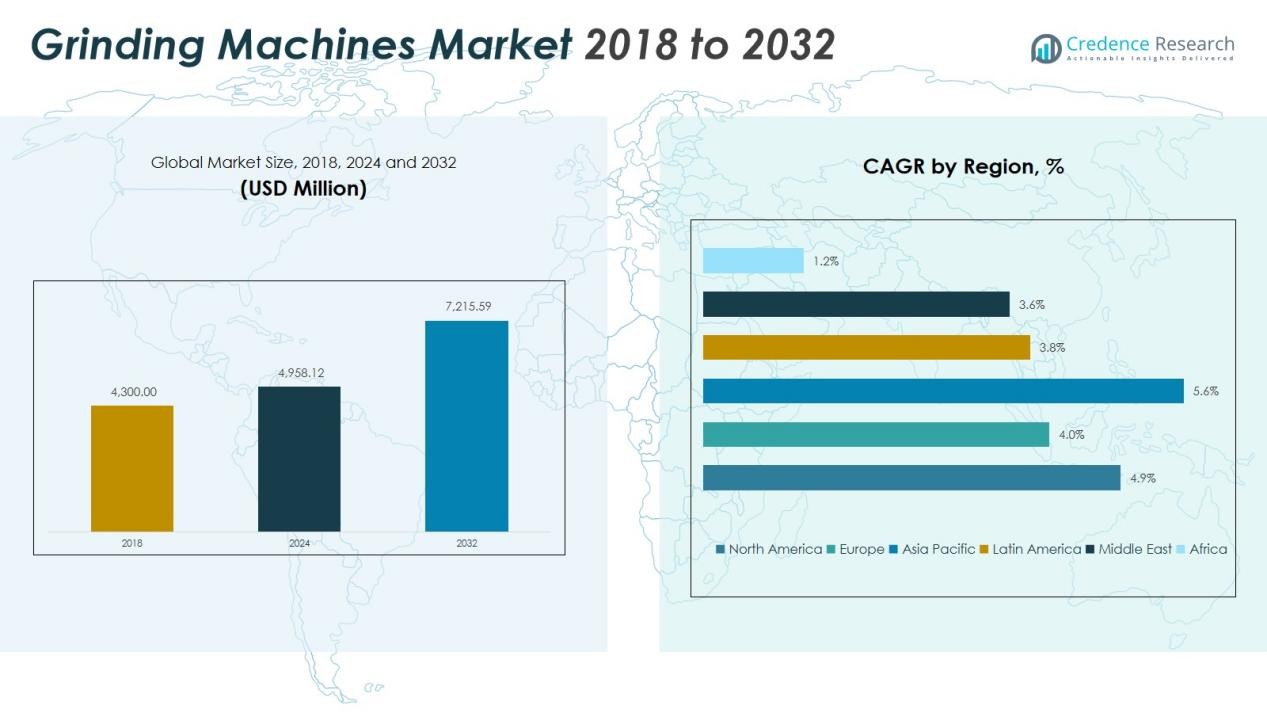
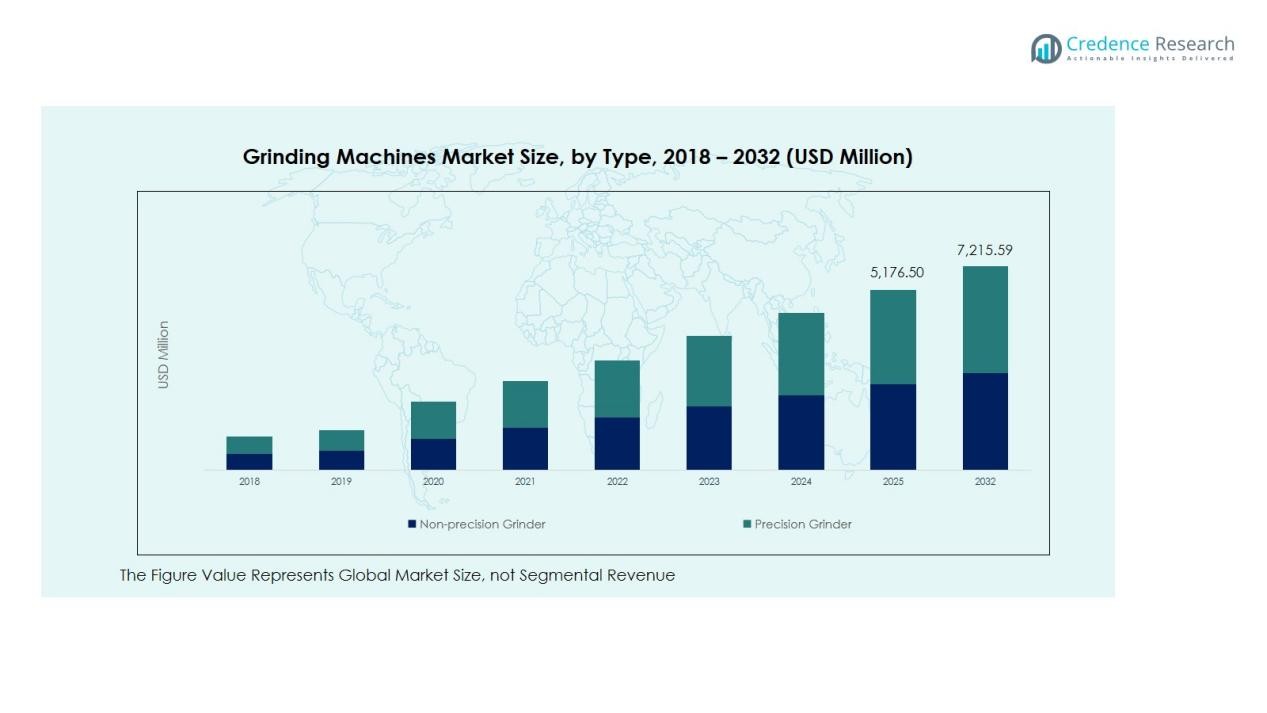
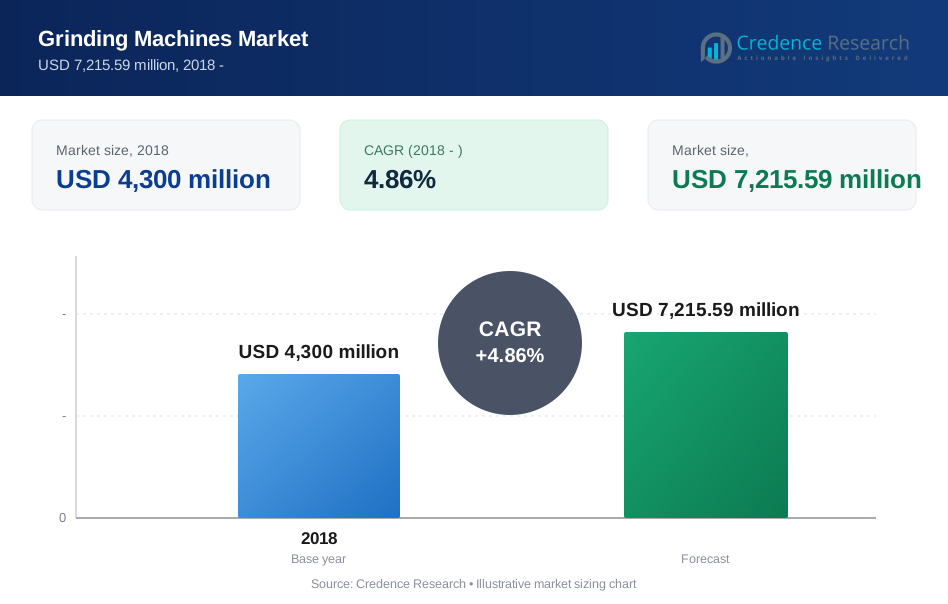
The Global Grinding Machines Market size was valued at USD 4,300 million in 2018 to USD 4,958.12 million in 2024 and is anticipated to reach USD 7,215.59 million by 2032, at a CAGR of 4.86% during the forecast period.
| REPORT ATTRIBUTE | DETAILS |
|---|---|
| Historical Period | 2020-2023 |
| Base Year | 2024 |
| Forecast Period | 2025-2032 |
| Grinding Machines Market Size 2024 | USD 4,958.12 Million |
| Grinding Machines Market, CAGR | 4.86% |
| Grinding Machines Market Size 2032 | USD 7,215.59 Million |
Key drivers include the rising need for high-accuracy manufacturing in automotive, aerospace, and electronics industries. Growing adoption of CNC and smart grinding machines enhances production efficiency and precision. Expanding automation and Industry 4.0 initiatives are encouraging manufacturers to modernize facilities with digitalized and energy-efficient grinding systems. In addition, the demand for electric vehicles and miniaturized components is boosting the use of precision grinding tools in production lines.
Regionally, Asia-Pacific dominates the global market, supported by strong manufacturing bases in China, Japan, India, and South Korea. North America and Europe follow, driven by increased automation and investment in high-value metal processing. Meanwhile, emerging economies in Southeast Asia and Latin America are witnessing rapid growth due to rising industrialization, infrastructure development, and government support for manufacturing modernization.
Market Insights:
- The Global Grinding Machines Market was valued at USD 4,300 million in 2018, reached USD 4,958.12 million in 2024, and is projected to hit USD 7,215.59 million by 2032, growing at a CAGR of 4.86%.
- Asia-Pacific held the largest share of over 40%, driven by its strong manufacturing base in China, Japan, and India, and rapid industrialization.
- Europe accounted for around 25% of the global market, supported by advanced automotive and aerospace industries emphasizing precision and sustainability.
- North America represented nearly 20% share, driven by automation and strong investments in high-precision machining across aerospace and automotive sectors.
- Asia-Pacific is the fastest-growing region, supported by smart manufacturing adoption, low production costs, and expanding export-driven industries.
Market Drivers:
Rising Demand for Precision and High-Performance Manufacturing Tools
The Global Grinding Machines Market is driven by the growing need for superior precision in industrial processes. Manufacturers in automotive, aerospace, and electronics sectors are investing in advanced grinding systems to achieve tighter tolerances and smoother finishes. High-performance machines are replacing traditional equipment to meet complex design requirements. The shift toward accuracy and consistency supports productivity gains across large-scale production environments.
- For instance, The Company Store's Company Plush™ decorative pillow cover collection features ultra-plush microfleece construction with a density of 530 GSM (grams per square meter), providing premium texture for home interiors, while coordinating with matching blankets and throws that demonstrate the versatility of fleece materials in creating complete bedroom and living space solutions.
Growing Adoption of Automation and Smart Manufacturing Technologies
Automation is transforming the grinding machinery landscape, improving process efficiency and operational reliability. The integration of CNC systems, IoT connectivity, and machine learning allows real-time performance monitoring and predictive maintenance. It helps minimize downtime and reduce manual intervention, increasing throughput and quality control. Manufacturers prefer smart grinding systems that align with Industry 4.0 standards and enable data-driven decision-making.
- For instance, the Siemens SINUMERIK automation platform and associated digital solutions, such as Manage MyMachines or Analyze MyPerformance within the Siemens Xcelerator portfolio (formerly MindSphere), enable real-time monitoring of machine data, including spindle loads and utilization. These platforms facilitate data collection for condition monitoring and support the implementation of predictive maintenance schedules.
Expansion of the Automotive and Aerospace Industries
The strong demand from automotive and aerospace sectors continues to support steady growth in the grinding machinery market. Electric vehicle production requires precision components such as gears, bearings, and drive systems. Aerospace manufacturers depend on grinding technology to achieve exact tolerances in engine and turbine parts. It remains a critical process for ensuring performance, safety, and compliance with international standards.
Technological Advancements and Material Innovations
Ongoing innovation in grinding wheel materials and machine designs is creating new opportunities. The development of cubic boron nitride (CBN) and diamond abrasives enhances durability and surface quality. It enables faster processing and lower energy use while maintaining high accuracy. Hybrid and multi-axis machines are gaining popularity due to their flexibility in handling varied materials and complex geometries.
Market Trends:
Integration of Digital Technologies and Automation in Grinding Operations
The Global Grinding Machines Market is witnessing a major shift toward automation and digital integration. Manufacturers are adopting CNC systems, sensors, and IoT-enabled platforms to optimize precision and reduce operational errors. Real-time monitoring and data analytics are improving machine performance and predictive maintenance. It supports consistent product quality while cutting downtime and operational costs. The use of AI-driven control systems is enhancing tool path accuracy and surface finishing. Robotic grinding solutions are also gaining traction in high-volume manufacturing environments, where efficiency and repeatability are critical. The trend toward automated process control is transforming grinding machines into intelligent production assets.
- For instance, Okamoto's advanced CNC surface grinding machines deliver tolerances as tight as 0.001 mm, ensuring minimal deviation for critical components in automotive, aerospace, and manufacturing sectors.
Shift Toward Sustainable, Energy-Efficient, and Hybrid Grinding Technologies
Sustainability is shaping product design and material selection across the grinding machinery industry. Manufacturers are developing eco-efficient machines that consume less power and minimize waste. The adoption of advanced lubricants and coolant filtration systems reduces environmental impact while extending machine life. It aligns with global energy conservation goals and industrial sustainability standards. Hybrid grinding machines capable of performing multiple operations are becoming popular for reducing setup times and floor space requirements. Demand for compact, noise-reduced, and low-emission equipment continues to rise in both developed and emerging markets. This shift toward sustainable innovation is redefining competitiveness and long-term value in precision manufacturing.
- For instance, Okuma Corporation's ECO Suite Plus system incorporates highly efficient hydraulic units that reduce power consumption from 840 W with conventional hydraulic systems to just 260 W at 25 min⁻¹, achieving a 69% reduction in hydraulic power consumption while maintaining dimensional accuracy and operational efficiency.
Market Challenges Analysis:
High Initial Investment and Maintenance Costs Restricting Adoption
The Global Grinding Machines Market faces challenges from high setup and maintenance costs, limiting adoption among small and medium-sized manufacturers. Advanced CNC and automated systems require significant upfront capital and skilled operators. It increases total ownership costs, especially in industries with low production volumes. Complex calibration and replacement of precision parts raise maintenance expenses. Many companies delay equipment upgrades due to budget constraints and limited return on investment visibility. The cost barrier slows modernization in developing regions, affecting overall market penetration.
Shortage of Skilled Labor and Complex Operational Requirements
The growing technological sophistication of grinding machines demands a highly skilled workforce for operation and maintenance. Many regions face shortages of trained machinists and technicians capable of handling digital control systems and advanced programming. It leads to underutilization of equipment and reduced process efficiency. Complex operational requirements also extend training cycles and increase production downtime. Small manufacturers struggle to integrate new systems without sufficient technical support. Limited knowledge of smart manufacturing tools continues to constrain productivity and global competitiveness within the market.
Market Opportunities:
Rising Demand from Emerging Economies and Expanding Manufacturing Sectors
The Global Grinding Machines Market is set to benefit from rapid industrialization and expanding manufacturing activity in emerging economies. Countries such as India, Vietnam, and Indonesia are increasing investments in metal fabrication, automotive, and aerospace production. Government initiatives promoting local manufacturing and automation support machine tool adoption. It creates new demand for precision grinding systems across mid-scale industries. Infrastructure growth and rising exports of industrial components further strengthen regional opportunities. The availability of affordable labor and expanding supplier networks enhances competitiveness for equipment manufacturers.
Advancements in Smart, Modular, and Energy-Efficient Grinding Technologies
Technological innovation offers strong growth prospects for the grinding machinery market. Smart machines with IoT, cloud analytics, and adaptive control systems enable higher efficiency and predictive maintenance. It allows manufacturers to improve uptime, reduce waste, and optimize resource use. Modular machine designs support customization for varied applications in automotive and medical component production. Demand for energy-efficient models aligned with sustainability goals is also increasing. Companies that integrate automation, AI, and eco-friendly materials will capture long-term growth in global and regional markets.
Market Segmentation Analysis:
By Type
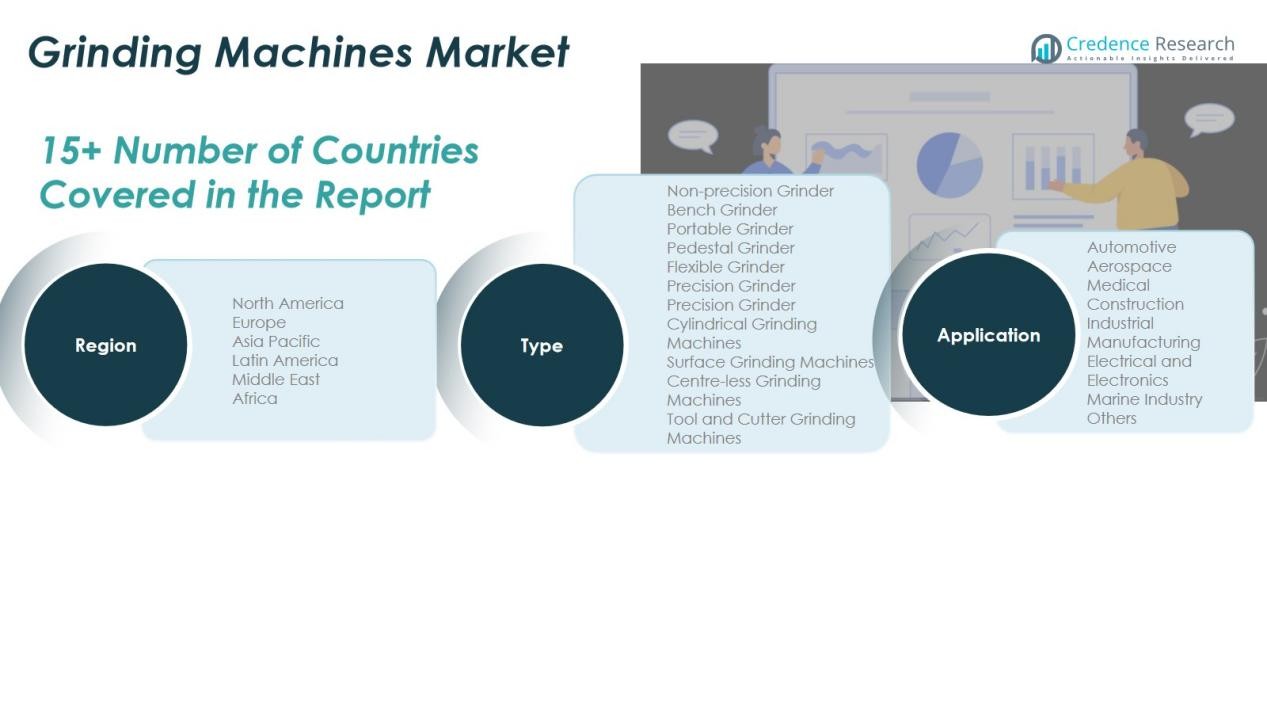
The Global Grinding Machines Market is segmented into non-precision and precision grinders. Non-precision grinders, including bench, pedestal, portable, and flexible types, serve general maintenance and light fabrication needs. They are widely used in small workshops and repair facilities for basic material removal. Precision grinders, such as cylindrical, surface, centre-less, and tool and cutter machines, dominate revenue share due to their role in high-accuracy machining. It supports industries requiring fine tolerances and surface quality, particularly in automotive, aerospace, and tool manufacturing. The growing shift toward CNC-based precision machines underscores the trend toward automation and enhanced repeatability.
- For instance, certain high-precision cylindrical grinders used in aerospace-grade component production are capable of achieving a roundness tolerance of 0.002 mm (2 micrometers) on a 100 mm bore.
By Application
The grinding machines market serves diverse industries, including automotive, aerospace, medical, construction, industrial manufacturing, electrical and electronics, and marine sectors. Automotive applications lead the market, driven by rising demand for precision-engineered engine parts and transmission components. Aerospace and medical sectors also present strong demand for high-performance grinding solutions to meet strict quality and safety standards. It enables the production of critical parts like turbine blades, implants, and precision tools. Expanding use in electronics and industrial manufacturing highlights the growing importance of grinding in producing miniaturized and durable components. The broad application base ensures stable long-term growth across global manufacturing ecosystems.
- For instance, a high-precision grinding firm reports achieving sub-10 micron diameter control on small-diameter shafts for sensors and connectors, illustrating the capability to support miniaturization trends.
Segmentations:
By Type
Non-Precision Grinder
- Bench Grinder
- Portable Grinder
- Pedestal Grinder
- Flexible Grinder
Precision Grinder
- Cylindrical Grinding Machines
- Surface Grinding Machines
- Centre-less Grinding Machines
- Tool and Cutter Grinding Machines
By Application
- Automotive
- Aerospace
- Medical
- Construction
- Industrial Manufacturing
- Electrical and Electronics
- Marine Industry
- Others
By Region
North America
- U.S.
- Canada
- Mexico
- Europe
- UK
- France
- Germany
- Italy
- Spain
- Russia
- Rest of Europe
Asia Pacific
- China
- Japan
- South Korea
- India
- Australia
- Southeast Asia
- Rest of Asia Pacific
Latin America
- Brazil
- Argentina
- Rest of Latin America
Middle East
- GCC Countries
- Israel
- Turkey
- Rest of Middle East
Africa
- South Africa
- Egypt
- Rest of Africa
Regional Analysis:
North America
The North America Grinding Machines Market size was valued at USD 915.90 million in 2018, reaching USD 1,034.23 million in 2024, and is anticipated to reach USD 1,501.58 million by 2032, at a CAGR of 4.9% during the forecast period. The region holds around 20% of the global market share. The Global Grinding Machines Market in this region benefits from strong technological adoption, advanced automation, and high precision demand from aerospace and automotive sectors. It gains support from government initiatives promoting smart manufacturing and energy-efficient machining. The U.S. leads the market with strong investments in R&D and industrial automation. Canada and Mexico follow, driven by expanding automotive supply chains and machinery exports.
Europe
The Europe Grinding Machines Market size was valued at USD 1,014.80 million in 2018, rising to USD 1,119.41 million in 2024, and is projected to reach USD 1,527.92 million by 2032, growing at a CAGR of 4.0%. Europe accounts for nearly 25% of global revenue share, supported by a robust manufacturing base and high emphasis on precision engineering. The Global Grinding Machines Market in Europe is led by Germany, Italy, and the UK due to their leadership in machine tool innovation. It is supported by demand from automotive, medical device, and aerospace industries. Environmental regulations also encourage energy-efficient and low-emission machine designs. The region continues to adopt Industry 4.0 systems to strengthen productivity.
Asia Pacific
The Asia Pacific Grinding Machines Market size was valued at USD 1,900.60 million in 2018, expanding to USD 2,245.26 million in 2024, and is expected to reach USD 3,458.44 million by 2032, registering a CAGR of 5.6%. The region dominates the Global Grinding Machines Market with over 40% share. China, Japan, and India lead production due to extensive industrial bases and rising investment in smart manufacturing. It benefits from low manufacturing costs, government initiatives, and strong export orientation. Rapid industrialization and growing automotive and electronics industries further stimulate demand. Southeast Asia is also emerging as a hub for mid-range machine production.
Latin America
The Latin America Grinding Machines Market size was valued at USD 249.40 million in 2018, increasing to USD 284.55 million in 2024, and is anticipated to reach USD 381.49 million by 2032, at a CAGR of 3.8%. The region represents around 8% of global market share. The Global Grinding Machines Market here grows with rising industrialization and foreign investment in automotive and construction equipment manufacturing. Brazil dominates regional demand due to a strong industrial base and machinery modernization programs. It is supported by local assembly units and imports from Asia and Europe. Argentina and Mexico show gradual improvement driven by infrastructure growth and export manufacturing.
Middle East
The Middle East Grinding Machines Market size was valued at USD 167.70 million in 2018, growing to USD 181.43 million in 2024, and is projected to reach USD 238.88 million by 2032, with a CAGR of 3.6%. The region holds nearly 5% of the global market share. The Global Grinding Machines Market benefits from diversification efforts in non-oil industries and infrastructure development. GCC countries lead adoption due to investments in manufacturing, aerospace, and defense. It is supported by foreign partnerships and industrial modernization programs. Turkey and Israel also show rising demand for precision machinery used in automotive and metal fabrication industries.
Africa
The Africa Grinding Machines Market size was valued at USD 51.60 million in 2018, increasing to USD 93.23 million in 2024, and is anticipated to reach USD 107.29 million by 2032, growing at a CAGR of 1.2%. The region accounts for less than 2% of the total Global Grinding Machines Market share. It faces slow adoption due to limited industrial infrastructure and low automation penetration. South Africa remains the major contributor, driven by mining equipment manufacturing and construction activity. It gradually expands through industrial growth in Egypt and Nigeria. The need for cost-effective grinding tools is expected to support gradual modernization across the continent.
Key Player Analysis:
- AMADA MACHINERY CO., LTD.
- Danobat
- ANCA
- Junker
- Körber AG
- Rieter
- Saurer Intelligent Technology AG
- Murata Machinery USA
- LMW Limited
- Trützschler Group SE
Competitive Analysis:
The Global Grinding Machines Market is highly competitive, with several established manufacturers focusing on technology, precision, and automation. Major players include AMADA MACHINERY CO., LTD., Danobat, ANCA, Junker, Körber AG, Rieter, and Saurer Intelligent Technology AG. It is characterized by continuous innovation in CNC technology, advanced abrasives, and digital process control to enhance productivity and accuracy. Companies compete on product customization, service reliability, and integration of smart manufacturing systems. Strategic partnerships and acquisitions are common to expand product portfolios and regional reach. The growing demand for energy-efficient and high-precision machines pushes manufacturers to invest heavily in R&D and automation. Competitive intensity remains strong, with Asia-Pacific-based firms gaining momentum through cost-effective production and technological improvements.
Recent Developments:
- In May 2024, Danobat strengthens its position in the U.S. rail market with the strategic acquisition of Delta Wheel Truing Solutions.
- In April 2024, Danobat inaugurated a 12,000-square-metre plant at its headquarters in Elgoibar to support expanding order books in aeronautics and wind power sectors, signaling capacity expansion and investment in manufacturing infrastructure.
Report Coverage:
The research report offers an in-depth analysis based on Type, Application and Region. It details leading market players, providing an overview of their business, product offerings, investments, revenue streams, and key applications. Additionally, the report includes insights into the competitive environment, SWOT analysis, current market trends, as well as the primary drivers and constraints. Furthermore, it discusses various factors that have driven market expansion in recent years. The report also explores market dynamics, regulatory scenarios, and technological advancements that are shaping the industry. It assesses the impact of external factors and global economic changes on market growth. Lastly, it provides strategic recommendations for new entrants and established companies to navigate the complexities of the market.
Future Outlook:
- Automation will dominate future manufacturing setups, driving demand for smart and adaptive grinding systems.
- Integration of artificial intelligence and machine learning will enhance predictive maintenance and process optimization.
- Manufacturers will invest in energy-efficient grinding technologies to align with global sustainability targets.
- Adoption of hybrid machines capable of multitasking will expand across precision engineering sectors.
- The rise of electric and autonomous vehicles will increase demand for precision-ground components.
- Asia-Pacific will remain the key manufacturing hub, supported by industrial growth and automation initiatives.
- Digital twin technology will gain traction to simulate grinding processes and improve efficiency.
- Miniaturization in electronics and medical devices will push innovation in micro-grinding machines.
- Collaborations between machine tool makers and software developers will strengthen smart factory integration.
- Aftermarket services, retrofitting, and digital upgrades will emerge as vital revenue sources for manufacturers.
Request a Free Sample
Fill in your details and we'll send you a free sample report.
- Sample data tables & charts
- Research methodology
Need a Custom Version of This Report?
Tailor the scope, geography, or segments to your exact requirements.
- Custom geography or segment scope
- Direct access to our analyst team
Frequently Asked Questions
What is the current market size for the Global Grinding Machines Market, and what is its projected size in 2032?
At what Compound Annual Growth Rate is the Global Grinding Machines Market projected to grow between 2024 and 2032?
Which market segment held the largest share in 2024?
What are the primary factors fueling the growth of the Global Grinding Machines Market?
Who are the leading companies in the Global Grinding Machines Market?
Which region commanded the largest share of the Global Grinding Machines Market in 2024?
Table of Content
Chapter 1. Report Introduction
- 1.1 Report Description & Purpose
- 1.1.1 Report Title & Market Definition
- 1.1.2 Unique Selling Propositions (USP) & Key Differentiators
- 1.1.3 Value Proposition for Stakeholders
- 1.2 Research Objectives
- 1.2.1 Market Sizing Objectives (Volume & Revenue)
- 1.2.2 Segmentation Objectives
- 1.2.3 Competitive Intelligence Objectives
- 1.2.4 Forecast & Scenario Objectives
- 1.3 Report Scope
- 1.3.1 Grinding Machines Scope – Types & Subtypes Covered
- 1.3.2 Geographic Scope – Regions & Countries Covered
- 1.3.3 Historical Period, Base Year & Forecast Period (2018; forecast to the forecast period)
- 1.3.4 Inclusions & Exclusions
- 1.4 HS Code & Classification Framework
- 1.5 Currency, Units & Pricing Basis
- 1.6 Target Stakeholders
- 1.7 Limitations & Assumptions
Chapter 2. Executive Summary
- 2.1 Global Grinding Machines Market Snapshot
- 2.1.1 Market Size – Historical (2018) & Forecast (the forecast period) (2018: USD 4,300 million → forecast year: USD 7,215.59 million)
- 2.1.2 Volume & Revenue – Global Totals
- 2.1.3 Key Market Highlights – Top Five Facts
- 2.2 Grinding Machines Market Segmentation Snapshot
- 2.2.1 Market Split by Region – 2018 vs.
- 2.3 Competitive Snapshot
- 2.3.1 Top 10 Players by Revenue Share – 2018
- 2.3.2 Top 10 Players by Volume Share – 2018
- 2.3.3 Recent Strategic Developments (18-Month Summary)
- 2.4 Key Investment Highlights & Strategic Conclusions
Chapter 3. Grinding Machines Market Dynamics & Industry Analysis
- 3.1 Market Overview & Context
- 3.1.1 Grinding Machines Market Position in the Broader Automotive Value Chain
- 3.1.2 OEM vs. Replacement Market Dynamics
- 3.1.3 Market Maturity & Development Stage by Region
- 3.2 Grinding Machines Market Drivers
- 3.3 Grinding Machines Market Restraints & Challenges
- 3.4 Grinding Machines Market Opportunities
- 3.5 Porter's Five Forces Analysis
- 3.5.1 Threat of New Entrants
- 3.5.2 Bargaining Power of Suppliers
- 3.5.3 Bargaining Power of Buyers
- 3.5.4 Threat of Substitutes
- 3.5.5 Competitive Rivalry – Intensity Assessment
- 3.6 Grinding Machines Value Chain Analysis
- 3.6.1 Upstream – Raw Material/Input Suppliers
- 3.6.1.1 Raw Material/Input 1
- 3.6.1.2 Raw Material/Input 2
- 3.6.1.3 Raw Material/Input 3
- 3.6.2 Midstream – Production/Manufacturing/Service Delivery
- 3.6.2.1 Production/Process Overview
- 3.6.2.2 Key Facility Locations & Capacity by Manufacturer
- 3.6.3 Downstream – Distribution & End Consumer
- 3.6.3.1 Primary Channel – B2B/OEM
- 3.6.3.2 Secondary Channels – Dealer, Retail, Online, Direct
- 3.6.4 Value Chain Profitability Analysis
- 3.6.1 Upstream – Raw Material/Input Suppliers
- 3.7 PESTEL Analysis
- 3.7.1 Political Factors
- 3.7.2 Economic Factors
- 3.7.3 Social Factors
- 3.7.4 Technological Factors
- 3.7.5 Environmental Factors
- 3.7.6 Legal Factors
- 3.8 Grinding Machines Supply Chain Analysis
- 3.8.1 Raw Material/Input Supply Risk Assessment
- 3.8.2 Manufacturing Concentration Risk (Geographic Exposure)
- 3.8.3 Trade Disruption Impact Analysis
- 3.9 Regulatory & Policy Landscape
Note: The regulatory and policy landscape section covers regulations based on their applicability to the market, Grinding Machines category, geography, and scope of the study. Only regulatory frameworks with a material impact on operations, compliance, trade, sustainability, or market access are analyzed in detail.
Chapter 4. Key Investment Pockets & Opportunity Analysis
- 4.1 Grinding Machines Market Attractiveness Analysis
- 4.1.1 By Region – Investment Attractiveness Matrix (Volume × CAGR)
- 4.2 Absolute Revenue Growth Opportunity
- 4.2.1 By Region – Absolute USD Growth Through the forecast period
- 4.3 Incremental Volume Opportunity
- 4.3.1 By Region – Incremental Volume Through the forecast period
- 4.3.2 Segment – Incremental Volume
- 4.4 Emerging Submarket Opportunity Deep Dive (Subject to Applicability)
- 4.5 Emerging Market Opportunity Scorecards
- 4.5.1 United States
- 4.5.2 Europe
- 4.5.3 Asia
- 4.5.4 Middle East & Africa
Note: Emerging Market Opportunity Scorecards will be included based on relevance and strategic importance. Regions listed are indicative and may vary depending on data availability and market dynamics.
Chapter 5. Grinding Machines Import-Export Analysis & Trade Flows
- 5.1 Global Trade Overview
- 5.1.1 Global Export Value by Country (2018)
- 5.1.2 Global Export Volume by Country (2018)
- 5.1.3 Global Import Value by Country (2018)
- 5.1.4 Global Import Volume by Country (2018)
- 5.1.5 Net Trade Balance by Country (2018)
- 5.2 Export Analysis – Segment
- 5.2.1 Type 1 (HS Code)
- 5.2.2 Type 2 (HS Code)
- 5.2.3 Type 3 (HS Code)
- 5.2.4 Type 4 (HS Code)
- 5.2.5 Type 5 (HS Code)
- 5.3 Import Analysis – Segment
- 5.3.1 Type 1 (HS Code)
- 5.3.2 Type 2 (HS Code)
- 5.3.3 Type 3 (HS Code)
- 5.3.4 Type 4 (HS Code)
- 5.3.5 Type 5 (HS Code)
- 5.4 Average Unit Trade Prices
- 5.4.1 Average Export Price – Segment & Country
- 5.4.2 Average Import Price – Segment & Source Country
- 5.4.3 Price Trends (2018)
- 5.5 Key Trade Route Analysis
- 5.5.1 Trade Route 1
- 5.5.2 Trade Route 2
- 5.5.3 Trade Route 3
- 5.5.4 Trade Route 4
- 5.5.5 Trade Route 5
- 5.6 Trade Policy Impact Assessment
- 5.6.1 US Anti-Dumping & Section 301 Tariffs
- 5.6.2 EU Customs Union Impact
- 5.6.3 Major Free Trade Agreements
- 5.6.4 USMCA Rules of Origin
Note: Trade policy analysis will be included only where relevant to the Grinding Machines market.
Chapter 6. Competitive Landscape & Company Benchmarking
- 6.1 Grinding Machines Market Concentration & Structure
- 6.1.1 Herfindahl-Hirschman Index (HHI) – vs. 2018
- 6.1.2 Tier 1, Tier 2 & Tier 3 Market Structure
- 6.1.3 Global, Regional & Local Player Dynamics
- 6.2 Grinding Machines Market Share Analysis – 2018
- 6.2.1 Global Revenue Share by Company
- 6.2.2 Global Volume Share by Company
- 6.2.3 Regional Revenue Share
- 6.2.4 Market Share Evolution ( vs. 2018)
- 6.2.5 OEM Segment Share by Company
- 6.2.6 Replacement Segment Share by Company
- 6.3 Production/Delivery Capacity & Facility Analysis
- 6.3.1 Global Installed Capacity
- 6.3.2 Capacity Utilization Rates
- 6.3.3 Production/Output Volume
- 6.3.4 Facility Locations & Capacity Map
- 6.3.5 Planned Capacity Additions
- 6.4 Grinding Machines Competitive Benchmarking Matrix
- 6.4.1 Revenue, Volume, CAGR & Profitability Comparison
- 6.4.2 Channel Revenue Mix
- 6.4.3 Geographic Revenue Exposure
- 6.4.4 R&D Intensity
- 6.4.5 Sustainability Maturity
- 6.5 Strategic Developments in Grinding Machines (Last 24 Months)
- 6.5.1 Mergers, Acquisitions & Divestments
- 6.5.2 New Grinding Machines Launches
- 6.5.3 Facility Expansions
- 6.5.4 Strategic Alliances, Joint Ventures & Partnerships
- 6.5.5 Distribution Expansion & Market Entry
- 6.5.6 Sustainability & ESG Initiatives
- 6.6 Competitive Strategy Mapping
- 6.6.1 Leader, Challenger, Follower & Niche Classification
- 6.6.2 Pricing Strategy Comparison
- 6.6.3 Channel Strategy Matrix
Note: Strategic developments are included based on their materiality and the availability of reliable information.
Chapter 7. Global Grinding Machines Market – By Distribution Channel
- 7.1 Segment Overview
- 7.1.1 Volume & Revenue Split by Channel (2018 & )
- 7.1.2 Channel Mix Evolution (the forecast period)
Chapter 8. Regional Market Analysis – Global Overview
- 8.1 Global Regional Overview
- 8.1.1 Regional Volume Share
- 8.1.2 Regional Revenue Share
- 8.1.3 Regional Volume by Region
- 8.1.4 Regional Revenue by Region
- 8.1.5 Regional Forecast Through the forecast period
- 8.2 Cross-Regional Segment Analysis
- 8.2.1 By Distribution Channel
- 8.2.2 By Brand/Price Tier
Chapter 9. North America Grinding Machines Market
- 9.1 United States
- 9.2 Canada
- 9.3 Mexico
Chapter 10. Europe Grinding Machines Market
- 10.1 Germany
- 10.2 France
- 10.3 Italy
- 10.4 United Kingdom
- 10.5 Spain
- 10.6 Poland
- 10.7 Russia
- 10.8 Netherlands
- 10.9 Belgium
- 10.10 Sweden
- 10.11 Denmark
- 10.12 Norway
- 10.13 Rest of Europe
Chapter 11. Asia Pacific Grinding Machines Market
- 11.1 China
- 11.2 India
- 11.3 Japan
- 11.4 South Korea
- 11.5 Thailand
- 11.6 Indonesia
- 11.7 Vietnam
- 11.8 Malaysia
- 11.9 Australia
- 11.10 Rest of Asia Pacific
Chapter 12. Latin America Grinding Machines Market
- 12.1 Brazil
- 12.2 Argentina
- 12.3 Colombia
- 12.4 Chile
- 12.5 Rest of Latin America
Chapter 13. Middle East Grinding Machines Market
- 13.1 Saudi Arabia
- 13.2 United Arab Emirates
- 13.3 Turkey
- 13.4 Israel
- 13.5 Iran
- 13.6 Rest of the Middle East
Chapter 14. Africa Grinding Machines Market
- 14.1 South Africa
- 14.2 Egypt
- 14.3 Nigeria
- 14.4 Morocco
- 14.5 Rest of Africa
Chapter 15. Grinding Machines Company Profiles
- 15.1 [Company 01]
- 15.1.1 Company Overview
- 15.1.2 Key Management Personnel
- 15.1.3 Products & Services Portfolio
- 15.1.4 Financial Performance
- 15.1.5 Key Market Focus & Geographic Presence
- 15.1.6 Recent Developments & Strategic Initiatives
Note: The company profile list is preliminary and may change based on research findings, market developments, data availability, and client requirements.
Chapter 16. Appendices
- Appendix A – List of Abbreviations & Acronyms
- Appendix B – Industry Classification Code Reference – Full Series
- Appendix C – Production & Capacity Data Tables
- Appendix D – End-Use & Demand Base Tables
- Appendix E – Consumption & Replacement Rate Assumptions
- Appendix F – ASP Reference Tables
- Appendix G – Manufacturing & Facility Database
- Appendix H – Import-Export Data Tables
- Appendix I – Regulatory Summary Tables
- Appendix J – Primary Research Participant List (Anonymized)
- Appendix K – Primary Research Questionnaire Framework
- Appendix L – Data Sources & Bibliography
- Appendix M – Market Size Divergence & Source Comparison
Chapter 17. Research Methodology
- 17.1 Research Framework & Philosophy
- 17.2 Secondary Research – Sources, Hierarchy & Data Extraction
- 17.3 Data Modeling – Bottom-Up & Top-Down Market Sizing
- 17.4 Primary Research – Stakeholder Framework, LOI & Sample Sizes
- 17.5 Forecast Methodology – Regression, Scenario & Sensitivity Analysis
- 17.6 Quality Control – Four-Layer Validation Framework
- 17.7 Limitations & Standard Assumptions
- 17.8 Disclaimer
