
| REPORT ATTRIBUTE | DETAILS |
|---|---|
| Historical Period | 2019-2022 |
| Base Year | 2023 |
| Forecast Period | 2024-2032 |
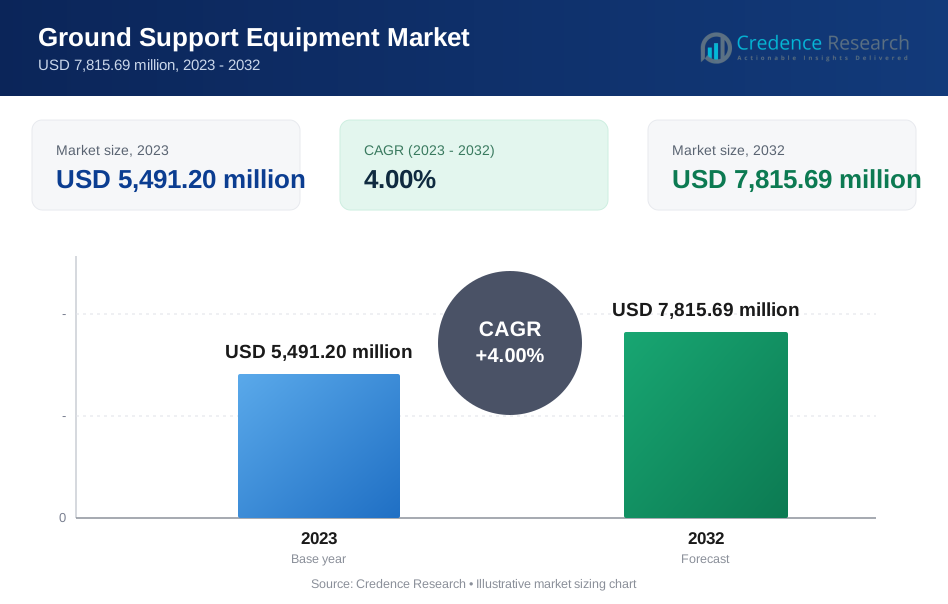
| Ground Support Equipment (GSE) Market Size 2023 | USD 5,491.20 Million |
| Ground Support Equipment (GSE) Market, CAGR | 4.00% |
| Ground Support Equipment (GSE) Market Size 2032 | USD 7,815.69 Million |
Market Overview
The Ground Support Equipment (GSE) Market is projected to grow from USD 5,491.20 million in 2023 to an estimated USD 7,815.69 million by 2032, with a compound annual growth rate (CAGR) of 4.00% from 2024 to 2032. This growth reflects the increasing demand for efficient aircraft handling and maintenance services at airports, driven by expanding air travel and the rising need for rapid aircraft turnaround times.
Several factors are driving the GSE market, including increased air traffic, a surge in airport construction projects, and a growing emphasis on ground operational efficiency. Technological advancements, such as the integration of electric and hybrid ground support vehicles, are shaping market trends as airports and airlines shift towards eco-friendly solutions to reduce carbon emissions. Additionally, the demand for advanced equipment to support a wide range of aircraft types is fueling the development of innovative GSE products designed to improve both safety and productivity.
Geographically, North America dominates the GSE market due to its large number of airports and high volume of air traffic, followed closely by Europe and the Asia-Pacific region, which are experiencing rapid growth in airport infrastructure and fleet expansion. Key players in the global GSE market include JBT Corporation, Teleflex Lionel-Dupont (TLD), Tronair Inc., Cavotec SA, and MULAG Fahrzeugwerk Heinz Wössner GmbH u. Co. KG, who are actively investing in R&D to develop advanced, sustainable, and cost-effective GSE solutions to maintain competitive advantages in this dynamic market.
Market Drivers
Increasing Air Passenger Traffic and Expanding Airline Fleets
The growth in global air passenger traffic is a primary driver of the GSE market. The International Air Transport Association (IATA) projects a consistent rise in passenger numbers, fueled by increasing urbanization, rising disposable incomes, and the growing preference for air travel over other modes of transportation. As a result, airlines are expanding their fleets to meet this demand, necessitating more ground support equipment to service these additional aircraft. From towing tractors to baggage loaders, ground support equipment ensures that aircraft are ready for quick turnarounds, minimizing idle time on the ground. The growing frequency of flights further emphasizes the need for dependable GSE, as airlines and airport operators strive to maintain on-time performance amid increasing air traffic.Moreover, this trend is accompanied by a rapid expansion of airport infrastructure, especially in emerging economies across Asia-Pacific, the Middle East, and Africa. Governments and private entities in these regions are investing significantly in the construction and modernization of airports to accommodate the rising passenger volumes. As new airports and terminals come online, the demand for GSE to equip these facilities intensifies, driving substantial growth in the GSE market. In established markets such as North America and Europe, existing airports are upgrading their equipment to handle the increased traffic more efficiently, further contributing to market expansion.
Focus on Efficiency and Reduced Aircraft Turnaround Time
Airlines and airport operators are increasingly focusing on operational efficiency and reducing aircraft turnaround times. Turnaround time refers to the duration between an aircraft's arrival and its next departure, encompassing activities such as refueling, catering, baggage handling, and passenger boarding. Ground support equipment plays a crucial role in minimizing these turnaround times by ensuring rapid and coordinated ground handling processes. Efficient GSE operations enable airlines to maintain schedules, minimize delays, and optimize fleet utilization, all of which contribute to improved profitability and customer satisfaction.The emphasis on efficiency is also driven by the cost-sensitive nature of the airline industry, where small improvements in operational metrics can lead to significant savings. For example, reducing turnaround time allows airlines to schedule more flights within the same period, enhancing asset utilization and revenue potential. This focus on optimizing operational processes has increased demand for innovative GSE solutions, such as automated baggage handling systems, advanced aircraft de-icing equipment, and high-speed tow tractors, all of which facilitate quick and seamless ground operations. For instance, a study by OAG found that in March 2023, United Airlines achieved an average turnaround time of just 68 minutes at its hub airports, demonstrating the industry's focus on efficiency. This emphasis on quick turnarounds highlights the crucial role of efficient ground support equipment in maintaining tight schedules.
Technological Advancements and Adoption of Electric GSE
The GSE market is witnessing a shift toward the adoption of electric and hybrid equipment, driven by the need for more sustainable airport operations and adherence to increasingly stringent environmental regulations. Conventional GSE, powered by fossil fuels, contributes to carbon emissions and airport noise pollution, posing environmental challenges for airport operators and nearby communities. To address these issues, the aviation industry is increasingly investing in electric and hybrid GSE that offer reduced emissions and quieter operations.Technological advancements have made electric GSE more reliable, efficient, and cost-effective. Innovations in battery technology, for example, have enhanced the energy storage capacity of electric GSE, allowing them to perform for extended periods without frequent recharging. The integration of telematics and IoT-enabled sensors into GSE has further enhanced operational efficiency by enabling real-time monitoring of equipment status, predictive maintenance, and remote diagnostics. These advancements not only improve equipment reliability but also help lower operational costs, making electric GSE an attractive option for airport operators aiming to achieve sustainability targets while maintaining high levels of operational efficiency. For instance, a recent survey revealed that nearly 70 percent of industry participants intend to invest in electric GSE, with approximately 65 percent planning to adopt eGSE within the next five years. This trend towards electric GSE showcases the industry's commitment to technological advancements and sustainability in ground operations.
Rising Demand for Safety and Compliance with Regulatory Standards
Safety is a top priority in the aviation industry, with stringent regulations governing ground handling operations to ensure the safety of passengers, crew, and aircraft. Regulatory bodies, such as the International Civil Aviation Organization (ICAO) and the Federal Aviation Administration (FAA), mandate various safety standards for ground handling operations, requiring airport operators and airlines to invest in compliant and well-maintained GSE. In addition, these regulations are regularly updated to address new safety concerns and technological advancements, prompting operators to continuously upgrade their equipment.The increasing focus on safety has led to a demand for advanced GSE that incorporates features such as anti-collision sensors, automated controls, and emergency stop mechanisms. For instance, modern tow tractors and belt loaders are often equipped with collision-avoidance technology to prevent accidents on the tarmac, enhancing safety during ground handling operations. Moreover, the GSE market is seeing growth in specialized equipment, such as advanced aircraft recovery systems and firefighting vehicles, which are essential for emergency preparedness and compliance with safety regulations. As airlines and airport operators prioritize safe operations, the demand for compliant and technologically advanced GSE is expected to rise, further driving market growth.
Market Trends
Shift Toward Electrification and Sustainable Solutions
One of the most significant trends in the GSE market is the move toward electrification and the adoption of sustainable solutions. In response to the aviation industry's commitment to reducing carbon emissions and achieving net-zero targets, airport operators and airlines are increasingly transitioning from diesel-powered GSE to electric and hybrid alternatives. Electric ground support equipment, such as baggage tractors, belt loaders, and pushback tractors, produces fewer greenhouse gas emissions and reduces noise pollution—an essential factor for airports located near urban areas. Additionally, advancements in battery technology have improved the performance and operational reliability of electric GSE, making them a more viable choice for airports looking to reduce their environmental footprint.For instance, the electrification of SATS's baggage tractors in Singapore has resulted in an improvement in carbon intensity for flight handling between 2019 and 2023.This shift is further encouraged by regulatory measures and government initiatives promoting eco-friendly airport operations. For instance, several countries offer incentives and subsidies for purchasing electric GSE, driving market adoption. Airport operators are also investing in infrastructure to support electric GSE, including charging stations and energy management systems. This trend is likely to accelerate as electric GSE technology advances, providing airports with cost-effective, efficient, and sustainable options that align with global environmental goals.For instance, the Indian government has launched a ₹5 billion program to promote electric mobility, which includes support for 372,215 electric vehicles, including 38,828 three-wheelers.
Growing Integration of Advanced Technologies for Enhanced Efficiency and Safety
The integration of advanced technologies in GSE is transforming ground operations, enhancing both efficiency and safety. IoT-enabled sensors, telematics, and data analytics are being incorporated into ground support equipment to enable real-time monitoring, predictive maintenance, and fleet management. These technologies allow airport operators to track the status and performance of their equipment, optimize usage, and schedule maintenance based on data-driven insights. Predictive maintenance, in particular, helps prevent unexpected equipment failures and reduces downtime, which is crucial for maintaining smooth airport operations.For instance, a leading manufacturing company implemented IoT predictive maintenance to monitor their production machinery, resulting in a 30% reduction in downtime.In addition, automation and robotics are gaining traction within the GSE market. Automated guided vehicles (AGVs), for example, are being used for baggage handling, while autonomous pushback tractors are being tested for aircraft towing. These automated solutions reduce the need for manual intervention, minimizing human error and enhancing safety. Advanced collision-avoidance systems, GPS tracking, and remote-control capabilities are also increasingly common in modern GSE, further contributing to safe and efficient ground operations. The adoption of such technologies reflects a broader industry trend toward digitization and automation, as airport operators strive to improve operational reliability, reduce costs, and comply with stringent safety standards.For instance, a healthcare facility used IoT predictive maintenance to monitor their medical devices, ensuring the reliability of critical equipment and improving patient safety.
Market Restraints and Challenges
High Initial Costs and Infrastructure Requirements for Electric GSE
The transition to electric GSE, while beneficial for sustainability, poses a significant financial challenge for many airport operators. Electric and hybrid GSE generally have higher upfront costs compared to their traditional fuel-powered counterparts, largely due to the expense of advanced battery technology and specialized components. For airports and airlines operating on tight budgets, the initial investment in electric GSE can be prohibitive. Furthermore, adopting electric GSE necessitates substantial infrastructure upgrades, including the installation of charging stations and power management systems. These additional costs can deter some operators from switching to electric options, particularly smaller airports or those located in regions where funding and resources are limited.Additionally, the availability and compatibility of charging infrastructure across different airport facilities can be a challenge. Without a standardized approach, electric GSE can face operational limitations, especially when charging stations are not widely available or located near the areas where they are needed. These factors can hinder the pace at which electric GSE is adopted, slowing the industry's progress toward sustainability goals and limiting market growth in the short term.
Maintenance and Operational Challenges for Advanced GSE Technologies
The increasing integration of advanced technologies, such as IoT sensors, automation, and telematics in GSE, also brings with it several operational and maintenance challenges. These sophisticated systems require specialized knowledge and skills to operate and maintain, posing a challenge for airports that may not have access to a highly trained technical workforce. As ground support equipment becomes more complex, the demand for skilled technicians capable of servicing these advanced machines rises, which can lead to increased operational costs and longer downtime if qualified personnel are unavailable.Moreover, technological advancements increase the dependency on software and digital systems, which can be vulnerable to cyber threats and connectivity issues. For instance, IoT-enabled GSE requires robust cybersecurity measures to protect sensitive operational data and prevent disruptions. The need for ongoing training, cybersecurity protocols, and reliable technical support can strain airport operators, especially in smaller or remote airports with limited resources. These operational challenges and maintenance complexities can hinder the widespread adoption of advanced GSE solutions, potentially slowing market growth and adoption rates.
Market Segmentation Analysis
By Equipment Type
The Ground Support Equipment (GSE) market by equipment type is categorized into passenger services, cargo loading, and airport service segments. The passenger services segment, which includes equipment like boarding steps, airport buses, and bed/chair lifts, is witnessing growth due to rising air passenger traffic as airports strive to enhance the boarding and deboarding experience. The cargo loading segment, encompassing container loaders, belt loaders, and other specialized handling machinery, is expanding with the increasing demand for air cargo services and the rapid growth of e-commerce, necessitating efficient loading solutions to minimize aircraft turnaround times. The airport service segment, which features essential equipment such as aircraft refuelers, tractors, ground power units, and de-icing machinery, remains crucial for smooth ground operations as global air traffic continues to rise, underscoring the importance of timely and efficient aircraft servicing on the tarmac.
By Application
The Ground Support Equipment (GSE) market is primarily driven by the commercial application segment, fueled by the rising number of commercial flights and expanding airline fleets. As commercial aviation grows, there is an increasing need for reliable GSE to support passenger services, cargo handling, and aircraft maintenance, indicating a positive outlook for this segment. Additionally, the defense segment contributes to market growth, as military operations require specialized GSE for aircraft maintenance and ground handling. With increased military budgets and the need for rapid deployment, the demand for support equipment to service defense aircraft is also on the rise.
Segments
Based on Equipment Type
- Passenger Services
- Cargo Loading
- Airport Service
Based on Application
- Commercial
- Defense
Based on Power Source
- Non-Electric
- Electric
- Hybrid
Based on Ownership Model
- Owned GSE
- Leased GSE
- Rental GSE
Based on Region
- North America
- US
- Canada
- Mexico
- Europe
- Germany
- France
- UK
- Italy
- Spain
- Rest of Europe
- Asia Pacific
- China
- Japan
- India
- South Korea
- South-east Asia
- Rest of Asia Pacific
- Latin America
- Brazil
- Argentina
- Rest of Latin America
- Middle East & Africa
- GCC Countries
- South Africa
Regional Analysis
North America (35%):
North America holds the largest share of the GSE market, accounting for approximately 35% of the global market. This dominance is driven by the presence of major international airports, high passenger and cargo traffic, and substantial investments in airport infrastructure across the United States and Canada. The region’s well-established aviation sector continuously modernizes its GSE fleets to enhance operational efficiency and meet stringent environmental standards. Moreover, the adoption of electric and hybrid GSE is particularly notable in North America, where regulatory measures encourage sustainability. The high number of airport construction and expansion projects also contributes to sustained demand for advanced GSE in this region.
Europe (25%):
Europe represents around 25% of the global GSE market. The region’s growth is fueled by the modernization of existing airport facilities and increasing air passenger traffic across major countries like the UK, Germany, and France. European regulations prioritize environmental sustainability, leading to a higher adoption rate of electric GSE. Airport operators in Europe are increasingly investing in eco-friendly GSE solutions to comply with the EU’s stringent carbon emissions regulations. Additionally, the region’s emphasis on adopting advanced technologies, such as automation and IoT-enabled GSE, supports operational efficiency and aligns with Europe’s strong focus on safety and regulatory compliance in ground handling operations.
Key players
- JBT Aero Tech
- Textron GSE
- Charlette Manutention
- Tronair
- Kalmar Motor AB
- Mulago
- Weihai Guang Tai Airport Equipment Co., Ltd.
- Millighan
- China International Marine Containers (Group) Co., Ltd. (CIMC)
- Cavotec SA
- TLD Goldhofer
- Tiger
- Tripel Airport Equipment
Competitive Analysis
The GSE market is highly competitive, with established players focusing on technological innovation, product diversification, and geographical expansion to maintain their positions. JBT Aero Tech, Textron GSE, and TLD Goldhofer lead the market by offering a comprehensive range of advanced, eco-friendly ground support solutions. These companies invest heavily in R&D to develop electric and hybrid GSE, addressing the industry's shift toward sustainable operations. Meanwhile, regional players like Weihai Guang Tai Airport Equipment and China International Marine Containers (CIMC) cater to growing demand in Asia-Pacific by offering cost-effective, localized solutions. Companies like Tronair and Cavotec SA emphasize specialized products, such as aircraft tugs and refueling systems, providing a competitive edge in niche markets. Overall, the industry is witnessing strategic partnerships, acquisitions, and increased focus on emerging markets as key players strive to expand their market share and enhance operational capabilities.
Recent Developments
- In August 2023, OSHKOSH Corporation acquired JBT AeroTech for $820 million. This acquisition is expected to bring significant growth opportunities for JBT AeroTech in the GSE market.
- In May 2024, Weihai Guangtai signed a global framework agreement with dnata, strengthening their strategic partnership in the GSE market. This agreement solidified Weihai Guangtai's position as a key supplier in dnata's global strategic procurement efforts.
- In February 2022, Cavotec announced the divestment of its Airports business to US-based investment company Fernweh Group LLC for an approximate implied enterprise value of EUR 16 million. This move was part of Cavotec's strategy to focus on sustainability solutions in Ports & Maritime and Industry markets.
- In 2023, JBT AeroTech partnered with Universal Hydrogen to develop a hydrogen fuel cell-powered mobile battery charger called H2AmpCart for airports. The companies aim to bring this product into service by the end of 2024.
- In August 2024, Kalmar detailed its driving excellence initiative as part of its recently launched strategy, aiming to achieve approximately EUR 50 million in gross efficiency improvements by the end of 2026. This initiative focuses on enhancing commercial and operational excellence in the GSE market.
Market Concentration and Characteristics
The Ground Support Equipment (GSE) market is moderately concentrated, with a mix of well-established multinational companies and regional players competing for market share. Major global players, such as JBT Aero Tech, Textron GSE, and TLD Goldhofer, dominate the market due to their comprehensive product portfolios, extensive R&D investments, and strong global distribution networks. These companies focus on developing advanced, sustainable equipment to meet the industry’s increasing demand for efficiency and environmental compliance. Additionally, smaller and regional companies, particularly in emerging markets, contribute to market diversity by providing cost-effective solutions tailored to local needs. The market is characterized by high capital requirements, significant R&D expenses, and a strong emphasis on technological innovation. As the industry evolves, companies are increasingly adopting electric and hybrid technologies and integrating advanced features, such as IoT and automation, to enhance safety, operational efficiency, and sustainability in airport operations.
Report Coverage
The research report offers an in-depth analysis based on Equipment Type, Application, Power Source, Ownership Model and Region. It details leading market players, providing an overview of their business, product offerings, investments, revenue streams, and key applications. Additionally, the report includes insights into the competitive environment, SWOT analysis, current market trends, as well as the primary drivers and constraints. Furthermore, it discusses various factors that have driven market expansion in recent years. The report also explores market dynamics, regulatory scenarios, and technological advancements that are shaping the industry. It assesses the impact of external factors and global economic changes on market growth. Lastly, it provides strategic recommendations for new entrants and established companies to navigate the complexities of the market.
Future Outlook
- The GSE market is expected to continue its growth trajectory, driven by increasing air passenger traffic, expanding airline fleets, and rising air cargo demand worldwide.
- The adoption of electric and hybrid GSE will accelerate as airports and airlines aim to reduce carbon emissions and comply with stringent environmental regulations.
- Ongoing improvements in battery technology will enhance the performance, reliability, and operational duration of electric GSE, making them more attractive for airport operators.
- The use of IoT-enabled GSE will expand, allowing real-time tracking, predictive maintenance, and fleet optimization to improve operational efficiency and reduce downtime.
- Automation will become more prevalent, with automated guided vehicles (AGVs) and autonomous pushback tractors enhancing ground handling efficiency and reducing the need for manual intervention.
- The Asia-Pacific and Middle East regions will experience significant growth due to large-scale airport construction projects and expanding aviation infrastructure investments.
- Leasing and rental options will gain popularity, particularly among smaller airports and airlines, offering flexible and cost-effective access to advanced GSE without large upfront investments.
- As environmental awareness grows, the demand for GSE that incorporates sustainable materials and reduces noise pollution will rise, particularly in urban-centric airports.
- The development of GSE with advanced safety technologies, such as collision-avoidance systems and remote operation capabilities, will address safety concerns and regulatory requirements.
- Key players will focus on strategic partnerships, acquisitions, and collaborations to expand their technological capabilities, increase global reach, and maintain competitive advantage in this evolving market.
Request a Free Sample
Fill in your details and we'll send you a free sample report.
- Sample data tables & charts
- Research methodology
Need a Custom Version of This Report?
Tailor the scope, geography, or segments to your exact requirements.
- Custom geography or segment scope
- Direct access to our analyst team
Frequently Asked Questions
What is the market size of the Ground Support Equipment (GSE) market in 2023 and 2032, and what is the expected CAGR?
What factors are driving the growth of the GSE market?
How is the shift toward electric GSE impacting the market?
Which regions dominate the GSE market, and why?
What role do technological advancements play in the GSE market?
Who are some of the major players in the GSE market?
Table of Content
Chapter 1. Report Introduction
- 1.1 Report Description & Purpose
- 1.1.1 Report Title & Market Definition
- 1.1.2 Unique Selling Propositions (USP) & Key Differentiators
- 1.1.3 Value Proposition for Stakeholders
- 1.2 Research Objectives
- 1.2.1 Market Sizing Objectives (Volume & Revenue)
- 1.2.2 Segmentation Objectives
- 1.2.3 Competitive Intelligence Objectives
- 1.2.4 Forecast & Scenario Objectives
- 1.3 Report Scope
- 1.3.1 Ground Support Equipment Scope – Types & Subtypes Covered
- 1.3.2 Geographic Scope – Regions & Countries Covered
- 1.3.3 Historical Period, Base Year & Forecast Period (2023; forecast to 2032)
- 1.3.4 Inclusions & Exclusions
- 1.4 HS Code & Classification Framework
- 1.5 Currency, Units & Pricing Basis
- 1.6 Target Stakeholders
- 1.7 Limitations & Assumptions
Chapter 2. Executive Summary
- 2.1 Global Ground Support Equipment Market Snapshot
- 2.1.1 Market Size – Historical (2023) & Forecast (2023-2032) (2023: USD 5,491.20 million → 2032: USD 7,815.69 million)
- 2.1.2 Volume & Revenue – Global Totals
- 2.1.3 Key Market Highlights – Top Five Facts
- 2.2 Ground Support Equipment Market Segmentation Snapshot
- 2.2.1 Market Split by Region – 2023 vs. 2032
- 2.3 Competitive Snapshot
- 2.3.1 Top 10 Players by Revenue Share – 2023
- 2.3.2 Top 10 Players by Volume Share – 2023
- 2.3.3 Recent Strategic Developments (18-Month Summary)
- 2.4 Key Investment Highlights & Strategic Conclusions
Chapter 3. Ground Support Equipment Market Dynamics & Industry Analysis
- 3.1 Market Overview & Context
- 3.1.1 Ground Support Equipment Market Position in the Broader Automotive Value Chain
- 3.1.2 OEM vs. Replacement Market Dynamics
- 3.1.3 Market Maturity & Development Stage by Region
- 3.2 Ground Support Equipment Market Drivers
- 3.3 Ground Support Equipment Market Restraints & Challenges
- 3.4 Ground Support Equipment Market Opportunities
- 3.5 Porter's Five Forces Analysis
- 3.5.1 Threat of New Entrants
- 3.5.2 Bargaining Power of Suppliers
- 3.5.3 Bargaining Power of Buyers
- 3.5.4 Threat of Substitutes
- 3.5.5 Competitive Rivalry – Intensity Assessment
- 3.6 Ground Support Equipment Value Chain Analysis
- 3.6.1 Upstream – Raw Material/Input Suppliers
- 3.6.1.1 Raw Material/Input 1
- 3.6.1.2 Raw Material/Input 2
- 3.6.1.3 Raw Material/Input 3
- 3.6.2 Midstream – Production/Manufacturing/Service Delivery
- 3.6.2.1 Production/Process Overview
- 3.6.2.2 Key Facility Locations & Capacity by Manufacturer
- 3.6.3 Downstream – Distribution & End Consumer
- 3.6.3.1 Primary Channel – B2B/OEM
- 3.6.3.2 Secondary Channels – Dealer, Retail, Online, Direct
- 3.6.4 Value Chain Profitability Analysis
- 3.6.1 Upstream – Raw Material/Input Suppliers
- 3.7 PESTEL Analysis
- 3.7.1 Political Factors
- 3.7.2 Economic Factors
- 3.7.3 Social Factors
- 3.7.4 Technological Factors
- 3.7.5 Environmental Factors
- 3.7.6 Legal Factors
- 3.8 Ground Support Equipment Supply Chain Analysis
- 3.8.1 Raw Material/Input Supply Risk Assessment
- 3.8.2 Manufacturing Concentration Risk (Geographic Exposure)
- 3.8.3 Trade Disruption Impact Analysis
- 3.9 Regulatory & Policy Landscape
Note: The regulatory and policy landscape section covers regulations based on their applicability to the market, Ground Support Equipment category, geography, and scope of the study. Only regulatory frameworks with a material impact on operations, compliance, trade, sustainability, or market access are analyzed in detail.
Chapter 4. Key Investment Pockets & Opportunity Analysis
- 4.1 Ground Support Equipment Market Attractiveness Analysis
- 4.1.1 By Region – Investment Attractiveness Matrix (Volume × CAGR)
- 4.2 Absolute Revenue Growth Opportunity
- 4.2.1 By Region – Absolute USD Growth Through 2032
- 4.3 Incremental Volume Opportunity
- 4.3.1 By Region – Incremental Volume Through 2032
- 4.3.2 Segment – Incremental Volume
- 4.4 Emerging Submarket Opportunity Deep Dive (Subject to Applicability)
- 4.5 Emerging Market Opportunity Scorecards
- 4.5.1 United States
- 4.5.2 Europe
- 4.5.3 Asia
- 4.5.4 Middle East & Africa
Note: Emerging Market Opportunity Scorecards will be included based on relevance and strategic importance. Regions listed are indicative and may vary depending on data availability and market dynamics.
Chapter 5. Ground Support Equipment Import-Export Analysis & Trade Flows
- 5.1 Global Trade Overview
- 5.1.1 Global Export Value by Country (2023)
- 5.1.2 Global Export Volume by Country (2023)
- 5.1.3 Global Import Value by Country (2023)
- 5.1.4 Global Import Volume by Country (2023)
- 5.1.5 Net Trade Balance by Country (2023)
- 5.2 Export Analysis – Segment
- 5.2.1 Type 1 (HS Code)
- 5.2.2 Type 2 (HS Code)
- 5.2.3 Type 3 (HS Code)
- 5.2.4 Type 4 (HS Code)
- 5.2.5 Type 5 (HS Code)
- 5.3 Import Analysis – Segment
- 5.3.1 Type 1 (HS Code)
- 5.3.2 Type 2 (HS Code)
- 5.3.3 Type 3 (HS Code)
- 5.3.4 Type 4 (HS Code)
- 5.3.5 Type 5 (HS Code)
- 5.4 Average Unit Trade Prices
- 5.4.1 Average Export Price – Segment & Country
- 5.4.2 Average Import Price – Segment & Source Country
- 5.4.3 Price Trends (2023)
- 5.5 Key Trade Route Analysis
- 5.5.1 Trade Route 1
- 5.5.2 Trade Route 2
- 5.5.3 Trade Route 3
- 5.5.4 Trade Route 4
- 5.5.5 Trade Route 5
- 5.6 Trade Policy Impact Assessment
- 5.6.1 US Anti-Dumping & Section 301 Tariffs
- 5.6.2 EU Customs Union Impact
- 5.6.3 Major Free Trade Agreements
- 5.6.4 USMCA Rules of Origin
Note: Trade policy analysis will be included only where relevant to the Ground Support Equipment market.
Chapter 6. Competitive Landscape & Company Benchmarking
- 6.1 Ground Support Equipment Market Concentration & Structure
- 6.1.1 Herfindahl-Hirschman Index (HHI) – vs. 2023
- 6.1.2 Tier 1, Tier 2 & Tier 3 Market Structure
- 6.1.3 Global, Regional & Local Player Dynamics
- 6.2 Ground Support Equipment Market Share Analysis – 2023
- 6.2.1 Global Revenue Share by Company
- 6.2.2 Global Volume Share by Company
- 6.2.3 Regional Revenue Share
- 6.2.4 Market Share Evolution ( vs. 2023)
- 6.2.5 OEM Segment Share by Company
- 6.2.6 Replacement Segment Share by Company
- 6.3 Production/Delivery Capacity & Facility Analysis
- 6.3.1 Global Installed Capacity
- 6.3.2 Capacity Utilization Rates
- 6.3.3 Production/Output Volume
- 6.3.4 Facility Locations & Capacity Map
- 6.3.5 Planned Capacity Additions
- 6.4 Ground Support Equipment Competitive Benchmarking Matrix
- 6.4.1 Revenue, Volume, CAGR & Profitability Comparison
- 6.4.2 Channel Revenue Mix
- 6.4.3 Geographic Revenue Exposure
- 6.4.4 R&D Intensity
- 6.4.5 Sustainability Maturity
- 6.5 Strategic Developments in Ground Support Equipment (Last 24 Months)
- 6.5.1 Mergers, Acquisitions & Divestments
- 6.5.2 New Ground Support Equipment Launches
- 6.5.3 Facility Expansions
- 6.5.4 Strategic Alliances, Joint Ventures & Partnerships
- 6.5.5 Distribution Expansion & Market Entry
- 6.5.6 Sustainability & ESG Initiatives
- 6.6 Competitive Strategy Mapping
- 6.6.1 Leader, Challenger, Follower & Niche Classification
- 6.6.2 Pricing Strategy Comparison
- 6.6.3 Channel Strategy Matrix
Note: Strategic developments are included based on their materiality and the availability of reliable information.
Chapter 7. Global Ground Support Equipment Market – By Distribution Channel
- 7.1 Segment Overview
- 7.1.1 Volume & Revenue Split by Channel (2023 & 2032)
- 7.1.2 Channel Mix Evolution (2023-2032)
Chapter 8. Regional Market Analysis – Global Overview
- 8.1 Global Regional Overview
- 8.1.1 Regional Volume Share
- 8.1.2 Regional Revenue Share
- 8.1.3 Regional Volume by Region
- 8.1.4 Regional Revenue by Region
- 8.1.5 Regional Forecast Through 2032
- 8.2 Cross-Regional Segment Analysis
- 8.2.1 By Distribution Channel
- 8.2.2 By Brand/Price Tier
Chapter 9. North America Ground Support Equipment Market
- 9.1 United States
- 9.2 Canada
- 9.3 Mexico
Chapter 10. Europe Ground Support Equipment Market
- 10.1 Germany
- 10.2 France
- 10.3 Italy
- 10.4 United Kingdom
- 10.5 Spain
- 10.6 Poland
- 10.7 Russia
- 10.8 Netherlands
- 10.9 Belgium
- 10.10 Sweden
- 10.11 Denmark
- 10.12 Norway
- 10.13 Rest of Europe
Chapter 11. Asia Pacific Ground Support Equipment Market
- 11.1 China
- 11.2 India
- 11.3 Japan
- 11.4 South Korea
- 11.5 Thailand
- 11.6 Indonesia
- 11.7 Vietnam
- 11.8 Malaysia
- 11.9 Australia
- 11.10 Rest of Asia Pacific
Chapter 12. Latin America Ground Support Equipment Market
- 12.1 Brazil
- 12.2 Argentina
- 12.3 Colombia
- 12.4 Chile
- 12.5 Rest of Latin America
Chapter 13. Middle East Ground Support Equipment Market
- 13.1 Saudi Arabia
- 13.2 United Arab Emirates
- 13.3 Turkey
- 13.4 Israel
- 13.5 Iran
- 13.6 Rest of the Middle East
Chapter 14. Africa Ground Support Equipment Market
- 14.1 South Africa
- 14.2 Egypt
- 14.3 Nigeria
- 14.4 Morocco
- 14.5 Rest of Africa
Chapter 15. Ground Support Equipment Company Profiles
- 15.1 [Company 01]
- 15.1.1 Company Overview
- 15.1.2 Key Management Personnel
- 15.1.3 Products & Services Portfolio
- 15.1.4 Financial Performance
- 15.1.5 Key Market Focus & Geographic Presence
- 15.1.6 Recent Developments & Strategic Initiatives
Note: The company profile list is preliminary and may change based on research findings, market developments, data availability, and client requirements.
Chapter 16. Appendices
- Appendix A – List of Abbreviations & Acronyms
- Appendix B – Industry Classification Code Reference – Full Series
- Appendix C – Production & Capacity Data Tables
- Appendix D – End-Use & Demand Base Tables
- Appendix E – Consumption & Replacement Rate Assumptions
- Appendix F – ASP Reference Tables
- Appendix G – Manufacturing & Facility Database
- Appendix H – Import-Export Data Tables
- Appendix I – Regulatory Summary Tables
- Appendix J – Primary Research Participant List (Anonymized)
- Appendix K – Primary Research Questionnaire Framework
- Appendix L – Data Sources & Bibliography
- Appendix M – Market Size Divergence & Source Comparison
Chapter 17. Research Methodology
- 17.1 Research Framework & Philosophy
- 17.2 Secondary Research – Sources, Hierarchy & Data Extraction
- 17.3 Data Modeling – Bottom-Up & Top-Down Market Sizing
- 17.4 Primary Research – Stakeholder Framework, LOI & Sample Sizes
- 17.5 Forecast Methodology – Regression, Scenario & Sensitivity Analysis
- 17.6 Quality Control – Four-Layer Validation Framework
- 17.7 Limitations & Standard Assumptions
- 17.8 Disclaimer
