
| REPORT ATTRIBUTE | DETAILS |
|---|---|
| Historical Period | 2019-2022 |
| Base Year | 2023 |
| Forecast Period | 2024-2032 |
| Gynecology Surgical Instruments Market Size 2023 | USD 2,487.96 million |
| Gynecology Surgical Instruments Market, CAGR | 7.38% |
| Gynecology Surgical Instruments Market Size 2032 | USD 4,722.30 million |
Market Overview
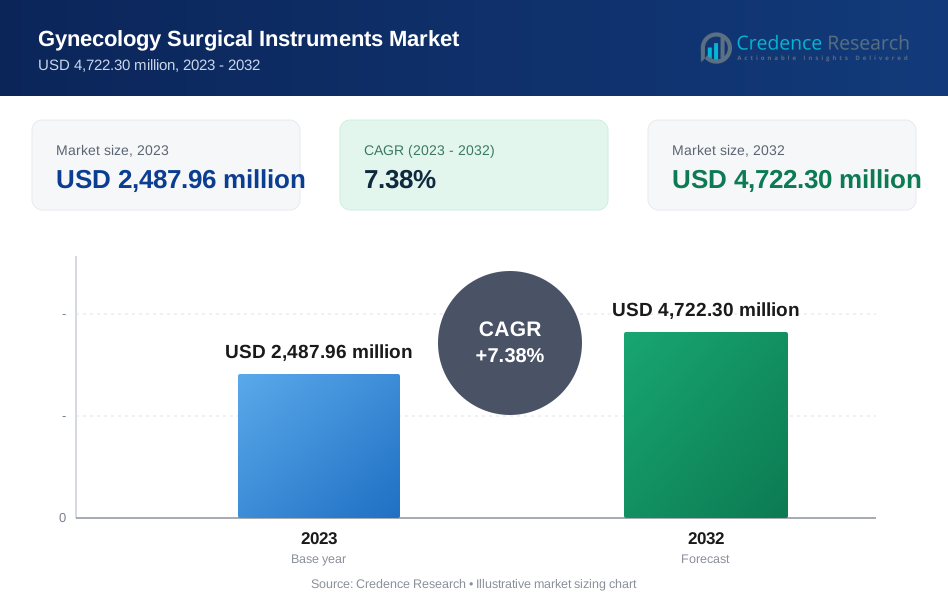
The global gynecology surgical instruments market is projected to grow from USD 2,487.96 million in 2023 to an estimated USD 4,722.30 million by 2032, with a compound annual growth rate (CAGR) of 7.38% from 2024 to 2032. This growth is driven by the increasing prevalence of gynecological disorders, a rising number of minimally invasive surgical procedures, and advancements in surgical technologies.
Key drivers in the market include a surge in the incidence of diseases such as ovarian and uterine cancers, endometriosis, and polycystic ovarian syndrome (PCOS), which necessitate surgical intervention. The increasing geriatric female population and the expansion of healthcare infrastructure in developing regions are also boosting demand for gynecology surgical instruments. Additionally, technological innovations, such as robot-assisted surgeries and improved diagnostic methods, are further enhancing market growth.
Geographically, North America dominates the gynecology surgical instruments market, driven by a robust healthcare system, high awareness, and a strong presence of key players like CooperSurgical Inc., Karl Storz GmbH, and Boston Scientific Corporation. Europe follows closely due to increasing government initiatives and healthcare spending. The Asia-Pacific region is anticipated to witness significant growth due to rising healthcare expenditures, an increasing patient population, and improved access to healthcare facilities. Key players actively enhancing their product portfolios and strategic partnerships are expected to maintain competitive dynamics in the market.
Market Drivers
Rising Prevalence of Gynecological Disorders and Surgeries
The increasing prevalence of gynecological disorders is a significant driver of the global gynecology surgical instruments market. Conditions like ovarian cancer, uterine fibroids, endometriosis, and polycystic ovarian syndrome often require surgical interventions, ranging from minimally invasive procedures to complex surgeries. For instance, a substantial number of new ovarian cancer cases diagnosed annually in the United States. Similarly, a significant percentage of women experience symptoms of uterine fibroids during their lifetime. The aging female population further contributes to this trend, as age-related gynecological issues become more common. Government health agencies report an increasing number of gynecological surgeries performed each year, reflecting the growing need for specialized instruments and driving market growth.
Technological Advancements and Adoption of Minimally Invasive Procedures
Technological innovations have transformed gynecological surgery, particularly with the advent of minimally invasive techniques. For instance, data from medical device companies shows a steady increase in the adoption of laparoscopic and robotic-assisted surgeries for gynecological procedures. Industry reports indicate that a substantial portion of hysterectomies are now performed using minimally invasive techniques. These advancements offer benefits such as reduced pain, shorter hospital stays, and quicker recovery times. Surveys of healthcare providers reveal a growing preference for specialized surgical instruments designed for minimally invasive operations. Additionally, government health agencies report improved patient outcomes and reduced healthcare costs associated with these procedures. The integration of advanced imaging technologies and AI-assisted surgical systems, as documented in medical technology surveys, further enhances surgical precision and outcomes, driving market growth.
Growing Healthcare Expenditure and Expansion of Healthcare Infrastructure
Rising healthcare expenditure, especially in developing regions, is significantly contributing to the expansion of the gynecology surgical instruments market. Governments and private sectors are investing heavily in healthcare infrastructure, increasing the availability of advanced surgical facilities and equipment. This expansion is accompanied by a focus on enhancing the quality of healthcare services, including gynecological care. In many developing countries, there is a concerted effort to improve access to essential surgical care, leading to a growing demand for surgical instruments. Moreover, international health organizations and non-governmental organizations are increasingly focusing on women’s health issues, further driving the market. These efforts are expected to improve surgical outcomes and increase the utilization of gynecology surgical instruments across various healthcare settings.
Increasing Focus on Women's Health and Government Initiatives
There is a growing global focus on women's health, which is driving the demand for gynecology surgical instruments. Governments and health organizations worldwide are implementing initiatives aimed at improving women's healthcare services, particularly in the areas of reproductive health and gynecological disorders. Campaigns promoting regular screenings, early diagnosis, and preventive care are raising awareness and leading to an increased number of surgical interventions. Additionally, many countries are providing better insurance coverage for gynecological surgeries, reducing the financial burden on patients and making surgeries more accessible. These policies are expected to create a favorable environment for the growth of the gynecology surgical instruments market, encouraging healthcare providers to invest in advanced surgical tools and techniques to cater to the rising demand.
Market Trends
Increasing Adoption of Minimally Invasive and Robotic-Assisted Surgeries
The global gynecology surgical instruments market is seeing a strong trend towards minimally invasive and robotic-assisted procedures. For instance, the number of laparoscopic hysterectomies performed has increased significantly over the past decade, now accounting for a substantial portion of all hysterectomies in developed countries. Government health data indicates robotic-assisted gynecologic surgeries have grown at a rapid pace, with some hospitals reporting double-digit year-over-year increases in robotic procedure volumes. This shift is driving demand for specialized instruments like advanced energy devices and robotic surgical systems. One major surgical robotics company reported that gynecology is now its fastest-growing specialty in terms of new system placements and procedure volumes. The trend is particularly pronounced in countries with advanced healthcare systems, though adoption is also accelerating in emerging markets. Industry analysts project the market for minimally invasive gynecologic instruments will continue expanding at a robust rate in coming years as more surgeons gain training and experience with these techniques.
Focus on Technological Advancements and Product Innovation
Technological innovation is a key trend shaping the gynecology surgical instruments market. For instance, a recent survey of gynecologic surgeons found that over half had adopted new surgical technologies or instruments in the past year to improve patient outcomes. Major medical device companies report increased R&D spending on gynecology products, with several launching advanced imaging systems and AI-enabled surgical tools. Government agencies have also accelerated approval pathways for innovative gynecologic devices. One regulatory body approved a record number of new gynecology instruments last year, including novel single-use scopes and robotic surgical accessories. Industry data shows strong sales growth for technologically-advanced products like 4K laparoscopic systems and "smart" electrosurgical devices. Emerging areas of innovation include AI-assisted surgical planning tools, augmented reality surgical guidance systems, and miniaturized robotic instruments. While high-tech devices currently represent a small portion of the overall market, analysts expect them to be a major driver of market expansion. Several startups focused on gynecologic surgical innovation have also attracted significant venture capital funding in recent years.
Market Restraints and Challenges
High Costs of Advanced Surgical Instruments and Procedures
The high cost of advanced gynecological surgical instruments and procedures poses a significant challenge to market growth. For instance, the average cost of robotic-assisted hysterectomy was substantially higher than traditional laparoscopic approaches. The U.S. Government Accountability Office reported that hospitals often struggle to recoup investments in expensive surgical technologies. Many smaller hospitals and clinics, especially in rural areas, cannot afford the latest laparoscopic and robotic systems. The World Health Organization has highlighted the disparity in access to advanced gynecological care between high and low-income countries due to cost barriers. Additionally, a significant portion of women delay or forego gynecological procedures due to financial concerns. The the high costs of research, development, and regulatory compliance for new surgical instruments are often passed on to healthcare providers and patients.
Stringent Regulatory Requirements and Product Approvals
Stringent regulatory requirements and lengthy approval processes present substantial challenges in the gynecology surgical instruments market. There is an increase in the average time for medical device approvals in recent years. A survey by the European Medical Technology Industry Association found that many companies face delays and increased costs due to the new EU Medical Device Regulation. The disparities in regulatory processes across different countries, creating barriers for global market expansion. A report from the U.S. Department of Health and Human Services emphasized the need for streamlined approval processes to encourage innovation in medical devices. The World Bank has noted that complex regulatory environments in developing countries often deter investment in advanced medical technologies. Smaller medical device companies struggle with the financial burden of extensive clinical trials required for regulatory approval. The Global Harmonization Task Force on Medical Devices stressed the importance of international regulatory harmonization to facilitate market access and innovation in surgical instruments.
Market Segmentation Analysis
By Product
The global gynecology surgical instruments market is segmented by product into scissors, forceps, trocars, dilators, and speculums. Forceps hold a substantial market share due to their extensive use in various gynecological surgeries. For instance, forceps are used in over half of all gynecological procedures. Scissors are also in significant demand, particularly for precise tissue cutting. Trocars are witnessing rising adoption due to the increasing prevalence of minimally invasive surgeries. A government health report indicated a double-digit increase in laparoscopic gynecological procedures over the past 5 years. Dilators and speculums also show steady growth driven by routine diagnostic procedures. Continuous product innovations, such as single-use and ergonomically designed instruments, are further driving growth. For example, a medical device manufacturer reported that sales of their new ergonomic forceps line grew substantially year-over-year. The introduction of advanced materials and coatings for improved functionality is also contributing to market expansion across all product segments.
By Application
The market is further segmented by application into laparoscopy, colposcopy, hysteroscopy, dilation and curettage (D&C), and endometrial biopsy. The laparoscopy segment dominates the market due to growing preference for minimally invasive surgeries. A multi-country study found that laparoscopic procedures now account for a majority of gynecological surgeries in developed nations. Hysteroscopy is also significant, driven by increasing use in diagnosing and treating intrauterine pathologies. For instance, a women's health organization reported a substantial rise in hysteroscopy procedures for fibroid treatment. Dilation and curettage procedures hold a notable share, used for both diagnostic and therapeutic purposes. A hospital survey indicated D&C remains one of the most common gynecological procedures performed. Colposcopy and endometrial biopsy segments are anticipated to witness steady growth due to increasing emphasis on early diagnosis. Government screening programs in several countries have led to higher rates of these diagnostic procedures being performed annually.
Segments
Based on product
- Scissors
- Forceps
- Trocar
- Dilators
- Speculum
Based on application
- Laparoscopy
- Colposcopy
- Hysteroscopy
- Dilation & Curettage
- Endometrial Biopsy
Based on region
- North America
- U.S.
- Canada
- Mexico
- Europe
- Germany
- France
- U.K.
- Italy
- Spain
- Rest of Europe
- Asia Pacific
- China
- Japan
- India
- South Korea
- South-east Asia
- Rest of Asia Pacific
- Latin America
- Brazil
- Argentina
- Rest of Latin America
- Middle East & Africa
- GCC Countries
- South Africa
- Rest of the Middle East and Africa
Regional Analysis
North American Region (24%):
North America represents around 24% of the global market share. This leadership is attributed to several factors, including a robust healthcare infrastructure and high awareness levels regarding women's health issues. Significant investments in advanced surgical technologies have further solidified the region's market standing. For instance, surveys conducted by healthcare authorities have shown a steady increase in the adoption of minimally invasive gynecological procedures across the United States and Canada. The rising prevalence of gynecological disorders, as reported in government health statistics, is another key driver fueling market growth. Additionally, data from medical device companies indicates a growing demand for sophisticated surgical instruments designed specifically for gynecological procedures. The region's strong focus on research and development in women's health has also contributed to its market leadership, with numerous clinical trials and studies being conducted to improve surgical outcomes and patient care.
European Region:
Europe is the second-largest market, with a market share of around 28%. The region's growth is propelled by strong government initiatives aimed at enhancing women's health and increasing healthcare expenditure. For instance, data from European health ministries shows a consistent rise in funding allocated to women's health programs and gynecological research. Surveys conducted by medical associations have revealed a growing trend towards the adoption of advanced surgical techniques across European countries. The region is witnessing an increasing demand for minimally invasive and robotic-assisted surgeries, as evidenced by data from surgical equipment manufacturers. Government health reports indicate a rising geriatric female population, which is contributing to the increased need for gynecological interventions. Furthermore, data from healthcare providers shows a growing awareness about early diagnosis and treatment of gynecological disorders, fostering market expansion. The region's well-established healthcare systems and high adoption rates of advanced surgical techniques, particularly in countries like Germany, France, and the United Kingdom, are key factors supporting market growth.
Key players
- Braun Melsungen AG
- CooperSurgical Inc.
- Ethicon, Inc.
- Karl Storz GmbH & Co. KG
- KLS Martin Group
- Medgyn Products, Inc.
- Olympus Corporation
- Richard Wolf GmbH
- Sklar Surgical Instruments
- Surgical Holdings
- Tetra Surgical
Competitive Analysis
The global gynecology surgical instruments market is highly competitive, with several leading players striving to maintain market dominance through innovation and strategic initiatives. Braun Melsungen AG and CooperSurgical Inc. lead with a comprehensive portfolio of advanced surgical instruments, focusing on technological advancements and product innovation. Ethicon, Inc. and Karl Storz GmbH & Co. KG are notable for their strong R&D capabilities and extensive distribution networks, enhancing their market presence. Olympus Corporation and Richard Wolf GmbH are prominent for their state-of-the-art imaging technologies and minimally invasive solutions. Companies like Medgyn Products, Inc., Sklar Surgical Instruments, Surgical Holdings, and Tetra Surgical also contribute with specialized instruments and a focus on quality and customer service. The competitive landscape is characterized by ongoing product development, strategic partnerships, and regional expansion to meet diverse market needs.
Recent Developments
- In November 2023, CooperSurgical expanded its medical device portfolio by acquiring select assets from Cook Medical for $300 million. While this acquisition did not specifically involve tablet counting machines, it demonstrates CooperSurgical's strategy of growth through acquisitions in the medical device space.
- In April 2024, Karl Storz expanded its direct sales operations in Europe by acquiring the Karl Storz-related business of distributor Stöpler in Belgium, Luxembourg, and the Netherlands. This acquisition aims to strengthen Karl Storz's market position and bring the company closer to its customers in these regions.
Market Concentration and Characteristics
The global gynecology surgical instruments market exhibits moderate to high market concentration, with several key players commanding a substantial share. Leading companies such as Braun Melsungen AG, CooperSurgical Inc., Ethicon, Inc., and Karl Storz GmbH & Co. KG dominate the market through their extensive product portfolios, advanced technological innovations, and robust distribution networks. This concentration is driven by the high barriers to entry, including significant capital investment and stringent regulatory requirements. The market is characterized by ongoing advancements in surgical technologies, a strong focus on research and development, and strategic partnerships and acquisitions aimed at expanding product offerings and geographical reach. While the presence of major players shapes the competitive landscape, there is also room for niche and emerging companies to innovate and capture market share through specialized and novel solutions.
Report Coverage
The research report offers an in-depth analysis based on product, application and region. It details leading market players, providing an overview of their business, product offerings, investments, revenue streams, and key applications. Additionally, the report includes insights into the competitive environment, SWOT analysis, current market trends, as well as the primary drivers and constraints. Furthermore, it discusses various factors that have driven market expansion in recent years. The report also explores market dynamics, regulatory scenarios, and technological advancements that are shaping the industry. It assesses the impact of external factors and global economic changes on market growth. Lastly, it provides strategic recommendations for new entrants and established companies to navigate the complexities of the market.
Future Outlook
- Continued innovation in surgical technologies, including robotic-assisted and minimally invasive procedures, will drive the demand for advanced gynecology instruments. Emerging technologies are expected to enhance surgical precision and patient outcomes.
- The increasing incidence of gynecological conditions such as cancers and endometriosis will boost the need for specialized surgical instruments. This trend will support market growth as more advanced tools are developed to address these conditions.
- Minimally invasive surgeries are gaining popularity due to their benefits like reduced recovery times and lower complication rates. This trend will drive the demand for specialized instruments designed for such procedures.
- Rapid healthcare infrastructure development and rising awareness in emerging markets, especially in Asia-Pacific and Latin America, will create new growth opportunities. Increased investment in healthcare facilities will further support market expansion.
- Higher healthcare spending across both developed and developing regions will drive the adoption of advanced gynecology surgical instruments. Improved funding will facilitate the procurement of state-of-the-art equipment and technologies.
- The integration of advanced imaging technologies such as 3D and 4K endoscopes will enhance surgical visualization and precision. This will boost the demand for compatible surgical instruments.
- Manufacturers will continue to focus on developing innovative and ergonomic surgical instruments. Enhanced product features and designs will cater to evolving surgical techniques and improve overall efficacy.
- Stringent regulatory requirements and lengthy approval processes may pose challenges for new product introductions. Navigating these regulatory landscapes will be crucial for market players seeking to innovate and expand
- The growing emphasis on reducing infection risks and enhancing convenience will drive the adoption of single-use gynecology instruments. This shift will influence market dynamics and product offerings.
- Key players will engage in strategic partnerships and acquisitions to expand their market presence and enhance product portfolios. These strategies will foster innovation and strengthen competitive positioning in the market.
Request a Free Sample
Fill in your details and we'll send you a free sample report.
- Sample data tables & charts
- Research methodology
Need a Custom Version of This Report?
Tailor the scope, geography, or segments to your exact requirements.
- Custom geography or segment scope
- Direct access to our analyst team
Frequently Asked Questions
What is the projected growth rate of the global gynecology surgical instrumentsmarket?
What factors are driving the growth of the gynecology surgical instruments market?
Which regions are leading the global gynecology surgical instruments market?
What role do technological innovations play in the market?
How does the increasing prevalence of gynecological disorders impact the market?
Table of Content
Chapter 1. Report Introduction
- 1.1 Report Description & Purpose
- 1.1.1 Report Title & Market Definition
- 1.1.2 Unique Selling Propositions (USP) & Key Differentiators
- 1.1.3 Value Proposition for Stakeholders
- 1.2 Research Objectives
- 1.2.1 Market Sizing Objectives (Volume & Revenue)
- 1.2.2 Segmentation Objectives
- 1.2.3 Competitive Intelligence Objectives
- 1.2.4 Forecast & Scenario Objectives
- 1.3 Report Scope
- 1.3.1 Gynecology Surgical Instruments Scope – Types & Subtypes Covered
- 1.3.2 Geographic Scope – Regions & Countries Covered
- 1.3.3 Historical Period, Base Year & Forecast Period (2023; forecast to 2032)
- 1.3.4 Inclusions & Exclusions
- 1.4 HS Code & Classification Framework
- 1.5 Currency, Units & Pricing Basis
- 1.6 Target Stakeholders
- 1.7 Limitations & Assumptions
Chapter 2. Executive Summary
- 2.1 Global Gynecology Surgical Instruments Market Snapshot
- 2.1.1 Market Size – Historical (2023) & Forecast (2023-2032) (2023: USD 2,487.96 million → 2032: USD 4,722.30 million)
- 2.1.2 Volume & Revenue – Global Totals
- 2.1.3 Key Market Highlights – Top Five Facts
- 2.2 Gynecology Surgical Instruments Market Segmentation Snapshot
- 2.2.1 Market Split by Region – 2023 vs. 2032
- 2.3 Competitive Snapshot
- 2.3.1 Top 10 Players by Revenue Share – 2023
- 2.3.2 Top 10 Players by Volume Share – 2023
- 2.3.3 Recent Strategic Developments (18-Month Summary)
- 2.4 Key Investment Highlights & Strategic Conclusions
Chapter 3. Gynecology Surgical Instruments Market Dynamics & Industry Analysis
- 3.1 Market Overview & Context
- 3.1.1 Gynecology Surgical Instruments Market Position in the Broader Automotive Value Chain
- 3.1.2 OEM vs. Replacement Market Dynamics
- 3.1.3 Market Maturity & Development Stage by Region
- 3.2 Gynecology Surgical Instruments Market Drivers
- 3.3 Gynecology Surgical Instruments Market Restraints & Challenges
- 3.4 Gynecology Surgical Instruments Market Opportunities
- 3.5 Porter's Five Forces Analysis
- 3.5.1 Threat of New Entrants
- 3.5.2 Bargaining Power of Suppliers
- 3.5.3 Bargaining Power of Buyers
- 3.5.4 Threat of Substitutes
- 3.5.5 Competitive Rivalry – Intensity Assessment
- 3.6 Gynecology Surgical Instruments Value Chain Analysis
- 3.6.1 Upstream – Raw Material/Input Suppliers
- 3.6.1.1 Raw Material/Input 1
- 3.6.1.2 Raw Material/Input 2
- 3.6.1.3 Raw Material/Input 3
- 3.6.2 Midstream – Production/Manufacturing/Service Delivery
- 3.6.2.1 Production/Process Overview
- 3.6.2.2 Key Facility Locations & Capacity by Manufacturer
- 3.6.3 Downstream – Distribution & End Consumer
- 3.6.3.1 Primary Channel – B2B/OEM
- 3.6.3.2 Secondary Channels – Dealer, Retail, Online, Direct
- 3.6.4 Value Chain Profitability Analysis
- 3.6.1 Upstream – Raw Material/Input Suppliers
- 3.7 PESTEL Analysis
- 3.7.1 Political Factors
- 3.7.2 Economic Factors
- 3.7.3 Social Factors
- 3.7.4 Technological Factors
- 3.7.5 Environmental Factors
- 3.7.6 Legal Factors
- 3.8 Gynecology Surgical Instruments Supply Chain Analysis
- 3.8.1 Raw Material/Input Supply Risk Assessment
- 3.8.2 Manufacturing Concentration Risk (Geographic Exposure)
- 3.8.3 Trade Disruption Impact Analysis
- 3.9 Regulatory & Policy Landscape
Note: The regulatory and policy landscape section covers regulations based on their applicability to the market, Gynecology Surgical Instruments category, geography, and scope of the study. Only regulatory frameworks with a material impact on operations, compliance, trade, sustainability, or market access are analyzed in detail.
Chapter 4. Key Investment Pockets & Opportunity Analysis
- 4.1 Gynecology Surgical Instruments Market Attractiveness Analysis
- 4.1.1 By Region – Investment Attractiveness Matrix (Volume × CAGR)
- 4.2 Absolute Revenue Growth Opportunity
- 4.2.1 By Region – Absolute USD Growth Through 2032
- 4.3 Incremental Volume Opportunity
- 4.3.1 By Region – Incremental Volume Through 2032
- 4.3.2 Segment – Incremental Volume
- 4.4 Emerging Submarket Opportunity Deep Dive (Subject to Applicability)
- 4.5 Emerging Market Opportunity Scorecards
- 4.5.1 United States
- 4.5.2 Europe
- 4.5.3 Asia
- 4.5.4 Middle East & Africa
Note: Emerging Market Opportunity Scorecards will be included based on relevance and strategic importance. Regions listed are indicative and may vary depending on data availability and market dynamics.
Chapter 5. Gynecology Surgical Instruments Import-Export Analysis & Trade Flows
- 5.1 Global Trade Overview
- 5.1.1 Global Export Value by Country (2023)
- 5.1.2 Global Export Volume by Country (2023)
- 5.1.3 Global Import Value by Country (2023)
- 5.1.4 Global Import Volume by Country (2023)
- 5.1.5 Net Trade Balance by Country (2023)
- 5.2 Export Analysis – Segment
- 5.2.1 Type 1 (HS Code)
- 5.2.2 Type 2 (HS Code)
- 5.2.3 Type 3 (HS Code)
- 5.2.4 Type 4 (HS Code)
- 5.2.5 Type 5 (HS Code)
- 5.3 Import Analysis – Segment
- 5.3.1 Type 1 (HS Code)
- 5.3.2 Type 2 (HS Code)
- 5.3.3 Type 3 (HS Code)
- 5.3.4 Type 4 (HS Code)
- 5.3.5 Type 5 (HS Code)
- 5.4 Average Unit Trade Prices
- 5.4.1 Average Export Price – Segment & Country
- 5.4.2 Average Import Price – Segment & Source Country
- 5.4.3 Price Trends (2023)
- 5.5 Key Trade Route Analysis
- 5.5.1 Trade Route 1
- 5.5.2 Trade Route 2
- 5.5.3 Trade Route 3
- 5.5.4 Trade Route 4
- 5.5.5 Trade Route 5
- 5.6 Trade Policy Impact Assessment
- 5.6.1 US Anti-Dumping & Section 301 Tariffs
- 5.6.2 EU Customs Union Impact
- 5.6.3 Major Free Trade Agreements
- 5.6.4 USMCA Rules of Origin
Note: Trade policy analysis will be included only where relevant to the Gynecology Surgical Instruments market.
Chapter 6. Competitive Landscape & Company Benchmarking
- 6.1 Gynecology Surgical Instruments Market Concentration & Structure
- 6.1.1 Herfindahl-Hirschman Index (HHI) – vs. 2023
- 6.1.2 Tier 1, Tier 2 & Tier 3 Market Structure
- 6.1.3 Global, Regional & Local Player Dynamics
- 6.2 Gynecology Surgical Instruments Market Share Analysis – 2023
- 6.2.1 Global Revenue Share by Company
- 6.2.2 Global Volume Share by Company
- 6.2.3 Regional Revenue Share
- 6.2.4 Market Share Evolution ( vs. 2023)
- 6.2.5 OEM Segment Share by Company
- 6.2.6 Replacement Segment Share by Company
- 6.3 Production/Delivery Capacity & Facility Analysis
- 6.3.1 Global Installed Capacity
- 6.3.2 Capacity Utilization Rates
- 6.3.3 Production/Output Volume
- 6.3.4 Facility Locations & Capacity Map
- 6.3.5 Planned Capacity Additions
- 6.4 Gynecology Surgical Instruments Competitive Benchmarking Matrix
- 6.4.1 Revenue, Volume, CAGR & Profitability Comparison
- 6.4.2 Channel Revenue Mix
- 6.4.3 Geographic Revenue Exposure
- 6.4.4 R&D Intensity
- 6.4.5 Sustainability Maturity
- 6.5 Strategic Developments in Gynecology Surgical Instruments (Last 24 Months)
- 6.5.1 Mergers, Acquisitions & Divestments
- 6.5.2 New Gynecology Surgical Instruments Launches
- 6.5.3 Facility Expansions
- 6.5.4 Strategic Alliances, Joint Ventures & Partnerships
- 6.5.5 Distribution Expansion & Market Entry
- 6.5.6 Sustainability & ESG Initiatives
- 6.6 Competitive Strategy Mapping
- 6.6.1 Leader, Challenger, Follower & Niche Classification
- 6.6.2 Pricing Strategy Comparison
- 6.6.3 Channel Strategy Matrix
Note: Strategic developments are included based on their materiality and the availability of reliable information.
Chapter 7. Global Gynecology Surgical Instruments Market – By Distribution Channel
- 7.1 Segment Overview
- 7.1.1 Volume & Revenue Split by Channel (2023 & 2032)
- 7.1.2 Channel Mix Evolution (2023-2032)
Chapter 8. Regional Market Analysis – Global Overview
- 8.1 Global Regional Overview
- 8.1.1 Regional Volume Share
- 8.1.2 Regional Revenue Share
- 8.1.3 Regional Volume by Region
- 8.1.4 Regional Revenue by Region
- 8.1.5 Regional Forecast Through 2032
- 8.2 Cross-Regional Segment Analysis
- 8.2.1 By Distribution Channel
- 8.2.2 By Brand/Price Tier
Chapter 9. North America Gynecology Surgical Instruments Market
- 9.1 United States
- 9.2 Canada
- 9.3 Mexico
Chapter 10. Europe Gynecology Surgical Instruments Market
- 10.1 Germany
- 10.2 France
- 10.3 Italy
- 10.4 United Kingdom
- 10.5 Spain
- 10.6 Poland
- 10.7 Russia
- 10.8 Netherlands
- 10.9 Belgium
- 10.10 Sweden
- 10.11 Denmark
- 10.12 Norway
- 10.13 Rest of Europe
Chapter 11. Asia Pacific Gynecology Surgical Instruments Market
- 11.1 China
- 11.2 India
- 11.3 Japan
- 11.4 South Korea
- 11.5 Thailand
- 11.6 Indonesia
- 11.7 Vietnam
- 11.8 Malaysia
- 11.9 Australia
- 11.10 Rest of Asia Pacific
Chapter 12. Latin America Gynecology Surgical Instruments Market
- 12.1 Brazil
- 12.2 Argentina
- 12.3 Colombia
- 12.4 Chile
- 12.5 Rest of Latin America
Chapter 13. Middle East Gynecology Surgical Instruments Market
- 13.1 Saudi Arabia
- 13.2 United Arab Emirates
- 13.3 Turkey
- 13.4 Israel
- 13.5 Iran
- 13.6 Rest of the Middle East
Chapter 14. Africa Gynecology Surgical Instruments Market
- 14.1 South Africa
- 14.2 Egypt
- 14.3 Nigeria
- 14.4 Morocco
- 14.5 Rest of Africa
Chapter 15. Gynecology Surgical Instruments Company Profiles
- 15.1 [Company 01]
- 15.1.1 Company Overview
- 15.1.2 Key Management Personnel
- 15.1.3 Products & Services Portfolio
- 15.1.4 Financial Performance
- 15.1.5 Key Market Focus & Geographic Presence
- 15.1.6 Recent Developments & Strategic Initiatives
Note: The company profile list is preliminary and may change based on research findings, market developments, data availability, and client requirements.
Chapter 16. Appendices
- Appendix A – List of Abbreviations & Acronyms
- Appendix B – Industry Classification Code Reference – Full Series
- Appendix C – Production & Capacity Data Tables
- Appendix D – End-Use & Demand Base Tables
- Appendix E – Consumption & Replacement Rate Assumptions
- Appendix F – ASP Reference Tables
- Appendix G – Manufacturing & Facility Database
- Appendix H – Import-Export Data Tables
- Appendix I – Regulatory Summary Tables
- Appendix J – Primary Research Participant List (Anonymized)
- Appendix K – Primary Research Questionnaire Framework
- Appendix L – Data Sources & Bibliography
- Appendix M – Market Size Divergence & Source Comparison
Chapter 17. Research Methodology
- 17.1 Research Framework & Philosophy
- 17.2 Secondary Research – Sources, Hierarchy & Data Extraction
- 17.3 Data Modeling – Bottom-Up & Top-Down Market Sizing
- 17.4 Primary Research – Stakeholder Framework, LOI & Sample Sizes
- 17.5 Forecast Methodology – Regression, Scenario & Sensitivity Analysis
- 17.6 Quality Control – Four-Layer Validation Framework
- 17.7 Limitations & Standard Assumptions
- 17.8 Disclaimer
