
Halal Cosmetics Market Overview:
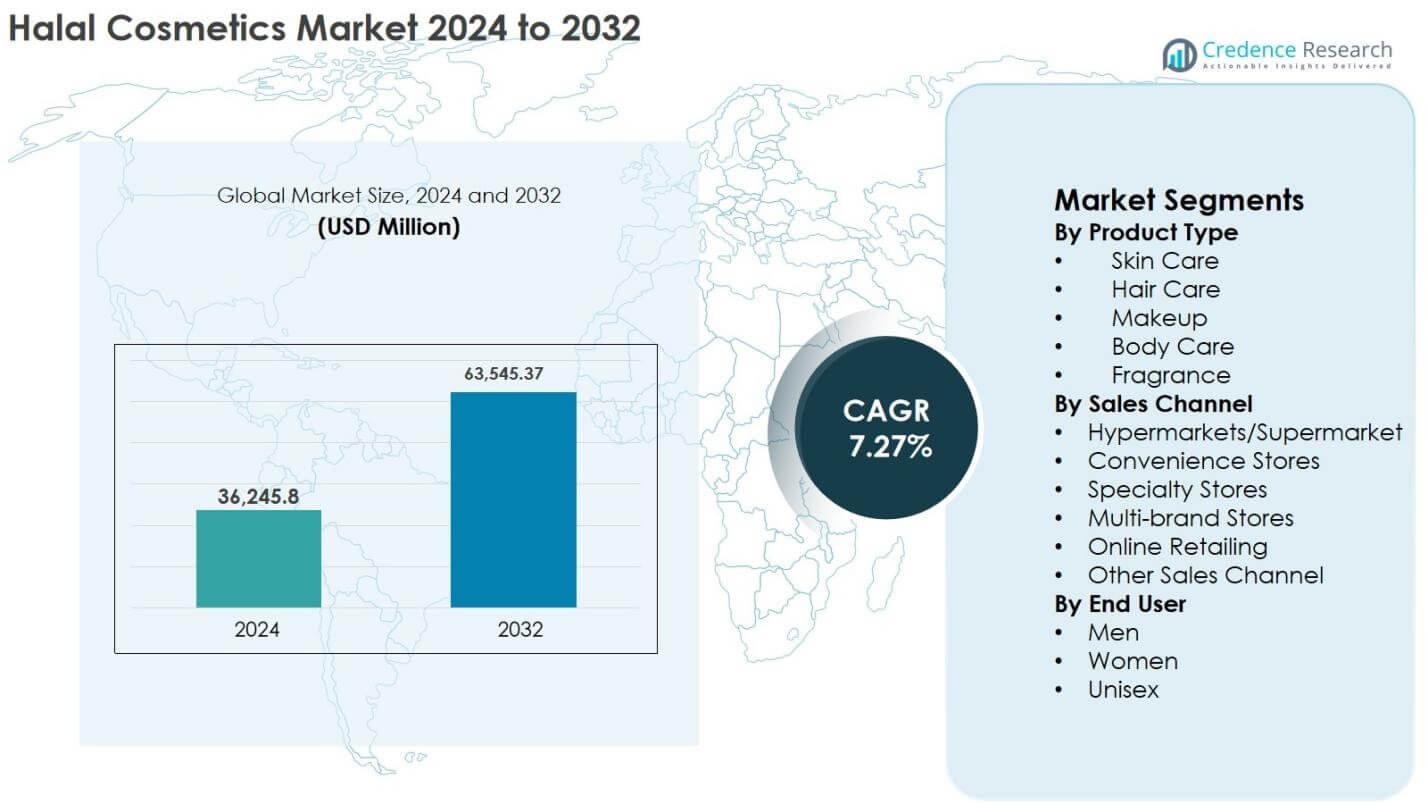
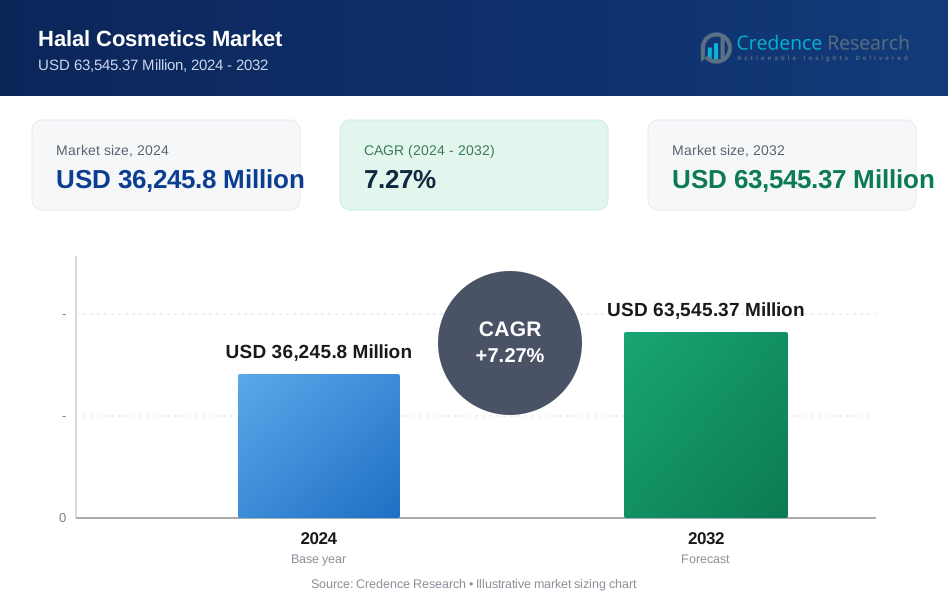
Halal Cosmetics Market size was valued at USD 36,245.8 Million in 2024 and is anticipated to reach USD 63,545.37 Million by 2032, growing at a CAGR of 7.27% during the forecast period.
| REPORT ATTRIBUTE | DETAILS |
|---|---|
| Historical Period | 2020-2023 |
| Base Year | 2024 |
| Forecast Period | 2025-2032 |
| Halal Cosmetics Market Size 2024 | USD 36,245.8 million |
| Halal Cosmetics Market, CAGR | 7.27% |
| Halal Cosmetics Market Size 2032 | USD 63,545.37 million |
Halal Cosmetics Market Insights
- The market is driven by rising consumer preference for ethical, clean-label, and alcohol-free beauty products, along with increasing awareness of halal certification standards across skincare, makeup, hair care, and fragrance segments.
- Key trends include rapid expansion of online retailing, premiumization of skincare products, plant-based and vegan-aligned halal formulations, and growing acceptance of gender-neutral and unisex cosmetic ranges across global markets.
- The competitive landscape comprises regional and international players such as Iba Cosmetics, Martha Tilaar Group, Kao Corporation, Andalou Naturals, Ivy Beauty Corporation Sdn Bhd, and Inglot Cosmetics, focusing on innovation, certified ingredient sourcing, and e-commerce-driven distribution strategies.
- Asia Pacific leads the market with a 39.8% regional share in 2024, followed by the Middle East & Africa with 24.6%, while the Skin Care segment remains dominant with a 38.6% share, supported by strong demand for dermo-cosmetic and natural beauty solutions.
Halal Cosmetics Market Segmentation Analysis:
By Product Type
The Halal Cosmetics market by product type is led by Skin Care, which accounts for 38.6% market share in 2024, making it the dominant sub-segment. Its growth is driven by rising consumer focus on ethical beauty, natural ingredients, and dermatologically safe formulations aligned with halal certification standards. Demand strengthens further across moisturizers, serums, sunscreens, and anti-aging products as consumers prioritize transparency and clean-label beauty. Hair Care and Makeup segments also expand steadily, supported by increasing awareness of halal-compliant dyes, shampoos, and color cosmetics, while Body Care and Fragrances gain traction among wellness-oriented and faith-conscious consumers.
- For instance, Wardah in Indonesia has built a large loyal base for its halal-certified skin care lines, including moisturizers and sunscreens formulated without alcohol or animal-derived ingredients
By Sales Channel
Across sales channels, Online Retailing emerges as the dominant sub-segment with 34.2% market share in 2024, supported by the rapid expansion of e-commerce platforms, social-commerce adoption, and broader accessibility of certified halal beauty brands worldwide. Digital channels enable brands to reach Muslim and ethical-conscious consumers across markets while offering product authenticity, certification transparency, and personalized buying experiences. Hypermarkets/Supermarkets and Specialty Stores continue to play an important role in urban retail penetration, while Multi-brand Stores expand curated halal product portfolios. Convenience Stores and Other Sales Channels maintain niche relevance in emerging and regional markets.
- For instance, Safi and Nurish Organiq highlight their JAKIM halal certifications on their official online stores and e-commerce listings, allowing consumers to verify product status and ingredients before purchase.
By End User
By end user, Women remain the dominant sub-segment with 71.4% market share in 2024, driven by strong adoption of halal beauty products across skincare, makeup, fragrance, and personal care categories. Rising awareness of ingredient safety, ethical sourcing, and religious compliance strengthens demand among female consumers in Southeast Asia, the Middle East, and expanding Western markets. The Unisex segment records steady growth as gender-neutral grooming trends rise, particularly in skincare and fragrances. Meanwhile, the Men segment gains momentum due to increasing interest in halal grooming, beard care, hair styling, and premium personal care solutions.
Key Growth Drivers
Rising Demand for Ethical, Safe, and Clean-Label Beauty Products
The Halal Cosmetics market grows significantly as consumers increasingly prioritize ethical beauty, clean formulations, and ingredient transparency. Halal-certified products appeal not only to Muslim consumers but also to a broader global audience seeking toxin-free, cruelty-free, and sustainably sourced cosmetics. The exclusion of alcohol, animal-derived ingredients, and harmful chemicals aligns with the clean-beauty movement, strengthening brand credibility and consumer trust. Rapid urbanization, rising disposable incomes, and lifestyle modernization in Southeast Asia, the Middle East, and South Asia further accelerate adoption. Additionally, younger consumers exhibit stronger awareness of certification standards and production integrity, driving premiumization and product diversification across skincare, fragrance, makeup, and personal care categories.
- For instance, Indonesia’s Wardah, one of the country’s leading cosmetic brands, promotes alcohol-free and halal-certified formulations that cater to both faith-based and clean-beauty consumers.
Expansion of International Distribution and E-Commerce Ecosystems
The rapid growth of cross-border e-commerce, digital retail platforms, and online certification awareness strengthens the global penetration of halal cosmetic brands. Online marketplaces enable niche and emerging brands to access geographically diverse consumer bases while ensuring product authenticity through certification visibility and traceable supply chains. Social commerce, influencer marketing, and digital beauty communities increase brand awareness and product education among millennials and Gen-Z buyers. Strategic partnerships between manufacturers, certification bodies, and global distributors enhance reliability and market outreach. Meanwhile, retail expansion through specialty stores, modern trade outlets, and multi-brand distribution frameworks improves product accessibility in established and emerging halal beauty markets.
- For instance, ESQA Cosmetics, certified by Indonesia’s BPJPH, lists its halal status and certification details across its online channels to reassure both local and overseas buyers.
Increasing Government Support and Certification Standardization
Government initiatives promoting halal-compliant manufacturing, export certification programs, and quality standardization play a vital role in strengthening the Halal Cosmetics market. National halal regulatory frameworks in Malaysia, Indonesia, GCC countries, and parts of Europe support structured certification processes, encouraging investment and industrial scaling. Public-sector backing fosters research and innovation in ingredient sourcing, biotechnology-based halal actives, and sustainable formulations. In addition, trade policies promoting halal product exports expand international market reach. The harmonization of certification standards across regions enhances transparency and trust while reducing compliance barriers for manufacturers, encouraging both global beauty firms and regional brands to enter the halal cosmetics landscape.
Key Trends & Opportunities
Innovation in Plant-Based, Vegan, and Organic Halal Beauty Solutions
A major opportunity emerges from the convergence of halal, vegan, and organic beauty trends, driving innovation in botanical-based formulations, natural extracts, and eco-friendly product lines. Consumers increasingly seek multifunctional skincare, sensitive-skin solutions, and dermatologically tested cosmetic products free from synthetic additives and irritants. This trend promotes development in halal-certified serums, dermo-cosmetics, scalp care, fragrances, and anti-aging solutions. Brands are also investing in biotechnological ingredient development and sustainable packaging to align with environmental priorities. The overlap between ethical lifestyle choices and faith-aligned consumption creates strong growth potential in premium, wellness-focused halal cosmetic offerings across international markets.
- For instance, Inika Organic in Australia offers halal-certified, vegan, and organic makeup and skincare with natural mineral formulations and a focus on recyclable or sustainable packaging.
Growth of Male Grooming and Unisex Halal Personal Care Products
Evolving grooming habits, rising lifestyle awareness, and social acceptance of self-care among men create new opportunities within the Halal Cosmetics market. Demand increases for halal-certified beard care, skincare, fragrances, and hair-styling products tailored to male preferences. At the same time, unisex cosmetic lines gain traction as consumers embrace minimalist routines and gender-neutral beauty positioning. Brands leverage inclusive marketing strategies and functional product innovation to appeal to broader demographics. This trend widens the addressable consumer base, stimulates product portfolio expansion, and strengthens long-term revenue growth across emerging and mature halal beauty markets.
- For instance, ESQA Cosmetics markets many of its halal-certified, vegan makeup and skincare products as suitable for all genders, focusing on function and skin benefits rather than gendered branding.
Key Challenges
Lack of Global Certification Uniformity and Supply Chain Complexity
One of the major challenges in the Halal Cosmetics market is the lack of universal certification alignment across regions, leading to regulatory ambiguity and varied compliance requirements. Differences in ingredient acceptance, production standards, and labeling norms create operational hurdles for multinational and emerging brands. Ingredient traceability across complex global supply chains further complicates verification processes. Smaller manufacturers face high certification and audit costs, limiting scalability and product innovation. These inconsistencies may affect consumer confidence and increase time-to-market cycles, requiring companies to invest in robust documentation systems, supplier validation mechanisms, and multi-regional certification approvals.
Limited Consumer Awareness in Non-Core Markets and Premium Pricing Barriers
While demand is strong in Muslim-majority regions, consumer awareness of halal cosmetics remains relatively limited in Western and non-core beauty markets, restricting broader adoption. In addition, halal-certified products often carry higher price points due to specialized ingredient sourcing, certification costs, and compliance procedures. Price sensitivity in developing economies may constrain uptake among mass-market consumers. Some mainstream buyers also perceive halal cosmetics as niche, requiring strong brand positioning and education-driven marketing strategies. Overcoming these challenges demands investment in consumer outreach, pricing optimization, and brand differentiation to enhance market acceptance and competitive positioning.
Regional Analysis
Asia Pacific
Asia Pacific holds the largest share of the Halal Cosmetics market, accounting for 39.8% in 2024, driven by strong consumer bases in Indonesia, Malaysia, India, and Pakistan along with rising urban Muslim populations. The region benefits from well-established halal certification frameworks, expanding domestic manufacturing, and increasing adoption of ethical and clean-label beauty products among millennials and Gen-Z consumers. Growing retail penetration across e-commerce platforms and specialty beauty stores further strengthens market expansion. Regional players and international brands continue to invest in product innovation, botanical formulations, and premium skincare ranges, reinforcing Asia Pacific’s leadership position during the forecast period.
Middle East & Africa
The Middle East & Africa commands a significant 24.6% market share in 2024, supported by strong religious adherence to halal standards, rising disposable incomes, and preference for premium personal-care and fragrance categories. GCC countries, particularly Saudi Arabia and the UAE, act as major consumption hubs due to expanding retail infrastructure, tourism-driven demand, and increasing female workforce participation. Africa also witnesses growing awareness of halal-certified cosmetics across urban centers. Continuous investments in specialty beauty outlets, modern trade channels, and certification-backed branding strengthen consumer trust, while local manufacturing initiatives and product localization strategies further stimulate regional market growth.
Europe
Europe accounts for 18.5% market share in 2024, largely driven by rising demand from Muslim communities across the UK, France, and Germany, along with increasing acceptance of ethical and vegan-aligned beauty products. Mainstream cosmetic brands are expanding halal-certified product portfolios to cater to inclusivity-driven consumer preferences. Strong regulatory oversight, sustainability-focused packaging, and premium skincare innovation support market penetration among conscious buyers. The growth of online retail, specialty ethnic beauty stores, and multicultural marketing strategies strengthens visibility for halal cosmetics across European markets, positioning the region as a rapidly expanding opportunity space for international and niche brands.
North America
North America holds 11.7% market share in 2024, supported by increasing awareness of halal standards among Muslim consumers in the United States and Canada, alongside rising adoption of clean-beauty and cruelty-free formulations across broader consumer groups. The region benefits from expanding distribution through online retail platforms, specialty beauty chains, and multicultural product assortments in mainstream stores. Premium skincare, fragrances, and makeup categories record strong growth momentum. Strategic product positioning around purity, transparency, and ingredient safety helps brands attract ethically conscious buyers, while ongoing awareness initiatives and influencer-led marketing further strengthen halal cosmetics penetration across urban markets.
Latin America
Latin America represents 5.4% market share in 2024, with gradual adoption driven by emerging awareness of halal-certified beauty products in Brazil, Argentina, and Mexico. Market expansion is supported by growing Muslim diaspora communities, rising interest in natural and plant-based cosmetics, and increasing availability of imported halal brands through online channels. Retail participation remains at an early stage, yet collaborative distribution partnerships and certification-focused labeling are improving consumer confidence. As regional manufacturers begin exploring halal-compliant production and export-oriented strategies, the market is expected to gain steady traction across niche skincare, personal-care, and fragrance segments over the coming years.
Halal Cosmetics Market Segmentations:
By Product Type
- Skin Care
- Hair Care
- Makeup
- Body Care
- Fragrance
By Sales Channel
- Hypermarkets/Supermarkets
- Convenience Stores
- Specialty Stores
- Multi-brand Stores
- Online Retailing
- Other Sales Channel
By End User
- Men
- Women
- Unisex
By Geography
- North America
- U.S.
- Canada
- Mexico
- Europe
- Germany
- France
- U.K.
- Italy
- Spain
- Rest of Europe
- Asia Pacific
- China
- Japan
- India
- South Korea
- South-east Asia
- Rest of Asia Pacific
- Latin America
- Brazil
- Argentina
- Rest of Latin America
- Middle East & Africa
- GCC Countries
- South Africa
- Rest of the Middle East and Africa
Competitive Landscape
The Halal Cosmetics market features a diverse and expanding competitive landscape comprising established global beauty manufacturers, regional halal-certified brands, and emerging niche players focused on ethical and faith-aligned formulations. Key players such as Iba Cosmetics, Martha Tilaar Group, Clara International, Kao Corporation, Andalou Naturals, Ivy Beauty Corporation Sdn Bhd, Nature’s Dream, Prolab Cosmetics, Inglot Cosmetics, One Pure, and Talent Cosmetics strengthen their market presence through product innovation, botanical ingredient sourcing, and certification-backed branding strategies. Companies increasingly invest in dermatologically safe skincare, halal-compliant makeup, and premium personal-care ranges to address rising consumer expectations for clean-label and sustainable beauty solutions. Many players expand distribution through e-commerce platforms, specialty beauty stores, and multi-brand retail partnerships while pursuing collaborations with certification bodies to enhance transparency and credibility. Continuous portfolio diversification, regional expansion initiatives, and targeted marketing toward millennial and Gen-Z consumers intensify competition and reinforce the long-term growth outlook of the Halal Cosmetics market.
Key Player Analysis
- Ivy Beauty Corporation Sdn Bhd
- Kao Corporation
- Prolab Cosmetics
- Andalou Naturals
- Inglot Cosmetics
- Clara International
- Nature’s Dream
- Martha Tilaar Group
- Talent Cosmetics
- Iba Cosmetics
Recent Developments
- In December 2025, the Saudi Halal Centre unveiled a new Halal Mark integrated with ESG standards, strengthening halal certification credibility and enhancing product trust across the halal cosmetics industry.
- In October 2025, Malaysia’s JEONG FAMILY partnered with Saudi beauty retailer Nice One to bring its Halal-ready kids beauty brand ILY to Saudi Arabia, with Nice One serving as the exclusive distributor across online and offline channels.
- In May 2025, BPJPH (Indonesia’s Halal Product Assurance Agency) announced regulatory action that all cosmetic products must have halal certification by October 17, 2026, which is driving market compliance and product reformulation activity by global and local brands.
Report Coverage
The research report offers an in-depth analysis based on Product Type, Sales Channel, End-User and Geography. It details leading market players, providing an overview of their business, product offerings, investments, revenue streams, and key applications. Additionally, the report includes insights into the competitive environment, SWOT analysis, current market trends, as well as the primary drivers and constraints. Furthermore, it discusses various factors that have driven market expansion in recent years. The report also explores market dynamics, regulatory scenarios, and technological advancements that are shaping the industry. It assesses the impact of external factors and global economic changes on market growth. Lastly, it provides strategic recommendations for new entrants and established companies to navigate the complexities of the market.
Future Outlook
- The market will witness sustained growth as ethical, clean-label, and certification-backed beauty products continue to gain wider consumer acceptance.
- Brands will increasingly invest in plant-based, vegan-aligned, and dermatologically safe formulations to strengthen product credibility and differentiation.
- E-commerce, social commerce, and cross-border online retailing will play a larger role in market expansion and global consumer outreach.
- Premium skincare, fragrance, and derma-cosmetic ranges will experience higher adoption as consumers shift toward wellness-oriented beauty preferences.
- Regional brands will expand into international markets through certification partnerships and private-label manufacturing collaborations.
- Male grooming and unisex product categories will grow steadily as lifestyle awareness and grooming culture strengthen across emerging markets.
- Supply chain transparency, ingredient traceability, and sustainability initiatives will become core value propositions for leading brands.
- Investments in R&D and biotechnology-based halal ingredients will support innovation across niche cosmetic segments.
- Marketing strategies will focus more on inclusivity, cultural alignment, and trust-based brand communication.
- Consolidation through mergers, acquisitions, and strategic partnerships will intensify as players scale operations and expand product portfolios.
Request a Free Sample
Fill in your details and we'll send you a free sample report.
- Sample data tables & charts
- Research methodology
Need a Custom Version of This Report?
Tailor the scope, geography, or segments to your exact requirements.
- Custom geography or segment scope
- Direct access to our analyst team
Frequently Asked Questions
What is the current market size for the Halal Cosmetics Market, and what is its projected size in 2032?
At what Compound Annual Growth Rate is the Halal Cosmetics Market projected to grow between 2024 and 2032?
Which Halal Cosmetics Market segment held the largest share in 2024?
What are the primary factors fueling the growth of the Halal Cosmetics Market?
Who are the leading companies in the Halal Cosmetics Market?
Which region commanded the largest share of the Halal Cosmetics Market in 2024?
Table of Content
Chapter 1. Report Introduction
- 1.1 Report Description & Purpose
- 1.1.1 Report Title & Market Definition
- 1.1.2 Unique Selling Propositions (USP) & Key Differentiators
- 1.1.3 Value Proposition for Stakeholders
- 1.2 Research Objectives
- 1.2.1 Market Sizing Objectives (Volume & Revenue)
- 1.2.2 Segmentation Objectives
- 1.2.3 Competitive Intelligence Objectives
- 1.2.4 Forecast & Scenario Objectives
- 1.3 Report Scope
- 1.3.1 Halal Cosmetics Scope – Types & Subtypes Covered
- 1.3.2 Geographic Scope – Regions & Countries Covered
- 1.3.3 Historical Period, Base Year & Forecast Period (2024; forecast to 2032)
- 1.3.4 Inclusions & Exclusions
- 1.4 HS Code & Classification Framework
- 1.5 Currency, Units & Pricing Basis
- 1.6 Target Stakeholders
- 1.7 Limitations & Assumptions
Chapter 2. Executive Summary
- 2.1 Global Halal Cosmetics Market Snapshot
- 2.1.1 Market Size – Historical (2024) & Forecast (2024-2032) (2024: USD 36,245.8 Million → 2032: USD 63,545.37 Million)
- 2.1.2 Volume & Revenue – Global Totals
- 2.1.3 Key Market Highlights – Top Five Facts
- 2.2 Halal Cosmetics Market Segmentation Snapshot
- 2.2.1 Market Split by Region – 2024 vs. 2032
- 2.3 Competitive Snapshot
- 2.3.1 Top 10 Players by Revenue Share – 2024
- 2.3.2 Top 10 Players by Volume Share – 2024
- 2.3.3 Recent Strategic Developments (18-Month Summary)
- 2.4 Key Investment Highlights & Strategic Conclusions
Chapter 3. Halal Cosmetics Market Dynamics & Industry Analysis
- 3.1 Market Overview & Context
- 3.1.1 Halal Cosmetics Market Position in the Broader Automotive Value Chain
- 3.1.2 OEM vs. Replacement Market Dynamics
- 3.1.3 Market Maturity & Development Stage by Region
- 3.2 Halal Cosmetics Market Drivers
- 3.3 Halal Cosmetics Market Restraints & Challenges
- 3.4 Halal Cosmetics Market Opportunities
- 3.5 Porter's Five Forces Analysis
- 3.5.1 Threat of New Entrants
- 3.5.2 Bargaining Power of Suppliers
- 3.5.3 Bargaining Power of Buyers
- 3.5.4 Threat of Substitutes
- 3.5.5 Competitive Rivalry – Intensity Assessment
- 3.6 Halal Cosmetics Value Chain Analysis
- 3.6.1 Upstream – Raw Material/Input Suppliers
- 3.6.1.1 Raw Material/Input 1
- 3.6.1.2 Raw Material/Input 2
- 3.6.1.3 Raw Material/Input 3
- 3.6.2 Midstream – Production/Manufacturing/Service Delivery
- 3.6.2.1 Production/Process Overview
- 3.6.2.2 Key Facility Locations & Capacity by Manufacturer
- 3.6.3 Downstream – Distribution & End Consumer
- 3.6.3.1 Primary Channel – B2B/OEM
- 3.6.3.2 Secondary Channels – Dealer, Retail, Online, Direct
- 3.6.4 Value Chain Profitability Analysis
- 3.6.1 Upstream – Raw Material/Input Suppliers
- 3.7 PESTEL Analysis
- 3.7.1 Political Factors
- 3.7.2 Economic Factors
- 3.7.3 Social Factors
- 3.7.4 Technological Factors
- 3.7.5 Environmental Factors
- 3.7.6 Legal Factors
- 3.8 Halal Cosmetics Supply Chain Analysis
- 3.8.1 Raw Material/Input Supply Risk Assessment
- 3.8.2 Manufacturing Concentration Risk (Geographic Exposure)
- 3.8.3 Trade Disruption Impact Analysis
- 3.9 Regulatory & Policy Landscape
Note: The regulatory and policy landscape section covers regulations based on their applicability to the market, Halal Cosmetics category, geography, and scope of the study. Only regulatory frameworks with a material impact on operations, compliance, trade, sustainability, or market access are analyzed in detail.
Chapter 4. Key Investment Pockets & Opportunity Analysis
- 4.1 Halal Cosmetics Market Attractiveness Analysis
- 4.1.1 By Region – Investment Attractiveness Matrix (Volume × CAGR)
- 4.2 Absolute Revenue Growth Opportunity
- 4.2.1 By Region – Absolute USD Growth Through 2032
- 4.3 Incremental Volume Opportunity
- 4.3.1 By Region – Incremental Volume Through 2032
- 4.3.2 Segment – Incremental Volume
- 4.4 Emerging Submarket Opportunity Deep Dive (Subject to Applicability)
- 4.5 Emerging Market Opportunity Scorecards
- 4.5.1 United States
- 4.5.2 Europe
- 4.5.3 Asia
- 4.5.4 Middle East & Africa
Note: Emerging Market Opportunity Scorecards will be included based on relevance and strategic importance. Regions listed are indicative and may vary depending on data availability and market dynamics.
Chapter 5. Halal Cosmetics Import-Export Analysis & Trade Flows
- 5.1 Global Trade Overview
- 5.1.1 Global Export Value by Country (2024)
- 5.1.2 Global Export Volume by Country (2024)
- 5.1.3 Global Import Value by Country (2024)
- 5.1.4 Global Import Volume by Country (2024)
- 5.1.5 Net Trade Balance by Country (2024)
- 5.2 Export Analysis – Segment
- 5.2.1 Type 1 (HS Code)
- 5.2.2 Type 2 (HS Code)
- 5.2.3 Type 3 (HS Code)
- 5.2.4 Type 4 (HS Code)
- 5.2.5 Type 5 (HS Code)
- 5.3 Import Analysis – Segment
- 5.3.1 Type 1 (HS Code)
- 5.3.2 Type 2 (HS Code)
- 5.3.3 Type 3 (HS Code)
- 5.3.4 Type 4 (HS Code)
- 5.3.5 Type 5 (HS Code)
- 5.4 Average Unit Trade Prices
- 5.4.1 Average Export Price – Segment & Country
- 5.4.2 Average Import Price – Segment & Source Country
- 5.4.3 Price Trends (2024)
- 5.5 Key Trade Route Analysis
- 5.5.1 Trade Route 1
- 5.5.2 Trade Route 2
- 5.5.3 Trade Route 3
- 5.5.4 Trade Route 4
- 5.5.5 Trade Route 5
- 5.6 Trade Policy Impact Assessment
- 5.6.1 US Anti-Dumping & Section 301 Tariffs
- 5.6.2 EU Customs Union Impact
- 5.6.3 Major Free Trade Agreements
- 5.6.4 USMCA Rules of Origin
Note: Trade policy analysis will be included only where relevant to the Halal Cosmetics market.
Chapter 6. Competitive Landscape & Company Benchmarking
- 6.1 Halal Cosmetics Market Concentration & Structure
- 6.1.1 Herfindahl-Hirschman Index (HHI) – vs. 2024
- 6.1.2 Tier 1, Tier 2 & Tier 3 Market Structure
- 6.1.3 Global, Regional & Local Player Dynamics
- 6.2 Halal Cosmetics Market Share Analysis – 2024
- 6.2.1 Global Revenue Share by Company
- 6.2.2 Global Volume Share by Company
- 6.2.3 Regional Revenue Share
- 6.2.4 Market Share Evolution ( vs. 2024)
- 6.2.5 OEM Segment Share by Company
- 6.2.6 Replacement Segment Share by Company
- 6.3 Production/Delivery Capacity & Facility Analysis
- 6.3.1 Global Installed Capacity
- 6.3.2 Capacity Utilization Rates
- 6.3.3 Production/Output Volume
- 6.3.4 Facility Locations & Capacity Map
- 6.3.5 Planned Capacity Additions
- 6.4 Halal Cosmetics Competitive Benchmarking Matrix
- 6.4.1 Revenue, Volume, CAGR & Profitability Comparison
- 6.4.2 Channel Revenue Mix
- 6.4.3 Geographic Revenue Exposure
- 6.4.4 R&D Intensity
- 6.4.5 Sustainability Maturity
- 6.5 Strategic Developments in Halal Cosmetics (Last 24 Months)
- 6.5.1 Mergers, Acquisitions & Divestments
- 6.5.2 New Halal Cosmetics Launches
- 6.5.3 Facility Expansions
- 6.5.4 Strategic Alliances, Joint Ventures & Partnerships
- 6.5.5 Distribution Expansion & Market Entry
- 6.5.6 Sustainability & ESG Initiatives
- 6.6 Competitive Strategy Mapping
- 6.6.1 Leader, Challenger, Follower & Niche Classification
- 6.6.2 Pricing Strategy Comparison
- 6.6.3 Channel Strategy Matrix
Note: Strategic developments are included based on their materiality and the availability of reliable information.
Chapter 7. Global Halal Cosmetics Market – By Distribution Channel
- 7.1 Segment Overview
- 7.1.1 Volume & Revenue Split by Channel (2024 & 2032)
- 7.1.2 Channel Mix Evolution (2024-2032)
Chapter 8. Regional Market Analysis – Global Overview
- 8.1 Global Regional Overview
- 8.1.1 Regional Volume Share
- 8.1.2 Regional Revenue Share
- 8.1.3 Regional Volume by Region
- 8.1.4 Regional Revenue by Region
- 8.1.5 Regional Forecast Through 2032
- 8.2 Cross-Regional Segment Analysis
- 8.2.1 By Distribution Channel
- 8.2.2 By Brand/Price Tier
Chapter 9. North America Halal Cosmetics Market
- 9.1 United States
- 9.2 Canada
- 9.3 Mexico
Chapter 10. Europe Halal Cosmetics Market
- 10.1 Germany
- 10.2 France
- 10.3 Italy
- 10.4 United Kingdom
- 10.5 Spain
- 10.6 Poland
- 10.7 Russia
- 10.8 Netherlands
- 10.9 Belgium
- 10.10 Sweden
- 10.11 Denmark
- 10.12 Norway
- 10.13 Rest of Europe
Chapter 11. Asia Pacific Halal Cosmetics Market
- 11.1 China
- 11.2 India
- 11.3 Japan
- 11.4 South Korea
- 11.5 Thailand
- 11.6 Indonesia
- 11.7 Vietnam
- 11.8 Malaysia
- 11.9 Australia
- 11.10 Rest of Asia Pacific
Chapter 12. Latin America Halal Cosmetics Market
- 12.1 Brazil
- 12.2 Argentina
- 12.3 Colombia
- 12.4 Chile
- 12.5 Rest of Latin America
Chapter 13. Middle East Halal Cosmetics Market
- 13.1 Saudi Arabia
- 13.2 United Arab Emirates
- 13.3 Turkey
- 13.4 Israel
- 13.5 Iran
- 13.6 Rest of the Middle East
Chapter 14. Africa Halal Cosmetics Market
- 14.1 South Africa
- 14.2 Egypt
- 14.3 Nigeria
- 14.4 Morocco
- 14.5 Rest of Africa
Chapter 15. Halal Cosmetics Company Profiles
- 15.1 [Company 01]
- 15.1.1 Company Overview
- 15.1.2 Key Management Personnel
- 15.1.3 Products & Services Portfolio
- 15.1.4 Financial Performance
- 15.1.5 Key Market Focus & Geographic Presence
- 15.1.6 Recent Developments & Strategic Initiatives
Note: The company profile list is preliminary and may change based on research findings, market developments, data availability, and client requirements.
Chapter 16. Appendices
- Appendix A – List of Abbreviations & Acronyms
- Appendix B – Industry Classification Code Reference – Full Series
- Appendix C – Production & Capacity Data Tables
- Appendix D – End-Use & Demand Base Tables
- Appendix E – Consumption & Replacement Rate Assumptions
- Appendix F – ASP Reference Tables
- Appendix G – Manufacturing & Facility Database
- Appendix H – Import-Export Data Tables
- Appendix I – Regulatory Summary Tables
- Appendix J – Primary Research Participant List (Anonymized)
- Appendix K – Primary Research Questionnaire Framework
- Appendix L – Data Sources & Bibliography
- Appendix M – Market Size Divergence & Source Comparison
Chapter 17. Research Methodology
- 17.1 Research Framework & Philosophy
- 17.2 Secondary Research – Sources, Hierarchy & Data Extraction
- 17.3 Data Modeling – Bottom-Up & Top-Down Market Sizing
- 17.4 Primary Research – Stakeholder Framework, LOI & Sample Sizes
- 17.5 Forecast Methodology – Regression, Scenario & Sensitivity Analysis
- 17.6 Quality Control – Four-Layer Validation Framework
- 17.7 Limitations & Standard Assumptions
- 17.8 Disclaimer
