
| REPORT ATTRIBUTE | DETAILS |
|---|---|
| Historical Period | 2019-2022 |
| Base Year | 2023 |
| Forecast Period | 2024-2032 |
| Hazardous Waste Materials Market Size 2023 | USD 14845.5 Million |
| Hazardous Waste Materials Market, CAGR | 5.60% |
| Hazardous Waste Materials Market Size 2032 | USD 24242.0 Million |
Market Insights
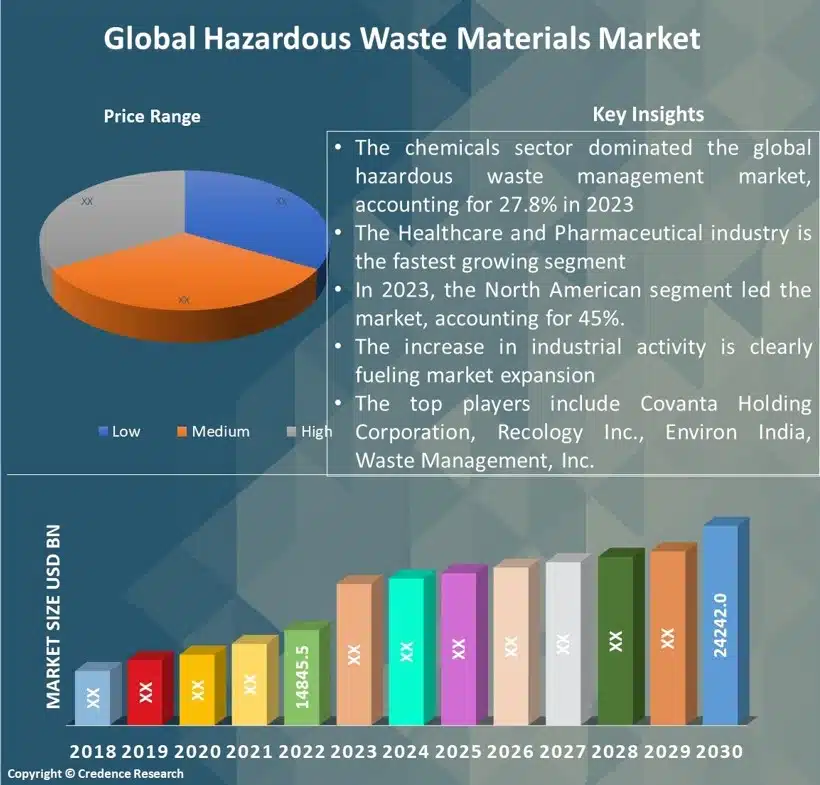
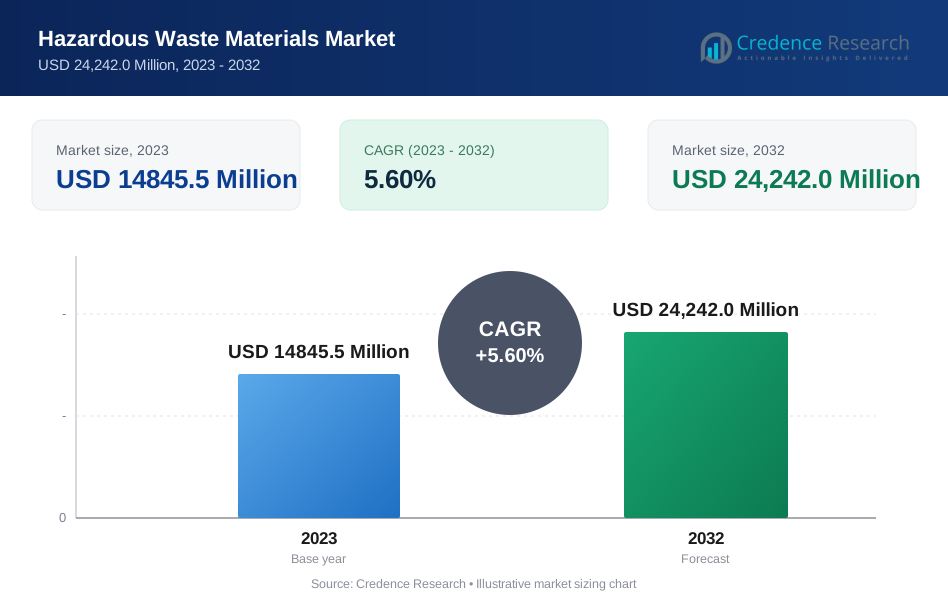
- The global demand for Hazardous Waste Materials was valued at USD 14845.5 Million in 2023 and is expected to reach USD 24242.0 Million in 2032, growing at a CAGR of 5.60% between 2024 and 2032.
- The chemicals industry dominated the global hazardous waste management market in 2023, accounting for 27.8%, with e-waste as the largest waste type category.
- In 2023, deep well injection accounted for 34.8% of the market, while landfilling accounted for 30.6%.
- The healthcare and pharmaceutical business is the fastest expanding segment. Another prominent category in the Hazardous Waste Materials Market is the oil and gas industry.
- The Waste Collection and Transportation category has a greater demand, while Waste Treatment and Disposal Services is another leading area of the Hazardous Waste Materials Market. Hazardous Waste Management Consulting is the third main segment.
- In 2023, the North American sector led the market, accounting for 34.8%, while Asia Pacific accounted for the second-largest share of the worldwide hazardous waste treatment market.
- The rise in industrial activity is certainly driving market expansion.
- The high expense of hazardous waste management is a significant hindrance to industry growth.
Executive Summary
Market Definition
Hazardous waste management refers to the entire set of methods and procedures used to handle, control, and dispose of waste substances that are capable of causing harm to human health or the environment. It includes activities such as waste collection, recycling, treatment, transportation, disposal, and continual monitoring of waste disposal facilities. The primary purpose of hazardous waste administration is to reduce the risks connected with hazardous waste while ensuring the safety of human health and the environment.
Market Overview
The global Hazardous Waste Materials Market has witnessed steady growth in recent years and is expected to grow at a CAGR of 5.60% between 2024 and 2032. The market was valued at USD 14845.5 million in 2023 and is expected to reach USD 24242.0 million in 2032.
There are several reasons that drive the hazardous waste management market. First, governments around the world have stepped up their efforts to address both hazardous and non-hazardous waste management. This increased focus on waste administration is due to growing concerns about environmental air pollution and public health dangers associated with improper handling of hazardous garbage. As a result, governments have adopted tough policies to change garbage disposal habits and promote responsible waste management.
Segmentation by Type of Hazardous Waste
- The chemicals sector dominated the global hazardous waste management market, accounting for 27.8% in 2023. The increase in chemical demand and production, combined with the rapid growth of the chemical sector in emerging nations, is likely to drive up need for chemical waste management globally in the coming years.
- In the waste management market, the leading waste type segment is e-waste. E-waste contains a variety of poisonous chemicals and dangerous substances, including mercury, brominated flame retardants (BFRs), chlorofluorocarbons (CFCs), and hydrochlorofluorocarbons (HCFCs).
Segmentation by Treatment and Disposal Methods
- Deep-well injection accounted for 34.8% of the market in 2023. This is because it is one of the cheapest ways to dispose of big amounts of hazardous waste. As a result, this method's popularity continues to grow.
- The landfilling category accounted for 30.6% of the market in 2023.
Segmentation by End-User Industry
- The Healthcare and Pharmaceutical industry is the fastest growing segment. This is due to the growing demand for efficient pharmaceutical waste disposal and the severe laws in place to ensure safe handling of hazardous products in the healthcare industry
- Another popular category in the Hazardous Waste Materials Market is the Oil and Gas Industry. This industry generates a large amount of hazardous waste during the exploration, production, and refining stages.
- The Chemical and Petrochemical industry holds the third largest share of the Hazardous Waste Materials Market.
Segmentation by Waste Management Services
- The Waste Collection and Transportation category has a larger demand. This is because effective hazardous waste collection and transportation are critical to ensuring safe handling and preventing environmental contamination.
- Waste Treatment and Disposal Services is another dominant section of the Hazardous Waste Materials Market. This category focuses on the proper treatment and disposal of hazardous waste products, guaranteeing regulatory compliance and reducing environmental effect.
- The third major segment in the Hazardous Waste Materials Market is Hazardous Waste Management Consulting.
Segmentation by Region
- In 2023, the North American segment led the market, accounting for 34.8%.
- In 2023, Asia Pacific accounted for the second-largest proportion of the global hazardous waste treatment market
- The rest of the world, including Latin America, the Middle East, and Africa, supplies the remaining demand for Hazardous Waste Materials.
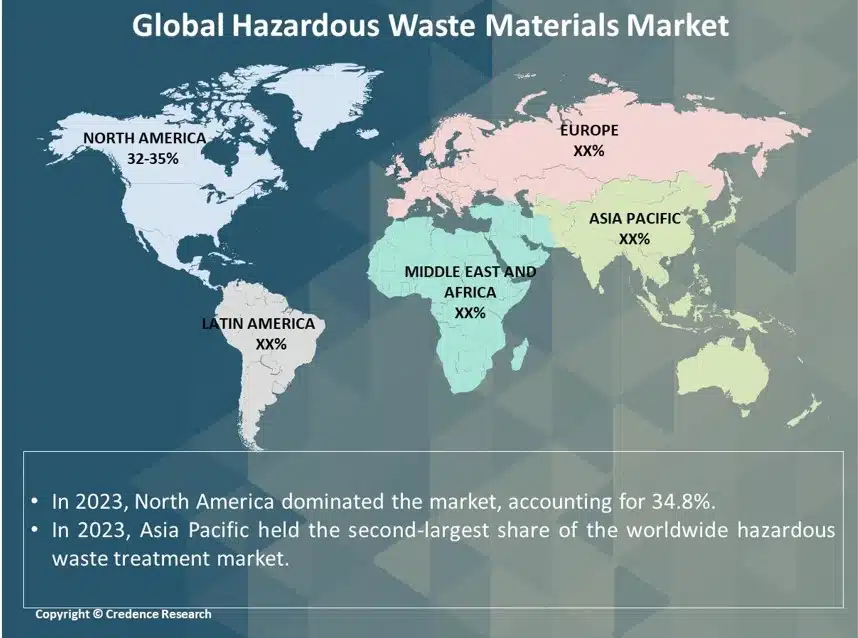
North America accounted for 34.8% of the global market in 2023, owing to strong expansion in the pharmaceutical, chemical, and oil and gas industries in the area. North America's economy is largely industrialized, with industries including manufacturing, chemicals, oil and gas, and healthcare. These industries generate a significant volume of hazardous waste, resulting in increased demand for hazardous waste management services. Furthermore, North America places a great emphasis on environmental sustainability and corporate social responsibility. Many businesses in the region focus appropriate waste management procedures to reduce their environmental impact and comply with legislation. This increases the demand for hazardous waste management services in the region.
In 2023, Asia Pacific accounted for the second-largest proportion of the global hazardous waste treatment market. Europe is a another larger market for hazardous material management than Latin America, the Middle East, and Africa. The hazardous waste management market in Europe is expected to grow over the forecast period due to technological developments in waste disposal methods. Furthermore, the use of trash recycling techniques has allowed players to increase their earnings. This possibility is widely exploited in the European market, making it particularly appealing to enterprises involved in medical waste management.
Key Highlights of the Report
The global Hazardous Waste Materials Market is segmented by Type of Hazardous Waste, Treatment and Disposal Methods, End-User Industry, Waste Management Services, and region. In the waste management market, e-waste is the main waste type segment, while the Waste Collection and Transportation category is in higher demand. The Healthcare and Pharmaceutical industry is the fastest growing segment, while Waste Treatment and Disposal Services is a significant section, with North America leading the market growth.
The market's primary drivers include increasing industrialization and urbanization, stringent regulations and enforcement, and growing industry awareness. Furthermore, high collection costs, a lack of awareness and understanding, and limited availability of new technologies and infrastructure are the primary restraints of the industry.
Nonetheless, North America was responsible for 34.8% of the global market in 2023, owing to high growth in the pharmaceutical, chemical, and oil and gas industries in the region. Furthermore, in 2023, Asia Pacific accounted for the second-largest share of the worldwide hazardous waste treatment market. Europe has a greater market for hazardous material management than Latin America, the Middle East, and Africa.
What Are The Main Drivers Of The Global Hazardous Waste Materials Market?
The Hazardous Waste Materials Market is influenced by numerous variables. The increasing speed of industrialization and urbanization has increased the production of hazardous garbage. As industries expand, so does the demand for effective waste management. Furthermore, stringent rules and enforcement by government agencies have required industry to ensure the safe management and disposal of hazardous waste. Non-compliance can result in severe penalties, providing a strong incentive for firms to prioritize waste management.
What Are The Major Challenges Faced By The Global Hazardous Waste Materials Market?
There are certain constraints to consider. The costs of collecting, transporting, and treating hazardous waste can be enormous. It necessitates specialized equipment, trained workers, and strict safety measures, all of which can put a strain on enterprises' financial resources. Furthermore, in some areas, there is a lack of awareness and understanding of effective hazardous waste management techniques. This can impede the adoption of appropriate waste management methods, resulting in improper disposal.
What Are The Growth Opportunities In The Global Hazardous Waste Materials Market?
The Hazardous Waste Materials Market has numerous prospects for growth and advancement. There is a potential to implement novel Treatment and Disposal Methods, such as waste-to-energy systems, which can convert hazardous waste into useable energy. This not only reduces trash, but also promotes sustainable practices. Furthermore, as industrial operations in emerging nations grow, so will the demand for waste management services. This involves offering specific services targeted to the distinct waste kinds and regulatory requirements of various sectors.
Market Drivers
The global Hazardous Waste Materials Market is driven by several factors. The following are the key drivers of the global Hazardous Waste Materials Market:
Increase In Industrial Activity
Economic progress has increased consumer confidence, prompting people to buy more items, thereby expanding industrial activity. High buyer confidence has led to greater automotive manufacturing and sales. Thus, increased industrial activity leads to the generation of additional garbage. Furthermore, the vehicle industry has adopted waste management practices because growing demand for raw materials may result in their depletion. As a result, steps are being taken to make better use of commodities and manage trash more efficiently.
For instance, Suez offers hazardous waste management solutions to industrial clients worldwide, assuring compliance with relevant legislation and the safety of people, property, and the environment at all phases of the waste management process. As a result, such development in industrial activity is likely to drive the worldwide hazardous waste management market over the forecast period.
Market Restraints
The global Hazardous Waste Materials Market faces some challenges that may hinder its growth. These include the following:
High Cost Of Hazardous Waste Handling
The risk of hazardous waste is determined by its volume, properties, and how it is disposed of and managed. The expense of disposing of medical waste is 22 times that of conventional trash. Furthermore, medical waste should be disposed of in regulated containers, and any things contaminated with blood or other potentially infectious materials (OPIM) should be handled with caution. With tight rules requiring efficient handling of hazardous wastes, service providers have embraced innovative procedures, technologies, and techniques. Such rigorous standards raise the complexity and cost of treatment.
As a result, using hazardous waste management services incurs substantial treatment costs, and service providers must meet closure and maintenance criteria. This raises the costs faced by all organizations throughout the supply chain, thus impeding the growth of the worldwide hazardous waste management market over the forecast period.
Opportunities
The global Hazardous Waste Materials Market offers significant growth opportunities. These include the following:
Growing Usage Of Construction And Demolition (C&D) Materials In Metropolitan Areas With An Increasing Number Of Construction Projects
Construction and demolition (C&D) materials are used in the construction, renovation, and deconstruction of buildings, roadways, and bridges. The Environmental Protection Agency (EPA) recommends a Sustainable Materials Management (SMM) method that identifies some C&D materials as commodities that can be used in new construction projects, thereby eliminating the need to mine and process virgin materials. The majority of construction and demolition debris produced in the United States is legally disposed of in landfills governed by the Code of Federal Regulations (CFR).
In some regions, all or part of the building and demolition waste stream is illegally dumped on land or in natural drainage systems, including water, in violation of legislation designed to safeguard human health, commerce, and the environment. Every year, businesses and citizens in the United States legally dispose of millions of tons of building waste in solid waste landfills. To promote long-term economic growth, smart cities are being built in metropolitan environments.
According to the United Nations, by 2030, 60% of the world's population will live in cities, with one out of every three people living in a metropolis with a population of 500,000 or more. More than 100 smart city initiatives are currently underway around the world, providing significant prospects for the construction industry. The need for building and roadways creates profitable chances for waste management industry players.
Competitive Landscape
Key Players
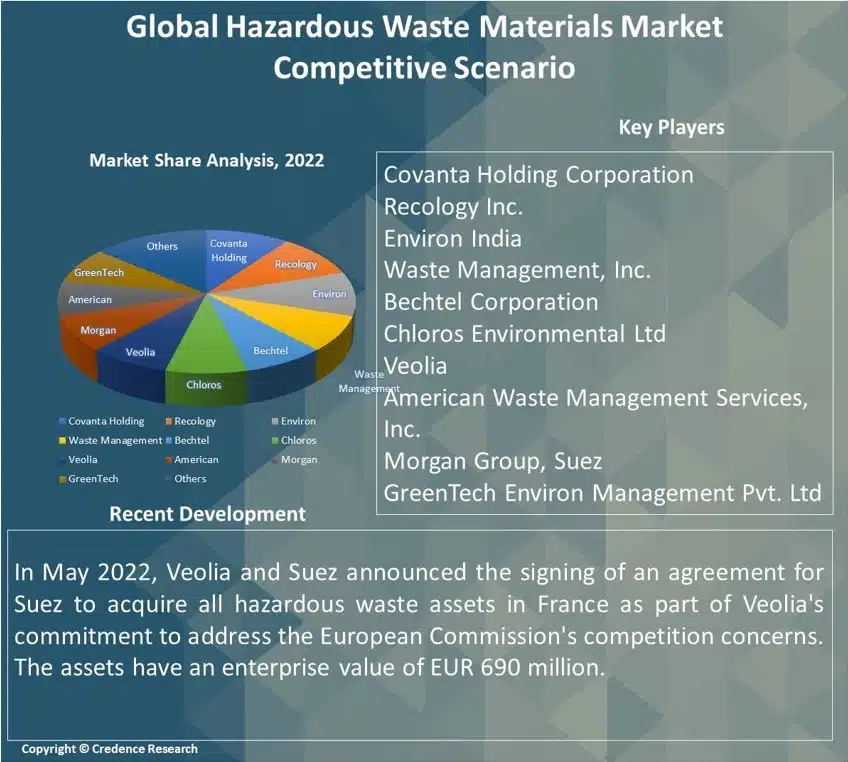
The global Hazardous Waste Materials Market is highly competitive, with several key players. Some of the major players in the market and their market share are as follows:
- Covanta Holding Corporation
- Recology Inc.
- Environ India
- Waste Management, Inc.
- Bechtel Corporation
- Chloros Environmental Ltd
- Veolia
- American Waste Management Services, Inc.
- Morgan Group, Suez
- GreenTech Environ Management Pvt. Ltd
- REMONDIS Medison GmbH
These organizations prioritize product innovation, Hazardous Waste Materials Centers expansion, and mergers and acquisitions to stay competitive.
The global Hazardous Waste Materials Market's key players continually seek to stay ahead by offering new products and developments.
In June 2019, Bechtel Corporation won the contract for self-disposal of the United States' chemical weapons stockpile. As part of the arrangement, over 15,000 mustard munitions would be destroyed at the Blue Grass Chemical Agent-Destruction Pilot Plant in Richmond, Kentucky. Destruction of the nerve agent is anticipated to commence later in 2019.
In March 2021, FCC Environmental Services bought Wastech Services Ltd. to extend its operations in Canada and boost its position in the waste management sector.
In October 2020, Waste Management has purchased Advanced Disposal Services, a solid waste management company. This acquisition enabled Waste Management to provide over 3 million new commercial, residential, and industrial customers with unrivalled access to innovative, sustainable waste management and recycling services, principally in 16 states across the eastern half of the United States.
Summary of Key Findings
- Construction and demolition (C&D) materials are increasingly being used in metropolitan areas as the number of construction projects grows.
- Market segmented by Type of Hazardous Waste, Treatment and Disposal Methods, End-User Industry, Waste Management Services, and region.
- The Healthcare and Pharmaceutical industry is the fastest expanding segment
- Deep-well injection accounted for 34.8% of the market in 2023
- North America is leading market growth; the market is highly competitive with key players including Covanta Holding Corporation, Recology Inc., Environ India, Waste Management, Inc. and Others.
Future Outlook
- Increasing awareness and stringent regulations driving the demand for proper hazardous waste management.
- Technological advancements leading to the development of innovative waste treatment and disposal methods.
- Growing emphasis on sustainability and environmental protection influencing waste management practices.
- Rising demand for specialized waste management services tailored to different industries and waste types.
- Expansion of the market with the presence of both multinational and regional waste management companies.
- Integration of waste-to-energy solutions for sustainable waste management.
How CXOs Can Benefit from the Credence Research Hazardous Waste Materials Market Report
The Credence Research Hazardous Waste Materials Market Report provides CXOs with a comprehensive overview of the market, including:
- Market size and growth forecast: The report provides detailed estimates of the global Hazardous Waste Materials Market size, segmented by Type of Hazardous Waste, Treatment and Disposal Methods, End-User Industry, Waste Management Services, and region. It also includes forecasts for the market through 2032, based on key trends and drivers.
- Market segmentation: The report segments the Hazardous Waste Materials Market by Type of Hazardous Waste, Treatment and Disposal Methods, End-User Industry, Waste Management Services, and region. This segmentation provides CXOs with a granular understanding of the market and the opportunities in each segment.
- Competitive landscape: The report profiles the key players in the Hazardous Waste Materials Market and provides insights into their strategies, product offerings, and financial performance. This information can help CXOs to identify and assess their competition.
- Key trends and drivers: The report identifies and analyzes the key trends and drivers that are shaping the Hazardous Waste Materials Market. This information can help CXOs to make informed decisions about their investments and strategies.
CXOs can use the insights from the Credence Research Hazardous Waste Materials Market Report to:
- Identify growth opportunities: The report can help CXOs to identify new growth opportunities in the Hazardous Waste Materials Market. For example, the report may highlight emerging markets or industries with a high demand for hazardous waste management services.
- Make informed investment decisions: The report can help CXOs to make informed investment decisions about Hazardous Waste Materials. For example, it provide insights into market trends, growth projections, and competitive landscape within the industry.
- Develop competitive strategies: The report can help CXOs to develop competitive strategies for their Hazardous Waste Materials businesses. For example, it offers a deep understanding of market trends, customer preferences, and competitive landscape. CXOs can leverage this information to identify their unique selling points, target specific market segments, and differentiate themselves from competitors.
- Track market developments: The report can help CXOs to track market developments and stay ahead of the curve. For example, the report provides insights into the latest trends and innovations in the Hazardous Waste Materials Market.
Overall, the Credence Research Hazardous Waste Materials Market Report is a valuable resource for CXOs who are looking to gain a deeper understanding of the market and identify opportunities for growth.
Segmentation
By Type of Hazardous Waste:
- Chemical Waste
- Biological Waste
- Radioactive Waste
- E-Waste (Electronic Waste)
- Medical Waste
- Industrial Waste
- Hazardous Construction and Demolition Waste
- Oil and Petroleum-Based Waste
- Hazardous Sludge and Solvents
- Asbestos Waste
- Pesticide Waste
- Others
By Treatment and Disposal Methods:
- Incineration
- Landfilling
- Hazardous Waste Recycling
- Deep Well Injection
- Chemical Stabilization and Solidification
- Biological Treatment
- Thermal Desorption
- Vitrification
- Encapsulation
- Secure Landfills for Hazardous Waste
- Others
By Treatment and Disposal Methods:
- Chemical and Petrochemical Industry
- Healthcare and Pharmaceuticals
- Manufacturing and Industrial Facilities
- Mining and Metallurgical Industries
- Electronics and Electrical Industry
- Construction and Demolition
- Oil and Gas Industry
- Automotive Industry
- Agricultural Sector
- Others
By Waste Management Services:
- Waste Collection and Transportation
- Waste Treatment and Disposal Services
- Hazardous Waste Management Consulting
- Site Remediation Services
- Emergency Response Services
- Waste Recycling Services
- Others
By Region
- North America
- The U.S.
- Canada
- Mexico
- Europe
- Germany
- France
- The U.K.
- Italy
- Spain
- Rest of Europe
- Asia Pacific
- China
- Japan
- India
- South Korea
- South-east Asia
- Rest of Asia Pacific
- Latin America
- Brazil
- Argentina
- Rest of Latin America
- Middle East & Africa
- GCC Countries
- South Africa
- Rest of Middle East and Africa
Request a Free Sample
Fill in your details and we'll send you a free sample report.
- Sample data tables & charts
- Research methodology
Need a Custom Version of This Report?
Tailor the scope, geography, or segments to your exact requirements.
- Custom geography or segment scope
- Direct access to our analyst team
Frequently Asked Questions
What is the current size of the global Hazardous Waste Materials Market?
What is the expected growth rate of the Hazardous Waste Materials Market between 2024 and 2032?
Which segment is leading the market share in terms of Type of Hazardous Waste?
Which Waste Management Services segment governs the demand for Product Mobility?
Who are the major players in the global Hazardous Waste Materials Market?
Table of Content
Chapter 1. Report Introduction
- 1.1 Report Description & Purpose
- 1.1.1 Report Title & Market Definition
- 1.1.2 Unique Selling Propositions (USP) & Key Differentiators
- 1.1.3 Value Proposition for Stakeholders
- 1.2 Research Objectives
- 1.2.1 Market Sizing Objectives (Volume & Revenue) (Volume Where Applicable)
- 1.2.2 Segmentation Objectives
- 1.2.3 Competitive Intelligence Objectives
- 1.2.4 Forecast & Scenario Objectives
- 1.3 Report Scope
- 1.3.1 Hazardous Waste Materials Scope – Segments & Subsegments Covered
- 1.3.2 Geographic Scope – Regions & Countries Covered
- 1.3.3 Historical Period, Base Year & Forecast Period (2023; forecast to 2032)
- 1.3.4 Inclusions & Exclusions
- 1.4 Industry Classification & Applicable Codes
- 1.5 Currency, Measurement Units & Valuation Basis
- 1.6 Target Stakeholders
- 1.7 Limitations & Assumptions
Chapter 2. Executive Summary
- 2.1 Global Hazardous Waste Materials Market Snapshot
- 2.1.1 Market Size – Historical (2023) & Forecast (2023-2032) (2023: USD 14845.5 Million → 2032: USD 24,242.0 Million)
- 2.1.2 Volume & Revenue – Global Totals (Volume Where Applicable)
- 2.1.3 Key Market Highlights – Top Five Facts
- 2.2 Hazardous Waste Materials Market Segmentation Snapshot
- 2.2.1 Market Split by Region – 2023 vs. 2032
- 2.3 Competitive Snapshot
- 2.3.1 Top 10 Players by Revenue Share – 2023
- 2.3.2 Top 10 Players by Volume Share – 2023 (Volume Where Applicable)
- 2.3.3 Recent Strategic Developments (18-Month Summary)
- 2.4 Key Investment Highlights & Strategic Conclusions
Chapter 3. Hazardous Waste Materials Market Dynamics & Industry Analysis
- 3.1 Market Overview & Context
- 3.1.1 Hazardous Waste Materials Market Position in the Broader Industry Value Chain
- 3.1.2 Demand Structure & Purchasing Dynamics
- 3.1.3 Market Maturity & Development Stage by Region
- 3.2 Hazardous Waste Materials Market Drivers
- 3.3 Hazardous Waste Materials Market Restraints & Challenges
- 3.4 Hazardous Waste Materials Market Opportunities
- 3.5 Porter's Five Forces Analysis
- 3.5.1 Threat of New Entrants
- 3.5.2 Bargaining Power of Suppliers
- 3.5.3 Bargaining Power of Buyers
- 3.5.4 Threat of Substitutes
- 3.5.5 Competitive Rivalry – Intensity Assessment
- 3.6 Hazardous Waste Materials Value Chain Analysis
- 3.6.1 Upstream – Key Inputs, Resources & Suppliers
- 3.6.1.1 Key Input/Resource 1
- 3.6.1.2 Key Input/Resource 2
- 3.6.1.3 Key Input/Resource 3
- 3.6.2 Midstream – Core Operations & Value Creation
- 3.6.2.1 Operating Model & Process Overview
- 3.6.2.2 Key Operating Locations & Capabilities by Company
- 3.6.3 Downstream – Market Channels & End Users
- 3.6.3.1 Direct Sales & Customer Engagement Channels
- 3.6.3.2 Indirect Sales, Intermediaries & Partner Channels
- 3.6.4 Value Chain Profitability Analysis
- 3.6.1 Upstream – Key Inputs, Resources & Suppliers
- 3.7 PESTEL Analysis
- 3.7.1 Political Factors
- 3.7.2 Economic Factors
- 3.7.3 Social Factors
- 3.7.4 Technological Factors
- 3.7.5 Environmental Factors
- 3.7.6 Legal Factors
- 3.8 Hazardous Waste Materials Supply Chain Analysis
- 3.8.1 Critical Input & Resource Availability Risk Assessment
- 3.8.2 Supplier & Operational Concentration Risk (Geographic Exposure)
- 3.8.3 Supply & Service Disruption Impact Analysis
- 3.9 Regulatory & Policy Landscape
Note: The regulatory and policy landscape section covers regulations based on their applicability to the market, Hazardous Waste Materials category, geography, and scope of the study. Only regulatory frameworks with a material impact on operations, compliance, trade, sustainability, or market access are analyzed in detail.
Chapter 4. Key Investment Pockets & Opportunity Analysis
- 4.1 Hazardous Waste Materials Market Attractiveness Analysis
- 4.1.1 By Region – Investment Attractiveness Matrix (Market Size × CAGR)
- 4.2 Absolute Revenue Growth Opportunity
- 4.2.1 By Region – Absolute Revenue Growth Through 2032
- 4.3 Incremental Demand Opportunity
- 4.3.1 By Region – Incremental Demand Through 2032
- 4.3.2 Segment – Incremental Demand
- 4.4 Emerging Submarket Opportunity Deep Dive (Subject to Applicability)
- 4.5 Priority Market Opportunity Scorecards
- 4.5.1 United States
- 4.5.2 Europe
- 4.5.3 Asia
- 4.5.4 Middle East & Africa
Note: Priority market opportunity scorecards reflect the geographic scope and strategic relevance of the study. Listed markets are indicative and may be adapted to the industry.
Chapter 5. Hazardous Waste Materials Cross-Border Trade & Market Access Analysis
- 5.1 International Trade & Cross-Border Activity Overview
- 5.1.1 Global Export Value by Country (2023)
- 5.1.2 Global Export Volume by Country (2023) (Volume Where Applicable)
- 5.1.3 Global Import Value by Country (2023)
- 5.1.4 Global Import Volume by Country (2023) (Volume Where Applicable)
- 5.1.5 Net Trade Balance by Country (2023)
- 5.2 Export Analysis – Segment
- 5.2.1 Category 1 (Applicable Classification Code)
- 5.2.2 Category 2 (Applicable Classification Code)
- 5.2.3 Category 3 (Applicable Classification Code)
- 5.2.4 Category 4 (Applicable Classification Code)
- 5.2.5 Category 5 (Applicable Classification Code)
- 5.3 Import Analysis – Segment
- 5.3.1 Category 1 (Applicable Classification Code)
- 5.3.2 Category 2 (Applicable Classification Code)
- 5.3.3 Category 3 (Applicable Classification Code)
- 5.3.4 Category 4 (Applicable Classification Code)
- 5.3.5 Category 5 (Applicable Classification Code)
- 5.4 Cross-Border Pricing & Transaction Benchmarks
- 5.4.1 Export Pricing – Segment & Country
- 5.4.2 Import Pricing – Segment & Source Country
- 5.4.3 Price Trends (2023)
- 5.5 Key Cross-Border Trade & Delivery Routes
- 5.5.1 Cross-Border Trade/Delivery Route 1
- 5.5.2 Cross-Border Trade/Delivery Route 2
- 5.5.3 Cross-Border Trade/Delivery Route 3
- 5.5.4 Cross-Border Trade/Delivery Route 4
- 5.5.5 Cross-Border Trade/Delivery Route 5
- 5.6 Trade Policy & Market Access Impact Assessment
- 5.6.1 Tariff & Non-Tariff Barriers
- 5.6.2 Regional Trade & Economic Integration Frameworks
- 5.6.3 Bilateral & Multilateral Trade Agreements
- 5.6.4 Cross-Border Operating, Licensing & Localization Requirements
Note: This chapter applies where cross-border trade or delivery is relevant to Hazardous Waste Materials. Goods, services, and digital offerings are assessed using applicable classifications and transaction measures. Import-export volumes, trade balances, and route analyses are included only where meaningful to the market.
Chapter 6. Competitive Landscape & Company Benchmarking
- 6.1 Hazardous Waste Materials Market Concentration & Structure
- 6.1.1 Herfindahl-Hirschman Index (HHI) – vs. 2023
- 6.1.2 Leading, Mid-Sized & Emerging Player Structure
- 6.1.3 Global, Regional & Local Player Dynamics
- 6.2 Hazardous Waste Materials Market Share Analysis – 2023
- 6.2.1 Global Revenue Share by Company
- 6.2.2 Global Volume Share by Company (Volume Where Applicable)
- 6.2.3 Regional Revenue Share
- 6.2.4 Market Share Evolution ( vs. 2023)
- 6.2.5 Company Market Share by Key Segment
- 6.2.6 Company Market Share by Customer Group
- 6.3 Operating Scale, Capacity & Infrastructure Analysis
- 6.3.1 Global Operating Scale & Supply Capacity
- 6.3.2 Resource Utilization & Operating Efficiency
- 6.3.3 Output, Service Delivery & Activity Metrics
- 6.3.4 Operating Footprint & Infrastructure Map
- 6.3.5 Planned Operational & Capacity Expansion
- 6.4 Hazardous Waste Materials Competitive Benchmarking Matrix
- 6.4.1 Revenue, Growth, Profitability & Operating Metric Comparison
- 6.4.2 Channel Revenue Mix
- 6.4.3 Geographic Revenue Exposure
- 6.4.4 R&D Intensity
- 6.4.5 Sustainability Maturity
- 6.5 Strategic Developments in Hazardous Waste Materials (Last 24 Months)
- 6.5.1 Mergers, Acquisitions & Divestments
- 6.5.2 New Products, Services & Solutions in Hazardous Waste Materials
- 6.5.3 Operational & Infrastructure Expansions
- 6.5.4 Strategic Alliances, Joint Ventures & Partnerships
- 6.5.5 Distribution Expansion & Market Entry
- 6.5.6 Sustainability & ESG Initiatives
- 6.6 Competitive Strategy Mapping
- 6.6.1 Leader, Challenger, Follower & Niche Classification
- 6.6.2 Pricing Strategy Comparison
- 6.6.3 Channel Strategy Matrix
Note: Strategic developments are included based on their materiality and the availability of reliable information.
Chapter 7. Global Hazardous Waste Materials Market – By Sales & Delivery Channel
- 7.1 Segment Overview
- 7.1.1 Volume & Revenue Split by Channel (2023 & 2032) (Volume Where Applicable)
- 7.1.2 Channel Mix Evolution (2023-2032)
Chapter 8. Regional Market Analysis – Global Overview
- 8.1 Global Regional Overview
- 8.1.1 Regional Volume Share (Volume Where Applicable)
- 8.1.2 Regional Revenue Share
- 8.1.3 Regional Volume by Region (Volume Where Applicable)
- 8.1.4 Regional Revenue by Region
- 8.1.5 Regional Forecast Through 2032
- 8.2 Cross-Regional Segment Analysis
- 8.2.1 By Sales & Delivery Channel
- 8.2.2 By Competitive Positioning & Price Tier
Chapter 9. North America Hazardous Waste Materials Market
- 9.1 United States
- 9.2 Canada
- 9.3 Mexico
Chapter 10. Europe Hazardous Waste Materials Market
- 10.1 Germany
- 10.2 France
- 10.3 Italy
- 10.4 United Kingdom
- 10.5 Spain
- 10.6 Poland
- 10.7 Russia
- 10.8 Netherlands
- 10.9 Belgium
- 10.10 Sweden
- 10.11 Denmark
- 10.12 Norway
- 10.13 Rest of Europe
Chapter 11. Asia Pacific Hazardous Waste Materials Market
- 11.1 China
- 11.2 India
- 11.3 Japan
- 11.4 South Korea
- 11.5 Thailand
- 11.6 Indonesia
- 11.7 Vietnam
- 11.8 Malaysia
- 11.9 Australia
- 11.10 Rest of Asia Pacific
Chapter 12. Latin America Hazardous Waste Materials Market
- 12.1 Brazil
- 12.2 Argentina
- 12.3 Colombia
- 12.4 Chile
- 12.5 Rest of Latin America
Chapter 13. Middle East Hazardous Waste Materials Market
- 13.1 Saudi Arabia
- 13.2 United Arab Emirates
- 13.3 Turkey
- 13.4 Israel
- 13.5 Iran
- 13.6 Rest of the Middle East
Chapter 14. Africa Hazardous Waste Materials Market
- 14.1 South Africa
- 14.2 Egypt
- 14.3 Nigeria
- 14.4 Morocco
- 14.5 Rest of Africa
Chapter 15. Hazardous Waste Materials Company Profiles
- 15.1 [Company 01]
- 15.1.1 Company Overview
- 15.1.2 Key Management Personnel
- 15.1.3 Products & Services Portfolio
- 15.1.4 Financial Performance
- 15.1.5 Key Market Focus & Geographic Presence
- 15.1.6 Recent Developments & Strategic Initiatives
Note: The company profile list is preliminary and may change based on research findings, market developments, data availability, and client requirements.
Chapter 16. Appendices
- Appendix A – List of Abbreviations & Acronyms
- Appendix B – Industry Classification Code Reference – Full Series
- Appendix C – Supply, Output & Operating Capacity Data Tables
- Appendix D – End-Use & Demand Base Tables
- Appendix E – Demand, Adoption & Usage Assumptions
- Appendix F – Pricing & Revenue Metric Reference Tables
- Appendix G – Company Operations & Infrastructure Database
- Appendix H – Cross-Border Trade & Activity Data Tables (Where Applicable)
- Appendix I – Regulatory Summary Tables
- Appendix J – Primary Research Participant List (Anonymized)
- Appendix K – Primary Research Questionnaire Framework
- Appendix L – Data Sources & Bibliography
- Appendix M – Market Size Divergence & Source Comparison
Chapter 17. Research Methodology
- 17.1 Research Framework & Philosophy
- 17.2 Secondary Research – Sources, Hierarchy & Data Extraction
- 17.3 Data Modeling – Bottom-Up & Top-Down Market Sizing
- 17.4 Primary Research – Stakeholder Framework, LOI & Sample Sizes
- 17.5 Forecast Methodology – Regression, Scenario & Sensitivity Analysis
- 17.6 Quality Control – Four-Layer Validation Framework
- 17.7 Limitations & Standard Assumptions
- 17.8 Disclaimer
