
| REPORT ATTRIBUTE | DETAILS |
|---|---|
| Historical Period | 2019-2022 |
| Base Year | 2023 |
| Forecast Period | 2024-2032 |
| Hematoxylin Market Size 2023 | USD 12,542.2 Million |
| Hematoxylin Market, CAGR | 8.50% |
| Hematoxylin Market Size 2032 | USD 26,136.1 Million |
Market Insights
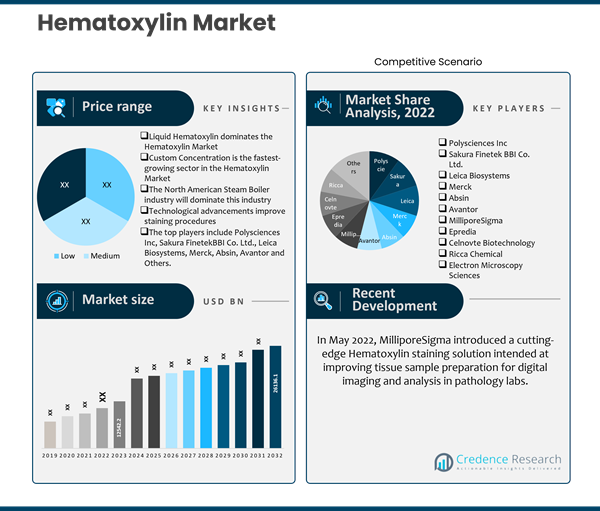
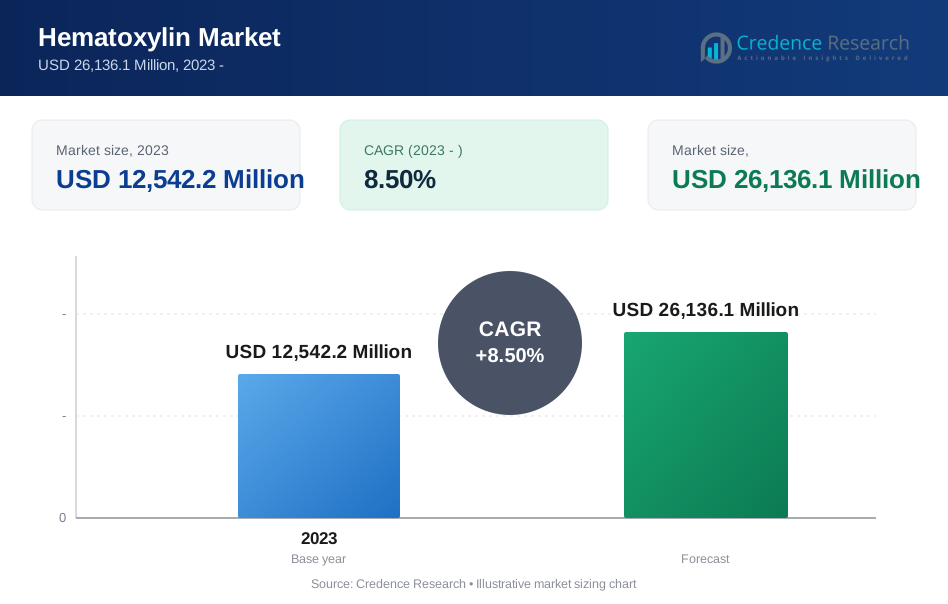
- The global demand for Hematoxylin was valued at USD 12,542.2 Million in 2023 and is expected to reach USD 26,136.1 Million in 2032, growing at a CAGR of 8.50% between 2024 and 2032.
- Synthetic Hematoxylin frequently holds the largest market share in the Hematoxylin Market, although Natural Hematoxylin remains a prominent market sector.
- Liquid Hematoxylin dominates the Hematoxylin Market, whereas Powder Hematoxylin has a large market share.
- Custom Concentration is the fastest-growing sector in the Hematoxylin Market; another major market category is Standard Concentration.
- Immunohistochemistry (IHC) is another particularly demanding category, and Histology and pathology also have a significant market share in the Hematoxylin Market. However, Special Staining typically holds the largest market share.
- Pharmaceutical companies often have the highest compound annual growth rate (CAGR) in the Hematoxylin Market, while Research Institutions are another attractive market sector for hematoxylin.
- Increasing demand for histological staining products propels market expansion.
- Regulatory challenges and compliance issues impede industry growth.
Executive Summary
Market Definition
The Hematoxylin Market is the market for the manufacture, distribution, and sale of hematoxylin, a natural dye used in histology and microscopy for blue staining of cell nuclei. It is thus a crucial factor in pathology and research since it aids in the viewing of tissues under a microscope and subsequent investigations. As a result, these hematoxylin market items supply manufacturers, distributors, and end users in industries such as healthcare, research, and education along the value chain.
Market Overview
The global Hematoxylin market has witnessed steady growth in recent years and is expected to grow at a CAGR of 8.50% between 2024 and 2032. The market was valued at USD 12,542.2 million in 2023 and is expected to reach USD 26,136.1 million in 2032.
The Hematoxylin Market is expanding steadily, driven by rising demand for histology and research applications that require cell staining for microscopic investigation. Key drivers include the rising frequency of chronic diseases, which necessitate enhanced diagnostic procedures increasing demand for hematoxylin in pathology labs and research centers. Furthermore, the rising pharmaceutical and biotechnology sectors drive market expansion because they demand hematoxylin for medication development and research. However, the market confronts constraints such as regulatory hurdles related to the safe handling and disposal of hematoxylin due to its chemical qualities, which might impede market expansion. Variations in raw material costs might also present difficulties for market participants. Despite these constraints, the Hematoxylin Market is predicted to expand due to an increased focus on healthcare and research developments.
Segmentation by Type of Hematoxylin
- Synthetic Hematoxylin often has the highest market share in the Hematoxylin Market due to its low cost, consistency, and convenience of use.
- Natural Hematoxylin remains a strong market sector, recognized for its classic appeal, natural sourcing, and use in areas where natural goods are sought.
Segmentation by Formulations
- Liquid Hematoxylin dominates the Hematoxylin Market due to its convenience, ease of use, and extensive applicability in various staining processes.
- Powder Hematoxylin commands a sizable market share, particularly in situations where staining solutions must be customized or where specific staining techniques prefer powdered formulations for more control over concentration and staining intensity.
Segmentation by Concentration
- Custom Concentration is the fastest-growing sector in the Hematoxylin Market, owing to rising demand for personalized staining solutions tailored to specific research requirements.
- Another prominent market category is the Standard Concentration, which is still commonly used for routine staining processes and provides a handy, ready-to-use choice for many labs and research centers.
Segmentation by Application
- Special Staining normally holds the greatest market share in the Hematoxylin Market because of its extensive use in various staining procedures and research areas.
- Immunohistochemistry (IHC) is another extremely demanding segment, noted for its specificity and sensitivity in detecting antigens in tissue samples, making it critical in diagnostic and research settings.
- Histology and pathology also have a considerable market share since they are fundamental disciplines in the study of tissues and illnesses. This drives demand for histological staining reagents such as Hematoxylin.
Segmentation by End User
- Pharmaceutical companies usually have the greatest compound annual growth rate (CAGR) in the Hematoxylin Market. This is because pharmaceutical businesses widely use histological staining products such as Hematoxylin in medication development, quality control, and research procedures, resulting in strong demand and market growth.
- Research Institutions are another popular market sector for hematoxylin. Histological staining materials are in high demand among research institutions for a variety of projects, investigations, and tests.
Segmentation by Region
- The North American Steam Boiler market will dominate this market
- The Asia-Pacific Steam Boiler Market will expand quickly between 2023 and 2032.
- The rest of the world, including Latin America, the Middle East, and Africa, supplies the remaining demand for Hematoxylin.
North America is the leading segment in the Hematoxylin Market due to a variety of factors. The region is home to a large number of pharmaceutical enterprises, research organizations, clinical laboratories, and educational institutions that use histological staining products such as Hematoxylin. North America is also noted for its excellent healthcare infrastructure, research facilities, and technology breakthroughs, all of which contribute to the region's demand for high-quality staining products. North America's dominant position in the Hematoxylin Market is due to the presence of important market players, research and development activities, and a high level of healthcare expenditure.
Moreover, the Asia-Pacific Steam Boiler Market will grow rapidly between 2023 and 2032. The region is seeing a major growth in healthcare infrastructure construction, more investment in research and development activities, and a greater emphasis on enhancing healthcare services. Furthermore, the rising prevalence of chronic diseases, expanding pharmaceutical industries, and rising demand for new medical technologies in Asia Pacific countries are propelling the Hematoxylin Market forward. The presence of a huge population base, improved healthcare standards, and more awareness regarding histological staining products such as Hematoxylin are all contributing to the Asia Pacific market's rapid expansion.
Key Highlights of the Report
The global Hematoxylin market is segmented by Type of Hematoxylin, Formulation, Concentration, Application, End User, and region. Special Staining typically retains the largest market share in the Hematoxylin Market, while Liquid Hematoxylin leads the market. Furthermore, Custom Concentration is the fastest-growing sector in the Hematoxylin Market, with pharmaceutical companies often experiencing the highest compound annual growth rate (CAGR). Additionally, immunohistochemistry (IHC) is another exceedingly tough category, with North America leading the market growth.
The Hematoxylin Market is largely driven by rising demand for histology and research applications, as well as expansion in the pharmaceutical and biotechnology sectors and an increase in chronic illness prevalence. On the other hand, the market faces obstacles such as regulatory difficulties in handling and disposal, changes in raw material prices, and low awareness and adoption in some countries. Despite these constraints, the market has possibilities to leverage on technological developments in staining techniques, expand into emerging regions, and develop eco-friendly and sustainable staining solutions to promote industry growth and innovation.
Nonetheless, North America is the dominant segment in the Hematoxylin Market for a multitude of reasons. The region is home to numerous pharmaceutical companies, research organizations, clinical laboratories, and educational institutions that use histological staining products like Hematoxylin. North America is the dominant segment in the Hematoxylin Market for a multitude of reasons. The region is home to numerous pharmaceutical companies, research organizations, clinical laboratories, and educational institutions that use histological staining products like Hematoxylin.
What Are The Main Drivers Of The Global Hematoxylin Market?
The Hematoxylin Market is largely driven by rising demand for histology and research applications, as well as expansion in the pharmaceutical and biotechnology sectors and an increase in chronic illness prevalence.
What Are The Major Challenges Faced By The Global Hematoxylin Market?
The market faces obstacles such as regulatory difficulties in handling and disposal, changes in raw material prices, and low awareness and adoption in some countries.
What Are The Growth Opportunities In The Global Hematoxylin Market?
Despite these constraints, the market has the possibility to leverage technological developments in staining techniques, expand into emerging regions, and develop eco-friendly and sustainable staining solutions to promote industry growth and innovation.
Market Drivers
Growing Demand for Histological Staining Products
The rising demand for histological staining products will power the growth of the hematoxylin market. Histology staining is an important technology applied in pathology, pharmaceuticals, and research to visualize cellular structure, which aids diagnosis and research studies. Hematoxylin is tremendously applied as a histological stain, so there is a huge demand for it due to its good cell nucleus-staining ability and cellular differentiation. Quality staining products like Hematoxylin are making big demands in the market, with a growing need for accurate and detailed histological analysis in clinical diagnostics, drug development, and research applications. As demand continues to increase, this factor is still pushing the Hematoxylin Market forward, hence opening opportunities for market extension and innovation.
Market Restraints
Regulatory Challenges and Compliance Issues
The regulatory challenges and compliance issues are a major constraint to the growth of the Hematoxylin market. Histological staining products like Hematoxylin are subjected to tight regulations and standards that help assure the products' safety, efficiency, and uniformity. It is a very complex and time-consuming process for manufacturers to get satisfaction from these requirements due to delays in the approval and launch of their products into the market. Moreover, the frequently changing regulations, compliance requirements, and extended documentation and testing may become burdensome for new product launches or geographical expansion by the market operators. These suppressed factors related to regulations are likely to negatively impact market growth, lower innovation, and increase the cost of operations for companies operating in the Hematoxylin Market.
Opportunities
Increasing Adoption of Digital Pathology Solutions
The increasing adoption of digital pathology solutions across countries bodes well for growth in the hematoxylin industry. Digital pathology is the digitization of histology slides enabling remote viewing, analysis, and storing of high-resolution pictures. The involvement of hematoxylin in the staining of tissue samples is critical for digital imaging and analysis. Digital pathology systems, which include embedded AI algorithms, can automate image processing for diagnosis while improving workflow efficiencies in pathology labs and research contexts. This type of technology benefits pathologists by improving teamwork, increasing diagnostic accuracy, and providing some data-driven views. With an increase in international demand, the Digital Pathology sector embraces the expansion potential of goods and their careful adaptation to digital imaging needs, hence leading to increased growth and innovation in the Hematoxylin Market for histological staining.
Competitive Landscape
Key Players
The global Hematoxylin market is highly competitive, with several key players. Some of the major players in the market and their market share are as follows:
- Polysciences Inc
- Sakura FinetekBBI Co. Ltd.
- Leica Biosystems
- Merck
- Absin
- Avantor
- MilliporeSigma
- Epredia
- Celnovte Biotechnology
- Ricca Chemical
- Electron Microscopy Sciences
- Abbey Color
- Beyotime
- Shanghai Mlbio Co.Ltd.
- Beijing Solarbio Science & Technology Co.Ltd.
These organizations prioritize product innovation, distribution channel expansion, and mergers and acquisitions to stay competitive.
The global Hematoxylin market's key players continually seek to stay ahead by offering new products and developments.
In November 2023, Leica Biosystems announced the release of a new Hematoxylin staining kit with improved performance for digital pathology.
In June 2024, Merck announced a new Hematoxylin product line that aims to increase staining quality and uniformity in histological analysis.
How are Companies Performing in the Hematoxylin Market?
The hematoxylin market is thriving, with both established and emerging businesses. Basin firms have recently emphasized on advances in staining techniques and sustainability practices. In the pursuit of sustainability, there should be a gradual reduction in carbon emissions from the production and disposal of ecologically friendly staining treatments. Startups digitize and boost the competitiveness of the histological staining business. The bottom line is that hematoxylin market firms are deeply committed to better sustainability, technical innovation, and overall value proposition enhancement.
Summary of Key Findings
- Increasing adoption of digital pathology solutions is the market opportunity.
- Market segmented by Type of Hematoxylin, Formulations, Concentration, Application, End User, and region.
- Synthetic Hematoxylin frequently has the biggest market share in the Hematoxylin Market
- Liquid Hematoxylin dominates the Hematoxylin Market.
- North America is leading market growth; the market is highly competitive with key players including Polysciences Inc, Sakura FinetekBBI Co. Ltd., Leica Biosystems, Merck, Absin, Avantor and Others.
Future Outlook
- Continued growth is being fueled by advances in healthcare and science.
- Technological advancements improve staining procedures.
- Growth into untapped markets.
- Concentrate on environmentally friendly and long-lasting staining solutions.
- Increased collaboration among industry participants on research and development.
- Regulatory developments for safe handling and disposal.
How CXOs Can Benefit from the Credence Research Hematoxylin Market Report
The Credence Research Hematoxylin Market Report provides CXOs with a comprehensive overview of the market, including:
- Market size and growth forecast:The report provides detailed estimates of the global Hematoxylin market size, segmented by Type of Hematoxylin, Formulation, Concentration, Application, End User, and region. It also includes forecasts for the market through 2032 based on key trends and drivers.
- Market segmentation:The report segments the Hematoxylin market by Type of Hematoxylin, Formulation, Concentration, Application, End User, and region. This segmentation provides CXOs with a granular understanding of the market and the opportunities in each segment.
- Competitive landscape:The report profiles the key players in the Hematoxylin market and provides insights into their strategies, product offerings, and financial performance. This information can help CXOs to identify and assess their competition.
- Key trends and drivers:The report identifies and analyzes the key trends and drivers that are shaping the Hematoxylin market. This information can help CXOs to make informed decisions about their investments and strategies.
CXOs can use the insights from the Credence Research Hematoxylin Market Report to:
- Identify growth opportunities:The report can help CXOs identify new growth opportunities in the Hematoxylin market. For example, by highlighting trends such as the increasing adoption of digital pathology solutions.
- Make informed investment decisions:The report can help CXOs to make informed investment decisions about Hematoxylin. For example, by understanding the growing demand for histological staining products like Hematoxylin and the potential impact of regulatory challenges on market growth.
- Develop competitive strategies:The report can help CXOs develop competitive strategies for their Hematoxylin businesses. For example, By analyzing market dynamics, competitor activities, and customer preferences, CXOs can gain valuable insights to differentiate their offerings in the market.
- Track market developments:The report can help CXOs to track market developments and stay ahead of the curve. For example, the report provides insights into the latest trends and innovations in the Hematoxylin market.
Overall, the Credence Research Hematoxylin Market Report is a valuable resource for CXOs who are looking to gain a deeper understanding of the market and identify opportunities for growth.
Segmentation
-
By Type of Hematoxylin:
- Natural Hematoxylin
- Synthetic Hematoxylin
-
By Formulation:
- Powder Hematoxylin
- Liquid Hematoxylin
-
By Concentration:
- Standard Concentration
- Custom Concentration
-
By Application:
- Histology and Pathology
- Microscopy
- Cytology
- Special Staining
- Immunohistochemistry (IHC)
-
By End User:
- Clinical Laboratories
- Research Institutions
- Pharmaceutical Companies
- Veterinary Clinics
- Educational Institutions
-
By Region
- North America
- US
- Canada
- Mexico
- Europe
- Germany
- France
- UK
- Italy
- Spain
- Rest of Europe
- Asia Pacific
- China
- Japan
- India
- South Korea
- South-east Asia
- Rest of Asia Pacific
- Latin America
- Brazil
- Argentina
- Rest of Latin America
- Middle East & Africa
- GCC Countries
- South Africa
- Rest of Middle East and Africa
- North America
Adjacent Markets
In the Hematoxylin market, several adjacent markets have high revenue growth opportunities. The key adjacent markets for Hematoxylin market -
Adjacent Markets |
||
| Eosin Market | Papanicolaou Stain Market | Toluidine Blue Market |
| Wright Stain Market | Masson's Trichrome Market | Safranin Market |
| Giemsa Stain Market | Periodic Acid-Schiff (PAS) Stain Market | Crystal Violet Market |
Request a Free Sample
Fill in your details and we'll send you a free sample report.
- Sample data tables & charts
- Research methodology
Need a Custom Version of This Report?
Tailor the scope, geography, or segments to your exact requirements.
- Custom geography or segment scope
- Direct access to our analyst team
Frequently Asked Questions
What is the current size of the global Hematoxylin market?
What is the expected growth rate of the Hematoxylin market between 2024 and 2032?
Which segment is leading the market share in terms of Type of Hematoxylin?
Which Application segment governs the demand for Hematoxylins in the world?
Which End User segment is expected to post the highest CAGR during the forecast period?
Which region is fueling the growth of the Hematoxylin industry?
Who are the major players in the global Hematoxylin market?
What are the major market drivers of the Hematoxylin industry?
What are the major market restraints of the Hematoxylin industry?
What are the major market opportunities of the Hematoxylin industry?
Table of Content
Chapter 1. Report Introduction
- 1.1 Report Description & Purpose
- 1.1.1 Report Title & Market Definition
- 1.1.2 Unique Selling Propositions (USP) & Key Differentiators
- 1.1.3 Value Proposition for Stakeholders
- 1.2 Research Objectives
- 1.2.1 Market Sizing Objectives (Volume & Revenue)
- 1.2.2 Segmentation Objectives
- 1.2.3 Competitive Intelligence Objectives
- 1.2.4 Forecast & Scenario Objectives
- 1.3 Report Scope
- 1.3.1 Hematoxylin Scope – Types & Subtypes Covered
- 1.3.2 Geographic Scope – Regions & Countries Covered
- 1.3.3 Historical Period, Base Year & Forecast Period (2023; forecast to the forecast period)
- 1.3.4 Inclusions & Exclusions
- 1.4 HS Code & Classification Framework
- 1.5 Currency, Units & Pricing Basis
- 1.6 Target Stakeholders
- 1.7 Limitations & Assumptions
Chapter 2. Executive Summary
- 2.1 Global Hematoxylin Market Snapshot
- 2.1.1 Market Size – Historical (2023) & Forecast (the forecast period) (2023: USD 12,542.2 Million → forecast year: USD 26,136.1 Million)
- 2.1.2 Volume & Revenue – Global Totals
- 2.1.3 Key Market Highlights – Top Five Facts
- 2.2 Hematoxylin Market Segmentation Snapshot
- 2.2.1 Market Split by Region – 2023 vs.
- 2.3 Competitive Snapshot
- 2.3.1 Top 10 Players by Revenue Share – 2023
- 2.3.2 Top 10 Players by Volume Share – 2023
- 2.3.3 Recent Strategic Developments (18-Month Summary)
- 2.4 Key Investment Highlights & Strategic Conclusions
Chapter 3. Hematoxylin Market Dynamics & Industry Analysis
- 3.1 Market Overview & Context
- 3.1.1 Hematoxylin Market Position in the Broader Automotive Value Chain
- 3.1.2 OEM vs. Replacement Market Dynamics
- 3.1.3 Market Maturity & Development Stage by Region
- 3.2 Hematoxylin Market Drivers
- 3.3 Hematoxylin Market Restraints & Challenges
- 3.4 Hematoxylin Market Opportunities
- 3.5 Porter's Five Forces Analysis
- 3.5.1 Threat of New Entrants
- 3.5.2 Bargaining Power of Suppliers
- 3.5.3 Bargaining Power of Buyers
- 3.5.4 Threat of Substitutes
- 3.5.5 Competitive Rivalry – Intensity Assessment
- 3.6 Hematoxylin Value Chain Analysis
- 3.6.1 Upstream – Raw Material/Input Suppliers
- 3.6.1.1 Raw Material/Input 1
- 3.6.1.2 Raw Material/Input 2
- 3.6.1.3 Raw Material/Input 3
- 3.6.2 Midstream – Production/Manufacturing/Service Delivery
- 3.6.2.1 Production/Process Overview
- 3.6.2.2 Key Facility Locations & Capacity by Manufacturer
- 3.6.3 Downstream – Distribution & End Consumer
- 3.6.3.1 Primary Channel – B2B/OEM
- 3.6.3.2 Secondary Channels – Dealer, Retail, Online, Direct
- 3.6.4 Value Chain Profitability Analysis
- 3.6.1 Upstream – Raw Material/Input Suppliers
- 3.7 PESTEL Analysis
- 3.7.1 Political Factors
- 3.7.2 Economic Factors
- 3.7.3 Social Factors
- 3.7.4 Technological Factors
- 3.7.5 Environmental Factors
- 3.7.6 Legal Factors
- 3.8 Hematoxylin Supply Chain Analysis
- 3.8.1 Raw Material/Input Supply Risk Assessment
- 3.8.2 Manufacturing Concentration Risk (Geographic Exposure)
- 3.8.3 Trade Disruption Impact Analysis
- 3.9 Regulatory & Policy Landscape
Note: The regulatory and policy landscape section covers regulations based on their applicability to the market, Hematoxylin category, geography, and scope of the study. Only regulatory frameworks with a material impact on operations, compliance, trade, sustainability, or market access are analyzed in detail.
Chapter 4. Key Investment Pockets & Opportunity Analysis
- 4.1 Hematoxylin Market Attractiveness Analysis
- 4.1.1 By Region – Investment Attractiveness Matrix (Volume × CAGR)
- 4.2 Absolute Revenue Growth Opportunity
- 4.2.1 By Region – Absolute USD Growth Through the forecast period
- 4.3 Incremental Volume Opportunity
- 4.3.1 By Region – Incremental Volume Through the forecast period
- 4.3.2 Segment – Incremental Volume
- 4.4 Emerging Submarket Opportunity Deep Dive (Subject to Applicability)
- 4.5 Emerging Market Opportunity Scorecards
- 4.5.1 United States
- 4.5.2 Europe
- 4.5.3 Asia
- 4.5.4 Middle East & Africa
Note: Emerging Market Opportunity Scorecards will be included based on relevance and strategic importance. Regions listed are indicative and may vary depending on data availability and market dynamics.
Chapter 5. Hematoxylin Import-Export Analysis & Trade Flows
- 5.1 Global Trade Overview
- 5.1.1 Global Export Value by Country (2023)
- 5.1.2 Global Export Volume by Country (2023)
- 5.1.3 Global Import Value by Country (2023)
- 5.1.4 Global Import Volume by Country (2023)
- 5.1.5 Net Trade Balance by Country (2023)
- 5.2 Export Analysis – Segment
- 5.2.1 Type 1 (HS Code)
- 5.2.2 Type 2 (HS Code)
- 5.2.3 Type 3 (HS Code)
- 5.2.4 Type 4 (HS Code)
- 5.2.5 Type 5 (HS Code)
- 5.3 Import Analysis – Segment
- 5.3.1 Type 1 (HS Code)
- 5.3.2 Type 2 (HS Code)
- 5.3.3 Type 3 (HS Code)
- 5.3.4 Type 4 (HS Code)
- 5.3.5 Type 5 (HS Code)
- 5.4 Average Unit Trade Prices
- 5.4.1 Average Export Price – Segment & Country
- 5.4.2 Average Import Price – Segment & Source Country
- 5.4.3 Price Trends (2023)
- 5.5 Key Trade Route Analysis
- 5.5.1 Trade Route 1
- 5.5.2 Trade Route 2
- 5.5.3 Trade Route 3
- 5.5.4 Trade Route 4
- 5.5.5 Trade Route 5
- 5.6 Trade Policy Impact Assessment
- 5.6.1 US Anti-Dumping & Section 301 Tariffs
- 5.6.2 EU Customs Union Impact
- 5.6.3 Major Free Trade Agreements
- 5.6.4 USMCA Rules of Origin
Note: Trade policy analysis will be included only where relevant to the Hematoxylin market.
Chapter 6. Competitive Landscape & Company Benchmarking
- 6.1 Hematoxylin Market Concentration & Structure
- 6.1.1 Herfindahl-Hirschman Index (HHI) – vs. 2023
- 6.1.2 Tier 1, Tier 2 & Tier 3 Market Structure
- 6.1.3 Global, Regional & Local Player Dynamics
- 6.2 Hematoxylin Market Share Analysis – 2023
- 6.2.1 Global Revenue Share by Company
- 6.2.2 Global Volume Share by Company
- 6.2.3 Regional Revenue Share
- 6.2.4 Market Share Evolution ( vs. 2023)
- 6.2.5 OEM Segment Share by Company
- 6.2.6 Replacement Segment Share by Company
- 6.3 Production/Delivery Capacity & Facility Analysis
- 6.3.1 Global Installed Capacity
- 6.3.2 Capacity Utilization Rates
- 6.3.3 Production/Output Volume
- 6.3.4 Facility Locations & Capacity Map
- 6.3.5 Planned Capacity Additions
- 6.4 Hematoxylin Competitive Benchmarking Matrix
- 6.4.1 Revenue, Volume, CAGR & Profitability Comparison
- 6.4.2 Channel Revenue Mix
- 6.4.3 Geographic Revenue Exposure
- 6.4.4 R&D Intensity
- 6.4.5 Sustainability Maturity
- 6.5 Strategic Developments in Hematoxylin (Last 24 Months)
- 6.5.1 Mergers, Acquisitions & Divestments
- 6.5.2 New Hematoxylin Launches
- 6.5.3 Facility Expansions
- 6.5.4 Strategic Alliances, Joint Ventures & Partnerships
- 6.5.5 Distribution Expansion & Market Entry
- 6.5.6 Sustainability & ESG Initiatives
- 6.6 Competitive Strategy Mapping
- 6.6.1 Leader, Challenger, Follower & Niche Classification
- 6.6.2 Pricing Strategy Comparison
- 6.6.3 Channel Strategy Matrix
Note: Strategic developments are included based on their materiality and the availability of reliable information.
Chapter 7. Global Hematoxylin Market – By Distribution Channel
- 7.1 Segment Overview
- 7.1.1 Volume & Revenue Split by Channel (2023 & )
- 7.1.2 Channel Mix Evolution (the forecast period)
Chapter 8. Regional Market Analysis – Global Overview
- 8.1 Global Regional Overview
- 8.1.1 Regional Volume Share
- 8.1.2 Regional Revenue Share
- 8.1.3 Regional Volume by Region
- 8.1.4 Regional Revenue by Region
- 8.1.5 Regional Forecast Through the forecast period
- 8.2 Cross-Regional Segment Analysis
- 8.2.1 By Distribution Channel
- 8.2.2 By Brand/Price Tier
Chapter 9. North America Hematoxylin Market
- 9.1 United States
- 9.2 Canada
- 9.3 Mexico
Chapter 10. Europe Hematoxylin Market
- 10.1 Germany
- 10.2 France
- 10.3 Italy
- 10.4 United Kingdom
- 10.5 Spain
- 10.6 Poland
- 10.7 Russia
- 10.8 Netherlands
- 10.9 Belgium
- 10.10 Sweden
- 10.11 Denmark
- 10.12 Norway
- 10.13 Rest of Europe
Chapter 11. Asia Pacific Hematoxylin Market
- 11.1 China
- 11.2 India
- 11.3 Japan
- 11.4 South Korea
- 11.5 Thailand
- 11.6 Indonesia
- 11.7 Vietnam
- 11.8 Malaysia
- 11.9 Australia
- 11.10 Rest of Asia Pacific
Chapter 12. Latin America Hematoxylin Market
- 12.1 Brazil
- 12.2 Argentina
- 12.3 Colombia
- 12.4 Chile
- 12.5 Rest of Latin America
Chapter 13. Middle East Hematoxylin Market
- 13.1 Saudi Arabia
- 13.2 United Arab Emirates
- 13.3 Turkey
- 13.4 Israel
- 13.5 Iran
- 13.6 Rest of the Middle East
Chapter 14. Africa Hematoxylin Market
- 14.1 South Africa
- 14.2 Egypt
- 14.3 Nigeria
- 14.4 Morocco
- 14.5 Rest of Africa
Chapter 15. Hematoxylin Company Profiles
- 15.1 [Company 01]
- 15.1.1 Company Overview
- 15.1.2 Key Management Personnel
- 15.1.3 Products & Services Portfolio
- 15.1.4 Financial Performance
- 15.1.5 Key Market Focus & Geographic Presence
- 15.1.6 Recent Developments & Strategic Initiatives
Note: The company profile list is preliminary and may change based on research findings, market developments, data availability, and client requirements.
Chapter 16. Appendices
- Appendix A – List of Abbreviations & Acronyms
- Appendix B – Industry Classification Code Reference – Full Series
- Appendix C – Production & Capacity Data Tables
- Appendix D – End-Use & Demand Base Tables
- Appendix E – Consumption & Replacement Rate Assumptions
- Appendix F – ASP Reference Tables
- Appendix G – Manufacturing & Facility Database
- Appendix H – Import-Export Data Tables
- Appendix I – Regulatory Summary Tables
- Appendix J – Primary Research Participant List (Anonymized)
- Appendix K – Primary Research Questionnaire Framework
- Appendix L – Data Sources & Bibliography
- Appendix M – Market Size Divergence & Source Comparison
Chapter 17. Research Methodology
- 17.1 Research Framework & Philosophy
- 17.2 Secondary Research – Sources, Hierarchy & Data Extraction
- 17.3 Data Modeling – Bottom-Up & Top-Down Market Sizing
- 17.4 Primary Research – Stakeholder Framework, LOI & Sample Sizes
- 17.5 Forecast Methodology – Regression, Scenario & Sensitivity Analysis
- 17.6 Quality Control – Four-Layer Validation Framework
- 17.7 Limitations & Standard Assumptions
- 17.8 Disclaimer
