| REPORT ATTRIBUTE | DETAILS |
|---|---|
| Historical Period | 2020-2023 |
| Base Year | 2024 |
| Forecast Period | 2025-2032 |
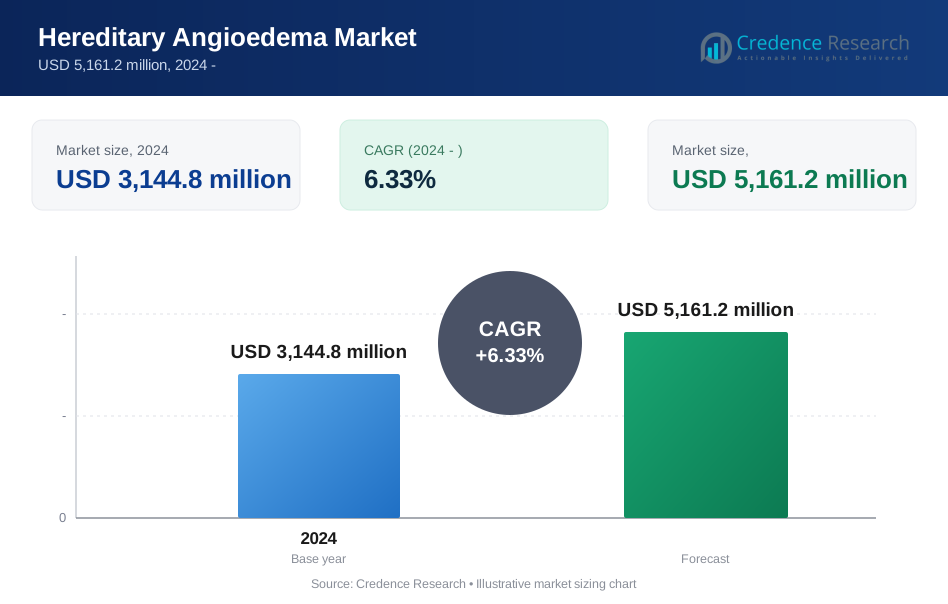
| Hereditary Angioedema Market Size 2024 | USD 3,144.8 million |
| Hereditary Angioedema Market, CAGR | 6.33% |
| Hereditary Angioedema Market Size 2032 | USD 5,161.2 million |
Market Overview
The Hereditary Angioedema market size was valued at USD 2,010.4 million in 2018, increased to USD 3,144.8 million in 2024, and is anticipated to reach USD 5,161.2 million by 2032, at a CAGR of 6.33% during the forecast period.
The Hereditary Angioedema market is driven by leading players such as Takeda Pharma, CSL Behring, Pharming Group, Ionis Pharmaceuticals Inc., KalVista Pharmaceuticals, Shire plc, Teva Pharmaceutical Industries Ltd., iBio, Inc., and Attune Pharmaceuticals. These companies focus on expanding their treatment portfolios through strategic R&D and regulatory approvals, particularly in the development of targeted and oral therapies. North America leads the global market with a 31.2% share in 2024, supported by advanced healthcare infrastructure, high awareness, and strong reimbursement frameworks. Europe and Asia Pacific follow, driven by rising diagnosis rates and increased access to biologics. The competitive landscape remains concentrated, with key players leveraging partnerships and innovations to strengthen their global presence and address the growing demand for effective long-term HAE treatments.
Market Insights
- The Hereditary Angioedema market was valued at USD 3,144.8 million in 2024 and is projected to reach USD 5,161.2 million by 2032, growing at a CAGR of 6.33% during the forecast period.
- Market growth is primarily driven by increased awareness, early diagnosis, and the rising adoption of targeted therapies like C1-esterase inhibitors and kallikrein inhibitors for both acute and prophylactic treatments.
- A notable trend is the shift toward oral therapies, especially oral kallikrein inhibitors, offering greater patient convenience and driving demand across outpatient and home care settings.
- The market is moderately consolidated with key players such as Takeda Pharma, CSL Behring, and Pharming Group leading innovation; emerging companies are contributing through clinical advancements in oral and long-acting therapies.
- Regionally, North America held a 31.2% market share in 2024, followed by Asia Pacific (26%) and Europe (21.9%); by drug class, C1-esterase inhibitors accounted for the largest segment share.
Market Segmentation Analysis:
By Drug Class:
The Hereditary Angioedema market is segmented into C1-esterase inhibitors, Bradykinin B2 receptor antagonists, Kallikrein inhibitors, and others. Among these, C1-esterase inhibitors dominate the market, accounting for the largest revenue share in 2024. Their efficacy in both acute and prophylactic treatment of HAE attacks has contributed significantly to their widespread adoption. Additionally, advancements in plasma-derived and recombinant formulations have improved safety profiles, enhancing patient compliance. The rising preference for targeted therapies and the strong clinical track record of C1-inhibitors continue to drive growth within this segment.
- For instance, BioCryst Pharmaceuticals’ ORLADEYO (berotralstat), the first once-daily oral kallikrein inhibitor, has been prescribed to more than 2,000 HAE patients globally since its U.S. launch in December 2020.
By Route of Administration
Based on the route of administration, the Hereditary Angioedema market is classified into oral and parenteral segments. Parenteral administration held the dominant share in 2024 due to its rapid onset of action and higher bioavailability, especially in acute attack management. Intravenous and subcutaneous formulations of C1-esterase inhibitors and kallikrein inhibitors are widely used in clinical settings. However, the oral segment is expected to witness steady growth owing to increasing patient preference for convenient dosing and the approval of oral kallikrein inhibitors, offering ease of administration without compromising efficacy.
- For instance, CSL Behring’s Berinert (C1-INH) is administered intravenously and has shown to reduce the median time to onset of symptom relief to 15 minutes, as per clinical trial NCT00288769.
By Distribution Channel
The market is segmented by distribution channel into hospital pharmacies, retail pharmacies, and online pharmacies. Hospital pharmacies led the market in 2024, supported by the requirement for immediate access to injectable treatments and the critical nature of managing acute HAE episodes. Their ability to store and dispense specialized medications in a controlled environment contributes to their dominant position. Nevertheless, the online pharmacy segment is expanding rapidly, driven by growing digitalization, ease of access to specialty drugs, and favorable reimbursement models, especially for chronic and prophylactic therapy users.
Market Overview
Advancements in Targeted Therapies
The growing adoption of targeted therapies such as C1-esterase inhibitors, kallikrein inhibitors, and bradykinin B2 receptor antagonists has significantly driven the Hereditary Angioedema (HAE) market. These drugs offer more precise and effective treatment options with fewer side effects compared to traditional therapies. The availability of both acute and prophylactic treatment regimens has enhanced patient outcomes and increased demand. Continuous clinical research and regulatory approvals for novel agents are expected to expand therapeutic options and further strengthen market growth in the coming years.
- For instance, Pharvaris’s oral bradykinin B2 receptor antagonist, PHVS416, showed a mean time to symptom relief of 1.6 hours in Phase 2 RAPIDe-1 trial (NCT04618211), compared to 9.1 hours in the placebo group.
Rising Awareness and Diagnosis Rates
Increased awareness campaigns by healthcare organizations and patient advocacy groups have led to improved diagnosis rates for HAE. Historically underdiagnosed due to its rarity and overlapping symptoms with other conditions, HAE is now receiving greater clinical attention. Enhanced genetic screening and improved physician education have enabled early and accurate diagnosis, allowing timely initiation of treatment. This shift is contributing to a larger treated patient pool, thereby accelerating market expansion across both developed and emerging economies.
- For instance, HAEi Global Access Program facilitated access to diagnostics and treatment in over 100 countries, helping to identify and treat over 2,500 previously undiagnosed HAE patients since its launch.
Favorable Reimbursement and Regulatory Landscape
The HAE market benefits from supportive reimbursement policies and an encouraging regulatory environment in major regions such as North America and Europe. Many governments and private insurers cover high-cost therapies due to the severity and chronic nature of the disease. Additionally, orphan drug designations and fast-track approvals by regulatory authorities have incentivized pharmaceutical companies to invest in the development of HAE treatments. These factors collectively lower the financial burden on patients and improve access to life-saving medications.
Key Trends & Opportunities
Shift Toward Oral Prophylactic Therapies
A notable trend in the HAE market is the shift from injectable treatments to oral prophylactic therapies. The launch of oral kallikrein inhibitors has transformed long-term disease management by offering improved convenience, compliance, and quality of life. This shift addresses patient concerns related to injection-site reactions and the burden of frequent infusions. The growing preference for oral therapies presents an opportunity for manufacturers to invest in more patient-centric treatment modalities and expand their market share.
- For instance, BioCryst Pharmaceuticals’ Orladeyo (berotralstat), the first once-daily oral kallikrein inhibitor approved for HAE, demonstrated a mean reduction of 2.3 HAE attacks per month in patients treated over a 24-week period in the APeX-2 study (NCT03485911).
Emergence of Personalized and Genetic Medicine
The rise of personalized medicine and genetic profiling presents a significant opportunity in HAE management. As HAE is a hereditary condition, advances in genetic testing and biomarker discovery are enabling early diagnosis and tailored therapies. Pharmaceutical companies are increasingly focusing on precision-based drug development to target specific mutations and patient subtypes. This approach improves treatment efficacy and minimizes adverse effects, paving the way for innovation in both diagnostics and therapeutics within the HAE market.
- For instance, Ionis Pharmaceuticals’ IONIS-PKK-LRx (donidalorsen) reduced mean plasma prekallikrein concentration from 5.3 µg/mL to 0.16 µg/mL and decreased the mean number of monthly HAE attacks from 3.6 to 0.2 over a 16-week treatment period in its Phase 2 trial (NCT04030598).
Key Challenges
High Cost of Treatment
One of the primary challenges in the HAE market is the high cost of available therapies. Biologics and specialty drugs for HAE can cost thousands of dollars annually per patient, placing a financial burden on healthcare systems and uninsured individuals. Despite reimbursement support in some regions, cost-related barriers still limit access in low- and middle-income countries. This price sensitivity remains a major hurdle for market penetration and equitable treatment access globally.
Limited Patient Pool Due to Rarity
Hereditary Angioedema is an ultra-rare disorder, affecting a small population globally, which poses a challenge for market scalability. The limited patient pool restricts clinical trial sizes, slows down drug development timelines, and reduces commercial viability for some pharmaceutical players. This scarcity also leads to difficulties in physician awareness and delayed diagnosis in less developed regions. As a result, manufacturers must balance high R&D costs with relatively low market volumes.
Complexity in Disease Management and Misdiagnosis
HAE symptoms often mimic those of more common conditions, leading to frequent misdiagnosis and inappropriate treatment. The complexity of disease management, including distinguishing between HAE subtypes and identifying triggering factors, makes it challenging for general practitioners to initiate proper care. Delays in diagnosis and suboptimal treatment regimens can compromise patient outcomes and hinder the overall effectiveness of healthcare delivery, posing a challenge to market growth and treatment standardization.
Regional Analysis
North America
North America dominated the Hereditary Angioedema market in 2024, holding a significant market share of approximately 31.2%, with a valuation of USD 981.35 million, up from USD 645.52 million in 2018. The region is projected to reach USD 1,548.36 million by 2032, registering a CAGR of 5.8% during the forecast period. This strong growth is attributed to high disease awareness, advanced diagnostic infrastructure, and the presence of key pharmaceutical players. Supportive reimbursement policies and early adoption of novel therapies further reinforce the region’s leadership in the global market for Hereditary Angioedema treatment.
Europe
Europe accounted for around 21.9% of the global Hereditary Angioedema market share in 2024, with a market size of USD 687.90 million, increasing from USD 437.85 million in 2018. The market is anticipated to reach USD 1,135.46 million by 2032, expanding at a CAGR of 6.4%. The region’s growth is driven by increased diagnosis rates, favorable healthcare reimbursement systems, and growing clinical research activities. Additionally, rising patient access to biologics and improved healthcare policies in countries like Germany, France, and the UK contribute to consistent market expansion across the continent.
Asia Pacific
Asia Pacific represented approximately 26.0% of the global Hereditary Angioedema market in 2024, with a value of USD 816.74 million, rising from USD 498.17 million in 2018. The market is expected to reach USD 1,422.43 million by 2032, growing at the fastest regional CAGR of 7.1%. This growth is fueled by increasing awareness, expanding healthcare infrastructure, and improving access to genetic testing and treatment in countries such as China, India, and Japan. Additionally, rising healthcare spending and favorable government initiatives support the region’s upward market trajectory in rare disease management.
Latin America
Latin America held a market share of about 11.2% in 2024, with revenues increasing to USD 351.77 million, up from USD 226.16 million in 2018. The market is forecast to reach USD 572.89 million by 2032, progressing at a CAGR of 6.2%. Growing awareness of hereditary angioedema and gradual improvements in diagnostic and treatment capabilities are contributing to regional growth. Brazil and Mexico are key markets, supported by government-backed rare disease programs and increasing penetration of specialty pharmaceuticals. However, access limitations and economic disparities pose challenges to widespread adoption of novel therapies.
Middle East
The Middle East captured a modest 5.4% share of the global Hereditary Angioedema market in 2024, valued at USD 171.30 million, up from USD 108.56 million in 2018. The market is anticipated to reach USD 284.38 million by 2032, growing at a CAGR of 6.5%. The growth is supported by rising investments in healthcare infrastructure, increasing awareness of rare genetic disorders, and expanding availability of advanced biologics. The Gulf Cooperation Council (GCC) countries, particularly the UAE and Saudi Arabia, are spearheading regional development through government-led health initiatives and partnerships with global biotech companies.
Africa
Africa accounted for the smallest share of the Hereditary Angioedema market at 4.3% in 2024, with a market size of USD 135.72 million, rising from USD 94.08 million in 2018. The market is projected to reach USD 197.67 million by 2032, recording a CAGR of 4.7%, the lowest among all regions. Limited healthcare access, low diagnosis rates, and high costs of biologic therapies remain key constraints. However, gradual improvements in healthcare access, increased funding for rare disease programs, and international support from NGOs and health agencies are expected to foster incremental growth over the forecast period.
Market Segmentations:
By Drug Class
- C1-esterase inhibitor
- Bradykinin B2 receptor antagonist
- Kallikrein inhibitor
- Others
By Route of Administration
- Oral
- Parenteral
By Distribution Channel
- Hospital Pharmacies
- Retail Pharmacies
- Online Pharmacies
By Geography:
- North America
- U.S.
- Canada
- Mexico
- Europe
- Germany
- France
- U.K.
- Italy
- Spain
- Rest of Europe
- Asia Pacific
- China
- Japan
- India
- South Korea
- South-east Asia
- Rest of Asia Pacific
- Latin America
- Brazil
- Argentina
- Rest of Latin America
- Middle East & Africa
- GCC Countries
- South Africa
- Rest of the Middle East and Africa
Competitive Landscape
The Hereditary Angioedema (HAE) market is characterized by a concentrated competitive landscape, with a few key players driving innovation and market share. Companies such as Takeda Pharma, CSL Behring, Pharming Group, and Ionis Pharmaceuticals dominate the space with established product portfolios and strong global distribution networks. These players focus heavily on research and development to introduce novel therapies, particularly oral and subcutaneous options, aimed at improving patient convenience and compliance. Strategic collaborations, licensing agreements, and acquisitions further strengthen their market positions and expand treatment accessibility. Emerging biopharmaceutical firms like KalVista Pharmaceuticals and Attune Pharmaceuticals are contributing to pipeline diversification, particularly in the development of next-generation kallikrein inhibitors. The market also benefits from orphan drug incentives and favorable regulatory frameworks, enabling faster product approvals. Overall, the competitive environment is marked by a blend of established pharmaceutical giants and agile innovators, all striving to address unmet clinical needs and improve quality of life for HAE patients.
Key Player Analysis
- Takeda Pharma
- CSL Behring
- Pharming Group
- Ionis Pharmaceuticals Inc.
- KalVista Pharmaceuticals
- Shire plc
- Teva Pharmaceutical Industries, Ltd.
- iBio, Inc
- Attune Pharmaceuticals
Recent Developments
- In June 2025, the U.S. FDA approved CSL Behring’s Andembry, a monoclonal antibody designed to prevent hereditary angioedema (HAE) attacks in patients aged 12 years and older. Andembry is the first prophylactic therapy to specifically target factor XIIa, offering a novel approach to HAE prevention. It is self-administered once a month via a prefilled pen, enhancing patient convenience and adherence. This U.S. approval follows earlier regulatory clearances in Japan, Europe, and the U.K.
- In February 2025, Takeda (TSE:4502/NYSE:TAK) announced today that the EMA has approved an additional 2 mL pre-filled pen option for TAKHZYRO® (lanadelumab) for subcutaneous administration in adolescents (aged 12 years and above) and adult patients with hereditary angioedema.
- In May 2024, Ionis announced positive Phase 3 results for donidalorsen (OASIS-HAE and OASISplus studies), showing significant and sustained reduction in HAE attack rates, with over 90% improvement after one year for both monthly and every two-month dosing.
Market Concentration & Characteristics
The Hereditary Angioedema Market shows moderate concentration, with a small group of established pharmaceutical companies controlling a significant portion of global revenue. Key players include Takeda Pharma, CSL Behring, and Pharming Group, each holding a strong product pipeline and global distribution networks. It features high entry barriers due to the complexity of biologic drug development, stringent regulatory pathways, and limited patient population. Companies focus on specialized treatment options targeting disease mechanisms such as C1-inhibitor deficiency and kallikrein activity. The market reflects characteristics typical of rare disease segments, including high per-patient treatment costs and strong reliance on orphan drug designations. Innovation plays a central role, with a shift toward oral therapies and long-term prophylactic solutions. Demand remains steady due to the chronic and potentially life-threatening nature of the condition, which drives the need for continuous treatment and follow-up care. Reimbursement structures in developed regions support patient access, while low awareness and limited healthcare resources restrict growth in several low- and middle-income countries. The market benefits from focused R&D efforts and strategic collaborations, contributing to product diversification and expanded reach.
Report Coverage
The research report offers an in-depth analysis based on Drug Class, Route of Administration, Distribution Channel and Geography. It details leading market players, providing an overview of their business, product offerings, investments, revenue streams, and key applications. Additionally, the report includes insights into the competitive environment, SWOT analysis, current market trends, as well as the primary drivers and constraints. Furthermore, it discusses various factors that have driven market expansion in recent years. The report also explores market dynamics, regulatory scenarios, and technological advancements that are shaping the industry. It assesses the impact of external factors and global economic changes on market growth. Lastly, it provides strategic recommendations for new entrants and established companies to navigate the complexities of the market.
Future Outlook
- The market will continue to expand due to increasing awareness and early diagnosis of hereditary angioedema.
- Oral prophylactic therapies will gain traction, improving patient adherence and convenience.
- Key players will invest in developing next-generation therapies with fewer side effects and longer duration.
- Genetic testing will play a greater role in accurate and early disease identification.
- Regulatory support for orphan drugs will encourage further innovation and faster approvals.
- North America and Europe will maintain strong market positions due to robust healthcare infrastructure.
- Asia Pacific will show significant growth driven by rising healthcare access and disease recognition.
- Online pharmacies will emerge as a preferred channel for distribution, especially for chronic therapies.
- Collaboration between biotech firms and large pharmaceutical companies will increase.
- Research will focus on expanding treatment options for all subtypes of hereditary angioedema.
Request a Free Sample
Fill in your details and we'll send you a free sample report.
- Sample data tables & charts
- Research methodology
Market Dynamics
Advancements in Targeted Therapies
The introduction and adoption of targeted therapies such as C1-esterase inhibitors, kallikrein inhibitors, and bradykinin B2 receptor antagonists have improved treatment efficacy and safety, driving market growth by offering more precise and effective options for both acute and prophylactic management of hereditary angioedema.
Rising Awareness and Early Diagnosis
Increased awareness campaigns and improved genetic screening have led to higher diagnosis rates, expanding the treated patient pool and accelerating market expansion, especially as hereditary angioedema was historically underdiagnosed due to its rarity and symptom overlap with other conditions.
Shift Toward Oral Prophylactic Therapies
The launch and growing preference for oral kallikrein inhibitors and other oral therapies are transforming long-term disease management, improving patient convenience and adherence, and expanding demand in outpatient and home care settings.
Favorable Reimbursement and Regulatory Support
Supportive reimbursement policies and orphan drug incentives in major markets like North America and Europe reduce the financial burden on patients and encourage pharmaceutical investment in novel HAE treatments, facilitating broader access and faster regulatory approvals.
Emergence of Personalized and Genetic Medicine
Advances in genetic testing and biomarker discovery are enabling earlier and more accurate diagnosis, as well as the development of personalized therapies tailored to specific patient subtypes, which enhances treatment outcomes and drives innovation in the market.
Need a Custom Version of This Report?
Tailor the scope, geography, or segments to your exact requirements.
- Custom geography or segment scope
- Direct access to our analyst team
Frequently Asked Questions
What is the current size of the Hereditary Angioedema Market?
What factors are driving the growth of the Hereditary Angioedema Market?
What are some challenges faced by the Hereditary Angioedema Market?
Who are the major players in the Hereditary Angioedema Market?
Table of Content
Chapter 1 Market Segmentation
- 1.1 Segmentation Framework
- 1.1.1 Product and Service Classification
- 1.1.2 Application and End-Use Classification
- 1.1.3 Technology and Solution Classification
- 1.1.4 Customer and Distribution Channel Classification
- 1.1.5 Geographic Segmentation
- 1.1.6 Market Segment Definitions and Boundaries
- 1.2 By Drug Class
- 1.2.1 C1-esterase inhibitor
- 1.2.2 Bradykinin B2 receptor antagonist
- 1.2.3 Kallikrein inhibitor
- 1.2.4 Others
- 1.3 By Route of Administration
- 1.3.1 Oral
- 1.3.2 Parenteral
Chapter 2 Introduction
- 2.1 Report Objectives and Scope
- 2.2 Product Definition and Industry Terminology
- 2.3 Market Inclusions and Exclusions
- 2.4 Research Process
- 2.4.1 Primary Research and Expert Interviews
- 2.4.2 Secondary Research and Source Review
- 2.4.3 Top-Down and Bottom-Up Estimation
- 2.4.4 Data Triangulation and Verification
- 2.5 Market Size Measurement Basis
- 2.5.1 2024: USD 3,144.8 million → 2032: USD 5,161.2 million
- 2.6 Historical and Forecast Reference Periods
- 2.6.1 Base Year: 2024
- 2.6.2 Forecast Period: 2024-2032
- 2.7 Research Assumptions and Limitations
Chapter 3 Executive Summary
- 3.1 Market Snapshot and Key Findings
- 3.2 Base-Year Market Size, 2024
- 3.3 Forecast Market Size, 2032
- 3.4 Revenue and Volume Growth Outlook
- 3.5 Key Demand and Supply Indicators
- 3.6 Leading Market Segments
- 3.7 Fastest-Growing Market Opportunities
- 3.8 Regional Performance Highlights
- 3.9 Technology and Industry Transformation
- 3.10 Competitive Landscape Summary
- 3.11 Analyst View and Strategic Implications
Chapter 4 Global Hereditary Angioedema Market Trends and Developments
- 4.1 Historical Industry Development
- 4.2 Recent Market Trends and Developments
- 4.3 Demand and Customer Behavior Trends
- 4.4 Technology and Product Innovation
- 4.5 Artificial Intelligence, Automation and Digitalization
- 4.6 Local Manufacturing and Supply Chain Realignment
- 4.7 Industry Partnerships, Mergers and Acquisitions
- 4.8 Sustainability and Circular Economy Developments
- 4.9 Government and Private Sector Investment Trends
- 4.10 Emerging Business Models and Commercialization
- 4.11 Industry Developments and Announcements
Chapter 5 Global Hereditary Angioedema Market Production, Supply and Demand Analysis
- 5.1 Demand Trend and Consumption Analysis
- 5.2 Demand Forecast, 2024-2032
- 5.3 Production and Output Trend
- 5.4 Production and Output Forecast, 2024-2032
- 5.5 Installed Capacity and Capacity Utilization
- 5.6 Company-Wise Production Plants and Statistics
- 5.6.1 Installed Production Capacity
- 5.6.2 Actual Production
- 5.6.3 Planned Capacity and Expansion Targets
- 5.7 Supply Chain Structure and Procurement Trends
- 5.8 Supply-Demand Gap and Bottlenecks
- 5.9 Import Dependence and Sourcing Structure
- 5.10 Contract Manufacturing and Outsourcing
- 5.11 Regional Supply and Demand Concentration
Chapter 6 Global Hereditary Angioedema Market Pricing Analysis
- 6.1 Pricing Structure and Measurement
- 6.2 Historical Pricing Trends
- 6.3 Pricing Outlook, 2024-2032
- 6.4 Average Selling Price and Unit Economics
- 6.5 Pricing by Product and Market Segment
- 6.6 Geographic Pricing Differences
- 6.7 Key Input, Energy, Labor and Logistics Costs
- 6.8 Contract Pricing and Purchasing Models
- 6.9 Pricing Sensitivity and Competitive Positioning
- 6.10 Price, Margin and Profitability Implications
Chapter 7 Global Hereditary Angioedema Market Dynamics
- 7.1 Market Growth Drivers
- 7.1.1 Demand-Side Drivers
- 7.1.2 Technology and Innovation Drivers
- 7.1.3 Infrastructure and Investment Drivers
- 7.1.4 Regulatory and Policy Drivers
- 7.2 Market Restraints
- 7.2.1 Cost and Affordability Constraints
- 7.2.2 Technology and Adoption Barriers
- 7.2.3 Supply Chain and Operational Constraints
- 7.3 Market Challenges
- 7.3.1 Competitive Pressure and Margin Erosion
- 7.3.2 Skills, Infrastructure and Implementation Gaps
- 7.4 Emerging Market Opportunities
- 7.5 Market Dynamics Impact and Time-Horizon Assessment
Chapter 8 Global Hereditary Angioedema Value Chain Analysis
- 8.1 Industry Value Chain Overview
- 8.2 Upstream Suppliers and Critical Inputs
- 8.3 Technology and Component Providers
- 8.4 Manufacturing or Service Delivery
- 8.5 Distribution, Channel Partners and Integrators
- 8.6 Downstream Applications and End Users
- 8.7 Value Addition and Profit Pools
- 8.8 Vertical Integration and Outsourcing
- 8.9 Supplier Concentration and Risk
- 8.10 Supply Chain Localization and Resilience
Chapter 9 Global Hereditary Angioedema Market Regulations and Policies
- 9.1 Relevant Laws, Standards and Compliance Frameworks
- 9.2 Product, Service, Safety and Quality Requirements
- 9.3 Government Policies, Incentives and Subsidies
- 9.4 Imports, Exports and Trade Barriers
- 9.5 Public Procurement and Local Content Requirements
- 9.6 Environmental and Sustainability Compliance
- 9.7 Upcoming Policy Changes and Market Implications
Chapter 10 Global Hereditary Angioedema Market Hotspots and Opportunities
- 10.1 Market Opportunity Mapping and Growth Hotspots
- 10.2 High-Growth Applications and Customer Groups
- 10.3 Underserved Markets and White-Space Opportunities
- 10.4 Emerging Technology and Product Opportunities
- 10.5 New Capacity and Investment Hotspots
- 10.6 Market Entry and Expansion Opportunities
- 10.7 Distribution and Partnership Opportunities
- 10.8 Near-Term and Long-Term Commercial Potential
- 10.9 Opportunity Attractiveness and Execution Risks
Chapter 11 Global Hereditary Angioedema Market Outlook, 2024-2032
- 11.1 Market Size and Analysis
- 11.1.1 Revenue (Market Measurement: 2024: USD 3,144.8 million → 2032: USD 5,161.2 million)
- 11.1.2 Market Volume and Quantity Sold
- 11.1.3 Historical Market Size
- 11.1.4 Base-Year Market Size, 2024
- 11.2 Market Forecast, 2024-2032
- 11.2.1 Revenue Forecast to 2032
- 11.2.2 Volume Forecast to 2032
- 11.2.3 CAGR and Year-on-Year Growth
- 11.2.4 Incremental Revenue Opportunity
- 11.3 Forecast Assumptions and Scenario Analysis
- 11.3.1 Base-Case Forecast
- 11.3.2 Optimistic and Conservative Scenarios
- 11.3.3 Technology, Pricing and Policy Sensitivities
- 11.4 Market Attractiveness and Growth Outlook
Chapter 12 Global Hereditary Angioedema Market Segmentation and Outlook
- 12.1 Segmentation Summary and Market Shares, 2024
- 12.2 Largest and Fastest-Growing Segments
- 12.3 By Drug Class - Market Size and Forecast, 2024-2032
- 12.3.1 Segment Definition and Scope
- 12.3.2 Historical Market Size
- 12.3.3 Revenue Forecast, 2024-2032
- 12.3.4 Volume Forecast, 2024-2032
- 12.3.5 Base-Year Market Share, 2024
- 12.3.6 Segment CAGR and Growth Drivers
- 12.3.7 Subsegment Market Size and Forecast
- 12.3.7.1 C1-esterase inhibitor
- 12.3.7.2 Bradykinin B2 receptor antagonist
- 12.3.7.3 Kallikrein inhibitor
- 12.3.7.4 Others
- 12.3.8 Subsegment Pricing and Adoption Trends
- 12.3.9 Leading Suppliers and Competition
- 12.3.10 Regional Demand and Opportunities
- 12.4 By Route of Administration - Market Size and Forecast, 2024-2032
- 12.4.1 Segment Definition and Scope
- 12.4.2 Historical Market Size
- 12.4.3 Revenue Forecast, 2024-2032
- 12.4.4 Volume Forecast, 2024-2032
- 12.4.5 Base-Year Market Share, 2024
- 12.4.6 Segment CAGR and Growth Drivers
- 12.4.7 Subsegment Market Size and Forecast
- 12.4.7.1 Oral
- 12.4.7.2 Parenteral
- 12.4.8 Subsegment Pricing and Adoption Trends
- 12.4.9 Leading Suppliers and Competition
- 12.4.10 Regional Demand and Opportunities
- 12.5 Segment Growth Comparison
- 12.6 Segment Attractiveness and Priority Matrix
Chapter 13 Global Hereditary Angioedema Geographic Market Outlook, 2024-2032
- 13.1 Regional Market Size and Share, 2024
- 13.2 Regional Market Forecast, 2024-2032
- 13.3 Regional Pricing, Production and Demand Differences
- 13.4 North America
- 13.4.1 United States
- 13.4.2 Canada
- 13.4.3 Mexico
- 13.5 Europe
- 13.5.1 Germany
- 13.5.2 France
- 13.5.3 Italy
- 13.5.4 United Kingdom
- 13.5.5 Spain
- 13.5.6 Poland
- 13.5.7 Russia
- 13.5.8 Netherlands
- 13.5.9 Belgium
- 13.5.10 Sweden
- 13.5.11 Denmark
- 13.5.12 Norway
- 13.5.13 Rest of Europe
- 13.6 Asia Pacific
- 13.6.1 China
- 13.6.2 India
- 13.6.3 Japan
- 13.6.4 South Korea
- 13.6.5 Thailand
- 13.6.6 Indonesia
- 13.6.7 Vietnam
- 13.6.8 Malaysia
- 13.6.9 Australia
- 13.6.10 Rest of Asia Pacific
- 13.7 Latin America
- 13.7.1 Brazil
- 13.7.2 Argentina
- 13.7.3 Colombia
- 13.7.4 Chile
- 13.7.5 Rest of Latin America
- 13.8 Middle East
- 13.8.1 Saudi Arabia
- 13.8.2 United Arab Emirates
- 13.8.3 Turkey
- 13.8.4 Israel
- 13.8.5 Iran
- 13.8.6 Rest of the Middle East
- 13.9 Africa
- 13.9.1 South Africa
- 13.9.2 Egypt
- 13.9.3 Nigeria
- 13.9.4 Morocco
- 13.9.5 Rest of Africa
- 13.10 Regional Investment, Policy and Supply Chain Differences
- 13.11 Regional Competitive Landscape
- 13.12 Geographic Growth Hotspots
Chapter 14 Global Hereditary Angioedema Technology, Innovation and Sustainability Outlook
- 14.1 Technology Landscape and Maturity
- 14.2 Product, Process and Service Innovation
- 14.3 AI, Automation and Digital Tools in the Industry
- 14.4 Technology Adoption and Performance Benchmarking
- 14.5 Innovation Pipeline and R&D Investment
- 14.6 Patent and Intellectual Property Trends
- 14.7 Energy Efficiency and Resource Management
- 14.8 Sustainability, Recycling and Circularity
- 14.9 Technology Roadmap, 2024-2032
- 14.10 Risks of Obsolescence and Technology Substitution
Chapter 15 Global Hereditary Angioedema Market Key Strategic Imperatives
- 15.1 Growth and Market Entry Priorities
- 15.2 High-Return Products and Segments
- 15.3 Pricing, Profitability and Cost Optimization
- 15.4 Technology Investment and Product Differentiation
- 15.5 Supply Chain Localization and Resilience
- 15.6 Distribution and Customer Acquisition
- 15.7 Partnership, Acquisition and Capacity Strategy
- 15.8 Regional Expansion Priorities
- 15.9 Short-, Medium- and Long-Term Actions
Chapter 16 Competition Outlook
- 16.1 Industry Competition Characteristics
- 16.2 Market Structure and Concentration
- 16.3 Market Share and Competitive Positioning, 2024
- 16.4 Company-Wise Revenue and Product Benchmarking
- 16.5 Production and Service Capacity Benchmarking
- 16.6 Technology, Pricing and Differentiation
- 16.7 Regional Footprint and Distribution Strength
- 16.8 Mergers, Acquisitions and Strategic Alliances
- 16.9 New Entrants and Competitive Threats
- 16.10 Porter's Five Forces and Industry Attractiveness
- 16.11 Competitive Outlook, 2024-2032
Chapter 17 Company Profiles
- 17.1 Company Coverage and Selection Criteria
- 17.2 Takeda Pharma
- 17.2.1 Business Description
- 17.2.2 Company Ownership and Geographic Presence
- 17.2.3 Product and Service Portfolio
- 17.2.4 Manufacturing and Operating Footprint
- 17.2.5 Production Capacity and Expansion Plans
- 17.2.6 Financial Performance and Investment
- 17.2.7 Market Share and Competitive Position
- 17.2.8 Technology and Innovation Capabilities
- 17.2.9 Strategic Alliances or Partnerships
- 17.2.10 Recent Developments
- 17.2.11 Growth Strategy and Outlook
- 17.3 CSL Behring
- 17.4 Pharming Group
- 17.5 Ionis Pharmaceuticals Inc.
- 17.6 KalVista Pharmaceuticals
- 17.7 Shire plc
- 17.8 Teva Pharmaceutical Industries Ltd.
- 17.9 iBio, Inc.
- 17.10 Attune Pharmaceuticals
- 17.11 BioCryst Pharmaceuticals
- 17.12 Other Relevant Market Participants
Note: Every listed company is profiled on the structure shown under the first company. The company list is preliminary and may change based on research findings, market developments, data availability and client requirements.
Chapter 18 Disclaimer
- 18.1 Research and Forecast Disclaimer
- 18.2 Data Source and Estimation Limitations
Note: The depth of individual sections depends on data availability for this market. Volume, capacity, trade and other unit-based metrics are included where applicable.