
| REPORT ATTRIBUTE | DETAILS |
|---|---|
| Historical Period | 2019-2022 |
| Base Year | 2023 |
| Forecast Period | 2024-2032 |
| Human Machine Interface (HMI) Market Size 2023 | USD 5515.8 Million |
| Human Machine Interface (HMI) Market, CAGR | 8.80% |
| Human Machine Interface (HMI) Market Size 2032 | USD 11783.34 Million |
Market Insights
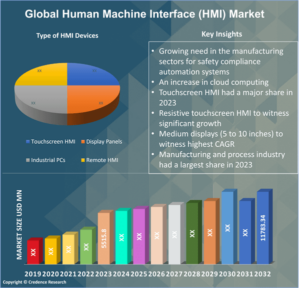
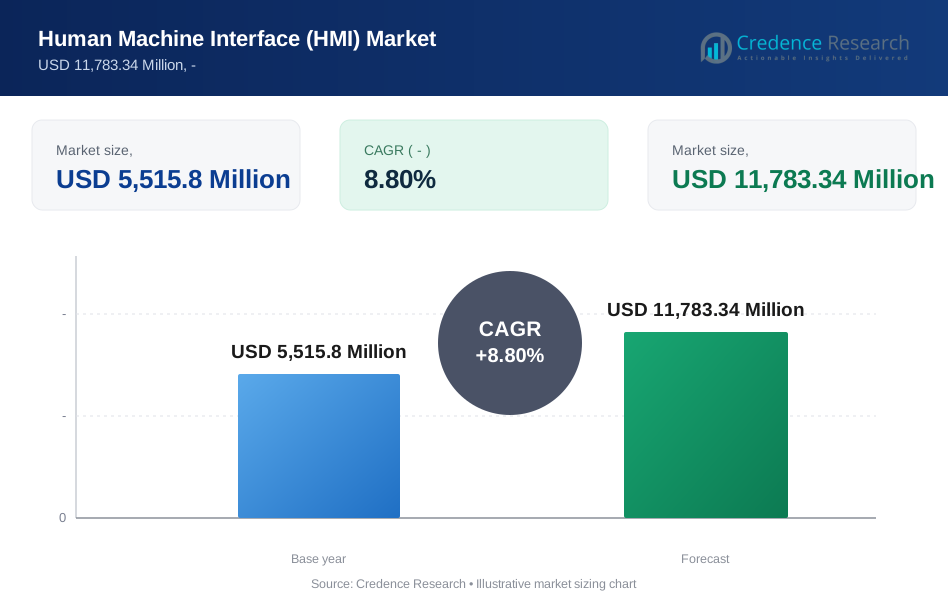
- The global demand for human-machine interface (HMI) was valued at USD 5515.8 Million in 2023 and is expected to reach USD 11783.34 Million in 2032, growing at a CAGR of 8.80% between 2024 and 2032.
- The largest type of HMI device is a touchscreen HMI. On the other hand, remote HMI is expected to grow at a strong CAGR.
- The leading technology segment is resistive touchscreen HMI.
- The CAGR for medium displays (5 to 10 inches) is expected to be the highest during the projection period.
- The manufacturing and process industry will probably have the highest CAGR throughout the prediction period.
- Control systems are estimated to have the greatest CAGR during the forecast period.
- The panel-mounted HMI segment will likely have the highest CAGR during the prediction period.
- Standard HMI will have the highest CAGR during the forecasting period.
- Wired connectivity (Ethernet, USB, etc.) would likely have the highest CAGR during the projection period.
- North America dominated the human-machine interface (HMI) market.
- Regarding human-machine interface (HMI) market share, Europe is expected to come second.
- Asia Pacific is anticipated to grow fastest in the human-machine interface (HMI) market.
- The most important market expansion drivers are expanding automation usage across sectors and integration for improved visualization and user experience.
- The continued advancement of HMI technologies and machine learning for predictive analysis presents numerous opportunities for the human-machine interface (HMI) industry.
Executive Summary
Market Definition
The interface that allows a human operator to communicate with a machine or system is known as the Human Machine Interface or HMI. This technology enables people to interact with and manage machinery and equipment across various sectors. The main objective of an HMI is to offer an interface that is easy to use and intuitive so that operations may be efficiently monitored, controlled, and managed.
Market Overview
With consistent growth in recent years, the global human-machine interface (HMI) market is predicted to expand at a compound annual growth rate (CAGR) of 8.80% between 2024 and 2032. The market was valued at USD 5515.8 million in 2023 and is expected to reach USD 11783.34 million in 2032.
The reliable and timely monitoring and control of data from various remote sites is a challenge manufacturing industries face. Additionally, manufacturers worldwide are looking for solutions allowing for remote operation, maintenance, and observation of machinery. Moreover, remote maintenance helps lower costs and improve efficiency compared to local maintenance practices. Mobility will be provided to the manufacturing and other sectors through remote monitoring and control of volume data. The need for HMI with communication devices to enable information access on their own communication devices is therefore rising as a result of this. Therefore, during the forecast period, these factors are anticipated to drive the expansion of the market.
A head-up display (HUD) that displays an Augmented Reality experience in real-time is made possible by a sophisticated automotive Human Machine Interface platform in conjunction with in-car sensors. As well as providing information like impending turning techniques and speed limit changes, the HUD aids in the driver's ability to see how other cars might move. Because fewer dashboard displays take up the driver's attention, driver and vehicle safety increases. The desire for more safety features in cars will, therefore, support the expansion of the global human-machine interface (HMI) market.
Segmentation by Type of HMI Devices
- Touchscreen HMI is the market leader in this type of HMI device. Touchscreens give a more intuitive and user-friendly interface compared to previous control systems. Controlling and monitoring operations is easier for operators by allowing them to engage with the system by touching buttons, icons, and graphical components on the screen.
- The remote HMI category will exhibit a sizable CAGR during the projected period. Operators or engineers can monitor the performance and status of machines or processes remotely with the help of a remote HMI. This is particularly helpful when it would be difficult to be physically present or where centralized monitoring is desired.
- Other types of HMI devices, including display panels and industrial PCs, additionally support the need for a human-machine interface (HMI).
Segmentation by Technology
- The main technology is resistive touchscreen HMI. A resistive touchscreen Human-Machine Interface (HMI) is a touch-sensitive display technology commonly used in numerous applications, including industrial control panels, medical equipment, and consumer electronics.
- The capacitive touchscreen HMI category will likely register a significant CAGR during forecasting. High touch sensitivity and precision are provided by capacitive touchscreens, resulting in a responsive and seamless user experience.
- Other technologies, including surface acoustic wave (SAW) touchscreen HMI, infrared (IR) touchscreen HMI, and others (gesture-based, optical, etc.), additionally support the need for human-machine interface (HMI).
Segmentation by Screen Size
- It is projected that the category of medium displays (5 to 10 inches) will grow at the fastest rate over the projection period. The 5 to 10-inch range of medium-sized screens is widely utilised in various electronic gadgets and applications because of its adaptability and ability to balance readability and compactness.
- Other screen sizes, such as small displays (below 5 inches) and large displays (above 10 inches), also contribute to the demand for human-machine interfaces (HMI).
Segmentation by End-User Industry
- The manufacturing and process industry category will likely have the highest CAGR during the projection period. Operators can use graphical interfaces provided by HMIs to see real-time data, including temperature, pressure, flow rates, and other important factors. Operators can track progress and spot plan deviations with the help of HMIs, which provide production schedules with a visual representation.
- Other end-user industries, such as oil and gas, energy and power, automotive, healthcare, food and beverage, aerospace and defense, and others, also contribute to the demand for human-machine interfaces (HMI).
Segmentation by Application
- Control systems are expected to have the foremost CAGR during the prediction period. HMI supports a unified control environment by integrating easily with automation systems and Programmable Logic Controllers (PLCs).
- Other applications, such as human-machine interaction, monitoring and visualization, data entry and control, and others (alarming, reporting, etc.), also contribute to the demand for human-machine interface (HMI).
Segmentation by Mounting Type
- Throughout the forecast duration, the panel-mounted HMI category is anticipated to have the greatest CAGR. Panel-mounted HMIs are frequently utilized in manufacturing, process control, and industrial automation applications where effective system operation and monitoring depend on a localized and integrated interface.
- Other mounting types, such as flush-mounted HMI, rack-mounted HMI, open-frame HMI, and portable HMI, also contribute to the demand for human-machine interface (HMI).
Segmentation by Degree of Customization
- Standard HMI is anticipated to have the highest CAGR throughout the forecast period. Standard HMIs are scalable and can grow with the user's needs to accommodate various operation sizes. For a variety of industrial applications, this flexibility is crucial.
- Another degree of customization, such as customized/engineered HMI, also contributes to the demand for human-machine interfaces (HMI).
Segmentation by Connectivity
- The wired connectivity (Ethernet, USB, etc.) category is expected to have the highest compound annual growth rate (CAGR) throughout the projection period. USB connections are built into certain HMIs to facilitate communication and data transmission. The HMI and external devices can exchange data and initiative and be configured via USB connections.
- Other connectivities, such as wireless connectivity (Wi-Fi, Bluetooth, etc.), also contribute to the human machine interface (HMI) demand.
Segmentation by Region
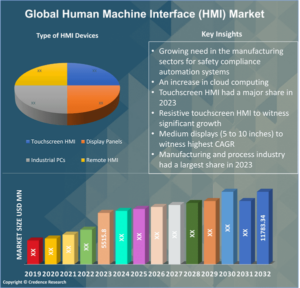
- North America leads the human-machine interface (HMI) industry. The necessity for superior HMI systems was being spurred by the expanding industrial automation trend in North America. To increase output and productivity, industries from various sectors, including manufacturing, oil and gas, and automotive, were implementing automation.
- Europe is estimated to rank second in market size for human-machine interface (HMI).
- Asia Pacific will witness the most rapid human-machine interface (HMI) market growth.
- World regions, including Africa, the Middle East, and Latin America, meet the remaining demand for human-machine interfaces (HMI).
The drivers propelling the global market expansion are the rise in Internet of Things (IoT) cooperation, the requirement for enhanced data visualization, the need for user-friendly interfaces, and the increase in industrial automation.
Regarding forecasting, North America will likely dominate the human-machine interface (HMI) market. During the projection period, the increase in automation projects is anticipated to boost regional demand. The manufacturing, automotive, aerospace, energy, and healthcare industries have a robust and varied industrial foundation in North America. To optimise workflows, boost output, and improve user experience, these industries have a strong demand for sophisticated HMIs. For HMI providers, the region's strong industrial footprint offers a sizable client base and market opportunity.
Throughout the forecast, the Asia Pacific region is anticipated to increase at the quickest rate. This is due to the population growth and increase in disposable revenue. China and Japan are regarded as the production centers of this region for the equipment needed to make the human interface machine. Manufacturing has also become one of the industries in India with the fastest growth. The 'Make in India' campaign prominently highlights the Indian economy and establishes India as a manufacturing hub on the international stage.
A PLI scheme worth USD 3.53 billion was sanctioned by the Indian government in September 2021 for the car and drone industries in an effort to strengthen India's manufacturing skills, according to the Indian Brand Equity Foundation (IBEF). Furthermore, the India Brand Equity Foundation (IBEF) asserts that India has the capacity to develop into a worldwide center for manufacturing. The country has the potential to contribute more than USD 500 billion a year to the world economy by 2030. This implies that the HMI market in the region would grow during that time, driving the industry.
Key Highlights of the Report
The global human-machine interface (HMI) market is segmented by type of HMI devices, technology, screen size, end-user industry, application, mounting type, degree of customization, connectivity, and region. As far as the type of HMI devices are concerned, touchscreen HMI is the market spearhead. Resistive touchscreen HMI is the top technology segment. The panel-mounted HMI category is anticipated to increase at the highest CAGR throughout the projection period. The standard HMI will experience the highest CAGR during the forecast period. Human machine interface (HMI) are expanding mostly in North America.
The surge in popularity of AR and VR technology and multi-touch screens stimulates the industry's growth. Furthermore, the manufacturing sector has seen a transformation in operations because of loT. Industrial loT is the word used to describe loT in the manufacturing industry. Furthermore, by replacing several indication lights, selectors, and push buttons, as well as by reducing the need for extra wires and display panels, it is anticipated that the human-machine interface will minimize operating costs. Additionally, managers can increase efficiency by cutting startup time by implementing a customizable HMI facility. It is anticipated that each of these elements will offer significant chances for the market share of human-machine interfaces to increase.
However, according to forecasts, North America will hold the largest market share for human-machine interface (HMI) globally. The growing consumer demand for wearable technology will impact the manufacturing industry in North America. This is also because arable devices are listed as one of the technologies exposed to hyper-depreciation in the National Industry 4.0 Plan. For instance, to respond quickly in the event of an alarm, operators will probably wear wristbands that provide them with a code. The Asia Pacific region is also assumed to have the market's sharpest growth. A smartwatch will serve as the user's assistant in the future. The future of the human-computer interface is being laid by emerging technologies such as voice, virtual reality, and smart wearables, which are all generating new patterns of interaction. These factors drive the growth of the Asia Pacific human-machine interface market.
Which Key Factors Are Driving The Global Human Machine Interface (HMI) Market?
Increased cloud computing, industrial activity, and the need for real-time data are some drivers encouraging the development of the human-machine interface (HMI) sector.
What Are The Key Challenges In The Global Market For Human Machine Interface (HMI)?
The human-machine interface (HMI) industry faces several difficulties in its further growth, including the need to provide HMI solutions in distant locations with inadequate connectivity and the challenges posed by expanding cybersecurity risks to the safety and security of HMI systems.
What Market Opportunities Exist For Human Machine Interface (HMI) Globally?
The increasing acceptance of human-machine interface (HMI) can be attributed to various factors such as integration with interactive robot systems, collaboration between operators and machines, and integration of HMI into supply chain activities.
Market Drivers
Growing Numbers of Discrete and Process Sectors are Implementing Industrial Automation
Process and discrete sectors are increasingly adopting industrial automation, which increases productivity, lowers labor costs, and improves operational efficiency. These technologies are essential to smooth monitoring, control, and data visualization because they make it easier for people to interface with automated machinery and control systems. The HMI market is anticipated to keep growing due to the persistent trend towards Industry 4.0 and smart manufacturing. It offers solutions enabling businesses to optimize their processes and maintain competitiveness in an increasingly automated environment. In addition, since industries strive to maintain their competitiveness in a constantly changing environment, the need for HMIs is increasing.
Advanced HMI systems are changing the game by enabling remote access and management of industrial processes. This gives businesses more flexibility and agility to respond to changing market conditions. Consequently, the market for HMIs is expected to experience steady expansion as industrial automation solidifies its position as a fundamental component of contemporary manufacturing and production, revolutionizing business operations and catering to future demands.
Market Restraints
High Expense of Upkeep and Installation
The high installation and upkeep costs severely constrain the market for human-machine interfaces (HMIs). Implementing HMI systems can incur hefty upfront costs, particularly for small and medium-sized enterprises. This covers the price of the expert services, software, and hardware needed for system integration. The total cost of implementation is further increased by the requirement for operators and maintenance staff to receive specialized training. These cost restrictions can potentially discourage certain organizations-especially those with tight budgets-from implementing HMI solutions, which would otherwise accelerate the market's expansion.
Smaller companies and organizations with fewer funds may find it especially difficult to pay these expenses, which may prevent them from implementing cutting-edge HMI technology. Moreover, companies may have problems hiring qualified specialists who can maintain and debug these systems, and continuing maintenance and software upgrades may raise the total cost of ownership. The total cost of ownership may increase over time due to the necessity for qualified personnel to handle any problems or system upgrades. To address this, HMI suppliers are putting more of an emphasis on providing more affordable and user-friendly solutions. They also aim to lessen the financial strain on businesses by giving long-term support and maintenance packages.
Opportunities
Growing Need in the Manufacturing Sectors for Safety Compliance Automation Systems
When safety compliance is integrated with HMI systems, industrial manufacturing businesses may guarantee worker safety in manufacturing settings. Real-time safety parameter monitoring, emergency shutdown procedures, and alarms that promptly notify operators of potential hazards are just a few characteristics that HMI systems can provide. Manufacturing firms may improve safety compliance, lower accidents, and minimize downtime from safety-related occurrences by easily integrating safety measures into the HMI interface. This eventually improves overall productivity and reduces costs. Manufacturers are looking for more sophisticated HMI systems incorporating automation and safety elements to protect workers and reduce hazards as they prioritize workplace safety and regulatory compliance. With the help of these systems, possible hazards can be immediately addressed through real-time monitoring, alerts, and safety interlocks.
Competitive Landscape
Key Players
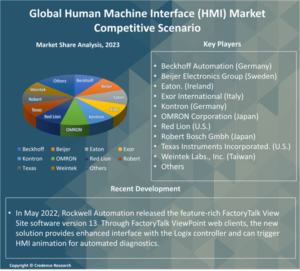
Several major competitors exist in the fiercely competitive global human-machine interface (HMI) market. The followings are a few of the leading market participants and their market shares:
- Beckhoff Automation (Germany)
- Beijer Electronics Group (Sweden)
- Eaton. (Ireland)
- Exor International (Italy)
- Kontron (Germany)
- OMRON Corporation (Japan)
- Red Lion (U.S.)
- Robert Bosch Gmbh (Japan)
- Texas Instruments Incorporated. (U.S.)
- Weintek Labs., Inc. (Taiwan)
- Rockwell Automation, Inc. (U.S.)
- Schneider Electric (France)
- ABB (Switzerland)
- Siemens (Germany)
- Mitsubishi Electric Corporation (Japan)
- Advantech Co., Ltd. (Taiwan)
- Emerson Electric Co. (U.S.)
- General Electric (U.S.)
- Honeywell International, Inc. (U.S.)
- Yokogawa Electric Corporation (Japan)
- Others
To remain competitive, these companies prioritize product innovation, distribution channel expansion, mergers, and acquisitions.
The major global human-machine interface (HMI) market players always try to remain ahead of the competition by introducing innovations and products.
In August 2022, Emerson introduced a sophisticated Machine visualization solution that offers graphical displays similar to those found on smartphones that are sturdy and user-friendly for industrial environments, catering to the needs of today's industrial workers. Using 10-point multi-touch functionality, the PACSystems RXi HMI's projective capacitive touchscreen technology allows users to interact with the visual interface.
In May 2022, ABB unveiled the release of ABB Ability NGX Hoist Control, a tool that helps mining firms optimize hoist operations for maximum performance and safety. The most recent ergonomic and human-factors engineering criteria were used in its design. Furthermore, it provides the most cutting-edge and user-friendly operator interface due to its foundation on the most recent human-machine interface (HMI) insights.
In March 2022, General Electric updated its high-performance automation software, iFIX, to provide industrial processes with faster time to insight and more efficiency. With the software quick installer tool, iFIX 2022 promises to shorten response times and, simplify PLC and control system browsing for quicker updates, all while enhancing user experience.
In January 2022, Honeywell revealed that Repsol had chosen the company to supply an integrated control and safety system (ICSS) for the most advanced biofuel production plant that would be constructed in Spain. Additionally, the business said that to carry out effective, sustainable, and low-emission operations, the new plant would make use of several Honeywell distributed control systems (DCS), emergency shutdown (ESD), fire and gas (F&G), and human-machine interface (HMI) solutions.
Summary of Key Findings
- HMIs with new technologies will enable human-machine communication while increasing precision, security, and problem-solving speed. To enhance the overall work experience of employees in enterprises, Industry 4.0 developers are implementing new HMIs, including powerful touchscreen displays, voice interfaces, gesture detection, and AR/VR tools.
- The market is segmented by type of HMI devices, technology, screen size, end-user industry, application, mounting type, degree of customization, connectivity, and region.
- The most popular type of HMI device in the market is the touchscreen HMI.
- Resistive touchscreen HMI is the foremost technology category.
- Regarding CAGR, medium displays (5 to 10 inches) are expected to grow fastest during the forecast period.
- The category for panel-mounted HMI will likely see the highest CAGR during the anticipated time frame.
- North America is leading market development; the market is highly competitive with key players including Beckhoff Automation (Germany), Beijer Electronics Group (Sweden), Eaton. (Ireland), Exor International (Italy), Kontron (Germany), OMRON Corporation (Japan), Red Lion (U.S.), Robert Bosch Gmbh (Japan), Texas Instruments Incorporated. (U.S.), Weintek Labs., Inc. (Taiwan), Rockwell Automation, Inc. (U.S.), Schneider Electric (France), ABB (Switzerland), Siemens (Germany), Mitsubishi Electric Corporation (Japan), Advantech Co., Ltd. (Taiwan), Emerson Electric Co. (U.S.), General Electric (U.S.), Honeywell International, Inc. (U.S.), Yokogawa Electric Corporation (Japan), and Others.
Future Outlook
- The human-machine interface (HMI) industry is expected to increase significantly in North America and has a positive outlook worldwide.
- The market's expansion will accelerate AI technology adoption. There are various advantages to using intelligent systems in industrial facilities, including lower costs and more production and profitability.
- The lack of qualified personnel to manage and keep up with advanced HMI technologies is one of the significant issues that would hinder the growth of the human-machine interface (HMI) market over the projected period.
- To stay ahead of the competition, key enterprises must develop new products, expand their market reach, and keep their prices competitive.
How CXOs Can Benefit from the Credence Research Human Machine Interface (HMI) Market Report
The Credence Research Human Machine Interface (HMI) Market Report provides CXOs with a comprehensive overview of the market, including:
- Market size and growth forecast: The report provides detailed estimates of the global human-machine interface (HMI) market size, segmented by type of HMI devices, technology, screen size, end-user industry, application, mounting type, degree of customization, connectivity, and region. It also includes forecasts for the market through 2032 based on key trends and drivers.
- Market segmentation: The report segments the human-machine interface (HMI) market by type of HMI devices, technology, screen size, end-user industry, application, mounting type, degree of customization, connectivity, and region. This segmentation provides CXOs with a granular understanding of the market and the opportunities in each segment.
- Competitive landscape:The report profiles the key players in the human-machine interface (HMI) market and provides insights into their strategies, product offerings, and financial performance. This information can help CXOs to identify and assess their competition.
- Key trends and drivers:The report identifies and analyzes the key trends and drivers shaping the human-machine interface (HMI) market. This information can help CXOs to make informed decisions about their investments and strategies.
CXOs can use the insights from the Credence Research Human Machine Interface (HMI) Market Report to:
- Identify growth opportunities: The report can help CXOs identify new growth opportunities in the human-machine interface (HMI) market. For example, the report identifies the automotive industry's growing demand for human-machine interfaces (HMI) as a key opportunity.
- Make informed investment decisions: The report can help CXOs make informed investment decisions about human-machine interface (HMI). For example, the report provides insights into the key factors to consider when evaluating human-machine interface (HMI) providers and selecting human-machine interface (HMI) solutions.
- Develop competitive strategies: The report can help CXOs develop competitive strategies for their human-machine interface (HMI) businesses. For example, the report identifies the key strategies that human-machine interface (HMI) providers use to differentiate themselves from their competitors.
- Track market developments: The report can help CXOs track market developments and stay ahead of the curve. For example, the report provides insights into the latest trends and innovations in the human-machine interface (HMI) market.
Overall, the Credence Research Human Machine Interface (HMI) Market Report is a valuable resource for CXOs who are looking to gain a deeper understanding of the market and identify growth opportunities.
Segmentation
- By Type of HMI Devices
- Touchscreen HMI
- Display Panels
- Industrial PCs
- Remote HMI
- By Technology
- Resistive Touchscreen HMI
- Capacitive Touchscreen HMI
- Surface Acoustic Wave (SAW) Touchscreen HMI
- Infrared (IR) Touchscreen HMI
- Others (Gesture-based, Optical, etc.)
- By Screen Size
- Small Displays (Below 5 inches)
- Medium Displays (5 to 10 inches)
- Large Displays (Above 10 inches)
- By End-User Industry
- Manufacturing and Process Industry
- Oil and Gas
- Energy and Power
- Automotive
- Healthcare
- Food and Beverage
- Aerospace and Defense
- Others
- By Application
- Control Systems
- Human-Machine Interaction
- Monitoring and Visualization
- Data Entry and Control
- Others (Alarming, Reporting, etc.)
- By Mounting Type
- Panel-Mounted HMI
- Flush-Mounted HMI
- Rack-Mounted HMI
- Open Frame HMI
- Portable HMI
- By Degree of Customization
- Standard HMI
- Customized/Engineered HMI
- By Connectivity
- Wired Connectivity (Ethernet, USB, etc.)
- Wireless Connectivity (Wi-Fi, Bluetooth, etc.)
- By Region
- North America
- U.S
- Canada
- Mexico
- Europe
- Germany
- France
- UK.
- Italy
- Spain
- Rest of Europe
- Asia Pacific
- China
- Japan
- India
- South Korea
- South-east Asia
- Rest of Asia Pacific
- Latin America
- Brazil
- Argentina
- Rest of Latin America
- Middle East & Africa
- GCC Countries
- South Africa
- Rest of Middle East and Africa
- North America
Adjacent Markets
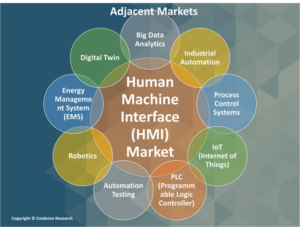
Several adjacent markets have high revenue growth opportunities in the human-machine interface (HMI) market. The key adjacent markets for the human-machine interface (HMI) market -
Request a Free Sample
Fill in your details and we'll send you a free sample report.
- Sample data tables & charts
- Research methodology
Need a Custom Version of This Report?
Tailor the scope, geography, or segments to your exact requirements.
- Custom geography or segment scope
- Direct access to our analyst team
Frequently Asked Questions
How big is the global human-machine interface (HMI) market right now?
What is the projected growth rate of the human-machine interface (HMI) marketbetween 2024 and 2032?
Which market segment leads in terms of HMI device type?
Regarding technology, which market category is in the lead?
Which end-user industry segment is estimated to have the highest CAGR throughout theforecast period?
In which region is the market for human-machine interface (HMI) expanding?
Who are the key participants in the global human-machine interface (HMI) market?
What main market factors drive the human-machine interface (HMI) sector?
Table of Content
Chapter 1. Report Introduction
- 1.1 Report Description & Purpose
- 1.1.1 Report Title & Market Definition
- 1.1.2 Unique Selling Propositions (USP) & Key Differentiators
- 1.1.3 Value Proposition for Stakeholders
- 1.2 Research Objectives
- 1.2.1 Market Sizing Objectives (Volume & Revenue)
- 1.2.2 Segmentation Objectives
- 1.2.3 Competitive Intelligence Objectives
- 1.2.4 Forecast & Scenario Objectives
- 1.3 Report Scope
- 1.3.1 Human Machine Interface (HMI) Scope – Types & Subtypes Covered
- 1.3.2 Geographic Scope – Regions & Countries Covered
- 1.3.3 Historical Period, Base Year & Forecast Period (the historical period; forecast to the forecast period)
- 1.3.4 Inclusions & Exclusions
- 1.4 HS Code & Classification Framework
- 1.5 Currency, Units & Pricing Basis
- 1.6 Target Stakeholders
- 1.7 Limitations & Assumptions
Chapter 2. Executive Summary
- 2.1 Global Human Machine Interface (HMI) Market Snapshot
- 2.1.1 Market Size – Historical (the historical period) & Forecast (the forecast period) (base year: USD 5,515.8 Million → forecast year: USD 11,783.34 Million)
- 2.1.2 Volume & Revenue – Global Totals
- 2.1.3 Key Market Highlights – Top Five Facts
- 2.2 Human Machine Interface (HMI) Market Segmentation Snapshot
- 2.2.1 Market Split by Region – vs.
- 2.3 Competitive Snapshot
- 2.3.1 Top 10 Players by Revenue Share –
- 2.3.2 Top 10 Players by Volume Share –
- 2.3.3 Recent Strategic Developments (18-Month Summary)
- 2.4 Key Investment Highlights & Strategic Conclusions
Chapter 3. Human Machine Interface (HMI) Market Dynamics & Industry Analysis
- 3.1 Market Overview & Context
- 3.1.1 Human Machine Interface (HMI) Market Position in the Broader Automotive Value Chain
- 3.1.2 OEM vs. Replacement Market Dynamics
- 3.1.3 Market Maturity & Development Stage by Region
- 3.2 Human Machine Interface (HMI) Market Drivers
- 3.3 Human Machine Interface (HMI) Market Restraints & Challenges
- 3.4 Human Machine Interface (HMI) Market Opportunities
- 3.5 Porter's Five Forces Analysis
- 3.5.1 Threat of New Entrants
- 3.5.2 Bargaining Power of Suppliers
- 3.5.3 Bargaining Power of Buyers
- 3.5.4 Threat of Substitutes
- 3.5.5 Competitive Rivalry – Intensity Assessment
- 3.6 Human Machine Interface (HMI) Value Chain Analysis
- 3.6.1 Upstream – Raw Material/Input Suppliers
- 3.6.1.1 Raw Material/Input 1
- 3.6.1.2 Raw Material/Input 2
- 3.6.1.3 Raw Material/Input 3
- 3.6.2 Midstream – Production/Manufacturing/Service Delivery
- 3.6.2.1 Production/Process Overview
- 3.6.2.2 Key Facility Locations & Capacity by Manufacturer
- 3.6.3 Downstream – Distribution & End Consumer
- 3.6.3.1 Primary Channel – B2B/OEM
- 3.6.3.2 Secondary Channels – Dealer, Retail, Online, Direct
- 3.6.4 Value Chain Profitability Analysis
- 3.6.1 Upstream – Raw Material/Input Suppliers
- 3.7 PESTEL Analysis
- 3.7.1 Political Factors
- 3.7.2 Economic Factors
- 3.7.3 Social Factors
- 3.7.4 Technological Factors
- 3.7.5 Environmental Factors
- 3.7.6 Legal Factors
- 3.8 Human Machine Interface (HMI) Supply Chain Analysis
- 3.8.1 Raw Material/Input Supply Risk Assessment
- 3.8.2 Manufacturing Concentration Risk (Geographic Exposure)
- 3.8.3 Trade Disruption Impact Analysis
- 3.9 Regulatory & Policy Landscape
Note: The regulatory and policy landscape section covers regulations based on their applicability to the market, Human Machine Interface (HMI) category, geography, and scope of the study. Only regulatory frameworks with a material impact on operations, compliance, trade, sustainability, or market access are analyzed in detail.
Chapter 4. Key Investment Pockets & Opportunity Analysis
- 4.1 Human Machine Interface (HMI) Market Attractiveness Analysis
- 4.1.1 By Region – Investment Attractiveness Matrix (Volume × CAGR)
- 4.2 Absolute Revenue Growth Opportunity
- 4.2.1 By Region – Absolute USD Growth Through the forecast period
- 4.3 Incremental Volume Opportunity
- 4.3.1 By Region – Incremental Volume Through the forecast period
- 4.3.2 Segment – Incremental Volume
- 4.4 Emerging Submarket Opportunity Deep Dive (Subject to Applicability)
- 4.5 Emerging Market Opportunity Scorecards
- 4.5.1 United States
- 4.5.2 Europe
- 4.5.3 Asia
- 4.5.4 Middle East & Africa
Note: Emerging Market Opportunity Scorecards will be included based on relevance and strategic importance. Regions listed are indicative and may vary depending on data availability and market dynamics.
Chapter 5. Human Machine Interface (HMI) Import-Export Analysis & Trade Flows
- 5.1 Global Trade Overview
- 5.1.1 Global Export Value by Country (the historical period)
- 5.1.2 Global Export Volume by Country (the historical period)
- 5.1.3 Global Import Value by Country (the historical period)
- 5.1.4 Global Import Volume by Country (the historical period)
- 5.1.5 Net Trade Balance by Country (the historical period)
- 5.2 Export Analysis – Segment
- 5.2.1 Type 1 (HS Code)
- 5.2.2 Type 2 (HS Code)
- 5.2.3 Type 3 (HS Code)
- 5.2.4 Type 4 (HS Code)
- 5.2.5 Type 5 (HS Code)
- 5.3 Import Analysis – Segment
- 5.3.1 Type 1 (HS Code)
- 5.3.2 Type 2 (HS Code)
- 5.3.3 Type 3 (HS Code)
- 5.3.4 Type 4 (HS Code)
- 5.3.5 Type 5 (HS Code)
- 5.4 Average Unit Trade Prices
- 5.4.1 Average Export Price – Segment & Country
- 5.4.2 Average Import Price – Segment & Source Country
- 5.4.3 Price Trends (the historical period)
- 5.5 Key Trade Route Analysis
- 5.5.1 Trade Route 1
- 5.5.2 Trade Route 2
- 5.5.3 Trade Route 3
- 5.5.4 Trade Route 4
- 5.5.5 Trade Route 5
- 5.6 Trade Policy Impact Assessment
- 5.6.1 US Anti-Dumping & Section 301 Tariffs
- 5.6.2 EU Customs Union Impact
- 5.6.3 Major Free Trade Agreements
- 5.6.4 USMCA Rules of Origin
Note: Trade policy analysis will be included only where relevant to the Human Machine Interface (HMI) market.
Chapter 6. Competitive Landscape & Company Benchmarking
- 6.1 Human Machine Interface (HMI) Market Concentration & Structure
- 6.1.1 Herfindahl-Hirschman Index (HHI) – vs.
- 6.1.2 Tier 1, Tier 2 & Tier 3 Market Structure
- 6.1.3 Global, Regional & Local Player Dynamics
- 6.2 Human Machine Interface (HMI) Market Share Analysis –
- 6.2.1 Global Revenue Share by Company
- 6.2.2 Global Volume Share by Company
- 6.2.3 Regional Revenue Share
- 6.2.4 Market Share Evolution ( vs. )
- 6.2.5 OEM Segment Share by Company
- 6.2.6 Replacement Segment Share by Company
- 6.3 Production/Delivery Capacity & Facility Analysis
- 6.3.1 Global Installed Capacity
- 6.3.2 Capacity Utilization Rates
- 6.3.3 Production/Output Volume
- 6.3.4 Facility Locations & Capacity Map
- 6.3.5 Planned Capacity Additions
- 6.4 Human Machine Interface (HMI) Competitive Benchmarking Matrix
- 6.4.1 Revenue, Volume, CAGR & Profitability Comparison
- 6.4.2 Channel Revenue Mix
- 6.4.3 Geographic Revenue Exposure
- 6.4.4 R&D Intensity
- 6.4.5 Sustainability Maturity
- 6.5 Strategic Developments in Human Machine Interface (HMI) (Last 24 Months)
- 6.5.1 Mergers, Acquisitions & Divestments
- 6.5.2 New Human Machine Interface (HMI) Launches
- 6.5.3 Facility Expansions
- 6.5.4 Strategic Alliances, Joint Ventures & Partnerships
- 6.5.5 Distribution Expansion & Market Entry
- 6.5.6 Sustainability & ESG Initiatives
- 6.6 Competitive Strategy Mapping
- 6.6.1 Leader, Challenger, Follower & Niche Classification
- 6.6.2 Pricing Strategy Comparison
- 6.6.3 Channel Strategy Matrix
Note: Strategic developments are included based on their materiality and the availability of reliable information.
Chapter 7. Global Human Machine Interface (HMI) Market – By Distribution Channel
- 7.1 Segment Overview
- 7.1.1 Volume & Revenue Split by Channel ( & )
- 7.1.2 Channel Mix Evolution (the forecast period)
Chapter 8. Regional Market Analysis – Global Overview
- 8.1 Global Regional Overview
- 8.1.1 Regional Volume Share
- 8.1.2 Regional Revenue Share
- 8.1.3 Regional Volume by Region
- 8.1.4 Regional Revenue by Region
- 8.1.5 Regional Forecast Through the forecast period
- 8.2 Cross-Regional Segment Analysis
- 8.2.1 By Distribution Channel
- 8.2.2 By Brand/Price Tier
Chapter 9. North America Human Machine Interface (HMI) Market
- 9.1 United States
- 9.2 Canada
- 9.3 Mexico
Chapter 10. Europe Human Machine Interface (HMI) Market
- 10.1 Germany
- 10.2 France
- 10.3 Italy
- 10.4 United Kingdom
- 10.5 Spain
- 10.6 Poland
- 10.7 Russia
- 10.8 Netherlands
- 10.9 Belgium
- 10.10 Sweden
- 10.11 Denmark
- 10.12 Norway
- 10.13 Rest of Europe
Chapter 11. Asia Pacific Human Machine Interface (HMI) Market
- 11.1 China
- 11.2 India
- 11.3 Japan
- 11.4 South Korea
- 11.5 Thailand
- 11.6 Indonesia
- 11.7 Vietnam
- 11.8 Malaysia
- 11.9 Australia
- 11.10 Rest of Asia Pacific
Chapter 12. Latin America Human Machine Interface (HMI) Market
- 12.1 Brazil
- 12.2 Argentina
- 12.3 Colombia
- 12.4 Chile
- 12.5 Rest of Latin America
Chapter 13. Middle East Human Machine Interface (HMI) Market
- 13.1 Saudi Arabia
- 13.2 United Arab Emirates
- 13.3 Turkey
- 13.4 Israel
- 13.5 Iran
- 13.6 Rest of the Middle East
Chapter 14. Africa Human Machine Interface (HMI) Market
- 14.1 South Africa
- 14.2 Egypt
- 14.3 Nigeria
- 14.4 Morocco
- 14.5 Rest of Africa
Chapter 15. Human Machine Interface (HMI) Company Profiles
- 15.1 [Company 01]
- 15.1.1 Company Overview
- 15.1.2 Key Management Personnel
- 15.1.3 Products & Services Portfolio
- 15.1.4 Financial Performance
- 15.1.5 Key Market Focus & Geographic Presence
- 15.1.6 Recent Developments & Strategic Initiatives
Note: The company profile list is preliminary and may change based on research findings, market developments, data availability, and client requirements.
Chapter 16. Appendices
- Appendix A – List of Abbreviations & Acronyms
- Appendix B – Industry Classification Code Reference – Full Series
- Appendix C – Production & Capacity Data Tables
- Appendix D – End-Use & Demand Base Tables
- Appendix E – Consumption & Replacement Rate Assumptions
- Appendix F – ASP Reference Tables
- Appendix G – Manufacturing & Facility Database
- Appendix H – Import-Export Data Tables
- Appendix I – Regulatory Summary Tables
- Appendix J – Primary Research Participant List (Anonymized)
- Appendix K – Primary Research Questionnaire Framework
- Appendix L – Data Sources & Bibliography
- Appendix M – Market Size Divergence & Source Comparison
Chapter 17. Research Methodology
- 17.1 Research Framework & Philosophy
- 17.2 Secondary Research – Sources, Hierarchy & Data Extraction
- 17.3 Data Modeling – Bottom-Up & Top-Down Market Sizing
- 17.4 Primary Research – Stakeholder Framework, LOI & Sample Sizes
- 17.5 Forecast Methodology – Regression, Scenario & Sensitivity Analysis
- 17.6 Quality Control – Four-Layer Validation Framework
- 17.7 Limitations & Standard Assumptions
- 17.8 Disclaimer
