
| REPORT ATTRIBUTE | DETAILS |
|---|---|
| Historical Period | 2019-2022 |
| Base Year | 2023 |
| Forecast Period | 2024-2032 |
| Hydraulic Fluid Connectors Market Size 2023 | USD 912.2 Million |
| Hydraulic Fluid Connectors Market, CAGR | 8.00% |
| Hydraulic Fluid Connectors Market Size 2032 | USD 1,823.4 Million |
Market Insights
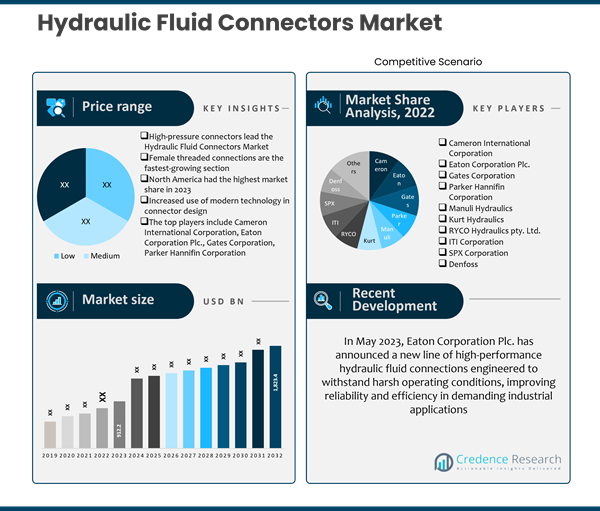
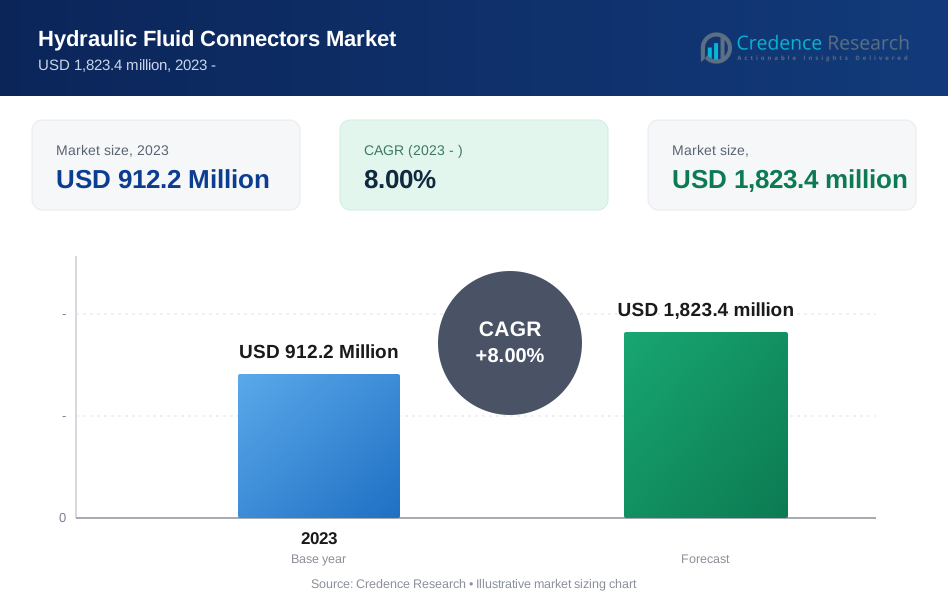
- The global demand for Hydraulic Fluid connectors was valued at USD 912.2 Million in 2023 and is expected to reach USD 1,823.4 Million in 2032, growing at a CAGR of 8.00% between 2024 and 2032.
- Hose fittings dominate the industry, while Quick Couplings are the second largest market share segment.
- Steel connections have the largest market share, while brass connectors are another high-demand market segment.
- Female threaded connections are the fastest-growing portion, while flanged connectors are another highly popular market segment.
- Flanged connectors are another extremely popular market sector, while elbow connectors are another substantial market section.
- High-pressure connectors lead the Hydraulic Fluid Connectors Market, while Medium-Pressure Connectors are also a significant market segment.
- In 2023, aerospace was the largest industry vertical in the global hydraulic fluid connectors market, and the agricultural segment is predicted to have the greatest increase in demand between 2023 and 2032.
- In 2023, North America dominated the hydraulic fluid connectors market, with Asia-Pacific being the fastest-growing region.
- Industrial automation promotes Hydraulic Fluid Connectors Market growth.
- The transition to electric actuators and pneumatic systems slows the growth of the Hydraulic Fluid Connectors Market.
Executive Summary
Market Definition
Hydraulic fluid connectors are transport components used in the liquid force industry for force transmission and other uses. Hoses, tubing, fittings, manifolds, and their assemblies are used in a wide range of pressure-driven applications in company operations such as aircraft, agribusiness hardware, development equipment, maritime, mining, and material handling.
Market Overview
The global Hydraulic Fluid Connectors market has witnessed steady growth in recent years and is expected to grow at a CAGR of 8.00% between 2024 and 2032. The market was valued at USD 912.2 million in 2023 and is expected to reach USD 1,823.4 million in 2032.
Several contributing factors are causing the hydraulic fluid connectors market to grow steadily. Growth in demand for hydraulic systems used in industries such as construction, agriculture, and the automotive market is now one of the sector's primary drivers: hydraulic fluid connectors play an important part in efficient power transfer. Connector design advancements made possible by technical innovation, such as quick-connect fittings or corrosion-resistant raw materials, boost system performance and longevity, driving market expansion even further. Furthermore, as the focus changes to more energy-efficient hydraulic systems, novel connectors that reduce fluid loss and improve overall hydraulic system efficiency are becoming increasingly popular.
However, it is also constrained by factors such as shifting raw material prices, which frequently change so dramatically that a significant adjustment in their price has a large impact on both manufacturing costs and the consequent selling price for many items. Another difficulty that market participants face in terms of compliance and product development is the strict environmental and safety rules for hydraulic systems. Despite these challenges, the Hydraulic Fluid Connectors Market is expected to grow further. This is made feasible by ongoing technological advancements and a surge in hydraulic systems used across a variety of sectors.
Segmentation by Type of Conductor Material
- Hose fittings dominate the market because they are widely used in a variety of sectors to connect hoses to hydraulic systems. Hose fittings are suitable for numerous applications due to their flexibility and ease of installation.
- Quick Couplings are another significant market share category. Quick couplings provide fast and efficient connections, allowing hydraulic systems to be assembled and disassembled easily and quickly.
Segmentation by Materials
- Steel Connectors account for the greatest market share in the Hydraulic Fluid Connectors Market. Steel connections are preferred for their longevity, strength, and resilience to high pressures, making them an excellent choice for demanding industrial applications requiring dependability.
- Brass connectors are another high-demand market category. Brass connectors are highly corrosion resistant, making them ideal for applications involving dampness or severe conditions.
Segmentation by End Connection
- Female threaded connections are the fastest-growing section of the Hydraulic Fluid connections Market. Female threaded connections are becoming increasingly popular due to their ease of installation, adaptability, and compatibility with a diverse range of components.
- Flanged connectors are another highly prominent market sector. Flanged connectors offer a strong and dependable connection, particularly in situations involving high pressures or significant flow rates.
Segmentation by Configuration
- Tee Connectors exhibit the highest CAGR growth rate in the Hydraulic Fluid Connectors Market. Tee connectors are gaining popularity because of their adaptability in splitting flow in hydraulic systems, which allows for more complicated layouts and efficient fluid distribution.
- Elbow Connectors are another significant market segment. Elbow connectors are frequently used in hydraulic systems to shift the flow direction, allowing for greater flexibility in pipeline routing and space restrictions.
Segmentation by Pressure Rating
- The Hydraulic Fluid Connectors Market is dominated by high-pressure connectors. High-pressure connectors are critical in situations where the hydraulic system is subjected to extreme pressure conditions, necessitating connectors that can withstand and preserve system integrity under high pressures.
- Medium-pressure connectors is another prominent market sector.
Segmentation by Industry Vertical
- In 2023, aerospace was the largest Industry Vertical category in the worldwide hydraulic fluid connectors market, closely followed by agriculture. The segment accounted for over 25% of global market sales in the same year. This segment's rise can be due mostly to a constant increase in the manufacturing of civil and military aircraft for leisure, business, and defense purposes.
- The construction industry's rapid rebound during the economic downturn, particularly in industrialized economies, along with infrastructural growth in emerging economies, has contributed to increased demand for hydraulic fluid connectors.
- The agriculture segment is expected to see the greatest increase in demand between 2023 and 2032. With an ever-increasing population, demand for food and textiles rises, pushing up need for hydraulic fluid connectors such as hoses and couplings in equipment such as harvesters and tractors.
Segmentation by Region
- In 2023, North America dominated the hydraulic fluid connectors market.
- Asia-Pacific is the fastest growing region in the Hydraulic Fluid Connectors Market.
- The rest of the world, including Latin America, the Middle East, and Africa, supplies the remaining demand for Hydraulic Fluid Connectors.
In 2023, North America dominated the Hydraulic Fluid Connectors Market for numerous reasons. The region boasts a significant presence of key industry players and manufacturers, resulting in a well-established market infrastructure. Furthermore, North America has a strong demand for hydraulic systems in a variety of industries, including automotive, aerospace, construction, and manufacturing, which drives market expansion. Furthermore, technical improvements and a focus on energy efficiency in the area contribute to North America's dominant position in the Hydraulic Fluid Connectors Market.
Asia Pacific is the fastest expanding region in the Hydraulic Fluid Connectors Market, owing to a variety of factors. The region's fast industrialization, increased investment in infrastructure development, and rising manufacturing sector are all driving demand for hydraulic systems and connectors. Furthermore, the expanding automobile sector in nations such as China, India, and Japan is driving market expansion. Furthermore, the focus on technological developments, rising urbanization, and the adoption of energy-efficient solutions in Asia Pacific are all contributing to the region's quick growth in the Hydraulic Fluid Connectors market.
Key Highlights of the Report
The global Hydraulic Fluid Connectors market is segmented by Type of Conductor Material, Materials, End Connection, Configuration, Pressure Rating, Industry Vertical, price range, and region. Hose fittings dominate the market, with Steel Connectors having the most market share. Furthermore, female threaded connections are the fastest-growing segment, and brass connectors are another popular market category. Also, Tee Connectors display the greatest CAGR growth rate in the Hydraulic Fluid Connectors Market, and Medium-pressure connectors is another major market segment., with North America leading the market growth.
The Hydraulic Fluid Connectors Market is primarily driven by factors such as increased demand for hydraulic systems, technological developments, and an emphasis on energy efficiency. However, variations in raw material prices, regulatory compliance difficulties, and the competitive landscape all provide barriers to market expansion. Despite these constraints, market competitors have potential to expand into emerging areas, develop customized solutions, and highlight sustainability in their offerings. By capitalizing on these drivers and opportunities while effectively controlling the restraints, players in the Hydraulic Fluid Connectors Market can position themselves for success in a competitive industry.
Nonetheless, North America dominated the hydraulic fluid connectors market in 2023 for a variety of factors. The region has a strong presence of key industry players and manufacturers, resulting in a well-developed market infrastructure. Moreover, Asia Pacific is the fastest-growing region in the Hydraulic Fluid Connectors Market due to a number of factors. The region's rapid industrialization, increased investment in infrastructure development, and thriving manufacturing sector are all driving demand for hydraulic systems and connectors.
What Are The Main Drivers Of The Global Hydraulic Fluid Connectors Market?
The Hydraulic Fluid Connectors Market is primarily driven by factors such as increased demand for hydraulic systems, technological developments, and an emphasis on energy efficiency.
What Are The Major Challenges Faced By The Global Hydraulic Fluid Connectors Market?
However, market expansion is hampered by volatility in raw material prices, regulatory compliance concerns, and a competitive environment.
What Are The Growth Opportunities In The Global Hydraulic Fluid Connectors Market?
Despite these constraints, market players have chances to expand into emerging markets, offer tailored solutions, and highlight sustainability in their products. Companies in the Hydraulic Fluid Connectors Market can position themselves for success in a competitive industrial environment by capitalizing on these drivers and opportunities while effectively managing the restrictions.
Market Drivers
Industrial Automation Drives Hydraulic Fluid Connectors Market Growth
One of the major factors fueling growth in the Hydraulic Fluid Connectors Market is increasing industrial automation in several sectors. As industries strive to achieve better efficiency, productivity, and cost-effectiveness, demand for hydraulic systems and connectors also increases to facilitate smooth automation processes. Hydraulic fluid connectors play a very key role in transmitting the power within automated machinery so that the control is precise and the operations are smooth. The hydraulic systems integrated into automated equipment—starting from manufacturing machinery to construction equipment, and even agricultural machinery—are boosting the market growth. This further intensifies with the incorporation of cutting-edge technologies like IoT and robotics that emphasize reliable hydraulic fluid connectors in the contemporary pursuit of industrial automation.
Market Restraints
Transition To Electric Actuators And Pneumatic Systems Hinders Hydraulic Fluid Connectors Market Growth
A key constraint to the growth of the Hydraulic Fluid Connectors Market is increased focus on alternative technologies such as electric actuators and pneumatic systems. While industries are trying to search for green, energy-efficient solutions, there has been a drift towards electrically powered systemswith an aspect of lower carbon emission and reduced maintenance requirements. This transition shakes the hydraulic fluid connectors market, for some applications might turn to other technologies beyond hydraulic systems, thus typically resulting in negative demand for hydraulic fluid connectors. In addition, the size of the upfront investment with respect to hydraulic systems, maintenance complexity against that of other technologies, perplexes the view of potential customers into embracing hydraulic fluid connectors, thereby hindering growth in some segments.
Opportunities
Demand For High-Performance Connectors For Industry Needs
A major growth opportunity for the hydraulic fluid connectors market would be the increasing demand for high-performance and customized connectors to meet specified industry needs. As industries evolve and demand higher efficiencies and specificity related to hydraulic systems, so will the requirements for connectors that can deliver better durability, reliability, and compatibility with diversified applications. By continuous improvement and development of hydraulic fluid connectors, companies can provide solutions tailored to address the challenges of relevant industries—extreme temperatures, high pressure settings, and corrosive conditions. On offer with a custom approach and solutions aimed at optimizing the performance of systems, manufacturers are in a position not only to break into previously absolutely unknown market segments but also to grow in competitive strength. This enables companies to gain a competitive advantage in the marketplace through the delivery of innovative, customized hydraulic fluid connectors, answering the changing needs of industries.
Competitive Landscape
Key Players
The global Hydraulic Fluid Connectors market is highly competitive, with several key players. Some of the major players in the market and their market share are as follows:
- Cameron International Corporation
- Eaton Corporation Plc.
- Gates Corporation
- Parker Hannifin Corporation
- Manuli Hydraulics
- Kurt Hydraulics
- RYCO Hydraulics pty. Ltd.
- ITI Corporation
- SPX Corporation
- Denfoss
These organizations prioritize product innovation, distribution channel expansion, and mergers and acquisitions to stay competitive.
The global Hydraulic Fluid Connectors market's key players continually seek to stay ahead by offering new products and developments.
In April 2023, Manuli Hydraulics introduced a line of revolutionary hydraulic fluid connectors with improved materials and design modifications to boost performance and endurance in essential hydraulic applications.
In February 2024, Parker Hannifin Corporation announced the introduction of a cutting-edge line of environmentally friendly hydraulic fluid connections, stressing sustainability and a lower carbon footprint in hydraulic systems.
How are Companies Performing in the Hydraulic Fluid Connectors Market?
Companies in the hydraulic fluid connectors market have outstanding performances, which are driven by a blend of historical players and pioneering startups. Recent developments within this market have brought changes to traditional connector design, materials, and manufacturing processes to improve solution performance and durability. Sustainability forms one of the crucial areas companies are working on through actions targeted at characteristics involving reduced carbon emissions to provide eco-friendly methods of production and offering energy-efficient solutions. This industry is trending toward making actions involved in it more sustainable to achieve global environmental goals while catering to the increasing demand for hydraulic systems all around the world.
Summary of Key Findings
- The primary market potential is the demand for high-performance connectors for industrial applications.
- Market segmented by Type of Conductor Material, Materials, End Connection, Configuration, Pressure Rating, Industry Vertical, and region.
- Female threaded connections are the fastest-growing segment
- Steel connectors have the highest market share
- North America is leading market growth; the market is highly competitive with key players including Cameron International Corporation, Eaton Corporation Plc., Gates Corporation, Parker Hannifin Corporation.
Future Outlook
- Continued increase in demand for hydraulic systems.
- Increased use of modern technology in connector design.
- Focus on sustainability and energy efficiency.
- Growth into new and emerging markets.
- Innovation in personalized solutions.
- Regulatory issues and compliance needs
How CXOs Can Benefit from the Credence Research Hydraulic Fluid Connectors Market Report
The Credence Research Hydraulic Fluid Connectors Market Report provides CXOs with a comprehensive overview of the market, including:
- Market size and growth forecast:The report provides detailed estimates of the global Hydraulic Fluid Connectors market size, segmented by Type of Conductor Material, Material, End Connection, Configuration, Pressure Rating, Industry Vertical, and region. It also includes forecasts for the market through 2032 based on key trends and drivers.
- Market segmentation:The report segments the Hydraulic Fluid Connectors market by Type of Conductor Material, Material, End Connection, Configuration, Pressure Rating, Industry Vertical, and region. This segmentation provides CXOs with a granular understanding of the market and the opportunities in each segment.
- Competitive Landscape:The report profiles the key players in the Hydraulic Fluid Connectors market and provides insights into their strategies, product offerings, and financial performance. This information can help CXOs to identify and assess their competition.
- Key trends and drivers:The report identifies and analyzes the key trends and drivers that are shaping the Hydraulic Fluid Connectors market. This information can help CXOs to make informed decisions about their investments and strategies.
CXOs can use the insights from the Credence Research Hydraulic Fluid Connectors Market Report to:
- Identify growth opportunities:The report can help CXOs identify new growth opportunities in the Hydraulic Fluid Connectors market. For example, by studying the increasing demand for customized connectors to meet specific industry needs, CXOs can explore the potential for developing specialized hydraulic fluid connectors that cater to unique applications.
- Make informed investment decisions:The report can help CXOs to make informed investment decisions about Hydraulic Fluid Connectors. For example, by analyzing factors such as the growth potential of the market, key players' strategies, and emerging technologies, CXOs can evaluate the investment opportunities in the sector.
- Develop competitive strategies:The report can help CXOs to develop competitive strategies for their Hydraulic Fluid Connectors businesses. For example, the report might provide a comprehensive overview of the key players in the market, their product offerings, pricing strategies, and market share
- Track market developments:The report can help CXOs track market developments and stay ahead of the curve. For example, the report provides insights into the latest trends and innovations in the Hydraulic Fluid Connectors market.
Overall, the Credence Research Hydraulic Fluid Connectors Market Report is a valuable resource for CXOs who are looking to gain a deeper understanding of the market and identify opportunities for growth.
Segmentation
-
Connector Type:
- Hose Fittings
- Tube Fittings
- Flanges and Flange Adapters
- Quick Couplings
-
Material:
- Steel Connectors
- Brass Connectors
- Aluminum Connectors
- Plastic Connectors
-
End Connection:
- Male Threaded
- Female Threaded
- Welded
- Flanged
-
Configuration:
- Straight Connectors
- Elbow Connectors
- Tee Connectors
- Cross Connectors
- Reducer Connectors
- Bulkhead Connectors
-
Pressure Rating:
- Low-Pressure Connectors
- Medium-Pressure Connectors
- High-Pressure Connectors
-
Industry Vertical:
- Construction and Mining
- Agriculture
- Automotive
- Oil and Gas
- Aerospace and Defense
- Marine
- Manufacturing
-
By Region
- North America
- US
- Canada
- Mexico
- Europe
- Germany
- France
- UK
- Italy
- Spain
- Rest of Europe
- Asia Pacific
- China
- Japan
- India
- South Korea
- South-east Asia
- Rest of Asia Pacific
- Latin America
- Brazil
- Argentina
- Rest of Latin America
- Middle East & Africa
- GCC Countries
- South Africa
- Rest of Middle East and Africa
- North America
Adjacent Markets
In the Hydraulic Fluid Connectors market, there are several adjacent markets which has high revenue growth opportunities. The key adjacent markets for Hydraulic Fluid Connectors market -
Adjacent Markets |
||
| Pneumatic Components Market | Hydraulic Pump Market | Hydraulic Filter Market |
| Industrial Hose Market | Hydraulic Valve Market | Hydraulic Motor Market |
| Hydraulic Cylinder Market | Hydraulic Power Unit Market | Hydraulic Seals Market |
Request a Free Sample
Fill in your details and we'll send you a free sample report.
- Sample data tables & charts
- Research methodology
Need a Custom Version of This Report?
Tailor the scope, geography, or segments to your exact requirements.
- Custom geography or segment scope
- Direct access to our analyst team
Frequently Asked Questions
What is the current size of the global Hydraulic Fluid Connectors market?
What is the expected growth rate of the Hydraulic Fluid Connectors market between 2024 and 2032?
Which segment is leading the market share in terms of Pressure Rating?
Which Industry Vertical segment governs the demand for Hydraulic Fluid connectors in the world?
Which Configuration segment is expected to post the highest CAGR during the forecast period?
Which region is fueling the growth of the Hydraulic Fluid Connectors industry?
Who are the major players in the global Hydraulic Fluid Connectors market?
What are the major market drivers of the Hydraulic Fluid Connectors industry?
What are the major market restraints of the Hydraulic Fluid Connectors industry?
What are the major market opportunities of the Hydraulic Fluid Connectors industry?
Table of Content
Chapter 1. Report Introduction
- 1.1 Report Description & Purpose
- 1.1.1 Report Title & Market Definition
- 1.1.2 Unique Selling Propositions (USP) & Key Differentiators
- 1.1.3 Value Proposition for Stakeholders
- 1.2 Research Objectives
- 1.2.1 Market Sizing Objectives (Volume & Revenue)
- 1.2.2 Segmentation Objectives
- 1.2.3 Competitive Intelligence Objectives
- 1.2.4 Forecast & Scenario Objectives
- 1.3 Report Scope
- 1.3.1 Hydraulic Fluid Connectors Scope – Types & Subtypes Covered
- 1.3.2 Geographic Scope – Regions & Countries Covered
- 1.3.3 Historical Period, Base Year & Forecast Period (2023; forecast to the forecast period)
- 1.3.4 Inclusions & Exclusions
- 1.4 HS Code & Classification Framework
- 1.5 Currency, Units & Pricing Basis
- 1.6 Target Stakeholders
- 1.7 Limitations & Assumptions
Chapter 2. Executive Summary
- 2.1 Global Hydraulic Fluid Connectors Market Snapshot
- 2.1.1 Market Size – Historical (2023) & Forecast (the forecast period) (2023: USD 912.2 Million → forecast year: USD 1,823.4 million)
- 2.1.2 Volume & Revenue – Global Totals
- 2.1.3 Key Market Highlights – Top Five Facts
- 2.2 Hydraulic Fluid Connectors Market Segmentation Snapshot
- 2.2.1 Market Split by Region – 2023 vs.
- 2.3 Competitive Snapshot
- 2.3.1 Top 10 Players by Revenue Share – 2023
- 2.3.2 Top 10 Players by Volume Share – 2023
- 2.3.3 Recent Strategic Developments (18-Month Summary)
- 2.4 Key Investment Highlights & Strategic Conclusions
Chapter 3. Hydraulic Fluid Connectors Market Dynamics & Industry Analysis
- 3.1 Market Overview & Context
- 3.1.1 Hydraulic Fluid Connectors Market Position in the Broader Automotive Value Chain
- 3.1.2 OEM vs. Replacement Market Dynamics
- 3.1.3 Market Maturity & Development Stage by Region
- 3.2 Hydraulic Fluid Connectors Market Drivers
- 3.3 Hydraulic Fluid Connectors Market Restraints & Challenges
- 3.4 Hydraulic Fluid Connectors Market Opportunities
- 3.5 Porter's Five Forces Analysis
- 3.5.1 Threat of New Entrants
- 3.5.2 Bargaining Power of Suppliers
- 3.5.3 Bargaining Power of Buyers
- 3.5.4 Threat of Substitutes
- 3.5.5 Competitive Rivalry – Intensity Assessment
- 3.6 Hydraulic Fluid Connectors Value Chain Analysis
- 3.6.1 Upstream – Raw Material/Input Suppliers
- 3.6.1.1 Raw Material/Input 1
- 3.6.1.2 Raw Material/Input 2
- 3.6.1.3 Raw Material/Input 3
- 3.6.2 Midstream – Production/Manufacturing/Service Delivery
- 3.6.2.1 Production/Process Overview
- 3.6.2.2 Key Facility Locations & Capacity by Manufacturer
- 3.6.3 Downstream – Distribution & End Consumer
- 3.6.3.1 Primary Channel – B2B/OEM
- 3.6.3.2 Secondary Channels – Dealer, Retail, Online, Direct
- 3.6.4 Value Chain Profitability Analysis
- 3.6.1 Upstream – Raw Material/Input Suppliers
- 3.7 PESTEL Analysis
- 3.7.1 Political Factors
- 3.7.2 Economic Factors
- 3.7.3 Social Factors
- 3.7.4 Technological Factors
- 3.7.5 Environmental Factors
- 3.7.6 Legal Factors
- 3.8 Hydraulic Fluid Connectors Supply Chain Analysis
- 3.8.1 Raw Material/Input Supply Risk Assessment
- 3.8.2 Manufacturing Concentration Risk (Geographic Exposure)
- 3.8.3 Trade Disruption Impact Analysis
- 3.9 Regulatory & Policy Landscape
Note: The regulatory and policy landscape section covers regulations based on their applicability to the market, Hydraulic Fluid Connectors category, geography, and scope of the study. Only regulatory frameworks with a material impact on operations, compliance, trade, sustainability, or market access are analyzed in detail.
Chapter 4. Key Investment Pockets & Opportunity Analysis
- 4.1 Hydraulic Fluid Connectors Market Attractiveness Analysis
- 4.1.1 By Region – Investment Attractiveness Matrix (Volume × CAGR)
- 4.2 Absolute Revenue Growth Opportunity
- 4.2.1 By Region – Absolute USD Growth Through the forecast period
- 4.3 Incremental Volume Opportunity
- 4.3.1 By Region – Incremental Volume Through the forecast period
- 4.3.2 Segment – Incremental Volume
- 4.4 Emerging Submarket Opportunity Deep Dive (Subject to Applicability)
- 4.5 Emerging Market Opportunity Scorecards
- 4.5.1 United States
- 4.5.2 Europe
- 4.5.3 Asia
- 4.5.4 Middle East & Africa
Note: Emerging Market Opportunity Scorecards will be included based on relevance and strategic importance. Regions listed are indicative and may vary depending on data availability and market dynamics.
Chapter 5. Hydraulic Fluid Connectors Import-Export Analysis & Trade Flows
- 5.1 Global Trade Overview
- 5.1.1 Global Export Value by Country (2023)
- 5.1.2 Global Export Volume by Country (2023)
- 5.1.3 Global Import Value by Country (2023)
- 5.1.4 Global Import Volume by Country (2023)
- 5.1.5 Net Trade Balance by Country (2023)
- 5.2 Export Analysis – Segment
- 5.2.1 Type 1 (HS Code)
- 5.2.2 Type 2 (HS Code)
- 5.2.3 Type 3 (HS Code)
- 5.2.4 Type 4 (HS Code)
- 5.2.5 Type 5 (HS Code)
- 5.3 Import Analysis – Segment
- 5.3.1 Type 1 (HS Code)
- 5.3.2 Type 2 (HS Code)
- 5.3.3 Type 3 (HS Code)
- 5.3.4 Type 4 (HS Code)
- 5.3.5 Type 5 (HS Code)
- 5.4 Average Unit Trade Prices
- 5.4.1 Average Export Price – Segment & Country
- 5.4.2 Average Import Price – Segment & Source Country
- 5.4.3 Price Trends (2023)
- 5.5 Key Trade Route Analysis
- 5.5.1 Trade Route 1
- 5.5.2 Trade Route 2
- 5.5.3 Trade Route 3
- 5.5.4 Trade Route 4
- 5.5.5 Trade Route 5
- 5.6 Trade Policy Impact Assessment
- 5.6.1 US Anti-Dumping & Section 301 Tariffs
- 5.6.2 EU Customs Union Impact
- 5.6.3 Major Free Trade Agreements
- 5.6.4 USMCA Rules of Origin
Note: Trade policy analysis will be included only where relevant to the Hydraulic Fluid Connectors market.
Chapter 6. Competitive Landscape & Company Benchmarking
- 6.1 Hydraulic Fluid Connectors Market Concentration & Structure
- 6.1.1 Herfindahl-Hirschman Index (HHI) – vs. 2023
- 6.1.2 Tier 1, Tier 2 & Tier 3 Market Structure
- 6.1.3 Global, Regional & Local Player Dynamics
- 6.2 Hydraulic Fluid Connectors Market Share Analysis – 2023
- 6.2.1 Global Revenue Share by Company
- 6.2.2 Global Volume Share by Company
- 6.2.3 Regional Revenue Share
- 6.2.4 Market Share Evolution ( vs. 2023)
- 6.2.5 OEM Segment Share by Company
- 6.2.6 Replacement Segment Share by Company
- 6.3 Production/Delivery Capacity & Facility Analysis
- 6.3.1 Global Installed Capacity
- 6.3.2 Capacity Utilization Rates
- 6.3.3 Production/Output Volume
- 6.3.4 Facility Locations & Capacity Map
- 6.3.5 Planned Capacity Additions
- 6.4 Hydraulic Fluid Connectors Competitive Benchmarking Matrix
- 6.4.1 Revenue, Volume, CAGR & Profitability Comparison
- 6.4.2 Channel Revenue Mix
- 6.4.3 Geographic Revenue Exposure
- 6.4.4 R&D Intensity
- 6.4.5 Sustainability Maturity
- 6.5 Strategic Developments in Hydraulic Fluid Connectors (Last 24 Months)
- 6.5.1 Mergers, Acquisitions & Divestments
- 6.5.2 New Hydraulic Fluid Connectors Launches
- 6.5.3 Facility Expansions
- 6.5.4 Strategic Alliances, Joint Ventures & Partnerships
- 6.5.5 Distribution Expansion & Market Entry
- 6.5.6 Sustainability & ESG Initiatives
- 6.6 Competitive Strategy Mapping
- 6.6.1 Leader, Challenger, Follower & Niche Classification
- 6.6.2 Pricing Strategy Comparison
- 6.6.3 Channel Strategy Matrix
Note: Strategic developments are included based on their materiality and the availability of reliable information.
Chapter 7. Global Hydraulic Fluid Connectors Market – By Distribution Channel
- 7.1 Segment Overview
- 7.1.1 Volume & Revenue Split by Channel (2023 & )
- 7.1.2 Channel Mix Evolution (the forecast period)
Chapter 8. Regional Market Analysis – Global Overview
- 8.1 Global Regional Overview
- 8.1.1 Regional Volume Share
- 8.1.2 Regional Revenue Share
- 8.1.3 Regional Volume by Region
- 8.1.4 Regional Revenue by Region
- 8.1.5 Regional Forecast Through the forecast period
- 8.2 Cross-Regional Segment Analysis
- 8.2.1 By Distribution Channel
- 8.2.2 By Brand/Price Tier
Chapter 9. North America Hydraulic Fluid Connectors Market
- 9.1 United States
- 9.2 Canada
- 9.3 Mexico
Chapter 10. Europe Hydraulic Fluid Connectors Market
- 10.1 Germany
- 10.2 France
- 10.3 Italy
- 10.4 United Kingdom
- 10.5 Spain
- 10.6 Poland
- 10.7 Russia
- 10.8 Netherlands
- 10.9 Belgium
- 10.10 Sweden
- 10.11 Denmark
- 10.12 Norway
- 10.13 Rest of Europe
Chapter 11. Asia Pacific Hydraulic Fluid Connectors Market
- 11.1 China
- 11.2 India
- 11.3 Japan
- 11.4 South Korea
- 11.5 Thailand
- 11.6 Indonesia
- 11.7 Vietnam
- 11.8 Malaysia
- 11.9 Australia
- 11.10 Rest of Asia Pacific
Chapter 12. Latin America Hydraulic Fluid Connectors Market
- 12.1 Brazil
- 12.2 Argentina
- 12.3 Colombia
- 12.4 Chile
- 12.5 Rest of Latin America
Chapter 13. Middle East Hydraulic Fluid Connectors Market
- 13.1 Saudi Arabia
- 13.2 United Arab Emirates
- 13.3 Turkey
- 13.4 Israel
- 13.5 Iran
- 13.6 Rest of the Middle East
Chapter 14. Africa Hydraulic Fluid Connectors Market
- 14.1 South Africa
- 14.2 Egypt
- 14.3 Nigeria
- 14.4 Morocco
- 14.5 Rest of Africa
Chapter 15. Hydraulic Fluid Connectors Company Profiles
- 15.1 [Company 01]
- 15.1.1 Company Overview
- 15.1.2 Key Management Personnel
- 15.1.3 Products & Services Portfolio
- 15.1.4 Financial Performance
- 15.1.5 Key Market Focus & Geographic Presence
- 15.1.6 Recent Developments & Strategic Initiatives
Note: The company profile list is preliminary and may change based on research findings, market developments, data availability, and client requirements.
Chapter 16. Appendices
- Appendix A – List of Abbreviations & Acronyms
- Appendix B – Industry Classification Code Reference – Full Series
- Appendix C – Production & Capacity Data Tables
- Appendix D – End-Use & Demand Base Tables
- Appendix E – Consumption & Replacement Rate Assumptions
- Appendix F – ASP Reference Tables
- Appendix G – Manufacturing & Facility Database
- Appendix H – Import-Export Data Tables
- Appendix I – Regulatory Summary Tables
- Appendix J – Primary Research Participant List (Anonymized)
- Appendix K – Primary Research Questionnaire Framework
- Appendix L – Data Sources & Bibliography
- Appendix M – Market Size Divergence & Source Comparison
Chapter 17. Research Methodology
- 17.1 Research Framework & Philosophy
- 17.2 Secondary Research – Sources, Hierarchy & Data Extraction
- 17.3 Data Modeling – Bottom-Up & Top-Down Market Sizing
- 17.4 Primary Research – Stakeholder Framework, LOI & Sample Sizes
- 17.5 Forecast Methodology – Regression, Scenario & Sensitivity Analysis
- 17.6 Quality Control – Four-Layer Validation Framework
- 17.7 Limitations & Standard Assumptions
- 17.8 Disclaimer
