
| REPORT ATTRIBUTE | DETAILS |
|---|---|
| Historical Period | 2019-2022 |
| Base Year | 2023 |
| Forecast Period | 2024-2032 |
| Hypodermic Needles Market Size 2023 | USD 2354.20 million |
| Hypodermic Needles Market, CAGR | 6.30% |
| Hypodermic Needles Market Size 2032 | USD 4079.84 million |
Market Insights
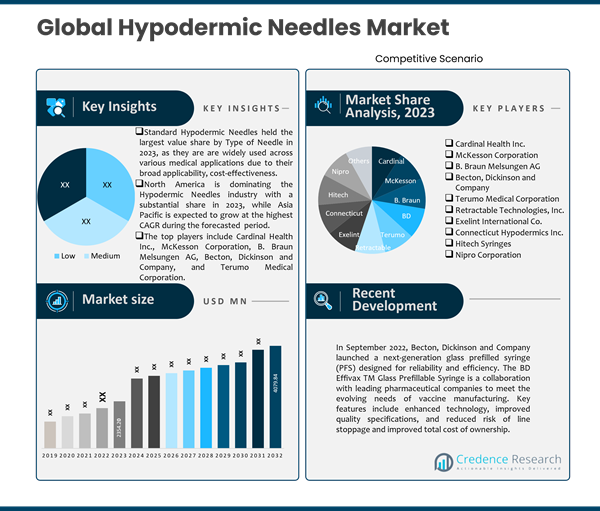
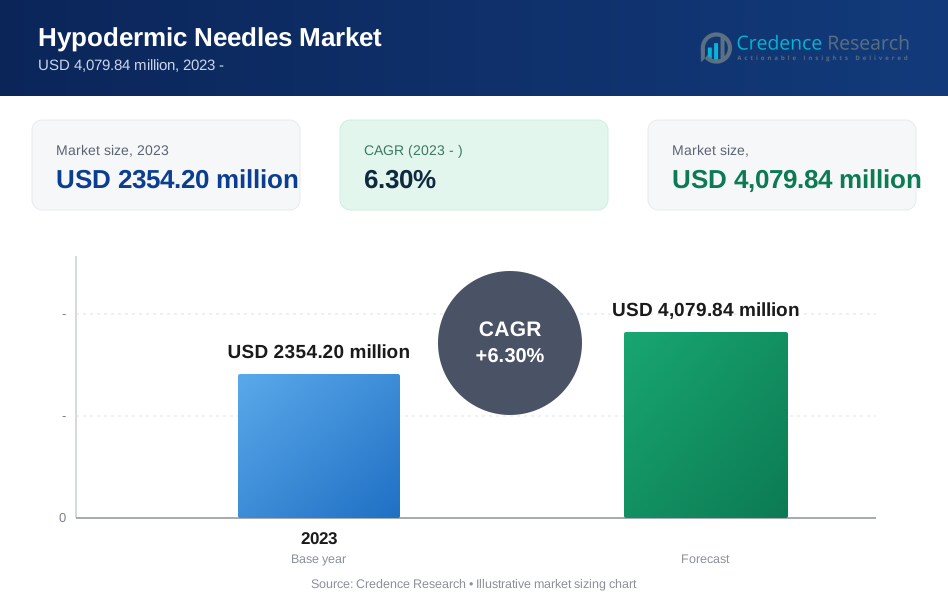
- The global demand for hypodermic needles was valued at USD 2354.20 million in 2023 and is expected to reach USD 4079.84 million in 2032, growing at a CAGR of 6.30% between 2024 and 2032.
- The Standard Hypodermic Needles segment was the market leader by Type of Needles, accounting for the highest share in value in 2023, and the Safety Hypodermic Needles segment is expected to grow rapidly throughout the forecast period.
- The Steel Needles segment was the market leader by Material, accounting for the highest share in value in 2023, and the Plastic Needles segment is expected to grow rapidly throughout the forecast period.
- The Therapeutic Injections segment was the market leader by Application, accounting for the highest share in value in 2023, and the Blood Collection segment is expected to grow rapidly throughout the forecast period.
- The Home Healthcare Settings segment is predicted to grow fastest over the projection period, while Hospitals and Clinics had the largest share by application in 2023.
- North America is dominating the Hypodermic Needles industry, with over one-third of the market in 2023.
- The market's primary possibilities include advancements in safety features, integration of smart technology, and customization for patient needs.
Executive Summary
Market Definition
A hypodermic needle is a medical device used to inject substances into the body or extract fluids from it. It consists of a thin, hollow, cylindrical needle made of stainless steel that is attached to a syringe. Hypodermic needles are commonly used for administering medications, vaccines, and other treatments, as well as for drawing blood samples. They come in various lengths and gauges to accommodate different medical needs and patient sizes. The term "hypodermic" means "under the skin," reflecting the needle's primary function of delivering substances directly into the tissue beneath the skin or into veins.
Market Overview
The global hypodermic needles market has witnessed steady growth in recent years and is expected to grow at a CAGR of 6.30% between 2024 and 2032. The market was valued at USD 2354.20 million in 2023 and is expected to reach USD 4079.84 million in 2032.
The growth of the Hypodermic Needles Market is significantly driven by the increasing prevalence of chronic diseases such as diabetes, cancer, and cardiovascular conditions. These diseases often require regular administration of medications and frequent blood tests, which in turn drives the demand for hypodermic needles. Additionally, the global population is aging, leading to a higher demand for various healthcare services, including injections and blood sampling. The growing geriatric population thus significantly contributes to the increased use of hypodermic needles.
Vaccination programs also play a crucial role in the expansion of the hypodermic needles market. With a heightened emphasis on immunization against infectious diseases such as influenza and COVID-19, the need for hypodermic needles has surged. Moreover, government initiatives and immunization programs are also pivotal in driving the growth of the hypodermic needles market. Policies aimed at promoting immunization and preventing diseases ensure a steady demand for hypodermic needles. Additionally, the increasing focus on infection control in healthcare settings boosts the use of disposable hypodermic needles to prevent cross-contamination. Growing awareness about the importance of maintaining stringent infection control measures enhances the market demand for high-quality, disposable hypodermic needles.
Furthermore, healthcare expenditure is on the rise globally, both in developed and developing countries. This increase in spending facilitates better access to medical treatments that require hypodermic needles. In addition, the growing trend toward home healthcare and the self-administration of medications has resulted in a higher demand for user-friendly hypodermic needles. As more patients opt for home-based care, the market for hypodermic needles continues to expand.
Segmentation by Type of Needle
- Standard Hypodermic Needles is the leading segment by Type of Needles and held the dominant share in value in 2023. These needles are widely used across various medical applications, including injections, vaccinations, and blood draws, due to their broad applicability, cost-effectiveness, and established presence in the market. Their extensive use in both healthcare facilities and home care settings contributes to their dominant market position.
- The Safety Hypodermic Needles segment is expected to exhibit the highest CAGR during the forecast period. This rapid growth is driven by increasing awareness of needlestick injuries and their associated health risks, leading to greater demand for safer needle alternatives. Regulatory mandates and guidelines promoting the use of safety-engineered devices to protect healthcare workers also bolster this segment’s growth. Innovations in safety needle designs, which improve usability and patient comfort, further accelerate their adoption and market expansion.
- Other segments, such as Pen Needles, IV Cannula Needles, and Blood Collection Needles segments, are anticipated to grow moderately during the forecasted period.
Segmentation by Material
- Steel Needles is the leading segment by Material and holds a substantial share in 2023. These needles have been the standard choice for medical procedures for many years due to their durability, sharpness, and reliability. Stainless steel needles are widely used across various applications, including injections, blood draws, and intravenous therapy, making them a preferred choice among healthcare professionals.
- Plastic Needles are the fastest-growing subsegment during the forecast period. This rapid growth is attributed to several factors, including advancements in polymer technology, increasing demand for single-use and disposable medical devices, and the development of specialized plastic needle designs for specific medical applications. Plastic needles offer advantages such as reduced risk of needlestick injuries, compatibility with certain medications, and customization options for unique patient needs, driving their adoption and market expansion.
Segmentation by Application
- Therapeutic Injections is the leading segment by Application and holds a substantial share in 2023. This subsegment encompasses a wide range of medical treatments, including the administration of medications, vaccines, and hormone therapies. Therapeutic injections are indispensable in managing various health conditions, from chronic diseases such as diabetes and arthritis to acute conditions requiring immediate treatment.
- Blood Collection is the fastest-growing segment during the forecast period. This rapid growth is driven by several factors, including increasing demand for blood tests for diagnostic purposes, screening, and monitoring of health conditions. As healthcare systems worldwide prioritize preventive care and early detection of diseases, the need for efficient and reliable blood collection methods is on the rise. Hypodermic needles play a critical role in blood collection procedures, making this subsegment a key growth driver in the market.
- Diagnostic Procedures also contribute substantially to the market share.
Segmentation by End User
- The Hospitals and Clinics held the largest market share by application in terms of value in 2023. These healthcare facilities are primary points of care delivery and handle a wide range of medical procedures, including therapeutic injections, diagnostic tests, and blood collection. The high volume of patient visits and medical procedures conducted in hospitals and clinics contributes to their significant demand for hypodermic needles.
- The Home Healthcare Settings is expected to be the fastest-growing segment during the forecasted period. This rapid growth is driven by several factors, including the increasing trend towards home-based medical care, advancements in medical technology, and the desire for patient convenience and comfort. As healthcare delivery shifts towards more patient-centric and cost-effective models, the demand for hypodermic needles suitable for use in home settings is on the rise. Additionally, the aging population and the prevalence of chronic diseases contribute to the growing need for home healthcare services, further fueling market growth.
- The Diagnostic Laboratories is projected to grow at a moderate CAGR and hold a lower share than the Hospitals and Clinics segment.
Segmentation by Region
- North America dominated the Hypodermic Needles industry in 2023, driven by the increasing prevalence of chronic diseases requiring frequent medical interventions, including drug administration through hypodermic needles.
- Asia Pacific is anticipated to showcase the highest growth rate during the forecasted period, propelled by the region's increasing prevalence of lifestyle diseases such as diabetes and obesity.
- The rest of the world, including Latin America, the Middle East, and Africa, supplies the remaining demand for retail inventory management software.
North America holds the dominant share of the hypodermic needles market and is expected to maintain its dominance during the forecast period. This dominance is attributed to the increasing prevalence of chronic diseases such as cancer and cardiovascular diseases in this region. Chronic diseases require frequent medical interventions, including drug administration through hypodermic needles, thus driving the demand for these needles. For instance, cancer patients undergoing chemotherapy and patients with cardiovascular diseases require hypodermic needles for administering medications or treatments.
Additionally, the enforcement of legislation by governments in this region mandates the use of safety syringes, which further drives the demand for hypodermic needles in the region. Safety syringes are designed to prevent needlestick injuries and reduce the risk of bloodborne infections among healthcare workers. Legislation such as the Needlestick Safety and Prevention Act in the United States requires healthcare facilities to use safety-engineered devices, including hypodermic needles. This regulatory environment ensures a steady demand for advanced hypodermic needles equipped with safety features, contributing to the market's growth in North America.
On the other hand, the Asia Pacific region is expected to be the fastest-growing market for hypodermic needles during the forecast period due to the high prevalence of diabetes, which significantly increases the demand for hypodermic needles. Diabetes increases the demand for hypodermic needles because diabetic patients require regular insulin injections to manage their blood sugar levels. According to the International Diabetes Federation (IDF), the total number of people living with diabetes is projected to rise to 113 million by 2030 in the South East Asia region.
Key Highlights of the Report
The global hypodermic needles market is segmented by Type of Needles, Material, Application, End User, and region. The Standard Hypodermic Needles segment dominated the market in 2023, holding the largest value share. However, Safety Hypodermic Needles are expected to see the fastest growth, and Hospitals and Clinics remain the primary End User, with North America leading the market share.
The global hypodermic needles market is growing due to the increasing prevalence of chronic diseases and an aging population that necessitates frequent medical injections and blood tests. Rising vaccination programs, advancements in needle technology, and greater healthcare spending further boost demand. Additionally, a heightened focus on infection control and prevention of needlestick injuries promotes the adoption of advanced, disposable hypodermic needles. Moreover, government initiatives and the expanding pharmaceutical industry also contribute to market growth.
Nonetheless, while North America led growth in the Hypodermic Needles industry in 2023, driven by the increasing prevalence of chronic diseases and stringent safety regulations, Asia Pacific is set for the highest forecasted growth, fueled by the rising prevalence of diabetes and increasing healthcare demands in the region.
What Are The Main Drivers Of The Global Hypodermic Needles Market?
The global hypodermic needles market is growing due to the increasing prevalence of chronic diseases and an aging population that necessitates frequent medical injections and blood tests. Rising vaccination programs, advancements in needle technology, and greater healthcare spending further boost demand. Additionally, a heightened focus on infection control and prevention of needlestick injuries promotes the adoption of advanced, disposable hypodermic needles. Moreover, government initiatives and the expanding pharmaceutical industry also contribute to market growth.
What are The Major Challenges Faced By The Global Hypodermic Needles Market?
The risk of needlestick injuries, which pose a serious health threat to healthcare workers and patients, is a major challenge to the expansion of the Hypodermic Needles Market. These injuries can lead to the transmission of bloodborne pathogens such as HIV and hepatitis, necessitating stringent safety protocols and innovative needle designs. Implementing these safety measures can be costly and complex. Additionally, the high cost associated with advanced hypodermic needles is a considerable barrier, restraining the growth of the market.
What Are The Growth Opportunities In The Global Hypodermic Needles Market?
Technological advancements in needle safety are poised to create substantial growth opportunities for the hypodermic needles market. These innovations enhance safety, efficiency, and user experience, aligning with regulatory trends and the growing demand for safer, more effective medical devices. By investing in and adopting these advanced technologies, the market can meet the evolving needs of healthcare providers and patients, driving future expansion and success.
Market Drivers
Growing Incidence of Chronic Diseases
The increasing prevalence of chronic diseases such as diabetes, cancer, and cardiovascular conditions is a significant factor driving the growth of the global hypodermic needles market. According to the World Health Organization (WHO), by 2050, chronic diseases will account for 86% of the 90 million annual deaths, representing a 90% increase since 2019. The International Agency for Research on Cancer (IARC) revealed that there were 9.7 million cancer deaths and 20 million new cancer cases in 2022, with new cases predicted to reach 35 million by 2050, which is a 77% increase. This rise will be most pronounced in low and medium-HDI countries, with cancer incidence increasing by 142% and 99%, respectively, and cancer mortality nearly doubling by 2050.
Moreover, deaths from cardiovascular disease (CVD) have surged globally from 12.1 million in 1990 to 20.5 million in 2021, as reported by the World Heart Federation (WHF). These chronic conditions necessitate regular administration of medications and frequent blood tests, which in turn drives the demand for hypodermic needles.
Additionally, the aging global population significantly contributes to this demand. The World Economic Forum projects that the number of people aged 65 and older will double by 2050, reaching 1.6 billion. The WHO further estimates that by 2030, one in six people globally will be aged 60 years or over, with the number of individuals aged 80 years or older expected to triple between 2020 and 2050, reaching 426 million. The growing geriatric population, which requires increased healthcare services, including injections and blood sampling, thus significantly boosts the need for hypodermic needles. These combined factors underscore the robust expansion of the hypodermic needles market.
Market Restraints
Risk of Needlestick Injuries
A significant factor restraining the growth of the hypodermic needles market is the inherent risk of needlestick injuries, which pose serious health threats to healthcare workers and patients. These injuries can result in the transmission of bloodborne pathogens, such as HIV and hepatitis, necessitating the implementation of stringent safety protocols and the development of innovative needle designs.
Moreover, the financial burden associated with advanced hypodermic needles is a considerable barrier to market growth. Safety-engineered needles and those equipped with special features are significantly more expensive than traditional needles. This price differential makes them less accessible, particularly in low-income regions where healthcare budgets are often constrained, thereby limiting the overall adoption of advanced hypodermic needles.
Opportunities
Technological Advancements in Needle Safety
Technological advancements in needle safety present a significant opportunity for the future growth of the hypodermic needles market. Innovations in needle design and safety mechanisms are driving the development of safer and more efficient hypodermic needles, addressing critical concerns around needlestick injuries and infection transmission. These advancements include the creation of retractable needles, which automatically withdraw after use to prevent accidental needlestick injuries and needles with built-in safety shields that cover the needle immediately after it is withdrawn from the patient.
The integration of smart technology into hypodermic needles is another promising development. Smart needles equipped with sensors can monitor and report on various parameters during injection, ensuring proper administration of medications and enhancing patient outcomes. Such technological innovations increase the efficiency and ease of use of hypodermic needles, making them more appealing to healthcare providers.
The push for these advanced safety features is also supported by regulatory bodies and healthcare organizations that prioritize patient and worker safety. As regulations become more stringent regarding the use of safe medical devices, the demand for technologically advanced hypodermic needles is expected to rise. This regulatory environment creates a conducive market for manufacturers to invest in and develop cutting-edge needle technologies.
Competitive Landscape
Key Players
The global hypodermic needles market is highly competitive, with several key players. Some of the major players in the market:
- Cardinal Health Inc.
- McKesson Corporation
- B. Braun Melsungen AG
- Becton, Dickinson and Company
- Terumo Medical Corporation
- Retractable Technologies, Inc.
- Exelint International Co.
- Connecticut Hypodermics Inc.
- Hitech Syringes
- Nipro Corporation
These organizations prioritize product innovation, partnerships, and collaborations to stay competitive.
The global hypodermic needles market's key players continually seek to stay ahead by launching new products.
In September 2022, Becton, Dickinson, and Company launched a next-generation glass prefilled syringe (PFS) designed for reliability and efficiency. The BD Effivax TM Glass Prefillable Syringe is a collaboration with leading pharmaceutical companies to meet the evolving needs of vaccine manufacturing. Key features include enhanced technology, improved quality specifications, reduced risk of line stoppage, and improved total cost of ownership.
How are Companies Performing in the Hypodermic Needles Market?
The global hypodermic needles market is highly competitive, with several key players.
Startups are playing a pivotal role in advancing the hypodermic needles industry by introducing innovative technologies and addressing key challenges such as safety, efficiency, and user experience. These emerging companies are often more agile and willing to take risks, leading to groundbreaking developments that can significantly impact the market.
One notable startup in this field is Retractable Technologies, Inc. This company has developed the VanishPoint needle, which features an automatic retraction mechanism to prevent needlestick injuries. Their technology has been widely recognized for its effectiveness in enhancing safety for healthcare workers, showcasing how startups can lead the way in creating safer medical devices.
Credence MedSystems is a startup focused on creating safer and more effective drug delivery systems. Their primary innovation is the Credence Companion Safety Syringe System, which features automatic needle retraction and a passive needle shield. This system enhances safety by reducing the risk of needlestick injuries and ensuring that the needle is fully enclosed after use. Credence's approach exemplifies how startups can improve the safety and usability of hypodermic needles.
Additionally, Portal Instruments is pioneering needle-free injection technology. Their system uses a precise, high-speed jet to deliver medication through the skin without a needle. This technology not only reduces pain and anxiety associated with needle injections but also opens up new possibilities for drug delivery that are less invasive and more comfortable for patients. Portal Instruments' innovation demonstrates the potential for startups to revolutionize traditional hypodermic needle technology.
Moreover, Safety Syringes, Inc. is dedicated to reducing needlestick injuries through innovative syringe designs. They have developed a range of safety syringes that include features including retractable needles and integrated needle guards. These designs are simple to use and do not require additional training, making them an attractive option for healthcare providers looking to enhance safety without adding complexity.
These startups are driving significant advancements in the hypodermic needles market by addressing critical issues such as needlestick injuries, patient comfort, and the overall safety and efficiency of drug delivery systems. Through their innovative products and approaches, they are helping to shape the future of medical device technology, ensuring better outcomes for healthcare providers and patients.
Summary of Key Findings
- The global hypodermic needles market is growing due to the increasing prevalence of chronic diseases and an aging population that necessitates frequent medical injections and blood tests. Rising vaccination programs, advancements in needle technology, and greater healthcare spending further boost demand. Additionally, a heightened focus on infection control and prevention of needlestick injuries promotes the adoption of advanced, disposable hypodermic needles. Moreover, government initiatives and the expanding pharmaceutical industry also contribute to market growth.
- Market segmented by type of needles, material, application, end-user, and region.
- Standard Hypodermic Needles are the most popular, with Hospitals and Clinics remaining the primary End User.
- North America is leading market growth; the market is highly competitive, with key players including Cardinal Health Inc., McKesson Corporation, B. Braun Melsungen AG, Becton, Dickinson and Company, Terumo Medical Corporation, Retractable Technologies, Inc., Exelint International Co., Connecticut Hypodermics Inc., Hitech Syringes, and Nipro Corporation.
Future Outlook
- Positive outlook for the global hypodermic needles market with significant growth potential in the North American region.
- The key drivers accelerating the growth of the Hypodermic Needles Market include the increasing prevalence of chronic diseases and the rising geriatric population.
- During the forecast period, the risk of needlestick injuries, which pose a serious health threat to healthcare workers and patients, is expected to restrain the market growth.
- Key firms must focus on product innovation, growing market reach, and maintaining competitive pricing to keep ahead of the competition.
How CXOs Can Benefit from the Credence Research Hypodermic Needles Market Report
The Credence Research Hypodermic Needles Market Report provides CXOs with a comprehensive overview of the market, including:
- Market size and growth forecast:The report provides detailed estimates of the global hypodermic needles market size, segmented by type of needles, material, application, end-user, and region. It also includes forecasts for the market through 2032 based on key trends and drivers.
- Market segmentation:The report segments the Hypodermic Needles Market by type of needles, material, application, end-user, and region. This segmentation provides CXOs with a granular understanding of the market and the opportunities in each segment.
- Competitive Landscape:The report profiles the key players in the Hypodermic Needles Market and provides insights into their strategies, product offerings, and financial performance. This information can help CXOs to identify and assess their competition.
- Key trends and drivers:The report identifies and analyzes the key trends and drivers shaping the Hypodermic Needles Market. This information can help CXOs make informed decisions about their investments and strategies.
CXOs can use the insights from the Credence Research Hypodermic Needles Market Report to:
- Identify growth opportunities:The report can help CXOs identify new growth opportunities in the Hypodermic Needles Market. For example, it identifies the increasing prevalence of chronic diseases and the rising geriatric population.
- Make informed investment decisions:The report can help CXOs make informed investment decisions about Hypodermic Needles. For example, it provides insights into the key factors to consider when evaluating Hypodermic Needles providers.
- Develop competitive strategies:The report can help CXOs develop competitive strategies for their Hypodermic Needles businesses. For example, it identifies the key strategies that Hypodermic Needles providers are using to differentiate themselves from their competitors.
- Track market developments:The report can help CXOs monitor market developments and stay ahead of the curve. For example, it provides insights into the latest trends and innovations in the Hypodermic Needles Market.
The Credence Research Hypodermic Needles Market Report is helpful for CXOs who want to learn more about the market and identify potential opportunities.
Segmentation
-
By Type of Needles
- Standard Hypodermic Needles
- Safety Hypodermic Needles
- Pen Needles
- IV Cannula Needles
- Blood Collection Needles
-
By Material
- Stainless Steel Needles
- Plastic Needles
-
By Application
- Therapeutic Injections
- Diagnostic Procedures
- Blood Collection
-
By End User
- Hospitals and Clinics
- Diagnostic Laboratories
- Home Healthcare Settings
-
By Region
- North America
- US
- Canada
- Mexico
- Europe
- Germany
- France
- UK
- Italy
- Spain
- Rest of Europe
- Asia Pacific
- China
- Japan
- India
- South Korea
- South-east Asia
- Rest of Asia Pacific
- Latin America
- Brazil
- Argentina
- Rest of Latin America
- Middle East & Africa
- GCC Countries
- South Africa
- Rest of the Middle East and Africa
- North America
Adjacent Markets
In the Hypodermic Needles Market, several adjacent markets have high revenue growth opportunities. The key adjacent markets for Hypodermic Needles are-
Adjacent Markets |
||
| Safety Needles Market | Syringes Market | Disposable Syringes Market |
| Insulin Pens Market | Blood Collection Devices Market | Medical Devices Market |
| Suture Needles Market | IV Catheter Needles Market | Intravenous Needles Market |
Request a Free Sample
Fill in your details and we'll send you a free sample report.
- Sample data tables & charts
- Research methodology
Need a Custom Version of This Report?
Tailor the scope, geography, or segments to your exact requirements.
- Custom geography or segment scope
- Direct access to our analyst team
Frequently Asked Questions
What is the current size of the global hypodermic needles market?
What is the expected growth rate of the Hypodermic Needles Market between 2024 and 2032?
Which segment is leading the market share in terms of Type of Needles?
Which End User governs the demand for Hypodermic Needles globally?
Which Application is expected to post the highest CAGR during the forecast period?
Which region is fueling the growth of the Hypodermic Needles industry?
Who are the major players in the global hypodermic needles market?
What are the major market drivers of the Hypodermic Needles industry?
What are the major market restraints of the Hypodermic Needles industry?
What are the major market opportunities of the Hypodermic Needles industry?
Table of Content
Chapter 1. Report Introduction
- 1.1 Report Description & Purpose
- 1.1.1 Report Title & Market Definition
- 1.1.2 Unique Selling Propositions (USP) & Key Differentiators
- 1.1.3 Value Proposition for Stakeholders
- 1.2 Research Objectives
- 1.2.1 Market Sizing Objectives (Volume & Revenue)
- 1.2.2 Segmentation Objectives
- 1.2.3 Competitive Intelligence Objectives
- 1.2.4 Forecast & Scenario Objectives
- 1.3 Report Scope
- 1.3.1 Hypodermic Needles Scope – Types & Subtypes Covered
- 1.3.2 Geographic Scope – Regions & Countries Covered
- 1.3.3 Historical Period, Base Year & Forecast Period (2023; forecast to the forecast period)
- 1.3.4 Inclusions & Exclusions
- 1.4 HS Code & Classification Framework
- 1.5 Currency, Units & Pricing Basis
- 1.6 Target Stakeholders
- 1.7 Limitations & Assumptions
Chapter 2. Executive Summary
- 2.1 Global Hypodermic Needles Market Snapshot
- 2.1.1 Market Size – Historical (2023) & Forecast (the forecast period) (2023: USD 2354.20 million → forecast year: USD 4,079.84 million)
- 2.1.2 Volume & Revenue – Global Totals
- 2.1.3 Key Market Highlights – Top Five Facts
- 2.2 Hypodermic Needles Market Segmentation Snapshot
- 2.2.1 Market Split by Region – 2023 vs.
- 2.3 Competitive Snapshot
- 2.3.1 Top 10 Players by Revenue Share – 2023
- 2.3.2 Top 10 Players by Volume Share – 2023
- 2.3.3 Recent Strategic Developments (18-Month Summary)
- 2.4 Key Investment Highlights & Strategic Conclusions
Chapter 3. Hypodermic Needles Market Dynamics & Industry Analysis
- 3.1 Market Overview & Context
- 3.1.1 Hypodermic Needles Market Position in the Broader Automotive Value Chain
- 3.1.2 OEM vs. Replacement Market Dynamics
- 3.1.3 Market Maturity & Development Stage by Region
- 3.2 Hypodermic Needles Market Drivers
- 3.3 Hypodermic Needles Market Restraints & Challenges
- 3.4 Hypodermic Needles Market Opportunities
- 3.5 Porter's Five Forces Analysis
- 3.5.1 Threat of New Entrants
- 3.5.2 Bargaining Power of Suppliers
- 3.5.3 Bargaining Power of Buyers
- 3.5.4 Threat of Substitutes
- 3.5.5 Competitive Rivalry – Intensity Assessment
- 3.6 Hypodermic Needles Value Chain Analysis
- 3.6.1 Upstream – Raw Material/Input Suppliers
- 3.6.1.1 Raw Material/Input 1
- 3.6.1.2 Raw Material/Input 2
- 3.6.1.3 Raw Material/Input 3
- 3.6.2 Midstream – Production/Manufacturing/Service Delivery
- 3.6.2.1 Production/Process Overview
- 3.6.2.2 Key Facility Locations & Capacity by Manufacturer
- 3.6.3 Downstream – Distribution & End Consumer
- 3.6.3.1 Primary Channel – B2B/OEM
- 3.6.3.2 Secondary Channels – Dealer, Retail, Online, Direct
- 3.6.4 Value Chain Profitability Analysis
- 3.6.1 Upstream – Raw Material/Input Suppliers
- 3.7 PESTEL Analysis
- 3.7.1 Political Factors
- 3.7.2 Economic Factors
- 3.7.3 Social Factors
- 3.7.4 Technological Factors
- 3.7.5 Environmental Factors
- 3.7.6 Legal Factors
- 3.8 Hypodermic Needles Supply Chain Analysis
- 3.8.1 Raw Material/Input Supply Risk Assessment
- 3.8.2 Manufacturing Concentration Risk (Geographic Exposure)
- 3.8.3 Trade Disruption Impact Analysis
- 3.9 Regulatory & Policy Landscape
Note: The regulatory and policy landscape section covers regulations based on their applicability to the market, Hypodermic Needles category, geography, and scope of the study. Only regulatory frameworks with a material impact on operations, compliance, trade, sustainability, or market access are analyzed in detail.
Chapter 4. Key Investment Pockets & Opportunity Analysis
- 4.1 Hypodermic Needles Market Attractiveness Analysis
- 4.1.1 By Region – Investment Attractiveness Matrix (Volume × CAGR)
- 4.2 Absolute Revenue Growth Opportunity
- 4.2.1 By Region – Absolute USD Growth Through the forecast period
- 4.3 Incremental Volume Opportunity
- 4.3.1 By Region – Incremental Volume Through the forecast period
- 4.3.2 Segment – Incremental Volume
- 4.4 Emerging Submarket Opportunity Deep Dive (Subject to Applicability)
- 4.5 Emerging Market Opportunity Scorecards
- 4.5.1 United States
- 4.5.2 Europe
- 4.5.3 Asia
- 4.5.4 Middle East & Africa
Note: Emerging Market Opportunity Scorecards will be included based on relevance and strategic importance. Regions listed are indicative and may vary depending on data availability and market dynamics.
Chapter 5. Hypodermic Needles Import-Export Analysis & Trade Flows
- 5.1 Global Trade Overview
- 5.1.1 Global Export Value by Country (2023)
- 5.1.2 Global Export Volume by Country (2023)
- 5.1.3 Global Import Value by Country (2023)
- 5.1.4 Global Import Volume by Country (2023)
- 5.1.5 Net Trade Balance by Country (2023)
- 5.2 Export Analysis – Segment
- 5.2.1 Type 1 (HS Code)
- 5.2.2 Type 2 (HS Code)
- 5.2.3 Type 3 (HS Code)
- 5.2.4 Type 4 (HS Code)
- 5.2.5 Type 5 (HS Code)
- 5.3 Import Analysis – Segment
- 5.3.1 Type 1 (HS Code)
- 5.3.2 Type 2 (HS Code)
- 5.3.3 Type 3 (HS Code)
- 5.3.4 Type 4 (HS Code)
- 5.3.5 Type 5 (HS Code)
- 5.4 Average Unit Trade Prices
- 5.4.1 Average Export Price – Segment & Country
- 5.4.2 Average Import Price – Segment & Source Country
- 5.4.3 Price Trends (2023)
- 5.5 Key Trade Route Analysis
- 5.5.1 Trade Route 1
- 5.5.2 Trade Route 2
- 5.5.3 Trade Route 3
- 5.5.4 Trade Route 4
- 5.5.5 Trade Route 5
- 5.6 Trade Policy Impact Assessment
- 5.6.1 US Anti-Dumping & Section 301 Tariffs
- 5.6.2 EU Customs Union Impact
- 5.6.3 Major Free Trade Agreements
- 5.6.4 USMCA Rules of Origin
Note: Trade policy analysis will be included only where relevant to the Hypodermic Needles market.
Chapter 6. Competitive Landscape & Company Benchmarking
- 6.1 Hypodermic Needles Market Concentration & Structure
- 6.1.1 Herfindahl-Hirschman Index (HHI) – vs. 2023
- 6.1.2 Tier 1, Tier 2 & Tier 3 Market Structure
- 6.1.3 Global, Regional & Local Player Dynamics
- 6.2 Hypodermic Needles Market Share Analysis – 2023
- 6.2.1 Global Revenue Share by Company
- 6.2.2 Global Volume Share by Company
- 6.2.3 Regional Revenue Share
- 6.2.4 Market Share Evolution ( vs. 2023)
- 6.2.5 OEM Segment Share by Company
- 6.2.6 Replacement Segment Share by Company
- 6.3 Production/Delivery Capacity & Facility Analysis
- 6.3.1 Global Installed Capacity
- 6.3.2 Capacity Utilization Rates
- 6.3.3 Production/Output Volume
- 6.3.4 Facility Locations & Capacity Map
- 6.3.5 Planned Capacity Additions
- 6.4 Hypodermic Needles Competitive Benchmarking Matrix
- 6.4.1 Revenue, Volume, CAGR & Profitability Comparison
- 6.4.2 Channel Revenue Mix
- 6.4.3 Geographic Revenue Exposure
- 6.4.4 R&D Intensity
- 6.4.5 Sustainability Maturity
- 6.5 Strategic Developments in Hypodermic Needles (Last 24 Months)
- 6.5.1 Mergers, Acquisitions & Divestments
- 6.5.2 New Hypodermic Needles Launches
- 6.5.3 Facility Expansions
- 6.5.4 Strategic Alliances, Joint Ventures & Partnerships
- 6.5.5 Distribution Expansion & Market Entry
- 6.5.6 Sustainability & ESG Initiatives
- 6.6 Competitive Strategy Mapping
- 6.6.1 Leader, Challenger, Follower & Niche Classification
- 6.6.2 Pricing Strategy Comparison
- 6.6.3 Channel Strategy Matrix
Note: Strategic developments are included based on their materiality and the availability of reliable information.
Chapter 7. Global Hypodermic Needles Market – By Distribution Channel
- 7.1 Segment Overview
- 7.1.1 Volume & Revenue Split by Channel (2023 & )
- 7.1.2 Channel Mix Evolution (the forecast period)
Chapter 8. Regional Market Analysis – Global Overview
- 8.1 Global Regional Overview
- 8.1.1 Regional Volume Share
- 8.1.2 Regional Revenue Share
- 8.1.3 Regional Volume by Region
- 8.1.4 Regional Revenue by Region
- 8.1.5 Regional Forecast Through the forecast period
- 8.2 Cross-Regional Segment Analysis
- 8.2.1 By Distribution Channel
- 8.2.2 By Brand/Price Tier
Chapter 9. North America Hypodermic Needles Market
- 9.1 United States
- 9.2 Canada
- 9.3 Mexico
Chapter 10. Europe Hypodermic Needles Market
- 10.1 Germany
- 10.2 France
- 10.3 Italy
- 10.4 United Kingdom
- 10.5 Spain
- 10.6 Poland
- 10.7 Russia
- 10.8 Netherlands
- 10.9 Belgium
- 10.10 Sweden
- 10.11 Denmark
- 10.12 Norway
- 10.13 Rest of Europe
Chapter 11. Asia Pacific Hypodermic Needles Market
- 11.1 China
- 11.2 India
- 11.3 Japan
- 11.4 South Korea
- 11.5 Thailand
- 11.6 Indonesia
- 11.7 Vietnam
- 11.8 Malaysia
- 11.9 Australia
- 11.10 Rest of Asia Pacific
Chapter 12. Latin America Hypodermic Needles Market
- 12.1 Brazil
- 12.2 Argentina
- 12.3 Colombia
- 12.4 Chile
- 12.5 Rest of Latin America
Chapter 13. Middle East Hypodermic Needles Market
- 13.1 Saudi Arabia
- 13.2 United Arab Emirates
- 13.3 Turkey
- 13.4 Israel
- 13.5 Iran
- 13.6 Rest of the Middle East
Chapter 14. Africa Hypodermic Needles Market
- 14.1 South Africa
- 14.2 Egypt
- 14.3 Nigeria
- 14.4 Morocco
- 14.5 Rest of Africa
Chapter 15. Hypodermic Needles Company Profiles
- 15.1 [Company 01]
- 15.1.1 Company Overview
- 15.1.2 Key Management Personnel
- 15.1.3 Products & Services Portfolio
- 15.1.4 Financial Performance
- 15.1.5 Key Market Focus & Geographic Presence
- 15.1.6 Recent Developments & Strategic Initiatives
Note: The company profile list is preliminary and may change based on research findings, market developments, data availability, and client requirements.
Chapter 16. Appendices
- Appendix A – List of Abbreviations & Acronyms
- Appendix B – Industry Classification Code Reference – Full Series
- Appendix C – Production & Capacity Data Tables
- Appendix D – End-Use & Demand Base Tables
- Appendix E – Consumption & Replacement Rate Assumptions
- Appendix F – ASP Reference Tables
- Appendix G – Manufacturing & Facility Database
- Appendix H – Import-Export Data Tables
- Appendix I – Regulatory Summary Tables
- Appendix J – Primary Research Participant List (Anonymized)
- Appendix K – Primary Research Questionnaire Framework
- Appendix L – Data Sources & Bibliography
- Appendix M – Market Size Divergence & Source Comparison
Chapter 17. Research Methodology
- 17.1 Research Framework & Philosophy
- 17.2 Secondary Research – Sources, Hierarchy & Data Extraction
- 17.3 Data Modeling – Bottom-Up & Top-Down Market Sizing
- 17.4 Primary Research – Stakeholder Framework, LOI & Sample Sizes
- 17.5 Forecast Methodology – Regression, Scenario & Sensitivity Analysis
- 17.6 Quality Control – Four-Layer Validation Framework
- 17.7 Limitations & Standard Assumptions
- 17.8 Disclaimer
