
| REPORT ATTRIBUTE | DETAILS |
|---|---|
| Historical Period | 2019-2022 |
| Base Year | 2023 |
| Forecast Period | 2024-2032 |
| In-Flight Connectivity Market Size 2023 | USD 4815.2 Million |
| In-Flight Connectivity Market, CAGR | 8.80% |
| In-Flight Connectivity Market Size 2032 | USD 10286.6 Million |
Market Insights
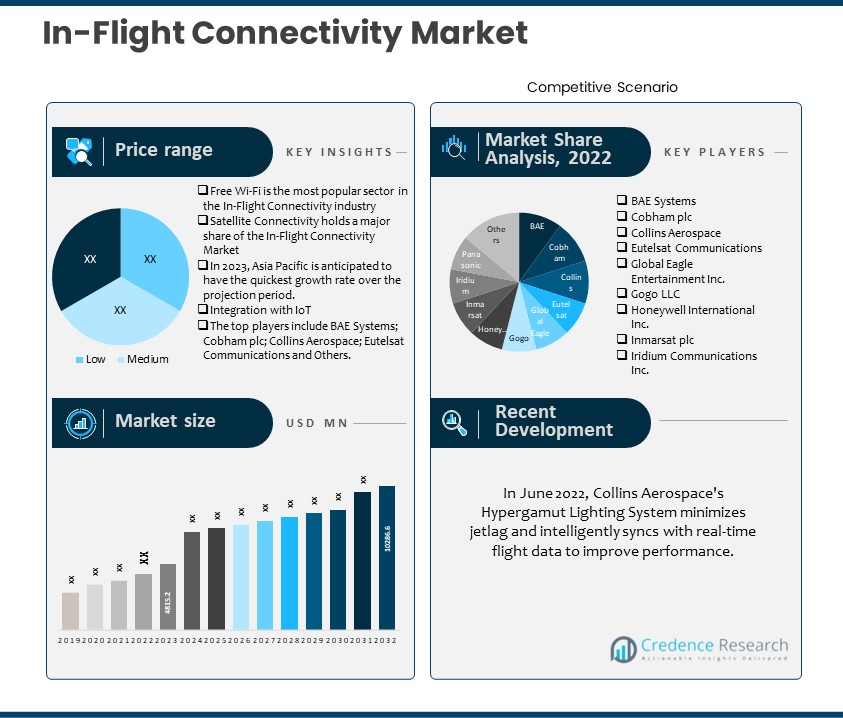
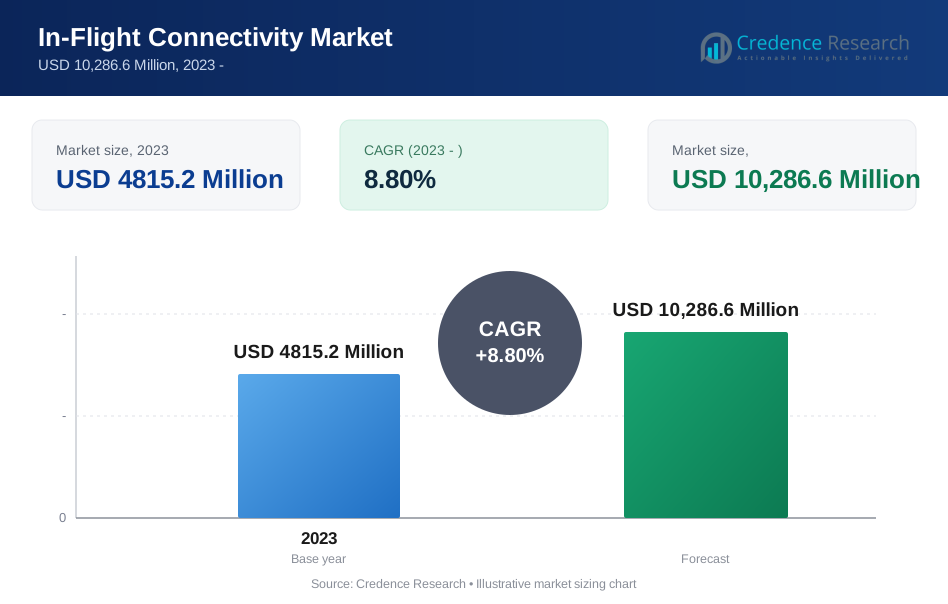
- The global demand for In-Flight Connectivity was valued at USD 4815.2 Million in 2023 and is expected to reach USD 10286.6 Million in 2032, growing at a CAGR of 8.80% between 2024 and 2032.
- The In-Flight Connectivity Market is dominated by Satellite Connectivity, with Air-to-Ground (ATG) Connectivity also playing a key role.
- Free Wi-Fi is the most popular sector in the In-Flight Connectivity industry, and the Paid Wi-Fi segment is an important part of the industry.
- High-Speed Connectivity is the fastest-growing category of the In-Flight Connectivity Market, with Standard Connectivity and Low-Bandwidth Connectivity being other significant market segments.
- In 2023, the Narrow-Body Aircraft sector led the industry, while the Wide-Body Aircraft category is predicted to rise rapidly throughout the forecast period.
- In 2023, North America had the biggest revenue share at 38.2%, while Asia Pacific is expected to see the quickest growth rate over the projected period.
- Increasing passenger numbers drive the in-flight entertainment and connectivity market.
- High cost impedes market growth.
Executive Summary
Market Definition
In-flight entertainment and connectivity (IFEC) is the onboard internet service provided by airlines to business and commercial aircraft passengers. This service is accessible through personal electronic devices (PEDs) such as smartphones and laptop computers for internet browsing, gaming, and streaming movies and serials. IFEC systems appear to operate without the need for visible wires. The wiring is concealed within the aircraft walls, beginning in the top panel, near the oxygen masks and air conditioning controls. These wires are then linked to the power units, which are arranged in a few rows along the aircraft's sidewall.
Market Overview
The global In-Flight Connectivity Market has witnessed steady growth in recent years and is expected to grow at a CAGR of 8.80% between 2024 and 2032. The market was valued at USD 4815.2 million in 2023 and is expected to reach USD 10286.6 million in 2032.
Changing passenger demand for constant connectivity aboard is one of the key factors driving industry growth. Furthermore, the increasing number of nonstop long-distance flights worldwide is expected to provide significant growth opportunities in the coming years.
The IFEC market is on the approach of joining the mainstream, becoming a standard service on international flights rather than an optional extra. Airlines routinely change their IFC service provider in order to understand better the technology's functionality, passenger experience, and overall value to the airline. This trend is likely to increase market competition and the amount of collaborations and partnerships as satellite connectivity providers and airlines work together to provide faultless IFEC services onboard.
Segmentation By Technology Type
- Satellite Connectivity holds a major share of the In-Flight Connectivity Market. Satellite connectivity is critical in delivering internet access to airplanes around the world, giving passengers with broad coverage and reliable connectivity while flying.
- On the other hand, the Air-to-Ground (ATG) Connectivity category is also significant in the market.
Segmentation By Service Model
- Free Wi-Fi is the most popular sector in the In-Flight Connectivity Market. Passengers typically choose free Wi-Fi since it allows them to stay connected during their flights without paying additional fees. Airlines that offer free Wi-Fi can attract more passengers and improve their entire flight experience.
- On the other hand, the Paid Wi-Fi segment is a significant part of the market. Some airlines provide paid Wi-Fi services to passengers who demand faster or more dependable internet connectivity during their flights.
Segmentation by Connectivity Speed and Quality
- High-Speed Connectivity is the fastest-growing category of the In-Flight Connectivity Market. Passengers are increasingly requesting high-speed internet connection while flying to stream video, work, or remain in touch with friends and family.
- Standard Connectivity and Low-Bandwidth Connectivity are other key market segments.
Segmentation By Aircraft Type
- In 2023, the Narrow-Body Aircraft segment led the industry, accounting for more than 52.70% of total revenues. The segment is expected to expand at the fastest rate and maintain its leadership position during the projection period. The rising demand for short-haul flights, as well as the development of new travel routes and airports, drove this segment's rapid growth.
- The Wide-Body Aircraft category is expected to grow at a high rate over the forecast period.
Segmentation by Region
- In 2023, North America had the greatest revenue share at 38.2%.
- Asia Pacific is predicted to experience the fastest growth rate over the projection period.
- The rest of the world, including Latin America, the Middle East, and Africa, supplies the remaining demand for In-Flight Connectivity.
North America dominated the industry in 2023, accounting for about 38.20% of total sales. Regional airlines in wealthier nations are projected to use such systems more frequently, resulting in further regional industry growth. Some of the region's most well-known airlines, such as United Airlines, Inc. and Delta Air Lines, Inc., are always attempting to give compensating material via Wi-Fi or provide medications to passengers. Furthermore, the growing popularity of the BYOD trend is anticipated to relieve airlines of the need to nest back-seat screens, reducing overall aircraft weight.
Moreover, Asia Pacific is predicted to experience the fastest growth rate over the projection period. As passenger traffic grows, so does the need for aircraft outfitted with cutting-edge entertainment and communication systems. This is boosting regional market growth. Several significant airlines in the region offer modern IFEC amenities to its first-class guests. For example, Garuda Indonesia, Indonesia's flag carrier, provides premium travel class passengers with a choice of onboard entertainment options such as live TV streaming, in-flight shopping, and games.
Key Highlights of the Report
Technology Type, Service Model, Connectivity Speed and Quality, Aircraft Type, and region segment of the global In-Flight Connectivity Market. The narrow-body aircraft sector topped the industry in 2023, and the category with the strongest rate of growth is high-speed connectivity. Air-to-ground (ATG) connectivity is a prominent segment in the market, and free Wi-Fi is the most popular sector in the air-to-ground connectivity market and North America, leading the market growth.
The market is driven primarily by passenger demand, technological advancements, and airline competitive strategies. Furthermore, concerns regarding cost and ROI, regulatory and certification barriers, and sector player saturation are the market's main limitations. Additionally, increasing operational efficiency, integration with ancillary services, and opportunities for monetization are significant opportunities in the sector.
North America led the industry in 2023, accounting for around 38.20% of total sales. Regional airlines in wealthy countries are expected to employ such systems more frequently, driving additional regional industry expansion. Furthermore, Asia Pacific is expected to have the fastest growth rate during the projection period. As passenger traffic increases, so will the need for airplanes outfitted with cutting-edge entertainment and communication equipment.
What Are The Main Drivers Of The Global In-Flight Connectivity Market?
The In-Flight Connectivity Market is primarily driven by the growing need for seamless connectivity among passengers, ongoing technological improvements in communication systems, and a focus on improving the entire passenger experience and satisfaction during flights.
What Are The Major Challenges Faced By The Global In-Flight Connectivity Market?
However, the market faces challenges such as high installation and maintenance costs, regulatory hurdles and airspace restrictions that impede the deployment of in-flight connectivity solutions, and security and privacy concerns that must be addressed to ensure widespread adoption.
What Are The Growth Opportunities In The Global In-Flight Connectivity Market?
Despite these constraints, there are significant opportunities in the market, including growth potential in emerging markets where connectivity services are in high demand, the integration of advanced technologies such as 5G to improve in-flight connectivity, and the possibility of collaborations with satellite companies to improve passenger coverage and connectivity. These potential provide avenues for future growth and innovation in the In-Flight Connectivity Market.
Market Drivers
Several factors drive the global In-Flight Connectivity Market. The following are the key drivers of the global In-Flight Connectivity Market:
Rising Passenger Numbers
The increase in the number of airline passengers has been a primary driver for the in-flight entertainment and connection industry. The growing number of passengers has increased demand for a variety of in-flight entertainment offerings, including video streaming, text messaging, gaming, and internet browsing. For instance, the International Civil Aviation Organization (ICAO) estimates that the global number of airline passengers will reach 10.5 billion by 2040. According to Boeing's 2020-2039 commercial market projection, India's domestic air passenger market is predicted to double in size by 2030, compared to pre-pandemic levels. As a result, the increasing number of airline passengers is propelling the in-flight entertainment and connection market forward.
Market Restraints
The global In-Flight Connectivity Market faces some challenges that may hinder its growth. These include the following:
High Cost
High costs in the In-Flight Connectivity Market imply that there are high costs associated with installing and maintaining connectivity systems on airplanes. These costs include the purchase of equipment, satellite services, and the construction of essential infrastructure. They also cover continuing costs for keeping the systems up to date, maintaining them, and providing support as needed. Airlines find it difficult to justify these prices, especially when they must balance the requirement to provide good connection services with the costs of establishing and operating these systems.
Moreover, Installation expenses associated with networking technology and connectivity devices are expected to limit business growth. For example, air-to-ground technology costs about USD 80,000 per aircraft, whereas satellite technology deployment costs over USD 400,000. This considerably inhibits airlines' adoption of connection equipment and services, particularly in expanding markets such as Asia-Pacific and Latin America. In addition, in-flight connectivity services, including network planning, design, deployment, and integration, are costly.
Opportunities
The global In-Flight Connectivity Market offers significant growth opportunities. These include the following:
Growth in the Aerospace Industry
The rising aerospace industry is likely to drive the in-flight entertainment and networking market forward. The aerospace industry is concerned with vehicular travel within and beyond Earth's atmosphere, and it includes research, development, design, production, operation, and maintenance of aircraft and spacecraft. The growth of the aerospace sector produces a greater demand for improved in-flight entertainment and connectivity technologies, which improve the passenger experience and connectivity possibilities during air travel. For instance, Airbus SE, a Netherlands-based aerospace manufacturer, supplied 661 commercial aircraft to 84 clients in 2022, marking an 8% increase over the 611 units sold in 2021. As a result, the rising aircraft industry is driving the expansion of the in-flight entertainment and networking market.
Competitive Landscape
Key Players
The global In-Flight Connectivity Market is highly competitive, with several key players. Some of the major players in the market and their market share are as follows:
- BAE Systems
- Cobham plc
- Collins Aerospace
- Eutelsat Communications
- Global Eagle Entertainment Inc.
- Gogo LLC
- Honeywell International Inc.
- Inmarsat plc
- Iridium Communications Inc.
- Panasonic Corp.
- Safran (Zodiac Aerospace SA)
- SITAONAIR
- Thales SA
- ViaSat Inc.
These organizations prioritize product innovation, Connectivity Speed and Quality expansion, and mergers and acquisitions to stay competitive.
The global In-Flight Connectivity Market's key players continually seek to stay ahead by offering new products and developments.
In June 2022, Seeker technology is designed for persistent missiles that are difficult to detect.
In June 2022, Collins Aerospace and NIAR collaborate to create a concept for passengers using motorized wheelchairs aboard aircraft.
In May 2022, Eutelsat and Telenor Maritime have signed a significant connectivity maritime agreement, reinforcing Eutelsat ADVANCE's central role in the cruise industry.
Summary of Key Findings
- The growth of the aerospace industry raises the demand for in-flight entertainment and connectivity.
- The market is segmented by Technology Type, Continuous Monitoring is the largest market sector
- Standard Connectivity and Low-Bandwidth Connectivity being other major market segments.
- Free Wi-Fi is the most popular sector in the In-Flight Connectivity Market
- North America is leading in market growth; the market is highly competitive, with key players including BAE Systems; Cobham plc; Collins Aerospace; Eutelsat Communications and Others.
Future Outlook
- Technological Advances
- Improved passenger experience.
- Integration with IoT
How CXOs Can Benefit from the Credence Research In-Flight Connectivity Market Report
The Credence Research In-Flight Connectivity Market Report provides CXOs with a comprehensive overview of the market, including:
- Market size and growth forecast: The report provides detailed estimates of the global In-Flight Connectivity Market size, segmented By Technology Type, Service Model, Connectivity Speed and Quality, Aircraft Type and region. It also includes forecasts for the market through 2032 based on key trends and drivers.
- Market segmentation: The report segments the In-Flight Connectivity Market By Technology Type, Service Model, Connectivity Speed and Quality, Aircraft Type and region. This segmentation provides CXOs with a granular understanding of the market and the opportunities in each segment.
- Competitive Landscape: The report profiles the key players in the In-Flight Connectivity Market and provides insights into their strategies, product offerings, and financial performance. This information can help CXOs to identify and assess their competition.
- Key trends and drivers: The report identifies and analyzes the key trends and drivers that are shaping the In-Flight Connectivity Market. This information can help CXOs to make informed decisions about their investments and strategies.
CXOs can use the insights from the Credence Research In-Flight Connectivity Market Report to:
- Identify growth opportunities: The report can help CXOs to identify new growth opportunities in the In-Flight Connectivity Market. For example, by analyzing the data and trends in the report, they can make informed decisions on where to invest and expand their business.
- Make informed investment decisions: The report can help CXOs make informed investment decisions about In-Flight Connectivity. For example, it may provide useful insights into market trends, customer preferences, the competitive landscape, and growth prospects in the mobile accessories business..
- Develop competitive strategies: The report can help CXOs develop competitive strategies for their In-Flight Connectivity businesses. For example, by analyzing market trends, client preferences, and the competitive environment mentioned in the report, CXOs can fine-tune their strategies, differentiate their offers, and effectively position their firms in the marketplace.
- Track market developments: The report can help CXOs monitor market developments and stay ahead of the curve. For example, it provides insights into the latest trends and innovations in the In-Flight Connectivity Market.
Overall, the Credence Research In-Flight Connectivity Market Report is a valuable resource for CXOs who are looking to gain a deeper understanding of the market and identify .opportunities for growth.
Segmentation
- By Technology Type:
- Satellite Connectivity
- Air-to-Ground (ATG) Connectivity
- Hybrid Connectivity
- By Service Model:
- Free Wi-Fi
- Paid Wi-Fi
- Freemium Model
- By Connectivity Speed and Quality:
- High-Speed Connectivity
- Standard Connectivity
- Low-Bandwidth Connectivity
- By Aircraft Type:
- Narrow-Body Aircraft
- Wide-Body Aircraft
- Regional Aircraft
- By Region
- North America
- The U.S.
- Canada
- Mexico
- Europe
- Germany
- France
- The U.K.
- Italy
- Spain
- Rest of Europe
- Asia Pacific
- China
- Japan
- India
- South Korea
- South-east Asia
- Rest of Asia Pacific
- Latin America
- Brazil
- Argentina
- Rest of Latin America
- Middle East & Africa
- GCC Countries
- South Africa
- Rest of the Middle East and Africa
- North America
Request a Free Sample
Fill in your details and we'll send you a free sample report.
- Sample data tables & charts
- Research methodology
Need a Custom Version of This Report?
Tailor the scope, geography, or segments to your exact requirements.
- Custom geography or segment scope
- Direct access to our analyst team
Frequently Asked Questions
What is the current size of the global In-Flight Connectivity Market?
What is the expected growth rate of the In-Flight Connectivity Market between 2024 and 2032?
Which segment is leading the market share in terms of Aircraft Type?
Which Service Model segment governs the demand for In-Flight Connectivity in the world?
Who are the major players in the global In-Flight Connectivity Market?
Table of Content
Chapter 1. Report Introduction
- 1.1 Report Description & Purpose
- 1.1.1 Report Title & Market Definition
- 1.1.2 Unique Selling Propositions (USP) & Key Differentiators
- 1.1.3 Value Proposition for Stakeholders
- 1.2 Research Objectives
- 1.2.1 Market Sizing Objectives (Volume & Revenue)
- 1.2.2 Segmentation Objectives
- 1.2.3 Competitive Intelligence Objectives
- 1.2.4 Forecast & Scenario Objectives
- 1.3 Report Scope
- 1.3.1 In-Flight Connectivity Scope – Types & Subtypes Covered
- 1.3.2 Geographic Scope – Regions & Countries Covered
- 1.3.3 Historical Period, Base Year & Forecast Period (2023; forecast to the forecast period)
- 1.3.4 Inclusions & Exclusions
- 1.4 HS Code & Classification Framework
- 1.5 Currency, Units & Pricing Basis
- 1.6 Target Stakeholders
- 1.7 Limitations & Assumptions
Chapter 2. Executive Summary
- 2.1 Global In-Flight Connectivity Market Snapshot
- 2.1.1 Market Size – Historical (2023) & Forecast (the forecast period) (2023: USD 4815.2 Million → forecast year: USD 10,286.6 Million)
- 2.1.2 Volume & Revenue – Global Totals
- 2.1.3 Key Market Highlights – Top Five Facts
- 2.2 In-Flight Connectivity Market Segmentation Snapshot
- 2.2.1 Market Split by Region – 2023 vs.
- 2.3 Competitive Snapshot
- 2.3.1 Top 10 Players by Revenue Share – 2023
- 2.3.2 Top 10 Players by Volume Share – 2023
- 2.3.3 Recent Strategic Developments (18-Month Summary)
- 2.4 Key Investment Highlights & Strategic Conclusions
Chapter 3. In-Flight Connectivity Market Dynamics & Industry Analysis
- 3.1 Market Overview & Context
- 3.1.1 In-Flight Connectivity Market Position in the Broader Automotive Value Chain
- 3.1.2 OEM vs. Replacement Market Dynamics
- 3.1.3 Market Maturity & Development Stage by Region
- 3.2 In-Flight Connectivity Market Drivers
- 3.3 In-Flight Connectivity Market Restraints & Challenges
- 3.4 In-Flight Connectivity Market Opportunities
- 3.5 Porter's Five Forces Analysis
- 3.5.1 Threat of New Entrants
- 3.5.2 Bargaining Power of Suppliers
- 3.5.3 Bargaining Power of Buyers
- 3.5.4 Threat of Substitutes
- 3.5.5 Competitive Rivalry – Intensity Assessment
- 3.6 In-Flight Connectivity Value Chain Analysis
- 3.6.1 Upstream – Raw Material/Input Suppliers
- 3.6.1.1 Raw Material/Input 1
- 3.6.1.2 Raw Material/Input 2
- 3.6.1.3 Raw Material/Input 3
- 3.6.2 Midstream – Production/Manufacturing/Service Delivery
- 3.6.2.1 Production/Process Overview
- 3.6.2.2 Key Facility Locations & Capacity by Manufacturer
- 3.6.3 Downstream – Distribution & End Consumer
- 3.6.3.1 Primary Channel – B2B/OEM
- 3.6.3.2 Secondary Channels – Dealer, Retail, Online, Direct
- 3.6.4 Value Chain Profitability Analysis
- 3.6.1 Upstream – Raw Material/Input Suppliers
- 3.7 PESTEL Analysis
- 3.7.1 Political Factors
- 3.7.2 Economic Factors
- 3.7.3 Social Factors
- 3.7.4 Technological Factors
- 3.7.5 Environmental Factors
- 3.7.6 Legal Factors
- 3.8 In-Flight Connectivity Supply Chain Analysis
- 3.8.1 Raw Material/Input Supply Risk Assessment
- 3.8.2 Manufacturing Concentration Risk (Geographic Exposure)
- 3.8.3 Trade Disruption Impact Analysis
- 3.9 Regulatory & Policy Landscape
Note: The regulatory and policy landscape section covers regulations based on their applicability to the market, In-Flight Connectivity category, geography, and scope of the study. Only regulatory frameworks with a material impact on operations, compliance, trade, sustainability, or market access are analyzed in detail.
Chapter 4. Key Investment Pockets & Opportunity Analysis
- 4.1 In-Flight Connectivity Market Attractiveness Analysis
- 4.1.1 By Region – Investment Attractiveness Matrix (Volume × CAGR)
- 4.2 Absolute Revenue Growth Opportunity
- 4.2.1 By Region – Absolute USD Growth Through the forecast period
- 4.3 Incremental Volume Opportunity
- 4.3.1 By Region – Incremental Volume Through the forecast period
- 4.3.2 Segment – Incremental Volume
- 4.4 Emerging Submarket Opportunity Deep Dive (Subject to Applicability)
- 4.5 Emerging Market Opportunity Scorecards
- 4.5.1 United States
- 4.5.2 Europe
- 4.5.3 Asia
- 4.5.4 Middle East & Africa
Note: Emerging Market Opportunity Scorecards will be included based on relevance and strategic importance. Regions listed are indicative and may vary depending on data availability and market dynamics.
Chapter 5. In-Flight Connectivity Import-Export Analysis & Trade Flows
- 5.1 Global Trade Overview
- 5.1.1 Global Export Value by Country (2023)
- 5.1.2 Global Export Volume by Country (2023)
- 5.1.3 Global Import Value by Country (2023)
- 5.1.4 Global Import Volume by Country (2023)
- 5.1.5 Net Trade Balance by Country (2023)
- 5.2 Export Analysis – Segment
- 5.2.1 Type 1 (HS Code)
- 5.2.2 Type 2 (HS Code)
- 5.2.3 Type 3 (HS Code)
- 5.2.4 Type 4 (HS Code)
- 5.2.5 Type 5 (HS Code)
- 5.3 Import Analysis – Segment
- 5.3.1 Type 1 (HS Code)
- 5.3.2 Type 2 (HS Code)
- 5.3.3 Type 3 (HS Code)
- 5.3.4 Type 4 (HS Code)
- 5.3.5 Type 5 (HS Code)
- 5.4 Average Unit Trade Prices
- 5.4.1 Average Export Price – Segment & Country
- 5.4.2 Average Import Price – Segment & Source Country
- 5.4.3 Price Trends (2023)
- 5.5 Key Trade Route Analysis
- 5.5.1 Trade Route 1
- 5.5.2 Trade Route 2
- 5.5.3 Trade Route 3
- 5.5.4 Trade Route 4
- 5.5.5 Trade Route 5
- 5.6 Trade Policy Impact Assessment
- 5.6.1 US Anti-Dumping & Section 301 Tariffs
- 5.6.2 EU Customs Union Impact
- 5.6.3 Major Free Trade Agreements
- 5.6.4 USMCA Rules of Origin
Note: Trade policy analysis will be included only where relevant to the In-Flight Connectivity market.
Chapter 6. Competitive Landscape & Company Benchmarking
- 6.1 In-Flight Connectivity Market Concentration & Structure
- 6.1.1 Herfindahl-Hirschman Index (HHI) – vs. 2023
- 6.1.2 Tier 1, Tier 2 & Tier 3 Market Structure
- 6.1.3 Global, Regional & Local Player Dynamics
- 6.2 In-Flight Connectivity Market Share Analysis – 2023
- 6.2.1 Global Revenue Share by Company
- 6.2.2 Global Volume Share by Company
- 6.2.3 Regional Revenue Share
- 6.2.4 Market Share Evolution ( vs. 2023)
- 6.2.5 OEM Segment Share by Company
- 6.2.6 Replacement Segment Share by Company
- 6.3 Production/Delivery Capacity & Facility Analysis
- 6.3.1 Global Installed Capacity
- 6.3.2 Capacity Utilization Rates
- 6.3.3 Production/Output Volume
- 6.3.4 Facility Locations & Capacity Map
- 6.3.5 Planned Capacity Additions
- 6.4 In-Flight Connectivity Competitive Benchmarking Matrix
- 6.4.1 Revenue, Volume, CAGR & Profitability Comparison
- 6.4.2 Channel Revenue Mix
- 6.4.3 Geographic Revenue Exposure
- 6.4.4 R&D Intensity
- 6.4.5 Sustainability Maturity
- 6.5 Strategic Developments in In-Flight Connectivity (Last 24 Months)
- 6.5.1 Mergers, Acquisitions & Divestments
- 6.5.2 New In-Flight Connectivity Launches
- 6.5.3 Facility Expansions
- 6.5.4 Strategic Alliances, Joint Ventures & Partnerships
- 6.5.5 Distribution Expansion & Market Entry
- 6.5.6 Sustainability & ESG Initiatives
- 6.6 Competitive Strategy Mapping
- 6.6.1 Leader, Challenger, Follower & Niche Classification
- 6.6.2 Pricing Strategy Comparison
- 6.6.3 Channel Strategy Matrix
Note: Strategic developments are included based on their materiality and the availability of reliable information.
Chapter 7. Global In-Flight Connectivity Market – By Distribution Channel
- 7.1 Segment Overview
- 7.1.1 Volume & Revenue Split by Channel (2023 & )
- 7.1.2 Channel Mix Evolution (the forecast period)
Chapter 8. Regional Market Analysis – Global Overview
- 8.1 Global Regional Overview
- 8.1.1 Regional Volume Share
- 8.1.2 Regional Revenue Share
- 8.1.3 Regional Volume by Region
- 8.1.4 Regional Revenue by Region
- 8.1.5 Regional Forecast Through the forecast period
- 8.2 Cross-Regional Segment Analysis
- 8.2.1 By Distribution Channel
- 8.2.2 By Brand/Price Tier
Chapter 9. North America In-Flight Connectivity Market
- 9.1 United States
- 9.2 Canada
- 9.3 Mexico
Chapter 10. Europe In-Flight Connectivity Market
- 10.1 Germany
- 10.2 France
- 10.3 Italy
- 10.4 United Kingdom
- 10.5 Spain
- 10.6 Poland
- 10.7 Russia
- 10.8 Netherlands
- 10.9 Belgium
- 10.10 Sweden
- 10.11 Denmark
- 10.12 Norway
- 10.13 Rest of Europe
Chapter 11. Asia Pacific In-Flight Connectivity Market
- 11.1 China
- 11.2 India
- 11.3 Japan
- 11.4 South Korea
- 11.5 Thailand
- 11.6 Indonesia
- 11.7 Vietnam
- 11.8 Malaysia
- 11.9 Australia
- 11.10 Rest of Asia Pacific
Chapter 12. Latin America In-Flight Connectivity Market
- 12.1 Brazil
- 12.2 Argentina
- 12.3 Colombia
- 12.4 Chile
- 12.5 Rest of Latin America
Chapter 13. Middle East In-Flight Connectivity Market
- 13.1 Saudi Arabia
- 13.2 United Arab Emirates
- 13.3 Turkey
- 13.4 Israel
- 13.5 Iran
- 13.6 Rest of the Middle East
Chapter 14. Africa In-Flight Connectivity Market
- 14.1 South Africa
- 14.2 Egypt
- 14.3 Nigeria
- 14.4 Morocco
- 14.5 Rest of Africa
Chapter 15. In-Flight Connectivity Company Profiles
- 15.1 [Company 01]
- 15.1.1 Company Overview
- 15.1.2 Key Management Personnel
- 15.1.3 Products & Services Portfolio
- 15.1.4 Financial Performance
- 15.1.5 Key Market Focus & Geographic Presence
- 15.1.6 Recent Developments & Strategic Initiatives
Note: The company profile list is preliminary and may change based on research findings, market developments, data availability, and client requirements.
Chapter 16. Appendices
- Appendix A – List of Abbreviations & Acronyms
- Appendix B – Industry Classification Code Reference – Full Series
- Appendix C – Production & Capacity Data Tables
- Appendix D – End-Use & Demand Base Tables
- Appendix E – Consumption & Replacement Rate Assumptions
- Appendix F – ASP Reference Tables
- Appendix G – Manufacturing & Facility Database
- Appendix H – Import-Export Data Tables
- Appendix I – Regulatory Summary Tables
- Appendix J – Primary Research Participant List (Anonymized)
- Appendix K – Primary Research Questionnaire Framework
- Appendix L – Data Sources & Bibliography
- Appendix M – Market Size Divergence & Source Comparison
Chapter 17. Research Methodology
- 17.1 Research Framework & Philosophy
- 17.2 Secondary Research – Sources, Hierarchy & Data Extraction
- 17.3 Data Modeling – Bottom-Up & Top-Down Market Sizing
- 17.4 Primary Research – Stakeholder Framework, LOI & Sample Sizes
- 17.5 Forecast Methodology – Regression, Scenario & Sensitivity Analysis
- 17.6 Quality Control – Four-Layer Validation Framework
- 17.7 Limitations & Standard Assumptions
- 17.8 Disclaimer
