
| REPORT ATTRIBUTE | DETAILS |
|---|---|
| Historical Period | 2020-2023 |
| Base Year | 2024 |
| Forecast Period | 2025-2032 |
| Industrial Solvents Market Size 2024 | USD 34,660.50 Million |
| Industrial Solvents Market, CAGR | 7.24% |
| Industrial Solvents Market Size 2032 | USD 60,647.79 Million |
Market Overview
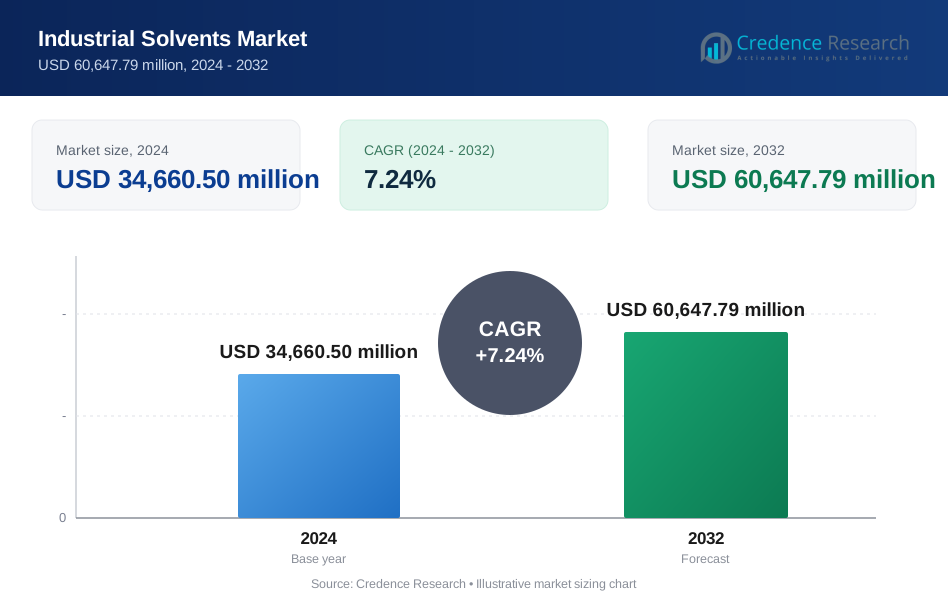
Global Industrial Solvents market size was valued at USD 34,660.50 million in 2024 and is anticipated to reach USD 60,647.79 million by 2032, at a CAGR of 7.24% during the forecast period (2024-2032).
The global industrial solvents market is experiencing strong growth, driven by rising demand across industries such as pharmaceuticals, paints and coatings, adhesives, and chemicals. Increasing urbanization, infrastructure development, and the expansion of manufacturing sectors are boosting solvent consumption worldwide. Additionally, the growing adoption of environmentally friendly and bio-based solvents, propelled by stringent environmental regulations and heightened sustainability awareness, is shaping market trends. Advances in solvent technology, including innovations aimed at improving efficiency and reducing toxicity, are further enhancing market potential. Emerging economies, particularly in Asia-Pacific and Latin America, are witnessing robust industrialization, creating new opportunities for market expansion. Furthermore, the shift toward water-based and green solvents in response to consumer preferences for safer, eco-friendly products continues to influence product development strategies across the industry.
The global industrial solvents market is influenced by regional dynamics, with key players across North America, Europe, and Asia-Pacific driving substantial growth. North America and Europe are major hubs due to stringent environmental regulations and advanced manufacturing industries, which have spurred demand for sustainable solvent solutions. In contrast, Asia-Pacific leads in industrial solvent consumption, driven by rapid industrialization, growing construction sectors, and expanding automotive and electronics industries. Companies like BASF SE, Dow Inc., ExxonMobil Corporation, and Shell Chemicals are dominant players in the market, offering a wide range of solvent solutions across various industries, including automotive, pharmaceuticals, and paints & coatings. These key players are investing in technological innovations, product diversification, and sustainable alternatives to meet regulatory requirements and consumer demand for eco-friendly solutions. As regional demand shifts toward green solvents, these companies are strategically positioning themselves to capture growth opportunities in emerging markets.
Market Insights
- The global industrial solvents market was valued at USD 34,660.50 million in 2024 and is expected to reach USD 60,647.79 million by 2032, growing at a CAGR of 7.24% during the forecast period (2024-2032).
- Growing demand for bio-based and green solvents is a major driver, as industries move toward eco-friendly alternatives to meet sustainability goals.
- Increased industrialization in emerging economies, especially in Asia-Pacific, is fueling demand for solvents in sectors like automotive, construction, and electronics.
- Technological advancements are enhancing the performance of solvents, including improved solubility and toxicity profiles, driving demand for specialized formulations.
- Stringent environmental regulations and the push for low-VOC and non-toxic solvents are influencing the market toward greener options.
- The market is highly competitive, with key players like BASF, Dow Inc., and ExxonMobil leading in innovation and product offerings.
- North America and Europe lead the market, but Asia-Pacific is expected to dominate in terms of growth due to industrial expansion.
Report Scope
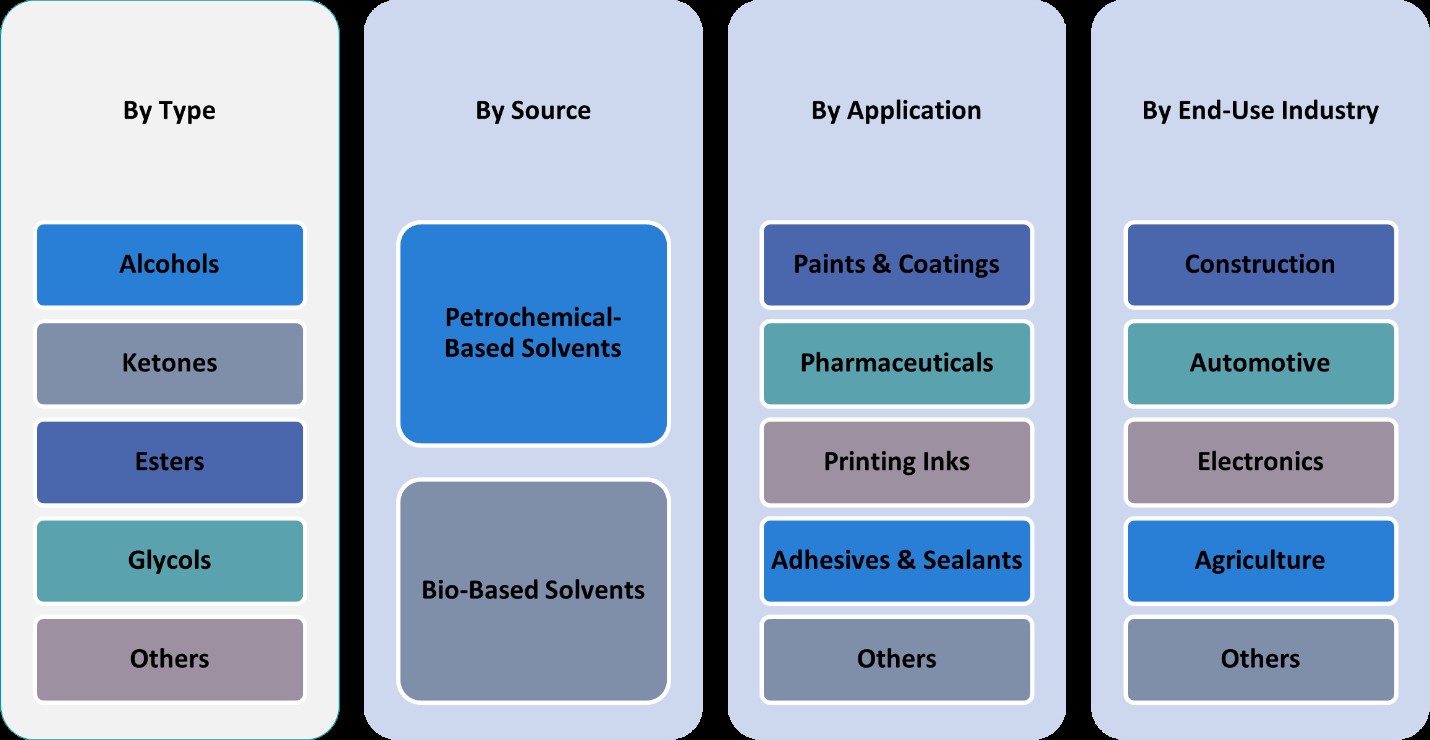
This report segments the Global Industrial Solvents Market as follows:
Market Drivers
Expanding Industrial and Manufacturing Activities
The growth of industrial and manufacturing sectors globally is a primary driver of the industrial solvents market. Increasing demand from industries such as automotive, construction, textiles, and chemicals has significantly boosted solvent consumption. For instance, the Annual Survey of Industries conducted by the Ministry of Statistics and Program Implementation highlights the expansion of manufacturing activities, with industrial output increasing across multiple sectors. Solvents play a crucial role in processes such as cleaning, degreasing, and chemical synthesis, making them indispensable in production operations. With emerging economies investing heavily in infrastructure and manufacturing capabilities, the need for high-performance solvents is expected to surge. Additionally, the rise in customized manufacturing solutions and the growing trend of industrial automation are creating new avenues for solvent application, further driving market expansion.
Technological Advancements and Innovation in Solvent Applications
Continuous advancements in solvent technology are another key driver of market growth. Research and development efforts are focused on creating solvents that offer improved performance, greater efficiency, and reduced environmental impact. For instance, the India Solvent Market Report discusses innovations in solvent applications, including hybrid solvent systems and multifunctional solvents. Innovations such as low-toxicity solvents, hybrid solvent systems, and multifunctional solvents are gaining traction across industries. Moreover, the increasing application of solvents in emerging fields like electronics, 3D printing, and energy storage technologies is opening new growth opportunities. Companies that invest in cutting-edge technologies and innovative product development are positioning themselves to capitalize on the evolving needs of diverse industrial sectors, ensuring long-term market expansion.
Rising Demand from Pharmaceuticals and Personal Care Sectors
The pharmaceutical and personal care industries are major contributors to the growth of the global industrial solvents market. Solvents are essential in drug formulation, extraction, purification, and the production of active pharmaceutical ingredients (APIs). The global increase in healthcare spending, a surge in pharmaceutical R&D activities, and the expansion of personal care product lines are intensifying the demand for specialized solvents. Furthermore, the development of new drug delivery systems and biopharmaceuticals requires high-purity solvents, thereby stimulating market growth. As consumers demand more health-conscious and safe personal care products, the industry is increasingly favoring bio-based and low-toxicity solvents, driving innovation in solvent formulations.
Shift Towards Eco-Friendly and Bio-Based Solvents
Growing environmental concerns and stringent regulatory frameworks are pushing industries toward the adoption of eco-friendly and bio-based solvents. Governments across regions are implementing strict emissions standards, encouraging manufacturers to reduce the use of volatile organic compounds (VOCs) and hazardous chemicals. This regulatory pressure is fostering the development and commercialization of green solvents derived from renewable sources such as corn, sugarcane, and soybeans. Industries are increasingly investing in sustainable practices and are incorporating bio-based alternatives into their product portfolios. This shift not only helps companies align with environmental standards but also meets the rising consumer demand for sustainable and safer chemical solutions.
Market Trends
Growing Adoption of Bio-Based and Green Solvents
The shift toward sustainability is significantly shaping the industrial solvents market, with increasing adoption of bio-based and green solvents. Industries are under rising pressure to reduce their environmental footprint and comply with stringent environmental regulations regarding volatile organic compounds (VOCs) and hazardous emissions. For instance, the Green Solvents and Bio-Solvents Market Report highlights that the market is witnessing substantial growth due to increasing regulatory pressures and environmental concerns. Consequently, manufacturers are investing heavily in the development of renewable, biodegradable, and non-toxic solvent alternatives derived from natural sources like corn, soy, and sugarcane. This trend not only helps companies achieve regulatory compliance but also meets the growing consumer demand for eco-friendly products, especially in sectors such as personal care, paints and coatings, and pharmaceuticals.
Technological Innovations Driving Performance Enhancement
Ongoing technological advancements are significantly enhancing solvent performance, creating new market opportunities. Innovations are focused on improving solvent properties such as solubility, volatility, and toxicity profiles, making them more efficient and safer for end-users. For instance, the Call for Proposal for Advancing Innovations in Eco-Friendly Chemical Technologies discusses India's efforts to strengthen technology development in the chemical sector, including innovations in green chemistry and process optimization. Hybrid solvents and tailor-made solvent blends are gaining popularity, offering superior results in specialized applications. Furthermore, advancements in nanotechnology and chemical engineering are enabling the creation of next-generation solvents designed for high-tech and sensitive industries. As industries increasingly demand high-performance, cost-effective, and environmentally safe solutions, technological innovation will continue to play a pivotal role in shaping the future trajectory of the global industrial solvents market.
Expansion of Solvent Applications Across Emerging Industries
Industrial solvents are finding new applications beyond traditional sectors, driving diversification within the market. Emerging industries such as electronics, energy storage, and 3D printing are increasingly utilizing specialized solvents for manufacturing processes and product development. In electronics, solvents are essential for cleaning components and in the production of semiconductors. Similarly, the demand for solvents in battery production for electric vehicles is growing rapidly. The continuous innovation across emerging technologies is widening the scope of solvent applications, encouraging manufacturers to develop more tailored and performance-enhancing solvent solutions to meet specific industrial needs.
Increasing Focus on Solvent Recycling and Reuse
Sustainability initiatives have also spurred a growing emphasis on solvent recycling and reuse across industries. Companies are investing in technologies that enable the recovery and purification of used solvents, reducing operational costs and minimizing environmental impact. Solvent recycling not only helps industries meet regulatory compliance but also aligns with corporate sustainability goals, providing a competitive edge in the market. The trend toward closed-loop systems and circular economy models is particularly prominent in the pharmaceutical, chemical, and manufacturing sectors. As industries prioritize resource efficiency, the demand for advanced solvent recovery systems is expected to rise steadily.
Market Challenges Analysis
Stringent Environmental Regulations and Health Concerns
The global industrial solvents market faces significant challenges due to increasingly stringent environmental regulations and growing health concerns. Regulatory bodies across North America, Europe, and parts of Asia are imposing stricter controls on the use and emissions of volatile organic compounds (VOCs) and hazardous air pollutants (HAPs) associated with traditional solvents. For instance, a Centre for Policy Research (CPR) study examines the effectiveness of environmental regulations in addressing industrial pollution, highlighting compliance challenges and enforcement mechanisms. These regulations compel manufacturers to reformulate products, invest in cleaner technologies, and transition toward eco-friendly alternatives, often resulting in higher operational costs. Furthermore, rising awareness of the potential health risks associated with prolonged solvent exposure - including respiratory problems and neurological effects - is prompting industries to limit the use of conventional solvents. The growing preference for low-VOC and non-toxic formulations puts pressure on companies to innovate while ensuring compliance, ultimately posing a challenge to maintaining profitability and operational efficiency.
Fluctuating Raw Material Prices and Supply Chain Disruptions
Another major challenge for the industrial solvents market is the volatility of raw material prices, particularly petrochemical-based feedstocks. Solvent production heavily depends on derivatives of crude oil and natural gas, making the market highly susceptible to fluctuations in global energy prices. Sudden price surges can significantly impact production costs and profit margins, especially for small and medium-sized enterprises. In addition, ongoing global supply chain disruptions driven by geopolitical tensions, trade restrictions, and transportation bottlenecks have further strained the availability of essential raw materials. These disruptions not only affect manufacturing timelines but also lead to uncertainties in product pricing and availability. To mitigate these risks, companies must diversify their supply sources, invest in supply chain resilience, and explore alternative feedstocks, all of which require substantial strategic planning and financial investment.
Market Opportunities
The global industrial solvents market presents significant growth opportunities driven by the increasing demand for sustainable and high-performance chemical solutions across multiple industries. The growing shift toward environmentally friendly practices is creating a strong market for bio-based and green solvents. With governments and regulatory agencies enforcing stricter emissions standards and promoting the use of low-VOC and non-toxic materials, industries are actively seeking alternative solvent solutions that align with sustainability goals. This shift has opened avenues for innovation in solvent formulations, especially those derived from renewable sources such as plant-based alcohols and esters. Companies that invest in the research and development of eco-friendly solvents stand to benefit from rising consumer awareness and regulatory incentives. Furthermore, growing application in sectors like pharmaceuticals, food processing, and personal care-where solvent purity and safety are critical-offers ample room for the introduction of high-value, specialty solvent products.
Emerging economies in Asia-Pacific, Latin America, and the Middle East also offer robust market expansion potential due to rapid industrialization, urban development, and growing investment in manufacturing and infrastructure projects. As these regions continue to strengthen their industrial base, the need for effective solvents in sectors such as construction, paints and coatings, and adhesives will rise accordingly. Additionally, advancements in technologies such as nanotechnology, electronics manufacturing, and battery production are fostering demand for specialized solvent applications, creating new growth opportunities for market players. Solvents used in electric vehicle battery components, for example, represent a fast-growing niche within the broader chemicals market. Companies that can adapt their product lines to meet the evolving technical and regulatory needs of these emerging applications will be well-positioned to capture market share and establish long-term competitive advantages. Strategic partnerships, localized production, and innovation-led product diversification will be key to unlocking these opportunities on a global scale.
Market Segmentation Analysis:
By Type:
The global industrial solvents market is diversified into several key types, each serving distinct industries. Alcohols are widely used in various applications, particularly in paints and coatings, pharmaceuticals, and cosmetics, due to their excellent solvency properties and ability to dissolve both hydrophilic and hydrophobic substances. Ketones are another crucial segment, known for their high effectiveness as cleaning agents and in applications like coatings and adhesives, where fast evaporation is beneficial. Esters are favored in industries like paints, coatings, and fragrances due to their pleasant odor and good solubility, making them ideal for products that require both performance and aesthetics. Glycols are often employed in antifreeze formulations, paints, and coatings, due to their ability to dissolve a wide range of substances and low toxicity. The Others category includes various solvents such as hydrocarbons, which find uses across multiple applications. These solvent types are pivotal in ensuring product performance, sustainability, and regulatory compliance across diverse industries.
By Application:
The industrial solvents market is also segmented based on its diverse applications. Paints & coatings represent a significant share of the market, driven by demand in automotive, construction, and industrial sectors. Solvents are critical in formulating paints and coatings, allowing proper dispersion of pigments and ensuring uniform consistency. Pharmaceuticals is another prominent application, with solvents playing a vital role in drug formulation, extraction, and purification processes. The need for high-purity solvents in pharmaceutical production is paramount to ensure safety and efficacy. Printing inks rely heavily on industrial solvents, as they aid in controlling viscosity and drying times. Solvents also help in maintaining ink stability and performance during high-speed printing. Adhesives & sealants require specific solvents to adjust their viscosity and provide optimal bonding strength, especially in industries such as automotive, construction, and packaging. Lastly, the Others segment includes diverse applications such as textiles, agriculture, and electronics, where solvents are used for cleaning, extraction, and as chemical intermediates. Each application segment drives unique demand, contributing to the overall growth and diversification of the global industrial solvents market.
Segments:
Based on Type:
- Alcohols
- Ketones
- Esters
- Glycols
- Others
Based on Application:
- Paints & Coatings
- Pharmaceuticals
- Printing Inks
- Adhesives & Sealants
- Others
Based on End- Use:
- Construction
- Automotive
- Electronics
- Agriculture
- Others
Based on Source:
- Petrochemical-Based Solvents
- Bio-Based Solvents
Based on the Geography:
- North America
- U.S.
- Canada
- Mexico
- Europe
- UK
- France
- Germany
- Italy
- Spain
- Russia
- Belgium
- Netherlands
- Austria
- Sweden
- Poland
- Denmark
- Switzerland
- Rest of Europe
- Asia Pacific
- China
- Japan
- South Korea
- India
- Australia
- Thailand
- Indonesia
- Vietnam
- Malaysia
- Philippines
- Taiwan
- Rest of Asia Pacific
- Latin America
- Brazil
- Argentina
- Peru
- Chile
- Colombia
- Rest of Latin America
- Middle East
- UAE
- KSA
- Israel
- Turkey
- Iran
- Rest of Middle East
- Africa
- Egypt
- Nigeria
- Algeria
- Morocco
- Rest of Africa
Regional Analysis
North America
North America holds a significant share of the global industrial solvents market, accounting for approximately 30% of the total market revenue. The demand for industrial solvents in this region is primarily driven by the robust automotive, pharmaceuticals, and paints and coatings sectors. The U.S., in particular, is a key player due to its advanced manufacturing capabilities and significant presence of multinational chemical companies. Stringent environmental regulations, including the EPA’s initiatives to reduce VOC emissions, are pushing industries toward greener solvent alternatives, such as bio-based and low-toxicity solvents. Furthermore, the increasing trend of sustainability and eco-conscious products in the region continues to bolster the demand for these innovative solutions. The well-established regulatory framework, combined with strong industrial demand, positions North America as a leading market for industrial solvents.
Europe
Europe is another prominent region in the global industrial solvents market, holding around 25% of the market share. The European market is highly driven by the demand from automotive, construction, and chemical manufacturing industries, where solvents are critical in product formulation and production processes. The European Union's stringent environmental regulations, such as the REACH (Registration, Evaluation, Authorization, and Restriction of Chemicals) regulations, have significantly influenced solvent formulations, pushing companies toward the use of more sustainable and environmentally friendly options. Germany, France, and the UK are major contributors to the demand for industrial solvents, with Germany being the largest market in the region due to its strong industrial base and chemical industry presence. The growing emphasis on sustainability and regulatory compliance is shaping the regional market dynamics, fostering the shift to green solvents.
Asia-Pacific
The Asia-Pacific region dominates the global industrial solvents market with the largest share of 40%, driven by rapid industrialization and urbanization in countries such as China, India, and Japan. The region's high demand for solvents in paints and coatings, pharmaceuticals, adhesives, and automotive manufacturing is fueling market growth. China, as the world's largest chemical producer, is a major contributor to the region's solvent consumption, with a rapidly expanding industrial sector. Additionally, the growing construction, automotive, and electronics industries in India and Southeast Asia further boost demand. The Asia-Pacific market is also seeing an increased focus on regulatory changes, pushing for lower-VOC solvents, especially in countries like Japan and South Korea. The region’s growing middle class, increased consumer demand for industrial products, and government support for infrastructure development provide a solid foundation for continued market growth.
Rest of the World (RoW)
The Rest of the World (RoW) region, which includes Latin America, the Middle East, and Africa, accounts for around 5% of the global industrial solvents market. Latin America, particularly Brazil and Mexico, has seen steady growth in demand for solvents, driven by the expansion of the automotive and construction industries. In the Middle East, the ongoing industrial growth in countries like Saudi Arabia and the UAE is contributing to the demand for solvents, especially in the petrochemical and construction sectors. Africa, while a smaller market, is experiencing growth due to increasing industrialization and the need for solvents in various applications, including agriculture and chemicals. Although the RoW region holds a smaller share of the market, its growth potential is substantial due to the ongoing industrial development and investments in infrastructure.
Key Player Analysis
- BASF SE
- Dow Inc.
- ExxonMobil Corporation
- Shell Chemicals
- LyondellBasell Industries
- Solvay S.A.
- Eastman Chemical Company
- INEOS Group
- Arkema S.A.
- Ashland Global Holdings Inc.
Competitive Analysis
The global industrial solvents market is highly competitive, with major players constantly innovating to maintain their market share. Leading companies such as BASF SE, Dow Inc., ExxonMobil Corporation, Shell Chemicals, LyondellBasell Industries, Solvay S.A., Eastman Chemical Company, INEOS Group, Arkema S.A., and Ashland Global Holdings Inc. are key contributors to the industry’s growth. These players offer a wide range of solvent solutions tailored to various industries, including automotive, paints & coatings, pharmaceuticals, and electronics. To stay ahead, they are investing heavily in research and development (R&D) to develop more sustainable, low-VOC, and bio-based solvent alternatives. A strong emphasis is placed on developing eco-friendly solutions, particularly bio-based and low-VOC solvents, to meet growing environmental concerns and stringent regulations. As sustainability becomes a major market driver, many players are investing heavily in research and development to create solvents that align with global environmental goals. Additionally, mergers, acquisitions, and strategic partnerships are common approaches for strengthening market presence and expanding capabilities. Companies are also adopting technology-driven solutions to enhance the efficiency, performance, and safety of their solvent products. Geographically, competition is especially fierce in emerging markets, where increasing industrialization and urbanization are driving solvent demand. The focus is also on gaining a foothold in the rapidly growing Asia-Pacific region, which presents significant opportunities due to its expanding automotive, construction, and manufacturing sectors. Overall, the competitive landscape is shaped by innovation, sustainability efforts, and geographical expansion strategies, which will continue to fuel market growth.
Recent Developments
- In April 2025, Eastman announced off-list price increases for several EOD (Ethylene Oxide Derivatives) solvents, including Eastman™ DB Solvent, effective April 7, 2025, reflecting ongoing cost and market pressures.
- In March 2025, BASF reported generating approximately €11 billion in 2024 sales from products launched in the past five years, driven by R&D focused on sustainability, biodegradable materials, and digital transformation. The company filed 1,159 new patents in 2024, with 45% targeting sustainability. R&D investment in 2024 was €2.1 billion, with a similar budget planned for 2025.
- In March and April 2025, Shell is restructuring its global chemicals business to boost profitability and reduce capital spending by 2030. This includes exploring strategic partnerships in the U.S., potentially closing some European assets, and selling existing assets like the Singapore refinery and chemical complex. The company aims to streamline operations, focus on core businesses, and improve returns for shareholders.
- In March 2025, BASF is expanding its production capacity for aminic antioxidants at its Puebla, Mexico site, targeting the growing demand for long-life lubricants. The project is set for completion in 2026.
- In March 2025, ExxonMobil announced a $100 million upgrade to its Baton Rouge, Louisiana plant to produce ultra-high-purity (99.999%) isopropyl alcohol (IPA) for the semiconductor industry by 2027.
- In March 2024, Dow announced plans to invest in new ethylene derivatives capacity-including carbonate solvents-on the U.S. Gulf Coast. This investment, supported by the U.S. Department of Energy, aims to supply carbonate solvents for lithium-ion batteries, supporting the domestic EV and energy storage market. The facility will capture over 90% of CO₂ from ethylene oxide production, aligning with sustainability goals.
Market Concentration & Characteristics
The global industrial solvents market is moderately concentrated, with a few large players holding a significant share, while also featuring numerous smaller companies that contribute to the diversity of offerings. Major market players leverage economies of scale, extensive distribution networks, and advanced R&D capabilities to maintain their competitive edge. However, there is room for innovation, particularly in the growing segment of green solvents, which is attracting new entrants focused on sustainability. The market characteristics are shaped by a high degree of product differentiation, as solvents are tailored for specific applications across industries like automotive, paints & coatings, pharmaceuticals, and electronics. Additionally, regulatory pressures regarding environmental sustainability and VOC emissions are pushing companies toward developing more eco-friendly and low-toxicity products. The competition is fierce, with companies striving for global reach through mergers, acquisitions, and technological advancements while balancing the demand for performance with environmental considerations.
Report Coverage
The research report offers an in-depth analysis based on Type, Application, End-Use, Source and Geography. It details leading market players, providing an overview of their business, product offerings, investments, revenue streams, and key applications. Additionally, the report includes insights into the competitive environment, SWOT analysis, current market trends, as well as the primary drivers and constraints. Furthermore, it discusses various factors that have driven market expansion in recent years. The report also explores market dynamics, regulatory scenarios, and technological advancements that are shaping the industry. It assesses the impact of external factors and global economic changes on market growth. Lastly, it provides strategic recommendations for new entrants and established companies to navigate the complexities of the market.
Future Outlook
- The global industrial solvents market is expected to witness steady growth due to increasing industrialization and urbanization in emerging economies.
- Demand for bio-based and eco-friendly solvents will rise as industries aim to meet stricter environmental regulations and sustainability goals.
- Technological advancements in solvent formulations will continue to enhance performance, focusing on low-toxicity and high-efficiency products.
- The automotive, construction, and electronics sectors will drive significant demand for solvents, especially in Asia-Pacific.
- Increased emphasis on regulatory compliance for low-VOC and non-toxic solvents will shape the development of new products.
- As industrial applications become more specialized, there will be greater demand for niche solvent solutions tailored to specific needs.
- Strategic collaborations and partnerships among major market players will lead to product innovation and market expansion.
- The growing trend of green chemistry and sustainability will foster the adoption of renewable solvents across various industries.
- The market will continue to see strong competition, with both established companies and new entrants vying for market share.
- Emerging economies in regions like Latin America and Africa will present new growth opportunities as their industrial sectors expand.
Request a Free Sample
Fill in your details and we'll send you a free sample report.
- Sample data tables & charts
- Research methodology
Need a Custom Version of This Report?
Tailor the scope, geography, or segments to your exact requirements.
- Custom geography or segment scope
- Direct access to our analyst team
Frequently Asked Questions
What is the current size of the Global Industrial Solvents?
What factors are driving the growth of the Global Industrial Solvents?
What are the key segments within the Global Industrial Solvents?
What are some challenges faced by the Global Industrial Solvents?
Who are the major players in the Global Industrial Solvents?
Table of Content
Chapter 1. Report Introduction
- 1.1 Report Description & Purpose
- 1.1.1 Report Title & Market Definition
- 1.1.2 Unique Selling Propositions (USP) & Key Differentiators
- 1.1.3 Value Proposition for Stakeholders
- 1.2 Research Objectives
- 1.2.1 Market Sizing Objectives (Volume & Revenue)
- 1.2.2 Segmentation Objectives
- 1.2.3 Competitive Intelligence Objectives
- 1.2.4 Forecast & Scenario Objectives
- 1.3 Report Scope
- 1.3.1 Industrial Solvents Scope – Types & Subtypes Covered
- 1.3.2 Geographic Scope – Regions & Countries Covered
- 1.3.3 Historical Period, Base Year & Forecast Period (2024; forecast to 2032)
- 1.3.4 Inclusions & Exclusions
- 1.4 HS Code & Classification Framework
- 1.5 Currency, Units & Pricing Basis
- 1.6 Target Stakeholders
- 1.7 Limitations & Assumptions
Chapter 2. Executive Summary
- 2.1 Global Industrial Solvents Market Snapshot
- 2.1.1 Market Size – Historical (2024) & Forecast (2024-2032) (2024: USD 34,660.50 million → 2032: USD 60,647.79 million)
- 2.1.2 Volume & Revenue – Global Totals
- 2.1.3 Key Market Highlights – Top Five Facts
- 2.2 Industrial Solvents Market Segmentation Snapshot
- 2.2.1 Market Split by Region – 2024 vs. 2032
- 2.3 Competitive Snapshot
- 2.3.1 Top 10 Players by Revenue Share – 2024
- 2.3.2 Top 10 Players by Volume Share – 2024
- 2.3.3 Recent Strategic Developments (18-Month Summary)
- 2.4 Key Investment Highlights & Strategic Conclusions
Chapter 3. Industrial Solvents Market Dynamics & Industry Analysis
- 3.1 Market Overview & Context
- 3.1.1 Industrial Solvents Market Position in the Broader Automotive Value Chain
- 3.1.2 OEM vs. Replacement Market Dynamics
- 3.1.3 Market Maturity & Development Stage by Region
- 3.2 Industrial Solvents Market Drivers
- 3.3 Industrial Solvents Market Restraints & Challenges
- 3.4 Industrial Solvents Market Opportunities
- 3.5 Porter's Five Forces Analysis
- 3.5.1 Threat of New Entrants
- 3.5.2 Bargaining Power of Suppliers
- 3.5.3 Bargaining Power of Buyers
- 3.5.4 Threat of Substitutes
- 3.5.5 Competitive Rivalry – Intensity Assessment
- 3.6 Industrial Solvents Value Chain Analysis
- 3.6.1 Upstream – Raw Material/Input Suppliers
- 3.6.1.1 Raw Material/Input 1
- 3.6.1.2 Raw Material/Input 2
- 3.6.1.3 Raw Material/Input 3
- 3.6.2 Midstream – Production/Manufacturing/Service Delivery
- 3.6.2.1 Production/Process Overview
- 3.6.2.2 Key Facility Locations & Capacity by Manufacturer
- 3.6.3 Downstream – Distribution & End Consumer
- 3.6.3.1 Primary Channel – B2B/OEM
- 3.6.3.2 Secondary Channels – Dealer, Retail, Online, Direct
- 3.6.4 Value Chain Profitability Analysis
- 3.6.1 Upstream – Raw Material/Input Suppliers
- 3.7 PESTEL Analysis
- 3.7.1 Political Factors
- 3.7.2 Economic Factors
- 3.7.3 Social Factors
- 3.7.4 Technological Factors
- 3.7.5 Environmental Factors
- 3.7.6 Legal Factors
- 3.8 Industrial Solvents Supply Chain Analysis
- 3.8.1 Raw Material/Input Supply Risk Assessment
- 3.8.2 Manufacturing Concentration Risk (Geographic Exposure)
- 3.8.3 Trade Disruption Impact Analysis
- 3.9 Regulatory & Policy Landscape
Note: The regulatory and policy landscape section covers regulations based on their applicability to the market, Industrial Solvents category, geography, and scope of the study. Only regulatory frameworks with a material impact on operations, compliance, trade, sustainability, or market access are analyzed in detail.
Chapter 4. Key Investment Pockets & Opportunity Analysis
- 4.1 Industrial Solvents Market Attractiveness Analysis
- 4.1.1 By Region – Investment Attractiveness Matrix (Volume × CAGR)
- 4.2 Absolute Revenue Growth Opportunity
- 4.2.1 By Region – Absolute USD Growth Through 2032
- 4.3 Incremental Volume Opportunity
- 4.3.1 By Region – Incremental Volume Through 2032
- 4.3.2 Segment – Incremental Volume
- 4.4 Emerging Submarket Opportunity Deep Dive (Subject to Applicability)
- 4.5 Emerging Market Opportunity Scorecards
- 4.5.1 United States
- 4.5.2 Europe
- 4.5.3 Asia
- 4.5.4 Middle East & Africa
Note: Emerging Market Opportunity Scorecards will be included based on relevance and strategic importance. Regions listed are indicative and may vary depending on data availability and market dynamics.
Chapter 5. Industrial Solvents Import-Export Analysis & Trade Flows
- 5.1 Global Trade Overview
- 5.1.1 Global Export Value by Country (2024)
- 5.1.2 Global Export Volume by Country (2024)
- 5.1.3 Global Import Value by Country (2024)
- 5.1.4 Global Import Volume by Country (2024)
- 5.1.5 Net Trade Balance by Country (2024)
- 5.2 Export Analysis – Segment
- 5.2.1 Type 1 (HS Code)
- 5.2.2 Type 2 (HS Code)
- 5.2.3 Type 3 (HS Code)
- 5.2.4 Type 4 (HS Code)
- 5.2.5 Type 5 (HS Code)
- 5.3 Import Analysis – Segment
- 5.3.1 Type 1 (HS Code)
- 5.3.2 Type 2 (HS Code)
- 5.3.3 Type 3 (HS Code)
- 5.3.4 Type 4 (HS Code)
- 5.3.5 Type 5 (HS Code)
- 5.4 Average Unit Trade Prices
- 5.4.1 Average Export Price – Segment & Country
- 5.4.2 Average Import Price – Segment & Source Country
- 5.4.3 Price Trends (2024)
- 5.5 Key Trade Route Analysis
- 5.5.1 Trade Route 1
- 5.5.2 Trade Route 2
- 5.5.3 Trade Route 3
- 5.5.4 Trade Route 4
- 5.5.5 Trade Route 5
- 5.6 Trade Policy Impact Assessment
- 5.6.1 US Anti-Dumping & Section 301 Tariffs
- 5.6.2 EU Customs Union Impact
- 5.6.3 Major Free Trade Agreements
- 5.6.4 USMCA Rules of Origin
Note: Trade policy analysis will be included only where relevant to the Industrial Solvents market.
Chapter 6. Competitive Landscape & Company Benchmarking
- 6.1 Industrial Solvents Market Concentration & Structure
- 6.1.1 Herfindahl-Hirschman Index (HHI) – vs. 2024
- 6.1.2 Tier 1, Tier 2 & Tier 3 Market Structure
- 6.1.3 Global, Regional & Local Player Dynamics
- 6.2 Industrial Solvents Market Share Analysis – 2024
- 6.2.1 Global Revenue Share by Company
- 6.2.2 Global Volume Share by Company
- 6.2.3 Regional Revenue Share
- 6.2.4 Market Share Evolution ( vs. 2024)
- 6.2.5 OEM Segment Share by Company
- 6.2.6 Replacement Segment Share by Company
- 6.3 Production/Delivery Capacity & Facility Analysis
- 6.3.1 Global Installed Capacity
- 6.3.2 Capacity Utilization Rates
- 6.3.3 Production/Output Volume
- 6.3.4 Facility Locations & Capacity Map
- 6.3.5 Planned Capacity Additions
- 6.4 Industrial Solvents Competitive Benchmarking Matrix
- 6.4.1 Revenue, Volume, CAGR & Profitability Comparison
- 6.4.2 Channel Revenue Mix
- 6.4.3 Geographic Revenue Exposure
- 6.4.4 R&D Intensity
- 6.4.5 Sustainability Maturity
- 6.5 Strategic Developments in Industrial Solvents (Last 24 Months)
- 6.5.1 Mergers, Acquisitions & Divestments
- 6.5.2 New Industrial Solvents Launches
- 6.5.3 Facility Expansions
- 6.5.4 Strategic Alliances, Joint Ventures & Partnerships
- 6.5.5 Distribution Expansion & Market Entry
- 6.5.6 Sustainability & ESG Initiatives
- 6.6 Competitive Strategy Mapping
- 6.6.1 Leader, Challenger, Follower & Niche Classification
- 6.6.2 Pricing Strategy Comparison
- 6.6.3 Channel Strategy Matrix
Note: Strategic developments are included based on their materiality and the availability of reliable information.
Chapter 7. Global Industrial Solvents Market – By Distribution Channel
- 7.1 Segment Overview
- 7.1.1 Volume & Revenue Split by Channel (2024 & 2032)
- 7.1.2 Channel Mix Evolution (2024-2032)
Chapter 8. Regional Market Analysis – Global Overview
- 8.1 Global Regional Overview
- 8.1.1 Regional Volume Share
- 8.1.2 Regional Revenue Share
- 8.1.3 Regional Volume by Region
- 8.1.4 Regional Revenue by Region
- 8.1.5 Regional Forecast Through 2032
- 8.2 Cross-Regional Segment Analysis
- 8.2.1 By Distribution Channel
- 8.2.2 By Brand/Price Tier
Chapter 9. North America Industrial Solvents Market
- 9.1 United States
- 9.2 Canada
- 9.3 Mexico
Chapter 10. Europe Industrial Solvents Market
- 10.1 Germany
- 10.2 France
- 10.3 Italy
- 10.4 United Kingdom
- 10.5 Spain
- 10.6 Poland
- 10.7 Russia
- 10.8 Netherlands
- 10.9 Belgium
- 10.10 Sweden
- 10.11 Denmark
- 10.12 Norway
- 10.13 Rest of Europe
Chapter 11. Asia Pacific Industrial Solvents Market
- 11.1 China
- 11.2 India
- 11.3 Japan
- 11.4 South Korea
- 11.5 Thailand
- 11.6 Indonesia
- 11.7 Vietnam
- 11.8 Malaysia
- 11.9 Australia
- 11.10 Rest of Asia Pacific
Chapter 12. Latin America Industrial Solvents Market
- 12.1 Brazil
- 12.2 Argentina
- 12.3 Colombia
- 12.4 Chile
- 12.5 Rest of Latin America
Chapter 13. Middle East Industrial Solvents Market
- 13.1 Saudi Arabia
- 13.2 United Arab Emirates
- 13.3 Turkey
- 13.4 Israel
- 13.5 Iran
- 13.6 Rest of the Middle East
Chapter 14. Africa Industrial Solvents Market
- 14.1 South Africa
- 14.2 Egypt
- 14.3 Nigeria
- 14.4 Morocco
- 14.5 Rest of Africa
Chapter 15. Industrial Solvents Company Profiles
- 15.1 [Company 01]
- 15.1.1 Company Overview
- 15.1.2 Key Management Personnel
- 15.1.3 Products & Services Portfolio
- 15.1.4 Financial Performance
- 15.1.5 Key Market Focus & Geographic Presence
- 15.1.6 Recent Developments & Strategic Initiatives
Note: The company profile list is preliminary and may change based on research findings, market developments, data availability, and client requirements.
Chapter 16. Appendices
- Appendix A – List of Abbreviations & Acronyms
- Appendix B – Industry Classification Code Reference – Full Series
- Appendix C – Production & Capacity Data Tables
- Appendix D – End-Use & Demand Base Tables
- Appendix E – Consumption & Replacement Rate Assumptions
- Appendix F – ASP Reference Tables
- Appendix G – Manufacturing & Facility Database
- Appendix H – Import-Export Data Tables
- Appendix I – Regulatory Summary Tables
- Appendix J – Primary Research Participant List (Anonymized)
- Appendix K – Primary Research Questionnaire Framework
- Appendix L – Data Sources & Bibliography
- Appendix M – Market Size Divergence & Source Comparison
Chapter 17. Research Methodology
- 17.1 Research Framework & Philosophy
- 17.2 Secondary Research – Sources, Hierarchy & Data Extraction
- 17.3 Data Modeling – Bottom-Up & Top-Down Market Sizing
- 17.4 Primary Research – Stakeholder Framework, LOI & Sample Sizes
- 17.5 Forecast Methodology – Regression, Scenario & Sensitivity Analysis
- 17.6 Quality Control – Four-Layer Validation Framework
- 17.7 Limitations & Standard Assumptions
- 17.8 Disclaimer
