
| REPORT ATTRIBUTE | DETAILS |
|---|---|
| Historical Period | 2019-2022 |
| Base Year | 2023 |
| Forecast Period | 2024-2032 |
| Infusion Pumps Market Size 2024 | USD 17548.2 Million |
| Infusion Pumps Market, CAGR | 7.50% |
| Infusion Pumps Market Size 2032 | USD 33644.0 Million |
Market Insights
- The global demand for Infusion Pumps Market was valued at USD 17548.2 Million in 2023 and is expected to reach USD 33644.0 Million in 2032, growing at a CAGR of 7.50% between 2024 and 2032.
- The Volumetric Infusion Pumps segment is the market leader by product type, accounting for more than 20% of total value in 2023, while the Ambulatory Infusion Pumps segment is expected to grow rapidly throughout the forecast period.
- The healthcare industry dominates the global need for Infusion Pumps Market, accounting for more than 25% in 2023 and is predicted to expand at a high CAGR.
- The Diabetes Management application sector is predicted to grow fastest over the projection period, while the Pain Management segment will have a market share of more than 22% in 2023.
- Over the projection period, the Smart Infusion Pumps category is expected to expand at the highest rate, while the Traditional Infusion Pumps category will dominate the market in 2023 with a 30% share.
- The Continuous Infusion mode of administration is expected to expand quickly over the forecast period, while the Intermittent Infusion segment will have the greatest market share in 2023.
- The hospitals category dominated the market with 40% of the total revenue share by end-user segment. In contrast, the Homecare Settings category will expand fastest throughout the projected period.
- With a significant market share of over 40% in 2023 and projections of high CAGR growth, the Integrated Pump Software Platforms category will likely continue to dominate the Infusion Pump Management Software globally.
- North America is fueling the growth of the Infusion Pumps Market with over one-third share in 2023, while Asia-Pacific and Europe collectively account for just under 50% share in 2023. Europe held over 15% share in 2023.
- Due to the increasing prevalence of chronic diseases and the need for precise medication delivery, the market for Infusion Pumps is driven by the growing demand for advanced healthcare solutions and technological advancements in infusion pump systems.
- The market's primary possibilities include the significant growth potential in North America, increased acceptance from healthcare establishments, and novel distribution methods.
Executive Summary
Market Definition
The Infusion Pumps Market involves the utilization of medical devices designed to deliver fluids, including medications and nutrients, into a patient's body in a controlled manner. Infusion pumps play a critical role in healthcare settings, ensuring precise administration of fluids for various medical purposes. These devices are widely employed in hospitals, ambulatory surgical centers, homecare settings, specialty clinics, and long-term care facilities.
Market Overview
The global Infusion Pumps market has witnessed substantial growth in recent years and is projected to grow at a CAGR of 7.50% between 2024 and 2032. The market was valued at USD 17,548.2 million in 2023 and is anticipated to reach USD 33,644.0 million in 2032.
The key driver fueling the growth of the Infusion Pumps market is the increasing demand for advanced medical devices, driven by the need for accurate and controlled drug administration. The prevalence of chronic diseases and the expanding aging population contribute to the rising adoption of infusion pumps for various medical applications. The market is experiencing growth due to the effectiveness and precision of infusion pumps in delivering medications in healthcare settings.
In addition, the continuous advancements in infusion pump technology and the development of smart infusion pumps provide new opportunities for the Infusion Pumps market to expand. The market is poised for growth due to the integration of infusion pump management software, offering enhanced control and monitoring capabilities. The increasing adoption of infusion pumps in various healthcare settings, including hospitals, ambulatory surgical centers (ASCs), homecare settings, specialty clinics, and long-term care facilities, further contributes to the market's positive trajectory.
Key players in the Infusion Pumps market include Medtronic (Ireland), Becton Dickinson and Company (U.S.), Baxter (U.S.), Insulet Corporation (U.S.), ICU Medical, Inc. (U.S.), B. Braun Melsungen AG (Germany), Smiths Medical (Smiths Group plc.) (U.S.), Fresenius Kabi AG (Germany), Terumo Corporation (Japan), F. Hoffmann-La Roche Ltd (Switzerland), and Shenzhen Mindray Bio-Medical Electronics Co., Ltd. (China). These companies play a crucial role in driving innovation and market growth through their research and development efforts in infusion pump technology.
The Infusion Pumps market is anticipated to witness substantial growth, supported by the increasing awareness of infusion therapy benefits and the growing demand for advanced medical devices across the globe.
Segmentation Product Type:
- Volumetric Infusion Pumps held a dominant market share of approximately 28% in 2023, with a steady growth trajectory, driven by their widespread use in precise fluid administration.
- Syringe Infusion Pumps have fastest CAGR of approximately 8.5%, addressing critical care and anesthesia demands for accurate drug delivery.
- Insulin Infusion Pumps: Contributed significantly to diabetes management, with an estimated market share of 18% in 2023.
Segmentation by Application:
- Chemotherapy dominated market share with approximately 15% market share in 2023.
- Pain Management held a substantial market share of 16%, with steady growth anticipated to reach 19%. Advances in pain treatment methodologies and an aging population contribute to this segment's positive outlook.
- Gastroenterology is expected to witness a significant market share increase, meeting the demand for accurate fluid and medication administration.
Segmentation by End-User:
- Hospitals led the market with an estimated share of 42% in 2023, expected to maintain dominance with a steady CAGR. Continuous demand for Infusion Pumps in diverse medical procedures and patient care drives the growth of this segment.
- Ambulatory Surgical Centers (ASCs) are poised for robust growth, with an estimated increase in market share to 22%. The portability and efficiency of Infusion Pumps make them vital in surgical and outpatient settings.
Segmentation by Technology:
- Traditional Infusion Pumps maintain a stable market share of approximately 65%, with steady growth expected.
- Smart Infusion Pumps is witnessing increasing adoption with a notable CAGR of approximately 9% indicates continuous growth as smart technologies become more integral to healthcare.
Segmentation by Infusion Pump Accessories:
- Accessories collectively maintain a stable market share of more than 15%.
Segmentation by Mode of Administration:
- Continuous Infusion maintains a stable market share more than 35%, reflecting ongoing improvements in continuous infusion technologies.
- Intermittent Infusion is anticipated to grow steady.
Segmentation by Power Source:
- Electric Infusion Pumps dominant market share of more than 45%, with steady growth expected reflecting ongoing advancements in electric infusion pump technologies.
- Battery-Powered Infusion Pumps have notable growth in market share whereas Manual Infusion Pumps contribute to specific use cases, maintaining a stable market share with minimal growth reflected in the CAGR.
Segmentation by Infusion Pump Management Software:
- Integrated Pump Software Platforms is anticipated to dominate market share.
- Stand-Alone Pump Management Software is anticipated to Holds more than 30% of the market share, with a consistent CAGR.
Segmentation by Material Type:
- Plastic Infusion Pumps to hold an estimated market share more than 60%, offering cost-effective and lightweight solutions.
- Metal Infusion Pumps are estimated to maintain a niche market share of more than 30% with a stable CAGR indicative of steady demand.
Segmentation by Region
- North America dominates the Infusion Pumps Market, contributing to more than one-third of the market share in 2023. This growth is attributed to the region's expanding healthcare infrastructure, technological advancements, and increased awareness about infusion therapy. The thriving healthcare sector, along with the rising prevalence of chronic diseases, further fuels the demand for infusion pumps in North America.
- Asia Pacific and Europe collectively constitute just under 55% of the Infusion Pumps Market share in 2023. Europe holds a substantial portion, accounting for over 20% of the market share in the same year. The increasing focus on advanced medical technologies, coupled with the growing aging population, contributes to the significant market presence in these regions.
- The rest of the world, including Latin America, the Middle East, and Africa, contributes to the remaining demand for infusion pumps. Factors such as improving healthcare infrastructure, rising healthcare expenditure, and increasing awareness about infusion therapy drive the market in these regions.
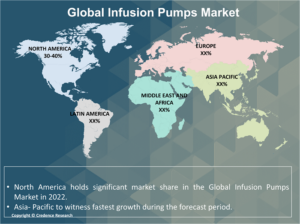
The Infusion Pumps Market experiences growth globally due to factors such as the rising prevalence of chronic diseases, increasing demand for advanced medical devices, and the expanding applications of infusion pumps across various medical specialties. The market's expansion is also propelled by the continuous development of innovative technologies in infusion pump systems.
The growth of the market in North America is attributed to the rising number of chronic diseases and the aging population in the region. According to the National Library of Medicine, the number of people aged 50 years and older with at least one chronic disease is projected to increase significantly, with a 99.5% increase estimated in the US from 2020 to 2035. As the number of people with chronic diseases increases, there is a heightened demand for advanced medical technologies, including infusion pumps, to manage and treat these conditions effectively. Additionally, the region is home to key companies such as Becton Dickinson and Company, Baxter, ICU Medical, Inc., Smiths Medical and others. These market players adopt various strategies, including acquisitions, partnerships, and product launches, to maintain competitiveness. A notable example is the collaboration between Smiths Medical and Ivenix in May 2022, marking the first comprehensive infusion management suite in the U.S. Focused on enhancing patient safety, this partnership addresses critical issues and aims to revolutionize healthcare delivery. Such strategic initiatives highlight the dynamic nature of the North American market, with companies actively seeking innovative collaborations to bring cutting-edge solutions to the forefront and meet the evolving needs of the healthcare landscape.
The Asia Pacific is anticipated to be the fastest-growing region for the Infusion Pumps Market over the forecast period. The region's abundance of healthcare facilities and the growing prevalence of chronic diseases are key factors fueling the expansion of the infusion pump market. Initiatives by governments, such as promoting advanced healthcare technologies, are also contributing to the growth of the market in the Asia Pacific.
The primary factor driving the growth of the Infusion Pumps Market is the increasing acceptability of infusion therapy for various medical applications. The rising need for precise drug delivery and continuous infusion in chemotherapy, pain management, and other medical procedures is favorably impacting the market's growth..
Key Highlights of the Report
The global Infusion Pumps Market is segmented by pump type, application, end-users, technology, accessories, mode of administration, power source, pump management software, and material type. Volumetric Infusion Pumps, Syringe Infusion Pumps, and Insulin Infusion Pumps are among the popular pump types, with hospitals, ambulatory surgical centers, and homecare settings being primary end-users. The market witnesses a significant presence of smart infusion pumps, offering advanced features for precise drug delivery.
Infusion pump accessories such as infusion sets, IV catheters, and needleless connectors play a crucial role in enhancing the efficiency of infusion therapies. The market is also segmented based on the mode of administration, including continuous infusion, intermittent infusion, and bolus infusion, catering to diverse medical needs.
The use of infusion pumps in chemotherapy, pain management, diabetes management, and pediatrics is driving market growth, with advancements in pump technology contributing to better patient outcomes. The availability of integrated pump software platforms and stand-alone pump management software further enhances the management and monitoring of infusion pumps.
The Infusion Pumps Market is characterized by a wide range of materials, including plastic infusion pumps and metal infusion pumps, offering flexibility and durability in different healthcare settings. Electric infusion pumps, battery-powered infusion pumps, and manual infusion pumps provide options for various power sources, accommodating different patient needs.
Leading global players in the Infusion Pumps Market include Medtronic, Becton Dickinson and Company, Baxter, Insulet Corporation, and ICU Medical, Inc. The market is witnessing growth across regions, with North America leading in market share, attributed to the presence of major healthcare organizations and continuous technological advancements. The Asia-Pacific region is expected to experience the highest growth rate, driven by the abundance of electronics manufacturing firms and increasing demand for advanced healthcare solutions.
What Are The Main Drivers Of The Infusion Pumps Market?
The increased prevalence of chronic diseases, growing aging population, rising demand for advanced medical technologies, and the expanding use of infusion pumps in various healthcare settings are the main factors propelling the Infusion Pumps Market forward. Additionally, the need for precise drug delivery, the convenience offered by infusion pumps, and technological advancements in infusion pump devices contribute to the market's growth.
What Are The Major Challenges Faced By The Infusion Pumps Market?
The main factors limiting the growth of the Infusion Pumps Market include regulatory challenges, concerns related to the safety and efficacy of infusion pumps, and the high cost associated with advanced infusion pump technologies. Additionally, competition among key market players and the need for skilled healthcare professionals for proper infusion pump usage pose challenges to market expansion.
What Are The Growth Opportunities In The Infusion Pumps Market?
The increasing adoption of home-based healthcare, the development of innovative infusion pump technologies, and the rising focus on personalized medicine present significant growth opportunities for the Infusion Pumps Market. Moreover, the expansion of the market in emerging economies, advancements in wireless connectivity for infusion pumps, and the integration of smart features in infusion pump devices create avenues for market growth during the forecast period.
Market Drivers
Growing Prevalence Of Chronic Diseases And Growing Aging Population
The growing prevalence of chronic diseases and the aging population present significant health challenges. The aging population tends to have a higher prevalence of chronic diseases worldwide, with a substantial impact on healthcare systems and resources. For example, in the US, six in ten adults have a chronic disease, and four in ten have two or more, while in Italy, more than 90% of older adults are affected by at least one chronic disease, and 60% have two or more. According to a report (2021) of International Diabetes Federation, 10.5% of the adult population (20-79 years) has diabetes, with almost half unaware that they are living with the condition. The increase in chronic diseases such as diabetes, hypertension, and obesity is closely linked to the aging population. These conditions are the leading drivers of illness, disability, death, and healthcare costs, emphasizing the need for targeted health promotion and disease prevention efforts. All this factors togather is driving the growth of the Infusion Pumps Market.
Market Restraints
Concerns Related To The Safety And Efficacy Of Infusion Pumps
Safety and efficacy concerns have significantly restrained the infusion pump market. The persistent worries regarding the reliability and security of infusion pumps have led to increased scrutiny from regulatory authorities and healthcare professionals. Instances of malfunctions, inaccurate dosing, and cybersecurity threats have raised alarms, impacting the trust in these devices. Manufacturers are under pressure to enhance safety features and adhere to stringent quality standards. For instance, in August 2023, Baxter Healthcare Corporation recalled 22,769 SIGMA Spectrum Infusion Pumps with Master Drug Library (Version 8) and Spectrum IQ Infusion Systems with Dose IQ Safety Software (Version 9) due to false upstream occlusion alarms after software upgrades. The FDA classifies it as a Class I recall, signaling potential serious injuries or death. Baxter reports 131 complaints, three serious injuries, and no deaths related to the issue. Affected customers receive urgent correction recommendations, including a no-charge software reversion. Until a fix is implemented, users must follow specified instructions to mitigate risks.
Opportunities
Development Of Innovative Infusion Pump Technologies
The development of innovative infusion pump technologies presents a substantial market opportunity for industry players. Advances such as smart pumps with connectivity features, precision dosing algorithms, and enhanced user interfaces are addressing safety concerns and improving overall efficiency. Integration with electronic health records and data analytics further enhances patient care. Market players focusing on these technological advancements are poised to capitalize on the growing demand for safer and more efficient infusion systems. For instance, In April 2023, Medtronic plc announces FDA approval for the MiniMed™ 780G system, the world's first insulin pump with meal detection technology. It offers automatic adjustments every 5 minutes for both basal and bolus insulin needs, addressing challenges during mealtimes for people with type 1 diabetes.
Competitive Landscape
Key Players
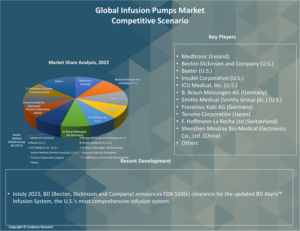
The global Infusion Pumps Market is highly competitive, with several key players. Some of the major players in the market and their market share are as follows:
- Medtronic (Ireland)
- Becton Dickinson and Company (U.S.)
- Baxter (U.S.)
- Insulet Corporation (U.S.)
- ICU Medical, Inc. (U.S.)
- B. Braun Melsungen AG (Germany)
- Smiths Medical (Smiths Group plc.) (U.S.)
- Fresenius Kabi AG (Germany)
- Terumo Corporation (Japan)
- F. Hoffmann-La Roche Ltd (Switzerland)
- Shenzhen Mindray Bio-Medical Electronics Co., Ltd. (China)
- Others
These organizations prioritize product innovation, distribution channel expansion, and mergers and acquisitions to stay competitive.
The global Infusion Pumps market's key players continually seek to stay ahead by offering new products and developments.
- In November 2022, Medtronic plc has launched the Extended Infusion Set in the U.S. It's labeled for up to 7-day wear, reducing changes and failures. Clinical studies show a 50% decrease in changes, improved comfort, and potential annual insulin cost savings of up to 25%. Additionally, it contributes to a 50% reduction in plastic waste.
- August 2022, Baxter has received FDA clearance for its Novum IQ syringe infusion pump with Dose IQ Safety Software, marking a significant milestone in medication delivery innovation. The pump integrates with electronic medical records and prioritizes safety, particularly for neonatal and pediatric patients. The platform's advanced connectivity and safety features aim to reduce medication errors and enhance data insights, showcasing Baxter's commitment to improving infusion therapy.
- June 2023, B. Braun launches DoseTrac Enterprise, a next-gen infusion management software, streamlining data insights for up to 40,000 pumps across multiple facilities. The software aids in reducing clinical IT infrastructure and has shown significant improvements in drug library compliance and alert reduction. Available on various devices.
Summary of Key Findings
- The demand for infusion pumps is on the rise due to the increasing need for precise drug delivery in healthcare settings, contributing to the growth of the Infusion Pumps Market.
- Market segmented by product type, application, end-user, technology, infusion pump accessories, mode of administration, power source, infusion pump management software, and material type.
- Volumetric infusion pumps, chemotherapy, hospitals, smart infusion pumps, infusion sets, continuous infusion, and electric infusion pumps are among the prominent segments.
- North America is a key contributor to market growth, and competition is intense with major players including Medtronic, Becton Dickinson and Company, Baxter, Insulet Corporation, ICU Medical, Inc., B. Braun Melsungen AG, Smiths Medical, Fresenius Kabi AG, Terumo Corporation, F. Hoffmann-La Roche Ltd, Shenzhen Mindray Bio-Medical Electronics Co., Ltd., and others.
Future Outlook
- Positive outlook for the global Infusion Pumps Market with significant growth potential in North America.
- The reliance of healthcare institutions on infusion pumps is a major factor driving market expansion in the government and business sectors.
- During the forecast period, the increasing adoption of infusion pump solutions is expected to limit the growth of traditional drug delivery methods.
- Key firms must focus on product innovation, expanding market reach, and maintaining competitive pricing to stay ahead in the competitive Infusion Pumps Market.
How CXOs Can Benefit from the Infusion Pumps Market Report
The Infusion Pumps Market Report provides CXOs with a comprehensive overview of the market, offering key insights into various aspects:
Market Size and Growth Forecast: The report furnishes detailed estimates of the global infusion pumps market size, segmented by product type, application, end-user, technology, and region. It also includes forecasts for the market through 2032, based on emerging trends and growth drivers.
Market Segmentation: CXOs can gain a granular understanding of the market by examining its segmentation based on product type, application, end-user, technology, and more. This segmentation allows CXOs to identify specific opportunities within each segment.
Competitive Landscape: The report profiles major players in the infusion pumps market, offering insights into their strategies, product portfolios, and financial performance. This information is invaluable for CXOs aiming to identify and evaluate their competition in the industry.
Key Trends and Drivers: Identification and analysis of the key trends and drivers shaping the infusion pumps market enable CXOs to make informed decisions regarding investments and strategic planning.
CXOs can leverage insights from the Infusion Pumps Market Report to:
Identify Growth Opportunities: The report helps CXOs pinpoint new growth opportunities within the infusion pumps market. For instance, it highlights the increasing demand for smart infusion pumps in various healthcare settings as a key growth opportunity.
Make Informed Investment Decisions: CXOs can use the report to make well-informed investment decisions regarding infusion pump technologies. It provides insights into critical factors to consider when evaluating infusion pump providers and selecting appropriate solutions.
Develop Competitive Strategies: The report aids CXOs in formulating competitive strategies for their infusion pumps businesses. It outlines key strategies employed by market leaders to differentiate themselves from competitors.
Track Market Developments: CXOs can stay abreast of market developments and innovations in infusion pump technologies. The report offers insights into the latest trends, technological advancements, and regulatory changes in the infusion pumps market.
In conclusion, the Infusion Pumps Market Report serves as a valuable resource for CXOs seeking a deeper understanding of the market dynamics and opportunities for growth within the healthcare and medical devices sector.
Segmentation
- By Product Type:
- Volumetric Infusion Pumps
- Syringe Infusion Pumps
- Insulin Infusion Pumps
- Ambulatory Infusion Pumps
- Enteral Infusion Pumps
- PCA (Patient-Controlled Analgesia) Infusion Pumps
- Others
- By Application:
- Chemotherapy
- Pain Management
- Gastroenterology
- Diabetes Management
- Pediatrics
- Hematology
- Neurology
- Others
- By End-User:
- Hospitals
- Ambulatory Surgical Centers (ASCs)
- Homecare Settings
- Specialty Clinics
- Long-Term Care Facilities
- By Technology:
- Traditional Infusion Pumps
- Smart Infusion Pumps
- By Infusion Pump Accessories:
- Infusion Sets
- IV Catheters
- Needleless Connectors
- IV Poles
- Valves and Stopcocks
- Other Accessories
- By Mode of Administration:
- Continuous Infusion
- Intermittent Infusion
- Bolus Infusion
- By Power Source:
- Electric Infusion Pumps
- Battery-Powered Infusion Pumps
- Manual Infusion Pumps
- By Infusion Pump Management Software:
- Integrated Pump Software Platforms
- Stand-Alone Pump Management Software
- By Material Type:
- Plastic Infusion Pumps
- Metal Infusion Pumps
- By Region
- North America
- US
- Canada
- Mexico
- Europe
- Germany
- France
- UK.
- Italy
- Spain
- Rest of Europe
- Asia Pacific
- China
- Japan
- India
- South Korea
- South-east Asia
- Rest of Asia Pacific
- Latin America
- Brazil
- Argentina
- Rest of Latin America
- Middle East & Africa
- GCC Countries
- South Africa
- Rest of Middle East and Africa
- North America
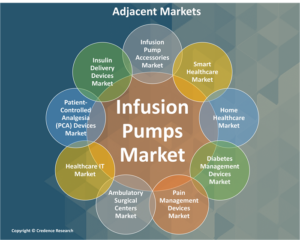
Adjacent Markets
In the Infusion Pumps Market, there are several adjacent markets which has high revenue growth opportunities. The key adjacent markets for Infusion Pumps Market -

Request a Free Sample
Fill in your details and we'll send you a free sample report.
- Sample data tables & charts
- Research methodology
Market Dynamics
Growing Prevalence of Chronic Diseases and Aging Population
The increasing incidence of chronic diseases such as diabetes, cancer, and cardiovascular conditions, particularly among the aging global population, is driving demand for infusion pumps to ensure precise and continuous medication delivery.
Technological Advancements and Smart Infusion Pumps
Continuous innovation in infusion pump technology, including the integration of smart features, wireless connectivity, and advanced software platforms, is enhancing safety, accuracy, and ease of use, thereby accelerating market adoption.
Expansion of Home-Based and Ambulatory Care
The shift toward homecare and ambulatory surgical centers, driven by patient preference and healthcare cost containment, is boosting demand for portable and user-friendly infusion pumps suitable for non-hospital settings.
Regulatory Push for Patient Safety and Medication Accuracy
Stricter regulatory standards and a focus on reducing medication errors are prompting healthcare providers to adopt advanced infusion pumps with enhanced safety features, supporting market growth.
Need a Custom Version of This Report?
Tailor the scope, geography, or segments to your exact requirements.
- Custom geography or segment scope
- Direct access to our analyst team
Frequently Asked Questions
What is the size of Infusion Pumps Market?
What is the expected growth rate of the Infusion Pumps Market between 2024 and 2032?
Which segment is leading the market share in terms of product type?
Which end-user segment governs the demand for Infusion Pumps globally?
Which application segment is expected to post the highest CAGR during the forecastperiod?
Which region is fueling the growth of the Infusion Pumps Market?
Who are the major players in the global Infusion Pumps Market?
What are the major market drivers of the Infusion Pumps Market?
Table of Content
Chapter 1 Market Segmentation
- 1.1 Segmentation Framework
- 1.1.1 Product and Service Classification
- 1.1.2 Application and End-Use Classification
- 1.1.3 Technology and Solution Classification
- 1.1.4 Customer and Distribution Channel Classification
- 1.1.5 Geographic Segmentation
- 1.1.6 Market Segment Definitions and Boundaries
- 1.2 By End-User
- 1.2.1 Hospitals
- 1.2.2 Ambulatory Surgical Centers (ASCs)
- 1.2.3 Homecare Settings
- 1.2.4 Specialty Clinics
- 1.2.5 Long-Term Care Facilities
- 1.3 By Technology
- 1.3.1 Traditional Infusion Pumps
- 1.3.2 Smart Infusion Pumps
- 1.4 By Application
- 1.4.1 Chemotherapy
- 1.4.2 Pain Management
- 1.4.3 Gastroenterology
- 1.4.4 Diabetes Management
- 1.4.5 Pediatrics
- 1.5 By Product Type
- 1.5.1 Volumetric Infusion Pumps
- 1.5.2 Syringe Infusion Pumps
- 1.5.3 Insulin Infusion Pumps
- 1.5.4 Ambulatory Infusion Pumps
- 1.5.5 Enteral Infusion Pumps
- 1.5.6 PCA Infusion Pumps
Chapter 2 Introduction
- 2.1 Report Objectives and Scope
- 2.2 Product Definition and Industry Terminology
- 2.3 Market Inclusions and Exclusions
- 2.4 Research Process
- 2.4.1 Primary Research and Expert Interviews
- 2.4.2 Secondary Research and Source Review
- 2.4.3 Top-Down and Bottom-Up Estimation
- 2.4.4 Data Triangulation and Verification
- 2.5 Market Size Measurement Basis
- 2.5.1 2023: USD 17,548.2 Million → 2032: USD 33,644.0 Million
- 2.6 Historical and Forecast Reference Periods
- 2.6.1 Base Year: 2023
- 2.6.2 Forecast Period: 2023-2032
- 2.7 Research Assumptions and Limitations
Chapter 3 Executive Summary
- 3.1 Market Snapshot and Key Findings
- 3.2 Base-Year Market Size, 2023
- 3.3 Forecast Market Size, 2032
- 3.4 Revenue and Volume Growth Outlook
- 3.5 Key Demand and Supply Indicators
- 3.6 Leading Market Segments
- 3.7 Fastest-Growing Market Opportunities
- 3.8 Regional Performance Highlights
- 3.9 Technology and Industry Transformation
- 3.10 Competitive Landscape Summary
- 3.11 Analyst View and Strategic Implications
Chapter 4 Global Infusion Pumps Market Trends and Developments
- 4.1 Historical Industry Development
- 4.2 Recent Market Trends and Developments
- 4.3 Demand and Customer Behavior Trends
- 4.4 Technology and Product Innovation
- 4.5 Artificial Intelligence, Automation and Digitalization
- 4.6 Local Manufacturing and Supply Chain Realignment
- 4.7 Industry Partnerships, Mergers and Acquisitions
- 4.8 Sustainability and Circular Economy Developments
- 4.9 Government and Private Sector Investment Trends
- 4.10 Emerging Business Models and Commercialization
- 4.11 Industry Developments and Announcements
Chapter 5 Global Infusion Pumps Market Production, Supply and Demand Analysis
- 5.1 Demand Trend and Consumption Analysis
- 5.2 Demand Forecast, 2023-2032
- 5.3 Production and Output Trend
- 5.4 Production and Output Forecast, 2023-2032
- 5.5 Installed Capacity and Capacity Utilization
- 5.6 Company-Wise Production Plants and Statistics
- 5.6.1 Installed Production Capacity
- 5.6.2 Actual Production
- 5.6.3 Planned Capacity and Expansion Targets
- 5.7 Supply Chain Structure and Procurement Trends
- 5.8 Supply-Demand Gap and Bottlenecks
- 5.9 Import Dependence and Sourcing Structure
- 5.10 Contract Manufacturing and Outsourcing
- 5.11 Regional Supply and Demand Concentration
Chapter 6 Global Infusion Pumps Market Pricing Analysis
- 6.1 Pricing Structure and Measurement
- 6.2 Historical Pricing Trends
- 6.3 Pricing Outlook, 2023-2032
- 6.4 Average Selling Price and Unit Economics
- 6.5 Pricing by Product and Market Segment
- 6.6 Geographic Pricing Differences
- 6.7 Key Input, Energy, Labor and Logistics Costs
- 6.8 Contract Pricing and Purchasing Models
- 6.9 Pricing Sensitivity and Competitive Positioning
- 6.10 Price, Margin and Profitability Implications
Chapter 7 Global Infusion Pumps Market Dynamics
- 7.1 Market Growth Drivers
- 7.1.1 Demand-Side Drivers
- 7.1.2 Technology and Innovation Drivers
- 7.1.3 Infrastructure and Investment Drivers
- 7.1.4 Regulatory and Policy Drivers
- 7.2 Market Restraints
- 7.2.1 Cost and Affordability Constraints
- 7.2.2 Technology and Adoption Barriers
- 7.2.3 Supply Chain and Operational Constraints
- 7.3 Market Challenges
- 7.3.1 Competitive Pressure and Margin Erosion
- 7.3.2 Skills, Infrastructure and Implementation Gaps
- 7.4 Emerging Market Opportunities
- 7.5 Market Dynamics Impact and Time-Horizon Assessment
Chapter 8 Global Infusion Pumps Value Chain Analysis
- 8.1 Industry Value Chain Overview
- 8.2 Upstream Suppliers and Critical Inputs
- 8.3 Technology and Component Providers
- 8.4 Manufacturing or Service Delivery
- 8.5 Distribution, Channel Partners and Integrators
- 8.6 Downstream Applications and End Users
- 8.7 Value Addition and Profit Pools
- 8.8 Vertical Integration and Outsourcing
- 8.9 Supplier Concentration and Risk
- 8.10 Supply Chain Localization and Resilience
Chapter 9 Global Infusion Pumps Market Regulations and Policies
- 9.1 Relevant Laws, Standards and Compliance Frameworks
- 9.2 Product, Service, Safety and Quality Requirements
- 9.3 Government Policies, Incentives and Subsidies
- 9.4 Imports, Exports and Trade Barriers
- 9.5 Public Procurement and Local Content Requirements
- 9.6 Environmental and Sustainability Compliance
- 9.7 Upcoming Policy Changes and Market Implications
Chapter 10 Global Infusion Pumps Market Hotspots and Opportunities
- 10.1 Market Opportunity Mapping and Growth Hotspots
- 10.2 High-Growth Applications and Customer Groups
- 10.3 Underserved Markets and White-Space Opportunities
- 10.4 Emerging Technology and Product Opportunities
- 10.5 New Capacity and Investment Hotspots
- 10.6 Market Entry and Expansion Opportunities
- 10.7 Distribution and Partnership Opportunities
- 10.8 Near-Term and Long-Term Commercial Potential
- 10.9 Opportunity Attractiveness and Execution Risks
Chapter 11 Global Infusion Pumps Market Outlook, 2023-2032
- 11.1 Market Size and Analysis
- 11.1.1 Revenue (Market Measurement: 2023: USD 17,548.2 Million → 2032: USD 33,644.0 Million)
- 11.1.2 Market Volume and Quantity Sold
- 11.1.3 Historical Market Size
- 11.1.4 Base-Year Market Size, 2023
- 11.2 Market Forecast, 2023-2032
- 11.2.1 Revenue Forecast to 2032
- 11.2.2 Volume Forecast to 2032
- 11.2.3 CAGR and Year-on-Year Growth
- 11.2.4 Incremental Revenue Opportunity
- 11.3 Forecast Assumptions and Scenario Analysis
- 11.3.1 Base-Case Forecast
- 11.3.2 Optimistic and Conservative Scenarios
- 11.3.3 Technology, Pricing and Policy Sensitivities
- 11.4 Market Attractiveness and Growth Outlook
Chapter 12 Global Infusion Pumps Market Segmentation and Outlook
- 12.1 Segmentation Summary and Market Shares, 2023
- 12.2 Largest and Fastest-Growing Segments
- 12.3 By End-User - Market Size and Forecast, 2023-2032
- 12.3.1 Segment Definition and Scope
- 12.3.2 Historical Market Size
- 12.3.3 Revenue Forecast, 2023-2032
- 12.3.4 Volume Forecast, 2023-2032
- 12.3.5 Base-Year Market Share, 2023
- 12.3.6 Segment CAGR and Growth Drivers
- 12.3.7 Subsegment Market Size and Forecast
- 12.3.7.1 Hospitals
- 12.3.7.2 Ambulatory Surgical Centers (ASCs)
- 12.3.7.3 Homecare Settings
- 12.3.7.4 Specialty Clinics
- 12.3.7.5 Long-Term Care Facilities
- 12.3.8 Subsegment Pricing and Adoption Trends
- 12.3.9 Leading Suppliers and Competition
- 12.3.10 Regional Demand and Opportunities
- 12.4 By Technology - Market Size and Forecast, 2023-2032
- 12.4.1 Segment Definition and Scope
- 12.4.2 Historical Market Size
- 12.4.3 Revenue Forecast, 2023-2032
- 12.4.4 Volume Forecast, 2023-2032
- 12.4.5 Base-Year Market Share, 2023
- 12.4.6 Segment CAGR and Growth Drivers
- 12.4.7 Subsegment Market Size and Forecast
- 12.4.7.1 Traditional Infusion Pumps
- 12.4.7.2 Smart Infusion Pumps
- 12.4.8 Subsegment Pricing and Adoption Trends
- 12.4.9 Leading Suppliers and Competition
- 12.4.10 Regional Demand and Opportunities
- 12.5 By Application - Market Size and Forecast, 2023-2032
- 12.5.1 Segment Definition and Scope
- 12.5.2 Historical Market Size
- 12.5.3 Revenue Forecast, 2023-2032
- 12.5.4 Volume Forecast, 2023-2032
- 12.5.5 Base-Year Market Share, 2023
- 12.5.6 Segment CAGR and Growth Drivers
- 12.5.7 Subsegment Market Size and Forecast
- 12.5.7.1 Chemotherapy
- 12.5.7.2 Pain Management
- 12.5.7.3 Gastroenterology
- 12.5.7.4 Diabetes Management
- 12.5.7.5 Pediatrics
- 12.5.8 Subsegment Pricing and Adoption Trends
- 12.5.9 Leading Suppliers and Competition
- 12.5.10 Regional Demand and Opportunities
- 12.6 By Product Type - Market Size and Forecast, 2023-2032
- 12.6.1 Segment Definition and Scope
- 12.6.2 Historical Market Size
- 12.6.3 Revenue Forecast, 2023-2032
- 12.6.4 Volume Forecast, 2023-2032
- 12.6.5 Base-Year Market Share, 2023
- 12.6.6 Segment CAGR and Growth Drivers
- 12.6.7 Subsegment Market Size and Forecast
- 12.6.7.1 Volumetric Infusion Pumps
- 12.6.7.2 Syringe Infusion Pumps
- 12.6.7.3 Insulin Infusion Pumps
- 12.6.7.4 Ambulatory Infusion Pumps
- 12.6.7.5 Enteral Infusion Pumps
- 12.6.7.6 PCA Infusion Pumps
- 12.6.8 Subsegment Pricing and Adoption Trends
- 12.6.9 Leading Suppliers and Competition
- 12.6.10 Regional Demand and Opportunities
- 12.7 Segment Growth Comparison
- 12.8 Segment Attractiveness and Priority Matrix
Chapter 13 Global Infusion Pumps End-Use and Application Market Outlook
- 13.1 End-Use Industry and Customer Demand Structure
- 13.2 Leading Applications and Customer Groups
- 13.3 End-Use Market Size, Share and Forecast
- 13.4 Major End-Use Industry Deep Dives
- 13.4.1 Customer Requirements and Use Cases
- 13.4.2 Demand and Replacement Cycles
- 13.4.3 Technical and Regulatory Considerations
- 13.4.4 Purchasing and Procurement Models
- 13.4.5 Leading Vendors and Distribution Channels
- 13.4.6 Forecast and Commercial Opportunities
- 13.5 Emerging Applications and Cross-Segment Demand
- 13.6 End-Use Industry Investment Priorities
Chapter 14 Global Infusion Pumps Geographic Market Outlook, 2023-2032
- 14.1 Regional Market Size and Share, 2023
- 14.2 Regional Market Forecast, 2023-2032
- 14.3 Regional Pricing, Production and Demand Differences
- 14.4 North America
- 14.4.1 United States
- 14.4.2 Canada
- 14.4.3 Mexico
- 14.5 Europe
- 14.5.1 Germany
- 14.5.2 France
- 14.5.3 Italy
- 14.5.4 United Kingdom
- 14.5.5 Spain
- 14.5.6 Poland
- 14.5.7 Russia
- 14.5.8 Netherlands
- 14.5.9 Belgium
- 14.5.10 Sweden
- 14.5.11 Denmark
- 14.5.12 Norway
- 14.5.13 Rest of Europe
- 14.6 Asia Pacific
- 14.6.1 China
- 14.6.2 India
- 14.6.3 Japan
- 14.6.4 South Korea
- 14.6.5 Thailand
- 14.6.6 Indonesia
- 14.6.7 Vietnam
- 14.6.8 Malaysia
- 14.6.9 Australia
- 14.6.10 Rest of Asia Pacific
- 14.7 Latin America
- 14.7.1 Brazil
- 14.7.2 Argentina
- 14.7.3 Colombia
- 14.7.4 Chile
- 14.7.5 Rest of Latin America
- 14.8 Middle East
- 14.8.1 Saudi Arabia
- 14.8.2 United Arab Emirates
- 14.8.3 Turkey
- 14.8.4 Israel
- 14.8.5 Iran
- 14.8.6 Rest of the Middle East
- 14.9 Africa
- 14.9.1 South Africa
- 14.9.2 Egypt
- 14.9.3 Nigeria
- 14.9.4 Morocco
- 14.9.5 Rest of Africa
- 14.10 Regional Investment, Policy and Supply Chain Differences
- 14.11 Regional Competitive Landscape
- 14.12 Geographic Growth Hotspots
Chapter 15 Global Infusion Pumps Technology, Innovation and Sustainability Outlook
- 15.1 Technology Landscape and Maturity
- 15.2 Product, Process and Service Innovation
- 15.3 AI, Automation and Digital Tools in the Industry
- 15.4 Technology Adoption and Performance Benchmarking
- 15.5 Innovation Pipeline and R&D Investment
- 15.6 Patent and Intellectual Property Trends
- 15.7 Energy Efficiency and Resource Management
- 15.8 Sustainability, Recycling and Circularity
- 15.9 Technology Roadmap, 2023-2032
- 15.10 Risks of Obsolescence and Technology Substitution
Chapter 16 Global Infusion Pumps Market Key Strategic Imperatives
- 16.1 Growth and Market Entry Priorities
- 16.2 High-Return Products and Segments
- 16.3 Pricing, Profitability and Cost Optimization
- 16.4 Technology Investment and Product Differentiation
- 16.5 Supply Chain Localization and Resilience
- 16.6 Distribution and Customer Acquisition
- 16.7 Partnership, Acquisition and Capacity Strategy
- 16.8 Regional Expansion Priorities
- 16.9 Short-, Medium- and Long-Term Actions
Chapter 17 Competition Outlook
- 17.1 Industry Competition Characteristics
- 17.2 Market Structure and Concentration
- 17.3 Market Share and Competitive Positioning, 2023
- 17.4 Company-Wise Revenue and Product Benchmarking
- 17.5 Production and Service Capacity Benchmarking
- 17.6 Technology, Pricing and Differentiation
- 17.7 Regional Footprint and Distribution Strength
- 17.8 Mergers, Acquisitions and Strategic Alliances
- 17.9 New Entrants and Competitive Threats
- 17.10 Porter's Five Forces and Industry Attractiveness
- 17.11 Competitive Outlook, 2023-2032
Chapter 18 Company Profiles
- 18.1 Company Coverage and Selection Criteria
- 18.2 Medtronic
- 18.2.1 Business Description
- 18.2.2 Company Ownership and Geographic Presence
- 18.2.3 Product and Service Portfolio
- 18.2.4 Manufacturing and Operating Footprint
- 18.2.5 Production Capacity and Expansion Plans
- 18.2.6 Financial Performance and Investment
- 18.2.7 Market Share and Competitive Position
- 18.2.8 Technology and Innovation Capabilities
- 18.2.9 Strategic Alliances or Partnerships
- 18.2.10 Recent Developments
- 18.2.11 Growth Strategy and Outlook
- 18.3 Becton Dickinson and Company
- 18.4 Baxter
- 18.5 Insulet Corporation
- 18.6 ICU Medical, Inc.
- 18.7 B. Braun Melsungen AG
- 18.8 Smiths Medical (Smiths Group plc.)
- 18.9 Fresenius Kabi AG
- 18.10 Terumo Corporation
- 18.11 Shenzhen Mindray Bio-Medical Electronics Co., Ltd.
- 18.12 Other Relevant Market Participants
Note: Every listed company is profiled on the structure shown under the first company. The company list is preliminary and may change based on research findings, market developments, data availability and client requirements.
Chapter 19 Disclaimer
- 19.1 Research and Forecast Disclaimer
- 19.2 Data Source and Estimation Limitations
Note: The depth of individual sections depends on data availability for this market. Volume, capacity, trade and other unit-based metrics are included where applicable.

