
Internet Protocol Television (IPTV) Market Overview:
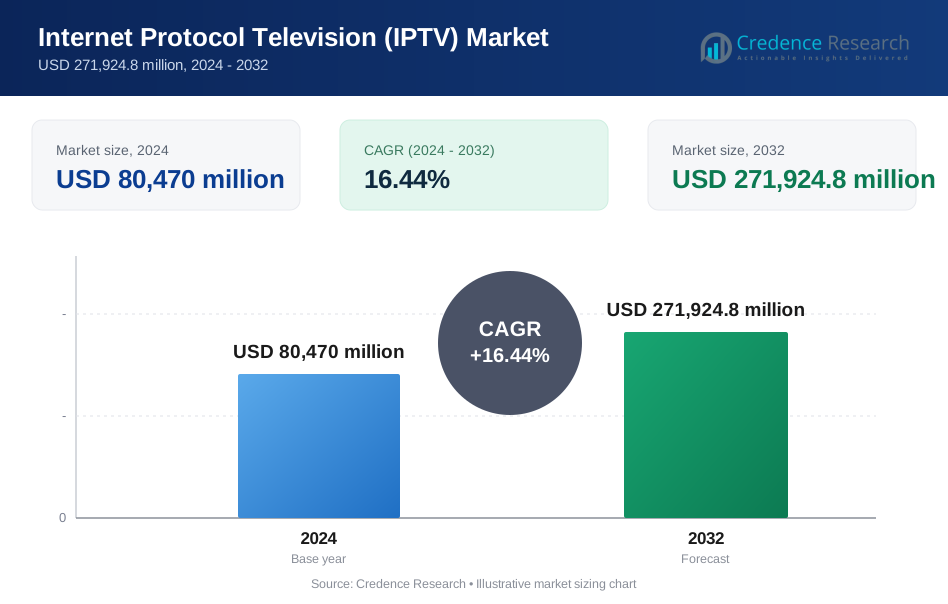
Internet Protocol Television (IPTV) Market size was valued at USD 80,470 million in 2024 and is anticipated to reach USD 271,924.8 million by 2032, growing at a CAGR of 16.44% during the forecast period.
| REPORT ATTRIBUTE | DETAILS |
|---|---|
| Historical Period | 2020-2023 |
| Base Year | 2024 |
| Forecast Period | 2025-2032 |
| Internet Protocol Television (IPTV) Market Size 2024 | USD 80,470 million |
| Internet Protocol Television (IPTV) Market, CAGR | 16.44% |
| Internet Protocol Television (IPTV) Market Size 2032 | USD 271,924.8million |
Internet Protocol Television (IPTV) Market Insights
- Market growth is driven by rapid expansion of high-speed broadband and fiber networks, increasing demand for on-demand and personalized content, and rising adoption of smart TVs and connected devices across residential and commercial users.
- Key market trends include convergence of IPTV with OTT platforms, growing adoption of cloud-based IPTV solutions, and increased use of AI-driven analytics, while major players focus on bundled services and content partnerships to strengthen market presence.
- Market growth faces restraints such as high infrastructure deployment costs, complex content licensing requirements, and increasing concerns related to piracy and regulatory compliance across regions.
- Asia Pacific led the market with a 38.2% regional share in 2024, while the software segment dominated by component with a 58.6% share, supported by strong investments in middleware, cloud platforms, and content management solutions.
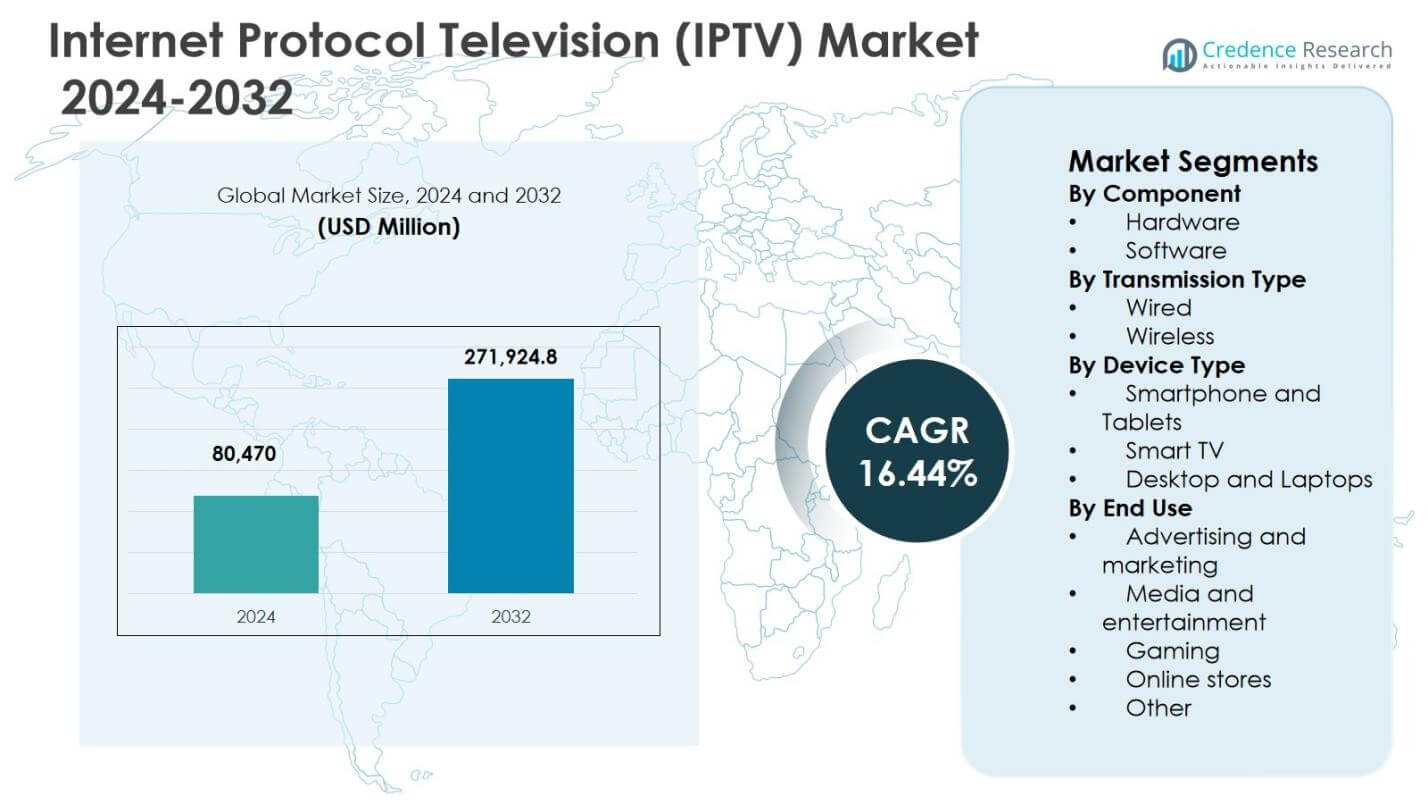
Internet Protocol Television (IPTV) Market Segmentation Analysis:
By Component:
The Internet Protocol Television (IPTV) Market by component is segmented into hardware and software, with software dominating the segment by accounting for 58.6% market share in 2024. The dominance of software is driven by rising deployment of IPTV middleware, content management systems, video analytics, and cloud-based platforms that enable personalized content delivery, scalability, and seamless integration with OTT services. Growing investments by telecom operators in software-defined networks, AI-driven recommendation engines, and subscription management tools further accelerate software adoption, while hardware demand remains steady for set-top boxes and network infrastructure upgrades.
- For instance, Anevia's Genova software encoder enabled CNI to launch North America's first ultra-low latency IPTV streaming service in 2019, supporting up to 30 channels at 720p30 with HEVC for scalable live TV and VOD.
By Transmission Type:
Based on transmission type, the market is categorized into wired and wireless, where wired transmission held the largest share of 63.2% in 2024. The dominance of wired IPTV is supported by its higher bandwidth capacity, stable connectivity, lower latency, and superior video quality for high-definition and ultra-high-definition content. Fiber-optic and broadband infrastructure expansion by telecom providers, particularly in urban regions, continues to strengthen wired IPTV adoption. Meanwhile, wireless IPTV adoption is increasing due to mobile streaming growth, though network reliability constraints limit its overall share.
- For instance, Bharti Airtel launched IPTV services in 2000 cities in India in March 2025, adding 76,000 digital TV users in Q4 FY25 through its fiber infrastructure like Airtel Xstream Fiber.
By Device Type:
By device type, the Internet Protocol Television (IPTV) Market includes smartphones and tablets, smart TVs, and desktops and laptops, with smart TVs leading the segment with a 46.9% market share in 2024. The dominance of smart TVs is driven by their built-in IPTV applications, large-screen viewing experience, and seamless integration with broadband networks and smart home ecosystems. Rising consumer preference for on-demand and live streaming content on connected TVs, along with increasing smart TV penetration across residential households, continues to fuel strong growth in this segment.
Key Growth Drivers
Expansion of High-Speed Broadband and Fiber Infrastructure
The Internet Protocol Television (IPTV) Market is significantly driven by the rapid expansion of high-speed broadband and fiber-optic infrastructure across developed and emerging economies. Telecom operators continue to deploy fiber-to-the-home and advanced broadband networks to support bandwidth-intensive IPTV services. Improved network stability, higher data speeds, and reduced latency enable seamless delivery of HD and UHD content, interactive TV, and video-on-demand services. These infrastructure advancements strengthen service reliability, enhance user experience, and support large-scale IPTV subscriber growth in residential, commercial, and hospitality environments.
- For instance, Verizon launched Fios TV over its fiber-optic network, offering over 180 digital channels including more than 20 in HD, along with 600 video-on-demand titles.
Rising Demand for On-Demand and Personalized Viewing
Increasing consumer preference for flexible, on-demand, and personalized content consumption is a major growth driver for the Internet Protocol Television (IPTV) Market. IPTV platforms enable features such as catch-up TV, video-on-demand, and personalized recommendations using analytics and artificial intelligence. These capabilities improve viewer engagement and allow service providers to tailor content based on user behavior and preferences. The growing demand for multilingual, regional, and niche content further supports IPTV adoption, helping providers attract diverse customer segments and improve subscriber retention rates.
- For instance, TashanTV delivers over 15,000 channels in 15+ Indian regional languages like Hindi, Bengali, Tamil, Punjabi, and Marathi, alongside English and international options for global audiences.
Integration with Smart Devices and Connected Ecosystems
The growing penetration of smart TVs, smartphones, tablets, and connected home devices is accelerating IPTV adoption globally. IPTV services integrate seamlessly with smart ecosystems, enabling multi-screen viewing, synchronized content access, and interactive user interfaces. Compatibility with voice assistants and smart home platforms enhances ease of use and content discovery. As consumers increasingly adopt connected lifestyles, IPTV providers leverage device integration and bundled service offerings to expand reach, improve user convenience, and strengthen long-term customer engagement.
Key Trends & Opportunities
Convergence of IPTV with OTT and Hybrid Content Models
A prominent trend in the Internet Protocol Television (IPTV) Market is the convergence of IPTV services with OTT platforms and hybrid content delivery models. Providers increasingly combine live television, on-demand libraries, and third-party streaming applications within unified interfaces. This convergence enhances content diversity, improves user experience, and creates new revenue opportunities through bundled subscriptions and targeted advertising. Hybrid IPTV-OTT models also enable operators to differentiate services, address evolving viewing habits, and expand monetization across multiple devices and user segments.
- For instance, Reliance Jio integrates IPTV with OTT through JioTV+, aggregating 800+ digital TV channels and 13+ OTT apps like Netflix, Amazon Prime Video, and JioHotstar under a single login on its set-top box and smart TVs.
Adoption of Cloud-Based IPTV Platforms and Advanced Analytics
The shift toward cloud-based IPTV platforms presents a strong growth opportunity for the market. Cloud deployment enables scalability, faster service launches, and reduced infrastructure costs for providers. Integrated analytics and artificial intelligence tools support personalized content delivery, predictive network management, and dynamic ad insertion. These capabilities improve service efficiency and revenue optimization. As operators transition to cloud-native architectures, IPTV providers gain flexibility to expand geographically, innovate service offerings, and respond quickly to changing consumer demand.
- For instance, Accion Labs developed a cloud-based TV streaming platform for a leading provider, enabling global access to live and recorded programs via responsive web UI and APIs.
Key Challenges
High Infrastructure and Deployment Costs
High infrastructure and deployment costs remain a key challenge for the Internet Protocol Television (IPTV) Market. Significant capital investment is required for fiber networks, middleware platforms, content delivery systems, and customer-premises equipment. Smaller service providers often struggle to compete with large telecom operators that possess established infrastructure. Ongoing expenses related to network upgrades, cybersecurity, and system maintenance further pressure operating margins, limiting IPTV expansion in cost-sensitive and rural markets.
Content Licensing, Piracy, and Regulatory Complexity
Content licensing challenges, digital piracy, and regulatory compliance issues pose major obstacles for IPTV providers. Acquiring exclusive content rights involves high costs and complex negotiations, while piracy and unauthorized streaming reduce revenue potential. Additionally, IPTV operators must comply with diverse regional regulations related to broadcasting standards, data protection, and content distribution. Managing these legal and regulatory complexities increases operational risk and necessitates continuous investment in content protection, compliance systems, and rights management solutions.
Regional Analysis
North America
The Internet Protocol Television (IPTV) Market in North America accounted for 27.4% market share in 2024, driven by advanced broadband infrastructure, high smart TV penetration, and strong demand for on-demand and live streaming services. The United States leads regional growth due to widespread fiber deployment, early adoption of cloud-based IPTV platforms, and strong presence of telecom and media service providers. Increasing integration of IPTV with OTT platforms, rising demand for UHD content, and growing adoption across hospitality and enterprise sectors continue to support sustained IPTV expansion across the region.
Europe
Europe captured 24.1% of the Internet Protocol Television (IPTV) Market share in 2024, supported by strong broadband penetration and increasing adoption of IPTV services by telecom operators. Countries such as the UK, Germany, France, and Spain are key contributors due to rising demand for multilingual content, hybrid IPTV-OTT services, and regulatory support for digital broadcasting. The region benefits from widespread fiber-to-the-home networks and growing consumer preference for bundled telecom services. Increasing focus on content personalization and smart home integration further drives regional IPTV adoption.
Asia Pacific
Asia Pacific dominated the Internet Protocol Television (IPTV) Market with a 38.2% market share in 2024, driven by rapid urbanization, expanding broadband infrastructure, and a growing digital population. China, India, South Korea, and Japan are major contributors, supported by rising smartphone and smart TV adoption. Increasing demand for regional language content, live streaming, and cost-effective subscription models accelerates IPTV growth. Government initiatives supporting digital connectivity and significant investments by telecom operators in fiber networks further strengthen Asia Pacific’s position as the fastest-growing regional market.
Latin America
Latin America held 6.1% market share in the Internet Protocol Television (IPTV) Market in 2024, supported by expanding broadband access and growing demand for affordable digital TV services. Brazil, Mexico, and Argentina lead regional adoption as telecom operators increasingly offer IPTV as part of bundled internet and voice services. Rising smartphone usage, improving network infrastructure, and increasing preference for on-demand content drive market growth. However, infrastructure gaps and pricing sensitivity remain challenges, while ongoing digital transformation initiatives continue to create growth opportunities across the region.
Middle East & Africa
The Middle East & Africa accounted for 4.2% of the Internet Protocol Television (IPTV) Market share in 2024, driven by increasing investments in broadband infrastructure and smart city projects. Countries such as the UAE, Saudi Arabia, and South Africa are key markets, supported by high demand for premium content and multilingual programming. Expanding fiber networks, growing smart TV penetration, and rising adoption of IPTV in hospitality and commercial sectors support regional growth. Gradual digitalization and improving internet accessibility continue to enhance IPTV adoption potential.
Internet Protocol Television (IPTV) Market Segmentations:
By Component
- Hardware
- Software
By Transmission Type
- Wired
- Wireless
By Device Type
- Smartphone and Tablets
- Smart TV
- Desktop and Laptops
By End Use
- Advertising and marketing
- Media and entertainment
- Gaming
- Online stores
- Other
By Geography
- North America
- U.S.
- Canada
- Mexico
- Europe
- Germany
- France
- U.K.
- Italy
- Spain
- Rest of Europe
- Asia Pacific
- China
- Japan
- India
- South Korea
- South-east Asia
- Rest of Asia Pacific
- Latin America
- Brazil
- Argentina
- Rest of Latin America
- Middle East & Africa
- GCC Countries
- South Africa
- Rest of the Middle East and Africa
Competitive Landscape
Competitive landscape of the Internet Protocol Television (IPTV) Market is characterized by the presence of major players such as AT&T Inc., Verizon Communications Inc., Orange S.A., Deutsche Telekom AG, Telefónica S.A., China Telecom Corporation Limited, Vodafone Group Plc, KT Corporation, Rostelecom, and NTT Communications. These companies compete through extensive broadband infrastructure, bundled service offerings, and continuous investments in IPTV middleware, cloud platforms, and content partnerships. Market participants focus on integrating IPTV with OTT services, enhancing user interfaces, and deploying AI-driven personalization to strengthen customer engagement. Strategic collaborations with content providers, adoption of cloud-based delivery models, and expansion into enterprise and hospitality segments remain key competitive strategies. Additionally, players emphasize regional content customization and multi-device compatibility to address diverse consumer preferences. Continuous network upgrades, fiber expansion, and innovation in interactive and on-demand services further intensify competition, enabling leading providers to maintain strong subscriber bases and geographic reach.
Key Player Analysis
- Pluto TV
- Hulu + Live TV
- ESPN Unlimited
- Peacock TV
- DirecTV Stream
- Paramount Plus
- fuboTV
- Sling TV
- Xfinity Stream
- YouTube TV
Recent Developments
- In March 2025, Bharti Airtel launched its IPTV services across 2000 cities in India, expanding its digital TV footprint and enhancing home entertainment offerings for customers nationwide.
- In August 2025, Netplus partnered with Nokia to roll out 400G and SDAN technology to scale high-speed broadband and IPTV services across the Punjab region, boosting network capacity and service quality.
- In August 2025, Vodafone Group extended its partnership with Kaltura to enhance Cloud TV services using AI-driven solutions for better user engagement and personalization.
Report Coverage
The research report offers an in-depth analysis based on Component, Transmission Type, Device Type, End Use and Geography. It details leading market players, providing an overview of their business, product offerings, investments, revenue streams, and key applications. Additionally, the report includes insights into the competitive environment, SWOT analysis, current market trends, as well as the primary drivers and constraints. Furthermore, it discusses various factors that have driven market expansion in recent years. The report also explores market dynamics, regulatory scenarios, and technological advancements that are shaping the industry. It assesses the impact of external factors and global economic changes on market growth. Lastly, it provides strategic recommendations for new entrants and established companies to navigate the complexities of the market.
Future Outlook
- The Internet Protocol Television (IPTV) Market will continue to expand driven by rising demand for high-quality live and on-demand digital content.
- Increasing deployment of fiber-to-the-home and high-speed broadband networks will strengthen IPTV service reliability and adoption.
- Integration of IPTV platforms with OTT services will become more widespread, enabling unified and flexible content delivery models.
- Cloud-based IPTV architectures will gain traction due to scalability, cost efficiency, and faster service deployment.
- Artificial intelligence and data analytics will play a larger role in content personalization and user experience optimization.
- Smart TV and connected device penetration will remain a key factor supporting multi-screen IPTV consumption.
- Telecom operators will increasingly bundle IPTV with internet and voice services to improve customer retention.
- Growth in enterprise and hospitality IPTV applications will create additional revenue opportunities.
- Enhanced cybersecurity and content protection technologies will become critical to address piracy concerns.
- Emerging markets will witness faster IPTV adoption supported by digitalization initiatives and improving internet access.
Request a Free Sample
Fill in your details and we'll send you a free sample report.
- Sample data tables & charts
- Research methodology
Need a Custom Version of This Report?
Tailor the scope, geography, or segments to your exact requirements.
- Custom geography or segment scope
- Direct access to our analyst team
Frequently Asked Questions
What is the current market size for the Internet Protocol Television (IPTV) Market, and what is its projected size in 2032?
At what Compound Annual Growth Rate is the Internet Protocol Television (IPTV) Market projected to grow between 2024 and 2032?
Which Internet Protocol Television (IPTV) Market segment held the largest share in 2024?
What are the primary factors fueling the growth of the Internet Protocol Television (IPTV) Market?
Who are the leading companies in the Internet Protocol Television (IPTV) Market?
Which region commanded the largest share of the Internet Protocol Television (IPTV) Market in 2024?
Table of Content
Chapter 1. Report Introduction
- 1.1 Report Description & Purpose
- 1.1.1 Report Title & Market Definition
- 1.1.2 Unique Selling Propositions (USP) & Key Differentiators
- 1.1.3 Value Proposition for Stakeholders
- 1.2 Research Objectives
- 1.2.1 Market Sizing Objectives (Volume & Revenue) (Volume Where Applicable)
- 1.2.2 Segmentation Objectives
- 1.2.3 Competitive Intelligence Objectives
- 1.2.4 Forecast & Scenario Objectives
- 1.3 Report Scope
- 1.3.1 Internet Protocol Television (IPTV) Scope – Segments & Subsegments Covered
- 1.3.2 Geographic Scope – Regions & Countries Covered
- 1.3.3 Historical Period, Base Year & Forecast Period (2024; forecast to 2032)
- 1.3.4 Inclusions & Exclusions
- 1.4 Industry Classification & Applicable Codes
- 1.5 Currency, Measurement Units & Valuation Basis
- 1.6 Target Stakeholders
- 1.7 Limitations & Assumptions
Chapter 2. Executive Summary
- 2.1 Global Internet Protocol Television (IPTV) Market Snapshot
- 2.1.1 Market Size – Historical (2024) & Forecast (2024-2032) (2024: USD 80,470 million → 2032: USD 271,924.8 million)
- 2.1.2 Volume & Revenue – Global Totals (Volume Where Applicable)
- 2.1.3 Key Market Highlights – Top Five Facts
- 2.2 Internet Protocol Television (IPTV) Market Segmentation Snapshot
- 2.2.1 Market Split by Region – 2024 vs. 2032
- 2.3 Competitive Snapshot
- 2.3.1 Top 10 Players by Revenue Share – 2024
- 2.3.2 Top 10 Players by Volume Share – 2024 (Volume Where Applicable)
- 2.3.3 Recent Strategic Developments (18-Month Summary)
- 2.4 Key Investment Highlights & Strategic Conclusions
Chapter 3. Internet Protocol Television (IPTV) Market Dynamics & Industry Analysis
- 3.1 Market Overview & Context
- 3.1.1 Internet Protocol Television (IPTV) Market Position in the Broader Industry Value Chain
- 3.1.2 Demand Structure & Purchasing Dynamics
- 3.1.3 Market Maturity & Development Stage by Region
- 3.2 Internet Protocol Television (IPTV) Market Drivers
- 3.3 Internet Protocol Television (IPTV) Market Restraints & Challenges
- 3.4 Internet Protocol Television (IPTV) Market Opportunities
- 3.5 Porter's Five Forces Analysis
- 3.5.1 Threat of New Entrants
- 3.5.2 Bargaining Power of Suppliers
- 3.5.3 Bargaining Power of Buyers
- 3.5.4 Threat of Substitutes
- 3.5.5 Competitive Rivalry – Intensity Assessment
- 3.6 Internet Protocol Television (IPTV) Value Chain Analysis
- 3.6.1 Upstream – Key Inputs, Resources & Suppliers
- 3.6.1.1 Key Input/Resource 1
- 3.6.1.2 Key Input/Resource 2
- 3.6.1.3 Key Input/Resource 3
- 3.6.2 Midstream – Core Operations & Value Creation
- 3.6.2.1 Operating Model & Process Overview
- 3.6.2.2 Key Operating Locations & Capabilities by Company
- 3.6.3 Downstream – Market Channels & End Users
- 3.6.3.1 Direct Sales & Customer Engagement Channels
- 3.6.3.2 Indirect Sales, Intermediaries & Partner Channels
- 3.6.4 Value Chain Profitability Analysis
- 3.6.1 Upstream – Key Inputs, Resources & Suppliers
- 3.7 PESTEL Analysis
- 3.7.1 Political Factors
- 3.7.2 Economic Factors
- 3.7.3 Social Factors
- 3.7.4 Technological Factors
- 3.7.5 Environmental Factors
- 3.7.6 Legal Factors
- 3.8 Internet Protocol Television (IPTV) Supply Chain Analysis
- 3.8.1 Critical Input & Resource Availability Risk Assessment
- 3.8.2 Supplier & Operational Concentration Risk (Geographic Exposure)
- 3.8.3 Supply & Service Disruption Impact Analysis
- 3.9 Regulatory & Policy Landscape
Note: The regulatory and policy landscape section covers regulations based on their applicability to the market, Internet Protocol Television (IPTV) category, geography, and scope of the study. Only regulatory frameworks with a material impact on operations, compliance, trade, sustainability, or market access are analyzed in detail.
Chapter 4. Key Investment Pockets & Opportunity Analysis
- 4.1 Internet Protocol Television (IPTV) Market Attractiveness Analysis
- 4.1.1 By Region – Investment Attractiveness Matrix (Market Size × CAGR)
- 4.2 Absolute Revenue Growth Opportunity
- 4.2.1 By Region – Absolute Revenue Growth Through 2032
- 4.3 Incremental Demand Opportunity
- 4.3.1 By Region – Incremental Demand Through 2032
- 4.3.2 Segment – Incremental Demand
- 4.4 Emerging Submarket Opportunity Deep Dive (Subject to Applicability)
- 4.5 Priority Market Opportunity Scorecards
- 4.5.1 United States
- 4.5.2 Europe
- 4.5.3 Asia
- 4.5.4 Middle East & Africa
Note: Priority market opportunity scorecards reflect the geographic scope and strategic relevance of the study. Listed markets are indicative and may be adapted to the industry.
Chapter 5. Internet Protocol Television (IPTV) Cross-Border Trade & Market Access Analysis
- 5.1 International Trade & Cross-Border Activity Overview
- 5.1.1 Global Export Value by Country (2024)
- 5.1.2 Global Export Volume by Country (2024) (Volume Where Applicable)
- 5.1.3 Global Import Value by Country (2024)
- 5.1.4 Global Import Volume by Country (2024) (Volume Where Applicable)
- 5.1.5 Net Trade Balance by Country (2024)
- 5.2 Export Analysis – Segment
- 5.2.1 Category 1 (Applicable Classification Code)
- 5.2.2 Category 2 (Applicable Classification Code)
- 5.2.3 Category 3 (Applicable Classification Code)
- 5.2.4 Category 4 (Applicable Classification Code)
- 5.2.5 Category 5 (Applicable Classification Code)
- 5.3 Import Analysis – Segment
- 5.3.1 Category 1 (Applicable Classification Code)
- 5.3.2 Category 2 (Applicable Classification Code)
- 5.3.3 Category 3 (Applicable Classification Code)
- 5.3.4 Category 4 (Applicable Classification Code)
- 5.3.5 Category 5 (Applicable Classification Code)
- 5.4 Cross-Border Pricing & Transaction Benchmarks
- 5.4.1 Export Pricing – Segment & Country
- 5.4.2 Import Pricing – Segment & Source Country
- 5.4.3 Price Trends (2024)
- 5.5 Key Cross-Border Trade & Delivery Routes
- 5.5.1 Cross-Border Trade/Delivery Route 1
- 5.5.2 Cross-Border Trade/Delivery Route 2
- 5.5.3 Cross-Border Trade/Delivery Route 3
- 5.5.4 Cross-Border Trade/Delivery Route 4
- 5.5.5 Cross-Border Trade/Delivery Route 5
- 5.6 Trade Policy & Market Access Impact Assessment
- 5.6.1 Tariff & Non-Tariff Barriers
- 5.6.2 Regional Trade & Economic Integration Frameworks
- 5.6.3 Bilateral & Multilateral Trade Agreements
- 5.6.4 Cross-Border Operating, Licensing & Localization Requirements
Note: This chapter applies where cross-border trade or delivery is relevant to Internet Protocol Television (IPTV). Goods, services, and digital offerings are assessed using applicable classifications and transaction measures. Import-export volumes, trade balances, and route analyses are included only where meaningful to the market.
Chapter 6. Competitive Landscape & Company Benchmarking
- 6.1 Internet Protocol Television (IPTV) Market Concentration & Structure
- 6.1.1 Herfindahl-Hirschman Index (HHI) – vs. 2024
- 6.1.2 Leading, Mid-Sized & Emerging Player Structure
- 6.1.3 Global, Regional & Local Player Dynamics
- 6.2 Internet Protocol Television (IPTV) Market Share Analysis – 2024
- 6.2.1 Global Revenue Share by Company
- 6.2.2 Global Volume Share by Company (Volume Where Applicable)
- 6.2.3 Regional Revenue Share
- 6.2.4 Market Share Evolution ( vs. 2024)
- 6.2.5 Company Market Share by Key Segment
- 6.2.6 Company Market Share by Customer Group
- 6.3 Operating Scale, Capacity & Infrastructure Analysis
- 6.3.1 Global Operating Scale & Supply Capacity
- 6.3.2 Resource Utilization & Operating Efficiency
- 6.3.3 Output, Service Delivery & Activity Metrics
- 6.3.4 Operating Footprint & Infrastructure Map
- 6.3.5 Planned Operational & Capacity Expansion
- 6.4 Internet Protocol Television (IPTV) Competitive Benchmarking Matrix
- 6.4.1 Revenue, Growth, Profitability & Operating Metric Comparison
- 6.4.2 Channel Revenue Mix
- 6.4.3 Geographic Revenue Exposure
- 6.4.4 R&D Intensity
- 6.4.5 Sustainability Maturity
- 6.5 Strategic Developments in Internet Protocol Television (IPTV) (Last 24 Months)
- 6.5.1 Mergers, Acquisitions & Divestments
- 6.5.2 New Products, Services & Solutions in Internet Protocol Television (IPTV)
- 6.5.3 Operational & Infrastructure Expansions
- 6.5.4 Strategic Alliances, Joint Ventures & Partnerships
- 6.5.5 Distribution Expansion & Market Entry
- 6.5.6 Sustainability & ESG Initiatives
- 6.6 Competitive Strategy Mapping
- 6.6.1 Leader, Challenger, Follower & Niche Classification
- 6.6.2 Pricing Strategy Comparison
- 6.6.3 Channel Strategy Matrix
Note: Strategic developments are included based on their materiality and the availability of reliable information.
Chapter 7. Global Internet Protocol Television (IPTV) Market – By Sales & Delivery Channel
- 7.1 Segment Overview
- 7.1.1 Volume & Revenue Split by Channel (2024 & 2032) (Volume Where Applicable)
- 7.1.2 Channel Mix Evolution (2024-2032)
Chapter 8. Regional Market Analysis – Global Overview
- 8.1 Global Regional Overview
- 8.1.1 Regional Volume Share (Volume Where Applicable)
- 8.1.2 Regional Revenue Share
- 8.1.3 Regional Volume by Region (Volume Where Applicable)
- 8.1.4 Regional Revenue by Region
- 8.1.5 Regional Forecast Through 2032
- 8.2 Cross-Regional Segment Analysis
- 8.2.1 By Sales & Delivery Channel
- 8.2.2 By Competitive Positioning & Price Tier
Chapter 9. North America Internet Protocol Television (IPTV) Market
- 9.1 United States
- 9.2 Canada
- 9.3 Mexico
Chapter 10. Europe Internet Protocol Television (IPTV) Market
- 10.1 Germany
- 10.2 France
- 10.3 Italy
- 10.4 United Kingdom
- 10.5 Spain
- 10.6 Poland
- 10.7 Russia
- 10.8 Netherlands
- 10.9 Belgium
- 10.10 Sweden
- 10.11 Denmark
- 10.12 Norway
- 10.13 Rest of Europe
Chapter 11. Asia Pacific Internet Protocol Television (IPTV) Market
- 11.1 China
- 11.2 India
- 11.3 Japan
- 11.4 South Korea
- 11.5 Thailand
- 11.6 Indonesia
- 11.7 Vietnam
- 11.8 Malaysia
- 11.9 Australia
- 11.10 Rest of Asia Pacific
Chapter 12. Latin America Internet Protocol Television (IPTV) Market
- 12.1 Brazil
- 12.2 Argentina
- 12.3 Colombia
- 12.4 Chile
- 12.5 Rest of Latin America
Chapter 13. Middle East Internet Protocol Television (IPTV) Market
- 13.1 Saudi Arabia
- 13.2 United Arab Emirates
- 13.3 Turkey
- 13.4 Israel
- 13.5 Iran
- 13.6 Rest of the Middle East
Chapter 14. Africa Internet Protocol Television (IPTV) Market
- 14.1 South Africa
- 14.2 Egypt
- 14.3 Nigeria
- 14.4 Morocco
- 14.5 Rest of Africa
Chapter 15. Internet Protocol Television (IPTV) Company Profiles
- 15.1 [Company 01]
- 15.1.1 Company Overview
- 15.1.2 Key Management Personnel
- 15.1.3 Products & Services Portfolio
- 15.1.4 Financial Performance
- 15.1.5 Key Market Focus & Geographic Presence
- 15.1.6 Recent Developments & Strategic Initiatives
Note: The company profile list is preliminary and may change based on research findings, market developments, data availability, and client requirements.
Chapter 16. Appendices
- Appendix A – List of Abbreviations & Acronyms
- Appendix B – Industry Classification Code Reference – Full Series
- Appendix C – Supply, Output & Operating Capacity Data Tables
- Appendix D – End-Use & Demand Base Tables
- Appendix E – Demand, Adoption & Usage Assumptions
- Appendix F – Pricing & Revenue Metric Reference Tables
- Appendix G – Company Operations & Infrastructure Database
- Appendix H – Cross-Border Trade & Activity Data Tables (Where Applicable)
- Appendix I – Regulatory Summary Tables
- Appendix J – Primary Research Participant List (Anonymized)
- Appendix K – Primary Research Questionnaire Framework
- Appendix L – Data Sources & Bibliography
- Appendix M – Market Size Divergence & Source Comparison
Chapter 17. Research Methodology
- 17.1 Research Framework & Philosophy
- 17.2 Secondary Research – Sources, Hierarchy & Data Extraction
- 17.3 Data Modeling – Bottom-Up & Top-Down Market Sizing
- 17.4 Primary Research – Stakeholder Framework, LOI & Sample Sizes
- 17.5 Forecast Methodology – Regression, Scenario & Sensitivity Analysis
- 17.6 Quality Control – Four-Layer Validation Framework
- 17.7 Limitations & Standard Assumptions
- 17.8 Disclaimer
