
| REPORT ATTRIBUTE | DETAILS |
|---|---|
| Historical Period | 2019-2022 |
| Base Year | 2023 |
| Forecast Period | 2024-2032 |
| Inulin Market Size 2023 | USD 1951.2 Million |
| Inulin Market, CAGR | 7.00% |
| Inulin Market Size 2032 | USD 3587.2 Million |
Market Insights
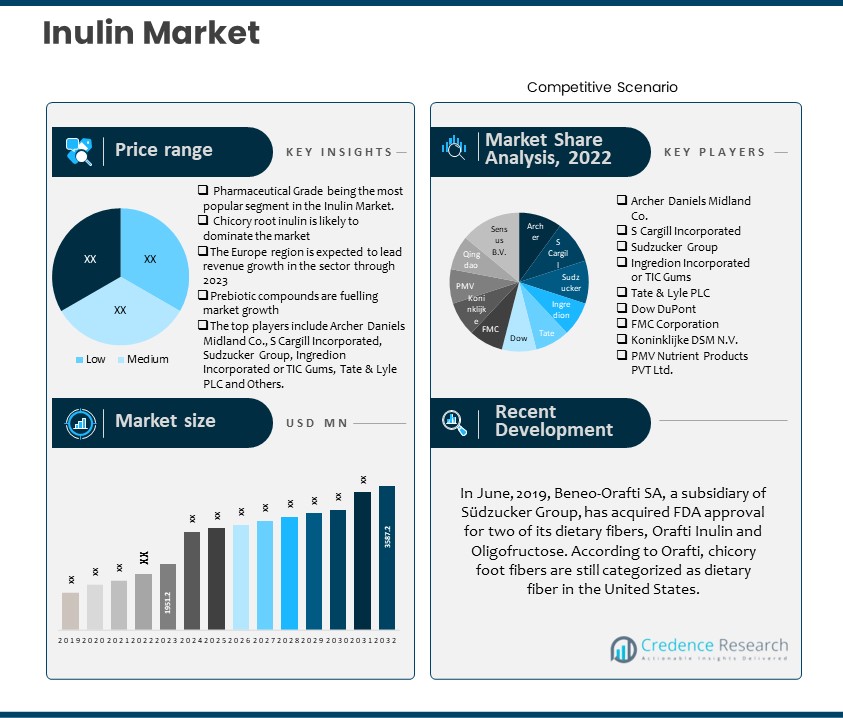
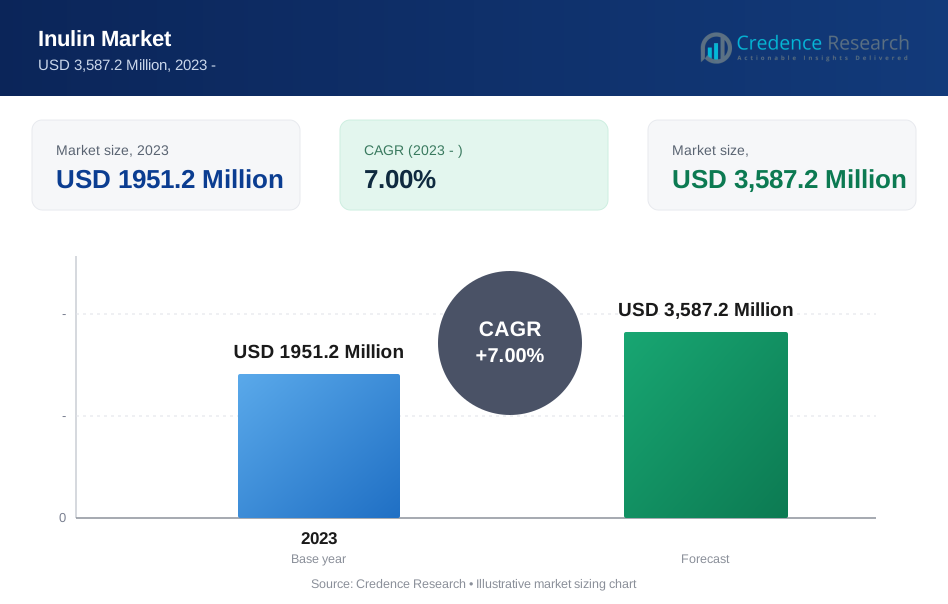
- The global demand for Inulin was valued at USD 1951.2 Million in 2023 and is expected to reach USD 3587.2 Million in 2032, growing at a CAGR of 7.00% between 2024 and 2032.
- The chicory root inulin segment is projected to dominate, while the Jerusalem artichoke inulin industry is expanding.
- The food-grade inulin category is predicted to dominate the market over the forecast period, with pharmaceutical grade being the most popular segment in the Inulin Market.
- Functional Foods are the most in-demand segment in the Inulin industry. Dairy products are another key area in the Inulin market.
- Digestive Health Supplements are the most important category in the Inulin Market, while Prebiotic Supplements are another major part.
- The Europe region is predicted to drive revenue growth in the sector until 2023. Accounting for 38.2%, the Asia Pacific region is predicted to have the fastest CAGR in the inulin market during the forecast period.
- The increased prevalence of diabetes globally is expected to fuel market growth.
- Side effects of inulin are expected to restrict market expansion.
Executive Summary
Market Definition
Inulin is a component of dietary fibers called fructans, which are naturally occurring polysaccharides generated by a variety of plants. It is derived from chicory and has applications in food and drinks, medicines, and nutritional supplements.
Market Overview
The global Inulin Market has witnessed steady growth in recent years and is expected to grow at a CAGR of 7.00% between 2024 and 2032. The market was valued at USD 1951.2 million in 2023 and is expected to reach USD 3587.2 million in 2032.
Inulin, a naturally occurring polysaccharide, is commonly derived from plants such as chicory roots. It belongs to the fructan group and is composed of chains of fructose molecules connected together by β (2-1) glycosidic linkages. One of its primary properties is its ability to operate as a prebiotic, stimulating the growth of good gut flora, which is a major reason for its growing popularity in the food and beverage business. Inulin is a soluble fiber with a variety of functional capabilities, including texturizing and gelling abilities, which make it a popular ingredient in the formulation of numerous food products.
The inulin market is characterized by its growing popularity and a wide range of applications. Inulin's potential health benefits have led to applications in pharmaceuticals and dietary supplements, in addition to the food industry. It is known to improve digestive health, increase calcium absorption, and aid in weight management, which aligns with rising consumer demand for functional ingredients that promote overall well-being.
Segmentation By Type of Inulin
- The chicory root inulin segment is expected to dominate the market due to its widespread availability in powdered and liquid form for inulin makers. Agave inulin is a good source of dietary fiber and prebiotics.
- The Jerusalem artichoke inulin market is expanding due to rising demand for Jerusalem artichoke-based snacks like chips and crisps.
Segmentation By Grade of Inulin
- The food-grade inulin category is expected to dominate the market during the forecast period, accounting for more than 60% of the total. Rising demand for inulin in food and beverage items such as bread and confectionery, dairy products, meat products, and beverages is driving the leading market.
- Pharmaceutical Grade are the most popular segment in the Inulin Market. In the pharmaceutical grade, Inulin is used to improve intestinal health, minimize the risk of obesity, and regulate blood sugar.
Segmentation by Application in Food and Beverage
- Functional Foods is the most in-demand segment in the Inulin market. Functional meals are becoming more popular as customers seek items with health advantages beyond basic nutrition.
- Another significant area in the Inulin Market is Dairy Products. Inulin is often added in dairy products such as yogurt, cheese, and milk-based beverages to improve nutritional value by increasing fiber content and supporting intestinal health.
Segmentation By Application in Dietary Supplements
- Digestive Health Supplements is the most important category in the Inulin Market. Inulin is a prebiotic fiber that improves gut health by encouraging the growth of beneficial bacteria in the digestive tract.
- Prebiotic Supplements are another key section of the Inulin Market. Prebiotic supplements contain substances such as inulin, which preferentially promote the growth of good bacteria in the stomach.
Segmentation by Region
- The Europe region is expected to lead revenue growth in the sector through 2023. Accounting for 38.2%.
- The Asia Pacific region is expected to have the quickest CAGR in the inulin market during the forecast period.
- The rest of the world, including Latin America, the Middle East, and Africa, supplies the remaining demand for Inulin.
Europe will lead the market in 2023 due to several factors contributing to the region's strong demand for inulin. Europe has seen a growing emphasis on healthy and functional foods, owing to a more health-conscious population. Inulin, with its acknowledged prebiotic and dietary fiber qualities, is in line with health and wellness trends, driving food and beverage makers to use it in a wide range of products.
Furthermore, The Asia Pacific region is expected to have the quickest CAGR in the inulin market during the forecast period. The region's food habits and lifestyles are changing significantly, with a greater emphasis on health and wellbeing. As consumers in Asia Pacific become more aware of the benefits of dietary fibers and prebiotics such as inulin, they express an interest in functional foods and ingredients that support digestive health and general well-being. The growing middle class, particularly in densely populated countries like as China and India, is boosting demand for functional ingredients, resulting in strong expansion in the region's inulin industry.
Key Highlights of the Report
Type of Inulin, Grade of Inulin, Application in Food and Beverage, Application in Dietary Supplements, and region segments of the global Inulin Market. The vacuum-forming industry dominated the market, with automotive and transportation predicted to be the fastest-growing segments. In addition, the Polypropylene (PP) category is predicted to have the highest CAGR during the forecast period, and electronic packaging is another major industry sector and North America, leading the market growth.
The increased prevalence of diabetes worldwide is expected to fuel growth in the global inulin market during the forecast period. Additionally, side effects from inulin are expected to hinder global inulin market growth. Also, increased public awareness of inulin's health benefits is expected to create significant opportunities for global inulin market competitors.
Europe will lead the market in 2023 due to many factors, including the region's high demand for inulin. As a result of a more health-conscious populace, Europe has seen an increase in emphasis on healthy and functional foods. Furthermore, the Asia-Pacific region is predicted to have the fastest CAGR in the inulin market during the forecast period.
What Are The Main Drivers Of The Global Inulin Market?
Several factors are fueling growth. The rising prevalence of diabetes worldwide is likely to drive growth in the worldwide inulin market over the forecast period. As inulin use or consumption increases worldwide, the worldwide inulin market is predicted to grow during the forecast period.
What Are The Major Challenges Faced By The Global Inulin Market?
On the other side, the market has some constraints that may restrict its growth. Side effects from inulin are predicted to stymie worldwide inulin market expansion. Additionally, the availability of different dietary fibers and prebiotic compounds is likely to impede the growth of the global inulin market.
What Are The Growth Opportunities In The Global Inulin Market?
Despite these challenges, the Inulin Market has tremendous growth opportunities. The growing public awareness of inulin's health benefits is likely to generate considerable potential prospects for global inulin market players. Rising demand for dietary fiber ingredients is likely to present attractive growth possibilities for participants in the inulin market.
Market Drivers
Several factors drive the global Inulin Market. The following are the key drivers of the global Inulin Market:
Rising Prevalence Of Diabetes Worldwide
The rising prevalence of diabetes worldwide is a major driver of the global inulin industry. Inulin is a natural dietary fiber with a low glycemic index, which means it does not induce a sudden spike in blood sugar levels. This makes inulin an important nutrient for diabetics since it helps manage blood sugar levels and improves insulin sensitivity. As more people are diagnosed with diabetes and seek healthier eating options, the demand for inulin as a functional ingredient in food and supplements is projected to increase. The potential health benefits of inulin in regulating blood sugar levels and increasing general health help to drive market growth in response to the rising diabetes epidemic.
Market Restraints
The global Inulin Market faces some challenges that may hinder its growth. These include the following:
Side Effects Of Inulin
The adverse effects of inulin are expected to hinder the expansion of the global inulin market. While most people absorb inulin well, some may develop digestive difficulties such as bloating, gas, and diarrhea after taking significant amounts of it. These negative effects may dissuade some consumers from using inulin-containing goods, hence reducing market demand. Furthermore, those with certain medical problems, such as irritable bowel syndrome (IBS), may be particularly sensitive to inulin, causing their symptoms to worsen. Concerns about potential negative effects may cause caution in adopting treatments containing inulin, limiting market expansion.
Opportunities
The global Inulin Market offers significant growth opportunities. These include the following:
Growing Public Awareness Of Inulin's Health Benefits
The growing public knowledge of the health benefits of inulin is expected to provide significant potential prospects for players in the global inulin market. As more people learn about the benefits of inulin for digestive health, weight management, and overall well-being, there is an increasing demand for products containing this beneficial ingredient. With consumers actively looking for functional foods and supplements that promote gut health and a healthy lifestyle, the market for inulin-rich products is growing. This increased awareness presents a suitable climate for manufacturers and suppliers to launch innovative inulin-based products to meet the expanding health-conscious customer base. By using this opportunity to educate consumers about the benefits of inulin and providing a varied variety of appealing products, players in the inulin market may leverage on the growing interest in health and wellness to drive market expansion and penetration.
Competitive Landscape
Key Players
The global Inulin Market is highly competitive, with several key players. Some of the major players in the market and their market share are as follows:
- Archer Daniels Midland Co.
- S Cargill Incorporated
- Sudzucker Group
- Ingredion Incorporated or TIC Gums
- Tate & Lyle PLC
- Dow DuPont
- FMC Corporation
- Koninklijke DSM N.V.
- PMV Nutrient Products PVT Ltd.
- Qingdao Oriental Tongxiang International Trading Co. Ltd.
- Sensus B.V.
- Steviva Brands, Inc.
- Tereos S.A.
- The IIDEA Company
- TrooFoods Ltd.
These organizations prioritize product innovation, Application in Food and Beverage expansion, and mergers and acquisitions to stay competitive.
The global Inulin Market's key players continually seek to stay ahead by offering new products and developments.
In November 2021, Beneo intended to invest more than € 30 million to boost capacity at its prebiotic chicory root fiber production locations in Chile and Belgium. When finished, the plan will increase BENEO's global chicory root fibre production by more than 40%.
In March 2019, Cosucra and Mexican FXM components collaborated to distribute their pea and chicory components in Mexico. Cosucra, headquartered in Belgium, produces protein isolate, fiber, and starches from peas, as well as inulin fiber from chicory root.
Summary of Key Findings
- The expanding public knowledge of inulin's health benefits is projected to provide significant potential opportunities for global inulin market players.
- The market is segmented by Type of Inulin: Grade of Inulin, Application in Food and Beverage, Application in Dietary Supplements, and regions.
- Food-grade inulin is predicted to dominate the market over the forecast period
- The Digestive Health Supplements are the most important category in the Inulin Market
- North America is leading in market growth; the market is highly competitive, with key players including Archer Daniels Midland Co., S Cargill Incorporated, Sudzucker Group, Ingredion Incorporated or TIC Gums, Tate & Lyle PLC and Others.
Future Outlook
- Increasing knowledge of digestive health advantages.
- Growing uses in nutritional supplements and medications.
- Technological developments in production processes
- Growing application in the food and beverage industries.
- New market prospects in developing countries.
How CXOs Can Benefit from the Credence Research Inulin Market Report
The Credence Research Inulin Market Report provides CXOs with a comprehensive overview of the market, including:
- Market size and growth forecast: The report provides detailed estimates of the global Inulin Market size, segmented By Type of Inulin, Grade of Inulin, Application in Food and Beverage, Application in Dietary Supplements and region. It also includes forecasts for the market through 2032 based on key trends and drivers.
- Market segmentation: The report segments the Inulin Market By Type of Inulin, Grade of Inulin, Application in Food and Beverage, Application in Dietary Supplements and region. This segmentation provides CXOs with a granular understanding of the market and the opportunities in each segment.
- Competitive Landscape: The report profiles the key players in the Inulin Market and provides insights into their strategies, product offerings, and financial performance. This information can help CXOs to identify and assess their competition.
- Key trends and drivers: The report identifies and analyzes the key trends and drivers that are shaping the Inulin Market. This information can help CXOs to make informed decisions about their investments and strategies.
CXOs can use the insights from the Credence Research Inulin Market Report to:
- Identify growth opportunities: The report can help CXOs to identify new growth opportunities in the Inulin Market. For example, by analyzing the data and trends in the report, they can make informed decisions on where to invest and expand their business.
- Make informed investment decisions: The report can help CXOs make informed investment decisions about Inulin. For example, it may provide useful insights into market trends, customer preferences, the competitive landscape, and growth prospects in the mobile accessories business..
- Develop competitive strategies: The report can help CXOs develop competitive strategies for their Inulin businesses. For example, by analyzing market trends, client preferences, and the competitive environment mentioned in the report, CXOs can fine-tune their strategies, differentiate their offers, and effectively position their firms in the marketplace.
- Track market developments: The report can help CXOs monitor market developments and stay ahead of the curve. For example, it provides insights into the latest trends and innovations in the Inulin Market.
Overall, the Credence Research Inulin Market Report is a valuable resource for CXOs who are looking to gain a deeper understanding of the market and identify .opportunities for growth.
Segmentation
- By Type of Inulin:
- Chicory Root Inulin
- Agave Inulin
- Jerusalem Artichoke Inulin
- Other Plant Sources
- By Grade of Inulin:
- Food Grade
- Pharmaceutical Grade
- Cosmetic Grade
- Industrial Grade
- By Application in Food and Beverage:
- Functional Foods
- Beverages
- Dairy Products
- Bakery and Confectionery
- Functional Beverages
- By Application in Dietary Supplements:
- Prebiotic Supplements
- Fiber Supplements
- Weight Management Supplements
- Digestive Health Supplements
- By Region
- North America
- The U.S.
- Canada
- Mexico
- Europe
- Germany
- France
- The U.K.
- Italy
- Spain
- Rest of Europe
- Asia Pacific
- China
- Japan
- India
- South Korea
- South-east Asia
- Rest of Asia Pacific
- Latin America
- Brazil
- Argentina
- Rest of Latin America
- Middle East & Africa
- GCC Countries
- South Africa
- Rest of the Middle East and Africa
- North America
Request a Free Sample
Fill in your details and we'll send you a free sample report.
- Sample data tables & charts
- Research methodology
Need a Custom Version of This Report?
Tailor the scope, geography, or segments to your exact requirements.
- Custom geography or segment scope
- Direct access to our analyst team
Frequently Asked Questions
What is the current size of the global Inulin Market?
What is the expected growth rate of the Inulin Market between 2024 and 2032?
Which segment is leading the market share in terms of Grade of Inulin?
Which Type of Inulin segment is expected to post the Highest CAGR rate during the forecast period?
Who are the major players in the global Inulin Market?
Table of Content
Chapter 1. Report Introduction
- 1.1 Report Description & Purpose
- 1.1.1 Report Title & Market Definition
- 1.1.2 Unique Selling Propositions (USP) & Key Differentiators
- 1.1.3 Value Proposition for Stakeholders
- 1.2 Research Objectives
- 1.2.1 Market Sizing Objectives (Volume & Revenue)
- 1.2.2 Segmentation Objectives
- 1.2.3 Competitive Intelligence Objectives
- 1.2.4 Forecast & Scenario Objectives
- 1.3 Report Scope
- 1.3.1 Inulin Scope – Types & Subtypes Covered
- 1.3.2 Geographic Scope – Regions & Countries Covered
- 1.3.3 Historical Period, Base Year & Forecast Period (2023; forecast to the forecast period)
- 1.3.4 Inclusions & Exclusions
- 1.4 HS Code & Classification Framework
- 1.5 Currency, Units & Pricing Basis
- 1.6 Target Stakeholders
- 1.7 Limitations & Assumptions
Chapter 2. Executive Summary
- 2.1 Global Inulin Market Snapshot
- 2.1.1 Market Size – Historical (2023) & Forecast (the forecast period) (2023: USD 1951.2 Million → forecast year: USD 3,587.2 Million)
- 2.1.2 Volume & Revenue – Global Totals
- 2.1.3 Key Market Highlights – Top Five Facts
- 2.2 Inulin Market Segmentation Snapshot
- 2.2.1 Market Split by Region – 2023 vs.
- 2.3 Competitive Snapshot
- 2.3.1 Top 10 Players by Revenue Share – 2023
- 2.3.2 Top 10 Players by Volume Share – 2023
- 2.3.3 Recent Strategic Developments (18-Month Summary)
- 2.4 Key Investment Highlights & Strategic Conclusions
Chapter 3. Inulin Market Dynamics & Industry Analysis
- 3.1 Market Overview & Context
- 3.1.1 Inulin Market Position in the Broader Automotive Value Chain
- 3.1.2 OEM vs. Replacement Market Dynamics
- 3.1.3 Market Maturity & Development Stage by Region
- 3.2 Inulin Market Drivers
- 3.3 Inulin Market Restraints & Challenges
- 3.4 Inulin Market Opportunities
- 3.5 Porter's Five Forces Analysis
- 3.5.1 Threat of New Entrants
- 3.5.2 Bargaining Power of Suppliers
- 3.5.3 Bargaining Power of Buyers
- 3.5.4 Threat of Substitutes
- 3.5.5 Competitive Rivalry – Intensity Assessment
- 3.6 Inulin Value Chain Analysis
- 3.6.1 Upstream – Raw Material/Input Suppliers
- 3.6.1.1 Raw Material/Input 1
- 3.6.1.2 Raw Material/Input 2
- 3.6.1.3 Raw Material/Input 3
- 3.6.2 Midstream – Production/Manufacturing/Service Delivery
- 3.6.2.1 Production/Process Overview
- 3.6.2.2 Key Facility Locations & Capacity by Manufacturer
- 3.6.3 Downstream – Distribution & End Consumer
- 3.6.3.1 Primary Channel – B2B/OEM
- 3.6.3.2 Secondary Channels – Dealer, Retail, Online, Direct
- 3.6.4 Value Chain Profitability Analysis
- 3.6.1 Upstream – Raw Material/Input Suppliers
- 3.7 PESTEL Analysis
- 3.7.1 Political Factors
- 3.7.2 Economic Factors
- 3.7.3 Social Factors
- 3.7.4 Technological Factors
- 3.7.5 Environmental Factors
- 3.7.6 Legal Factors
- 3.8 Inulin Supply Chain Analysis
- 3.8.1 Raw Material/Input Supply Risk Assessment
- 3.8.2 Manufacturing Concentration Risk (Geographic Exposure)
- 3.8.3 Trade Disruption Impact Analysis
- 3.9 Regulatory & Policy Landscape
Note: The regulatory and policy landscape section covers regulations based on their applicability to the market, Inulin category, geography, and scope of the study. Only regulatory frameworks with a material impact on operations, compliance, trade, sustainability, or market access are analyzed in detail.
Chapter 4. Key Investment Pockets & Opportunity Analysis
- 4.1 Inulin Market Attractiveness Analysis
- 4.1.1 By Region – Investment Attractiveness Matrix (Volume × CAGR)
- 4.2 Absolute Revenue Growth Opportunity
- 4.2.1 By Region – Absolute USD Growth Through the forecast period
- 4.3 Incremental Volume Opportunity
- 4.3.1 By Region – Incremental Volume Through the forecast period
- 4.3.2 Segment – Incremental Volume
- 4.4 Emerging Submarket Opportunity Deep Dive (Subject to Applicability)
- 4.5 Emerging Market Opportunity Scorecards
- 4.5.1 United States
- 4.5.2 Europe
- 4.5.3 Asia
- 4.5.4 Middle East & Africa
Note: Emerging Market Opportunity Scorecards will be included based on relevance and strategic importance. Regions listed are indicative and may vary depending on data availability and market dynamics.
Chapter 5. Inulin Import-Export Analysis & Trade Flows
- 5.1 Global Trade Overview
- 5.1.1 Global Export Value by Country (2023)
- 5.1.2 Global Export Volume by Country (2023)
- 5.1.3 Global Import Value by Country (2023)
- 5.1.4 Global Import Volume by Country (2023)
- 5.1.5 Net Trade Balance by Country (2023)
- 5.2 Export Analysis – Segment
- 5.2.1 Type 1 (HS Code)
- 5.2.2 Type 2 (HS Code)
- 5.2.3 Type 3 (HS Code)
- 5.2.4 Type 4 (HS Code)
- 5.2.5 Type 5 (HS Code)
- 5.3 Import Analysis – Segment
- 5.3.1 Type 1 (HS Code)
- 5.3.2 Type 2 (HS Code)
- 5.3.3 Type 3 (HS Code)
- 5.3.4 Type 4 (HS Code)
- 5.3.5 Type 5 (HS Code)
- 5.4 Average Unit Trade Prices
- 5.4.1 Average Export Price – Segment & Country
- 5.4.2 Average Import Price – Segment & Source Country
- 5.4.3 Price Trends (2023)
- 5.5 Key Trade Route Analysis
- 5.5.1 Trade Route 1
- 5.5.2 Trade Route 2
- 5.5.3 Trade Route 3
- 5.5.4 Trade Route 4
- 5.5.5 Trade Route 5
- 5.6 Trade Policy Impact Assessment
- 5.6.1 US Anti-Dumping & Section 301 Tariffs
- 5.6.2 EU Customs Union Impact
- 5.6.3 Major Free Trade Agreements
- 5.6.4 USMCA Rules of Origin
Note: Trade policy analysis will be included only where relevant to the Inulin market.
Chapter 6. Competitive Landscape & Company Benchmarking
- 6.1 Inulin Market Concentration & Structure
- 6.1.1 Herfindahl-Hirschman Index (HHI) – vs. 2023
- 6.1.2 Tier 1, Tier 2 & Tier 3 Market Structure
- 6.1.3 Global, Regional & Local Player Dynamics
- 6.2 Inulin Market Share Analysis – 2023
- 6.2.1 Global Revenue Share by Company
- 6.2.2 Global Volume Share by Company
- 6.2.3 Regional Revenue Share
- 6.2.4 Market Share Evolution ( vs. 2023)
- 6.2.5 OEM Segment Share by Company
- 6.2.6 Replacement Segment Share by Company
- 6.3 Production/Delivery Capacity & Facility Analysis
- 6.3.1 Global Installed Capacity
- 6.3.2 Capacity Utilization Rates
- 6.3.3 Production/Output Volume
- 6.3.4 Facility Locations & Capacity Map
- 6.3.5 Planned Capacity Additions
- 6.4 Inulin Competitive Benchmarking Matrix
- 6.4.1 Revenue, Volume, CAGR & Profitability Comparison
- 6.4.2 Channel Revenue Mix
- 6.4.3 Geographic Revenue Exposure
- 6.4.4 R&D Intensity
- 6.4.5 Sustainability Maturity
- 6.5 Strategic Developments in Inulin (Last 24 Months)
- 6.5.1 Mergers, Acquisitions & Divestments
- 6.5.2 New Inulin Launches
- 6.5.3 Facility Expansions
- 6.5.4 Strategic Alliances, Joint Ventures & Partnerships
- 6.5.5 Distribution Expansion & Market Entry
- 6.5.6 Sustainability & ESG Initiatives
- 6.6 Competitive Strategy Mapping
- 6.6.1 Leader, Challenger, Follower & Niche Classification
- 6.6.2 Pricing Strategy Comparison
- 6.6.3 Channel Strategy Matrix
Note: Strategic developments are included based on their materiality and the availability of reliable information.
Chapter 7. Global Inulin Market – By Distribution Channel
- 7.1 Segment Overview
- 7.1.1 Volume & Revenue Split by Channel (2023 & )
- 7.1.2 Channel Mix Evolution (the forecast period)
Chapter 8. Regional Market Analysis – Global Overview
- 8.1 Global Regional Overview
- 8.1.1 Regional Volume Share
- 8.1.2 Regional Revenue Share
- 8.1.3 Regional Volume by Region
- 8.1.4 Regional Revenue by Region
- 8.1.5 Regional Forecast Through the forecast period
- 8.2 Cross-Regional Segment Analysis
- 8.2.1 By Distribution Channel
- 8.2.2 By Brand/Price Tier
Chapter 9. North America Inulin Market
- 9.1 United States
- 9.2 Canada
- 9.3 Mexico
Chapter 10. Europe Inulin Market
- 10.1 Germany
- 10.2 France
- 10.3 Italy
- 10.4 United Kingdom
- 10.5 Spain
- 10.6 Poland
- 10.7 Russia
- 10.8 Netherlands
- 10.9 Belgium
- 10.10 Sweden
- 10.11 Denmark
- 10.12 Norway
- 10.13 Rest of Europe
Chapter 11. Asia Pacific Inulin Market
- 11.1 China
- 11.2 India
- 11.3 Japan
- 11.4 South Korea
- 11.5 Thailand
- 11.6 Indonesia
- 11.7 Vietnam
- 11.8 Malaysia
- 11.9 Australia
- 11.10 Rest of Asia Pacific
Chapter 12. Latin America Inulin Market
- 12.1 Brazil
- 12.2 Argentina
- 12.3 Colombia
- 12.4 Chile
- 12.5 Rest of Latin America
Chapter 13. Middle East Inulin Market
- 13.1 Saudi Arabia
- 13.2 United Arab Emirates
- 13.3 Turkey
- 13.4 Israel
- 13.5 Iran
- 13.6 Rest of the Middle East
Chapter 14. Africa Inulin Market
- 14.1 South Africa
- 14.2 Egypt
- 14.3 Nigeria
- 14.4 Morocco
- 14.5 Rest of Africa
Chapter 15. Inulin Company Profiles
- 15.1 [Company 01]
- 15.1.1 Company Overview
- 15.1.2 Key Management Personnel
- 15.1.3 Products & Services Portfolio
- 15.1.4 Financial Performance
- 15.1.5 Key Market Focus & Geographic Presence
- 15.1.6 Recent Developments & Strategic Initiatives
Note: The company profile list is preliminary and may change based on research findings, market developments, data availability, and client requirements.
Chapter 16. Appendices
- Appendix A – List of Abbreviations & Acronyms
- Appendix B – Industry Classification Code Reference – Full Series
- Appendix C – Production & Capacity Data Tables
- Appendix D – End-Use & Demand Base Tables
- Appendix E – Consumption & Replacement Rate Assumptions
- Appendix F – ASP Reference Tables
- Appendix G – Manufacturing & Facility Database
- Appendix H – Import-Export Data Tables
- Appendix I – Regulatory Summary Tables
- Appendix J – Primary Research Participant List (Anonymized)
- Appendix K – Primary Research Questionnaire Framework
- Appendix L – Data Sources & Bibliography
- Appendix M – Market Size Divergence & Source Comparison
Chapter 17. Research Methodology
- 17.1 Research Framework & Philosophy
- 17.2 Secondary Research – Sources, Hierarchy & Data Extraction
- 17.3 Data Modeling – Bottom-Up & Top-Down Market Sizing
- 17.4 Primary Research – Stakeholder Framework, LOI & Sample Sizes
- 17.5 Forecast Methodology – Regression, Scenario & Sensitivity Analysis
- 17.6 Quality Control – Four-Layer Validation Framework
- 17.7 Limitations & Standard Assumptions
- 17.8 Disclaimer
