
| REPORT ATTRIBUTE | DETAILS |
|---|---|
| Historical Period | 2019-2022 |
| Base Year | 2023 |
| Forecast Period | 2024-2032 |
| Kerosene (JET A-1) Market Size 2023 | USD 254184.20 Million |
| Kerosene (JET A-1) Market, CAGR | 14.60% |
| Kerosene (JET A-1) Market Size 2032 | USD 866582.89 Million |
Market Insights
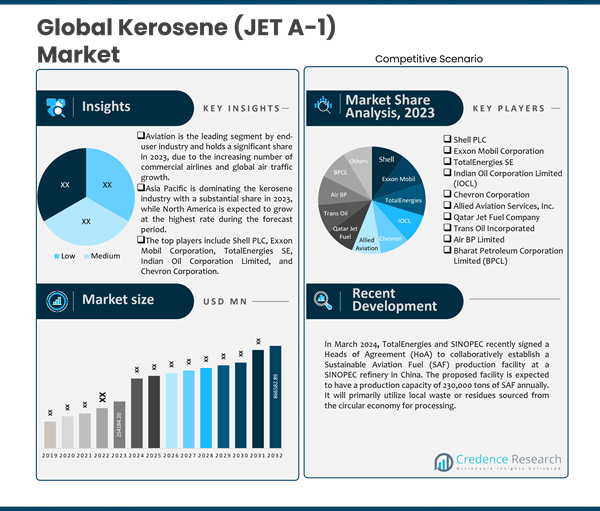
- The global demand for Kerosene (JET A-1) was valued at USD 254184.20 Million in 2023 and is expected to reach USD 866582.89 Million in 2032, growing at a CAGR of 14.60% between 2024 and 2032.
- The Aviation segment dominates the global need by end-users, accounting for a significant portion in 2023. The Aerospace & Defense segment is predicted to expand at a high CAGR.
- Over the projection period, Military Aviation is expected to expand at the highest rate, while Commercial Aviation dominate the market in 2023 with a substantial share.
- Asia Pacific is dominating the Kerosene (JET A-1) industry with a substantial share in 2023, while North America is expected to grow at the highest rate during the forecast period.
- The market's primary possibilities include advanced fuel technologies, increased military aviation expenditure, stricter environmental regulations, and the growing air cargo sector.
Executive Summary
Market Definition
Kerosene (JET A-1) is a type of aviation fuel primarily used in jet and turboprop engines. It is a high-quality, refined petroleum product known for its purity and consistent performance under a wide range of operating conditions. JET A-1 is characterized by its specific boiling point range, typically between 150°C and 250°C, and its low freezing point of -47°C, making it suitable for high-altitude and cold-weather operations. The fuel is designed to meet stringent specifications for energy content, combustion characteristics, and environmental standards, ensuring efficient and safe performance in aviation applications.
Market Overview
The global Kerosene (JET A-1) Market has witnessed steady growth in recent years and is expected to grow at a CAGR of 14.60% between 2024 and 2032. The market was valued at USD 254184.20 million in 2023 and is expected to reach USD 866582.89 million in 2032.
The global increase in passenger air traffic drives the growth of the Kerosene (JET A-1) market. As more people travel by air for business and leisure, airlines expand their fleets and flight frequencies, leading to higher consumption of JET A-1 fuel. Economic development in emerging markets boosts air travel as disposable incomes rise, allowing more people to afford air travel. Additionally, global trade growth necessitates efficient cargo transport, further increasing fuel demand.
Moreover, airlines are continually expanding and modernizing their fleets to meet growing demand and improve fuel efficiency. Newer aircraft often require significant volumes of JET A-1, fueling the market growth. Advancements in aircraft technology and efficiency drive the need for high-quality fuel. While these technologies aim to reduce overall fuel consumption, the enhanced performance and safety requirements necessitate the use of premium fuels such as JET A-1.
Additionally, the proliferation of low-cost carriers (LCCs) has made air travel more accessible to a broader population. LCCs, with their frequent flights and rapid turnover, contribute substantially to the increased demand for JET A-1. Military operations and defense strategies often rely on JET A-1 due to its reliability and performance characteristics. Military aviation activities, including training and operations, consistently demand large quantities of JET A-1 fuel.
Furthermore, the push for greater global connectivity through air travel, supported by international policies and agreements, promotes more flights and new routes, subsequently driving up the demand for JET A-1. The rise in e-commerce and just-in-time manufacturing has increased the need for fast and efficient cargo transport by air.
This sector’s growth translates directly into higher JET A-1 consumption. While the aviation industry seeks to reduce its carbon footprint, the transition to sustainable aviation fuels (SAFs) is gradual. In the interim, JET A-1 remains a critical component due to its established infrastructure and widespread availability.
In addition, geopolitical stability and favorable trade policies can enhance market growth by ensuring a stable supply chain for crude oil, the primary raw material for JET A-1 production. Investments in airport infrastructure, including new airports and expansion of existing ones, support increased flight operations. Improved facilities can handle more flights, thus raising the demand for JET A-1 fuel. Stricter environmental regulations drive innovation in fuel formulations to reduce emissions. These factors, coupled with the ongoing need for reliable aviation fuel in both commercial and military sectors, ensure the continued importance and growth of the JET A-1 market.
Segmentation by End User Industry
- Aviation boasts the dominating position in the Kerosene (JET A-1) industry, holding a massive share in 2023 due to the extensive demand driven by commercial airlines and global air traffic growth.
- The Aerospace & Defense is expected to grow with the highest CAGR during the projected period due to increased military spending, technological advancements, and geopolitical factors.
- The transportation segment also contributes to the growth of the market.
Segmentation by Application
- Commercial Aviation boasts the dominating position in the Kerosene (JET A-1) industry, holding a massive share in 2023 due to its high-volume demand driven by extensive global passenger traffic, a large fleet size, and the continuous operation of numerous commercial flights worldwide.
- Military Aviation is expected to grow at the highest rate, driven by rising defense budgets, technological advancements in military aircraft, operational intensity, and geopolitical factors.
- General Aviation and Emergency Services also contribute significantly to the growth of the market.
Segmentation by Region
- Asia Pacific dominates the Kerosene (JET A-1) industry with a massive share in 2023 due to the region's rising air passenger and air freight traffic in developing economies. Additionally, the region's growing urbanization and surging GDP growth contribute significantly to market expansion. Furthermore, government initiatives aimed at fostering travel and tourism further propel market growth.
- The North American market is expected to grow at the highest rate during the forecasted period.
- The rest of the world, including Latin America, the Middle East, and Africa, supplies the remaining demand for the Kerosene (JET A-1) industry.
The Asia Pacific region emerges as a pivotal driver of growth in the Kerosene (JET A-1) market, commanding the largest market share globally and serving as a cornerstone of the aviation fuel industry. According to the International Air Transport Association (IATA), Asia-Pacific airlines experienced an extraordinary 126.1% surge in full-year international traffic in 2023 compared to the previous year, maintaining the strongest year-over-year rate among all regions. This surge is underpinned by robust capacity growth, soaring to 101.8%, while the load factor climbed an impressive 9.0 percentage points to reach 83.1%.
Moreover, China, the second-largest domestic aviation market globally, following the United States, is poised for exponential growth. By 2040, projections anticipate an additional 2.87 billion yearly passengers traveling to, from, and within the Asia-Pacific region, propelling the total market size to an impressive 4.4 billion passengers. The region's rising air passenger and air freight traffic, especially from burgeoning economies including India, Indonesia, and Thailand, foretell a dramatic upsurge in the Asia-Pacific jet fuel market throughout the forecast period.
Additionally, the region's growing urbanization and surging GDP growth contribute significantly to market expansion. The International Monetary Fund (IMF) recently upgraded its forecast for China's GDP growth in 2023 to 5.2%, signifying a substantial increase compared to the previous year. Moreover, Asian Jet Fuel demand witnessed a notable uptick in 2021, with cash premiums quadrupling on a FOB Singapore basis, indicating heightened activity in the aviation sector.
Furthermore, government initiatives aimed at fostering travel and tourism further propel market growth. For instance, China's implementation of visa-free travel for citizens of select countries, coupled with improved air capacity, is anticipated to accelerate outbound and inbound tourism in 2024, as per the first UNWTO World Tourism Barometer. Such initiatives create a conducive environment for the Asia-Pacific region to emerge as a key driver of growth in the Kerosene (JET A-1) market, offering substantial growth for market players to capitalize on the region's dynamic aviation industry landscape.
On the other hand, North America emerges as a significant driver of growth in the Kerosene (Jet A-1) market, poised to experience the highest growth rate within the industry. The thriving American tourism sector plays a pivotal role, contributing over USD 1.1 trillion to the United States' GDP annually. Domestic and international travel collectively contribute to this robust figure, with domestic travel within the country witnessing a 2% increase from the previous year, totaling 2.29 billion trips. While outbound international travel by Americans experienced a comparatively smaller increase at 3.5%, amounting to 79.6 million trips.
Leisure-based travel dominates the tourism landscape in America, accounting for 73.8% of all tourism activities, leaving the remaining 26.2% for business and other purposes. This substantial tourism expenditure, totaling USD 1.089 trillion annually, directly supports 5.29 million jobs, driving economic growth and fueling demand for aviation fuel, including Kerosene (Jet A-1).
Moreover, the increasing demand for Kerosene (Jet A-1) is bolstered by the expansion of military aviation activities in North America. The United States Air Force's budget allocation of USD 392 million for the development of collaborative combat aircraft in fiscal year 2024, along with additional expenditures of USD 5.4 billion over the next four years, underscores the significant role of military aviation in driving fuel demand. With the United States operating approximately 25% of the world's military aircraft and commanding nearly 39% of all fighter planes globally, the region emerges as a key driver of growth in the Kerosene (Jet A-1) market.
Key Highlights of the Report
The global Kerosene (JET A-1) Market is segmented by type of device, end-user, application, and region. Aviation is the most popular end user. In addition, the Commercial Aviation is the most demanding application, with the Asia Pacific region leading the market share.
The growth of the Kerosene (JET A-1) market is driven by increased global air travel for both business and leisure, economic growth in emerging markets, and expanding airline fleets. Technological advancements in aviation and the rise of low-cost carriers further boost fuel demand. Moreover, growing military operations also rely heavily on JET A-1. Enhanced global connectivity and the rise in air cargo due to e-commerce contribute significantly to market growth. Furthermore, geopolitical stability, trade policies, and investments in airport infrastructure support market growth.
Nonetheless, Asia Pacific is anticipated to have the greatest share of the worldwide Kerosene (JET A-1) Market due to the region's rising air passenger and air freight traffic in developing economies. Additionally, the region's growing urbanization and surging GDP growth contribute significantly to market expansion. Moreover, government initiatives aimed at fostering travel and tourism further propel market growth in the region. Furthermore, the market is anticipated to expand at the highest rate in the North American region due to the thriving American tourism sector and the expansion of military aviation activities in North America.
What Are the Main Drivers of the Global Kerosene (JET A-1) Market?
The expansion of the Kerosene (JET A-1) market is fueled by the surge in global air travel for business and leisure, economic development in emerging markets, and the growth of airline fleets. Technological advancements in aviation and the proliferation of low-cost carriers further increase fuel demand. Additionally, the military's significant reliance on JET A-1 enhanced global connectivity, and the rise in air cargo driven by e-commerce substantially contributed to market growth. Moreover, geopolitical stability, favorable trade policies, and investments in airport infrastructure also play a crucial role in supporting the market's growth.
What Are the Major Challenges Faced by the Global Kerosene (JET A-1) Market?
Fluctuating crude oil prices and strict carbon emissions regulations are significant constraints on the global Kerosene (JET A-1) market. High oil prices increase production costs, leading to higher ticket prices for passengers and reduced demand for air travel. Moreover, stringent emissions regulations add to operational costs, as airlines must invest in carbon offset programs. Additionally, pressure to transition to sustainable aviation fuels further limits the growth of traditional jet fuels.
What Are the Growth Opportunities in the Global Kerosene (JET A-1) Market?
Advancements in aircraft technology and engine efficiency are poised to create opportunities for the Kerosene (JET A-1) Market in the future. By adapting to evolving aircraft technology, developing sustainable fuel solutions, and optimizing fuel delivery systems, JET A-1 suppliers can capitalize on emerging opportunities and maintain their relevance in an ever-changing market landscape.
Market Drivers
Substantial Surge of Air Travel
The substantial surge in air travel is a significant factor driving the global growth of the Kerosene (JET A-1) market globally. The increasing number of passengers traveling for both business and leisure purposes reflects broader economic and social changes. The International Air Transport Association (IATA) announced that the recovery in air travel continued in December 2023, with total 2023 traffic edging closer to matching pre-pandemic demand. Total traffic in 2023, measured in revenue passenger kilometers (RPKs), rose 36.9% compared to 2022. Globally, full-year 2023 traffic was at 94.1% of pre-pandemic (2019) levels. December 2023 total traffic rose 25.3% compared to December 2022, reaching 97.5% of the December 2019 level. These statistics highlight the robust recovery and growth in air travel, further driving the demand for JET A-1.
For business travelers, globalization has necessitated frequent international travel to maintain competitive edge and business operations across multiple countries. Meanwhile, the rise in disposable incomes, particularly in emerging markets, has made air travel more accessible to a broader segment of the population, allowing more people to travel for leisure. The proliferation of low-cost carriers has significantly reduced the cost of air travel, democratizing access and increasing the number of flights. These carriers, through their business models, rely on high-frequency, short-haul routes, which cumulatively lead to substantial JET A-1 fuel consumption.
Moreover, the expansion of international tourism has also contributed to the surge in air travel. Governments and tourism boards are actively promoting their countries as tourist destinations, often resulting in increased flights to and from these locations. Events, festivals, and attractions in various parts of the world draw large numbers of international visitors, necessitating more flights and, consequently, more aviation fuel.
According to the first UNWTO World Tourism Barometer of the year, international tourism ended 2023 at 88% of pre-pandemic levels, with an estimated 1.3 billion international arrivals. Total export revenues from tourism (including passenger transport) are estimated at USD 1.6 trillion in 2023, almost 95% of the USD 1.7 trillion recorded in 2019. These factors contribute to a greater number of flights and higher fuel consumption, underscoring the critical role of JET A-1 in the expanding aviation industry.
Market Restraints
Fluctuating Crude Oil Prices and Strict Carbon Emissions Regulations
A significant factor restraining the growth of the global Kerosene (JET A-1) market is fluctuating crude oil prices. These fluctuations can significantly impact the production and supply of jet fuel, resulting in market instability and hindering overall growth. When crude oil prices experience sharp increases, the cost of producing JET A-1 rises, subsequently raising the operational costs for airlines. In response, airlines may reduce flight frequencies or adjust routes, leading to decreased demand for aviation fuel. Conversely, during periods of low crude oil prices, profit margins for refineries producing JET A-1 may shrink, affecting investment in production capacity expansion or innovation. This cyclicality in crude oil prices creates uncertainty within the market, constraining its potential for sustained growth.
Moreover, stringent regulations on carbon emissions pose another significant constraint on the growth of the jet fuel market. These regulations, aimed at reducing greenhouse gas emissions and mitigating climate change, often entail higher compliance costs for airlines and fuel producers.
Implementing measures to reduce carbon emissions, such as investing in carbon offset programs or purchasing carbon credits, can add to the operational expenses of airlines, making traditional jet fuels less attractive. Additionally, as governments worldwide intensify their efforts to combat climate change, there is growing pressure on the aviation industry to transition towards sustainable aviation fuels (SAFs) with lower carbon footprints. This shift away from traditional jet fuels further diminishes the growth prospects of the global Kerosene (JET A-1) market.
Opportunities
Innovations in Aircraft Technology
Technological innovations are poised to significantly influence the future trajectory of the Kerosene (JET A-1) market. As advancements in aircraft technology and engine efficiency continue to evolve, they directly impact the demand for aviation fuel, including JET A-1. While these advancements may initially suggest a potential decrease in overall fuel demand due to improved fuel efficiency, they also unveil promising opportunities for JET A-1 suppliers to adapt and innovate.
Moreover, as airlines strive to optimize operating costs and reduce environmental impact, there is a growing demand for fuels that not only meet regulatory standards but also align with sustainability goals. Technological innovations provide a pathway for JET A-1 suppliers to explore alternative feedstocks and production processes, such as biofuels or synthetic fuels, that offer lower carbon footprints without compromising performance. This shift towards sustainable aviation fuels presents a transformative opportunity for the market, allowing suppliers to position themselves as leaders in environmentally responsible fuel solutions.
Competitive Landscape
Key Players
The global Kerosene (JET A-1) Market is highly competitive, with several key players. Some of the major players in the market and their market share are as follows:
- Shell PLC
- Exxon Mobil Corporation
- TotalEnergies SE
- Indian Oil Corporation Limited (IOCL)
- Chevron Corporation
- Allied Aviation Services, Inc.
- Qatar Jet Fuel Company
- Trans Oil Incorporated
- Air BP Limited
- Bharat Petroleum Corporation Limited (BPCL)
- Others
These organizations prioritize expansion and joint ventures to stay competitive.
The global Kerosene (JET A-1) Market's key players continually seek to stay ahead by offering new products and developments.
In March 2024, TotalEnergies and SINOPEC recently signed a Heads of Agreement (HoA) to collaboratively establish a Sustainable Aviation Fuel (SAF) production facility at a SINOPEC refinery in China. The proposed facility is expected to have a production capacity of 230,000 tons of SAF annually. It will primarily utilize local waste or residues sourced from the circular economy for processing.
In February 2024, Shell Plc and Cosan SA jointly owned company, Raizen aimed at establishing a sustainable jet fuel facility in Brazil. This venture not only offers economic benefits but also aligns with broader environmental and sustainability goals. By reducing carbon emissions and promoting the growth of a green economy, the initiative supports efforts to mitigate climate change and enhance environmental stewardship.
How are Companies Performing in the Kerosene (JET A-1) Market?
The global Kerosene (JET A-1) Market is highly competitive, with several key players.
Startups are playing a pivotal role in shaping the future of the Kerosene (Jet A-1) industry, bringing innovation, agility, and fresh perspectives to the aviation fuel sector. These entrepreneurial ventures are contributing in various ways, from developing sustainable aviation fuels (SAFs) to optimizing fuel distribution and enhancing operational efficiency. Startups are making an impact in the development of sustainable aviation fuels. Companies, including LanzaJet and Velocys, are pioneering the production of SAFs from waste biomass, agricultural residues, and municipal solid waste. By utilizing innovative conversion technologies, these startups are transforming non-recyclable waste into low-carbon, renewable jet fuels, thereby reducing the industry's carbon footprint and advancing towards a more sustainable future.
In addition to fuel production, startups are also disrupting the aviation fuel supply chain. Companies, including SkyNRG and Neste, are pioneering the development of digital platforms and blockchain technologies to optimize fuel procurement, distribution, and tracking. By streamlining processes and enhancing transparency, these startups are improving supply chain efficiency and reducing operational costs for airlines and fuel suppliers. Startups are driving innovation and transformation in the Kerosene (Jet A-1) industry, offering solutions that improve operational efficiency and sustainability.
Summary of Key Findings
- The expansion of the Kerosene (JET A-1) market is fueled by the surge in global air travel for business and leisure, economic development in emerging markets, and the growth of airline fleets. Technological advancements in aviation and the proliferation of low-cost carriers further increase fuel demand. Additionally, the military's significant reliance on JET A-1 enhanced global connectivity, and the rise in air cargo driven by e-commerce substantially contributed to market growth.
- Market segmented by end-user industry, application, and region.
- Asia Pacific is the leading segment by end-user industry and holds a substantial share due to the region's rising air passenger and air freight traffic in developing economies. Additionally, the region's growing urbanization and surging GDP growth contribute significantly to market expansion.
- Aviation boasts the dominating position in the Kerosene (JET A-1) industry, holding a massive share in 2023 due to the growth of commercial airlines and global air traffic growth.
- Asia Pacific is leading market growth; the market is highly competitive with key players including Shell PLC, Exxon Mobil Corporation, TotalEnergies SE, Indian Oil Corporation Limited (IOCL), Chevron Corporation, Allied Aviation Services, Inc., Qatar Jet Fuel Company, Trans Oil Incorporated, Air BP Limited, Bharat Petroleum Corporation Limited (BPCL) and Others.
Future Outlook
- Positive outlook for the global Kerosene (JET A-1) Market with significant growth potential in the North American region.
- One of the main factors promoting the market's expansion is the surge in global air travel for business and leisure, economic development in emerging markets, and the growth of airline fleets.
- During the forecast period, fluctuating crude oil prices and strict carbon emissions regulations are expected to act as significant factors restraining the growth of the Kerosene (JET A-1) Market.
- To stay competitive, key firms in the Kerosene (JET A-1) Market should prioritize advanced fuel technologies, increased military aviation expenditure, stricter environmental regulations, and the growing air cargo sector.
How CXOs Can Benefit from the Credence Research Kerosene (JET A-1) Market Report
The Credence Research Kerosene (JET A-1) Market Report provides CXOs with a comprehensive overview of the market, including:
- Market size and growth forecast:The report provides detailed estimates of the global Kerosene (JET A-1) Market size, segmented by end-user industry, application, and region. It also includes forecasts for the market through 2032 based on key trends and drivers.
- Market segmentation:The report segments the Kerosene (JET A-1) Market by end-user industry, application, and region. This segmentation provides CXOs with a granular understanding of the market and the opportunities in each segment.
- Competitive Landscape:The report profiles the key players in the Kerosene (JET A-1) Market and provides insights into their strategies, product offerings, and financial performance. This information can help CXOs to identify and assess their competition.
- Key trends and drivers:The report identifies and analyses the key trends and drivers shaping the Kerosene (JET A-1) Market. This information can help CXOs make informed decisions about their investments and strategies.
CXOs can use the insights from the Credence Research Kerosene (JET A-1) Market Report to:
- Identify growth opportunities:The report can help CXOs to identify new growth opportunities in the Kerosene (JET A-1) Market. For example, the report identifies surge in global air travel for business and leisure, economic development in emerging markets, and the growth of airline fleets.
- Make informed investment decisions:The report can help CXOs make informed investment decisions about Kerosene (JET A-1) industry. For example, it provides insights into the key factors to consider when evaluating and selecting Kerosene (JET A-1) providers.
- Develop competitive strategies:The report can help CXOs develop competitive strategies for their Kerosene (JET A-1) businesses. For example, the report identifies the key strategies that Kerosene (JET A-1) providers are using to differentiate themselves from their competitors.
- Track market developments:The report can help CXOs monitor market developments and stay ahead of the curve. For example, it provides insights into the latest trends and innovations in the Kerosene (JET A-1) Market.
Overall, the Credence Research Kerosene (JET A-1) Market Report is a valuable resource for CXOs who are looking to gain a deeper understanding of the market and identify opportunities for growth.
Segmentation
-
By End-User Industry
- Aviation
- Aerospace & Defense
- Transportation
-
By Application
- Commercial Aviation
- Military Aviation
- General Aviation
- Emergency Services
-
By Region
- North Americas
- US
- Canada
- Mexico
- Europe
- Germany
- France
- UK.
- Italy
- Spain
- Rest of Europe
- Asia Pacific
- China
- Japan
- India
- South Korea
- South-east Asia
- Rest of Asia Pacific
- Latin America
- Brazil
- Argentina
- Rest of Latin America
- Middle East & Africa
- GCC Countries
- South Africa
- Rest of the Middle East and Africa
- North Americas
Adjacent Markets
In the Kerosene (JET A-1) Market, several adjacent markets have high revenue growth opportunities. The key adjacent markets for Kerosene (JET A-1) Market -
Adjacent Markets |
||
| Jet Fuel Market | Aviation Gasoline (AvGas) Market | Biojet Fuel Market |
| Aviation Fuel Additives Market | Commercial aviation market | Military Aircraft Market |
| Aerospace and Defense Market | Sustainable Aviation Fuel Market | Aviation Fuel Blending Market |

Request a Free Sample
Fill in your details and we'll send you a free sample report.
- Sample data tables & charts
- Research methodology
Market Dynamics
Surge in Global Air Travel
The rapid increase in both business and leisure air travel, especially in emerging markets, is driving up demand for JET A-1 as airlines expand fleets and flight frequencies to accommodate more passengers.
Expansion of Airline Fleets and Low-Cost Carriers
Airlines are modernizing and expanding their fleets, while the proliferation of low-cost carriers is making air travel accessible to a broader population, both of which significantly boost JET A-1 consumption.
Growth in Military Aviation Expenditure
Rising defense budgets and increased military aviation activities, particularly in North America and Asia Pacific, are fueling demand for JET A-1 due to its reliability and performance in military operations.
Rise in Air Cargo and E-Commerce
The growth of global trade and e-commerce has led to higher air cargo volumes, increasing the need for efficient and reliable jet fuel to support frequent cargo flights.
Infrastructure Investments and Urbanization
Significant investments in airport infrastructure and rapid urbanization, especially in Asia Pacific, are enabling more flight operations and supporting sustained growth in JET A-1 demand.
Need a Custom Version of This Report?
Tailor the scope, geography, or segments to your exact requirements.
- Custom geography or segment scope
- Direct access to our analyst team
Frequently Asked Questions
What is the current size of the global Kerosene (JET A-1) Market?
What is the expected growth rate of the Kerosene (JET A-1) Market between 2024 and 2032?
What is the Forecast period considered for Kerosene (JET A-1) Market?
Which segment is leading the market share in terms of Application?
Which region is expected to post the highest CAGR during the forecast period?
Which region is dominating the Kerosene (JET A-1) Market share?
Who are the major players in the global Kerosene (JET A-1) Market?
What are the major market drivers of the global Kerosene (JET A-1) Market?
What is the major market restraint of the Kerosene (JET A-1) Market?
What are the major market opportunities of the global Kerosene (JET A-1) Market?
Table of Content
Chapter 1 Market Segmentation
- 1.1 Segmentation Framework
- 1.1.1 Product and Service Classification
- 1.1.2 Application and End-Use Classification
- 1.1.3 Technology and Solution Classification
- 1.1.4 Customer and Distribution Channel Classification
- 1.1.5 Geographic Segmentation
- 1.1.6 Market Segment Definitions and Boundaries
- 1.2 By Application
- 1.2.1 Commercial Aviation
- 1.2.2 Military Aviation
- 1.2.3 General Aviation
- 1.2.4 Emergency Services
- 1.3 By End-User Industry
- 1.3.1 Aviation
- 1.3.2 Aerospace & Defense
- 1.3.3 Transportation
Chapter 2 Introduction
- 2.1 Report Objectives and Scope
- 2.2 Product Definition and Industry Terminology
- 2.3 Market Inclusions and Exclusions
- 2.4 Research Process
- 2.4.1 Primary Research and Expert Interviews
- 2.4.2 Secondary Research and Source Review
- 2.4.3 Top-Down and Bottom-Up Estimation
- 2.4.4 Data Triangulation and Verification
- 2.5 Market Size Measurement Basis
- 2.5.1 2023: USD 254184.20 Million → 2032: USD 866,582.89 Million
- 2.6 Historical and Forecast Reference Periods
- 2.6.1 Base Year: 2023
- 2.6.2 Forecast Period: 2023-2032
- 2.7 Research Assumptions and Limitations
Chapter 3 Executive Summary
- 3.1 Market Snapshot and Key Findings
- 3.2 Base-Year Market Size, 2023
- 3.3 Forecast Market Size, 2032
- 3.4 Revenue and Volume Growth Outlook
- 3.5 Key Demand and Supply Indicators
- 3.6 Leading Market Segments
- 3.7 Fastest-Growing Market Opportunities
- 3.8 Regional Performance Highlights
- 3.9 Technology and Industry Transformation
- 3.10 Competitive Landscape Summary
- 3.11 Analyst View and Strategic Implications
Chapter 4 Global Kerosene (JET A-1) Market Trends and Developments
- 4.1 Historical Industry Development
- 4.2 Recent Market Trends and Developments
- 4.3 Demand and Customer Behavior Trends
- 4.4 Technology and Product Innovation
- 4.5 Artificial Intelligence, Automation and Digitalization
- 4.6 Local Manufacturing and Supply Chain Realignment
- 4.7 Industry Partnerships, Mergers and Acquisitions
- 4.8 Sustainability and Circular Economy Developments
- 4.9 Government and Private Sector Investment Trends
- 4.10 Emerging Business Models and Commercialization
- 4.11 Industry Developments and Announcements
Chapter 5 Global Kerosene (JET A-1) Market Production, Supply and Demand Analysis
- 5.1 Demand Trend and Consumption Analysis
- 5.2 Demand Forecast, 2023-2032
- 5.3 Production and Output Trend
- 5.4 Production and Output Forecast, 2023-2032
- 5.5 Installed Capacity and Capacity Utilization
- 5.6 Company-Wise Production Plants and Statistics
- 5.6.1 Installed Production Capacity
- 5.6.2 Actual Production
- 5.6.3 Planned Capacity and Expansion Targets
- 5.7 Supply Chain Structure and Procurement Trends
- 5.8 Supply-Demand Gap and Bottlenecks
- 5.9 Import Dependence and Sourcing Structure
- 5.10 Contract Manufacturing and Outsourcing
- 5.11 Regional Supply and Demand Concentration
Chapter 6 Global Kerosene (JET A-1) Market Pricing Analysis
- 6.1 Pricing Structure and Measurement
- 6.2 Historical Pricing Trends
- 6.3 Pricing Outlook, 2023-2032
- 6.4 Average Selling Price and Unit Economics
- 6.5 Pricing by Product and Market Segment
- 6.6 Geographic Pricing Differences
- 6.7 Key Input, Energy, Labor and Logistics Costs
- 6.8 Contract Pricing and Purchasing Models
- 6.9 Pricing Sensitivity and Competitive Positioning
- 6.10 Price, Margin and Profitability Implications
Chapter 7 Global Kerosene (JET A-1) Market Dynamics
- 7.1 Market Growth Drivers
- 7.1.1 Demand-Side Drivers
- 7.1.2 Technology and Innovation Drivers
- 7.1.3 Infrastructure and Investment Drivers
- 7.1.4 Regulatory and Policy Drivers
- 7.2 Market Restraints
- 7.2.1 Cost and Affordability Constraints
- 7.2.2 Technology and Adoption Barriers
- 7.2.3 Supply Chain and Operational Constraints
- 7.3 Market Challenges
- 7.3.1 Competitive Pressure and Margin Erosion
- 7.3.2 Skills, Infrastructure and Implementation Gaps
- 7.4 Emerging Market Opportunities
- 7.5 Market Dynamics Impact and Time-Horizon Assessment
Chapter 8 Global Kerosene (JET A-1) Value Chain Analysis
- 8.1 Industry Value Chain Overview
- 8.2 Upstream Suppliers and Critical Inputs
- 8.3 Technology and Component Providers
- 8.4 Manufacturing or Service Delivery
- 8.5 Distribution, Channel Partners and Integrators
- 8.6 Downstream Applications and End Users
- 8.7 Value Addition and Profit Pools
- 8.8 Vertical Integration and Outsourcing
- 8.9 Supplier Concentration and Risk
- 8.10 Supply Chain Localization and Resilience
Chapter 9 Global Kerosene (JET A-1) Market Regulations and Policies
- 9.1 Relevant Laws, Standards and Compliance Frameworks
- 9.2 Product, Service, Safety and Quality Requirements
- 9.3 Government Policies, Incentives and Subsidies
- 9.4 Imports, Exports and Trade Barriers
- 9.5 Public Procurement and Local Content Requirements
- 9.6 Environmental and Sustainability Compliance
- 9.7 Upcoming Policy Changes and Market Implications
Chapter 10 Global Kerosene (JET A-1) Market Hotspots and Opportunities
- 10.1 Market Opportunity Mapping and Growth Hotspots
- 10.2 High-Growth Applications and Customer Groups
- 10.3 Underserved Markets and White-Space Opportunities
- 10.4 Emerging Technology and Product Opportunities
- 10.5 New Capacity and Investment Hotspots
- 10.6 Market Entry and Expansion Opportunities
- 10.7 Distribution and Partnership Opportunities
- 10.8 Near-Term and Long-Term Commercial Potential
- 10.9 Opportunity Attractiveness and Execution Risks
Chapter 11 Global Kerosene (JET A-1) Market Outlook, 2023-2032
- 11.1 Market Size and Analysis
- 11.1.1 Revenue (Market Measurement: 2023: USD 254184.20 Million → 2032: USD 866,582.89 Million)
- 11.1.2 Market Volume and Quantity Sold
- 11.1.3 Historical Market Size
- 11.1.4 Base-Year Market Size, 2023
- 11.2 Market Forecast, 2023-2032
- 11.2.1 Revenue Forecast to 2032
- 11.2.2 Volume Forecast to 2032
- 11.2.3 CAGR and Year-on-Year Growth
- 11.2.4 Incremental Revenue Opportunity
- 11.3 Forecast Assumptions and Scenario Analysis
- 11.3.1 Base-Case Forecast
- 11.3.2 Optimistic and Conservative Scenarios
- 11.3.3 Technology, Pricing and Policy Sensitivities
- 11.4 Market Attractiveness and Growth Outlook
Chapter 12 Global Kerosene (JET A-1) Market Segmentation and Outlook
- 12.1 Segmentation Summary and Market Shares, 2023
- 12.2 Largest and Fastest-Growing Segments
- 12.3 By Application - Market Size and Forecast, 2023-2032
- 12.3.1 Segment Definition and Scope
- 12.3.2 Historical Market Size
- 12.3.3 Revenue Forecast, 2023-2032
- 12.3.4 Volume Forecast, 2023-2032
- 12.3.5 Base-Year Market Share, 2023
- 12.3.6 Segment CAGR and Growth Drivers
- 12.3.7 Subsegment Market Size and Forecast
- 12.3.7.1 Commercial Aviation
- 12.3.7.2 Military Aviation
- 12.3.7.3 General Aviation
- 12.3.7.4 Emergency Services
- 12.3.8 Subsegment Pricing and Adoption Trends
- 12.3.9 Leading Suppliers and Competition
- 12.3.10 Regional Demand and Opportunities
- 12.4 By End-User Industry - Market Size and Forecast, 2023-2032
- 12.4.1 Segment Definition and Scope
- 12.4.2 Historical Market Size
- 12.4.3 Revenue Forecast, 2023-2032
- 12.4.4 Volume Forecast, 2023-2032
- 12.4.5 Base-Year Market Share, 2023
- 12.4.6 Segment CAGR and Growth Drivers
- 12.4.7 Subsegment Market Size and Forecast
- 12.4.7.1 Aviation
- 12.4.7.2 Aerospace & Defense
- 12.4.7.3 Transportation
- 12.4.8 Subsegment Pricing and Adoption Trends
- 12.4.9 Leading Suppliers and Competition
- 12.4.10 Regional Demand and Opportunities
- 12.5 Segment Growth Comparison
- 12.6 Segment Attractiveness and Priority Matrix
Chapter 13 Global Kerosene (JET A-1) End-Use and Application Market Outlook
- 13.1 End-Use Industry and Customer Demand Structure
- 13.2 Leading Applications and Customer Groups
- 13.3 End-Use Market Size, Share and Forecast
- 13.4 Major End-Use Industry Deep Dives
- 13.4.1 Customer Requirements and Use Cases
- 13.4.2 Demand and Replacement Cycles
- 13.4.3 Technical and Regulatory Considerations
- 13.4.4 Purchasing and Procurement Models
- 13.4.5 Leading Vendors and Distribution Channels
- 13.4.6 Forecast and Commercial Opportunities
- 13.5 Emerging Applications and Cross-Segment Demand
- 13.6 End-Use Industry Investment Priorities
Chapter 14 Global Kerosene (JET A-1) Geographic Market Outlook, 2023-2032
- 14.1 Regional Market Size and Share, 2023
- 14.2 Regional Market Forecast, 2023-2032
- 14.3 Regional Pricing, Production and Demand Differences
- 14.4 North America
- 14.4.1 United States
- 14.4.2 Canada
- 14.4.3 Mexico
- 14.5 Europe
- 14.5.1 Germany
- 14.5.2 France
- 14.5.3 Italy
- 14.5.4 United Kingdom
- 14.5.5 Spain
- 14.5.6 Poland
- 14.5.7 Russia
- 14.5.8 Netherlands
- 14.5.9 Belgium
- 14.5.10 Sweden
- 14.5.11 Denmark
- 14.5.12 Norway
- 14.5.13 Rest of Europe
- 14.6 Asia Pacific
- 14.6.1 China
- 14.6.2 India
- 14.6.3 Japan
- 14.6.4 South Korea
- 14.6.5 Thailand
- 14.6.6 Indonesia
- 14.6.7 Vietnam
- 14.6.8 Malaysia
- 14.6.9 Australia
- 14.6.10 Rest of Asia Pacific
- 14.7 Latin America
- 14.7.1 Brazil
- 14.7.2 Argentina
- 14.7.3 Colombia
- 14.7.4 Chile
- 14.7.5 Rest of Latin America
- 14.8 Middle East
- 14.8.1 Saudi Arabia
- 14.8.2 United Arab Emirates
- 14.8.3 Turkey
- 14.8.4 Israel
- 14.8.5 Iran
- 14.8.6 Rest of the Middle East
- 14.9 Africa
- 14.9.1 South Africa
- 14.9.2 Egypt
- 14.9.3 Nigeria
- 14.9.4 Morocco
- 14.9.5 Rest of Africa
- 14.10 Regional Investment, Policy and Supply Chain Differences
- 14.11 Regional Competitive Landscape
- 14.12 Geographic Growth Hotspots
Chapter 15 Global Kerosene (JET A-1) Technology, Innovation and Sustainability Outlook
- 15.1 Technology Landscape and Maturity
- 15.2 Product, Process and Service Innovation
- 15.3 AI, Automation and Digital Tools in the Industry
- 15.4 Technology Adoption and Performance Benchmarking
- 15.5 Innovation Pipeline and R&D Investment
- 15.6 Patent and Intellectual Property Trends
- 15.7 Energy Efficiency and Resource Management
- 15.8 Sustainability, Recycling and Circularity
- 15.9 Technology Roadmap, 2023-2032
- 15.10 Risks of Obsolescence and Technology Substitution
Chapter 16 Global Kerosene (JET A-1) Market Key Strategic Imperatives
- 16.1 Growth and Market Entry Priorities
- 16.2 High-Return Products and Segments
- 16.3 Pricing, Profitability and Cost Optimization
- 16.4 Technology Investment and Product Differentiation
- 16.5 Supply Chain Localization and Resilience
- 16.6 Distribution and Customer Acquisition
- 16.7 Partnership, Acquisition and Capacity Strategy
- 16.8 Regional Expansion Priorities
- 16.9 Short-, Medium- and Long-Term Actions
Chapter 17 Competition Outlook
- 17.1 Industry Competition Characteristics
- 17.2 Market Structure and Concentration
- 17.3 Market Share and Competitive Positioning, 2023
- 17.4 Company-Wise Revenue and Product Benchmarking
- 17.5 Production and Service Capacity Benchmarking
- 17.6 Technology, Pricing and Differentiation
- 17.7 Regional Footprint and Distribution Strength
- 17.8 Mergers, Acquisitions and Strategic Alliances
- 17.9 New Entrants and Competitive Threats
- 17.10 Porter's Five Forces and Industry Attractiveness
- 17.11 Competitive Outlook, 2023-2032
Chapter 18 Company Profiles
- 18.1 Company Coverage and Selection Criteria
- 18.2 Shell PLC
- 18.2.1 Business Description
- 18.2.2 Company Ownership and Geographic Presence
- 18.2.3 Product and Service Portfolio
- 18.2.4 Manufacturing and Operating Footprint
- 18.2.5 Production Capacity and Expansion Plans
- 18.2.6 Financial Performance and Investment
- 18.2.7 Market Share and Competitive Position
- 18.2.8 Technology and Innovation Capabilities
- 18.2.9 Strategic Alliances or Partnerships
- 18.2.10 Recent Developments
- 18.2.11 Growth Strategy and Outlook
- 18.3 Exxon Mobil Corporation
- 18.4 TotalEnergies SE
- 18.5 Indian Oil Corporation Limited (IOCL)
- 18.6 Chevron Corporation
- 18.7 Allied Aviation Services, Inc.
- 18.8 Qatar Jet Fuel Company
- 18.9 Trans Oil Incorporated
- 18.10 Air BP Limited
- 18.11 Bharat Petroleum Corporation Limited (BPCL)
- 18.12 Other Relevant Market Participants
Note: Every listed company is profiled on the structure shown under the first company. The company list is preliminary and may change based on research findings, market developments, data availability and client requirements.
Chapter 19 Disclaimer
- 19.1 Research and Forecast Disclaimer
- 19.2 Data Source and Estimation Limitations
Note: The depth of individual sections depends on data availability for this market. Volume, capacity, trade and other unit-based metrics are included where applicable.

