
| REPORT ATTRIBUTE | DETAILS |
|---|---|
| Historical Period | 2019-2022 |
| Base Year | 2023 |
| Forecast Period | 2024-2032 |
| Load Cell Market Size 2023 | USD 123,145.58 Million |
| Load Cell Market, CAGR | 3.50% |
| Load Cell Market Size 2032 | USD 167,834.79 Million |
Market Overview
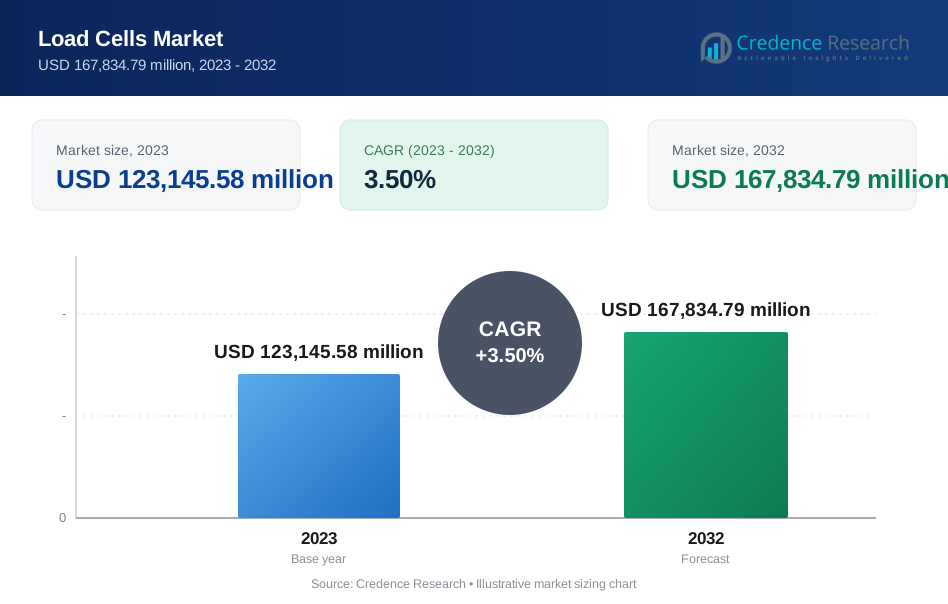
The Load Cell Market is projected to grow from USD 123,145.58 million in 2023 to USD 167,834.79 million by 2032, reflecting a compound annual growth rate (CAGR) of 3.50%.
The Global Load Cell Market is driven by the increasing demand for precision measurement in industries such as automotive, healthcare, and aerospace, where accurate weight and force measurements are crucial. Technological advancements in load cell designs, including digital load cells and wireless solutions, enhance accuracy and data transmission capabilities, further boosting market adoption. Additionally, the growing focus on automation and industrial process optimization is leading to the widespread use of load cells in automated machinery and robotics. The market also benefits from the rising emphasis on safety standards and regulatory compliance, driving the need for reliable and accurate load measurement solutions.
The Global Load Cell Market is geographically diverse, with North America and Europe leading due to their advanced industrial sectors, widespread adoption of automation, and strong presence of key market players. Asia-Pacific is expected to witness rapid growth, driven by increasing industrialization, rising demand for automation, and expanding manufacturing bases in countries like China and India. Key players dominating the market include ABB Ltd., Honeywell International Inc., Flintec Group AB, and METTLER TOLEDO, who leverage their technological expertise, extensive product portfolios, and strategic partnerships to maintain a competitive edge and cater to the growing global demand for load cells.
Market Drivers
Industrial Automation and Smart Manufacturing
The integration of load cells into industrial automation systems is enhancing production efficiency and reducing downtime by providing precise measurement capabilities. For instance, a 2023 survey of 1,350 manufacturers in 13 countries showed that 97% of respondents plan to use smart manufacturing technologies, which include load cells, over the next one to two years. These devices are crucial for precision control in manufacturing processes, ensuring that product quality and consistency are maintained. By generating accurate, real-time data, load cells enable data-driven decision-making, which is essential for predictive maintenance and process optimization. This data helps manufacturers monitor equipment performance and identify potential issues before they lead to costly downtime, further increasing overall operational efficiency.
Growing Demand for Weighing and Measurement Solutions
Load cells play a vital role in optimizing supply chain operations by providing accurate weighing capabilities, which are crucial for effective inventory management, logistics, and pricing strategies. For instance, industry reports show that companies implementing advanced weighing solutions have seen substantial improvements in inventory accuracy and reduced shipping errors. In industries where quality control is paramount, load cells help ensure that products meet specific weight and volume requirements, thus maintaining high standards of product quality. Furthermore, regulatory compliance across various sectors necessitates the use of precise weighing and measurement solutions, driving the adoption of load cells to meet these stringent standards and avoid penalties.
Advances in Technology
Technological advancements are propelling the load cell market forward, particularly through the integration of Internet of Things (IoT) platforms that enable remote monitoring, data analysis, and predictive maintenance. The trend towards miniaturization has led to the development of smaller, more compact load cells, which expand their application potential in various fields. Additionally, the use of advanced materials in load cell construction is enhancing their performance, durability, and accuracy, making them more reliable for critical applications. These technological innovations are opening up new possibilities for the use of load cells across diverse industries.
Increasing Focus on Sustainability and Energy Efficiency
Load cells are increasingly being used to promote sustainability and energy efficiency across different sectors. They help optimize energy usage by monitoring consumption and identifying areas for improvement, contributing to more efficient operations. Accurate weighing capabilities provided by load cells can also reduce waste and optimize material usage, which is essential for sustainable practices. Furthermore, load cells are being employed in various sustainable applications, such as renewable energy projects and waste management systems, where accurate measurement and monitoring are crucial for success.
Market Trends
Technological Advancements and Increasing Focus on Precision
The Global Load Cell Market is witnessing significant technological advancements that are reshaping its landscape. For instance, the digital load cell segment is gaining popularity due to its high efficiency and durability. One of the key trends is the integration of load cells with Internet of Things (IoT) platforms, which enables remote monitoring, data analysis, and predictive maintenance. This connectivity allows for real-time data transmission, making load cells integral to modern automation and smart manufacturing systems. Additionally, the adoption of wireless communication technologies is streamlining the installation and maintenance of load cell systems, reducing wiring complexities and improving operational flexibility. The drive towards smart manufacturing further increases the demand for load cells that can provide high-resolution data and support complex automation processes. Higher resolution capabilities are increasingly required to meet the precision demands of industries such as aerospace, automotive, and pharmaceuticals, where even minor deviations can have significant consequences. Advances in calibration techniques are also ensuring that load cells provide accurate and reliable measurements, enhancing their suitability for critical applications.
Miniaturization, Customization, and Expanding Applications
The trend towards miniaturization is expanding the application range of load cells, with smaller and more compact designs enabling their use in space-constrained environments. The development of load cells with smaller form factors is allowing their integration into various devices, such as industrial machinery, medical equipment, and consumer electronics, broadening their utility. The market is also seeing a growing demand for customized load cell solutions tailored to the specific needs of different industries and applications. Manufacturers are responding by developing load cells that comply with industry-specific standards and regulations, ensuring that they meet the stringent requirements of sectors like food and beverage, pharmaceuticals, and aerospace. In addition to traditional applications, load cells are finding new uses in emerging industries such as renewable energy, healthcare, and robotics. This diversification is driving market growth, as load cells are now being used for tasks ranging from monitoring energy output in wind turbines to ensuring precision in robotic surgery. The expanding applications underscore the versatility and adaptability of load cells, highlighting their increasing importance across various sectors.
Market Challenges Analysis
Technological Limitations and Environmental Challenges
The Load Cell Market faces significant technological limitations that impact the performance and reliability of these devices. One of the primary challenges is maintaining the accuracy and calibration of load cells over time, particularly in harsh environments or under frequent use. Calibration issues can arise due to wear and tear, leading to measurement inaccuracies and compromising the reliability of the data collected. For instance, in industrial settings, the integration of load cells with digital solutions like cloud computing and advanced analytics software is enhancing their utility. Additionally, environmental factors such as temperature variations, humidity, and vibrations can affect load cell performance. For instance, exposure to extreme temperatures can cause thermal drift, while high humidity levels can lead to corrosion, both of which can negatively impact the accuracy of load cells. Electromagnetic interference (EMI) is another concern, especially in industrial settings where numerous electronic devices operate simultaneously. EMI can disrupt the operation of load cells, causing erroneous readings and reducing the overall reliability of the system. Addressing these challenges requires robust design and advanced materials that can withstand environmental stresses and ensure long-term accuracy and reliability.
Cost and Pricing Pressure Amid Competitive Landscape
The load cell market is characterized by intense competition, with numerous manufacturers offering a wide range of products at varying price points. This competitive landscape creates significant pricing pressure, forcing manufacturers to focus on cost reduction strategies to remain competitive. However, reducing costs can impact product quality and innovation, as manufacturers may need to compromise on materials, design, or research and development investments. This pressure to lower prices while maintaining high standards can be a difficult balance to strike, especially in a market where reliability and precision are critical. Additionally, supply chain disruptions pose a major challenge, particularly in the context of global events such as economic downturns, geopolitical tensions, or natural disasters. These disruptions can lead to shortages of components or raw materials, affecting the production and availability of load cells. The availability of specialized components used in load cell manufacturing can be particularly challenging for niche applications, where specific materials or technologies are required. Ensuring a reliable supply chain and managing costs effectively are essential for manufacturers to navigate the competitive landscape and meet market demand.
Market Segmentation Analysis:
By Type:
The Global Load Cell Market is segmented by type into Single Point Load Cells, Bending Beam Load Cells, Shear Beam Load Cells, S-type Load Cells, and Others. Single Point Load Cells are widely used due to their accuracy and reliability, making them suitable for platform scales and small to medium-sized weighing applications. Bending Beam Load Cells are favored for their precision in dynamic applications, such as industrial weighing and process control. Shear Beam Load Cells offer high accuracy and are commonly used in industrial environments where durability is crucial, including heavy-duty weighing and batching systems. S-type Load Cells are known for their compact design and versatility, ideal for both tension and compression applications, such as mechanical testing and suspended weighing systems. The 'Others' category includes specialized load cells tailored to niche applications, emphasizing the market's broad scope and adaptability to various industry needs.
By Application:
Load cells find diverse applications, with key segments including Sorting Machinery, Checkweighers, Multi-head Filling Machines, and Industrial Scales, which are further categorized into Hopper Scales, Conveyor Scales, and Packaging Scales. Sorting Machinery utilizes load cells for accurate weight measurement, ensuring product consistency and quality control. Checkweighers, essential in manufacturing and packaging lines, rely on load cells for real-time weight verification, preventing product discrepancies. Multi-head Filling Machines use load cells to ensure precise filling volumes, crucial in food and beverage industries for maintaining product integrity. Industrial Scales, including Hopper Scales, Conveyor Scales, and Packaging Scales, leverage load cells to measure and monitor material weight, optimizing inventory management, and production processes. The 'Others' category encompasses various specialized applications across different industries, highlighting the versatility and critical role of load cells in enhancing operational efficiency and accuracy.
Segments:
Based on Type:
- Single Point Load Cell
- Bending Beam Load Cell
- Shear Beam Load Cell
- S-type Load Cell
- Others
Based on Application:
- Sorting Machinery
- Checkweighers
- Multi-head Filling Machines
- Industrial Scales
- Hopper Scales
- Conveyor Scales
- Packaging Scales
- Others
Based on Weighing Capacity:
- Low Capacity
- Medium Capacity
- High Capacity
Based on the Geography:
- North America
- U.S.
- Canada
- Mexico
- Europe
- Germany
- France
- U.K.
- Italy
- Spain
- Rest of Europe
- Asia Pacific
- China
- Japan
- India
- South Korea
- South-east Asia
- Rest of Asia Pacific
- Latin America
- Brazil
- Argentina
- Rest of Latin America
- Middle East & Africa
- GCC Countries
- South Africa
- Rest of the Middle East and Africa
Regional Analysis
North America
North America holds the largest market share, accounting for approximately 35% of the global market value. For instance, in North America, the dominance of the load cell market is further reinforced by the recent boom in EV battery factory construction. This region's dominance is driven by the strong presence of major load cell manufacturers, advanced technological infrastructure, and high adoption rates across various industries. The United States leads the North American market, with robust demand from sectors such as aerospace, automotive, and healthcare. Stringent quality control regulations and the increasing focus on precision measurement in manufacturing processes further fuel the market growth in this region.
Asia-Pacific
Asia-Pacific follows closely, with a market share of around 30% and is projected to experience the fastest growth in the coming years. China and Japan are the primary contributors to the region's market expansion, driven by rapid industrialization, increasing automation in manufacturing, and growing investments in research and development. The region's burgeoning automotive and consumer electronics industries are major consumers of load cells, utilizing them for quality assurance and process optimization. Additionally, the rising adoption of IoT and Industry 4.0 technologies in countries like South Korea and India is creating new opportunities for load cell applications in smart manufacturing and logistics.
Key Player Analysis
- ABB Ltd.
- Alfa Laval AB
- ALTHEN Gmbh
- Flintec Group AB
- Force Switch Corp.
- FUTEK Advanced Sensor Technology, Inc.
- Honeywell International Inc.
- Hottinger Bruel & Kjaer A/S
- Interface, Inc.
- Kristler Group
- Load cell central
- Loadstar Sensors
- METTLER TOLEDO
- NMB Technologies Corporation
Competitive Analysis
The Global Load Cell Market is highly competitive, with leading players such as ABB Ltd., Honeywell International Inc., METTLER TOLEDO, Flintec Group AB, and FUTEK Advanced Sensor Technology, Inc. dominating the landscape. These companies maintain a strong market presence through extensive product portfolios that cater to various applications, including industrial automation, weighing systems, and healthcare. Their competitive edge is further strengthened by continuous investment in research and development to introduce innovative and high-precision load cell technologies. Strategic partnerships and acquisitions are common strategies employed by these companies to expand their market reach and enhance their technological capabilities. Additionally, these market leaders leverage their global distribution networks and strong customer relationships to secure significant market share. As the demand for precision measurement and automation solutions grows, these companies continue to focus on providing customized, reliable, and efficient load cell solutions to meet the evolving needs of different industries.
Recent Developments
- In June 2024, Honeywell completed the acquisition of Carrier Global Corporation’s Global Access Solutions business for $4.95 billion.
- In 2024, Loadstar Sensors announced a strategic partnership with Olander to bring their Autonomous Inventory Management solution, Stockvue.ai, to Olander’s customer base in the fastener industry
Market Concentration & Characteristics
The Global Load Cell Market is characterized by moderate market concentration, with several key players holding significant market shares due to their technological expertise, product innovation, and extensive distribution networks. Companies such as ABB Ltd., Honeywell International Inc., and METTLER TOLEDO lead the market, leveraging their strong brand recognition and comprehensive product portfolios that cater to diverse applications across industries. The market is marked by a high level of competition, driven by the continuous demand for precision, reliability, and cost-effectiveness in load cell solutions. The adoption of advanced technologies, such as IoT integration and wireless communication, further differentiates market offerings, allowing companies to cater to specific industry needs, such as industrial automation, healthcare, and logistics. Despite the dominance of major players, the market also includes numerous smaller and regional companies that contribute to innovation and meet niche market demands. This competitive environment fosters ongoing product development and technological advancements, ensuring a dynamic and evolving market landscape.
Report Coverage
The research report offers an in-depth analysis based on Type, Application, Weighing Capacity and Geography. It details leading market players, providing an overview of their business, product offerings, investments, revenue streams, and key applications. Additionally, the report includes insights into the competitive environment, SWOT analysis, current market trends, as well as the primary drivers and constraints. Furthermore, it discusses various factors that have driven market expansion in recent years. The report also explores market dynamics, regulatory scenarios, and technological advancements that are shaping the industry. It assesses the impact of external factors and global economic changes on market growth. Lastly, it provides strategic recommendations for new entrants and established companies to navigate the complexities of the market.
Future Outlook
- The Global Load Cell Market is expected to grow steadily, driven by the increasing demand for precision weighing and measurement solutions across industries.
- Technological advancements, such as IoT integration and wireless capabilities, will enhance load cell functionality and expand their application range.
- The adoption of smart manufacturing and industrial automation will boost demand for load cells in production and process control.
- The rise of e-commerce and logistics will increase the need for accurate weighing solutions in inventory management and shipping.
- Energy-efficient and sustainable load cell designs will gain popularity as industries focus on reducing environmental impact.
- Emerging markets, particularly in Asia-Pacific, will present significant growth opportunities due to expanding industrialization and infrastructure development.
- The growing healthcare sector will drive demand for load cells in medical devices and patient monitoring systems.
- Customization and specialized solutions will become more prevalent to meet the specific requirements of different industries.
- Companies will invest in research and development to improve load cell accuracy, durability, and performance.
- Strategic partnerships and acquisitions will be key for companies looking to enhance their market presence and expand product offerings.
Request a Free Sample
Fill in your details and we'll send you a free sample report.
- Sample data tables & charts
- Research methodology
Need a Custom Version of This Report?
Tailor the scope, geography, or segments to your exact requirements.
- Custom geography or segment scope
- Direct access to our analyst team
Frequently Asked Questions
What is the current size of the Global Load Cell Market?
What factors are driving the growth of the Global Load Cell Market?
What are the key segments within the Global Load Cell Market?
What are some challenges faced by the Global Load Cell Market?
Who are the major players in the Global Load Cell Market?
Table of Content
Chapter 1. Report Introduction
- 1.1 Report Description & Purpose
- 1.1.1 Report Title & Market Definition
- 1.1.2 Unique Selling Propositions (USP) & Key Differentiators
- 1.1.3 Value Proposition for Stakeholders
- 1.2 Research Objectives
- 1.2.1 Market Sizing Objectives (Volume & Revenue) (Volume Where Applicable)
- 1.2.2 Segmentation Objectives
- 1.2.3 Competitive Intelligence Objectives
- 1.2.4 Forecast & Scenario Objectives
- 1.3 Report Scope
- 1.3.1 Load Cells Scope – Segments & Subsegments Covered
- 1.3.2 Geographic Scope – Regions & Countries Covered
- 1.3.3 Historical Period, Base Year & Forecast Period (2023; forecast to 2032)
- 1.3.4 Inclusions & Exclusions
- 1.4 Industry Classification & Applicable Codes
- 1.5 Currency, Measurement Units & Valuation Basis
- 1.6 Target Stakeholders
- 1.7 Limitations & Assumptions
Chapter 2. Executive Summary
- 2.1 Global Load Cells Market Snapshot
- 2.1.1 Market Size – Historical (2023) & Forecast (2023-2032) (2023: USD 123,145.58 million → 2032: USD 167,834.79 million)
- 2.1.2 Volume & Revenue – Global Totals (Volume Where Applicable)
- 2.1.3 Key Market Highlights – Top Five Facts
- 2.2 Load Cells Market Segmentation Snapshot
- 2.2.1 Market Split by Region – 2023 vs. 2032
- 2.3 Competitive Snapshot
- 2.3.1 Top 10 Players by Revenue Share – 2023
- 2.3.2 Top 10 Players by Volume Share – 2023 (Volume Where Applicable)
- 2.3.3 Recent Strategic Developments (18-Month Summary)
- 2.4 Key Investment Highlights & Strategic Conclusions
Chapter 3. Load Cells Market Dynamics & Industry Analysis
- 3.1 Market Overview & Context
- 3.1.1 Load Cells Market Position in the Broader Industry Value Chain
- 3.1.2 Demand Structure & Purchasing Dynamics
- 3.1.3 Market Maturity & Development Stage by Region
- 3.2 Load Cells Market Drivers
- 3.3 Load Cells Market Restraints & Challenges
- 3.4 Load Cells Market Opportunities
- 3.5 Porter's Five Forces Analysis
- 3.5.1 Threat of New Entrants
- 3.5.2 Bargaining Power of Suppliers
- 3.5.3 Bargaining Power of Buyers
- 3.5.4 Threat of Substitutes
- 3.5.5 Competitive Rivalry – Intensity Assessment
- 3.6 Load Cells Value Chain Analysis
- 3.6.1 Upstream – Key Inputs, Resources & Suppliers
- 3.6.1.1 Key Input/Resource 1
- 3.6.1.2 Key Input/Resource 2
- 3.6.1.3 Key Input/Resource 3
- 3.6.2 Midstream – Core Operations & Value Creation
- 3.6.2.1 Operating Model & Process Overview
- 3.6.2.2 Key Operating Locations & Capabilities by Company
- 3.6.3 Downstream – Market Channels & End Users
- 3.6.3.1 Direct Sales & Customer Engagement Channels
- 3.6.3.2 Indirect Sales, Intermediaries & Partner Channels
- 3.6.4 Value Chain Profitability Analysis
- 3.6.1 Upstream – Key Inputs, Resources & Suppliers
- 3.7 PESTEL Analysis
- 3.7.1 Political Factors
- 3.7.2 Economic Factors
- 3.7.3 Social Factors
- 3.7.4 Technological Factors
- 3.7.5 Environmental Factors
- 3.7.6 Legal Factors
- 3.8 Load Cells Supply Chain Analysis
- 3.8.1 Critical Input & Resource Availability Risk Assessment
- 3.8.2 Supplier & Operational Concentration Risk (Geographic Exposure)
- 3.8.3 Supply & Service Disruption Impact Analysis
- 3.9 Regulatory & Policy Landscape
Note: The regulatory and policy landscape section covers regulations based on their applicability to the market, Load Cells category, geography, and scope of the study. Only regulatory frameworks with a material impact on operations, compliance, trade, sustainability, or market access are analyzed in detail.
Chapter 4. Key Investment Pockets & Opportunity Analysis
- 4.1 Load Cells Market Attractiveness Analysis
- 4.1.1 By Region – Investment Attractiveness Matrix (Market Size × CAGR)
- 4.2 Absolute Revenue Growth Opportunity
- 4.2.1 By Region – Absolute Revenue Growth Through 2032
- 4.3 Incremental Demand Opportunity
- 4.3.1 By Region – Incremental Demand Through 2032
- 4.3.2 Segment – Incremental Demand
- 4.4 Emerging Submarket Opportunity Deep Dive (Subject to Applicability)
- 4.5 Priority Market Opportunity Scorecards
- 4.5.1 United States
- 4.5.2 Europe
- 4.5.3 Asia
- 4.5.4 Middle East & Africa
Note: Priority market opportunity scorecards reflect the geographic scope and strategic relevance of the study. Listed markets are indicative and may be adapted to the industry.
Chapter 5. Load Cells Cross-Border Trade & Market Access Analysis
- 5.1 International Trade & Cross-Border Activity Overview
- 5.1.1 Global Export Value by Country (2023)
- 5.1.2 Global Export Volume by Country (2023) (Volume Where Applicable)
- 5.1.3 Global Import Value by Country (2023)
- 5.1.4 Global Import Volume by Country (2023) (Volume Where Applicable)
- 5.1.5 Net Trade Balance by Country (2023)
- 5.2 Export Analysis – Segment
- 5.2.1 Category 1 (Applicable Classification Code)
- 5.2.2 Category 2 (Applicable Classification Code)
- 5.2.3 Category 3 (Applicable Classification Code)
- 5.2.4 Category 4 (Applicable Classification Code)
- 5.2.5 Category 5 (Applicable Classification Code)
- 5.3 Import Analysis – Segment
- 5.3.1 Category 1 (Applicable Classification Code)
- 5.3.2 Category 2 (Applicable Classification Code)
- 5.3.3 Category 3 (Applicable Classification Code)
- 5.3.4 Category 4 (Applicable Classification Code)
- 5.3.5 Category 5 (Applicable Classification Code)
- 5.4 Cross-Border Pricing & Transaction Benchmarks
- 5.4.1 Export Pricing – Segment & Country
- 5.4.2 Import Pricing – Segment & Source Country
- 5.4.3 Price Trends (2023)
- 5.5 Key Cross-Border Trade & Delivery Routes
- 5.5.1 Cross-Border Trade/Delivery Route 1
- 5.5.2 Cross-Border Trade/Delivery Route 2
- 5.5.3 Cross-Border Trade/Delivery Route 3
- 5.5.4 Cross-Border Trade/Delivery Route 4
- 5.5.5 Cross-Border Trade/Delivery Route 5
- 5.6 Trade Policy & Market Access Impact Assessment
- 5.6.1 Tariff & Non-Tariff Barriers
- 5.6.2 Regional Trade & Economic Integration Frameworks
- 5.6.3 Bilateral & Multilateral Trade Agreements
- 5.6.4 Cross-Border Operating, Licensing & Localization Requirements
Note: This chapter applies where cross-border trade or delivery is relevant to Load Cells. Goods, services, and digital offerings are assessed using applicable classifications and transaction measures. Import-export volumes, trade balances, and route analyses are included only where meaningful to the market.
Chapter 6. Competitive Landscape & Company Benchmarking
- 6.1 Load Cells Market Concentration & Structure
- 6.1.1 Herfindahl-Hirschman Index (HHI) – vs. 2023
- 6.1.2 Leading, Mid-Sized & Emerging Player Structure
- 6.1.3 Global, Regional & Local Player Dynamics
- 6.2 Load Cells Market Share Analysis – 2023
- 6.2.1 Global Revenue Share by Company
- 6.2.2 Global Volume Share by Company (Volume Where Applicable)
- 6.2.3 Regional Revenue Share
- 6.2.4 Market Share Evolution ( vs. 2023)
- 6.2.5 Company Market Share by Key Segment
- 6.2.6 Company Market Share by Customer Group
- 6.3 Operating Scale, Capacity & Infrastructure Analysis
- 6.3.1 Global Operating Scale & Supply Capacity
- 6.3.2 Resource Utilization & Operating Efficiency
- 6.3.3 Output, Service Delivery & Activity Metrics
- 6.3.4 Operating Footprint & Infrastructure Map
- 6.3.5 Planned Operational & Capacity Expansion
- 6.4 Load Cells Competitive Benchmarking Matrix
- 6.4.1 Revenue, Growth, Profitability & Operating Metric Comparison
- 6.4.2 Channel Revenue Mix
- 6.4.3 Geographic Revenue Exposure
- 6.4.4 R&D Intensity
- 6.4.5 Sustainability Maturity
- 6.5 Strategic Developments in Load Cells (Last 24 Months)
- 6.5.1 Mergers, Acquisitions & Divestments
- 6.5.2 New Products, Services & Solutions in Load Cells
- 6.5.3 Operational & Infrastructure Expansions
- 6.5.4 Strategic Alliances, Joint Ventures & Partnerships
- 6.5.5 Distribution Expansion & Market Entry
- 6.5.6 Sustainability & ESG Initiatives
- 6.6 Competitive Strategy Mapping
- 6.6.1 Leader, Challenger, Follower & Niche Classification
- 6.6.2 Pricing Strategy Comparison
- 6.6.3 Channel Strategy Matrix
Note: Strategic developments are included based on their materiality and the availability of reliable information.
Chapter 7. Global Load Cells Market – By Sales & Delivery Channel
- 7.1 Segment Overview
- 7.1.1 Volume & Revenue Split by Channel (2023 & 2032) (Volume Where Applicable)
- 7.1.2 Channel Mix Evolution (2023-2032)
Chapter 8. Regional Market Analysis – Global Overview
- 8.1 Global Regional Overview
- 8.1.1 Regional Volume Share (Volume Where Applicable)
- 8.1.2 Regional Revenue Share
- 8.1.3 Regional Volume by Region (Volume Where Applicable)
- 8.1.4 Regional Revenue by Region
- 8.1.5 Regional Forecast Through 2032
- 8.2 Cross-Regional Segment Analysis
- 8.2.1 By Sales & Delivery Channel
- 8.2.2 By Competitive Positioning & Price Tier
Chapter 9. North America Load Cells Market
- 9.1 United States
- 9.2 Canada
- 9.3 Mexico
Chapter 10. Europe Load Cells Market
- 10.1 Germany
- 10.2 France
- 10.3 Italy
- 10.4 United Kingdom
- 10.5 Spain
- 10.6 Poland
- 10.7 Russia
- 10.8 Netherlands
- 10.9 Belgium
- 10.10 Sweden
- 10.11 Denmark
- 10.12 Norway
- 10.13 Rest of Europe
Chapter 11. Asia Pacific Load Cells Market
- 11.1 China
- 11.2 India
- 11.3 Japan
- 11.4 South Korea
- 11.5 Thailand
- 11.6 Indonesia
- 11.7 Vietnam
- 11.8 Malaysia
- 11.9 Australia
- 11.10 Rest of Asia Pacific
Chapter 12. Latin America Load Cells Market
- 12.1 Brazil
- 12.2 Argentina
- 12.3 Colombia
- 12.4 Chile
- 12.5 Rest of Latin America
Chapter 13. Middle East Load Cells Market
- 13.1 Saudi Arabia
- 13.2 United Arab Emirates
- 13.3 Turkey
- 13.4 Israel
- 13.5 Iran
- 13.6 Rest of the Middle East
Chapter 14. Africa Load Cells Market
- 14.1 South Africa
- 14.2 Egypt
- 14.3 Nigeria
- 14.4 Morocco
- 14.5 Rest of Africa
Chapter 15. Load Cells Company Profiles
- 15.1 [Company 01]
- 15.1.1 Company Overview
- 15.1.2 Key Management Personnel
- 15.1.3 Products & Services Portfolio
- 15.1.4 Financial Performance
- 15.1.5 Key Market Focus & Geographic Presence
- 15.1.6 Recent Developments & Strategic Initiatives
Note: The company profile list is preliminary and may change based on research findings, market developments, data availability, and client requirements.
Chapter 16. Appendices
- Appendix A – List of Abbreviations & Acronyms
- Appendix B – Industry Classification Code Reference – Full Series
- Appendix C – Supply, Output & Operating Capacity Data Tables
- Appendix D – End-Use & Demand Base Tables
- Appendix E – Demand, Adoption & Usage Assumptions
- Appendix F – Pricing & Revenue Metric Reference Tables
- Appendix G – Company Operations & Infrastructure Database
- Appendix H – Cross-Border Trade & Activity Data Tables (Where Applicable)
- Appendix I – Regulatory Summary Tables
- Appendix J – Primary Research Participant List (Anonymized)
- Appendix K – Primary Research Questionnaire Framework
- Appendix L – Data Sources & Bibliography
- Appendix M – Market Size Divergence & Source Comparison
Chapter 17. Research Methodology
- 17.1 Research Framework & Philosophy
- 17.2 Secondary Research – Sources, Hierarchy & Data Extraction
- 17.3 Data Modeling – Bottom-Up & Top-Down Market Sizing
- 17.4 Primary Research – Stakeholder Framework, LOI & Sample Sizes
- 17.5 Forecast Methodology – Regression, Scenario & Sensitivity Analysis
- 17.6 Quality Control – Four-Layer Validation Framework
- 17.7 Limitations & Standard Assumptions
- 17.8 Disclaimer
