
| REPORT ATTRIBUTE | DETAILS |
|---|---|
| Historical Period | 2019-2022 |
| Base Year | 2023 |
| Forecast Period | 2024-2032 |
| Lubricants Market Size 2023 | USD 1,75,484.2 Million |
| Lubricants Market, CAGR | 3.5% |
| Lubricants Market Size 2032 | USD 2,39,166.9 Million |
Market Insights
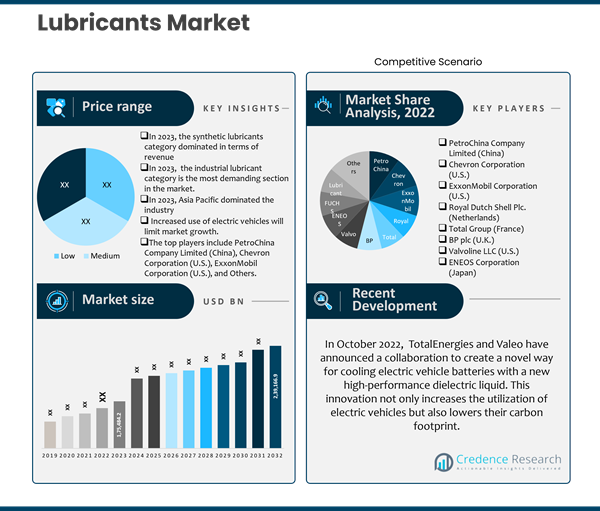
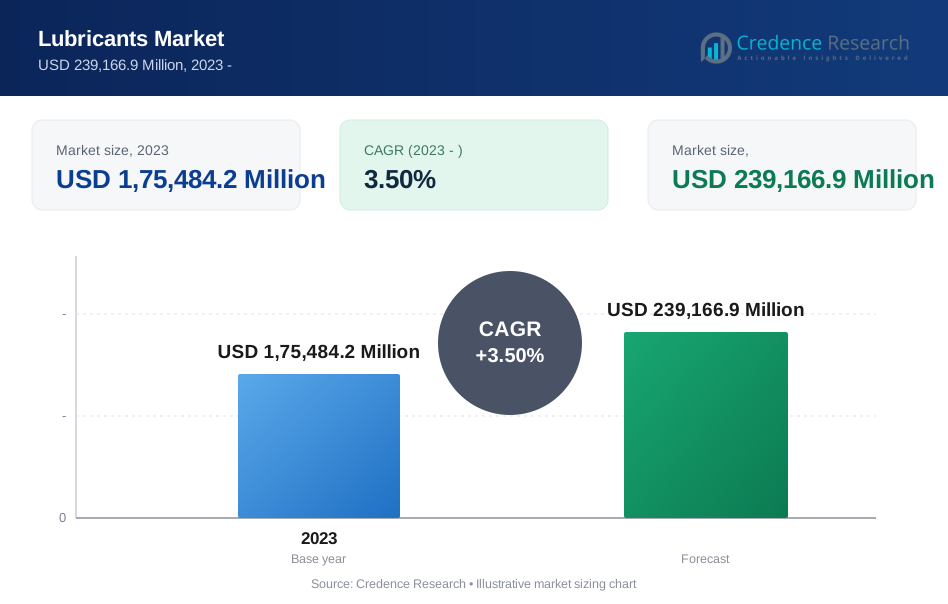
- The global demand for Lubricants was valued at USD 1,75,484.2 Million in 2023 and is expected to reach USD 2,39,166.9 Million in 2032, growing at a CAGR of 3.50% between 2024 and 2032.
- The synthetic lubricants category leads in terms of revenue, and Mineral Lubricants are the fastest-expanding segment.
- In 2023, the automotive category led the market, while the industrial lubricant category is the most demanded segment.
- Group II base oils are the most prevalent, whereas Group III base oils are another significant market group.
- The automotive industry is the leading segment, while mining and construction are another major segment with the highest CAGR.
- In 2023, Asia Pacific dominated the industry, accounting for 44.6% of sales, and North America is predicted to experience the largest growth.
- The rising demand for high-performance lubricants is expected to boost the lubricant market.
- The increased use of electric vehicles will limit market growth.
Executive Summary
Market Definition
Lubricants are fluids, oils, or greases used to minimize friction between two surfaces in close contact. These fluids are critical in automotive and industrial applications because they reduce friction between moving components. They are also used to prevent corrosion, oxidation, and thermal stability in industrial components. Growing competition among significant industry leaders has contributed to market expansion throughout time.
Market Overview
The global Lubricants market has witnessed steady growth in recent years and is expected to grow at a CAGR of 3.50% between 2024 and 2032. The market was valued at USD 1,75,484.2 million in 2023 and is expected to reach USD 2,39,166.9 million in 2032.
Lubricants are becoming increasingly important in the automotive industry because they reduce friction and wear in engines, hence improving performance and efficiency. As the world's population and income levels expand, so does the demand for automobiles, resulting in an increase in lubricants. Lubricants are utilized in a variety of industrial applications, such as manufacturing, mining, and power generation. As the global economy expands, so will the demand for lubricants in these industries, propelling market expansion even further.
In addition, there is a growing emphasis on energy efficiency and sustainability. Great-performance lubricants that reduce energy consumption and carbon emissions are in great demand as businesses attempt to comply with environmental requirements and lower their carbon footprint. Furthermore, there is a rising preference for bio-based lubricants, which are created from renewable resources and are biodegradable, making them more environmentally friendly than traditional petroleum-based lubricants.
Furthermore, the growing use of innovative technologies like additive manufacturing and robotics increases the demand for high-performance lubricants that can tolerate high temperatures and pressures. These technologies require lubricants with special characteristics. As their usage grows, so will the demand for high-performance lubricants, which will drive the lubricant industry even higher.
Segmentation by Type of Lubricant
- During the predicted period, the synthetic lubricants category dominated in terms of revenue. The growing demand for synthetic lubricants as base oils for lubricant production is driven by their compatibility with automotive components, lower vehicular emissions, and lower costs. Polyalphaolefins are lubricants derived from synthetic base oils of the Group IV category.
- Mineral lubricants are the fastest expanding segment in the lubricants market, driven by rising demand from industries such as automotive, industrial, and construction.
Segmentation by Applications
- In 2023, the automotive category dominated the market. This is explained by an increase in passenger vehicle sales, such as buses, trucks, and other consumer vehicles. As a result of their economic progress, emerging economies such as China, India, and Brazil have improved public transportation. This trend is expected to boost demand for commercial automotive lubricants.
- The industrial lubricant category is the most demanding section in the market. Global demand for general industrial lubricants is expected to increase as the world becomes more industrialized. They are designed to keep the machinery running smoothly at high speeds. They're commonly used in a variety of industries, including manufacturing, oil and gas, and food processing.
Segmentation by End User
- Group II Base Oils is the most popular category. These basic oils strike a fair mix between performance and cost, making them commonly employed in lubricant compositions. They are more oxidation stable and perform better than Group I Base Oils, making them popular among lubricant makers.
- Group III Base Oils is another prominent market category. Group III base oils have excellent viscosity index, moderate volatility, and oxidative stability. They are increasingly being employed in high-performance lubricants, particularly in applications that require long oil change intervals and good energy efficiency.
Segmentation by Industry Vertical
- The Automotive Industry is the leading segment. Because of the widespread usage of lubricants in engines, transmissions, and other automotive components, this sector consumes a substantial amount of lubricant. The automobile industry's significant need for lubricants stems from the need for improved engine performance, decreased wear and tear, and longer engine life.
- Mining and construction are another industry segment with the greatest CAGR. Lubricant consumption in this area is rapidly increasing as a result of rising demand for heavy gear and equipment in mining and construction activities.
Segmentation by Region
- In 2023, Asia Pacific dominated the industry, accounting for 44.6% of sales.
- North America is expected to have the highest growth.
- The rest of the world, including Latin America, the Middle East, and Africa, supplies the remaining demand for Lubricants.
The Asia-Pacific region dominated the lubricants market in terms of revenue share. Rising vehicle ownership, combined with the rapid industrialization of numerous nations in the region, has been a major driver of revenue growth in this industry. Furthermore, the growing demand for high-quality lubricants with sophisticated features such as enhanced fuel efficiency, longer lifespan, and performance has accelerated the market's growth. Furthermore, the spike in building and infrastructure development activities in Southeast Asian nations such as Vietnam, Indonesia, and the Philippines has resulted in a large increase in lubricant consumption, accelerating the market's expansion.
However, North America is anticipated to have the highest growth. The rising aerospace industry in the region, combined with an increase in crude oil output, has been a key driver of market expansion. Furthermore, the spike in automotive production and the constant growth of the manufacturing sector have increased demand for high-quality lubricants, accelerating market expansion. The increased usage of eco-friendly lubricants, as well as the execution of severe environmental regulations in the region, are driving market expansion.
Key Highlights of the Report
The global Lubricants market is segmented by Type of Lubricant, Applications, End Users, Industry Vertical, and region. In 2023, the automotive sector dominated the market, while synthetic lubricants led in terms of revenue. Also, Mineral Lubricants are the fastest-expanding segment, while industrial lubricants are the most in-demand. Furthermore, Group II Base Oils is the most popular category, and Mining and Construction are another industry segment with the highest CAGR, with Asia Pacific leading the market growth.
Increasing industrialization, increased vehicle manufacturing, and a focus on product efficiency are the market's primary drivers. The market's primary restrictions are fluctuating raw material prices, environmental laws, and competition from alternative technologies. Furthermore, the development of eco-friendly lubricants, expansion into emerging countries, and technological developments are the significant opportunities in the industry.
Nonetheless, The Asia-Pacific region led the lubricants market in terms of revenue share. Rising vehicle ownership, combined with the fast industrialization of several countries in the region, has been a primary driver of revenue growth in this sector. However, North America is expected to have the most growth. The increasing aerospace industry in the region, combined with an increase in crude oil output, has been a key driver of market growth.
What Are The Main Drivers Of The Global Lubricants Market?
Increasing industrialization, increased vehicle manufacturing and a focus on product efficiency are the market's primary drivers.
What Are The Major Challenges Faced By The Global Lubricants Market?
The market's primary restrictions are fluctuating raw material prices, environmental laws, and competition from alternative technologies.
What Are The Growth Opportunities In The Global Lubricants Market?
The development of eco-friendly lubricants, expansion into emerging countries, and technological developments are significant opportunities in the industry.
Market Drivers
The growing demand for high-performance lubricants is likely to enhance the lubricant market
High-performance lubricants are designed to endure intense temperatures and pressures, resulting in increased fuel efficiency, longer equipment life, and lower maintenance costs. The rising awareness of the significance of maintenance and frequent oil changes is also projected to boost demand for lubricants. Consumers are becoming more aware of the need to maintain their vehicles to ensure peak performance and lifetime, which is projected to drive demand for lubricants. Overall, the automotive industry's rapid growth, rising demand for high-performance lubricants, and increased awareness of the need of maintenance are all projected to drive the lubricants market in the future years.
Market Restraints
Increasing use of electric vehicles will limit market growth
The automotive industry makes a substantial contribution to the consumption and growth of the worldwide lubricant products market. Traditional autos utilize a variety of oils to keep their engines running well over time. However, if the demand for crude oil rises, so will environmental concerns. Consumers in established and emerging markets are becoming interested in electric automobiles. Furthermore, as technology progresses, the advantages of electric vehicles become increasingly evident. Electric vehicle adoption is predicted to impede the growth of the automotive industry.
According to the International Energy Agency, China sold 3 million electric vehicles in 2020, representing a 40% increase over 2019. It is the world's largest and fastest-growing electric vehicle market, as well as a global manufacturing center for electronic and electrical components. Leading electric vehicle manufacturers, like Tesla, are investing in the Chinese market to capitalize on the sector's promise. Electric vehicles are also becoming more popular in industrialized countries such as the United States, Japan, and Western Europe.
Opportunities
Increasing R&D in the automotive industry
Since 1991, the global automotive industry has grown rapidly due to increased openness, the introduction of new and existing models, easy access to financing at cheap interest rates, and price reductions by dealers and manufacturers. Even though many factors influence automotive demand, pent-up demand and the opening up of new markets resulted in passenger vehicle sales nearly doubling over the last decade, albeit from a low base. As more individuals sought personal mobility, auto sales soared, including traditional and innovative electric vehicles. The demand for improved components is growing at a rapid pace. The increase in automotive sales has resulted in rising demand for lubricants.
Competitive Landscape
Key Players
The global Lubricants market is highly competitive, with several key players. Some of the major players in the market and their market share are as follows:
- PetroChina Company Limited (China)
- Chevron Corporation (U.S.)
- ExxonMobil Corporation (U.S.)
- Royal Dutch Shell Plc. (Netherlands)
- Total Group (France)
- BP plc (U.K.)
- Valvoline LLC (U.S.)
- ENEOS Corporation (Japan)
- The FUCHS Group (Germany)
- Global Lubricant Industry LLC (UAE)
- Shield Lubricants (India)
- AMALIE Oil Co. (U.S.)
- Others
These organizations prioritize product innovation, distribution channel expansion, and mergers and acquisitions to stay competitive.
The global Lubricants market's key players continually seek to stay ahead by offering new products and developments.
In September 2023, TotalEnergies Lubrifiants accelerated the use of recycled plastics (50% PCR high-density polyethylene) in their lubricant bottles following a 2021 trial project called Quartz Xtra bottles. This intends to contribute to the circular economy and reduce the use of virgin plastic.
In March 2023, ExxonMobil plans to invest approximately INR 900 crore (~USD 110 million) to build a lubricants production plant in Raigad, Maharashtra, India. Once completed, the plant's annual output capacity is estimated to be 159,000 kl of finished lubricants. This factory will meet rising demand from industries including mining, construction, power, steel, and manufacturing, among others.
How are Companies Performing in the Lubricants Market?
The vast majority of companies in this lubricant marketplace are doing well, particularly those that are new and have developed improvements to meet changing customer needs. Recent advances have mostly focused on sustainability in terms of low carbon emissions and ecologically friendly products. This sustainability trend is linked to the global push to slow climate change and reduce the environmental impact of lubricant manufacturing and use. Companies are expanding their investment in R&D to develop high-performance, ecologically sustainable lubricants, reflecting a rising commitment to minimal environmental impact within industries.
Summary of Key Findings
- Increasing R&D in the automotive sector is the primary market opportunity.
- Market segmented by Type of Lubricant, Applications, End Users, Industry Vertical, and region.
- Group II base oils are the most popular segment in the market.
- Industrial lubricant category being the most demanded part.
- Asia Pacific is leading market growth; the market is highly competitive with key players including PetroChina Company Limited (China), Chevron Corporation (U.S.), ExxonMobil Corporation (U.S.), Royal Dutch Shell Plc. (Netherlands), Total Group (France) and Others.
Future Outlook
- Shift to bio-based lubricants.
- Increasing emphasis on sustainability and environmental impact.
- Technological improvements result in increasingly specialized lubricant products.
- Rising demand in emerging markets.
- Industry consolidation and strategic collaborations.
How CXOs Can Benefit from the Credence Research Lubricants Market Report
The Credence Research Lubricants Market Report provides CXOs with a comprehensive overview of the market, including:
- Market size and growth forecast:The report provides detailed estimates of the global Lubricants market size, segmented by Type of Lubricant, Application, End User, Industry Vertical, and region. It also includes forecasts for the market through 2032 based on key trends and drivers.
- Market segmentation:The report segments the Lubricants market by Type of Lubricant, Application, End User, Industry Vertical, and region. This segmentation provides CXOs with a granular understanding of the market and the opportunities in each segment.
- Competitive Landscape:The report profiles the key players in the Lubricants market and provides insights into their strategies, product offerings, and financial performance. This information can help CXOs to identify and assess their competition.
- Key trends and drivers:The report identifies and analyzes the key trends and drivers that are shaping the Lubricants market. This information can help CXOs to make informed decisions about their investments and strategies.
CXOs can use the insights from the Credence Research Lubricants Market Report to:
- Identify growth opportunities:The report can help CXOs identify new growth opportunities in the Lubricants market. For example, Understanding customer preferences and market segmentation for targeted investment allocation.
- Make informed investment decisions: The report can help CXOs make informed investment decisions about Lubricants. For example, Identifying key market trends and growth drivers to guide investment strategies and Analyzing competitive landscape and market dynamics to assess market opportunities
- Develop competitive strategies:The report can help CXOs develop competitive strategies for their Lubricants businesses. For example, the report may offer information on innovative use cases for Lubricants, potential partnerships or collaborations with other industry players, and strategies to differentiate products or services in the market.
- Track market developments:The report can help CXOs track market developments and stay ahead of the curve. For example, the report provides insights into the latest trends and innovations in the Lubricants market.
Overall, the Credence Research Lubricants Market Report is a valuable resource for CXOs who are looking to gain a deeper understanding of the market and identify opportunities for growth.
Segmentation
-
Type of Lubricant:
- Mineral Lubricants
- Synthetic Lubricants
- Bio-based Lubricants
- Greases
- Solid Lubricants
-
Application:
- Automotive Lubricants
- Industrial Lubricants
- Marine Lubricants
- Aviation Lubricants
- Rail Lubricants
- Mining Lubricants
- Construction Lubricants
- Agricultural Lubricants
-
Base Oil Type:
- Group I Base Oils
- Group II Base Oils
- Group III Base Oils
- Group IV Base Oils
- Group V Base Oils
-
End User:
- Automotive Industry
- Manufacturing Sector
- Transportation and Logistics
- Mining and Construction
- Maritime Industry
-
By Region
- North America
- US
- Canada
- Mexico
- Europe
- Germany
- France
- UK
- Italy
- Spain
- Rest of Europe
- Asia Pacific
- China
- Japan
- India
- South Korea
- South-east Asia
- Rest of Asia Pacific
- Latin America
- Brazil
- Argentina
- Rest of Latin America
- Middle East & Africa
- GCC Countries
- South Africa
- Rest of Middle East and Africa
- North America
Adjacent Markets
In the Lubricants market, there are several adjacent markets which have high revenue growth opportunities. The key adjacent markets for Lubricants market -
Adjacent Markets |
||
| Petroleum Market | Industrial Equipment Market | Metalworking Fluids Market |
| Chemical Market | Specialty Chemicals Market | Greases Market |
| Automotive Market | Oil and Gas Market | Additives Market |
Request a Free Sample
Fill in your details and we'll send you a free sample report.
- Sample data tables & charts
- Research methodology
Need a Custom Version of This Report?
Tailor the scope, geography, or segments to your exact requirements.
- Custom geography or segment scope
- Direct access to our analyst team
Frequently Asked Questions
What is the current size of the global Lubricants market?
What is the expected growth rate of the Lubricants market between 2024 and 2032?
Which segment is leading the market share in terms of Type of Lubricant?
Which Application segment governs the demand for lubricants in the world?
Which End User segment is expected to post the Highest CAGR during the forecast period?
Which region is fueling the growth of the Lubricants industry?
Who are the major players in the global Lubricants market?
What are the major market drivers of the Lubricants industry?
What are the major market restraints of the Lubricants industry?
What are the major market opportunities of the Lubricants industry?
Table of Content
Chapter 1. Report Introduction
- 1.1 Report Description & Purpose
- 1.1.1 Report Title & Market Definition
- 1.1.2 Unique Selling Propositions (USP) & Key Differentiators
- 1.1.3 Value Proposition for Stakeholders
- 1.2 Research Objectives
- 1.2.1 Market Sizing Objectives (Volume & Revenue)
- 1.2.2 Segmentation Objectives
- 1.2.3 Competitive Intelligence Objectives
- 1.2.4 Forecast & Scenario Objectives
- 1.3 Report Scope
- 1.3.1 Lubricants Scope – Types & Subtypes Covered
- 1.3.2 Geographic Scope – Regions & Countries Covered
- 1.3.3 Historical Period, Base Year & Forecast Period (2023; forecast to the forecast period)
- 1.3.4 Inclusions & Exclusions
- 1.4 HS Code & Classification Framework
- 1.5 Currency, Units & Pricing Basis
- 1.6 Target Stakeholders
- 1.7 Limitations & Assumptions
Chapter 2. Executive Summary
- 2.1 Global Lubricants Market Snapshot
- 2.1.1 Market Size – Historical (2023) & Forecast (the forecast period) (2023: USD 1,75,484.2 Million → forecast year: USD 239,166.9 Million)
- 2.1.2 Volume & Revenue – Global Totals
- 2.1.3 Key Market Highlights – Top Five Facts
- 2.2 Lubricants Market Segmentation Snapshot
- 2.2.1 Market Split by Region – 2023 vs.
- 2.3 Competitive Snapshot
- 2.3.1 Top 10 Players by Revenue Share – 2023
- 2.3.2 Top 10 Players by Volume Share – 2023
- 2.3.3 Recent Strategic Developments (18-Month Summary)
- 2.4 Key Investment Highlights & Strategic Conclusions
Chapter 3. Lubricants Market Dynamics & Industry Analysis
- 3.1 Market Overview & Context
- 3.1.1 Lubricants Market Position in the Broader Automotive Value Chain
- 3.1.2 OEM vs. Replacement Market Dynamics
- 3.1.3 Market Maturity & Development Stage by Region
- 3.2 Lubricants Market Drivers
- 3.3 Lubricants Market Restraints & Challenges
- 3.4 Lubricants Market Opportunities
- 3.5 Porter's Five Forces Analysis
- 3.5.1 Threat of New Entrants
- 3.5.2 Bargaining Power of Suppliers
- 3.5.3 Bargaining Power of Buyers
- 3.5.4 Threat of Substitutes
- 3.5.5 Competitive Rivalry – Intensity Assessment
- 3.6 Lubricants Value Chain Analysis
- 3.6.1 Upstream – Raw Material/Input Suppliers
- 3.6.1.1 Raw Material/Input 1
- 3.6.1.2 Raw Material/Input 2
- 3.6.1.3 Raw Material/Input 3
- 3.6.2 Midstream – Production/Manufacturing/Service Delivery
- 3.6.2.1 Production/Process Overview
- 3.6.2.2 Key Facility Locations & Capacity by Manufacturer
- 3.6.3 Downstream – Distribution & End Consumer
- 3.6.3.1 Primary Channel – B2B/OEM
- 3.6.3.2 Secondary Channels – Dealer, Retail, Online, Direct
- 3.6.4 Value Chain Profitability Analysis
- 3.6.1 Upstream – Raw Material/Input Suppliers
- 3.7 PESTEL Analysis
- 3.7.1 Political Factors
- 3.7.2 Economic Factors
- 3.7.3 Social Factors
- 3.7.4 Technological Factors
- 3.7.5 Environmental Factors
- 3.7.6 Legal Factors
- 3.8 Lubricants Supply Chain Analysis
- 3.8.1 Raw Material/Input Supply Risk Assessment
- 3.8.2 Manufacturing Concentration Risk (Geographic Exposure)
- 3.8.3 Trade Disruption Impact Analysis
- 3.9 Regulatory & Policy Landscape
Note: The regulatory and policy landscape section covers regulations based on their applicability to the market, Lubricants category, geography, and scope of the study. Only regulatory frameworks with a material impact on operations, compliance, trade, sustainability, or market access are analyzed in detail.
Chapter 4. Key Investment Pockets & Opportunity Analysis
- 4.1 Lubricants Market Attractiveness Analysis
- 4.1.1 By Region – Investment Attractiveness Matrix (Volume × CAGR)
- 4.2 Absolute Revenue Growth Opportunity
- 4.2.1 By Region – Absolute USD Growth Through the forecast period
- 4.3 Incremental Volume Opportunity
- 4.3.1 By Region – Incremental Volume Through the forecast period
- 4.3.2 Segment – Incremental Volume
- 4.4 Emerging Submarket Opportunity Deep Dive (Subject to Applicability)
- 4.5 Emerging Market Opportunity Scorecards
- 4.5.1 United States
- 4.5.2 Europe
- 4.5.3 Asia
- 4.5.4 Middle East & Africa
Note: Emerging Market Opportunity Scorecards will be included based on relevance and strategic importance. Regions listed are indicative and may vary depending on data availability and market dynamics.
Chapter 5. Lubricants Import-Export Analysis & Trade Flows
- 5.1 Global Trade Overview
- 5.1.1 Global Export Value by Country (2023)
- 5.1.2 Global Export Volume by Country (2023)
- 5.1.3 Global Import Value by Country (2023)
- 5.1.4 Global Import Volume by Country (2023)
- 5.1.5 Net Trade Balance by Country (2023)
- 5.2 Export Analysis – Segment
- 5.2.1 Type 1 (HS Code)
- 5.2.2 Type 2 (HS Code)
- 5.2.3 Type 3 (HS Code)
- 5.2.4 Type 4 (HS Code)
- 5.2.5 Type 5 (HS Code)
- 5.3 Import Analysis – Segment
- 5.3.1 Type 1 (HS Code)
- 5.3.2 Type 2 (HS Code)
- 5.3.3 Type 3 (HS Code)
- 5.3.4 Type 4 (HS Code)
- 5.3.5 Type 5 (HS Code)
- 5.4 Average Unit Trade Prices
- 5.4.1 Average Export Price – Segment & Country
- 5.4.2 Average Import Price – Segment & Source Country
- 5.4.3 Price Trends (2023)
- 5.5 Key Trade Route Analysis
- 5.5.1 Trade Route 1
- 5.5.2 Trade Route 2
- 5.5.3 Trade Route 3
- 5.5.4 Trade Route 4
- 5.5.5 Trade Route 5
- 5.6 Trade Policy Impact Assessment
- 5.6.1 US Anti-Dumping & Section 301 Tariffs
- 5.6.2 EU Customs Union Impact
- 5.6.3 Major Free Trade Agreements
- 5.6.4 USMCA Rules of Origin
Note: Trade policy analysis will be included only where relevant to the Lubricants market.
Chapter 6. Competitive Landscape & Company Benchmarking
- 6.1 Lubricants Market Concentration & Structure
- 6.1.1 Herfindahl-Hirschman Index (HHI) – vs. 2023
- 6.1.2 Tier 1, Tier 2 & Tier 3 Market Structure
- 6.1.3 Global, Regional & Local Player Dynamics
- 6.2 Lubricants Market Share Analysis – 2023
- 6.2.1 Global Revenue Share by Company
- 6.2.2 Global Volume Share by Company
- 6.2.3 Regional Revenue Share
- 6.2.4 Market Share Evolution ( vs. 2023)
- 6.2.5 OEM Segment Share by Company
- 6.2.6 Replacement Segment Share by Company
- 6.3 Production/Delivery Capacity & Facility Analysis
- 6.3.1 Global Installed Capacity
- 6.3.2 Capacity Utilization Rates
- 6.3.3 Production/Output Volume
- 6.3.4 Facility Locations & Capacity Map
- 6.3.5 Planned Capacity Additions
- 6.4 Lubricants Competitive Benchmarking Matrix
- 6.4.1 Revenue, Volume, CAGR & Profitability Comparison
- 6.4.2 Channel Revenue Mix
- 6.4.3 Geographic Revenue Exposure
- 6.4.4 R&D Intensity
- 6.4.5 Sustainability Maturity
- 6.5 Strategic Developments in Lubricants (Last 24 Months)
- 6.5.1 Mergers, Acquisitions & Divestments
- 6.5.2 New Lubricants Launches
- 6.5.3 Facility Expansions
- 6.5.4 Strategic Alliances, Joint Ventures & Partnerships
- 6.5.5 Distribution Expansion & Market Entry
- 6.5.6 Sustainability & ESG Initiatives
- 6.6 Competitive Strategy Mapping
- 6.6.1 Leader, Challenger, Follower & Niche Classification
- 6.6.2 Pricing Strategy Comparison
- 6.6.3 Channel Strategy Matrix
Note: Strategic developments are included based on their materiality and the availability of reliable information.
Chapter 7. Global Lubricants Market – By Distribution Channel
- 7.1 Segment Overview
- 7.1.1 Volume & Revenue Split by Channel (2023 & )
- 7.1.2 Channel Mix Evolution (the forecast period)
Chapter 8. Regional Market Analysis – Global Overview
- 8.1 Global Regional Overview
- 8.1.1 Regional Volume Share
- 8.1.2 Regional Revenue Share
- 8.1.3 Regional Volume by Region
- 8.1.4 Regional Revenue by Region
- 8.1.5 Regional Forecast Through the forecast period
- 8.2 Cross-Regional Segment Analysis
- 8.2.1 By Distribution Channel
- 8.2.2 By Brand/Price Tier
Chapter 9. North America Lubricants Market
- 9.1 United States
- 9.2 Canada
- 9.3 Mexico
Chapter 10. Europe Lubricants Market
- 10.1 Germany
- 10.2 France
- 10.3 Italy
- 10.4 United Kingdom
- 10.5 Spain
- 10.6 Poland
- 10.7 Russia
- 10.8 Netherlands
- 10.9 Belgium
- 10.10 Sweden
- 10.11 Denmark
- 10.12 Norway
- 10.13 Rest of Europe
Chapter 11. Asia Pacific Lubricants Market
- 11.1 China
- 11.2 India
- 11.3 Japan
- 11.4 South Korea
- 11.5 Thailand
- 11.6 Indonesia
- 11.7 Vietnam
- 11.8 Malaysia
- 11.9 Australia
- 11.10 Rest of Asia Pacific
Chapter 12. Latin America Lubricants Market
- 12.1 Brazil
- 12.2 Argentina
- 12.3 Colombia
- 12.4 Chile
- 12.5 Rest of Latin America
Chapter 13. Middle East Lubricants Market
- 13.1 Saudi Arabia
- 13.2 United Arab Emirates
- 13.3 Turkey
- 13.4 Israel
- 13.5 Iran
- 13.6 Rest of the Middle East
Chapter 14. Africa Lubricants Market
- 14.1 South Africa
- 14.2 Egypt
- 14.3 Nigeria
- 14.4 Morocco
- 14.5 Rest of Africa
Chapter 15. Lubricants Company Profiles
- 15.1 [Company 01]
- 15.1.1 Company Overview
- 15.1.2 Key Management Personnel
- 15.1.3 Products & Services Portfolio
- 15.1.4 Financial Performance
- 15.1.5 Key Market Focus & Geographic Presence
- 15.1.6 Recent Developments & Strategic Initiatives
Note: The company profile list is preliminary and may change based on research findings, market developments, data availability, and client requirements.
Chapter 16. Appendices
- Appendix A – List of Abbreviations & Acronyms
- Appendix B – Industry Classification Code Reference – Full Series
- Appendix C – Production & Capacity Data Tables
- Appendix D – End-Use & Demand Base Tables
- Appendix E – Consumption & Replacement Rate Assumptions
- Appendix F – ASP Reference Tables
- Appendix G – Manufacturing & Facility Database
- Appendix H – Import-Export Data Tables
- Appendix I – Regulatory Summary Tables
- Appendix J – Primary Research Participant List (Anonymized)
- Appendix K – Primary Research Questionnaire Framework
- Appendix L – Data Sources & Bibliography
- Appendix M – Market Size Divergence & Source Comparison
Chapter 17. Research Methodology
- 17.1 Research Framework & Philosophy
- 17.2 Secondary Research – Sources, Hierarchy & Data Extraction
- 17.3 Data Modeling – Bottom-Up & Top-Down Market Sizing
- 17.4 Primary Research – Stakeholder Framework, LOI & Sample Sizes
- 17.5 Forecast Methodology – Regression, Scenario & Sensitivity Analysis
- 17.6 Quality Control – Four-Layer Validation Framework
- 17.7 Limitations & Standard Assumptions
- 17.8 Disclaimer
