
Market Overview:
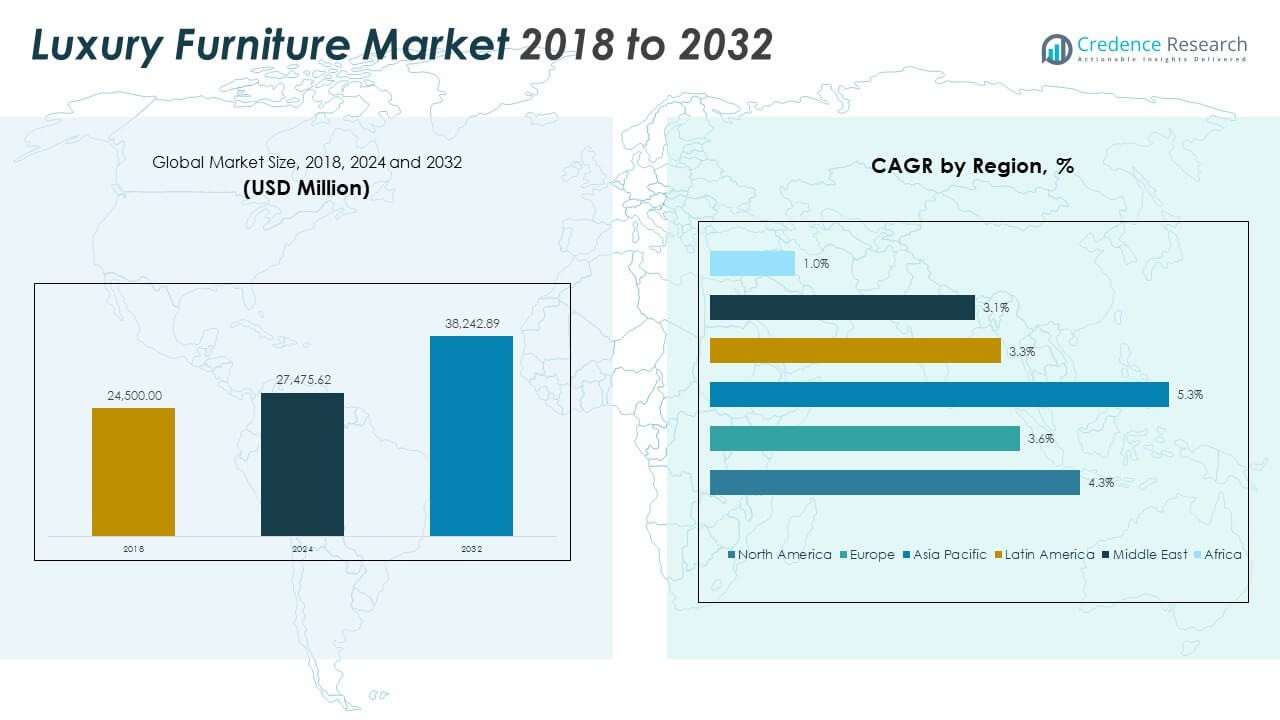
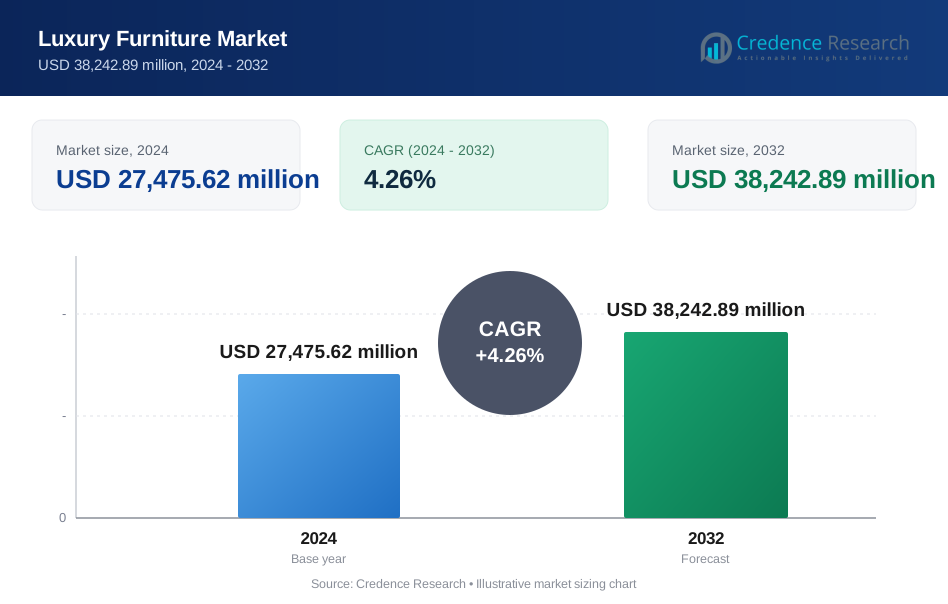
The Global Luxury Furniture Market size was valued at USD 24,500.00 million in 2018 to USD 27,475.62 million in 2024 and is anticipated to reach USD 38,242.89 million by 2032, at a CAGR of 4.26% during the forecast period.
| REPORT ATTRIBUTE | DETAILS |
|---|---|
| Historical Period | 2020-2023 |
| Base Year | 2024 |
| Forecast Period | 2025-2032 |
| Luxury Furniture Market Size 2024 | USD 27,475.62 Million |
| Luxury Furniture Market, CAGR | 4.26% |
| Luxury Furniture Market Size 2032 | USD 38,242.89 Million |
Rising disposable income, rapid urbanization, and lifestyle shifts are driving the luxury furniture market. Consumers increasingly prefer high-quality, aesthetic, and durable home furnishings. Growing demand for personalized and sustainable furniture designs, along with the expansion of luxury housing and hospitality sectors, further boosts market growth. Technological innovations in smart and modular furniture and online retail expansion also enhance accessibility and adoption among premium consumers.
Regionally, North America leads due to strong purchasing power and established luxury brands, while Europe follows with its heritage design and craftsmanship. The Asia-Pacific region is emerging rapidly, supported by urban development and increasing investments in residential and commercial infrastructure. Rising awareness of premium interior design and growing middle-class wealth are fueling demand across China, India, and Southeast Asian nations.
Market Insights:
- The Global Luxury Furniture Market was valued at USD 24,500.00 million in 2018, reaching USD 27,475.62 million in 2024, and is expected to attain USD 38,242.89 million by 2032, expanding at a CAGR of 4.26% during the forecast period.
- North America (28.9%), Europe (25.2%), and Asia Pacific (34.6%) hold the largest market shares, driven by strong consumer spending, advanced manufacturing, and rising demand for premium interiors.
- Asia Pacific remains the fastest-growing region with 34.6% share, propelled by urbanization, luxury housing projects, and growing middle-class wealth across China, India, and Southeast Asia.
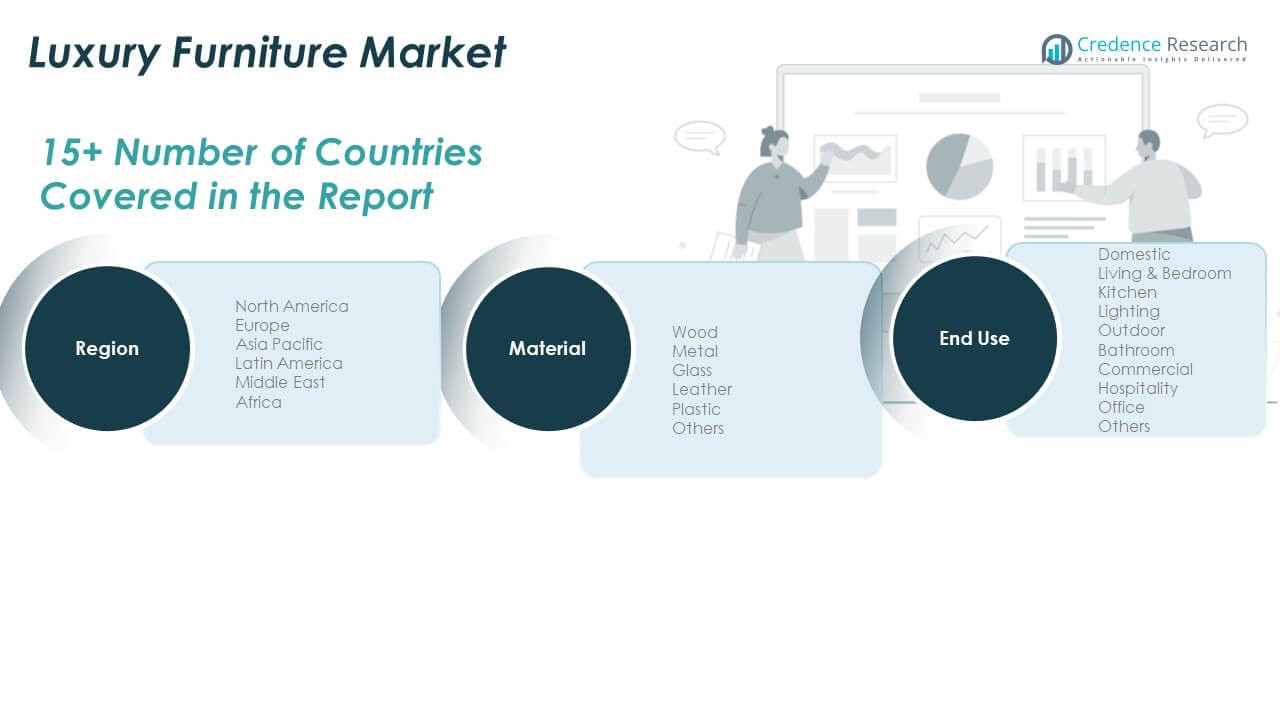
- Based on material segmentation, wood accounts for nearly 35% of the total market share due to its durability, craftsmanship appeal, and timeless demand across residential and commercial use.
- Metal and glass together contribute around 40% of market share, supported by increasing preference for modern, minimalist, and modular luxury furniture designs.
Market Drivers:
Rising Urbanization and Growing Affluence Boost Demand for Premium Home Décor
Urban expansion and rising disposable incomes are driving global demand for luxury furniture. Consumers in metropolitan areas increasingly seek sophisticated designs that reflect lifestyle and status. The Global Luxury Furniture Market benefits from the growth of luxury residential projects and upscale commercial spaces. Affluent homeowners prefer designer furniture made from premium wood, leather, and metal. Strong housing and hospitality investments expand opportunities for luxury furniture makers. Growing urban middle-class populations in Asia-Pacific are fueling this trend further. Customization and brand value are becoming crucial purchase motivators. Retail showrooms and online luxury platforms enhance visibility and reach.
- For instance, SCAVOLINI S.P.A. showcased its modular luxury kitchen collection at major urban showrooms in 2025, which resulted in increased customization inquiries and urban footfall according to multiple international product launch updates and press releases.
Expansion of the Hospitality and Real Estate Sectors Elevates Product Consumption
Luxury furniture demand is surging due to rapid development in hotels, resorts, and luxury real estate. Hospitality investors emphasize aesthetics, durability, and comfort to attract elite clientele. It creates consistent demand for high-end furniture across lobbies, suites, and lounges. The Global Luxury Furniture Market benefits from developers collaborating with international brands to furnish luxury interiors. Rising global tourism increases spending on luxury accommodations and furnishings. Premium furniture rental services are also gaining traction among event organizers. Expansion of branded hotels in emerging economies drives market penetration. The growing preference for statement designs and eco-conscious materials strengthens brand positioning.
- For instance, a leading luxury furniture manufacturer could partner with a major hospitality group to supply custom-certified luxury furniture for a newly developed European hotel, with over 1,200 pieces delivered to suites and lobbies.
Growing Popularity of Sustainable and Eco-Friendly Furniture Solutions
Environmental awareness is reshaping consumer preferences toward sustainable luxury furniture. Manufacturers are investing in responsibly sourced materials like reclaimed wood and eco-leather. The Global Luxury Furniture Market is adapting to stricter environmental regulations and consumer expectations. Green certifications are influencing brand credibility among eco-conscious buyers. Energy-efficient production and circular economy practices are becoming standard strategies. Sustainable product lines attract premium pricing due to ethical appeal. Partnerships with green designers enhance innovation and transparency. It strengthens brand loyalty while aligning luxury aesthetics with environmental responsibility.
Technological Innovation and Integration of Smart Furniture Systems
Technological advancements are revolutionizing the luxury furniture landscape through digital craftsmanship and automation. The Global Luxury Furniture Market is witnessing innovations in modular designs, AR-based visualization, and smart connectivity. Furniture integrated with sensors and wireless charging appeals to modern buyers. It supports remote comfort adjustments and space optimization for urban homes. 3D printing enables intricate, personalized furniture designs with precision. Online customization tools allow real-time visualization and seamless ordering. Virtual showrooms enhance customer engagement and purchasing confidence. Such innovations are redefining consumer expectations of premium furniture experiences.
Market Trends:
Shift Toward Minimalist and Contemporary Design Preferences
Modern buyers prefer minimalistic and functional luxury furniture emphasizing clean lines and open spaces. The Global Luxury Furniture Market is witnessing a transition from ornate to sleek, contemporary aesthetics. Designers are blending natural textures with neutral tones for timeless appeal. Compact modular furniture suits smaller urban living environments. It reflects practicality without compromising visual sophistication. Scandinavian and Japanese minimalism inspire global collections. Lightweight, adaptable furniture aligns with lifestyle mobility trends. Such stylistic evolution is shaping new purchasing behaviors and brand differentiation.
E-Commerce Expansion and Rise of Virtual Retail Platforms
Digital transformation is driving new retail experiences in the luxury furniture segment. The Global Luxury Furniture Market is experiencing growth through online boutiques, AR-based shopping, and virtual showrooms. Consumers enjoy real-time customization and immersive visualization before purchase. It eliminates geographic barriers, enabling global brand access. Secure payment systems and white-glove delivery improve customer trust. Brands are leveraging social media marketing to attract affluent millennials. Digital integration enhances transparency and user engagement. Hybrid models combining online customization and offline touchpoints are becoming dominant.
- For instance, Laura Ashley Holdings PLC was acquired by Marquee Brands in January 2025 and continues to operate a licensing-focused business model. The company operates in more than 200 lifestyle categories through a network of over 100 licensed partners.
Increased Collaboration Between Designers and International Luxury Brands
Cross-industry collaborations are redefining innovation and exclusivity in the luxury furniture domain. The Global Luxury Furniture Market benefits from partnerships between furniture artisans and fashion or automotive brands. These collaborations merge craftsmanship with brand prestige and limited-edition releases. It enhances perceived value and attracts high-net-worth clients seeking unique pieces. Designers integrate material innovation and brand storytelling into collections. Joint marketing campaigns amplify visibility and aspiration appeal. Global design fairs showcase such collaborations, influencing upcoming trends. These alliances reinforce cultural luxury and artistic exclusivity.
Emphasis on Customization and Personalization of Living Spaces
Affluent consumers increasingly desire bespoke furniture tailored to personal tastes and spatial needs. The Global Luxury Furniture Market responds with on-demand customization services and premium craftsmanship. It supports individual expression through material, color, and configuration flexibility. Digital modelling enables instant design previews and order adjustments. Personalized interiors drive emotional connection and long-term loyalty. Custom-made furniture enhances exclusivity and uniqueness in luxury homes. Designers and brands offer concierge-level consultation for elite clients. Such personalization trends underline the emotional and experiential side of luxury consumption.
Market Challenges Analysis:
High Production and Material Costs Limit Affordability and Market Penetration
Luxury furniture production demands premium raw materials and skilled craftsmanship, driving up costs significantly. The Global Luxury Furniture Market faces pricing pressures due to limited supply of high-grade wood, marble, and leather. It restricts market reach among mid-tier buyers seeking affordable luxury. Fluctuating material prices further strain profit margins for manufacturers. Supply chain disruptions affect sourcing consistency and delivery timelines. Skilled labor shortages slow down production efficiency and innovation cycles. Economic downturns reduce discretionary spending on luxury goods. Maintaining quality while managing costs remains a persistent challenge for global brands.
Counterfeit Products and Market Fragmentation Reduce Brand Trust and Profitability
Counterfeit luxury furniture is eroding consumer confidence and damaging brand reputation. The Global Luxury Furniture Market experiences competition from low-cost replicas imitating designer aesthetics. It undermines genuine craftsmanship and reduces sales of authentic brands. Market fragmentation among numerous local players weakens pricing consistency. Intellectual property protection remains difficult in emerging markets. Online marketplaces further complicate authenticity verification. Managing global distribution channels to ensure brand integrity is complex. Brands must invest in digital tagging and traceability systems to combat counterfeiting effectively. Maintaining exclusivity while expanding accessibility remains a delicate balance for the industry.
Market Opportunities:
Expansion Across Emerging Economies and Luxury Real Estate Development
Emerging markets in Asia-Pacific, the Middle East, and Latin America present strong opportunities for expansion. The Global Luxury Furniture Market benefits from rising disposable incomes and urban luxury housing. It supports new investments in high-end apartments, hotels, and offices. Foreign brands are entering these regions through partnerships and localized production. Rapid construction and interior design growth drive product adoption. Retail chains and design studios expand visibility in tier-one and tier-two cities. Increasing cultural exposure to Western lifestyles fuels aspirational purchases. Global brands targeting these consumers can capture strong long-term growth potential.
Integration of Smart and Sustainable Furniture Designs for Future Homes
The growing demand for intelligent, eco-friendly furniture solutions opens new innovation frontiers. The Global Luxury Furniture Market embraces technology-enabled comfort, modularity, and sustainability. It drives investment in smart seating, lighting, and storage systems. Energy-efficient materials and digital functionality enhance product differentiation. Partnerships with architects and tech firms create advanced home ecosystems. Consumers value furniture that merges aesthetics with convenience and sustainability. Eco-smart luxury designs appeal to environmentally aware, tech-savvy buyers. This convergence between luxury and technology defines the next era of high-end furniture innovation.
Market Segmentation Analysis:
By Material
The Global Luxury Furniture Market is segmented by material into wood, metal, glass, leather, plastic, and others. Wood dominates due to its timeless appeal, durability, and craftsmanship versatility across classic and modern designs. Metal furniture is gaining traction for its sleek aesthetics and structural strength suited to contemporary interiors. Glass segments are favored for creating spacious visual effects in luxury homes and offices. Leather maintains steady demand for premium sofas and chairs reflecting sophistication and comfort. Plastic and other composite materials serve niche spaces emphasizing lightness and design flexibility. This diverse material base supports product innovation and enhances brand differentiation.
- For instance, furniture companies like Mobelcenter and Nella Vetrina operate within the global luxury furniture market, which is expected to reach an estimated US$41.20 billion by 2033. While specific, verifiable public sales data for individual companies is limited, industry reports note general market trends, such as the overall global luxury furniture market growing at a CAGR of around 6.01% from 2025 to 2033, indicating strong sector performance.
By End-Use
The market is divided by end-use into domestic and commercial segments. The domestic category includes living and bedroom, kitchen, lighting, outdoor, and bathroom furniture. Rising residential renovation and growing interest in personalized home décor are propelling demand across these sub-segments. Luxury lighting and outdoor collections are becoming integral to premium home design trends. The commercial segment covers hospitality, office, and others, driven by upscale hotels, corporate offices, and exclusive retail interiors. It benefits from rapid expansion in luxury tourism and workplace modernization. High-quality furnishings enhance ambiance and brand perception across both sectors, reinforcing market growth.
- For instance, the UAE luxury furniture market is experiencing a significant growth in the residential and hospitality sectors, driven by new high-end real estate developments. Simultaneously, general trends indicate that many established brands are investing in online platforms and new technologies, such as Augmented Reality (AR) showrooms, to meet evolving consumer preferences.
Segmentation:
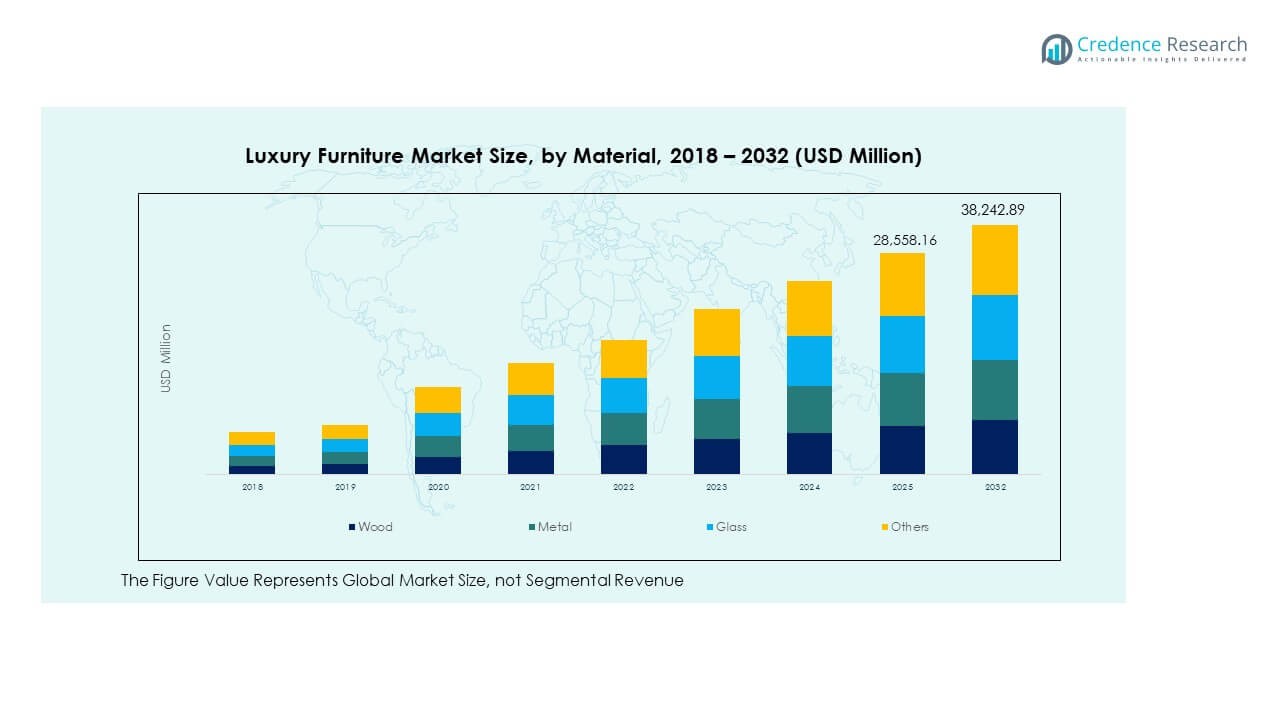
By Material:
- Wood
- Metal
- Glass
- Leather
- Plastic
- Others
By End-Use:
- Domestic
- Living & Bedroom
- Kitchen
- Lighting
- Outdoor
- Bathroom
- Commercial
- Hospitality
- Office
- Others
By Region:
- North America
- S.
- Canada
- Mexico
- Europe
- UK
- France
- Germany
- Italy
- Spain
- Russia
- Rest of Europe
- Asia Pacific
- China
- Japan
- South Korea
- India
- Australia
- Southeast Asia
- Rest of Asia Pacific
- Latin America
- Brazil
- Argentina
- Rest of Latin America
- Middle East
- GCC Countries
- Israel
- Turkey
- Rest of Middle East
- Africa
- South Africa
- Egypt
- Rest of Africa
Regional Analysis:
North America
The North America Luxury Furniture Market size was valued at USD 7,203.00 million in 2018 to USD 7,956.77 million in 2024 and is anticipated to reach USD 11,056.09 million by 2032, at a CAGR of 4.3% during the forecast period. North America holds a market share of approximately 28.9%. The region leads due to its strong consumer purchasing power and the presence of established luxury brands. The Global Luxury Furniture Market benefits from the concentration of premium home décor retailers and rising investments in luxury housing projects. Demand is driven by interior design trends focusing on personalization and sustainability. Technological integration in smart homes also increases adoption of luxury furnishings. The United States represents the largest market owing to robust real estate development and evolving lifestyle preferences. Canada and Mexico contribute through rising urbanization and growth in high-end hospitality infrastructure.
Europe
The Europe Luxury Furniture Market size was valued at USD 6,774.25 million in 2018 to USD 7,316.01 million in 2024 and is anticipated to reach USD 9,646.87 million by 2032, at a CAGR of 3.6% during the forecast period. Europe accounts for a market share of around 25.2%. The region remains a hub for traditional craftsmanship and designer collaborations. The Global Luxury Furniture Market in Europe is supported by established design capitals such as Italy, France, and Germany. Growing consumer focus on heritage furniture, sustainability, and premium materials sustains market maturity. Luxury furniture houses emphasize artistic craftsmanship blended with modern functionality. Demand growth in Eastern Europe is emerging due to new urban developments and hospitality projects. Italy leads exports with strong brand identity, while Northern Europe focuses on minimalist and eco-conscious designs.
Asia Pacific
The Asia Pacific Luxury Furniture Market size was valued at USD 7,563.15 million in 2018 to USD 8,779.72 million in 2024 and is anticipated to reach USD 13,232.07 million by 2032, at a CAGR of 5.3% during the forecast period. The region commands a market share of approximately 34.6%, making it the fastest-growing globally. Rapid urbanization, a rising middle class, and luxury real estate expansion are key drivers. The Global Luxury Furniture Market benefits from rising disposable income and cultural acceptance of luxury living. China and India dominate consumption through urban housing and commercial construction. Japan and South Korea maintain strong demand for modern minimalist designs. Local manufacturers increasingly collaborate with international brands to meet growing domestic demand. Expanding e-commerce platforms further enhance regional accessibility and consumer reach.
Latin America
The Latin America Luxury Furniture Market size was valued at USD 1,612.10 million in 2018 to USD 1,791.14 million in 2024 and is anticipated to reach USD 2,320.20 million by 2032, at a CAGR of 3.3% during the forecast period. Latin America holds a market share of about 6.1%. The region’s growth is supported by the expanding hospitality and tourism industry. The Global Luxury Furniture Market is gaining traction across Brazil, Argentina, and Chile, where rising urbanization drives interior décor investments. Demand for European-inspired designs and local craftsmanship is growing among affluent consumers. Government incentives for infrastructure and commercial property projects are aiding market expansion. Brazil remains the largest contributor due to its strong retail network and luxury housing developments. However, economic volatility and high import tariffs restrain faster growth.
Middle East
The Middle East Luxury Furniture Market size was valued at USD 1,004.50 million in 2018 to USD 1,060.38 million in 2024 and is anticipated to reach USD 1,342.54 million by 2032, at a CAGR of 3.1% during the forecast period. The region captures a market share of nearly 3.5%. The Global Luxury Furniture Market is expanding across GCC countries due to high investments in luxury hotels, villas, and commercial spaces. Strong demand for opulent, custom-made furniture aligns with architectural modernization. Dubai and Saudi Arabia lead adoption through large-scale real estate and hospitality projects. International brands are entering through partnerships with regional distributors. Increasing expatriate population and tourism also enhance premium furniture consumption. Preference for contemporary Arabic and Italian fusion designs defines market character.
Africa
The Africa Luxury Furniture Market size was valued at USD 343.00 million in 2018 to USD 571.60 million in 2024 and is anticipated to reach USD 645.13 million by 2032, at a CAGR of 1.0% during the forecast period. Africa holds a market share of roughly 1.7%. The Global Luxury Furniture Market in Africa is gradually developing with growing urban centers and rising disposable incomes. South Africa remains the key market driven by luxury residential and hospitality projects. Nigeria and Egypt show growing interest in modern home interiors. Limited manufacturing infrastructure and high import dependency hinder growth. Local artisans are slowly integrating modern techniques with traditional craftsmanship. Government housing projects and real estate investments may drive gradual market expansion. Increasing online furniture platforms and retail partnerships are expected to support future growth.
Key Player Analysis:
- Duresta
- Mobelcenter
- Valderamobili
- Giovanni Visentin
- SCAVOLINI S.P.A.
- Laura Ashley Holdings PLC
- Iola Modern
- Nella Vetrina
- Henredon
Competitive Analysis:
The Global Luxury Furniture Market is highly competitive with a mix of established global brands and regional manufacturers. It is driven by innovation, craftsmanship, and design differentiation. Leading companies such as Duresta, Valderamobili, Scavolini S.p.A., Laura Ashley Holdings PLC, and Nella Vetrina focus on expanding product portfolios and enhancing customer experience. It emphasizes customization, sustainability, and smart furniture integration to attract premium buyers. Companies are investing in digital platforms and collaborations to expand brand visibility. Strategic alliances and design partnerships remain essential for maintaining market leadership. Rising competition among European and Asian players is reshaping the global luxury furniture landscape.
Recent Developments:
- In April 2025, the Duresta brand’s parent company, the Durst Group, announced the acquisition of callas software, a provider of PDF automation and prepress technology. This deal is significant as it underscores Durst’s focus on advancing integrated, intelligent software platforms for the wider design and manufacturing sector, including luxury furnishings. The acquisition is positioned to yield new capabilities and efficiencies across Durst’s business divisions such as upholstery and luxury furniture, to which Duresta belongs.
- In January 2025, Laura Ashley was strategically acquired by Marquee Brands, a major global brand accelerator. This acquisition retained Laura Ashley’s UK-based team and aimed to leverage the legacy brand’s strong market presence by expanding into new regions and platforms through new partnerships. With distribution in over 80 countries and across 150 branded locations, Marquee Brands seeks to unlock further category expansion and innovation for Laura Ashley in the luxury home, fashion, and lifestyle market.
Report Coverage:
The research report offers an in-depth analysis based on Segment 1, Segment 2 It details leading market players, providing an overview of their business, product offerings, investments, revenue streams, and key applications. Additionally, the report includes insights into the competitive environment, SWOT analysis, current market trends, as well as the primary drivers and constraints. Furthermore, it discusses various factors that have driven market expansion in recent years. The report also explores market dynamics, regulatory scenarios, and technological advancements that are shaping the industry. It assesses the impact of external factors and global economic changes on market growth. Lastly, it provides strategic recommendations for new entrants and established companies to navigate the complexities of the market.
Future Outlook:
- Rising demand for sustainable and eco-luxury furniture solutions.
- Expansion of digital retail and AR-based customization platforms.
- Growth in hospitality and real estate driving premium furniture sales.
- Increasing preference for modular and space-efficient designs.
- Strong market potential in Asia Pacific through urbanization and housing growth.
- Adoption of smart, tech-integrated luxury furniture for modern living.
- Enhanced collaboration between luxury designers and technology firms.
- Brand diversification through regional partnerships and online presence.
- Focus on recyclable materials and green manufacturing certifications.
- Growing influence of experiential luxury and bespoke craftsmanship.
Request a Free Sample
Fill in your details and we'll send you a free sample report.
- Sample data tables & charts
- Research methodology
Need a Custom Version of This Report?
Tailor the scope, geography, or segments to your exact requirements.
- Custom geography or segment scope
- Direct access to our analyst team
Frequently Asked Questions
What is the current market size for the Global Luxury Furniture Market, and what is its projected size in 2032?
At what Compound Annual Growth Rate is the Global Luxury Furniture Market projected to grow between 2025 and 2032?
Which Global Luxury Furniture Market segment held the largest share in 2024?
What are the primary factors fueling the growth of the Global Luxury Furniture Market?
Who are the leading companies in the Global Luxury Furniture Market?
Which region commanded the largest share of the Global Luxury Furniture Market in 2024?
Table of Content
Chapter 1. Report Introduction
- 1.1 Report Description & Purpose
- 1.1.1 Report Title & Market Definition
- 1.1.2 Unique Selling Propositions (USP) & Key Differentiators
- 1.1.3 Value Proposition for Stakeholders
- 1.2 Research Objectives
- 1.2.1 Market Sizing Objectives (Volume & Revenue) (Volume Where Applicable)
- 1.2.2 Segmentation Objectives
- 1.2.3 Competitive Intelligence Objectives
- 1.2.4 Forecast & Scenario Objectives
- 1.3 Report Scope
- 1.3.1 Luxury Furniture Scope – Segments & Subsegments Covered
- 1.3.2 Geographic Scope – Regions & Countries Covered
- 1.3.3 Historical Period, Base Year & Forecast Period (2024; forecast to 2032)
- 1.3.4 Inclusions & Exclusions
- 1.4 Industry Classification & Applicable Codes
- 1.5 Currency, Measurement Units & Valuation Basis
- 1.6 Target Stakeholders
- 1.7 Limitations & Assumptions
Chapter 2. Executive Summary
- 2.1 Global Luxury Furniture Market Snapshot
- 2.1.1 Market Size – Historical (2024) & Forecast (2024-2032) (2024: USD 27,475.62 million → 2032: USD 38,242.89 million)
- 2.1.2 Volume & Revenue – Global Totals (Volume Where Applicable)
- 2.1.3 Key Market Highlights – Top Five Facts
- 2.2 Luxury Furniture Market Segmentation Snapshot
- 2.2.1 Market Split by Region – 2024 vs. 2032
- 2.3 Competitive Snapshot
- 2.3.1 Top 10 Players by Revenue Share – 2024
- 2.3.2 Top 10 Players by Volume Share – 2024 (Volume Where Applicable)
- 2.3.3 Recent Strategic Developments (18-Month Summary)
- 2.4 Key Investment Highlights & Strategic Conclusions
Chapter 3. Luxury Furniture Market Dynamics & Industry Analysis
- 3.1 Market Overview & Context
- 3.1.1 Luxury Furniture Market Position in the Broader Industry Value Chain
- 3.1.2 Demand Structure & Purchasing Dynamics
- 3.1.3 Market Maturity & Development Stage by Region
- 3.2 Luxury Furniture Market Drivers
- 3.3 Luxury Furniture Market Restraints & Challenges
- 3.4 Luxury Furniture Market Opportunities
- 3.5 Porter's Five Forces Analysis
- 3.5.1 Threat of New Entrants
- 3.5.2 Bargaining Power of Suppliers
- 3.5.3 Bargaining Power of Buyers
- 3.5.4 Threat of Substitutes
- 3.5.5 Competitive Rivalry – Intensity Assessment
- 3.6 Luxury Furniture Value Chain Analysis
- 3.6.1 Upstream – Key Inputs, Resources & Suppliers
- 3.6.1.1 Key Input/Resource 1
- 3.6.1.2 Key Input/Resource 2
- 3.6.1.3 Key Input/Resource 3
- 3.6.2 Midstream – Core Operations & Value Creation
- 3.6.2.1 Operating Model & Process Overview
- 3.6.2.2 Key Operating Locations & Capabilities by Company
- 3.6.3 Downstream – Market Channels & End Users
- 3.6.3.1 Direct Sales & Customer Engagement Channels
- 3.6.3.2 Indirect Sales, Intermediaries & Partner Channels
- 3.6.4 Value Chain Profitability Analysis
- 3.6.1 Upstream – Key Inputs, Resources & Suppliers
- 3.7 PESTEL Analysis
- 3.7.1 Political Factors
- 3.7.2 Economic Factors
- 3.7.3 Social Factors
- 3.7.4 Technological Factors
- 3.7.5 Environmental Factors
- 3.7.6 Legal Factors
- 3.8 Luxury Furniture Supply Chain Analysis
- 3.8.1 Critical Input & Resource Availability Risk Assessment
- 3.8.2 Supplier & Operational Concentration Risk (Geographic Exposure)
- 3.8.3 Supply & Service Disruption Impact Analysis
- 3.9 Regulatory & Policy Landscape
Note: The regulatory and policy landscape section covers regulations based on their applicability to the market, Luxury Furniture category, geography, and scope of the study. Only regulatory frameworks with a material impact on operations, compliance, trade, sustainability, or market access are analyzed in detail.
Chapter 4. Key Investment Pockets & Opportunity Analysis
- 4.1 Luxury Furniture Market Attractiveness Analysis
- 4.1.1 By Region – Investment Attractiveness Matrix (Market Size × CAGR)
- 4.2 Absolute Revenue Growth Opportunity
- 4.2.1 By Region – Absolute Revenue Growth Through 2032
- 4.3 Incremental Demand Opportunity
- 4.3.1 By Region – Incremental Demand Through 2032
- 4.3.2 Segment – Incremental Demand
- 4.4 Emerging Submarket Opportunity Deep Dive (Subject to Applicability)
- 4.5 Priority Market Opportunity Scorecards
- 4.5.1 United States
- 4.5.2 Europe
- 4.5.3 Asia
- 4.5.4 Middle East & Africa
Note: Priority market opportunity scorecards reflect the geographic scope and strategic relevance of the study. Listed markets are indicative and may be adapted to the industry.
Chapter 5. Luxury Furniture Cross-Border Trade & Market Access Analysis
- 5.1 International Trade & Cross-Border Activity Overview
- 5.1.1 Global Export Value by Country (2024)
- 5.1.2 Global Export Volume by Country (2024) (Volume Where Applicable)
- 5.1.3 Global Import Value by Country (2024)
- 5.1.4 Global Import Volume by Country (2024) (Volume Where Applicable)
- 5.1.5 Net Trade Balance by Country (2024)
- 5.2 Export Analysis – Segment
- 5.2.1 Category 1 (Applicable Classification Code)
- 5.2.2 Category 2 (Applicable Classification Code)
- 5.2.3 Category 3 (Applicable Classification Code)
- 5.2.4 Category 4 (Applicable Classification Code)
- 5.2.5 Category 5 (Applicable Classification Code)
- 5.3 Import Analysis – Segment
- 5.3.1 Category 1 (Applicable Classification Code)
- 5.3.2 Category 2 (Applicable Classification Code)
- 5.3.3 Category 3 (Applicable Classification Code)
- 5.3.4 Category 4 (Applicable Classification Code)
- 5.3.5 Category 5 (Applicable Classification Code)
- 5.4 Cross-Border Pricing & Transaction Benchmarks
- 5.4.1 Export Pricing – Segment & Country
- 5.4.2 Import Pricing – Segment & Source Country
- 5.4.3 Price Trends (2024)
- 5.5 Key Cross-Border Trade & Delivery Routes
- 5.5.1 Cross-Border Trade/Delivery Route 1
- 5.5.2 Cross-Border Trade/Delivery Route 2
- 5.5.3 Cross-Border Trade/Delivery Route 3
- 5.5.4 Cross-Border Trade/Delivery Route 4
- 5.5.5 Cross-Border Trade/Delivery Route 5
- 5.6 Trade Policy & Market Access Impact Assessment
- 5.6.1 Tariff & Non-Tariff Barriers
- 5.6.2 Regional Trade & Economic Integration Frameworks
- 5.6.3 Bilateral & Multilateral Trade Agreements
- 5.6.4 Cross-Border Operating, Licensing & Localization Requirements
Note: This chapter applies where cross-border trade or delivery is relevant to Luxury Furniture. Goods, services, and digital offerings are assessed using applicable classifications and transaction measures. Import-export volumes, trade balances, and route analyses are included only where meaningful to the market.
Chapter 6. Competitive Landscape & Company Benchmarking
- 6.1 Luxury Furniture Market Concentration & Structure
- 6.1.1 Herfindahl-Hirschman Index (HHI) – vs. 2024
- 6.1.2 Leading, Mid-Sized & Emerging Player Structure
- 6.1.3 Global, Regional & Local Player Dynamics
- 6.2 Luxury Furniture Market Share Analysis – 2024
- 6.2.1 Global Revenue Share by Company
- 6.2.2 Global Volume Share by Company (Volume Where Applicable)
- 6.2.3 Regional Revenue Share
- 6.2.4 Market Share Evolution ( vs. 2024)
- 6.2.5 Company Market Share by Key Segment
- 6.2.6 Company Market Share by Customer Group
- 6.3 Operating Scale, Capacity & Infrastructure Analysis
- 6.3.1 Global Operating Scale & Supply Capacity
- 6.3.2 Resource Utilization & Operating Efficiency
- 6.3.3 Output, Service Delivery & Activity Metrics
- 6.3.4 Operating Footprint & Infrastructure Map
- 6.3.5 Planned Operational & Capacity Expansion
- 6.4 Luxury Furniture Competitive Benchmarking Matrix
- 6.4.1 Revenue, Growth, Profitability & Operating Metric Comparison
- 6.4.2 Channel Revenue Mix
- 6.4.3 Geographic Revenue Exposure
- 6.4.4 R&D Intensity
- 6.4.5 Sustainability Maturity
- 6.5 Strategic Developments in Luxury Furniture (Last 24 Months)
- 6.5.1 Mergers, Acquisitions & Divestments
- 6.5.2 New Products, Services & Solutions in Luxury Furniture
- 6.5.3 Operational & Infrastructure Expansions
- 6.5.4 Strategic Alliances, Joint Ventures & Partnerships
- 6.5.5 Distribution Expansion & Market Entry
- 6.5.6 Sustainability & ESG Initiatives
- 6.6 Competitive Strategy Mapping
- 6.6.1 Leader, Challenger, Follower & Niche Classification
- 6.6.2 Pricing Strategy Comparison
- 6.6.3 Channel Strategy Matrix
Note: Strategic developments are included based on their materiality and the availability of reliable information.
Chapter 7. Global Luxury Furniture Market – By Sales & Delivery Channel
- 7.1 Segment Overview
- 7.1.1 Volume & Revenue Split by Channel (2024 & 2032) (Volume Where Applicable)
- 7.1.2 Channel Mix Evolution (2024-2032)
Chapter 8. Regional Market Analysis – Global Overview
- 8.1 Global Regional Overview
- 8.1.1 Regional Volume Share (Volume Where Applicable)
- 8.1.2 Regional Revenue Share
- 8.1.3 Regional Volume by Region (Volume Where Applicable)
- 8.1.4 Regional Revenue by Region
- 8.1.5 Regional Forecast Through 2032
- 8.2 Cross-Regional Segment Analysis
- 8.2.1 By Sales & Delivery Channel
- 8.2.2 By Competitive Positioning & Price Tier
Chapter 9. North America Luxury Furniture Market
- 9.1 United States
- 9.2 Canada
- 9.3 Mexico
Chapter 10. Europe Luxury Furniture Market
- 10.1 Germany
- 10.2 France
- 10.3 Italy
- 10.4 United Kingdom
- 10.5 Spain
- 10.6 Poland
- 10.7 Russia
- 10.8 Netherlands
- 10.9 Belgium
- 10.10 Sweden
- 10.11 Denmark
- 10.12 Norway
- 10.13 Rest of Europe
Chapter 11. Asia Pacific Luxury Furniture Market
- 11.1 China
- 11.2 India
- 11.3 Japan
- 11.4 South Korea
- 11.5 Thailand
- 11.6 Indonesia
- 11.7 Vietnam
- 11.8 Malaysia
- 11.9 Australia
- 11.10 Rest of Asia Pacific
Chapter 12. Latin America Luxury Furniture Market
- 12.1 Brazil
- 12.2 Argentina
- 12.3 Colombia
- 12.4 Chile
- 12.5 Rest of Latin America
Chapter 13. Middle East Luxury Furniture Market
- 13.1 Saudi Arabia
- 13.2 United Arab Emirates
- 13.3 Turkey
- 13.4 Israel
- 13.5 Iran
- 13.6 Rest of the Middle East
Chapter 14. Africa Luxury Furniture Market
- 14.1 South Africa
- 14.2 Egypt
- 14.3 Nigeria
- 14.4 Morocco
- 14.5 Rest of Africa
Chapter 15. Luxury Furniture Company Profiles
- 15.1 [Company 01]
- 15.1.1 Company Overview
- 15.1.2 Key Management Personnel
- 15.1.3 Products & Services Portfolio
- 15.1.4 Financial Performance
- 15.1.5 Key Market Focus & Geographic Presence
- 15.1.6 Recent Developments & Strategic Initiatives
Note: The company profile list is preliminary and may change based on research findings, market developments, data availability, and client requirements.
Chapter 16. Appendices
- Appendix A – List of Abbreviations & Acronyms
- Appendix B – Industry Classification Code Reference – Full Series
- Appendix C – Supply, Output & Operating Capacity Data Tables
- Appendix D – End-Use & Demand Base Tables
- Appendix E – Demand, Adoption & Usage Assumptions
- Appendix F – Pricing & Revenue Metric Reference Tables
- Appendix G – Company Operations & Infrastructure Database
- Appendix H – Cross-Border Trade & Activity Data Tables (Where Applicable)
- Appendix I – Regulatory Summary Tables
- Appendix J – Primary Research Participant List (Anonymized)
- Appendix K – Primary Research Questionnaire Framework
- Appendix L – Data Sources & Bibliography
- Appendix M – Market Size Divergence & Source Comparison
Chapter 17. Research Methodology
- 17.1 Research Framework & Philosophy
- 17.2 Secondary Research – Sources, Hierarchy & Data Extraction
- 17.3 Data Modeling – Bottom-Up & Top-Down Market Sizing
- 17.4 Primary Research – Stakeholder Framework, LOI & Sample Sizes
- 17.5 Forecast Methodology – Regression, Scenario & Sensitivity Analysis
- 17.6 Quality Control – Four-Layer Validation Framework
- 17.7 Limitations & Standard Assumptions
- 17.8 Disclaimer
