
Magnetic Resonance Imaging (MRI) Market Overview:
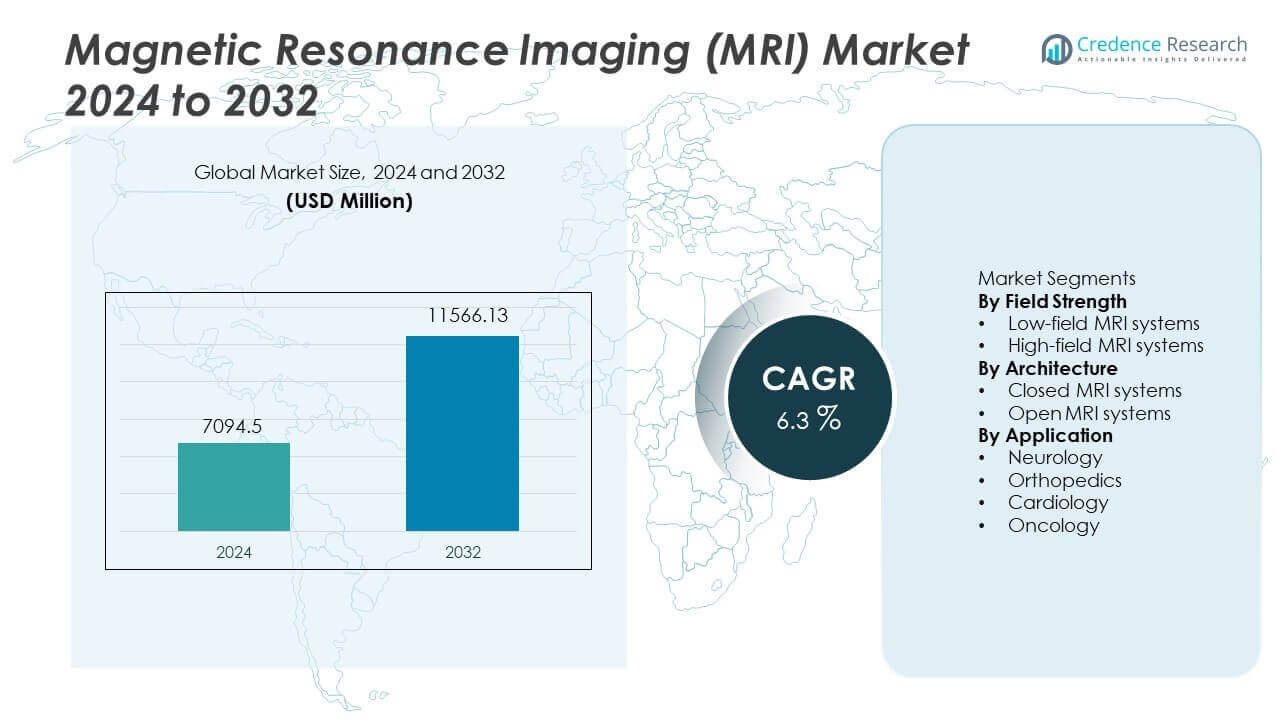
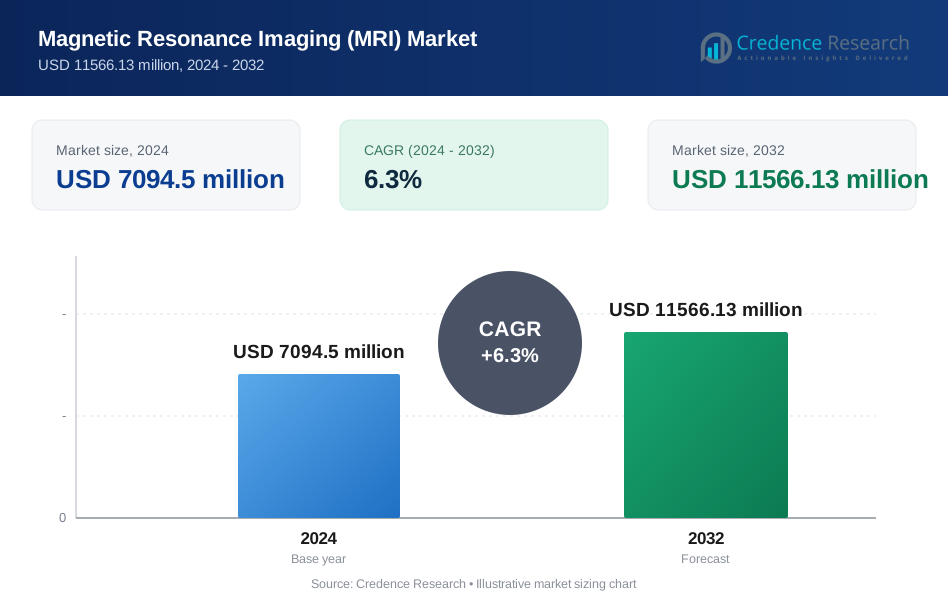
The Magnetic Resonance Imaging (MRI) market was valued at USD 7094.5 million in 2024 and is anticipated to reach USD 11566.13 million by 2032, growing at a CAGR of 6.3% during the forecast period.
| REPORT ATTRIBUTE | DETAILS |
|---|---|
| Historical Period | 2020-2023 |
| Base Year | 2024 |
| Forecast Period | 2025-2032 |
| Magnetic Resonance Imaging (MRI) Market Size 2024 | USD 7094.5 million |
| Magnetic Resonance Imaging (MRI) Market, CAGR | 6.3% |
| Magnetic Resonance Imaging (MRI) Market Size 2032 | USD 11566.13 million |
Magnetic Resonance Imaging (MRI) Market Insights
- Rising burden of neurological and chronic diseases drives the Magnetic Resonance Imaging market, with high-field MRI systems leading the segment at a 68% share due to superior image quality.
- Market trends show strong adoption of closed MRI systems, which hold a 72% share, supported by higher field strength and advanced diagnostic capability.
- Competitive analysis indicates a consolidated Magnetic Resonance Imaging market, where leading players focus on AI integration, faster scan times, and workflow efficiency to strengthen positioning.
- Regional analysis shows North America leading the Magnetic Resonance Imaging market with a 38% share, followed by Europe at 28% and Asia Pacific at 24%, driven by healthcare infrastructure expansion and imaging demand.
Magnetic Resonance Imaging (MRI) Market Segmentation Analysis:
By Field Strength
The By Field Strength segment of the Magnetic Resonance Imaging (MRI) market is dominated by high-field MRI systems, which hold a 68% market share. High-field systems, typically 1.5T and 3T, deliver superior image resolution and faster scan times, making them preferred for complex diagnostic applications. Strong demand from hospitals and diagnostic imaging centers drives adoption. Growth in neurological, cardiac, and oncology imaging further supports this segment. Low-field MRI systems account for the remaining share, supported by lower cost, reduced power requirements, and use in outpatient settings. However, limited image clarity and narrower clinical applications keep low-field systems secondary to high-field MRI solutions.
- For instance, Hyperfine’s Swoop, operating at 0.064T, supports bedside neuro scans, completing brain exams in 5 minutes, but lacks high-resolution detail needed for advanced diagnoses.
By Architecture
Within the By Architecture segment, closed MRI systems lead the MRI market with a 72% share. Closed systems provide higher magnetic field strength and better image quality, supporting accurate diagnosis across multiple clinical areas. Hospitals favor closed MRI systems for high patient throughput and advanced imaging protocols. Continuous technology upgrades improve patient comfort and scan efficiency. Open MRI systems hold the remaining share, driven by demand for claustrophobic and obese patient imaging. Open designs improve patient experience and accessibility but offer lower field strength, which limits adoption in advanced diagnostic procedures compared to closed MRI systems.
- For instance, Esaote’s O-Scan system delivers focused musculoskeletal imaging at 0.31T, handling extremity scans in under 12 minutes, but cannot match closed system clarity for whole-body diagnosis.
By Application
The By Application segment is led by neurology, accounting for a 34% share of the Magnetic Resonance Imaging market. MRI remains the gold standard for brain and spinal cord imaging due to high soft-tissue contrast. Rising prevalence of neurological disorders drives strong demand. Oncology follows with significant adoption for tumor detection and staging. Orthopedics benefits from MRI use in joint and musculoskeletal imaging, while cardiology adoption grows with advancements in cardiac MRI techniques. Despite growth across all applications, neurology remains dominant due to diagnostic accuracy requirements and increasing neurological disease burden.
Key Growth Drivers
Rising Burden of Chronic and Neurological Diseases
The growing prevalence of chronic and neurological disorders strongly drives the Magnetic Resonance Imaging market. Conditions such as stroke, brain tumors, epilepsy, and multiple sclerosis require advanced imaging for accurate diagnosis. MRI provides high soft-tissue contrast without radiation exposure. Hospitals increasingly rely on MRI for early disease detection and monitoring. Aging populations further increase scan volumes. Demand rises across neurology, oncology, and cardiology applications. Healthcare systems invest in advanced MRI infrastructure to improve diagnostic accuracy. This driver sustains long-term MRI adoption across developed and emerging regions.
- For instance, Philips Healthcare reported that its Ingenia Elition 3.0T system completed neurological diffusion scans in under 7 minutes while delivering high spatial resolution, helping clinicians assess stroke cases with greater speed.
Technological Advancements in MRI Systems
Continuous innovation accelerates growth in the Magnetic Resonance Imaging market. Vendors introduce high-field systems with faster scan times and improved image clarity. AI-based software enhances workflow efficiency and diagnostic confidence. Advanced coils and gradient systems improve resolution and reduce noise. Shorter scan durations improve patient comfort and throughput. These advancements expand MRI use in complex clinical cases. Hospitals upgrade existing systems to maintain competitiveness. Technology progress strengthens MRI value across multiple specialties and care settings.
- For instance, GE HealthCare’s AIR Recon DL reduced noise and boosted image sharpness by up to 60%, while supporting scan time cuts averaging 30% in musculoskeletal exams, helping clinicians make clearer diagnoses.
Expansion of Diagnostic Imaging Infrastructure
Healthcare infrastructure expansion supports Magnetic Resonance Imaging market growth. Governments invest in hospital modernization and diagnostic capacity. Private imaging centers expand to meet rising diagnostic demand. MRI adoption increases in secondary and tertiary care facilities. Public-private partnerships improve access to advanced imaging. Growth in medical tourism further boosts demand. Emerging economies expand imaging services to underserved areas. Infrastructure development ensures wider MRI availability and sustained market expansion.
Key Trends & Opportunities
Growing Adoption of High-Field and Advanced MRI
High-field MRI adoption presents strong opportunities in the market. Providers prefer 1.5T and 3T systems for superior diagnostic performance. Advanced MRI enables functional and diffusion imaging applications. Demand grows for precision diagnostics in oncology and neurology. Research institutions adopt advanced MRI for clinical studies. Premium imaging services support higher reimbursement potential. This trend creates opportunities for system upgrades and premium product offerings.
- For instance, Siemens Healthineers’ MAGNETOM Vida 3T system uses a 204-channel coil architecture and delivers whole-body diffusion scans in under 11 minutes, supporting high-precision tumor tracking in clinical studies.
Rising Demand for Patient-Centric Imaging Solutions
Patient comfort trends create new opportunities in the Magnetic Resonance Imaging market. Vendors develop quieter systems and wider bore designs. Open and short-bore MRI systems improve patient compliance. Reduced scan anxiety increases procedure completion rates. Pediatric and geriatric imaging benefit from comfort-focused designs. Hospitals differentiate services through patient-friendly imaging solutions. This trend supports broader MRI adoption and service expansion.
- For instance, Canon Medical’s Vantage Galan 3T system reduces acoustic noise by up to 99% using Pianissimo hardware and delivers a 71 cm bore, helping anxious patients complete full studies without sedation.
Key Challenges
High Cost of MRI Systems and Installation
High capital investment remains a major challenge in the Magnetic Resonance Imaging market. MRI systems require significant upfront spending. Installation demands specialized shielding and infrastructure. Maintenance and service costs add financial pressure. Smaller hospitals face budget constraints. High ownership costs limit adoption in low-income regions. Reimbursement challenges affect return on investment. Cost barriers slow market penetration in price-sensitive healthcare systems.
Shortage of Skilled MRI Professionals
Workforce limitations challenge Magnetic Resonance Imaging market growth. MRI operation requires trained radiologists and technologists. Skill shortages affect scan quality and throughput. Training programs require time and investment. Rural and developing regions face staffing gaps. Workflow inefficiencies increase operational burden. Advanced MRI techniques demand specialized expertise. Addressing talent shortages remains critical for sustained market expansion.
Regional Analysis
North America
North America leads the Magnetic Resonance Imaging market with a 38% market share, driven by advanced healthcare infrastructure and high diagnostic adoption. The United States dominates regional demand due to strong hospital networks and high imaging volumes. Early adoption of high-field MRI systems supports complex neurological and oncology diagnostics. Favorable reimbursement policies encourage technology upgrades. Presence of leading MRI manufacturers strengthens innovation and service support. Rising prevalence of chronic diseases sustains scan demand. Continuous investment in AI-enabled imaging improves workflow efficiency. The region remains the largest contributor due to technology leadership and strong healthcare spending.
Europe
Europe holds a 28% share of the Magnetic Resonance Imaging market, supported by well-established public healthcare systems. Countries such as Germany, France, and the United Kingdom drive demand through widespread diagnostic access. Strong focus on early disease detection supports MRI utilization. Government funding promotes equipment modernization in public hospitals. High adoption in neurology and oncology imaging sustains volumes. Strict quality and safety standards favor advanced MRI systems. Research activity and clinical trials further support demand. Europe maintains steady growth through infrastructure upgrades and emphasis on precision diagnostics.
Asia Pacific
Asia Pacific accounts for a 24% market share in the Magnetic Resonance Imaging market, driven by expanding healthcare infrastructure. China, Japan, and India lead regional adoption due to rising diagnostic demand. Growing population and chronic disease burden increase imaging volumes. Government initiatives improve access to advanced medical imaging. Private diagnostic centers expand rapidly in urban areas. Demand for cost-effective MRI systems supports wider penetration. Medical tourism also contributes to growth. The region shows strong long-term potential due to healthcare investment and rising awareness.
Latin America
Latin America represents a 6% share of the Magnetic Resonance Imaging market, supported by gradual healthcare modernization. Brazil and Mexico lead demand through hospital expansion and private imaging centers. MRI adoption increases for neurology and orthopedic diagnostics. Budget constraints influence system selection and upgrade cycles. Public-private partnerships support diagnostic access improvements. Urban healthcare facilities drive most demand. Growing awareness of early diagnosis supports imaging utilization. Regional growth remains steady but depends on healthcare funding stability and infrastructure development.
Middle East and Africa
The Middle East and Africa hold a 4% share of the Magnetic Resonance Imaging market, reflecting early-stage development. Gulf countries drive demand through investments in advanced hospitals. Medical tourism supports adoption of high-end MRI systems. Public healthcare expansion improves diagnostic access. Africa shows gradual growth due to limited infrastructure and funding constraints. Demand centers on tertiary hospitals and private facilities. Government-led healthcare projects support incremental adoption. Long-term growth depends on infrastructure investment and skilled workforce development.
Magnetic Resonance Imaging (MRI) Market Segmentations:
By Field Strength
- Low-field MRI systems
- High-field MRI systems
By Architecture
- Closed MRI systems
- Open MRI systems
By Application
- Neurology
- Orthopedics
- Cardiology
- Oncology
By Geography
- North America
- U.S.
- Canada
- Mexico
- Europe
- Germany
- France
- U.K.
- Italy
- Spain
- Rest of Europe
- Asia Pacific
- China
- Japan
- India
- South Korea
- South-east Asia
- Rest of Asia Pacific
- Latin America
- Brazil
- Argentina
- Rest of Latin America
- Middle East & Africa
- GCC Countries
- South Africa
- Rest of the Middle East and Africa
Competitive Landscape
Competitive landscape analysis highlights a consolidated Magnetic Resonance Imaging (MRI) market led by GE HealthCare, Siemens Healthineers, Philips Healthcare, Canon Medical Systems, and Fujifilm Healthcare. These players compete through advanced imaging technology, strong global distribution, and continuous system upgrades. Leading companies focus on high-field MRI systems, AI-enabled software, and workflow automation to improve diagnostic accuracy and throughput. Product portfolios emphasize faster scan times, enhanced image quality, and patient comfort features. Strategic investments in research and development support innovation in functional and cardiac MRI. Partnerships with hospitals and research institutes strengthen clinical adoption. Regional manufacturing and service networks improve installation and after-sales support. Smaller players compete by offering cost-effective and specialty MRI systems. Overall competition centers on technology leadership, clinical performance, service reliability, and long-term customer relationships.
Key Player Analysis
- GE HealthCare
- Siemens Healthineers
- Philips Healthcare
- Canon Medical Systems Corporation
- Fujifilm Healthcare
- Hitachi Medical Systems
- Esaote S.p.A.
- United Imaging Healthcare
- Bruker Corporation
- Neusoft Medical Systems
Recent Developments
- In February 2025, Philips introduced its helium-free 1.5T MRI with integrated AI across workflow steps in Europe.
- In 2025, Siemens Healthineers significantly expanded its MRI portfolio by launching and showcasing systems that heavily integrate AI-enabled imaging and workflow enhancements.
- In November 2024, GE HealthCare received FDA clearance for its SIGNA™ MAGNUS 3.0T MRI system focused on advanced neuroimaging and research.
Report Coverage
The research report offers an in-depth analysis based on Field Strength, Architecture, Application and Geography. It details leading market players, providing an overview of their business, product offerings, investments, revenue streams, and key applications. Additionally, the report includes insights into the competitive environment, SWOT analysis, current market trends, as well as the primary drivers and constraints. Furthermore, it discusses various factors that have driven market expansion in recent years. The report also explores market dynamics, regulatory scenarios, and technological advancements that are shaping the industry. It assesses the impact of external factors and global economic changes on market growth. Lastly, it provides strategic recommendations for new entrants and established companies to navigate the complexities of the market.
Future Outlook
- Demand for Magnetic Resonance Imaging systems will rise with growing chronic disease prevalence.
- High-field Magnetic Resonance Imaging systems will remain the preferred technology choice.
- Artificial intelligence integration will improve imaging speed and diagnostic accuracy.
- Hospitals will continue upgrading Magnetic Resonance Imaging equipment for advanced applications.
- Neurology and oncology imaging will drive higher scan volumes.
- Patient-centric system designs will gain wider adoption.
- Emerging markets will increase investment in Magnetic Resonance Imaging infrastructure.
- Service and maintenance offerings will grow in importance for providers.
- Workforce training programs will support advanced Magnetic Resonance Imaging usage.
- Long-term healthcare investment will sustain Magnetic Resonance Imaging market growth.
Request a Free Sample
Fill in your details and we'll send you a free sample report.
- Sample data tables & charts
- Research methodology
Need a Custom Version of This Report?
Tailor the scope, geography, or segments to your exact requirements.
- Custom geography or segment scope
- Direct access to our analyst team
Frequently Asked Questions
What is the current market size for Magnetic Resonance Imaging (MRI) market, and what is its projected size in 2032?
At what Compound Annual Growth Rate is the Magnetic Resonance Imaging (MRI) market projected to grow between 2024 and 2032?
Which Magnetic Resonance Imaging (MRI) market segment held the largest share in 2024?
What are the primary factors fueling the growth of the Magnetic Resonance Imaging (MRI) market?
Who are the leading companies in the Magnetic Resonance Imaging (MRI) market?
Which region commanded the largest share of the Magnetic Resonance Imaging (MRI) market in 2024?
Table of Content
Chapter 1 Market Segmentation
- 1.1 Segmentation Framework
- 1.1.1 Product and Service Classification
- 1.1.2 Application and End-Use Classification
- 1.1.3 Technology and Solution Classification
- 1.1.4 Customer and Distribution Channel Classification
- 1.1.5 Geographic Segmentation
- 1.1.6 Market Segment Definitions and Boundaries
Chapter 2 Introduction
- 2.1 Report Objectives and Scope
- 2.2 Product Definition and Industry Terminology
- 2.3 Market Inclusions and Exclusions
- 2.4 Research Process
- 2.4.1 Primary Research and Expert Interviews
- 2.4.2 Secondary Research and Source Review
- 2.4.3 Top-Down and Bottom-Up Estimation
- 2.4.4 Data Triangulation and Verification
- 2.5 Market Size Measurement Basis
- 2.5.1 2024: USD 7094.5 million → 2032: USD 11566.13 million
- 2.6 Historical and Forecast Reference Periods
- 2.6.1 Base Year: 2024
- 2.6.2 Forecast Period: 2024-2032
- 2.7 Research Assumptions and Limitations
Chapter 3 Executive Summary
- 3.1 Market Snapshot and Key Findings
- 3.2 Base-Year Market Size, 2024
- 3.3 Forecast Market Size, 2032
- 3.4 Revenue and Volume Growth Outlook
- 3.5 Key Demand and Supply Indicators
- 3.6 Leading Market Segments
- 3.7 Fastest-Growing Market Opportunities
- 3.8 Regional Performance Highlights
- 3.9 Technology and Industry Transformation
- 3.10 Competitive Landscape Summary
- 3.11 Analyst View and Strategic Implications
Chapter 4 Global Magnetic Resonance Imaging (MRI) Market Trends and Developments
- 4.1 Historical Industry Development
- 4.2 Recent Market Trends and Developments
- 4.3 Demand and Customer Behavior Trends
- 4.4 Technology and Product Innovation
- 4.5 Artificial Intelligence, Automation and Digitalization
- 4.6 Local Manufacturing and Supply Chain Realignment
- 4.7 Industry Partnerships, Mergers and Acquisitions
- 4.8 Sustainability and Circular Economy Developments
- 4.9 Government and Private Sector Investment Trends
- 4.10 Emerging Business Models and Commercialization
- 4.11 Industry Developments and Announcements
Chapter 5 Global Magnetic Resonance Imaging (MRI) Market Production, Supply and Demand Analysis
- 5.1 Demand Trend and Consumption Analysis
- 5.2 Demand Forecast, 2024-2032
- 5.3 Production and Output Trend
- 5.4 Production and Output Forecast, 2024-2032
- 5.5 Installed Capacity and Capacity Utilization
- 5.6 Company-Wise Production Plants and Statistics
- 5.6.1 Installed Production Capacity
- 5.6.2 Actual Production
- 5.6.3 Planned Capacity and Expansion Targets
- 5.7 Supply Chain Structure and Procurement Trends
- 5.8 Supply-Demand Gap and Bottlenecks
- 5.9 Import Dependence and Sourcing Structure
- 5.10 Contract Manufacturing and Outsourcing
- 5.11 Regional Supply and Demand Concentration
Chapter 6 Global Magnetic Resonance Imaging (MRI) Market Pricing Analysis
- 6.1 Pricing Structure and Measurement
- 6.2 Historical Pricing Trends
- 6.3 Pricing Outlook, 2024-2032
- 6.4 Average Selling Price and Unit Economics
- 6.5 Pricing by Product and Market Segment
- 6.6 Geographic Pricing Differences
- 6.7 Key Input, Energy, Labor and Logistics Costs
- 6.8 Contract Pricing and Purchasing Models
- 6.9 Pricing Sensitivity and Competitive Positioning
- 6.10 Price, Margin and Profitability Implications
Chapter 7 Global Magnetic Resonance Imaging (MRI) Market Dynamics
- 7.1 Market Growth Drivers
- 7.1.1 Demand-Side Drivers
- 7.1.2 Technology and Innovation Drivers
- 7.1.3 Infrastructure and Investment Drivers
- 7.1.4 Regulatory and Policy Drivers
- 7.2 Market Restraints
- 7.2.1 Cost and Affordability Constraints
- 7.2.2 Technology and Adoption Barriers
- 7.2.3 Supply Chain and Operational Constraints
- 7.3 Market Challenges
- 7.3.1 Competitive Pressure and Margin Erosion
- 7.3.2 Skills, Infrastructure and Implementation Gaps
- 7.4 Emerging Market Opportunities
- 7.5 Market Dynamics Impact and Time-Horizon Assessment
Chapter 8 Global Magnetic Resonance Imaging (MRI) Value Chain Analysis
- 8.1 Industry Value Chain Overview
- 8.2 Upstream Suppliers and Critical Inputs
- 8.3 Technology and Component Providers
- 8.4 Manufacturing or Service Delivery
- 8.5 Distribution, Channel Partners and Integrators
- 8.6 Downstream Applications and End Users
- 8.7 Value Addition and Profit Pools
- 8.8 Vertical Integration and Outsourcing
- 8.9 Supplier Concentration and Risk
- 8.10 Supply Chain Localization and Resilience
Chapter 9 Global Magnetic Resonance Imaging (MRI) Market Regulations and Policies
- 9.1 Relevant Laws, Standards and Compliance Frameworks
- 9.2 Product, Service, Safety and Quality Requirements
- 9.3 Government Policies, Incentives and Subsidies
- 9.4 Imports, Exports and Trade Barriers
- 9.5 Public Procurement and Local Content Requirements
- 9.6 Environmental and Sustainability Compliance
- 9.7 Upcoming Policy Changes and Market Implications
Chapter 10 Global Magnetic Resonance Imaging (MRI) Market Hotspots and Opportunities
- 10.1 Market Opportunity Mapping and Growth Hotspots
- 10.2 High-Growth Applications and Customer Groups
- 10.3 Underserved Markets and White-Space Opportunities
- 10.4 Emerging Technology and Product Opportunities
- 10.5 New Capacity and Investment Hotspots
- 10.6 Market Entry and Expansion Opportunities
- 10.7 Distribution and Partnership Opportunities
- 10.8 Near-Term and Long-Term Commercial Potential
- 10.9 Opportunity Attractiveness and Execution Risks
Chapter 11 Global Magnetic Resonance Imaging (MRI) Market Outlook, 2024-2032
- 11.1 Market Size and Analysis
- 11.1.1 Revenue (Market Measurement: 2024: USD 7094.5 million → 2032: USD 11566.13 million)
- 11.1.2 Market Volume and Quantity Sold
- 11.1.3 Historical Market Size
- 11.1.4 Base-Year Market Size, 2024
- 11.2 Market Forecast, 2024-2032
- 11.2.1 Revenue Forecast to 2032
- 11.2.2 Volume Forecast to 2032
- 11.2.3 CAGR and Year-on-Year Growth
- 11.2.4 Incremental Revenue Opportunity
- 11.3 Forecast Assumptions and Scenario Analysis
- 11.3.1 Base-Case Forecast
- 11.3.2 Optimistic and Conservative Scenarios
- 11.3.3 Technology, Pricing and Policy Sensitivities
- 11.4 Market Attractiveness and Growth Outlook
Chapter 12 Global Magnetic Resonance Imaging (MRI) Market Segmentation and Outlook
- 12.1 Segmentation Summary and Market Shares, 2024
- 12.2 Largest and Fastest-Growing Segments
- 12.3 Segment Growth Comparison
- 12.4 Segment Attractiveness and Priority Matrix
Chapter 13 Global Magnetic Resonance Imaging (MRI) Geographic Market Outlook, 2024-2032
- 13.1 Regional Market Size and Share, 2024
- 13.2 Regional Market Forecast, 2024-2032
- 13.3 Regional Pricing, Production and Demand Differences
- 13.4 North America
- 13.4.1 United States
- 13.4.2 Canada
- 13.4.3 Mexico
- 13.5 Europe
- 13.5.1 Germany
- 13.5.2 France
- 13.5.3 Italy
- 13.5.4 United Kingdom
- 13.5.5 Spain
- 13.5.6 Poland
- 13.5.7 Russia
- 13.5.8 Netherlands
- 13.5.9 Belgium
- 13.5.10 Sweden
- 13.5.11 Denmark
- 13.5.12 Norway
- 13.5.13 Rest of Europe
- 13.6 Asia Pacific
- 13.6.1 China
- 13.6.2 India
- 13.6.3 Japan
- 13.6.4 South Korea
- 13.6.5 Thailand
- 13.6.6 Indonesia
- 13.6.7 Vietnam
- 13.6.8 Malaysia
- 13.6.9 Australia
- 13.6.10 Rest of Asia Pacific
- 13.7 Latin America
- 13.7.1 Brazil
- 13.7.2 Argentina
- 13.7.3 Colombia
- 13.7.4 Chile
- 13.7.5 Rest of Latin America
- 13.8 Middle East
- 13.8.1 Saudi Arabia
- 13.8.2 United Arab Emirates
- 13.8.3 Turkey
- 13.8.4 Israel
- 13.8.5 Iran
- 13.8.6 Rest of the Middle East
- 13.9 Africa
- 13.9.1 South Africa
- 13.9.2 Egypt
- 13.9.3 Nigeria
- 13.9.4 Morocco
- 13.9.5 Rest of Africa
- 13.10 Regional Investment, Policy and Supply Chain Differences
- 13.11 Regional Competitive Landscape
- 13.12 Geographic Growth Hotspots
Chapter 14 Global Magnetic Resonance Imaging (MRI) Technology, Innovation and Sustainability Outlook
- 14.1 Technology Landscape and Maturity
- 14.2 Product, Process and Service Innovation
- 14.3 AI, Automation and Digital Tools in the Industry
- 14.4 Technology Adoption and Performance Benchmarking
- 14.5 Innovation Pipeline and R&D Investment
- 14.6 Patent and Intellectual Property Trends
- 14.7 Energy Efficiency and Resource Management
- 14.8 Sustainability, Recycling and Circularity
- 14.9 Technology Roadmap, 2024-2032
- 14.10 Risks of Obsolescence and Technology Substitution
Chapter 15 Global Magnetic Resonance Imaging (MRI) Market Key Strategic Imperatives
- 15.1 Growth and Market Entry Priorities
- 15.2 High-Return Products and Segments
- 15.3 Pricing, Profitability and Cost Optimization
- 15.4 Technology Investment and Product Differentiation
- 15.5 Supply Chain Localization and Resilience
- 15.6 Distribution and Customer Acquisition
- 15.7 Partnership, Acquisition and Capacity Strategy
- 15.8 Regional Expansion Priorities
- 15.9 Short-, Medium- and Long-Term Actions
Chapter 16 Competition Outlook
- 16.1 Industry Competition Characteristics
- 16.2 Market Structure and Concentration
- 16.3 Market Share and Competitive Positioning, 2024
- 16.4 Company-Wise Revenue and Product Benchmarking
- 16.5 Production and Service Capacity Benchmarking
- 16.6 Technology, Pricing and Differentiation
- 16.7 Regional Footprint and Distribution Strength
- 16.8 Mergers, Acquisitions and Strategic Alliances
- 16.9 New Entrants and Competitive Threats
- 16.10 Porter's Five Forces and Industry Attractiveness
- 16.11 Competitive Outlook, 2024-2032
Chapter 17 Company Profiles
- 17.1 Company Coverage and Selection Criteria
- 17.2 Leading Market Participants – Standard Profile Structure
- 17.2.1 Business Description
- 17.2.2 Company Ownership and Geographic Presence
- 17.2.3 Product and Service Portfolio
- 17.2.4 Manufacturing and Operating Footprint
- 17.2.5 Production Capacity and Expansion Plans
- 17.2.6 Financial Performance and Investment
- 17.2.7 Market Share and Competitive Position
- 17.2.8 Technology and Innovation Capabilities
- 17.2.9 Strategic Alliances or Partnerships
- 17.2.10 Recent Developments
- 17.2.11 Growth Strategy and Outlook
- 17.3 Other Relevant Market Participants
Note: Every listed company is profiled on the structure shown under the first company. The company list is preliminary and may change based on research findings, market developments, data availability and client requirements.
Chapter 18 Disclaimer
- 18.1 Research and Forecast Disclaimer
- 18.2 Data Source and Estimation Limitations
Note: The depth of individual sections depends on data availability for this market. Volume, capacity, trade and other unit-based metrics are included where applicable.
