
| REPORT ATTRIBUTE | DETAILS |
|---|---|
| Historical Period | 2019-2022 |
| Base Year | 2023 |
| Forecast Period | 2024-2032 |
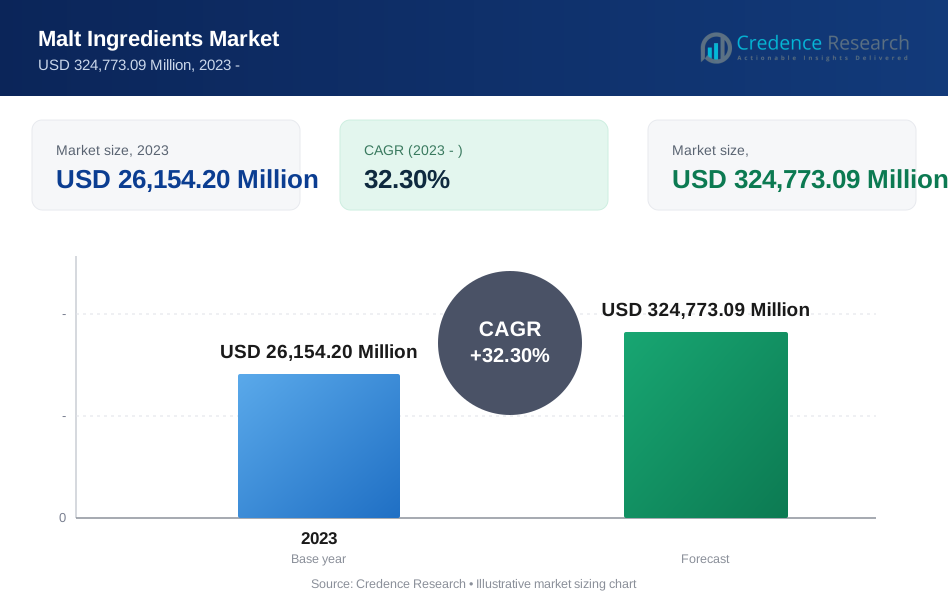
| Malt Ingredients Market Size 2023 | USD 26,154.20 Million |
| Malt Ingredients Market, CAGR | 32.30% |
| Malt Ingredients Market Size 2032 | USD 324,773.09 Million |
Market Insights
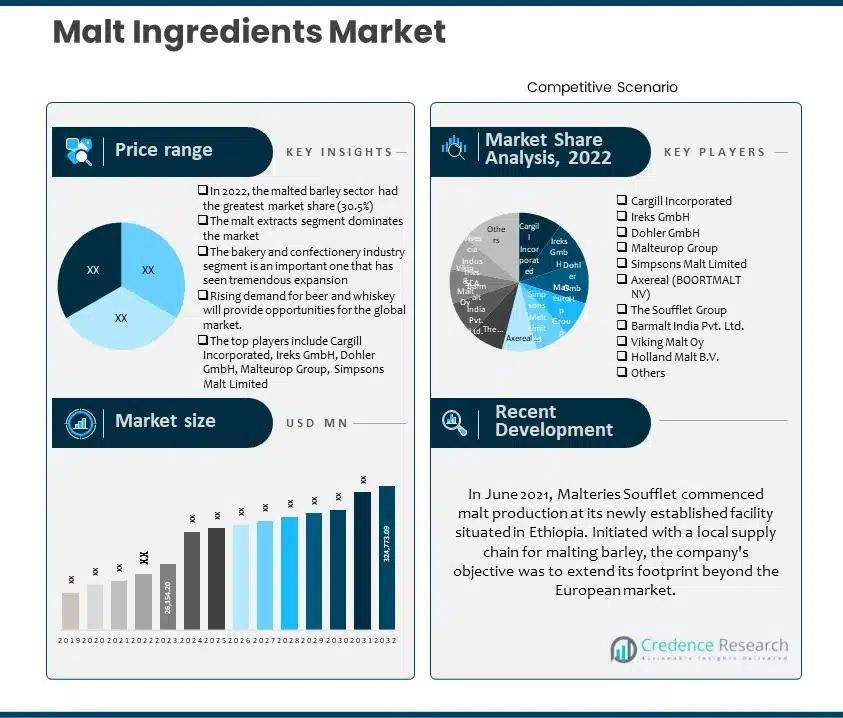
- The global demand for Malt Ingredients was valued at USD 26,154.20 Million in 2023 and is expected to reach USD 324,773.09 Million in 2032, growing at a CAGR of 32.30% between 2024 and 2032.
- The malted barley sector is the market leader by type of malt ingredients, accounting for more than 31% of total value in 2023, while the malted wheat segment is expected to grow rapidly throughout the forecast period.
- The malt extracts ingredients dominates the global need for malt ingredients, accounting for more than 20% in 2023 and malt flour is predicted to expand at a high CAGR.
- The bakery and confectionery industry sector is predicted to grow fastest over the projection period, while the brewing industry segment will have a market share of more than 25% in 2023.
- Over the projection period, the processed malt ingredients category is expected to expand at the highest rate, while the raw malt ingredients category will dominate the market in 2023 with a 25% share.
- The specialty malts category is expected to expand quickly over the forecast period, while the base malts segment will have the greatest market share in 2023.
- Europe is fueling the growth of the Malt Ingredients industry with over one-third share in 2023, while Asia Pacific and North America collectively account for just under 55% share in 2023. North America held over 20% share in 2023.
- Due to the rising demand for beer and whiskey, particularly in emerging economies, is driving the growth of the malt ingredients market, as malt is a key ingredient in the production of these beverages.
- The market's primary possibilities include the significant growth potential in Europe, consumer preference for natural and minimally processed ingredients in food and beverages is driving the demand for malt ingredients in Europe.
Executive Summary
Market Definition
Malt ingredients refer to various products derived from malted barley or other cereal grains, which are commonly used in the food and beverage industry for flavoring, coloring, and enhancing nutritional profiles. These ingredients are produced through the malting process, where grains are germinated, dried, and sometimes roasted to develop specific flavors and characteristics. Malt ingredients include malt extracts, malt flour, malted barley, and specialty malts like caramel malt and roasted malt. They are widely used in the production of alcoholic beverages such as beer and whiskey, as well as in non-alcoholic beverages, baked goods, breakfast cereals, and snacks. In essence, malt ingredients play a crucial role in adding flavor, texture, and nutritional value to a wide range of food and beverage products.
Market Overview
The global Malt Ingredients market has witnessed steady growth in recent years and is expected to grow at a CAGR of 32.30% between 2024 and 2032. The market was valued at USD 26,154.20 million in 2023 and is expected to reach USD 324,773.09 million in 2032.
The key driver boosting the growth rate of the Malt Ingredients market is the increasing consumption of alcoholic beverages driving market expansion. The popularity of convenience foods, such as breakfast cereals, snacks, and baked goods, is fueling the demand for malt ingredients, which are used for flavoring, coloring, and enhancing nutritional profiles. The global expansion of the brewing industry, driven by changing consumer preferences and the emergence of craft breweries, is boosting the demand for malt ingredients for beer production.
Furthermore, the increasing consumer awareness about the health benefits of malt-based products, such as their high fiber content and potential to improve digestive health, is contributing to market growth. In addition, ongoing product innovations and new product launches incorporating malt ingredients, such as malted milkshakes, malted beverages, and malted energy bars, are expanding the market.
Segmentation by Type of Malt Ingredients
- Malted barley is the leading segment by type of malt ingredients and held over 31% share in value in 2023, attributable to the rising demand for beer and whiskey, particularly in emerging economies.
- The malted wheat segment will likely exhibit a significant CAGR during the forecast period. The growing market for non-alcoholic beverages, including malt-based drinks, malted milk, and malted beverages.
Segmentation by Form of Malt Ingredients
- The malt extracts segment governs the demand for Malt Ingredients in the world, holding a massive share of over 20% in 2023, and malt flour is also expected to grow at a rapid CAGR because malt ongoing product innovations and new product launches incorporating malt ingredients, such as malted milkshakes, malted beverages, and malted energy bars, are expanding the market.
- The malted barley, malted grains, malt syrup, and others sectors segment contributes to the demand for Malt Ingredients.
Segmentation by End-User Industry
- The bakery and confectionery industry segment is expected to post the highest CAGR during the forecast period. This is primarily due to the growing market for non-alcoholic beverages, including malt-based drinks, malted milk, and malted beverages.
- The brewing industry segment is leading the market share with over 19% share in 2023.
Segmentation by Processing Level
- The processed malt ingredients (e.g., malt extracts, malt flour) segment is anticipated to register the highest CAGR during the projection period.
- With a market share of nearly 25% in 2023, the raw malt ingredients is currently in the lead.
- The category of processing level segment includes Specialty Malt Ingredients (e.g., roasted malt, caramel malt), Liquid Malt Ingredients (e.g., malt extracts, malt syrups), and Dry Malt Ingredients (e.g., malted grains, malt flour).
Segmentation by Quality and Color
- The base malts (e.g., pale malt, Pilsner malt) dominate the global need for Malt Ingredients, accounting for more than 20% in 2023 and specialty malts (e.g., caramel malt, chocolate malt) are predicted to expand at a high CAGR.
- The rest of the demand for malt ingredients comes from the roasted malts (e.g., roasted barley, black malt), light malt extracts, dark malt extracts, and others.
Segmentation by Region
- Europe is fueling the growth of the Malt Ingredients industry with over one-third share in 2023 due to the region's rising popularity of craft beverages, including craft beer and artisanal spirits, is creating opportunities for the malt ingredients market.
- Asia Pacific and North America collectively account for just under 55% share in 2023, with North America holding over 20% share in the same year.
- The rest of the world, including Latin America, the Middle East, and Africa, supplies the remaining demand for Malt Ingredients.
The market for Malt Ingredients is driven by regulatory initiatives promoting the use of healthier ingredients in food and beverages, along with labeling requirements highlighting nutritional content, are driving the adoption of malt ingredients, and expansion of the foodservice industry, thereby stimulating market growth.
Europe emerges as a dominant region with significant consumption and production levels. European countries such as Germany, the United Kingdom, and Belgium are renowned for their longstanding brewing traditions, which drive the demand for malt ingredients in the region. Additionally, Europe boasts a well-established food and beverage industry, including the bakery, confectionery, and dairy sectors, where malt ingredients are widely utilized for flavoring and enhancing nutritional profiles. Furthermore, the growing popularity of craft breweries and artisanal food products in Europe further contributes to the demand for malt ingredients, solidifying the region's dominance in the market.
The Asia Pacific is expected to be the fastest-growing region over the forecast period. Rapid industrialization, urbanization, and economic growth in countries like China, India, Japan, and South Korea are driving the adoption of Malt Ingredients technology across various sectors. As consumer preferences evolve and demand for premium food and beverage products rises, there is a growing inclination towards malt-based beverages, snacks, and bakery products in the Asia Pacific region. Moreover, the expanding foodservice industry, coupled with the rising popularity of craft beverages and artisanal food products, presents lucrative opportunities for malt ingredient manufacturers in the region. Overall, while Europe maintains its dominance in the malt ingredients market, Asia Pacific emerges as a key growth driver, fueled by changing consumer preferences and a thriving food and beverage industry.
The primary factor driving the Malt Ingredients market's growth rate is the expansion of the foodservice industry, including restaurants, cafes, and catering services, is driving the demand for malt ingredients for use in various culinary applications and menu offerings. In addition, the rising popularity of craft beverages, including craft beer and artisanal spirits, is creating opportunities for the malt ingredients market, as craft producers seek high-quality ingredients for their products.
Key Highlights of the Report
The global Malt Ingredients market is segmented by type of malt ingredients, form of malt ingredients, end-use industry, processing level, quality and color, and region. Malted Barley-based Malt Ingredients are the most popular, while malt extracts, and brewing industry are the primary segments. In addition, raw malt ingredients, and processed malt ingredients are the most commonly used categories. However, base malts (e.g., pale malt, Pilsner malt) dominate the market, with Europe leading the market growth.
One of the main factors propelling the global market for Malt Ingredients is increasing consumption of alcoholic beverages. The popularity of convenience foods, such as breakfast cereals, snacks, and baked goods, is fueling the demand for malt ingredients, which are used for flavoring, coloring, and enhancing nutritional profiles. The global expansion of the brewing industry, driven by changing consumer preferences and the emergence of craft breweries, is boosting the demand for malt ingredients for beer production.
Nonetheless, Europe is anticipated to have the greatest share of the global malt ingredients market due to the significant consumption and production levels. Furthermore, the market is anticipated to expand at the highest rate in the Asia-Pacific (APAC) region as consumer preferences evolve and demand for premium food and beverage products rises, there is a growing inclination towards malt-based beverages, snacks, and bakery products in the Asia Pacific region.
What Are The Main Drivers Of The Global Malt Ingredients Market?
Key drivers include the increasing consumption of alcoholic beverages, particularly beer and whiskey, which rely heavily on malt ingredients. Additionally, the growing demand for convenience foods, rising health awareness among consumers, and expansion of the brewing industry contribute to market growth.
What Are The Major Challenges Faced By The Global Malt Ingredients Market?
Challenges include fluctuations in raw material prices, competition from other ingredients, regulatory hurdles related to labeling and health claims, and environmental concerns associated with malting processes. Supply chain disruptions and changing consumer preferences also pose challenges to market growth.
What Are The Growth Opportunities In The Global Malt Ingredients Market?
Growth opportunities in the global Malt Ingredients market include the expansion of non-alcoholic beverage segments, such as malt-based drinks and beverages, as well as the development of specialty malt products for niche markets. Furthermore, innovation in food and beverage products, increasing demand for natural and organic ingredients, and expansion into emerging markets offer avenues for growth in the malt ingredients market.
Market Drivers
The global Malt Ingredients market is driven by several factors. The following are the key drivers of the global Malt Ingredients market:
Growing Demand for Craft Beverages
One significant driver of the global malt ingredients market is the growing demand for craft beverages. As consumers increasingly seek unique and artisanal products, craft breweries and distilleries are experiencing a surge in popularity. Craft beverages often prioritize high-quality ingredients, including malt, to create distinctive flavors and profiles. This trend drives the demand for malt ingredients, presenting growth opportunities for manufacturers and suppliers in the market.
Market Restraints
The global Malt Ingredients market faces some challenges that may hinder its growth. These include the following:
Fluctuations in Raw Material Prices
A major restraint faced by the global malt ingredients market is the fluctuations in raw material prices. Malt ingredients are primarily derived from barley and other cereal grains, and the prices of these raw materials can be volatile due to factors such as weather conditions, crop yields, and geopolitical events. Fluctuating raw material prices can pose challenges for manufacturers in terms of cost management and profitability, impacting the stability of the market.
Opportunities
The global Malt Ingredients market offers significant growth opportunities. These include the following:
Expansion into Health and Wellness Segment
An opportunity for growth in the global malt ingredients market lies in the expansion into the health and wellness segment. With increasing consumer awareness about the importance of healthy eating habits, there is a growing demand for food and beverage products with added nutritional benefits. Malt ingredients, known for their high fiber content, vitamins, and minerals, can be positioned as natural and nutritious ingredients for various functional foods, beverages, and supplements. By capitalizing on this trend, manufacturers can tap into new consumer segments and drive market growth.
Competitive Landscape
Key Players
The global Malt Ingredients market is highly competitive, with several key players. Some of the major players in the market and their market share are as follows:
- Cargill Incorporated
- Ireks GmbH
- Dohler GmbH
- Malteurop Group
- Simpsons Malt Limited
- Axereal (BOORTMALT NV)
- The Soufflet Group
- Barmalt India Pvt. Ltd.
- Viking Malt Oy
- Vivescia Industries SCA
- Polttimo Oy
- Malt Products Corporation
- Muntons Plc.
- Crisp Malting Group
- Holland Malt B.V.
- Others
These organizations prioritize product innovation, distribution channel expansion, and mergers and acquisitions to stay competitive.
The global Malt Ingredients market's key players continually seek to stay ahead by offering new products and developments.
In September 2022, Muntons introduced barley and wheat malt ingredients tailored for the production of plant-based meat alternatives. With a focus on environmental sustainability, the company aimed to provide manufacturers with 100% eco-friendly ingredients for crafting plant-based burgers, sliced deli beef, and sausages.
In June 2021, Malteries Soufflet commenced malt production at its newly established facility situated in Ethiopia. Initiated with a local supply chain for malting barley, the company's objective was to extend its footprint beyond the European market.
Summary of Key Findings
- The demand for Malt Ingredients is rising due to the adoption of malt extracts in food supplements, expansion of bakery and confectionery industry, and innovation in food and beverage sector, which is boosting the growth of the Malt Ingredients market.
- Market segmented by type of malt ingredients, form of malt ingredients, end-use industry, processing level, quality and color, and region.
- Malted Barley-based Malt Ingredients are the most popular, while malt extracts, and brewing industry are the primary segments. In addition, raw malt ingredients, and processed malt ingredients are the most commonly used categories.
- However, base malts (e.g., pale malt, Pilsner malt) dominate the market.
- Europe is leading market growth; the market is highly competitive with key players including Cargill Incorporated, Ireks GmbH, Dohler GmbH, Malteurop Group, Simpsons Malt Limited, Axereal (BOORTMALT NV), The Soufflet Group, Barmalt India Pvt. Ltd., Viking Malt Oy, Vivescia Industries SCA, Polttimo Oy, Malt Products Corporation, Muntons Plc., Crisp Malting Group, Holland Malt B.V., and Others.
Future Outlook
- Positive outlook for the global Malt Ingredients market with significant growth potential in the European region
- One of the main factors promoting the market's expansion is the government and business sectors' current reliance on Malt Ingredients.
- During the forecast period, fluctuation in raw material prices is a significant factor projected to restrain the growth of the Malt Ingredients market.
- Key firms must focus on product innovation, growing market reach, and maintaining competitive pricing to keep ahead of the competition.
How CXOs Can Benefit from the Credence Research Malt Ingredients Market Report
The Credence Research Malt Ingredients Market Report provides CXOs with a comprehensive overview of the market, including:
- Market size and growth forecast: The report provides detailed estimates of the global Malt Ingredients market size, segmented by type of malt ingredients, form of malt ingredients, end-use industry, processing level, quality and color, and region. It also includes forecasts for the market through 2032, based on key trends and drivers.
- Market segmentation: The report segments the Malt Ingredients market by type of malt ingredients, form of malt ingredients, end-use industry, processing level, quality and color, and region. This segmentation provides CXOs with a granular understanding of the market and the opportunities in each segment.
- Competitive landscape: The report profiles the key players in the Malt Ingredients market and provides insights into their strategies, product offerings, and financial performance. This information can help CXOs to identify and assess their competition.
- Key trends and drivers: The report identifies and analyzes the key trends and drivers that are shaping the Malt Ingredients This information can help CXOs to make informed decisions about their investments and strategies.
CXOs can use the insights from the Credence Research Malt Ingredients Market Report to:
- Identify growth opportunities: The report can help CXOs to identify new growth opportunities in the Malt Ingredients For example, the report identifies the growing demand for Malt Ingredients from Malt Ingredients providers and manufacturing companies as a key opportunity.
- Make informed investment decisions: The report can help CXOs to make informed investment decisions about Malt Ingredients. For example, the report provides insights into the key factors to consider when evaluating Malt Ingredients providers and selecting Malt Ingredients
- Develop competitive strategies: The report can help CXOs to develop competitive strategies for their Malt Ingredients For example, the report identifies the key strategies that Malt Ingredients providers are using to differentiate themselves from their competitors.
- Track market developments: The report can help CXOs to track market developments and stay ahead of the curve. For example, the report provides insights into the latest trends and innovations in the Malt Ingredients
Overall, the Credence Research Malt Ingredients Market Report is a valuable resource for CXOs who are looking to gain a deeper understanding of the market and identify opportunities for growth.
Segmentation
- By Type of Malt Ingredients
- Malted Barley
- Malted Wheat
- Malted Rye
- Malted Sorghum
- Malted Corn
- Others
- By Form of Malt Ingredients
- Malt Extracts
- Malt Flour
- Malted Barley
- Malted Grains
- Malt Syrup
- Others
- By End-Use Industry
- Brewing Industry
- Beer Production
- Craft Brewing
- Distilled Spirits (e.g., whiskey, bourbon)
- Bakery and Confectionery Industry
- Bread and Baked Goods
- Cookies and Biscuits
- Cakes and Pastries
- Confectionery Items (e.g., chocolates, candies)
- Food Manufacturing
- Breakfast Cereals
- Snack Foods (e.g., granola bars, trail mix)
- Ready-to-Eat Meals
- Infant Nutrition
- Others
- Pharmaceuticals Industry
- Medicinal Syrups and Formulations
- Nutritional Supplements
- Others
- Animal Feed Industry
- Livestock Feed
- Pet Food
- Aquafeed
- Others
- By Processing Level
- Raw Malt Ingredients
- Processed Malt Ingredients (e.g., malt extracts, malt flour)
- Specialty Malt Ingredients (e.g., roasted malt, caramel malt)
- Liquid Malt Ingredients (e.g., malt extracts, malt syrups)
- Dry Malt Ingredients (e.g., malted grains, malt flour)
- By Quality and Color
- Base Malts (e.g., pale malt, Pilsner malt)
- Specialty Malts (e.g., caramel malt, chocolate malt)
- Roasted Malts (e.g., roasted barley, black malt)
- Light Malt Extracts
- Dark Malt Extracts
- Others
- By Region
- North America
- The U.S.
- Canada
- Mexico
- Europe
- Germany
- France
- The U.K.
- Italy
- Spain
- Rest of Europe
- Asia Pacific
- China
- Japan
- India
- South Korea
- South-east Asia
- Rest of Asia Pacific
- Latin America
- Brazil
- Argentina
- Rest of Latin America
- Middle East & Africa
- GCC Countries
- South Africa
- Rest of Middle East and Africa
- North America
- Brewing Industry
Request a Free Sample
Fill in your details and we'll send you a free sample report.
- Sample data tables & charts
- Research methodology
Need a Custom Version of This Report?
Tailor the scope, geography, or segments to your exact requirements.
- Custom geography or segment scope
- Direct access to our analyst team
Frequently Asked Questions
What is the current size of the global Malt Ingredients market?
What is the expected growth rate of the Malt Ingredients market between 2024 and 2032?
Which segment is leading the market share in terms of type of malt ingredients?
Which form of malt ingredients segment governs the demand for Malt Ingredients in the world?
Who are the major players in the global Malt Ingredients market?
Table of Content
Chapter 1. Report Introduction
- 1.1 Report Description & Purpose
- 1.1.1 Report Title & Market Definition
- 1.1.2 Unique Selling Propositions (USP) & Key Differentiators
- 1.1.3 Value Proposition for Stakeholders
- 1.2 Research Objectives
- 1.2.1 Market Sizing Objectives (Volume & Revenue) (Volume Where Applicable)
- 1.2.2 Segmentation Objectives
- 1.2.3 Competitive Intelligence Objectives
- 1.2.4 Forecast & Scenario Objectives
- 1.3 Report Scope
- 1.3.1 Malt Ingredients Scope – Segments & Subsegments Covered
- 1.3.2 Geographic Scope – Regions & Countries Covered
- 1.3.3 Historical Period, Base Year & Forecast Period (2023; forecast to the forecast period)
- 1.3.4 Inclusions & Exclusions
- 1.4 Industry Classification & Applicable Codes
- 1.5 Currency, Measurement Units & Valuation Basis
- 1.6 Target Stakeholders
- 1.7 Limitations & Assumptions
Chapter 2. Executive Summary
- 2.1 Global Malt Ingredients Market Snapshot
- 2.1.1 Market Size – Historical (2023) & Forecast (the forecast period) (2023: USD 26,154.20 Million → forecast year: USD 324,773.09 Million)
- 2.1.2 Volume & Revenue – Global Totals (Volume Where Applicable)
- 2.1.3 Key Market Highlights – Top Five Facts
- 2.2 Malt Ingredients Market Segmentation Snapshot
- 2.2.1 Market Split by Region – 2023 vs.
- 2.3 Competitive Snapshot
- 2.3.1 Top 10 Players by Revenue Share – 2023
- 2.3.2 Top 10 Players by Volume Share – 2023 (Volume Where Applicable)
- 2.3.3 Recent Strategic Developments (18-Month Summary)
- 2.4 Key Investment Highlights & Strategic Conclusions
Chapter 3. Malt Ingredients Market Dynamics & Industry Analysis
- 3.1 Market Overview & Context
- 3.1.1 Malt Ingredients Market Position in the Broader Industry Value Chain
- 3.1.2 Demand Structure & Purchasing Dynamics
- 3.1.3 Market Maturity & Development Stage by Region
- 3.2 Malt Ingredients Market Drivers
- 3.3 Malt Ingredients Market Restraints & Challenges
- 3.4 Malt Ingredients Market Opportunities
- 3.5 Porter's Five Forces Analysis
- 3.5.1 Threat of New Entrants
- 3.5.2 Bargaining Power of Suppliers
- 3.5.3 Bargaining Power of Buyers
- 3.5.4 Threat of Substitutes
- 3.5.5 Competitive Rivalry – Intensity Assessment
- 3.6 Malt Ingredients Value Chain Analysis
- 3.6.1 Upstream – Key Inputs, Resources & Suppliers
- 3.6.1.1 Key Input/Resource 1
- 3.6.1.2 Key Input/Resource 2
- 3.6.1.3 Key Input/Resource 3
- 3.6.2 Midstream – Core Operations & Value Creation
- 3.6.2.1 Operating Model & Process Overview
- 3.6.2.2 Key Operating Locations & Capabilities by Company
- 3.6.3 Downstream – Market Channels & End Users
- 3.6.3.1 Direct Sales & Customer Engagement Channels
- 3.6.3.2 Indirect Sales, Intermediaries & Partner Channels
- 3.6.4 Value Chain Profitability Analysis
- 3.6.1 Upstream – Key Inputs, Resources & Suppliers
- 3.7 PESTEL Analysis
- 3.7.1 Political Factors
- 3.7.2 Economic Factors
- 3.7.3 Social Factors
- 3.7.4 Technological Factors
- 3.7.5 Environmental Factors
- 3.7.6 Legal Factors
- 3.8 Malt Ingredients Supply Chain Analysis
- 3.8.1 Critical Input & Resource Availability Risk Assessment
- 3.8.2 Supplier & Operational Concentration Risk (Geographic Exposure)
- 3.8.3 Supply & Service Disruption Impact Analysis
- 3.9 Regulatory & Policy Landscape
Note: The regulatory and policy landscape section covers regulations based on their applicability to the market, Malt Ingredients category, geography, and scope of the study. Only regulatory frameworks with a material impact on operations, compliance, trade, sustainability, or market access are analyzed in detail.
Chapter 4. Key Investment Pockets & Opportunity Analysis
- 4.1 Malt Ingredients Market Attractiveness Analysis
- 4.1.1 By Region – Investment Attractiveness Matrix (Market Size × CAGR)
- 4.2 Absolute Revenue Growth Opportunity
- 4.2.1 By Region – Absolute Revenue Growth Through the forecast period
- 4.3 Incremental Demand Opportunity
- 4.3.1 By Region – Incremental Demand Through the forecast period
- 4.3.2 Segment – Incremental Demand
- 4.4 Emerging Submarket Opportunity Deep Dive (Subject to Applicability)
- 4.5 Priority Market Opportunity Scorecards
- 4.5.1 United States
- 4.5.2 Europe
- 4.5.3 Asia
- 4.5.4 Middle East & Africa
Note: Priority market opportunity scorecards reflect the geographic scope and strategic relevance of the study. Listed markets are indicative and may be adapted to the industry.
Chapter 5. Malt Ingredients Cross-Border Trade & Market Access Analysis
- 5.1 International Trade & Cross-Border Activity Overview
- 5.1.1 Global Export Value by Country (2023)
- 5.1.2 Global Export Volume by Country (2023) (Volume Where Applicable)
- 5.1.3 Global Import Value by Country (2023)
- 5.1.4 Global Import Volume by Country (2023) (Volume Where Applicable)
- 5.1.5 Net Trade Balance by Country (2023)
- 5.2 Export Analysis – Segment
- 5.2.1 Category 1 (Applicable Classification Code)
- 5.2.2 Category 2 (Applicable Classification Code)
- 5.2.3 Category 3 (Applicable Classification Code)
- 5.2.4 Category 4 (Applicable Classification Code)
- 5.2.5 Category 5 (Applicable Classification Code)
- 5.3 Import Analysis – Segment
- 5.3.1 Category 1 (Applicable Classification Code)
- 5.3.2 Category 2 (Applicable Classification Code)
- 5.3.3 Category 3 (Applicable Classification Code)
- 5.3.4 Category 4 (Applicable Classification Code)
- 5.3.5 Category 5 (Applicable Classification Code)
- 5.4 Cross-Border Pricing & Transaction Benchmarks
- 5.4.1 Export Pricing – Segment & Country
- 5.4.2 Import Pricing – Segment & Source Country
- 5.4.3 Price Trends (2023)
- 5.5 Key Cross-Border Trade & Delivery Routes
- 5.5.1 Cross-Border Trade/Delivery Route 1
- 5.5.2 Cross-Border Trade/Delivery Route 2
- 5.5.3 Cross-Border Trade/Delivery Route 3
- 5.5.4 Cross-Border Trade/Delivery Route 4
- 5.5.5 Cross-Border Trade/Delivery Route 5
- 5.6 Trade Policy & Market Access Impact Assessment
- 5.6.1 Tariff & Non-Tariff Barriers
- 5.6.2 Regional Trade & Economic Integration Frameworks
- 5.6.3 Bilateral & Multilateral Trade Agreements
- 5.6.4 Cross-Border Operating, Licensing & Localization Requirements
Note: This chapter applies where cross-border trade or delivery is relevant to Malt Ingredients. Goods, services, and digital offerings are assessed using applicable classifications and transaction measures. Import-export volumes, trade balances, and route analyses are included only where meaningful to the market.
Chapter 6. Competitive Landscape & Company Benchmarking
- 6.1 Malt Ingredients Market Concentration & Structure
- 6.1.1 Herfindahl-Hirschman Index (HHI) – vs. 2023
- 6.1.2 Leading, Mid-Sized & Emerging Player Structure
- 6.1.3 Global, Regional & Local Player Dynamics
- 6.2 Malt Ingredients Market Share Analysis – 2023
- 6.2.1 Global Revenue Share by Company
- 6.2.2 Global Volume Share by Company (Volume Where Applicable)
- 6.2.3 Regional Revenue Share
- 6.2.4 Market Share Evolution ( vs. 2023)
- 6.2.5 Company Market Share by Key Segment
- 6.2.6 Company Market Share by Customer Group
- 6.3 Operating Scale, Capacity & Infrastructure Analysis
- 6.3.1 Global Operating Scale & Supply Capacity
- 6.3.2 Resource Utilization & Operating Efficiency
- 6.3.3 Output, Service Delivery & Activity Metrics
- 6.3.4 Operating Footprint & Infrastructure Map
- 6.3.5 Planned Operational & Capacity Expansion
- 6.4 Malt Ingredients Competitive Benchmarking Matrix
- 6.4.1 Revenue, Growth, Profitability & Operating Metric Comparison
- 6.4.2 Channel Revenue Mix
- 6.4.3 Geographic Revenue Exposure
- 6.4.4 R&D Intensity
- 6.4.5 Sustainability Maturity
- 6.5 Strategic Developments in Malt Ingredients (Last 24 Months)
- 6.5.1 Mergers, Acquisitions & Divestments
- 6.5.2 New Products, Services & Solutions in Malt Ingredients
- 6.5.3 Operational & Infrastructure Expansions
- 6.5.4 Strategic Alliances, Joint Ventures & Partnerships
- 6.5.5 Distribution Expansion & Market Entry
- 6.5.6 Sustainability & ESG Initiatives
- 6.6 Competitive Strategy Mapping
- 6.6.1 Leader, Challenger, Follower & Niche Classification
- 6.6.2 Pricing Strategy Comparison
- 6.6.3 Channel Strategy Matrix
Note: Strategic developments are included based on their materiality and the availability of reliable information.
Chapter 7. Global Malt Ingredients Market – By Sales & Delivery Channel
- 7.1 Segment Overview
- 7.1.1 Volume & Revenue Split by Channel (2023 & ) (Volume Where Applicable)
- 7.1.2 Channel Mix Evolution (the forecast period)
Chapter 8. Regional Market Analysis – Global Overview
- 8.1 Global Regional Overview
- 8.1.1 Regional Volume Share (Volume Where Applicable)
- 8.1.2 Regional Revenue Share
- 8.1.3 Regional Volume by Region (Volume Where Applicable)
- 8.1.4 Regional Revenue by Region
- 8.1.5 Regional Forecast Through the forecast period
- 8.2 Cross-Regional Segment Analysis
- 8.2.1 By Sales & Delivery Channel
- 8.2.2 By Competitive Positioning & Price Tier
Chapter 9. North America Malt Ingredients Market
- 9.1 United States
- 9.2 Canada
- 9.3 Mexico
Chapter 10. Europe Malt Ingredients Market
- 10.1 Germany
- 10.2 France
- 10.3 Italy
- 10.4 United Kingdom
- 10.5 Spain
- 10.6 Poland
- 10.7 Russia
- 10.8 Netherlands
- 10.9 Belgium
- 10.10 Sweden
- 10.11 Denmark
- 10.12 Norway
- 10.13 Rest of Europe
Chapter 11. Asia Pacific Malt Ingredients Market
- 11.1 China
- 11.2 India
- 11.3 Japan
- 11.4 South Korea
- 11.5 Thailand
- 11.6 Indonesia
- 11.7 Vietnam
- 11.8 Malaysia
- 11.9 Australia
- 11.10 Rest of Asia Pacific
Chapter 12. Latin America Malt Ingredients Market
- 12.1 Brazil
- 12.2 Argentina
- 12.3 Colombia
- 12.4 Chile
- 12.5 Rest of Latin America
Chapter 13. Middle East Malt Ingredients Market
- 13.1 Saudi Arabia
- 13.2 United Arab Emirates
- 13.3 Turkey
- 13.4 Israel
- 13.5 Iran
- 13.6 Rest of the Middle East
Chapter 14. Africa Malt Ingredients Market
- 14.1 South Africa
- 14.2 Egypt
- 14.3 Nigeria
- 14.4 Morocco
- 14.5 Rest of Africa
Chapter 15. Malt Ingredients Company Profiles
- 15.1 [Company 01]
- 15.1.1 Company Overview
- 15.1.2 Key Management Personnel
- 15.1.3 Products & Services Portfolio
- 15.1.4 Financial Performance
- 15.1.5 Key Market Focus & Geographic Presence
- 15.1.6 Recent Developments & Strategic Initiatives
Note: The company profile list is preliminary and may change based on research findings, market developments, data availability, and client requirements.
Chapter 16. Appendices
- Appendix A – List of Abbreviations & Acronyms
- Appendix B – Industry Classification Code Reference – Full Series
- Appendix C – Supply, Output & Operating Capacity Data Tables
- Appendix D – End-Use & Demand Base Tables
- Appendix E – Demand, Adoption & Usage Assumptions
- Appendix F – Pricing & Revenue Metric Reference Tables
- Appendix G – Company Operations & Infrastructure Database
- Appendix H – Cross-Border Trade & Activity Data Tables (Where Applicable)
- Appendix I – Regulatory Summary Tables
- Appendix J – Primary Research Participant List (Anonymized)
- Appendix K – Primary Research Questionnaire Framework
- Appendix L – Data Sources & Bibliography
- Appendix M – Market Size Divergence & Source Comparison
Chapter 17. Research Methodology
- 17.1 Research Framework & Philosophy
- 17.2 Secondary Research – Sources, Hierarchy & Data Extraction
- 17.3 Data Modeling – Bottom-Up & Top-Down Market Sizing
- 17.4 Primary Research – Stakeholder Framework, LOI & Sample Sizes
- 17.5 Forecast Methodology – Regression, Scenario & Sensitivity Analysis
- 17.6 Quality Control – Four-Layer Validation Framework
- 17.7 Limitations & Standard Assumptions
- 17.8 Disclaimer
