
Market Insights
- Between 2024 and 2032, the global market for managed equipment services (MES) is projected to expand at a compound annual growth rate (CAGR) of XX%, from an estimated USD XX million in 2023 to USD XX million in 2032.
- The largest category is asset management. Procurement and installation, on the other hand, are expected to grow at a strong CAGR.
- The imaging equipment category will expand rapidly.
- Throughout the projected period, the CAGR for hospitals is anticipated to be the highest.
- Throughout the projection period, the cloud-based delivery model category should have the largest compound annual growth rate.
- Asia Pacific controlled the managed equipment services (MES) market.
- Regarding the market share of managed equipment services (MES), Europe is expected to come second.
- North America is expected to experience the fastest growth in the managed equipment services (MES) industry.
- The growing older population and the quick advancement of medical technology and equipment are contributing to the growth of the global managed equipment services (MES) market.
- The managed equipment services (MES) industry could benefit from the growing tendency of healthcare facilities to outsource non-core services to focus on patient care and the increasing prevalence of chronic illnesses requiring sophisticated medical equipment.
Executive Summary
Market Definition
A complete, long-term outsourcing agreement known as Managed Equipment Services (MES) involves a specialized third-party supplier managing every facet of a healthcare facility's medical equipment lifecycle. This service usually covers the purchase, setting up, upkeep, modernization, and final replacement of medical equipment. By taking care of the technical and operational aspects of the equipment, the MES provider allows healthcare personnel to concentrate on providing patient care.
Market Overview
It is predicted that the managed equipment services (MES) industry will continue its upward trajectory between 2024 and 2032, growing at a compound annual growth rate (CAGR) of XX%. From its projected USD XX million in 2023 to USD XX million in 2032, the market will continue to grow.
Medical equipment frequently advances and is improved as a result of ongoing innovations in medical technology. Newer models with increased capabilities, increased efficiency, and better patient outcomes are frequently the result of these advancements. It can be difficult and expensive for healthcare facilities to keep up with these improvements. In order to solve this, MES providers oversee the routine maintenance and replacement of medical equipment. They guarantee that healthcare facilities don't have to shoulder the weight of large capital expenditures in order to have access to the newest technologies. This management covers the purchase, setup, and upkeep of the equipment, making sure that it is always current and operating at peak efficiency to enable top-notch patient care.
The globalization of the healthcare industry and the use of advanced medical technology are among the significant factors propelling the managed equipment services market. Healthcare organizations continue to gain from the continuous innovation and development of new medical technology, which gives them improved capacities and increased precision in the provision of medical services and diagnostics. Hospitals must, however, make large capital investments in order to acquire the newest and most advanced technology.
Segmentation by Service Type
- Asset management is the market leader in terms of service type. Medical equipment must be efficiently tracked, maintained, and optimized to ensure cost-effectiveness, compliance, and good operational performance in healthcare facilities. This has created a demand for asset management in the Managed Equipment Services (MES) sector.
- The procurement and installation category will exhibit a sizable CAGR during the projected period. Healthcare facilities looking for more efficient ways to acquire and integrate cutting-edge medical equipment that guarantees smooth operation, economic viability, and adherence to regulations are the main drivers of demand in the Managed Equipment Services (MES) market for procurement and installation.
- Other service types, including maintenance and repair, replacement and upgradation, training and support, and consulting services, also support the need for managed equipment services (MES).
Segmentation by Equipment Type
- Imaging equipment is considered the best category for equipment type. The need for dependable, cutting-edge diagnostic instruments that guarantee excellent patient care, operational efficiency, and prompt maintenance inside healthcare institutions is driving demand for imaging equipment in the Managed Equipment Services (MES) industry.
- The surgical equipment category will likely register a significant CAGR during forecasting. In the Managed Equipment Services (MES) industry, the demand for sophisticated, trustworthy instruments that improve surgical accuracy, facilitate intricate operations, and guarantee dependable, superior performance and upkeep in medical institutions propel the demand for surgical equipment.
- Other types of equipment, such as diagnostic, therapeutic, and patient monitoring equipment, further enhance the need for managed equipment services (MES).
Segmentation by End-User
- The hospitals category is projected to grow faster over the projection period. Hospitals require Managed Equipment Services (MES) to outsource equipment management, maintenance, and upgrades to specialized providers in order to guarantee access to cutting-edge, well-maintained medical equipment, improve operational efficiency, lower costs, and free up healthcare staff to concentrate on patient care.
- Other end-users, including ambulatory surgical centers (ASCs), diagnostic centers, clinics, and others, also influence the need for managed equipment services (MES).
Segmentation by Delivery Model
- The cloud-based category is likely to have the greatest CAGR throughout the forecast period. The Managed Equipment Services (MES) market is experiencing a surge in demand for cloud-based delivery models due to factors such as developed scalability, real-time data access, automated maintenance processes, and enhanced equipment management. These developments will increase operational efficiency and reduce costs for healthcare facilities.
- Other delivery models, such as on-premises and hybrid, also contribute to the demand for managed equipment services (MES).
Segmentation by Region
- Asia Pacific leads the managed equipment services (MES) industry. This is due to the rising demand for managed equipment services (MES) from the Asia Pacific countries such as China, India, Australia, and other countries.
- Europe is estimated to rank second in the managed equipment services (MES) market size.
- It is anticipated that the managed equipment services (MES) market in North America will grow quickly.
- Regions, including Latin America, the Middle East, and Africa, meet the remaining need for managed equipment services (MES).
The global managed equipment services market is being influenced primarily by increasing requirements for healthcare services and the widespread deployment of high-tech medical equipment. In addition, the industry is governed by ongoing innovation and the advancement of contemporary medical technology. Due to the abundance of data from patient medical histories, clinical trials, biotechnology, and other fields, manufacturers are finding it more and harder to grow. The growing need for pharmaceuticals, medical devices, and research in these fields contributes to the need for MES.
It is anticipated that the managed equipment services (MES) market in Asia Pacific will surpass those in the entire world. Numerous variables influence the demand for managed equipment services (MES) in Asia Pacific ambulatory surgical centers (ASCs). The region's ASCs are growing quickly because of rising healthcare costs, patients' preference for outpatient operations, and government programs to improve the region's healthcare infrastructure. By overseeing the acquisition, preservation, and updates of equipment while guaranteeing operational effectiveness and regulatory compliance, MES provides ASCs with affordable options. MES's adaptability and scalability enable ASCs to achieve their objective of providing superior surgical treatment in a convenient outpatient environment by meeting their needs for cutting-edge medical equipment without having to make significant upfront investments.
It is projected that the managed equipment services (MES) market will develop at the fastest rate in the North American region. The necessity for successful management of modern imaging and diagnostic equipment has generated the need for Managed Equipment Services (MES) in diagnostic facilities across North America. MES suppliers provide all-inclusive solutions that cover equipment updates, maintenance, and acquisition, guaranteeing peak performance and adherence to legal requirements. Diagnostic centers gain access to the newest technology without a large capital investment, better equipment uptime, and smaller operating costs, all of which improve patient experiences and operational effectiveness.
Key Highlights of the Report
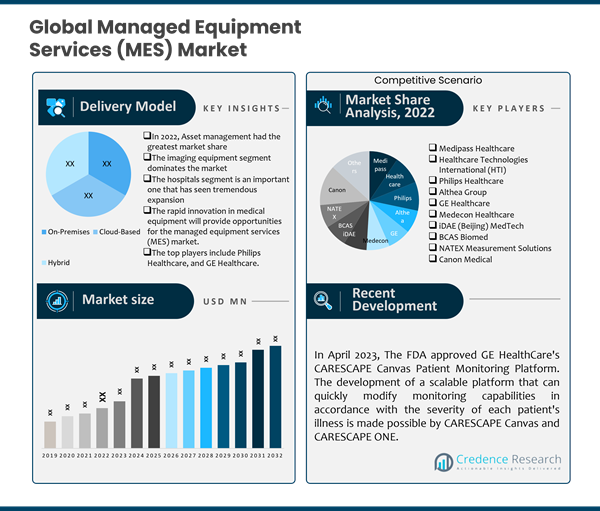
The global managed equipment services (MES) market is segmented by service type, equipment type, end-user, delivery model, and region. As far as the service type is concerned, asset management is the market spearhead. Imaging equipment is the top equipment type category. Throughout the forecast period, the category of hospitals is expected to grow at the greatest CAGR. During the predicted period, the category with the highest CAGR will be the cloud-based delivery model. Asia Pacific is seeing the most growth in the managed equipment services (MES) market.
For profitable market growth, MES vendors must seamlessly integrate new technology with the hospital systems that are currently in place. Healthcare institutions need integrated solutions that maximize the advantages of new technology with the least amount of operational interruption. The smooth integration of new technology with clinical information systems, electronic health records (EHR), and other hospital management platforms is a specialty of MES suppliers. Improved data accuracy, increased workflow efficiency, and improved patient care outcomes are all supported by this integration. Managed Equipment Services (MES) companies accelerate the adoption of MES throughout the healthcare industry by providing streamlined integration services that assist healthcare institutions in adopting and successfully utilizing advanced medical equipment.
It is anticipated that the Asia Pacific will hold the biggest global market share for managed equipment services (MES). With more people needing dependable medical equipment at home, Managed Equipment Services (MES) are becoming more and more popular in India's home care settings. By ensuring that medical equipment is maintained, upgraded, and functions at its best, MES supports lower hospital visits for older and chronic patients while also providing high-quality care. In addition, it is projected that the market in North America will grow at the quickest rate. In order to guarantee access to cutting-edge medical technology, maximize operational effectiveness, and save maintenance costs, clinics throughout Canada are placing an increasing demand on Managed Equipment Services (MES). Better patient care and more efficient clinical operations are made possible by the dependable, modern technology that MES supplies to clinics.
Which Key Factors Are Driving The Global Managed Equipment Services (MES) Market?
The rise in global healthcare spending, the availability of funding, and infrastructure developments in the healthcare industry are boosting the demand for managed equipment services (MES).
What Are The Main Challenges Confronting The Global Managed Equipment Services (MES) Market?
Rapid technological advancements that cause equipment to become outdated quickly and a lack of qualified personnel to administer and run MES solutions are the two primary challenges confronting the managed equipment services (MES) industry.
What Market Opportunities Exist For Managed Equipment Services (MES) Globally?
Some factors supporting the growth of the managed equipment services (MES) market include efforts to improve public health infrastructure and the requirement that healthcare facilities adhere to health and safety regulations.
Market Drivers
Rapid Adoption of New Technology is Facilitated by MES Providers
The managed equipment services (MES) industry is growing at a fast rate due to the quick adoption of new technologies. Modern medical technology is continuously being added to healthcare institutions in an effort to enhance patient outcomes, operational effectiveness, and adherence to changing standards. In order to ensure a smooth connection with current systems, MES suppliers manage the complete lifecycle of medical equipment, from purchase to maintenance and upgrades. With the help of this service model, healthcare providers may keep up with technology developments without having to make significant capital expenditures. As a result, as hospitals concentrate on utilizing revolutionary technologies to improve healthcare delivery, there is an increase in demand for MES.
Market Restraints
High Initial Costs
The setup and integration of Managed Equipment Services (MES) require significant upfront investments, which limits the market's growth. This financial burden may discourage smaller healthcare facilities and those with tighter budgets from implementing MES systems. Despite MES's long-term advantages in operational efficiency, equipment maintenance, and cost management, its general adoption is slowed back by the substantial upfront costs associated with infrastructure, technology, and training.
Opportunities
Manufacturers of Equipment Establish Strategic Alliances With MES Providers
The market for managed equipment services (MES) is greatly expanded when medical equipment manufacturers form strategic partnerships with MES providers. Through these collaborations, manufacturers are able to present all-inclusive solutions by fusing their modern technology with the equipment management know-how of MES providers. The value proposition for healthcare facilities is improved by this synergy, which guarantees dependable, modern equipment and simplified maintenance. As a consequence, healthcare providers can concentrate on patient care while reaping the benefits of state-of-the-art technology and lighter operational responsibilities, leading to a rise in MES adoption and market development.
Competitive Landscape
Key Players
A number of significant players dominate the highly competitive global market for managed equipment services (MES). A handful of the top market players are shown below, together with their respective market shares:
- Medipass Healthcare
- Healthcare Technologies International (HTI)
- Philips Healthcare
- Althea Group
- GE Healthcare
- Medecon Healthcare
- iDAE (Beijing) MedTech
- BCAS Biomed
- NATEX Measurement Solutions
- Canon Medical
- Siemens Healthineers
- MES Group
- Others
In order to stay competitive, these organizations give priority to product innovation, expansion of their distribution channels, and mergers and acquisitions.
By creating cutting-edge ideas and goods, the foremost manufacturers in the global market for managed equipment services (MES) consistently strive to stay one step ahead of the competition.
In May 2022, the FDA granted Koninklijke Philips N.V. 510(k) approval for the high-performance MR 7700 system. This imaging equipment delivers Philips' excellent image quality using an innovative gradient system to enhance diagnostic processes.
In May 2022, An innovative wearable patient monitoring equipment called mWear was introduced by Shenzhen Mindray Bio-Medical Electronics Co., Ltd. In compliance with personalized settings, the gadget provides careers with the ability to receive patient status information through wearable mode and continuous mode.
In March 2022, A renowned Danish medical equipment manufacturer, Nordisk Røntgen Teknik A/S, was acquired by Canon Medical Systems, a Japanese medical equipment firm, as part of its global expansion plans for its X-ray business.
How are Companies Performing in the Managed Equipment Services (MES) Market?
Due to several significant factors, companies in the managed equipment services (MES) sector are performing well. Startup companies are concentrating on creating extremely sophisticated patient monitoring equipment for current and upcoming generations. Companies in the managed equipment services market continue to have profitable prospects due to the growing demand for sophisticated medical facilities. To make an impression in the market, emerging companies are working to innovate their products.
Companies of patient monitoring equipment are always improving their manufacturing processes to create novel solutions, with an emphasis on more accurate and affordable equipment. Leading health technology company Royal Philips introduced next-generation wearable biosensors in 2020 to detect patient deterioration early. In lower acuity care settings, this aids physicians in identifying challenges so they may act sooner and contribute to patients' improved health.
Prominent companies such as GE Healthcare, Siemens Healthineers, and Philips Healthcare are making significant investments in R&D to foster innovation and provide comprehensive MES solutions. In order to guarantee that healthcare facilities have access to the newest technology without having to bear the weight of hefty upfront expenses, these companies are concentrating on offering full services that cover the purchase, management, and upgrades of medical equipment.
Companies in the managed equipment services (MES) market are succeeding by emphasizing innovation, strategic alliances, and customer-centric solutions to meet the critical requirements of the healthcare sector and promote sustainable growth.
Summary of Key Findings
- The widespread adoption of digital health technologies and the growth of telemedicine, which requires specialized equipment, impact the need for managed equipment services.
- The market is segmented by service type, equipment type, end-user, delivery model, and region.
- In the market, the most prevalent service type is asset management.
- Imaging equipment is the foremost equipment type category.
- Hospitals are expected to grow fastest in terms of CAGR during the forecast period.
- During the predicted period, the Cloud-based delivery model is likely to have the greatest CAGR.
- In terms of market development, Asia Pacific is a leader; the market is highly competitive with key players including Medipass Healthcare, Healthcare Technologies International (HTI), Philips Healthcare, Althea Group, GE Healthcare, Medecon Healthcare, iDAE (Beijing) MedTech, BCAS Biomed, NATEX Measurement Solutions, Canon Medical, Siemens Healthineers, MES Group, and Others.
Future Outlook
- The managed equipment services (MES) industry is expected to increase significantly in Asia Pacific, and its outlook is positive worldwide.
- A number of factors, including the rise in connected medical devices, will result in further market expansion.
- The challenges in integrating MES solutions with current hospital systems and complicated regulatory requirements for medical equipment could impede market growth.
- Developing new products, reaching a wider market, and maintaining competitive prices are all necessary for major businesses to stay ahead of the competition.
How the Credence Research Managed Equipment Services (MES) Market Report Can Help CXOs
The Credence Research Managed Equipment Services (MES) Market Report provides CXOs with an extensive market overview and comprises the following:
- Market size and growth forecast: The study offers comprehensive market estimations for managed equipment services (MES) globally, broken down by service type, equipment type, end-user, delivery model, and region. Furthermore, the report includes market forecasts through 2032, derived from key drivers and trends.
- Market segmentation: The managed equipment services (MES) market is divided into segments by service type, equipment type, end-user, delivery model, and region in the research report. This segmentation helps CXOs understand the market and the opportunities inside each area in great depth.
- Competitive landscape: The study report provides a thorough analysis of the leading businesses in the managed equipment services (MES) sector, together with details on their revenue streams, product lines, and business strategies. With this information, CXOs can assess and identify their competitors.
- Key trends and drivers: The study report analyzes and highlights the key developments and elements driving the market for managed equipment services (MES). CXOs can utilize this information to make well-informed choices regarding their plans and investments.
The Credence Research Managed Equipment Services (MES) Market Report provides CXOs with insights that they may utilize to:
- Identify growth opportunities: This analysis is likely to help CXOs find fresh growth prospects in the managed equipment services (MES) sector. For example, the research recognizes the increasing requirement for managed equipment services (MES) from hospitals as a crucial opportunity.
- Make informed investment decisions: The study aids CXOs in making informed decisions about managed equipment services (MES). For example, it delivers information on the key variables to consider while picking managed equipment services (MES) solutions and evaluating suppliers.
- Develop competitive strategies: CXOs can utilize the research report to establish competitive strategies for their managed equipment services (MES) firms. The study paper explores the primary tactics employed by managed equipment services (MES) providers to set themselves apart from their rivals.
- Track market developments: By tracking market advancements, this research report could assist CXOs in remaining ahead of the curve. For example, it provides information about the latest advancements and patterns in the managed equipment services (MES) industry.
The Credence Research Managed Equipment Services (MES) Market Report is helpful for CXOs who want to learn more about the market and identify potential opportunities.
Segmentation
-
By Service Type
- Procurement and Installation
- Maintenance and Repair
- Replacement and Upgradation
- Asset Management
- Training and Support
- Consulting Services
-
By Equipment Type
- Imaging Equipment
- Surgical Equipment
- Diagnostic Equipment
- Therapeutic Equipment
- Patient Monitoring Equipment
- Others
-
By End-User
- Hospitals
- Ambulatory Surgical Centers (ASCs)
- Diagnostic Centers
- Clinics
- Others
-
By Delivery Model
- On-Premises
- Cloud-Based
- Hybrid
-
By Region
- North America
- US
- Canada
- Mexico
- Europe
- Germany
- France
- UK
- Italy
- Spain
- Rest of Europe
- Asia Pacific
- China
- Japan
- India
- South Korea
- South-east Asia
- Rest of Asia Pacific
- Latin America
- Brazil
- Argentina
- Rest of Latin America
- Middle East & Africa
- GCC Countries
- South Africa
- The Rest of the Middle East and Africa
- North America
Adjacent Markets
Several adjacent markets in the managed equipment services (MES) market have high revenue growth opportunities. The key adjacent markets for the managed equipment services (MES) market -
Adjacent Markets |
||
| Healthcare IT Market | Medical Devices Market | Telemedicine Market |
| Healthcare Infrastructure Market | Hospital Management Software Market | Clinical Engineering Market |
| Medical Imaging Market | Diagnostic Laboratories Market | Surgical Equipment Market |
Request a Free Sample
Fill in your details and we'll send you a free sample report.
- Sample data tables & charts
- Research methodology
Need a Custom Version of This Report?
Tailor the scope, geography, or segments to your exact requirements.
- Custom geography or segment scope
- Direct access to our analyst team
Frequently Asked Questions
How much does the global market currently hold for managed equipment services (MES)?
What is the managed equipment services (MES) market's projected growth rate between 2024 and 2032?
In terms of the service type, which market category is leading?
Regarding the equipment type, which market category is in the lead?
Which end-user category is anticipated to grow at the fastest rate throughout the projected period?
In which region is the market for managed equipment services (MES) expanding?
Who are the main players in the global managed equipment services (MES) industry?
Which market factors are the primary drivers of the managed equipment services (MES) industry?
What main market challenges prevent the growth of the managed equipment services (MES) sector?
What are the main market opportunities for the managed equipment services (MES) sector?
Table of Content
Chapter 1. Report Introduction
- 1.1 Report Description & Purpose
- 1.1.1 Report Title & Market Definition
- 1.1.2 Unique Selling Propositions (USP) & Key Differentiators
- 1.1.3 Value Proposition for Stakeholders
- 1.2 Research Objectives
- 1.2.1 Market Sizing Objectives (Volume & Revenue)
- 1.2.2 Segmentation Objectives
- 1.2.3 Competitive Intelligence Objectives
- 1.2.4 Forecast & Scenario Objectives
- 1.3 Report Scope
- 1.3.1 Managed Equipment Services (MES) Scope – Types & Subtypes Covered
- 1.3.2 Geographic Scope – Regions & Countries Covered
- 1.3.3 Historical Period, Base Year & Forecast Period (the historical period; forecast to the forecast period)
- 1.3.4 Inclusions & Exclusions
- 1.4 HS Code & Classification Framework
- 1.5 Currency, Units & Pricing Basis
- 1.6 Target Stakeholders
- 1.7 Limitations & Assumptions
Chapter 2. Executive Summary
- 2.1 Global Managed Equipment Services (MES) Market Snapshot
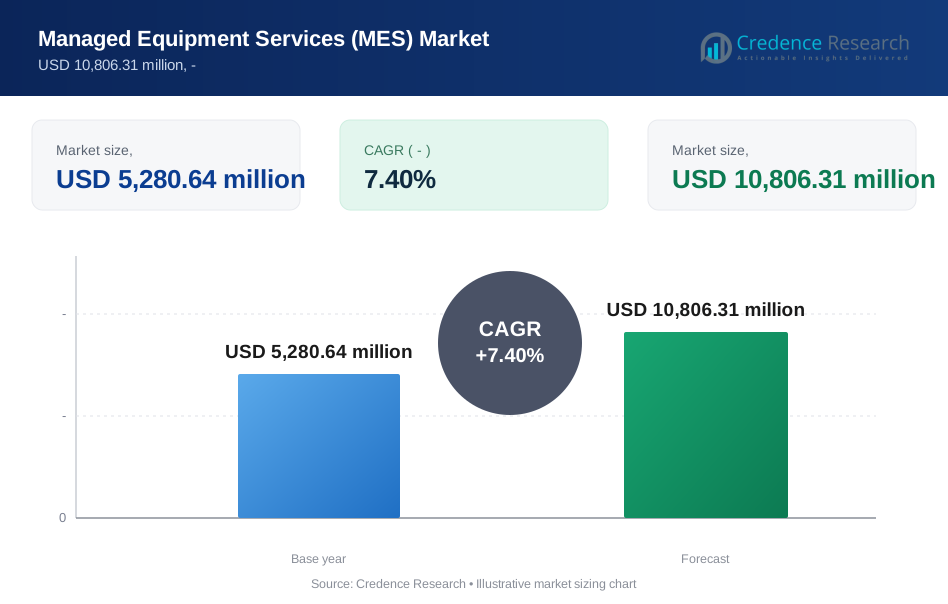
- 2.1.1 Market Size – Historical (the historical period) & Forecast (the forecast period) (base year: USD 5,280.64 million → forecast year: USD 10,806.31 million)
- 2.1.2 Volume & Revenue – Global Totals
- 2.1.3 Key Market Highlights – Top Five Facts
- 2.2 Managed Equipment Services (MES) Market Segmentation Snapshot
- 2.2.1 Market Split by Region – vs.
- 2.3 Competitive Snapshot
- 2.3.1 Top 10 Players by Revenue Share –
- 2.3.2 Top 10 Players by Volume Share –
- 2.3.3 Recent Strategic Developments (18-Month Summary)
- 2.4 Key Investment Highlights & Strategic Conclusions
Chapter 3. Managed Equipment Services (MES) Market Dynamics & Industry Analysis
- 3.1 Market Overview & Context
- 3.1.1 Managed Equipment Services (MES) Market Position in the Broader Automotive Value Chain
- 3.1.2 OEM vs. Replacement Market Dynamics
- 3.1.3 Market Maturity & Development Stage by Region
- 3.2 Managed Equipment Services (MES) Market Drivers
- 3.3 Managed Equipment Services (MES) Market Restraints & Challenges
- 3.4 Managed Equipment Services (MES) Market Opportunities
- 3.5 Porter's Five Forces Analysis
- 3.5.1 Threat of New Entrants
- 3.5.2 Bargaining Power of Suppliers
- 3.5.3 Bargaining Power of Buyers
- 3.5.4 Threat of Substitutes
- 3.5.5 Competitive Rivalry – Intensity Assessment
- 3.6 Managed Equipment Services (MES) Value Chain Analysis
- 3.6.1 Upstream – Raw Material/Input Suppliers
- 3.6.1.1 Raw Material/Input 1
- 3.6.1.2 Raw Material/Input 2
- 3.6.1.3 Raw Material/Input 3
- 3.6.2 Midstream – Production/Manufacturing/Service Delivery
- 3.6.2.1 Production/Process Overview
- 3.6.2.2 Key Facility Locations & Capacity by Manufacturer
- 3.6.3 Downstream – Distribution & End Consumer
- 3.6.3.1 Primary Channel – B2B/OEM
- 3.6.3.2 Secondary Channels – Dealer, Retail, Online, Direct
- 3.6.4 Value Chain Profitability Analysis
- 3.6.1 Upstream – Raw Material/Input Suppliers
- 3.7 PESTEL Analysis
- 3.7.1 Political Factors
- 3.7.2 Economic Factors
- 3.7.3 Social Factors
- 3.7.4 Technological Factors
- 3.7.5 Environmental Factors
- 3.7.6 Legal Factors
- 3.8 Managed Equipment Services (MES) Supply Chain Analysis
- 3.8.1 Raw Material/Input Supply Risk Assessment
- 3.8.2 Manufacturing Concentration Risk (Geographic Exposure)
- 3.8.3 Trade Disruption Impact Analysis
- 3.9 Regulatory & Policy Landscape
Note: The regulatory and policy landscape section covers regulations based on their applicability to the market, Managed Equipment Services (MES) category, geography, and scope of the study. Only regulatory frameworks with a material impact on operations, compliance, trade, sustainability, or market access are analyzed in detail.
Chapter 4. Key Investment Pockets & Opportunity Analysis
- 4.1 Managed Equipment Services (MES) Market Attractiveness Analysis
- 4.1.1 By Region – Investment Attractiveness Matrix (Volume × CAGR)
- 4.2 Absolute Revenue Growth Opportunity
- 4.2.1 By Region – Absolute USD Growth Through the forecast period
- 4.3 Incremental Volume Opportunity
- 4.3.1 By Region – Incremental Volume Through the forecast period
- 4.3.2 Segment – Incremental Volume
- 4.4 Emerging Submarket Opportunity Deep Dive (Subject to Applicability)
- 4.5 Emerging Market Opportunity Scorecards
- 4.5.1 United States
- 4.5.2 Europe
- 4.5.3 Asia
- 4.5.4 Middle East & Africa
Note: Emerging Market Opportunity Scorecards will be included based on relevance and strategic importance. Regions listed are indicative and may vary depending on data availability and market dynamics.
Chapter 5. Managed Equipment Services (MES) Import-Export Analysis & Trade Flows
- 5.1 Global Trade Overview
- 5.1.1 Global Export Value by Country (the historical period)
- 5.1.2 Global Export Volume by Country (the historical period)
- 5.1.3 Global Import Value by Country (the historical period)
- 5.1.4 Global Import Volume by Country (the historical period)
- 5.1.5 Net Trade Balance by Country (the historical period)
- 5.2 Export Analysis – Segment
- 5.2.1 Type 1 (HS Code)
- 5.2.2 Type 2 (HS Code)
- 5.2.3 Type 3 (HS Code)
- 5.2.4 Type 4 (HS Code)
- 5.2.5 Type 5 (HS Code)
- 5.3 Import Analysis – Segment
- 5.3.1 Type 1 (HS Code)
- 5.3.2 Type 2 (HS Code)
- 5.3.3 Type 3 (HS Code)
- 5.3.4 Type 4 (HS Code)
- 5.3.5 Type 5 (HS Code)
- 5.4 Average Unit Trade Prices
- 5.4.1 Average Export Price – Segment & Country
- 5.4.2 Average Import Price – Segment & Source Country
- 5.4.3 Price Trends (the historical period)
- 5.5 Key Trade Route Analysis
- 5.5.1 Trade Route 1
- 5.5.2 Trade Route 2
- 5.5.3 Trade Route 3
- 5.5.4 Trade Route 4
- 5.5.5 Trade Route 5
- 5.6 Trade Policy Impact Assessment
- 5.6.1 US Anti-Dumping & Section 301 Tariffs
- 5.6.2 EU Customs Union Impact
- 5.6.3 Major Free Trade Agreements
- 5.6.4 USMCA Rules of Origin
Note: Trade policy analysis will be included only where relevant to the Managed Equipment Services (MES) market.
Chapter 6. Competitive Landscape & Company Benchmarking
- 6.1 Managed Equipment Services (MES) Market Concentration & Structure
- 6.1.1 Herfindahl-Hirschman Index (HHI) – vs.
- 6.1.2 Tier 1, Tier 2 & Tier 3 Market Structure
- 6.1.3 Global, Regional & Local Player Dynamics
- 6.2 Managed Equipment Services (MES) Market Share Analysis –
- 6.2.1 Global Revenue Share by Company
- 6.2.2 Global Volume Share by Company
- 6.2.3 Regional Revenue Share
- 6.2.4 Market Share Evolution ( vs. )
- 6.2.5 OEM Segment Share by Company
- 6.2.6 Replacement Segment Share by Company
- 6.3 Production/Delivery Capacity & Facility Analysis
- 6.3.1 Global Installed Capacity
- 6.3.2 Capacity Utilization Rates
- 6.3.3 Production/Output Volume
- 6.3.4 Facility Locations & Capacity Map
- 6.3.5 Planned Capacity Additions
- 6.4 Managed Equipment Services (MES) Competitive Benchmarking Matrix
- 6.4.1 Revenue, Volume, CAGR & Profitability Comparison
- 6.4.2 Channel Revenue Mix
- 6.4.3 Geographic Revenue Exposure
- 6.4.4 R&D Intensity
- 6.4.5 Sustainability Maturity
- 6.5 Strategic Developments in Managed Equipment Services (MES) (Last 24 Months)
- 6.5.1 Mergers, Acquisitions & Divestments
- 6.5.2 New Managed Equipment Services (MES) Launches
- 6.5.3 Facility Expansions
- 6.5.4 Strategic Alliances, Joint Ventures & Partnerships
- 6.5.5 Distribution Expansion & Market Entry
- 6.5.6 Sustainability & ESG Initiatives
- 6.6 Competitive Strategy Mapping
- 6.6.1 Leader, Challenger, Follower & Niche Classification
- 6.6.2 Pricing Strategy Comparison
- 6.6.3 Channel Strategy Matrix
Note: Strategic developments are included based on their materiality and the availability of reliable information.
Chapter 7. Global Managed Equipment Services (MES) Market – By Distribution Channel
- 7.1 Segment Overview
- 7.1.1 Volume & Revenue Split by Channel ( & )
- 7.1.2 Channel Mix Evolution (the forecast period)
Chapter 8. Regional Market Analysis – Global Overview
- 8.1 Global Regional Overview
- 8.1.1 Regional Volume Share
- 8.1.2 Regional Revenue Share
- 8.1.3 Regional Volume by Region
- 8.1.4 Regional Revenue by Region
- 8.1.5 Regional Forecast Through the forecast period
- 8.2 Cross-Regional Segment Analysis
- 8.2.1 By Distribution Channel
- 8.2.2 By Brand/Price Tier
Chapter 9. North America Managed Equipment Services (MES) Market
- 9.1 United States
- 9.2 Canada
- 9.3 Mexico
Chapter 10. Europe Managed Equipment Services (MES) Market
- 10.1 Germany
- 10.2 France
- 10.3 Italy
- 10.4 United Kingdom
- 10.5 Spain
- 10.6 Poland
- 10.7 Russia
- 10.8 Netherlands
- 10.9 Belgium
- 10.10 Sweden
- 10.11 Denmark
- 10.12 Norway
- 10.13 Rest of Europe
Chapter 11. Asia Pacific Managed Equipment Services (MES) Market
- 11.1 China
- 11.2 India
- 11.3 Japan
- 11.4 South Korea
- 11.5 Thailand
- 11.6 Indonesia
- 11.7 Vietnam
- 11.8 Malaysia
- 11.9 Australia
- 11.10 Rest of Asia Pacific
Chapter 12. Latin America Managed Equipment Services (MES) Market
- 12.1 Brazil
- 12.2 Argentina
- 12.3 Colombia
- 12.4 Chile
- 12.5 Rest of Latin America
Chapter 13. Middle East Managed Equipment Services (MES) Market
- 13.1 Saudi Arabia
- 13.2 United Arab Emirates
- 13.3 Turkey
- 13.4 Israel
- 13.5 Iran
- 13.6 Rest of the Middle East
Chapter 14. Africa Managed Equipment Services (MES) Market
- 14.1 South Africa
- 14.2 Egypt
- 14.3 Nigeria
- 14.4 Morocco
- 14.5 Rest of Africa
Chapter 15. Managed Equipment Services (MES) Company Profiles
- 15.1 [Company 01]
- 15.1.1 Company Overview
- 15.1.2 Key Management Personnel
- 15.1.3 Products & Services Portfolio
- 15.1.4 Financial Performance
- 15.1.5 Key Market Focus & Geographic Presence
- 15.1.6 Recent Developments & Strategic Initiatives
Note: The company profile list is preliminary and may change based on research findings, market developments, data availability, and client requirements.
Chapter 16. Appendices
- Appendix A – List of Abbreviations & Acronyms
- Appendix B – Industry Classification Code Reference – Full Series
- Appendix C – Production & Capacity Data Tables
- Appendix D – End-Use & Demand Base Tables
- Appendix E – Consumption & Replacement Rate Assumptions
- Appendix F – ASP Reference Tables
- Appendix G – Manufacturing & Facility Database
- Appendix H – Import-Export Data Tables
- Appendix I – Regulatory Summary Tables
- Appendix J – Primary Research Participant List (Anonymized)
- Appendix K – Primary Research Questionnaire Framework
- Appendix L – Data Sources & Bibliography
- Appendix M – Market Size Divergence & Source Comparison
Chapter 17. Research Methodology
- 17.1 Research Framework & Philosophy
- 17.2 Secondary Research – Sources, Hierarchy & Data Extraction
- 17.3 Data Modeling – Bottom-Up & Top-Down Market Sizing
- 17.4 Primary Research – Stakeholder Framework, LOI & Sample Sizes
- 17.5 Forecast Methodology – Regression, Scenario & Sensitivity Analysis
- 17.6 Quality Control – Four-Layer Validation Framework
- 17.7 Limitations & Standard Assumptions
- 17.8 Disclaimer
