
| REPORT ATTRIBUTE | DETAILS |
|---|---|
| Historical Period | 2019-2022 |
| Base Year | 2023 |
| Forecast Period | 2024-2032 |
| Medical Device Analytical Testing Services Market Size 2023 | USD 10,682.37 Million |
| Medical Device Analytical Testing Services Market, CAGR | 8.35% |
| Medical Device Analytical Testing Services Market Size 2032 | USD 21,985.07 Million |
Market Overview
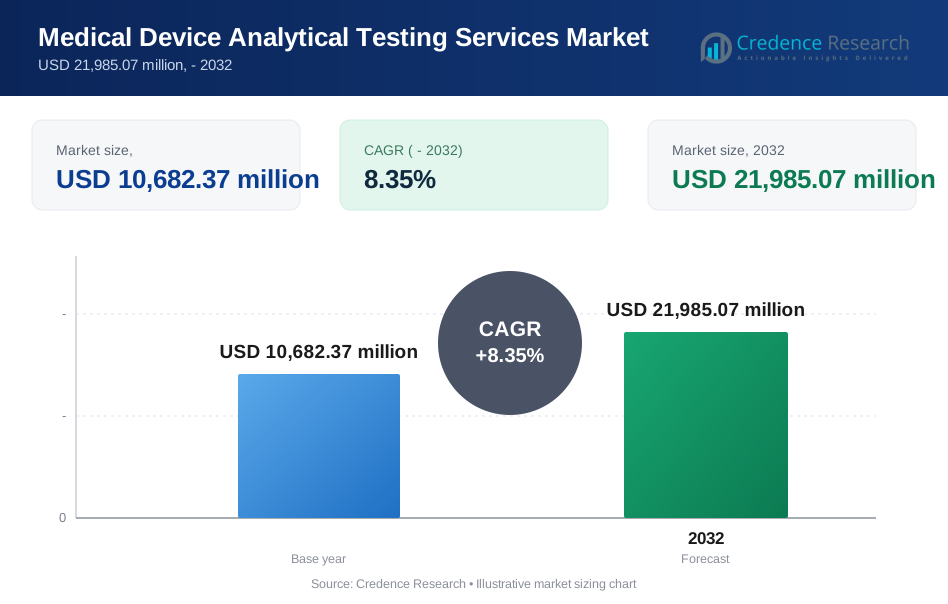
The Medical Device Analytical Testing Services Market is projected to grow from USD 10,682.37 million in 2023 to an estimated USD 21,985.07 million by 2032, with a compound annual growth rate (CAGR) of 8.35% from 2024 to 2032.
Key market drivers include the rising emphasis on regulatory compliance, the need for quality control and testing during the manufacturing process, and the increasing complexity of medical devices. The growing focus on patient safety, coupled with advancements in materials science and technology, is also fueling demand for specialized testing services. In addition, the market is witnessing notable trends such as outsourcing of testing services, the emergence of personalized medicine, and advancements in non-invasive diagnostic technologies.
Geographically, North America holds the largest market share due to the presence of established healthcare infrastructure and strict regulatory standards. Europe and the Asia Pacific regions are also significant markets, with the latter poised for rapid growth owing to increasing healthcare investments and a rising number of medical device manufacturers. Leading players in the market include Medpace, Eurofins Scientific, Charles River Laboratories, and Intertek Group, which are driving innovation and maintaining a competitive edge through strategic partnerships and acquisitions.
Market Insights
- The market is expected to grow from USD 10,682.37 million in 2023 to USD 21,985.07 million by 2032, with a CAGR of 8.35% from 2024 to 2032, driven by increasing medical device complexity and demand for regulatory compliance.
- Stringent regulatory standards globally are a key driver, pushing manufacturers to invest in specialized testing services to meet safety, efficacy, and quality benchmarks.
- Innovations in materials science and technology, including personalized medicine and non-invasive diagnostic tools, are fueling the demand for advanced testing services.
- As medical devices become more complex, especially with AI integration and new materials, the need for comprehensive testing services is growing.
- High testing costs and the need for specialized resources may hinder growth, particularly for small and mid-sized manufacturers seeking to meet regulatory requirements.
- North America holds the largest market share, while the Asia-Pacific region is poised for rapid growth due to increasing healthcare investments and device manufacturing.
- There is a rising trend of outsourcing testing services, allowing manufacturers to focus on core activities while relying on third-party experts to ensure device safety and compliance.
Market Drivers
Stringent Regulatory Standards and Compliance Requirements
One of the most significant drivers of the medical device analytical testing services market is the increasing complexity of regulatory requirements across different regions. Regulatory bodies such as the U.S. Food and Drug Administration (FDA), European Medicines Agency (EMA), and Japan's Pharmaceuticals and Medical Devices Agency (PMDA) have set stringent guidelines for medical device manufacturers to ensure patient safety and product efficacy. These regulations require comprehensive testing of medical devices at various stages, from design and development to manufacturing and post-market surveillance.The regulatory environment is evolving rapidly, with stricter controls on product safety, quality, and effectiveness. Manufacturers are required to submit detailed testing data to regulatory authorities before obtaining approval to market their devices. In addition, new guidelines are increasingly focused on ensuring that medical devices adhere to rigorous biocompatibility standards, sterility testing, and risk management processes. Consequently, medical device companies are outsourcing testing services to specialized laboratories and service providers to comply with these regulations. This demand for compliance testing is expected to drive substantial growth in the medical device analytical testing services market.For instance, the U.S. FDA mandates that medical device manufacturers submit extensive documentation and testing data to demonstrate compliance with safety and efficacy standards before market approval. This includes rigorous evaluations of biocompatibility and mechanical properties, which are critical for ensuring patient safety and device performance. Similarly, the European Medicines Agency (EMA) and Japan's Pharmaceuticals and Medical Devices Agency (PMDA) enforce stringent guidelines that require comprehensive testing across different stages of the product lifecycle to secure necessary certifications. These evolving regulations compel manufacturers to engage specialized testing services to meet compliance obligations effectively, thereby propelling growth in the analytical testing services market.
Growing Focus on Patient Safety and Quality Assurance
Patient safety remains a top priority in the healthcare industry, particularly with the increasing complexity and variety of medical devices entering the market. Medical devices—ranging from surgical instruments to implantable devices and diagnostic equipment—must undergo rigorous testing to ensure they are safe for use and function as intended. As medical devices become more intricate and technologically advanced, manufacturers are turning to specialized testing services to validate product performance, detect potential risks, and address any issues before commercialization.The focus on quality assurance (QA) is expanding across all stages of the product lifecycle. Testing services such as stability testing, biocompatibility testing, and materials testing are critical for verifying the safety and quality of medical devices. By conducting comprehensive tests, manufacturers can identify potential risks, including adverse reactions, device malfunctions, or failures that could jeopardize patient health. Analytical testing services ensure that medical devices meet the required specifications and quality standards, contributing to enhanced patient safety.Furthermore, the rising number of medical device recalls due to safety concerns underscores the importance of rigorous testing. A high-profile recall can lead to significant financial losses and damage to a company's reputation. To prevent such occurrences, manufacturers are increasingly prioritizing analytical testing to identify and mitigate risks early in the product development phase. As a result, the growing emphasis on patient safety and quality assurance is driving the demand for medical device analytical testing services.
Advancements in Medical Device Technology
Technological advancements in the medical device industry are another key driver of the analytical testing services market. The development of next-generation medical devices, such as smart implants, wearable health devices, and minimally invasive diagnostic tools, has introduced new challenges in testing and quality assurance. These devices often require specialized testing methodologies, as they integrate complex materials, sensors, and software components that traditional testing protocols may not adequately address.For example, medical devices that incorporate artificial intelligence (AI), machine learning, or IoT (Internet of Things) capabilities require testing for data security, functionality, and interoperability. In addition, devices that utilize novel materials or biocompatible polymers demand new testing approaches to assess potential reactions with the human body. Manufacturers must therefore rely on expert testing services that are equipped to handle these advanced technologies and provide accurate, reliable results.Moreover, the rise of personalized medicine is contributing to the increasing complexity of medical devices. Tailored devices that cater to individual patient needs, such as customized prosthetics or genetic testing devices, necessitate highly specific analytical testing to ensure they meet patient requirements. As medical devices continue to evolve, the demand for innovative and specialized testing services will grow, driving the overall market.
Outsourcing of Testing Services to Specialized Providers
As medical device manufacturers face increasing pressure to reduce time-to-market and manage operational costs, many are turning to third-party testing service providers to handle their analytical testing needs. Outsourcing testing services to specialized laboratories offers a range of benefits, including access to advanced testing equipment, expertise in regulatory compliance, and the ability to focus internal resources on core business functions like research and development or manufacturing.Outsourcing also helps manufacturers stay up to date with the latest testing methodologies and regulatory changes without the need for continuous investment in in-house testing infrastructure. Third-party testing providers often have the specialized knowledge and technology to perform advanced testing, such as material analysis, chemical testing, and failure mode analysis. They also offer flexibility in testing capacity, allowing manufacturers to scale their testing efforts based on production volumes and project timelines.Additionally, as the demand for regulatory compliance and product safety grows, many small and mid-sized medical device companies, which may not have the resources for large-scale in-house testing, are increasingly outsourcing testing services to established analytical service providers. This trend is expected to continue as manufacturers of all sizes seek cost-effective and efficient solutions for ensuring their products meet the highest safety standards. The outsourcing trend is, therefore, a major driver of growth in the medical device analytical testing services market.
Market Trends
Increased Outsourcing of Testing Services
A prominent trend in the medical device analytical testing services market is the growing outsourcing of testing activities to specialized third-party service providers. As medical device companies face increasing pressure to expedite the development and regulatory approval of their products, many are opting to outsource testing to external laboratories and testing firms. This trend is driven by the need to reduce operational costs, streamline product development timelines, and access the specialized expertise required for comprehensive testing.Outsourcing offers numerous benefits to medical device manufacturers. First, it provides access to a broader range of advanced testing capabilities without the need for hefty investments in in-house facilities or equipment. Specialized testing service providers are equipped with state-of-the-art technologies and have extensive experience in regulatory compliance, ensuring that manufacturers can meet both local and international regulatory requirements without maintaining large, costly testing infrastructures. This is particularly advantageous for small and medium-sized enterprises (SMEs) that may lack the resources to set up their own comprehensive testing facilities.Additionally, outsourcing allows manufacturers to focus their internal resources on core activities such as research and development, innovation, and product design. The ability to rapidly scale testing capacity and obtain timely results accelerates the overall product development process, reducing time-to-market. For instance, as medical device companies increasingly outsource their analytical testing services, they benefit from specialized expertise that accelerates product development timelines. A notable example is the rise in regulatory submissions; in 2023, the FDA reported over 20,000 applications for new devices, underscoring the urgency for manufacturers to comply with stringent guidelines. This surge has prompted many companies to rely on external laboratories that can efficiently manage the complexities of compliance testing, thereby reducing risks associated with product failures.As the demand for medical devices continues to rise globally, and as regulations become more stringent, outsourcing testing services is expected to remain a key trend driving growth in the analytical testing services market.
Focus on Non-Clinical Testing Services
The demand for non-clinical testing services, such as biocompatibility testing, sterilization validation, and material analysis, is rising as manufacturers seek to meet increasingly stringent safety and regulatory requirements. Non-clinical testing services are crucial in determining whether a medical device is safe for patient use and if it will perform as expected over time. Biocompatibility testing, in particular, has become a priority, as medical devices are increasingly made from novel materials that may have unforeseen interactions with the human body.As the healthcare industry focuses more on patient safety, ensuring that devices do not pose risks such as irritation, toxicity, or allergic reactions is paramount. Biocompatibility testing evaluates how the materials used in a device interact with biological systems, and it has become a regulatory necessity for approval in many markets. Additionally, tests such as endotoxin testing, cytotoxicity testing, and hemocompatibility testing are being increasingly employed to guarantee that medical devices do not adversely affect patients.Moreover, the demand for non-clinical testing services has intensified due to this focus on safety. Manufacturers are prioritizing these tests to ensure that their products do not pose safety risks to patients. For example, as healthcare focuses more on patient safety, comprehensive evaluations such as cytotoxicity and hemocompatibility testing are increasingly required before devices can be approved for market use.Sterilization validation is another critical aspect of non-clinical testing. As infection control and patient safety become central concerns in healthcare, the development of sterilization processes for reusable medical devices is more critical than ever. Analytical testing services providers are increasingly tasked with validating these sterilization processes, ensuring that devices are free of harmful pathogens before use. The growing emphasis on non-clinical testing services reflects both the increasing complexity of medical devices and the heightened focus on ensuring their safety.
Adoption of Advanced Testing Technologies
As medical devices become more complex and incorporate innovative technologies such as artificial intelligence (AI), machine learning, and the Internet of Things (IoT), there is an increasing demand for advanced analytical testing techniques to evaluate these devices. Manufacturers are developing devices with capabilities such as remote patient monitoring, predictive analytics, and real-time data collection—all of which require new testing methodologies to ensure functionality and safety.For example, wearable medical devices that track vital signs or manage chronic conditions often rely on embedded sensors and wireless data transmission. Testing such devices requires specialized methods to assess not only their physical functionality but also their cybersecurity and data integrity. As medical devices become more interconnected, there is a growing focus on cybersecurity testing to ensure that devices are protected from unauthorized access or data breaches—particularly in compliance with regulations like the Health Insurance Portability and Accountability Act (HIPAA) and the General Data Protection Regulation (GDPR).In addition to cybersecurity testing, there is an increased demand for advanced material testing—such as 3D-printed implants or bioresorbable materials used in drug-delivery devices. These materials often require specialized analytical techniques like electron microscopy, spectroscopy, and high-performance liquid chromatography (HPLC) to ensure their safety, efficacy, and biocompatibility. The trend toward adopting cutting-edge testing technologies ensures that the most sophisticated medical devices meet safety standards while delivering reliable performance.
Emerging Markets and Regulatory Harmonization
The medical device analytical testing services market is also experiencing growth driven by the expansion of healthcare infrastructure in emerging markets—particularly in regions such as Asia-Pacific, Latin America, and the Middle East. As these regions witness rapid economic development, rising healthcare expenditure, and increasing access to advanced medical technologies, the demand for medical devices is expanding—driving the need for comprehensive testing services.In many emerging markets; however; regulatory frameworks are still developing—leading to challenges in ensuring product compliance. To address this; many countries are working toward regulatory harmonization to align their standards with those of established markets like the U.S. and Europe. For instance; initiatives by organizations like the International Medical Device Regulators Forum (IMDRF) aim to simplify compliance processes for manufacturers looking to enter these regions.This trend toward regulatory harmonization is having a significant impact on the demand for analytical testing services. Manufacturers aiming to enter these emerging markets must ensure that their products comply with various regulatory standards—often requiring specific local requirements for testing. To simplify this process; testing service providers are adapting their offerings to help manufacturers meet the varying demands of different regions while ensuring that their products can be marketed globally.As the regulatory landscape evolves—especially in emerging markets—medical device testing service providers will play a pivotal role in helping manufacturers navigate these complexities—ensuring their devices can reach global markets while meeting all required standards. This trend is expected to lead to further growth in the medical device analytical testing services market as more companies seek to expand their reach into high-growth regions.
Market Challenges
Stringent Regulatory and Compliance Pressures
One of the primary challenges faced by the medical device analytical testing services market is the complexity and evolving nature of regulatory requirements across different regions. Medical devices are subject to strict safety, efficacy, and quality standards set by regulatory bodies such as the U.S. FDA, European Medicines Agency (EMA), and Japan's PMDA. As these regulations continue to tighten, manufacturers are under increasing pressure to ensure that their products comply with these stringent rules. This regulatory complexity is compounded by the growing number of device recalls and safety concerns, which heighten the risk of non-compliance. To meet these requirements, manufacturers must invest heavily in comprehensive testing services, which can be time-consuming and expensive. For testing service providers, keeping pace with rapidly changing regulations and ensuring that their testing procedures remain compliant with global standards presents a significant operational challenge. Furthermore, different regions have varying standards, which makes it difficult for manufacturers to streamline testing processes across multiple markets. Navigating these regulatory hurdles while maintaining the highest safety and quality standards is a persistent challenge that can impede market growth.
High Costs and Resource Intensive Nature of Testing
Another major challenge facing the medical device analytical testing services market is the high cost and resource-intensive nature of the testing process. The increasing complexity of medical devices, including advanced technologies like AI, IoT, and 3D-printed materials, demands more sophisticated and expensive testing methodologies. Devices that require testing for biocompatibility, sterilization validation, and material properties can incur substantial testing costs due to the specialized equipment, expertise, and time required. For small and mid-sized medical device companies, these high testing costs can be a barrier to entry or an obstacle to scaling production. As the industry continues to grow, the demand for more comprehensive testing services will rise, further increasing costs. Additionally, the need for specialized testing providers who can deliver precise and reliable results across a diverse range of devices adds another layer of expense. As manufacturers look to reduce costs, there may be a growing demand for more efficient, yet equally reliable, testing solutions, making it crucial for service providers to invest in innovative technologies that reduce testing time and costs.
Market Opportunities
Expansion in Emerging Markets
One of the most significant opportunities in the medical device analytical testing services market lies in the rapid growth of healthcare infrastructure in emerging markets such as Asia-Pacific, Latin America, and the Middle East. As these regions experience economic development, rising healthcare spending, and increased access to advanced medical technologies, the demand for medical devices is expanding, thus creating a need for comprehensive testing services. The growth of local medical device manufacturing and regulatory improvements in these regions will drive demand for quality assurance and regulatory compliance testing, especially as manufacturers seek to meet global standards. Testing service providers that can offer specialized solutions tailored to local regulatory requirements will be well-positioned to capitalize on this opportunity, expanding their market footprint in high-growth regions.
Advancements in Personalized and Precision Medicine
The ongoing shift toward personalized and precision medicine presents another key opportunity for the medical device analytical testing services market. As medical devices become increasingly customized to meet the unique needs of individual patients, there is an escalating demand for specialized testing to ensure that these devices are safe, effective, and meet patient-specific requirements. This trend is particularly prominent in areas like genetic testing, tailored prosthetics, and implantable devices. The complexity of these products necessitates advanced analytical testing techniques such as biomaterial testing, biocompatibility analysis, and software validation. Service providers who can offer high-precision, patient-specific testing services will find significant growth opportunities as the medical device industry continues to innovate with more personalized healthcare solutions.
Market Segmentation Analysis
By service
The medical device analytical testing services market is segmented into several categories, each addressing key aspects of device safety, compliance, and performance. The Biocompatibility Tests segment focuses on ensuring that materials used in medical devices, such as those in cardiovascular and orthopedic devices, are compatible with human tissue to prevent harmful reactions like toxicity. This segment is expanding as demand for advanced implants and devices grows. The Chemistry Tests segment includes services such as chemical characterization (E&L testing), analytical method validation, and toxicological risk assessments, ensuring materials do not release harmful substances and meet regulatory standards. The increasing complexity of medical devices with novel materials is fueling demand in this area. The Microbiology & Sterility Tests segment covers essential tests like bioburden determination and endotoxin testing to ensure devices are sterile, a growing priority with the rise in infection prevention and medical device use. The Package Validation segment ensures medical device packaging preserves sterility and integrity during transportation and storage, critical for maintaining product safety, especially for sterile items. Lastly, the Others category includes specialized testing services designed to meet unique regulatory or performance requirements for specific medical devices.
By Phase
The medical device analytical testing services market is divided into two phases: Preclinical and Clinical. In the Preclinical phase, testing focuses on evaluating the safety and effectiveness of medical devices before human trials, including large and small animal research, biocompatibility tests, chemistry tests, and microbiology & sterility tests. This phase is crucial for complex devices such as implants, prosthetics, and drug-delivery systems, where thorough testing is required to minimize risks during clinical trials. The Clinical phase, on the other hand, involves testing on human subjects to assess real-world safety and effectiveness. It includes additional rounds of biocompatibility assessments, clinical performance validation, and regulatory submissions, with analytical testing services ensuring devices meet the necessary standards for regulatory approval and clinical use.
Segments
Based on Service
- Biocompatibility Tests
- Cardiovascular Device’s Biocompatibility Tests
- Orthopaedic Device’s Biocompatibility Tests
- Others Tests
- Chemistry Test
- Chemical characterization (E&L)
- Analytical method development and validation
- Toxicological Risk Assessment and consulting
- Microbiology & Sterility Test
- Bioburden Determination
- Pyrogen & Endotoxin Testing
- Others Test
- Package Validation
- Others
Based on Phase
- Preclinical
- Large animal research
- Biocompatibility test
- Chemist test
- Microbiology & Sterility test
- Small animal research
- Biocompatibility test,
- Chemist test
- Microbiology & Sterility test
- Clinical
Based on Region
- North America
- U.S.
- Canada
- Mexico
- Europe
- Germany
- France
- U.K.
- Italy
- Spain
- Rest of Europe
- Asia Pacific
- China
- Japan
- India
- South Korea
- South-east Asia
- Rest of Asia Pacific
- Latin America
- Brazil
- Argentina
- Rest of Latin America
- Middle East & Africa
- GCC Countries
- South Africa
- Rest of the Middle East and Africa
Regional Analysis
North America (40%)
North America holds the largest market share in the medical device analytical testing services market, accounting for approximately 40% of the total market. This dominance is primarily driven by the well-established healthcare systems in the United States and Canada, alongside the presence of leading medical device manufacturers and regulatory bodies such as the U.S. Food and Drug Administration (FDA). The region's strict regulatory standards and the growing emphasis on patient safety significantly contribute to the demand for comprehensive testing services. Additionally, North America has a high concentration of medical device companies that require advanced testing solutions to ensure compliance with the FDA's rigorous approval processes. The ongoing innovation in the medical device sector, particularly in areas like implants, diagnostic tools, and wearables, further propels the demand for testing services.
Europe (30%)
Europe represents the second-largest market, capturing around 30% of the medical device analytical testing services market. The region benefits from a strong healthcare infrastructure, a unified regulatory framework under the European Medicines Agency (EMA), and increasing demand for innovative medical devices. Europe has a diverse medical device industry, from advanced diagnostics to life-saving devices, which drives the need for reliable and high-quality analytical testing services. As healthcare standards continue to rise and device complexity increases, the demand for specialized testing services, particularly in biocompatibility and sterilization testing, is expected to grow. Countries such as Germany, France, and the UK are leading players in the medical device sector, contributing significantly to the region's market share.
Key players
- SGS SA
- Laboratory Corporation of America Holdings
- Nelson Laboratories, LLC
- TÜV SÜD
- Charles River Laboratories
- Element Minnetonka
- North America Science Associates Inc. (NAMSA)
- Eurofins Scientific
- Pace Analytical Services LLC
- Intertek Group Plc
- Wu Xi App Tec
Competitive Analysis
The medical device analytical testing services market is highly competitive, with key players like SGS SA, Eurofins Scientific, and Charles River Laboratories leading the charge. These companies are known for their extensive testing portfolios, which include biocompatibility, chemistry, microbiology, and sterilization validation services. SGS SA and Eurofins Scientific stand out for their global reach and advanced technological capabilities, allowing them to cater to a wide range of regulatory requirements across regions. Companies like TÜV SÜD and Intertek Group Plc offer specialized services with a focus on quality control and compliance with international standards. The market is also seeing growth from emerging players like Wu Xi App Tec and Nelson Laboratories, which are leveraging innovation to capture market share. As manufacturers increasingly outsource testing services to streamline production, the competition among these companies intensifies, emphasizing the importance of cost-efficiency, speed, and regulatory expertise.
Recent Developments
- In November 2023, SGS Hong Kong received certification for China Mobile Hong Kong (CMHK) to ISO 37001, becoming one of the first central Chinese state-owned telecommunications firms to obtain this anti-bribery management system standard.
- In March 2024, Pace Analytical Services LLC announced the acquisition of a laboratory facility located in Lebanon, New Jersey from Curia. This acquisition aims to enhance their analytical testing capabilities.
Market Concentration and Characteristics
The medical device analytical testing services market is moderately concentrated, with a few large players such as SGS SA, Eurofins Scientific, and Charles River Laboratories dominating the industry. These companies have established global networks, extensive service portfolios, and strong reputations for regulatory compliance, giving them a competitive edge. However, the market also features a growing number of specialized players like Nelson Laboratories and Wu Xi App Tec, offering tailored services to meet the diverse needs of medical device manufacturers. The market is characterized by high specialization in testing services, as well as a continuous focus on innovation and compliance with evolving global regulatory standards. While larger firms benefit from economies of scale and broad geographic reach, smaller players are carving out niches by providing customized, high-quality testing solutions. As demand for comprehensive testing services continues to grow, particularly in emerging markets, the competitive landscape is expected to remain dynamic.
Report Coverage
The research report offers an in-depth analysis based on Service, Phase and Region. It details leading market players, providing an overview of their business, product offerings, investments, revenue streams, and key applications. Additionally, the report includes insights into the competitive environment, SWOT analysis, current market trends, as well as the primary drivers and constraints. Furthermore, it discusses various factors that have driven market expansion in recent years. The report also explores market dynamics, regulatory scenarios, and technological advancements that are shaping the industry. It assesses the impact of external factors and global economic changes on market growth. Lastly, it provides strategic recommendations for new entrants and established companies to navigate the complexities of the market.
Future Outlook
- As the medical device industry expands globally, the need for comprehensive analytical testing services will continue to rise, especially in emerging markets. Regulatory requirements will drive the demand for specialized testing solutions.
- The increasing complexity of medical devices, such as AI-powered implants and connected devices, will lead to the adoption of advanced testing technologies. Testing providers will invest in innovative methods like machine learning for predictive testing and data analysis.
- With more stringent regulatory frameworks globally, manufacturers will require analytical testing services to meet compliance standards. The emphasis on patient safety and quality assurance will continue to fuel market demand.
- Outsourcing of testing services to specialized providers will continue to grow, allowing manufacturers to focus on core activities. Third-party testing services will become integral to medical device development and production cycles.
- As personalized medicine gains prominence, there will be an increasing need for customized testing services. Devices tailored to individual patients will require specialized analytical testing to ensure biocompatibility and performance.
- Non-clinical tests, such as biocompatibility and material analysis, will see greater demand. These services are critical for ensuring that devices are safe for human use, especially as medical technologies evolve.
- Asia-Pacific and Latin America will see rapid growth in the demand for testing services due to rising healthcare investments and the increasing manufacturing of medical devices in these regions.
- The integration of digital tools, such as cloud-based data management and real-time testing results, will streamline testing processes. Digital technologies will enhance the efficiency and accuracy of testing services.
- Investments in research and development by both testing service providers and medical device manufacturers will lead to the creation of more advanced and accurate testing methods. This will drive innovation in the market.
- To stay competitive, smaller testing firms may merge with larger companies or form strategic partnerships. This consolidation will allow firms to broaden their service offerings and expand into new markets, ensuring long-term growth.
Request a Free Sample
Fill in your details and we'll send you a free sample report.
- Sample data tables & charts
- Research methodology
Need a Custom Version of This Report?
Tailor the scope, geography, or segments to your exact requirements.
- Custom geography or segment scope
- Direct access to our analyst team
Frequently Asked Questions
What is the market size of the Medical Device Analytical Testing Services market in 2023 and 2032?
What are the main drivers of growth in the Medical Device Analytical Testing Services market?
Which regions are leading the Medical Device Analytical Testing Services market?
How does outsourcing impact the Medical Device Analytical Testing Services market?
What trends are influencing the Medical Device Analytical Testing Services market?
Table of Content
Chapter 1. Report Introduction
- 1.1 Report Description & Purpose
- 1.1.1 Report Title & Market Definition
- 1.1.2 Unique Selling Propositions (USP) & Key Differentiators
- 1.1.3 Value Proposition for Stakeholders
- 1.2 Research Objectives
- 1.2.1 Market Sizing Objectives (Volume & Revenue)
- 1.2.2 Segmentation Objectives
- 1.2.3 Competitive Intelligence Objectives
- 1.2.4 Forecast & Scenario Objectives
- 1.3 Report Scope
- 1.3.1 Medical Device Analytical Testing Services Scope – Types & Subtypes Covered
- 1.3.2 Geographic Scope – Regions & Countries Covered
- 1.3.3 Historical Period, Base Year & Forecast Period (the historical period; forecast to 2032)
- 1.3.4 Inclusions & Exclusions
- 1.4 HS Code & Classification Framework
- 1.5 Currency, Units & Pricing Basis
- 1.6 Target Stakeholders
- 1.7 Limitations & Assumptions
Chapter 2. Executive Summary
- 2.1 Global Medical Device Analytical Testing Services Market Snapshot
- 2.1.1 Market Size – Historical (the historical period) & Forecast (2032) (base year: USD 10,682.37 million → 2032: USD 21,985.07 million)
- 2.1.2 Volume & Revenue – Global Totals
- 2.1.3 Key Market Highlights – Top Five Facts
- 2.2 Medical Device Analytical Testing Services Market Segmentation Snapshot
- 2.2.1 Market Split by Region – vs. 2032
- 2.3 Competitive Snapshot
- 2.3.1 Top 10 Players by Revenue Share –
- 2.3.2 Top 10 Players by Volume Share –
- 2.3.3 Recent Strategic Developments (18-Month Summary)
- 2.4 Key Investment Highlights & Strategic Conclusions
Chapter 3. Medical Device Analytical Testing Services Market Dynamics & Industry Analysis
- 3.1 Market Overview & Context
- 3.1.1 Medical Device Analytical Testing Services Market Position in the Broader Automotive Value Chain
- 3.1.2 OEM vs. Replacement Market Dynamics
- 3.1.3 Market Maturity & Development Stage by Region
- 3.2 Medical Device Analytical Testing Services Market Drivers
- 3.3 Medical Device Analytical Testing Services Market Restraints & Challenges
- 3.4 Medical Device Analytical Testing Services Market Opportunities
- 3.5 Porter's Five Forces Analysis
- 3.5.1 Threat of New Entrants
- 3.5.2 Bargaining Power of Suppliers
- 3.5.3 Bargaining Power of Buyers
- 3.5.4 Threat of Substitutes
- 3.5.5 Competitive Rivalry – Intensity Assessment
- 3.6 Medical Device Analytical Testing Services Value Chain Analysis
- 3.6.1 Upstream – Raw Material/Input Suppliers
- 3.6.1.1 Raw Material/Input 1
- 3.6.1.2 Raw Material/Input 2
- 3.6.1.3 Raw Material/Input 3
- 3.6.2 Midstream – Production/Manufacturing/Service Delivery
- 3.6.2.1 Production/Process Overview
- 3.6.2.2 Key Facility Locations & Capacity by Manufacturer
- 3.6.3 Downstream – Distribution & End Consumer
- 3.6.3.1 Primary Channel – B2B/OEM
- 3.6.3.2 Secondary Channels – Dealer, Retail, Online, Direct
- 3.6.4 Value Chain Profitability Analysis
- 3.6.1 Upstream – Raw Material/Input Suppliers
- 3.7 PESTEL Analysis
- 3.7.1 Political Factors
- 3.7.2 Economic Factors
- 3.7.3 Social Factors
- 3.7.4 Technological Factors
- 3.7.5 Environmental Factors
- 3.7.6 Legal Factors
- 3.8 Medical Device Analytical Testing Services Supply Chain Analysis
- 3.8.1 Raw Material/Input Supply Risk Assessment
- 3.8.2 Manufacturing Concentration Risk (Geographic Exposure)
- 3.8.3 Trade Disruption Impact Analysis
- 3.9 Regulatory & Policy Landscape
Note: The regulatory and policy landscape section covers regulations based on their applicability to the market, Medical Device Analytical Testing Services category, geography, and scope of the study. Only regulatory frameworks with a material impact on operations, compliance, trade, sustainability, or market access are analyzed in detail.
Chapter 4. Key Investment Pockets & Opportunity Analysis
- 4.1 Medical Device Analytical Testing Services Market Attractiveness Analysis
- 4.1.1 By Region – Investment Attractiveness Matrix (Volume × CAGR)
- 4.2 Absolute Revenue Growth Opportunity
- 4.2.1 By Region – Absolute USD Growth Through 2032
- 4.3 Incremental Volume Opportunity
- 4.3.1 By Region – Incremental Volume Through 2032
- 4.3.2 Segment – Incremental Volume
- 4.4 Emerging Submarket Opportunity Deep Dive (Subject to Applicability)
- 4.5 Emerging Market Opportunity Scorecards
- 4.5.1 United States
- 4.5.2 Europe
- 4.5.3 Asia
- 4.5.4 Middle East & Africa
Note: Emerging Market Opportunity Scorecards will be included based on relevance and strategic importance. Regions listed are indicative and may vary depending on data availability and market dynamics.
Chapter 5. Medical Device Analytical Testing Services Import-Export Analysis & Trade Flows
- 5.1 Global Trade Overview
- 5.1.1 Global Export Value by Country (the historical period)
- 5.1.2 Global Export Volume by Country (the historical period)
- 5.1.3 Global Import Value by Country (the historical period)
- 5.1.4 Global Import Volume by Country (the historical period)
- 5.1.5 Net Trade Balance by Country (the historical period)
- 5.2 Export Analysis – Segment
- 5.2.1 Type 1 (HS Code)
- 5.2.2 Type 2 (HS Code)
- 5.2.3 Type 3 (HS Code)
- 5.2.4 Type 4 (HS Code)
- 5.2.5 Type 5 (HS Code)
- 5.3 Import Analysis – Segment
- 5.3.1 Type 1 (HS Code)
- 5.3.2 Type 2 (HS Code)
- 5.3.3 Type 3 (HS Code)
- 5.3.4 Type 4 (HS Code)
- 5.3.5 Type 5 (HS Code)
- 5.4 Average Unit Trade Prices
- 5.4.1 Average Export Price – Segment & Country
- 5.4.2 Average Import Price – Segment & Source Country
- 5.4.3 Price Trends (the historical period)
- 5.5 Key Trade Route Analysis
- 5.5.1 Trade Route 1
- 5.5.2 Trade Route 2
- 5.5.3 Trade Route 3
- 5.5.4 Trade Route 4
- 5.5.5 Trade Route 5
- 5.6 Trade Policy Impact Assessment
- 5.6.1 US Anti-Dumping & Section 301 Tariffs
- 5.6.2 EU Customs Union Impact
- 5.6.3 Major Free Trade Agreements
- 5.6.4 USMCA Rules of Origin
Note: Trade policy analysis will be included only where relevant to the Medical Device Analytical Testing Services market.
Chapter 6. Competitive Landscape & Company Benchmarking
- 6.1 Medical Device Analytical Testing Services Market Concentration & Structure
- 6.1.1 Herfindahl-Hirschman Index (HHI) – vs.
- 6.1.2 Tier 1, Tier 2 & Tier 3 Market Structure
- 6.1.3 Global, Regional & Local Player Dynamics
- 6.2 Medical Device Analytical Testing Services Market Share Analysis –
- 6.2.1 Global Revenue Share by Company
- 6.2.2 Global Volume Share by Company
- 6.2.3 Regional Revenue Share
- 6.2.4 Market Share Evolution ( vs. )
- 6.2.5 OEM Segment Share by Company
- 6.2.6 Replacement Segment Share by Company
- 6.3 Production/Delivery Capacity & Facility Analysis
- 6.3.1 Global Installed Capacity
- 6.3.2 Capacity Utilization Rates
- 6.3.3 Production/Output Volume
- 6.3.4 Facility Locations & Capacity Map
- 6.3.5 Planned Capacity Additions
- 6.4 Medical Device Analytical Testing Services Competitive Benchmarking Matrix
- 6.4.1 Revenue, Volume, CAGR & Profitability Comparison
- 6.4.2 Channel Revenue Mix
- 6.4.3 Geographic Revenue Exposure
- 6.4.4 R&D Intensity
- 6.4.5 Sustainability Maturity
- 6.5 Strategic Developments in Medical Device Analytical Testing Services (Last 24 Months)
- 6.5.1 Mergers, Acquisitions & Divestments
- 6.5.2 New Medical Device Analytical Testing Services Launches
- 6.5.3 Facility Expansions
- 6.5.4 Strategic Alliances, Joint Ventures & Partnerships
- 6.5.5 Distribution Expansion & Market Entry
- 6.5.6 Sustainability & ESG Initiatives
- 6.6 Competitive Strategy Mapping
- 6.6.1 Leader, Challenger, Follower & Niche Classification
- 6.6.2 Pricing Strategy Comparison
- 6.6.3 Channel Strategy Matrix
Note: Strategic developments are included based on their materiality and the availability of reliable information.
Chapter 7. Global Medical Device Analytical Testing Services Market – By Distribution Channel
- 7.1 Segment Overview
- 7.1.1 Volume & Revenue Split by Channel ( & 2032)
- 7.1.2 Channel Mix Evolution (2032)
Chapter 8. Regional Market Analysis – Global Overview
- 8.1 Global Regional Overview
- 8.1.1 Regional Volume Share
- 8.1.2 Regional Revenue Share
- 8.1.3 Regional Volume by Region
- 8.1.4 Regional Revenue by Region
- 8.1.5 Regional Forecast Through 2032
- 8.2 Cross-Regional Segment Analysis
- 8.2.1 By Distribution Channel
- 8.2.2 By Brand/Price Tier
Chapter 9. North America Medical Device Analytical Testing Services Market
- 9.1 United States
- 9.2 Canada
- 9.3 Mexico
Chapter 10. Europe Medical Device Analytical Testing Services Market
- 10.1 Germany
- 10.2 France
- 10.3 Italy
- 10.4 United Kingdom
- 10.5 Spain
- 10.6 Poland
- 10.7 Russia
- 10.8 Netherlands
- 10.9 Belgium
- 10.10 Sweden
- 10.11 Denmark
- 10.12 Norway
- 10.13 Rest of Europe
Chapter 11. Asia Pacific Medical Device Analytical Testing Services Market
- 11.1 China
- 11.2 India
- 11.3 Japan
- 11.4 South Korea
- 11.5 Thailand
- 11.6 Indonesia
- 11.7 Vietnam
- 11.8 Malaysia
- 11.9 Australia
- 11.10 Rest of Asia Pacific
Chapter 12. Latin America Medical Device Analytical Testing Services Market
- 12.1 Brazil
- 12.2 Argentina
- 12.3 Colombia
- 12.4 Chile
- 12.5 Rest of Latin America
Chapter 13. Middle East Medical Device Analytical Testing Services Market
- 13.1 Saudi Arabia
- 13.2 United Arab Emirates
- 13.3 Turkey
- 13.4 Israel
- 13.5 Iran
- 13.6 Rest of the Middle East
Chapter 14. Africa Medical Device Analytical Testing Services Market
- 14.1 South Africa
- 14.2 Egypt
- 14.3 Nigeria
- 14.4 Morocco
- 14.5 Rest of Africa
Chapter 15. Medical Device Analytical Testing Services Company Profiles
- 15.1 [Company 01]
- 15.1.1 Company Overview
- 15.1.2 Key Management Personnel
- 15.1.3 Products & Services Portfolio
- 15.1.4 Financial Performance
- 15.1.5 Key Market Focus & Geographic Presence
- 15.1.6 Recent Developments & Strategic Initiatives
Note: The company profile list is preliminary and may change based on research findings, market developments, data availability, and client requirements.
Chapter 16. Appendices
- Appendix A – List of Abbreviations & Acronyms
- Appendix B – Industry Classification Code Reference – Full Series
- Appendix C – Production & Capacity Data Tables
- Appendix D – End-Use & Demand Base Tables
- Appendix E – Consumption & Replacement Rate Assumptions
- Appendix F – ASP Reference Tables
- Appendix G – Manufacturing & Facility Database
- Appendix H – Import-Export Data Tables
- Appendix I – Regulatory Summary Tables
- Appendix J – Primary Research Participant List (Anonymized)
- Appendix K – Primary Research Questionnaire Framework
- Appendix L – Data Sources & Bibliography
- Appendix M – Market Size Divergence & Source Comparison
Chapter 17. Research Methodology
- 17.1 Research Framework & Philosophy
- 17.2 Secondary Research – Sources, Hierarchy & Data Extraction
- 17.3 Data Modeling – Bottom-Up & Top-Down Market Sizing
- 17.4 Primary Research – Stakeholder Framework, LOI & Sample Sizes
- 17.5 Forecast Methodology – Regression, Scenario & Sensitivity Analysis
- 17.6 Quality Control – Four-Layer Validation Framework
- 17.7 Limitations & Standard Assumptions
- 17.8 Disclaimer
