
Market Overview:
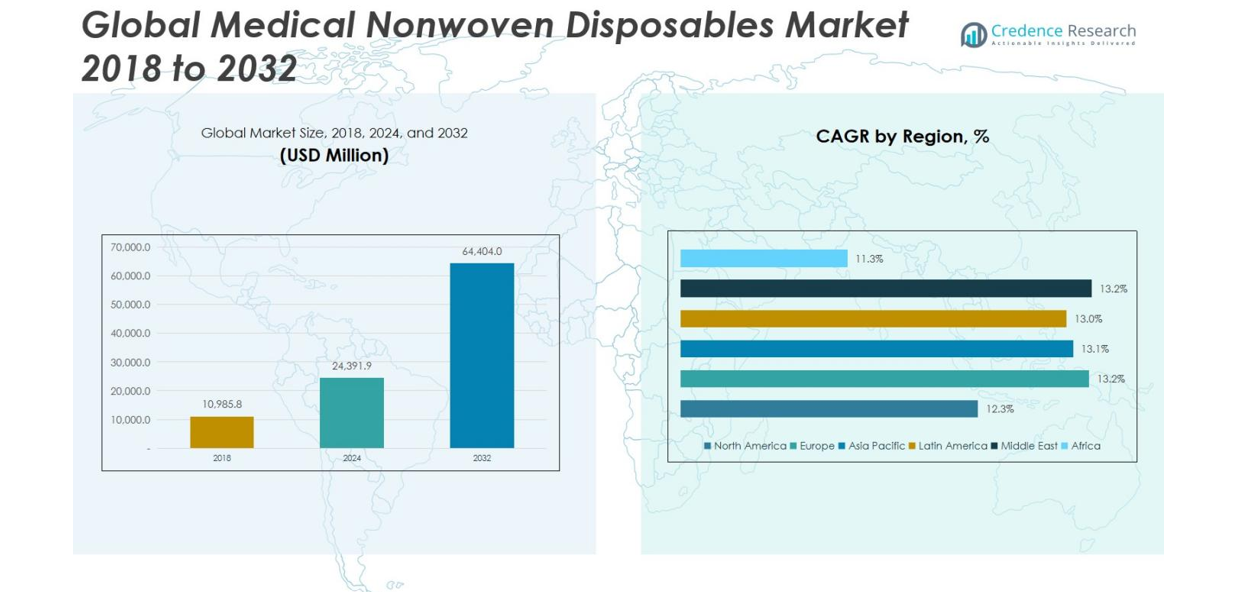
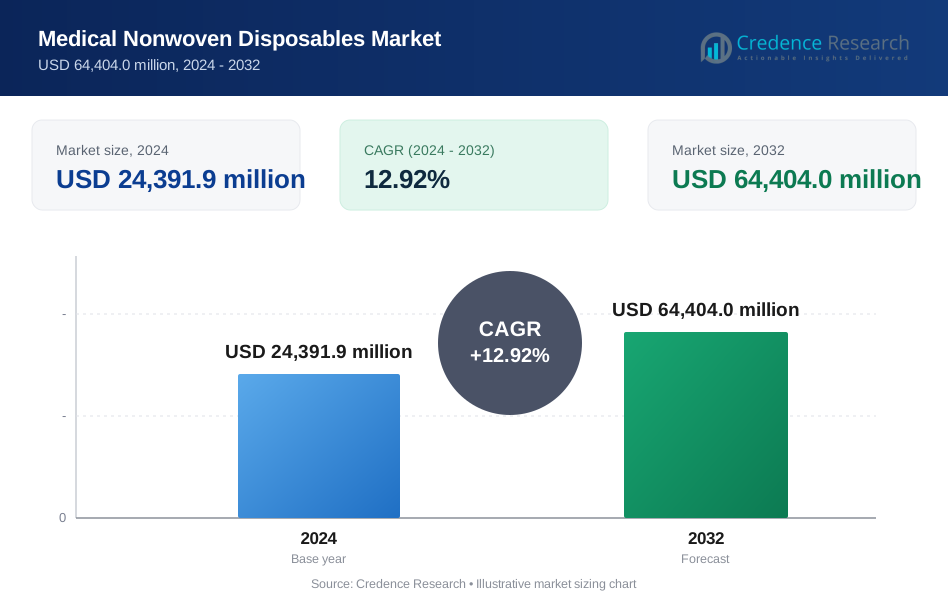
The global Medical Nonwoven Disposables Market was valued at USD 10,985.8 million in 2018 and expanded to USD 24,391.9 million in 2024. The market is anticipated to reach USD 64,404.0 million by 2032, growing at a robust CAGR of 12.92% during the forecast period.
| REPORT ATTRIBUTE | DETAILS |
|---|---|
| Historical Period | 2020-2023 |
| Base Year | 2024 |
| Forecast Period | 2025-2032 |
| Medical Nonwoven Disposables Market Size 2024 | USD 24,391.9 million |
| Medical Nonwoven Disposables Market, CAGR | 12.92% |
| Medical Nonwoven Disposables Market Size 2032 | USD 64,404.0 million |
The Medical Nonwoven Disposables Market is highly competitive, led by key players such as Asahi Kasei Corporation, Covidien, Domtar Corporation, First Quality Enterprises, Inc., Freudenberg Nonwoven, Kimberly Clark Corporation, Medline Industries, Inc., Cypress Medical, Unicharm Corporation, and Nobel Hygiene Pvt. Ltd. These companies focus on product innovation, sustainable solutions, and strategic expansions to strengthen market presence. Surgical nonwoven products, disposable diapers, and incontinence solutions are core offerings driving revenue growth. Regionally, Asia Pacific leads the market with a share of approximately 35%, driven by expanding healthcare infrastructure, rising surgical procedures, and increasing awareness of hygiene and infection control. Europe and North America follow with shares of around 25% and 22%, respectively, supported by advanced healthcare systems, stringent regulations, and high adoption of disposable products. Collectively, these regions and leading players define the market’s competitive and growth dynamics globally.
Maket Insights
- The global Medical Nonwoven Disposables Market was valued at USD 24,391.9 million in 2024 and is projected to reach USD 64,404.0 million by 2032, growing at a CAGR of 12.92%.
- Growth is driven by expanding healthcare infrastructure, rising surgical procedures, and increased adoption of disposable nonwoven products in hospitals, clinics, and home healthcare.
- Trends indicate a rising preference for biodegradable and sustainable products, ultra-absorbent diapers, and innovations in surgical gowns and incontinence solutions to enhance hygiene and patient comfort.
- The competitive landscape is dominated by players such as Asahi Kasei Corporation, Covidien, Kimberly Clark Corporation, Medline Industries, and Unicharm Corporation, who focus on R&D, strategic partnerships, and geographic expansion to capture market share.
- Regionally, Asia Pacific leads with approximately 35% market share, followed by Europe at 25% and North America at 22%, while surgical nonwoven products hold the largest segment share at 40% of global revenue.
Market Segmentation Analysis:
By Product
The surgical nonwoven products segment dominates the Medical Nonwoven Disposables Market, accounting for 40% of global revenue, with surgical gowns as the leading sub-segment at 35% share. This growth is driven by increasing surgical procedures worldwide, stringent infection control regulations, and the adoption of sterile, single-use materials in hospitals and ambulatory centers. Disposable diapers and incontinence products follow, contributing 32% and 28% of the market, respectively, with ultra-absorbent diapers and disposable underwear being key sub-segments. Rising awareness of hygiene, comfort-focused innovations, and biodegradable options are further boosting adoption across healthcare and home-care settings.
- For instance, Medline Industries and Kimberly-Clark are prominent in manufacturing sterile surgical gowns and drapes, with Medline continuously innovating in antimicrobial and fluid-resistant nonwoven textiles to improve safety standards.
By End-User
Hospitals lead the end-user segment, representing 50% of the market, due to high patient volumes, stringent hygiene standards, and increased surgical procedures. They drive demand for surgical gowns, drapes, and incontinence products. Nursing homes contribute approximately 15%, primarily through disposable underwear and adult diapers, fueled by aging populations and chronic care needs. Home healthcare, clinics, and ambulatory centers are emerging end users, driven by convenience, infection prevention, and rising adoption of disposable hygiene solutions. Collectively, these segments reflect a growing trend toward single-use, high-performance nonwoven products in healthcare settings.
- For instance, Medtecs International Corporation reported that its disposable surgical gowns, including CoverU Isolation Gowns, have achieved FDA 510(k) clearance, demonstrating their critical role in reducing surgical site infections worldwide.
Key Growth Drivers
Rising Healthcare Infrastructure and Hospitalization Rates
Expanding healthcare infrastructure worldwide, including hospitals, clinics, and ambulatory centers, is driving demand for medical nonwoven disposables. Increased hospitalization rates and surgical procedures require sterile, single-use products to minimize infection risks. Government initiatives to improve healthcare accessibility, particularly in emerging markets, further fuel demand. Hospitals and home healthcare providers increasingly rely on disposable nonwoven products to ensure patient safety, hygiene, and operational efficiency, reinforcing strong market growth and adoption across multiple end-user segments.
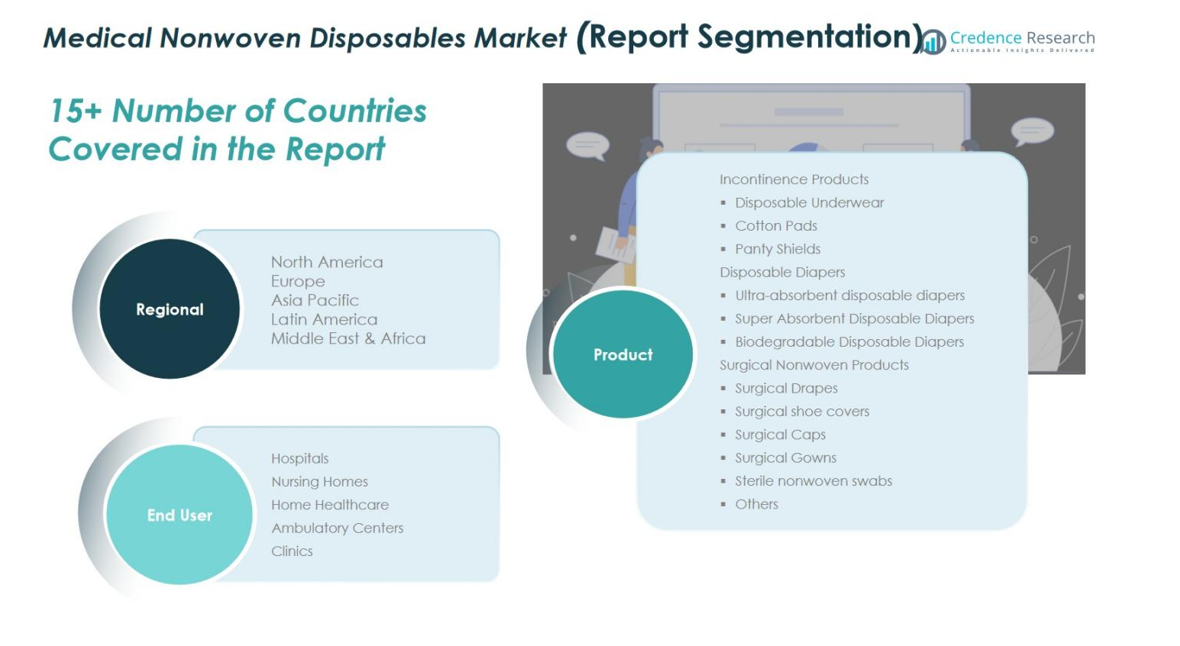
- For instance, analysis by Sg2, a Vizient company, shows that patients needing complex surgical care in hospitals are increasing, driving demand for single-use, sterile medical supplies to ensure patient safety.
Growing Awareness of Hygiene and Infection Control
Heightened awareness of hygiene and infection prevention has significantly boosted adoption of medical nonwoven disposables. Rising cases of hospital-acquired infections (HAIs) have encouraged hospitals and nursing homes to switch from reusable to disposable products. Disposable surgical gowns, drapes, and incontinence products reduce cross-contamination risks, promoting patient safety. Educational campaigns, coupled with stricter regulatory standards, are motivating healthcare providers to invest in nonwoven disposables, driving consistent market expansion across regions and end-user categories.
- For instance, 3M’s High Protection Surgical Gowns, made from durable nonwoven SMMS fabric, are designed to provide a reliable barrier against microorganisms and body fluids, enhancing patient and wearer safety during surgeries.
Technological Advancements and Product Innovation
Continuous innovation in materials, absorbency, and biodegradability is enhancing product performance and patient comfort. Companies are developing ultra-absorbent, lightweight, and eco-friendly disposables to meet consumer and regulatory expectations. Integration of sustainable solutions, such as biodegradable diapers and eco-friendly surgical products, is creating competitive advantages and expanding market reach. These innovations attract new end-users and increase usage frequency, fostering overall market growth while supporting environmentally conscious healthcare practices globally.
Key Trends & Opportunities
Sustainable and Biodegradable Products
The rising environmental awareness among healthcare providers and consumers is creating opportunities for biodegradable and sustainable nonwoven products. Companies are increasingly launching eco-friendly diapers, pads, and surgical items to reduce waste and align with global sustainability goals. Adoption of these products allows healthcare facilities to enhance their green credentials while maintaining hygiene standards. The growing preference for sustainable solutions presents a significant growth opportunity for manufacturers to differentiate their offerings and capture emerging environmentally conscious markets.
- For instance, Kudos, an eco-friendly diaper brand with 100% cotton lining, has expanded its presence to nearly 750 Target locations as of early 2025, illustrating growing market acceptance of sustainable, plastic-free alternatives in baby care.
Expansion of Home Healthcare Services
Home healthcare is rapidly gaining prominence due to aging populations, chronic diseases, and post-operative care requirements. Disposable nonwoven products, such as incontinence pads and adult diapers, are increasingly used in home settings, providing convenience and hygiene. Technological advancements in user-friendly products and increased availability through online channels further support this trend. Companies can capitalize on this shift by designing cost-effective, easy-to-use solutions, unlocking new market segments and revenue streams beyond traditional hospital and clinic-based consumption.
- For instance, Procter & Gamble launched its Always Discreet line, specifically designed for women managing bladder leaks, featuring Advanced Core Technology that absorbs and locks away fluids while OdorLock technology neutralizes odors, addressing both functionality and discretion for home users.
Key Challenges
High Production Costs and Raw Material Dependence
The production of high-quality nonwoven disposables depends on specialized fibers and polymers, which are subject to price volatility. Rising raw material costs and energy expenses increase manufacturing costs, impacting profit margins. Smaller manufacturers may struggle to maintain cost competitiveness, while large players face pressure to balance affordability with quality. This challenge necessitates strategic sourcing, process optimization, and innovation in materials to ensure sustainable growth without compromising product performance or market accessibility.
Stringent Regulatory Compliance and Quality Standards
Medical nonwoven disposables are subject to rigorous regulatory frameworks to ensure safety and effectiveness. Compliance with FDA, CE, and other regional standards requires extensive testing, documentation, and continuous monitoring. Navigating these regulations can delay product launches and increase operational costs. Non-compliance risks recalls, reputational damage, and financial penalties. Manufacturers must invest in quality management systems and regulatory expertise to mitigate risks, maintain market credibility, and sustain growth in a highly regulated healthcare environment.
Regional Analysis
North America
North America accounted for a significant share of the Medical Nonwoven Disposables Market, with a market value of USD 2,526.73 million in 2018. The region expanded to USD 5,448.11 million in 2024 and is projected to reach USD 13,814.65 million by 2032, growing at a CAGR of 12.3%. Strong demand is driven by advanced healthcare infrastructure, high awareness of infection control, and increasing surgical procedures. The adoption of disposable nonwoven products in hospitals, ambulatory centers, and home healthcare settings reinforces the region’s dominance, with North America holding a considerable market share in both mature and high-value product segments.
Europe
Europe represented a major portion of the global market, valued at USD 2,714.59 million in 2018 and reaching USD 6,127.60 million in 2024. The market is expected to attain USD 16,532.50 million by 2032, registering a CAGR of 13.2%. Growth is fueled by robust healthcare systems, stringent hygiene regulations, and increasing demand for sustainable and biodegradable nonwoven products. Hospitals, clinics, and home healthcare facilities are key end users, while government initiatives promoting patient safety and eco-friendly disposables support market expansion. Europe maintains a strong market share due to high product adoption and technological advancements.
Asia Pacific
Asia Pacific is the fastest-growing region, with a market size of USD 3,760.44 million in 2018, rising to USD 8,429.85 million in 2024, and projected to reach USD 22,541.39 million by 2032 at a CAGR of 13.1%. The region’s growth is driven by expanding healthcare infrastructure, urbanization, rising surgical procedures, and increased awareness of hygiene and infection control. Emerging economies such as China and India are fueling demand for incontinence products, disposable diapers, and surgical nonwoven products. Asia Pacific’s growing healthcare spending and rapid adoption of advanced disposable solutions are strengthening its global market share.
Latin America
Latin America’s market was valued at USD 1,172.18 million in 2018 and expanded to USD 2,620.39 million in 2024, with projections reaching USD 6,981.39 million by 2032, reflecting a CAGR of 13.0%. Growth is supported by increasing investments in healthcare infrastructure, modernization of hospitals, and rising awareness of hygiene practices. Demand for disposable incontinence products and surgical nonwoven items is steadily increasing across Brazil, Mexico, and other key countries. Latin America holds a moderate market share, driven by government initiatives and private sector investments that enhance accessibility to advanced medical nonwoven disposables.
Middle East
The Middle East market, valued at USD 476.78 million in 2018, grew to USD 1,077.43 million in 2024 and is expected to reach USD 2,911.06 million by 2032 at a CAGR of 13.2%. Market growth is fueled by rising healthcare expenditures, increasing number of hospitals, and the adoption of disposable surgical and incontinence products to ensure patient safety. Investments in advanced healthcare infrastructure and infection control practices in countries such as Saudi Arabia and the UAE are driving demand. The Middle East holds a growing market share, reflecting expanding healthcare capabilities and rising awareness of nonwoven solutions.
Africa
Africa accounted for a market value of USD 335.07 million in 2018, increasing to USD 688.55 million in 2024 and projected to reach USD 1,622.98 million by 2032, at a CAGR of 11.3%. Market growth is driven by increasing healthcare investments, establishment of new hospitals, and rising awareness of hygiene and infection control. Demand is particularly strong in surgical nonwoven products and incontinence solutions across key regions such as South Africa and Nigeria. Although Africa holds a smaller market share compared to other regions, ongoing healthcare development and increasing adoption of disposable solutions are creating steady growth opportunities.
Market Segmentations:
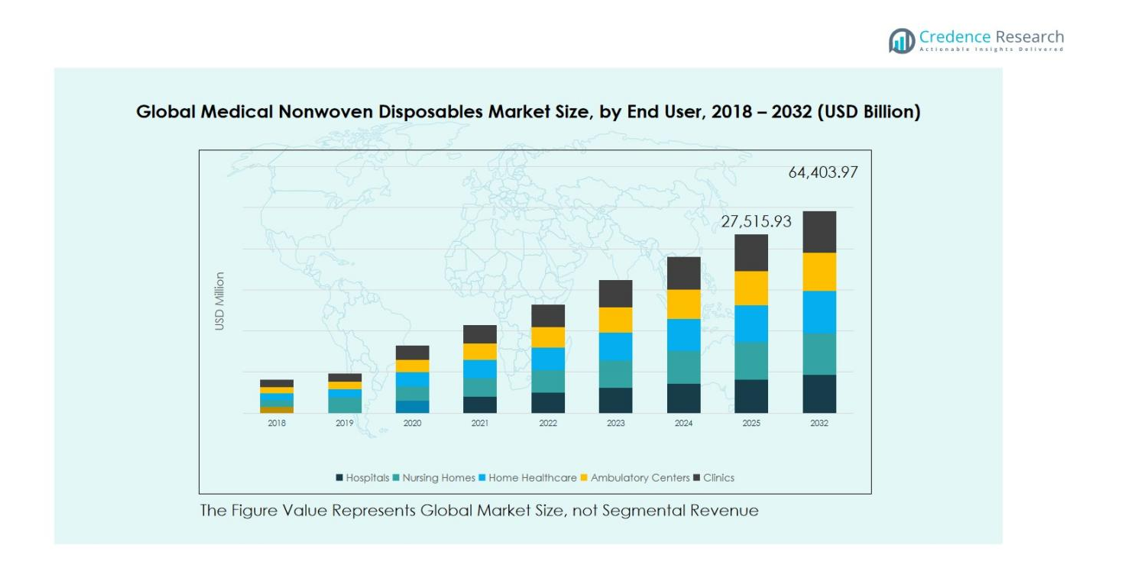
Incontinence Products
- Disposable Underwear
- Cotton Pads
- Panty Shields
Disposable Diapers
- Ultra-absorbent Disposable Diapers
- Super Absorbent Disposable Diapers
- Biodegradable Disposable Diapers
Surgical Nonwoven Products
- Surgical Drapes
- Surgical Shoe Covers
- Surgical Caps
- Surgical Gowns
- Sterile Nonwoven Swabs
- Others
By End User
- Hospitals
- Nursing Homes
- Home Healthcare
- Ambulatory Centers
- Clinics
By Region
- North America
- U.S.
- Canada
- Mexico
- Europe
- Germany
- France
- U.K.
- Italy
- Spain
- Rest of Europe
- Asia Pacific
- China
- Japan
- India
- South Korea
- South-east Asia
- Rest of Asia Pacific
- Latin America
- Brazil
- Argentina
- Rest of Latin America
- Middle East & Africa
- GCC Countries
- South Africa
- Rest of the Middle East and Africa
Competitive Landscape
The competitive landscape of the Medical Nonwoven Disposables Market features key players such as Asahi Kasei Corporation, Covidien, Domtar Corporation, First Quality Enterprises, Inc., Freudenberg Nonwoven, Kimberly Clark Corporation, Medline Industries, Inc., Cypress Medical, Unicharm Corporation, and Nobel Hygiene Pvt. Ltd. These companies compete through product innovation, strategic partnerships, and geographic expansion. Major players focus on developing ultra-absorbent, biodegradable, and sustainable nonwoven solutions to meet evolving regulatory standards and rising consumer demand. Investments in research and development enable improved product performance, comfort, and safety, while mergers, acquisitions, and collaborations help expand distribution networks. Regional and niche players contribute to competitive pressure by catering to specialized end-user requirements, enhancing affordability, and addressing local market demands. Overall, the market remains highly dynamic, with companies continuously leveraging innovation and operational efficiency to strengthen market position and capture emerging growth opportunities worldwide.
Key Player Analysis
- Asahi Kasei Corporation
- Covidien
- Domtar Corporation
- First Quality Enterprises, Inc.
- Freudenberg Nonwoven
- Kimberly Clark Corporation
- Medline Industries, Inc.
- Cypress Medical
- Unicharm Corporation
- Nobel Hygiene Pvt. Ltd
- Others
Recent Developments
- In September 2025, Lohmann & Rauscher acquired a 49% stake in the ADA Group, a Portuguese manufacturer of gauze, nonwoven products, bandages, incontinence products, and medical disposables.
- In April 2025, Intco Medical launched its Syntex Synthetic Disposable Latex Gloves worldwide. The gloves are engineered to enhance protection and comfort for healthcare professionals during medical procedures.
- In 2024, Unigloves partnered with KluraLabs to introduce the CrossGuard antimicrobial nitrile glove. This collaboration targets improved infection control in healthcare environments by providing gloves with antimicrobial properties
Report Coverage
The research report offers an in-depth analysis based on Product, End User and Region. It details leading market players, providing an overview of their business, product offerings, investments, revenue streams, and key applications. Additionally, the report includes insights into the competitive environment, SWOT analysis, current market trends, as well as the primary drivers and constraints. Furthermore, it discusses various factors that have driven market expansion in recent years. The report also explores market dynamics, regulatory scenarios, and technological advancements that are shaping the industry. It assesses the impact of external factors and global economic changes on market growth. Lastly, it provides strategic recommendations for new entrants and established companies to navigate the complexities of the market.
Future Outlook
- The market is expected to continue strong growth driven by rising healthcare demand globally.
- Adoption of disposable nonwoven products in hospitals and home healthcare will increase steadily.
- Technological advancements will enhance product performance, comfort, and absorbency.
- Biodegradable and sustainable products will gain prominence due to environmental concerns.
- Emerging economies will witness faster growth due to expanding healthcare infrastructure.
- Aging populations and chronic disease prevalence will drive demand for incontinence products.
- Surgical nonwoven products will see increased use due to rising surgical procedures.
- Companies will focus on innovation and partnerships to strengthen market presence.
- Regulatory standards and infection control measures will continue to influence product adoption.
- Online distribution and home healthcare channels will expand market accessibility and reach.
Request a Free Sample
Fill in your details and we'll send you a free sample report.
- Sample data tables & charts
- Research methodology
Need a Custom Version of This Report?
Tailor the scope, geography, or segments to your exact requirements.
- Custom geography or segment scope
- Direct access to our analyst team
Frequently Asked Questions
What is the current market size for Medical Nonwoven Disposables Market, and what is its projected size in 2032?
At what Compound Annual Growth Rate is the Medical Nonwoven Disposables Market projected to grow between 2025 and 2032?
Which Medical Nonwoven Disposables Market segment held the largest share in 2024?
What are the primary factors fueling the growth of the Medical Nonwoven Disposables Market?
Who are the major players in this market?
Which region commanded the largest share of the Omega 3 Market in 2024?
Table of Content
Chapter 1 Market Segmentation
- 1.1 Segmentation Framework
- 1.1.1 Product and Service Classification
- 1.1.2 Application and End-Use Classification
- 1.1.3 Technology and Solution Classification
- 1.1.4 Customer and Distribution Channel Classification
- 1.1.5 Geographic Segmentation
- 1.1.6 Market Segment Definitions and Boundaries
Chapter 2 Introduction
- 2.1 Report Objectives and Scope
- 2.2 Product Definition and Industry Terminology
- 2.3 Market Inclusions and Exclusions
- 2.4 Research Process
- 2.4.1 Primary Research and Expert Interviews
- 2.4.2 Secondary Research and Source Review
- 2.4.3 Top-Down and Bottom-Up Estimation
- 2.4.4 Data Triangulation and Verification
- 2.5 Market Size Measurement Basis
- 2.5.1 2024: USD 24,391.9 million → 2032: USD 64,404.0 million
- 2.6 Historical and Forecast Reference Periods
- 2.6.1 Base Year: 2024
- 2.6.2 Forecast Period: 2024-2032
- 2.7 Research Assumptions and Limitations
Chapter 3 Executive Summary
- 3.1 Market Snapshot and Key Findings
- 3.2 Base-Year Market Size, 2024
- 3.3 Forecast Market Size, 2032
- 3.4 Revenue and Volume Growth Outlook
- 3.5 Key Demand and Supply Indicators
- 3.6 Leading Market Segments
- 3.7 Fastest-Growing Market Opportunities
- 3.8 Regional Performance Highlights
- 3.9 Technology and Industry Transformation
- 3.10 Competitive Landscape Summary
- 3.11 Analyst View and Strategic Implications
Chapter 4 Global Medical Nonwoven Disposables Market Trends and Developments
- 4.1 Historical Industry Development
- 4.2 Recent Market Trends and Developments
- 4.3 Demand and Customer Behavior Trends
- 4.4 Technology and Product Innovation
- 4.5 Artificial Intelligence, Automation and Digitalization
- 4.6 Local Manufacturing and Supply Chain Realignment
- 4.7 Industry Partnerships, Mergers and Acquisitions
- 4.8 Sustainability and Circular Economy Developments
- 4.9 Government and Private Sector Investment Trends
- 4.10 Emerging Business Models and Commercialization
- 4.11 Industry Developments and Announcements
Chapter 5 Global Medical Nonwoven Disposables Market Production, Supply and Demand Analysis
- 5.1 Demand Trend and Consumption Analysis
- 5.2 Demand Forecast, 2024-2032
- 5.3 Production and Output Trend
- 5.4 Production and Output Forecast, 2024-2032
- 5.5 Installed Capacity and Capacity Utilization
- 5.6 Company-Wise Production Plants and Statistics
- 5.6.1 Installed Production Capacity
- 5.6.2 Actual Production
- 5.6.3 Planned Capacity and Expansion Targets
- 5.7 Supply Chain Structure and Procurement Trends
- 5.8 Supply-Demand Gap and Bottlenecks
- 5.9 Import Dependence and Sourcing Structure
- 5.10 Contract Manufacturing and Outsourcing
- 5.11 Regional Supply and Demand Concentration
Chapter 6 Global Medical Nonwoven Disposables Market Pricing Analysis
- 6.1 Pricing Structure and Measurement
- 6.2 Historical Pricing Trends
- 6.3 Pricing Outlook, 2024-2032
- 6.4 Average Selling Price and Unit Economics
- 6.5 Pricing by Product and Market Segment
- 6.6 Geographic Pricing Differences
- 6.7 Key Input, Energy, Labor and Logistics Costs
- 6.8 Contract Pricing and Purchasing Models
- 6.9 Pricing Sensitivity and Competitive Positioning
- 6.10 Price, Margin and Profitability Implications
Chapter 7 Global Medical Nonwoven Disposables Market Dynamics
- 7.1 Market Growth Drivers
- 7.1.1 Demand-Side Drivers
- 7.1.2 Technology and Innovation Drivers
- 7.1.3 Infrastructure and Investment Drivers
- 7.1.4 Regulatory and Policy Drivers
- 7.2 Market Restraints
- 7.2.1 Cost and Affordability Constraints
- 7.2.2 Technology and Adoption Barriers
- 7.2.3 Supply Chain and Operational Constraints
- 7.3 Market Challenges
- 7.3.1 Competitive Pressure and Margin Erosion
- 7.3.2 Skills, Infrastructure and Implementation Gaps
- 7.4 Emerging Market Opportunities
- 7.5 Market Dynamics Impact and Time-Horizon Assessment
Chapter 8 Global Medical Nonwoven Disposables Value Chain Analysis
- 8.1 Industry Value Chain Overview
- 8.2 Upstream Suppliers and Critical Inputs
- 8.3 Technology and Component Providers
- 8.4 Manufacturing or Service Delivery
- 8.5 Distribution, Channel Partners and Integrators
- 8.6 Downstream Applications and End Users
- 8.7 Value Addition and Profit Pools
- 8.8 Vertical Integration and Outsourcing
- 8.9 Supplier Concentration and Risk
- 8.10 Supply Chain Localization and Resilience
Chapter 9 Global Medical Nonwoven Disposables Market Regulations and Policies
- 9.1 Relevant Laws, Standards and Compliance Frameworks
- 9.2 Product, Service, Safety and Quality Requirements
- 9.3 Government Policies, Incentives and Subsidies
- 9.4 Imports, Exports and Trade Barriers
- 9.5 Public Procurement and Local Content Requirements
- 9.6 Environmental and Sustainability Compliance
- 9.7 Upcoming Policy Changes and Market Implications
Chapter 10 Global Medical Nonwoven Disposables Market Hotspots and Opportunities
- 10.1 Market Opportunity Mapping and Growth Hotspots
- 10.2 High-Growth Applications and Customer Groups
- 10.3 Underserved Markets and White-Space Opportunities
- 10.4 Emerging Technology and Product Opportunities
- 10.5 New Capacity and Investment Hotspots
- 10.6 Market Entry and Expansion Opportunities
- 10.7 Distribution and Partnership Opportunities
- 10.8 Near-Term and Long-Term Commercial Potential
- 10.9 Opportunity Attractiveness and Execution Risks
Chapter 11 Global Medical Nonwoven Disposables Market Outlook, 2024-2032
- 11.1 Market Size and Analysis
- 11.1.1 Revenue (Market Measurement: 2024: USD 24,391.9 million → 2032: USD 64,404.0 million)
- 11.1.2 Market Volume and Quantity Sold
- 11.1.3 Historical Market Size
- 11.1.4 Base-Year Market Size, 2024
- 11.2 Market Forecast, 2024-2032
- 11.2.1 Revenue Forecast to 2032
- 11.2.2 Volume Forecast to 2032
- 11.2.3 CAGR and Year-on-Year Growth
- 11.2.4 Incremental Revenue Opportunity
- 11.3 Forecast Assumptions and Scenario Analysis
- 11.3.1 Base-Case Forecast
- 11.3.2 Optimistic and Conservative Scenarios
- 11.3.3 Technology, Pricing and Policy Sensitivities
- 11.4 Market Attractiveness and Growth Outlook
Chapter 12 Global Medical Nonwoven Disposables Market Segmentation and Outlook
- 12.1 Segmentation Summary and Market Shares, 2024
- 12.2 Largest and Fastest-Growing Segments
- 12.3 Segment Growth Comparison
- 12.4 Segment Attractiveness and Priority Matrix
Chapter 13 Global Medical Nonwoven Disposables Geographic Market Outlook, 2024-2032
- 13.1 Regional Market Size and Share, 2024
- 13.2 Regional Market Forecast, 2024-2032
- 13.3 Regional Pricing, Production and Demand Differences
- 13.4 North America
- 13.4.1 United States
- 13.4.2 Canada
- 13.4.3 Mexico
- 13.5 Europe
- 13.5.1 Germany
- 13.5.2 France
- 13.5.3 Italy
- 13.5.4 United Kingdom
- 13.5.5 Spain
- 13.5.6 Poland
- 13.5.7 Russia
- 13.5.8 Netherlands
- 13.5.9 Belgium
- 13.5.10 Sweden
- 13.5.11 Denmark
- 13.5.12 Norway
- 13.5.13 Rest of Europe
- 13.6 Asia Pacific
- 13.6.1 China
- 13.6.2 India
- 13.6.3 Japan
- 13.6.4 South Korea
- 13.6.5 Thailand
- 13.6.6 Indonesia
- 13.6.7 Vietnam
- 13.6.8 Malaysia
- 13.6.9 Australia
- 13.6.10 Rest of Asia Pacific
- 13.7 Latin America
- 13.7.1 Brazil
- 13.7.2 Argentina
- 13.7.3 Colombia
- 13.7.4 Chile
- 13.7.5 Rest of Latin America
- 13.8 Middle East
- 13.8.1 Saudi Arabia
- 13.8.2 United Arab Emirates
- 13.8.3 Turkey
- 13.8.4 Israel
- 13.8.5 Iran
- 13.8.6 Rest of the Middle East
- 13.9 Africa
- 13.9.1 South Africa
- 13.9.2 Egypt
- 13.9.3 Nigeria
- 13.9.4 Morocco
- 13.9.5 Rest of Africa
- 13.10 Regional Investment, Policy and Supply Chain Differences
- 13.11 Regional Competitive Landscape
- 13.12 Geographic Growth Hotspots
Chapter 14 Global Medical Nonwoven Disposables Technology, Innovation and Sustainability Outlook
- 14.1 Technology Landscape and Maturity
- 14.2 Product, Process and Service Innovation
- 14.3 AI, Automation and Digital Tools in the Industry
- 14.4 Technology Adoption and Performance Benchmarking
- 14.5 Innovation Pipeline and R&D Investment
- 14.6 Patent and Intellectual Property Trends
- 14.7 Energy Efficiency and Resource Management
- 14.8 Sustainability, Recycling and Circularity
- 14.9 Technology Roadmap, 2024-2032
- 14.10 Risks of Obsolescence and Technology Substitution
Chapter 15 Global Medical Nonwoven Disposables Market Key Strategic Imperatives
- 15.1 Growth and Market Entry Priorities
- 15.2 High-Return Products and Segments
- 15.3 Pricing, Profitability and Cost Optimization
- 15.4 Technology Investment and Product Differentiation
- 15.5 Supply Chain Localization and Resilience
- 15.6 Distribution and Customer Acquisition
- 15.7 Partnership, Acquisition and Capacity Strategy
- 15.8 Regional Expansion Priorities
- 15.9 Short-, Medium- and Long-Term Actions
Chapter 16 Competition Outlook
- 16.1 Industry Competition Characteristics
- 16.2 Market Structure and Concentration
- 16.3 Market Share and Competitive Positioning, 2024
- 16.4 Company-Wise Revenue and Product Benchmarking
- 16.5 Production and Service Capacity Benchmarking
- 16.6 Technology, Pricing and Differentiation
- 16.7 Regional Footprint and Distribution Strength
- 16.8 Mergers, Acquisitions and Strategic Alliances
- 16.9 New Entrants and Competitive Threats
- 16.10 Porter's Five Forces and Industry Attractiveness
- 16.11 Competitive Outlook, 2024-2032
Chapter 17 Company Profiles
- 17.1 Company Coverage and Selection Criteria
- 17.2 Leading Market Participants – Standard Profile Structure
- 17.2.1 Business Description
- 17.2.2 Company Ownership and Geographic Presence
- 17.2.3 Product and Service Portfolio
- 17.2.4 Manufacturing and Operating Footprint
- 17.2.5 Production Capacity and Expansion Plans
- 17.2.6 Financial Performance and Investment
- 17.2.7 Market Share and Competitive Position
- 17.2.8 Technology and Innovation Capabilities
- 17.2.9 Strategic Alliances or Partnerships
- 17.2.10 Recent Developments
- 17.2.11 Growth Strategy and Outlook
- 17.3 Other Relevant Market Participants
Note: Every listed company is profiled on the structure shown under the first company. The company list is preliminary and may change based on research findings, market developments, data availability and client requirements.
Chapter 18 Disclaimer
- 18.1 Research and Forecast Disclaimer
- 18.2 Data Source and Estimation Limitations
Note: The depth of individual sections depends on data availability for this market. Volume, capacity, trade and other unit-based metrics are included where applicable.
