
Market Overview:
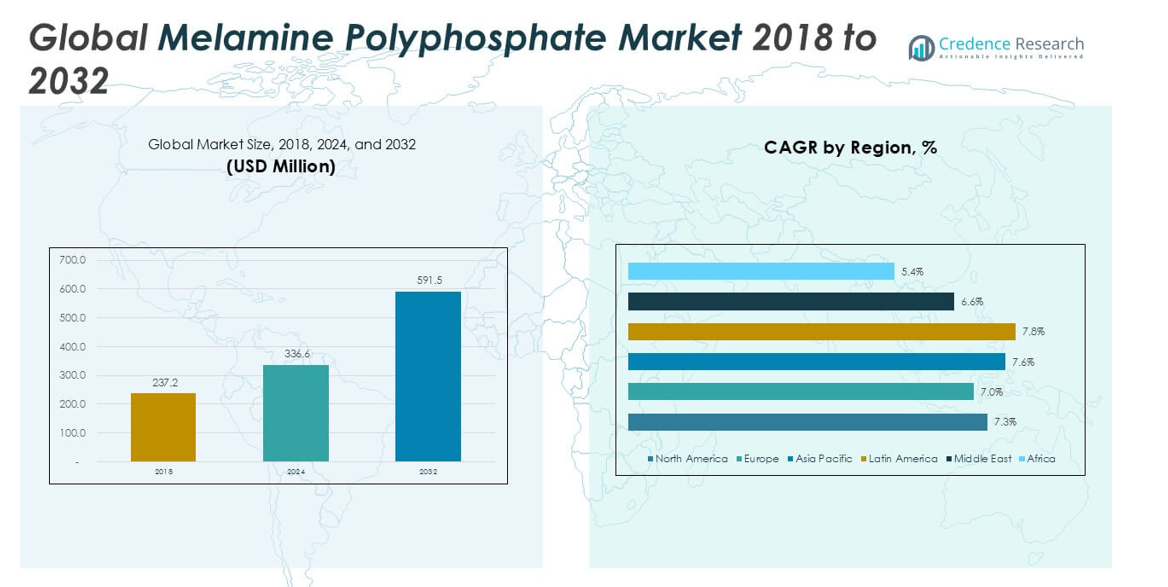
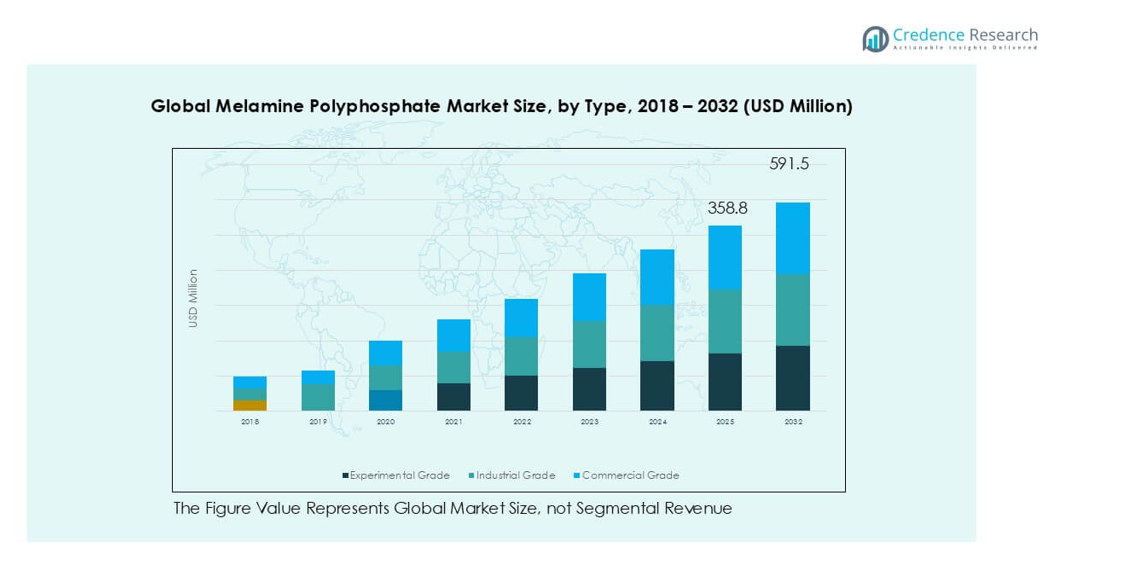
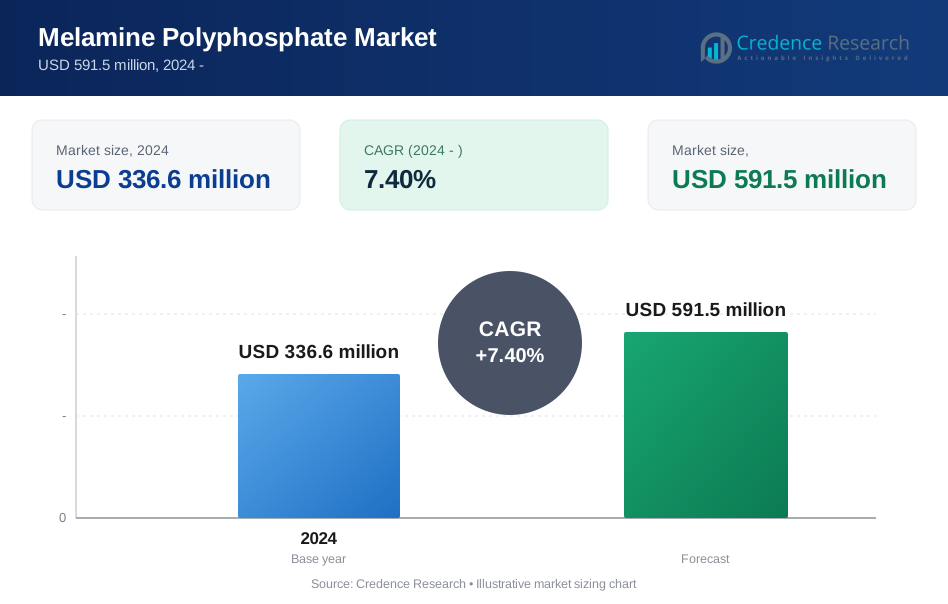
The Global Melamine Polyphosphate market size was valued at USD 237.2 million in 2018, increasing to USD 336.6 million in 2024, and is anticipated to reach USD 591.5 million by 2032, at a CAGR of 7.40% during the forecast period.
| REPORT ATTRIBUTE | DETAILS |
|---|---|
| Historical Period | 2020-2023 |
| Base Year | 2024 |
| Forecast Period | 2025-2032 |
| Melamine Polyphosphate Market Size 2024 | USD 336.6 million |
| Melamine Polyphosphate Market, CAGR | 7.40% |
| Melamine Polyphosphate Market Size 2032 | USD 591.5 million |
The global melamine polyphosphate market is shaped by prominent players such as Puyang Chengke Chemical, Shouguang Weidong Chemical, Cnsolver Technology, JLS Chemical, Zhenjiang Xingxing Flame Retardant Co., Ltd., and Century Multech Inc., which collectively account for a substantial share of global supply. These companies focus on delivering halogen-free flame retardant solutions to meet strict safety and environmental regulations. Regionally, Asia Pacific leads the market with 33% share in 2024, supported by rapid industrialization and rising adoption in automotive, construction, and textiles. North America follows with 27%, driven by advanced material applications and stringent fire safety standards, while Europe holds 22%, anchored by REACH and RoHS compliance. This regional dominance reflects strong regulatory frameworks and sustained industrial demand.
Market Insights
- The global melamine polyphosphate market was valued at USD 237.2 million in 2018, reached USD 336.6 million in 2024, and is projected to hit USD 591.5 million by 2032, expanding at a CAGR of 7.4%.
- Rising demand for halogen-free flame retardants in automotive, construction, and electronics drives market growth, supported by strict global fire safety regulations and eco-compliance standards.
- Key trends include increasing adoption in advanced polymers and composites, with synthetic resins holding over 55% share in 2024 as the dominant application segment.
- The competitive landscape features players such as Puyang Chengke Chemical, JLS Chemical, and Century Multech Inc., focusing on product innovation, sustainability, and strategic collaborations to maintain market strength.
- Regionally, Asia Pacific leads with 33% share in 2024, followed by North America at 27% and Europe at 22%, while Latin America (9%), Middle East (6%), and Africa (3%) present emerging opportunities.
Market Segmentation Analysis:
By Application
The synthetic resins segment accounted for the dominant share of the global melamine polyphosphate market in 2024, capturing over 55% of total revenue. Its widespread use in epoxy, polyester, and polyurethane formulations drives adoption, as these resins deliver superior flame retardancy and thermal stability. Rising demand in construction materials, electronics housings, and automotive components strengthens its position. Thermoplastic elastomers followed, supported by their flexibility and increasing role in wire coatings and cable sheathing. The “others” category, including coatings and adhesives, remains a smaller but steady contributor.
- For instance, JLS Chemical manufactures and supplies melamine polyphosphate to epoxy resin producers in Asia for use in flame-retardant applications such as building panels and electronic housings.
By End User
The automotive sector led the end-user segment in 2024 with more than 40% market share, driven by stringent safety regulations and the need for lightweight, flame-retardant materials in interiors and under-the-hood applications. Melamine polyphosphate is increasingly used in dashboards, seat components, and electrical systems to meet flammability standards. The textile industry ranks second, benefitting from its use in protective fabrics and industrial gear. Aerospace & defense and packaging sectors also show steady growth, while “others” include smaller applications in consumer goods and electronics.
- For instance, Century Multech Inc. is a supplier of melamine polyphosphate (MPP), a flame retardant used in textile applications like protective clothing. In 2023, the company served customers in North America and other regions.
Market Overview
Stringent Fire Safety Regulations
The growing enforcement of fire safety regulations across construction, automotive, and electronics industries has been a major driver for the melamine polyphosphate market. This compound is valued for its halogen-free flame retardant properties, making it a preferred choice over conventional halogenated additives that raise environmental and health concerns. In the construction industry, stringent codes demand safer building materials to reduce fire hazards, while automotive manufacturers integrate flame-retardant resins in interior and under-the-hood components. Electronics and electrical goods also increasingly rely on melamine polyphosphate to meet safety certifications. These regulations not only push demand from mature markets like North America and Europe but also encourage adoption in emerging economies where safety standards are tightening. The continued alignment with REACH and RoHS directives further reinforces its market presence, creating sustained demand growth.
- For instance, in 2023, JLS Chemical supplied a significant volume of its halogen-free flame retardants, including melamine-modified ammonium polyphosphate, to resin producers in China. These products are widely used in construction boards and insulation materials to help meet local fire safety standards, such as China's GB 8624.
Rising Demand in Automotive and Aerospace
The automotive and aerospace sectors represent strong demand bases due to their reliance on lightweight, durable, and flame-retardant materials. Melamine polyphosphate is widely used in thermoplastic and thermosetting resins for dashboards, cable insulation, seat frames, and aerospace interior panels. The increasing shift toward electric vehicles (EVs) has heightened the need for advanced flame-retardant materials in battery housings, wiring systems, and charging infrastructure. Aerospace manufacturers also prioritize safety-compliant, lightweight solutions that reduce overall fuel consumption while meeting stringent safety standards. With global EV sales expected to exceed 30 million units annually by 2030 and rising air travel demand, these sectors present robust growth opportunities. This combination of performance needs and regulatory compliance firmly positions melamine polyphosphate as a critical additive in next-generation mobility and aerospace technologies.
- For instance, in 2023, Chinese automotive component manufacturers sourced melamine polyphosphate from various domestic suppliers, including well-known chemical companies like Jiangsu Yoke Technology and Chengdu Dova New Material.
Shift Toward Sustainable and Halogen-Free Alternatives
Global sustainability goals and consumer awareness are accelerating the move toward eco-friendly flame retardants. Melamine polyphosphate is halogen-free, non-toxic, and exhibits low smoke emission, making it increasingly favored over brominated or chlorinated retardants. Governments and industries are actively phasing out halogenated additives due to environmental persistence and hazardous byproducts. Packaging, textiles, and electronics manufacturers are adopting melamine polyphosphate to align with environmental certifications and brand sustainability goals. The growing emphasis on circular economy principles and stricter eco-label requirements in the EU, U.S., and Asia Pacific further support this transition. Demand is particularly strong in Europe, where green initiatives and recycling mandates encourage wider use of sustainable flame retardants. This trend not only enhances adoption across diverse sectors but also pushes continuous innovation in high-performance formulations of melamine polyphosphate.
Key Trends & Opportunities
Integration in Advanced Polymers and Composites
One key trend shaping the market is the integration of melamine polyphosphate in advanced polymers and composite materials. As industries seek materials that combine lightweight performance, durability, and flame resistance, melamine polyphosphate has become a vital additive in epoxy, polyester, and polyurethane composites. Automotive and aerospace sectors, in particular, demand composites that can replace heavier metals while maintaining high safety standards. Additionally, the electronics sector is embracing melamine polyphosphate-enhanced polymers for enclosures, connectors, and circuit boards. This rising use in advanced formulations not only boosts demand but also opens opportunities for product differentiation and innovation.
- For instance, Hangzhou JLS Flame Retardants Chemical Co., Ltd. (JLS Chemical) manufactures halogen-free flame retardants, including melamine polyphosphate, for various applications in construction panels and automotive parts. In 2021, the company began construction on a new production facility with a planned capacity of 16,000 tons of flame retardants, and its total annual production capacity across all sites was reported as 58,000 metric tons as of October 2022.
Expansion in Emerging Economies
Rapid industrialization and infrastructure development in Asia Pacific, Latin America, and the Middle East present strong opportunities for melamine polyphosphate adoption. In these regions, rising construction projects, increasing automotive production, and expanding textile industries are creating significant demand. Governments are also introducing stricter fire safety norms, aligning with global best practices, which drives adoption of advanced flame retardants. China, India, and Southeast Asia are expected to lead consumption due to their booming manufacturing base and rising focus on safety compliance. This expansion in emerging economies positions the market for long-term growth while reducing dependency on mature markets in Europe and North America.
Key Challenges
High Production Costs and Price Volatility
One of the primary challenges in the global melamine polyphosphate market is the high cost of production compared to conventional flame retardants. The manufacturing process involves energy-intensive steps, which raise operational expenses. Moreover, raw material price volatility, especially in melamine and phosphoric acid, further impacts pricing stability. This cost factor often discourages adoption in price-sensitive markets, where low-cost halogenated flame retardants still dominate. Although regulatory pressures are gradually shifting preferences, balancing affordability with compliance remains a barrier. Manufacturers need to invest in process efficiency and scale-up strategies to counter this challenge and improve competitiveness.
Limited Processing Compatibility
Another challenge lies in the limited compatibility of melamine polyphosphate with certain polymers and processing techniques. Its relatively high decomposition temperature can restrict its use in specific thermoplastics that require low-temperature processing. Additionally, achieving uniform dispersion in some resins can be difficult, leading to compromised mechanical properties. These technical barriers limit broader adoption, particularly in high-performance applications where consistency and structural integrity are crucial. Industry players are focusing on developing modified grades and synergistic formulations to overcome these limitations, but progress remains gradual. This factor continues to challenge manufacturers and end-users seeking seamless integration.
Regional Analysis
North America
North America held a significant share of the global melamine polyphosphate market, valued at USD 65.04 million in 2018, reaching USD 91.70 million in 2024, and projected to attain USD 159.70 million by 2032, at a CAGR of 7.3%. The region accounted for nearly 27% market share in 2024, driven by strong demand from automotive, aerospace, and construction industries. Strict fire safety regulations and advanced material innovation further support adoption. The U.S. dominates regional consumption, with widespread use in resins and thermoplastic applications. Growth will remain steady as safety standards tighten further.
Europe
Europe represented a strong market base, valued at USD 52.44 million in 2018, increasing to USD 73.96 million in 2024, and expected to reach USD 128.83 million by 2032, with a CAGR of 7.0%. The region captured around 22% market share in 2024, supported by stringent EU regulations such as REACH and RoHS. Industries such as textiles, automotive, and electrical equipment rely heavily on halogen-free flame retardants. Germany, France, and the UK lead adoption due to mature manufacturing bases and sustainability-driven initiatives. Continuous regulatory compliance will sustain steady growth across diverse end-user segments.
Asia Pacific
Asia Pacific dominated the global melamine polyphosphate market, valued at USD 82.49 million in 2018, growing to USD 118.69 million in 2024, and projected to reach USD 212.28 million by 2032, registering the highest CAGR of 7.6%. With nearly 33% market share in 2024, the region leads consumption due to rapid industrialization, large-scale construction, and expanding automotive and textile sectors. China and India remain key markets, driven by rising safety standards and manufacturing growth. Increasing electronics production and government regulations on fire safety strengthen adoption, making Asia Pacific the largest and fastest-growing regional segment.
Latin America
Latin America’s melamine polyphosphate market was valued at USD 21.13 million in 2018, reaching USD 30.77 million in 2024, and is expected to rise to USD 55.90 million by 2032, with a CAGR of 7.8%, the second highest globally. The region held close to 9% market share in 2024, supported by expanding construction, packaging, and textile industries. Brazil and Mexico drive demand with growing industrialization and gradual adoption of stricter fire safety standards. The region’s increasing investment in manufacturing and infrastructure creates long-term opportunities, though growth depends on consistent regulatory enforcement.
Middle East
The Middle East market for melamine polyphosphate stood at USD 11.34 million in 2018, rising to USD 15.43 million in 2024, and projected to reach USD 25.55 million by 2032, at a CAGR of 6.6%. The region accounted for about 6% of market share in 2024, driven by construction, automotive, and aerospace applications. The UAE and Saudi Arabia lead regional adoption due to large-scale infrastructure projects and increasing demand for flame-retardant materials. While smaller than other regions, growth is steady as regulations on fire safety become more stringent and industrial adoption continues to expand.
Africa
Africa remains the smallest regional market, valued at USD 4.74 million in 2018, increasing to USD 6.10 million in 2024, and anticipated to reach USD 9.23 million by 2032, with a CAGR of 5.4%, the lowest among all regions. The region held roughly 3% market share in 2024, with growth concentrated in South Africa and parts of North Africa. Demand comes primarily from packaging and textiles, while construction adoption is gradually increasing. Limited industrialization and weaker enforcement of fire safety regulations restrain rapid expansion. However, urbanization and infrastructure development may unlock incremental opportunities over time.
Market Segmentations:
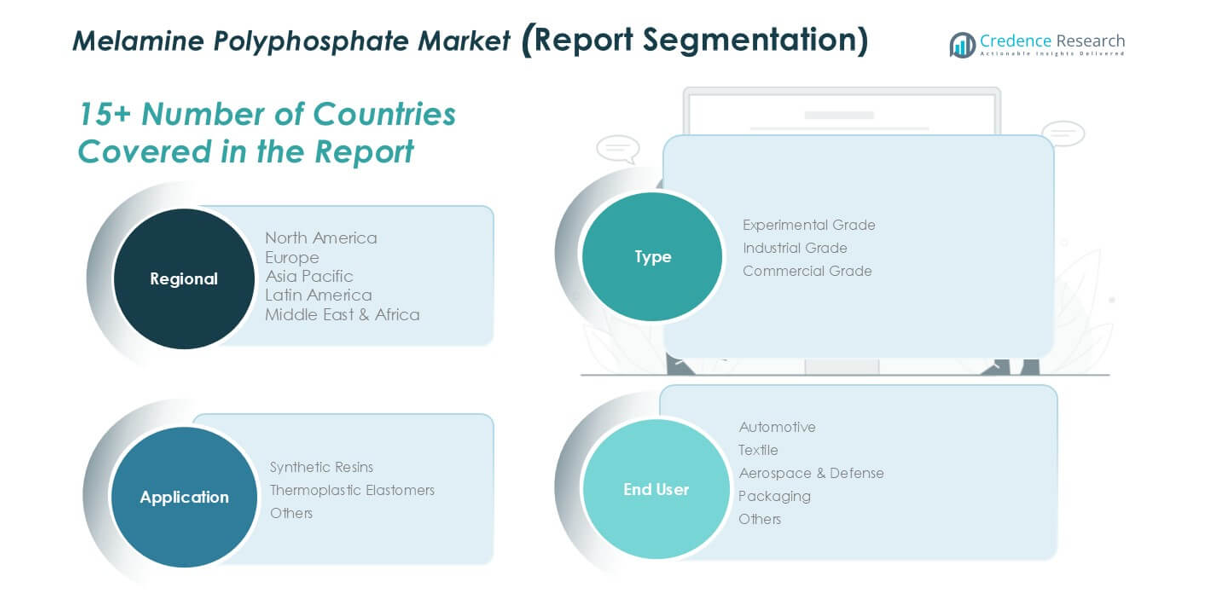
By Application
- Synthetic Resins
- Thermoplastic Elastomers
- Others
By End User
- Automotive
- Textile
- Aerospace & Defense
- Packaging
- Others
By Geography
- North America
- U.S.
- Canada
- Mexico
- Europe
- UK
- France
- Germany
- Italy
- Spain
- Russia
- Belgium
- Netherlands
- Austria
- Sweden
- Poland
- Denmark
- Switzerland
- Rest of Europe
- Asia Pacific
- China
- Japan
- South Korea
- India
- Australia
- Thailand
- Indonesia
- Vietnam
- Malaysia
- Philippines
- Taiwan
- Rest of Asia Pacific
- Latin America
- Brazil
- Argentina
- Peru
- Chile
- Colombia
- Rest of Latin America
- Middle East
- UAE
- KSA
- Israel
- Turkey
- Iran
- Rest of Middle East
- Africa
- Egypt
- Nigeria
- Algeria
- Morocco
- Rest of Africa
Competitive Landscape
The global melamine polyphosphate market features a moderately consolidated competitive landscape, with key players focusing on capacity expansion, product innovation, and compliance with fire safety and environmental standards. Companies such as Puyang Chengke Chemical, Shouguang Weidong Chemical, Cnsolver Technology, JLS Chemical, Zhenjiang Xingxing Flame Retardant Co., Ltd., and Century Multech Inc. dominate the industry through strong distribution networks and extensive product portfolios. These players invest heavily in research to develop halogen-free flame retardant solutions that meet stringent EU and U.S. regulations. Strategic collaborations with end-use sectors, including automotive, construction, and textiles, further enhance their market position. Financially robust firms leverage economies of scale to maintain competitive pricing, while smaller regional manufacturers compete by offering cost-effective alternatives in emerging markets. Recent developments also highlight increased investments in eco-friendly and high-performance formulations, reflecting industry focus on sustainability. Overall, competition remains intense, with innovation and regulatory compliance driving differentiation.
Key Player Analysis
- Puyang Chengke Chemical
- Shouguang Weidong Chemical
- Cnsolver Technology
- JLS Chemical
- Zhenjiang Xingxing Flame Retardant Co., Ltd.
- Century Multech Inc.
- Zhenjiang Xingxing Flame Retardant Co., Ltd.
- Other Key Players
Recent Developments
- In 2023, BASF announced plans to expand its MPP production capacity in China to meet the growing demand in the region.
- In 2023 Clariant has emphasized its commitment to developing more sustainable MPP production processes, potentially reducing environmental impact
Report Coverage
The research report offers an in-depth analysis based on Application, End-User and Geography. It details leading market players, providing an overview of their business, product offerings, investments, revenue streams, and key applications. Additionally, the report includes insights into the competitive environment, SWOT analysis, current market trends, as well as the primary drivers and constraints. Furthermore, it discusses various factors that have driven market expansion in recent years. The report also explores market dynamics, regulatory scenarios, and technological advancements that are shaping the industry. It assesses the impact of external factors and global economic changes on market growth. Lastly, it provides strategic recommendations for new entrants and established companies to navigate the complexities of the market.
Future Outlook
- The market will expand steadily with rising demand for halogen-free flame retardants.
- Asia Pacific will continue leading growth due to industrialization and stricter safety norms.
- Automotive and aerospace industries will drive adoption for lightweight and fire-resistant materials.
- Synthetic resins will remain the dominant application segment across end-use sectors.
- Sustainability focus will accelerate replacement of halogenated flame retardants worldwide.
- Innovation in advanced polymer formulations will create new application opportunities.
- Europe and North America will maintain strong demand through regulatory compliance.
- Latin America, Middle East, and Africa will see gradual adoption with infrastructure growth.
- Competitive intensity will increase as companies expand portfolios and capacity.
- Partnerships with end-users will enhance customized solutions for diverse industries.
Request a Free Sample
Fill in your details and we'll send you a free sample report.
- Sample data tables & charts
- Research methodology
Need a Custom Version of This Report?
Tailor the scope, geography, or segments to your exact requirements.
- Custom geography or segment scope
- Direct access to our analyst team
Frequently Asked Questions
What is the current market size for Global Melamine Polyphosphate market, and what is its projected size in 2032?
At what Compound Annual Growth Rate is the Global Melamine Polyphosphate market projected to grow between 2025 and 2032?
Which Global Melamine Polyphosphate market segment held the largest share in 2024?
What are the primary factors fueling the growth of the Global Melamine Polyphosphate market?
Who are the major players in this market?
Table of Content
Chapter 1. Report Introduction
- 1.1 Report Description & Purpose
- 1.1.1 Report Title & Market Definition
- 1.1.2 Unique Selling Propositions (USP) & Key Differentiators
- 1.1.3 Value Proposition for Stakeholders
- 1.2 Research Objectives
- 1.2.1 Market Sizing Objectives (Volume & Revenue)
- 1.2.2 Segmentation Objectives
- 1.2.3 Competitive Intelligence Objectives
- 1.2.4 Forecast & Scenario Objectives
- 1.3 Report Scope
- 1.3.1 Melamine Polyphosphate Scope – Types & Subtypes Covered
- 1.3.2 Geographic Scope – Regions & Countries Covered
- 1.3.3 Historical Period, Base Year & Forecast Period (2024; forecast to the forecast period)
- 1.3.4 Inclusions & Exclusions
- 1.4 HS Code & Classification Framework
- 1.5 Currency, Units & Pricing Basis
- 1.6 Target Stakeholders
- 1.7 Limitations & Assumptions
Chapter 2. Executive Summary
- 2.1 Global Melamine Polyphosphate Market Snapshot
- 2.1.1 Market Size – Historical (2024) & Forecast (the forecast period) (2024: USD 336.6 million → forecast year: USD 591.5 million)
- 2.1.2 Volume & Revenue – Global Totals
- 2.1.3 Key Market Highlights – Top Five Facts
- 2.2 Melamine Polyphosphate Market Segmentation Snapshot
- 2.2.1 Market Split by Region – 2024 vs.
- 2.3 Competitive Snapshot
- 2.3.1 Top 10 Players by Revenue Share – 2024
- 2.3.2 Top 10 Players by Volume Share – 2024
- 2.3.3 Recent Strategic Developments (18-Month Summary)
- 2.4 Key Investment Highlights & Strategic Conclusions
Chapter 3. Melamine Polyphosphate Market Dynamics & Industry Analysis
- 3.1 Market Overview & Context
- 3.1.1 Melamine Polyphosphate Market Position in the Broader Automotive Value Chain
- 3.1.2 OEM vs. Replacement Market Dynamics
- 3.1.3 Market Maturity & Development Stage by Region
- 3.2 Melamine Polyphosphate Market Drivers
- 3.3 Melamine Polyphosphate Market Restraints & Challenges
- 3.4 Melamine Polyphosphate Market Opportunities
- 3.5 Porter's Five Forces Analysis
- 3.5.1 Threat of New Entrants
- 3.5.2 Bargaining Power of Suppliers
- 3.5.3 Bargaining Power of Buyers
- 3.5.4 Threat of Substitutes
- 3.5.5 Competitive Rivalry – Intensity Assessment
- 3.6 Melamine Polyphosphate Value Chain Analysis
- 3.6.1 Upstream – Raw Material/Input Suppliers
- 3.6.1.1 Raw Material/Input 1
- 3.6.1.2 Raw Material/Input 2
- 3.6.1.3 Raw Material/Input 3
- 3.6.2 Midstream – Production/Manufacturing/Service Delivery
- 3.6.2.1 Production/Process Overview
- 3.6.2.2 Key Facility Locations & Capacity by Manufacturer
- 3.6.3 Downstream – Distribution & End Consumer
- 3.6.3.1 Primary Channel – B2B/OEM
- 3.6.3.2 Secondary Channels – Dealer, Retail, Online, Direct
- 3.6.4 Value Chain Profitability Analysis
- 3.6.1 Upstream – Raw Material/Input Suppliers
- 3.7 PESTEL Analysis
- 3.7.1 Political Factors
- 3.7.2 Economic Factors
- 3.7.3 Social Factors
- 3.7.4 Technological Factors
- 3.7.5 Environmental Factors
- 3.7.6 Legal Factors
- 3.8 Melamine Polyphosphate Supply Chain Analysis
- 3.8.1 Raw Material/Input Supply Risk Assessment
- 3.8.2 Manufacturing Concentration Risk (Geographic Exposure)
- 3.8.3 Trade Disruption Impact Analysis
- 3.9 Regulatory & Policy Landscape
Note: The regulatory and policy landscape section covers regulations based on their applicability to the market, Melamine Polyphosphate category, geography, and scope of the study. Only regulatory frameworks with a material impact on operations, compliance, trade, sustainability, or market access are analyzed in detail.
Chapter 4. Key Investment Pockets & Opportunity Analysis
- 4.1 Melamine Polyphosphate Market Attractiveness Analysis
- 4.1.1 By Region – Investment Attractiveness Matrix (Volume × CAGR)
- 4.2 Absolute Revenue Growth Opportunity
- 4.2.1 By Region – Absolute USD Growth Through the forecast period
- 4.3 Incremental Volume Opportunity
- 4.3.1 By Region – Incremental Volume Through the forecast period
- 4.3.2 Segment – Incremental Volume
- 4.4 Emerging Submarket Opportunity Deep Dive (Subject to Applicability)
- 4.5 Emerging Market Opportunity Scorecards
- 4.5.1 United States
- 4.5.2 Europe
- 4.5.3 Asia
- 4.5.4 Middle East & Africa
Note: Emerging Market Opportunity Scorecards will be included based on relevance and strategic importance. Regions listed are indicative and may vary depending on data availability and market dynamics.
Chapter 5. Melamine Polyphosphate Import-Export Analysis & Trade Flows
- 5.1 Global Trade Overview
- 5.1.1 Global Export Value by Country (2024)
- 5.1.2 Global Export Volume by Country (2024)
- 5.1.3 Global Import Value by Country (2024)
- 5.1.4 Global Import Volume by Country (2024)
- 5.1.5 Net Trade Balance by Country (2024)
- 5.2 Export Analysis – Segment
- 5.2.1 Type 1 (HS Code)
- 5.2.2 Type 2 (HS Code)
- 5.2.3 Type 3 (HS Code)
- 5.2.4 Type 4 (HS Code)
- 5.2.5 Type 5 (HS Code)
- 5.3 Import Analysis – Segment
- 5.3.1 Type 1 (HS Code)
- 5.3.2 Type 2 (HS Code)
- 5.3.3 Type 3 (HS Code)
- 5.3.4 Type 4 (HS Code)
- 5.3.5 Type 5 (HS Code)
- 5.4 Average Unit Trade Prices
- 5.4.1 Average Export Price – Segment & Country
- 5.4.2 Average Import Price – Segment & Source Country
- 5.4.3 Price Trends (2024)
- 5.5 Key Trade Route Analysis
- 5.5.1 Trade Route 1
- 5.5.2 Trade Route 2
- 5.5.3 Trade Route 3
- 5.5.4 Trade Route 4
- 5.5.5 Trade Route 5
- 5.6 Trade Policy Impact Assessment
- 5.6.1 US Anti-Dumping & Section 301 Tariffs
- 5.6.2 EU Customs Union Impact
- 5.6.3 Major Free Trade Agreements
- 5.6.4 USMCA Rules of Origin
Note: Trade policy analysis will be included only where relevant to the Melamine Polyphosphate market.
Chapter 6. Competitive Landscape & Company Benchmarking
- 6.1 Melamine Polyphosphate Market Concentration & Structure
- 6.1.1 Herfindahl-Hirschman Index (HHI) – vs. 2024
- 6.1.2 Tier 1, Tier 2 & Tier 3 Market Structure
- 6.1.3 Global, Regional & Local Player Dynamics
- 6.2 Melamine Polyphosphate Market Share Analysis – 2024
- 6.2.1 Global Revenue Share by Company
- 6.2.2 Global Volume Share by Company
- 6.2.3 Regional Revenue Share
- 6.2.4 Market Share Evolution ( vs. 2024)
- 6.2.5 OEM Segment Share by Company
- 6.2.6 Replacement Segment Share by Company
- 6.3 Production/Delivery Capacity & Facility Analysis
- 6.3.1 Global Installed Capacity
- 6.3.2 Capacity Utilization Rates
- 6.3.3 Production/Output Volume
- 6.3.4 Facility Locations & Capacity Map
- 6.3.5 Planned Capacity Additions
- 6.4 Melamine Polyphosphate Competitive Benchmarking Matrix
- 6.4.1 Revenue, Volume, CAGR & Profitability Comparison
- 6.4.2 Channel Revenue Mix
- 6.4.3 Geographic Revenue Exposure
- 6.4.4 R&D Intensity
- 6.4.5 Sustainability Maturity
- 6.5 Strategic Developments in Melamine Polyphosphate (Last 24 Months)
- 6.5.1 Mergers, Acquisitions & Divestments
- 6.5.2 New Melamine Polyphosphate Launches
- 6.5.3 Facility Expansions
- 6.5.4 Strategic Alliances, Joint Ventures & Partnerships
- 6.5.5 Distribution Expansion & Market Entry
- 6.5.6 Sustainability & ESG Initiatives
- 6.6 Competitive Strategy Mapping
- 6.6.1 Leader, Challenger, Follower & Niche Classification
- 6.6.2 Pricing Strategy Comparison
- 6.6.3 Channel Strategy Matrix
Note: Strategic developments are included based on their materiality and the availability of reliable information.
Chapter 7. Global Melamine Polyphosphate Market – By Distribution Channel
- 7.1 Segment Overview
- 7.1.1 Volume & Revenue Split by Channel (2024 & )
- 7.1.2 Channel Mix Evolution (the forecast period)
Chapter 8. Regional Market Analysis – Global Overview
- 8.1 Global Regional Overview
- 8.1.1 Regional Volume Share
- 8.1.2 Regional Revenue Share
- 8.1.3 Regional Volume by Region
- 8.1.4 Regional Revenue by Region
- 8.1.5 Regional Forecast Through the forecast period
- 8.2 Cross-Regional Segment Analysis
- 8.2.1 By Distribution Channel
- 8.2.2 By Brand/Price Tier
Chapter 9. North America Melamine Polyphosphate Market
- 9.1 United States
- 9.2 Canada
- 9.3 Mexico
Chapter 10. Europe Melamine Polyphosphate Market
- 10.1 Germany
- 10.2 France
- 10.3 Italy
- 10.4 United Kingdom
- 10.5 Spain
- 10.6 Poland
- 10.7 Russia
- 10.8 Netherlands
- 10.9 Belgium
- 10.10 Sweden
- 10.11 Denmark
- 10.12 Norway
- 10.13 Rest of Europe
Chapter 11. Asia Pacific Melamine Polyphosphate Market
- 11.1 China
- 11.2 India
- 11.3 Japan
- 11.4 South Korea
- 11.5 Thailand
- 11.6 Indonesia
- 11.7 Vietnam
- 11.8 Malaysia
- 11.9 Australia
- 11.10 Rest of Asia Pacific
Chapter 12. Latin America Melamine Polyphosphate Market
- 12.1 Brazil
- 12.2 Argentina
- 12.3 Colombia
- 12.4 Chile
- 12.5 Rest of Latin America
Chapter 13. Middle East Melamine Polyphosphate Market
- 13.1 Saudi Arabia
- 13.2 United Arab Emirates
- 13.3 Turkey
- 13.4 Israel
- 13.5 Iran
- 13.6 Rest of the Middle East
Chapter 14. Africa Melamine Polyphosphate Market
- 14.1 South Africa
- 14.2 Egypt
- 14.3 Nigeria
- 14.4 Morocco
- 14.5 Rest of Africa
Chapter 15. Melamine Polyphosphate Company Profiles
- 15.1 [Company 01]
- 15.1.1 Company Overview
- 15.1.2 Key Management Personnel
- 15.1.3 Products & Services Portfolio
- 15.1.4 Financial Performance
- 15.1.5 Key Market Focus & Geographic Presence
- 15.1.6 Recent Developments & Strategic Initiatives
Note: The company profile list is preliminary and may change based on research findings, market developments, data availability, and client requirements.
Chapter 16. Appendices
- Appendix A – List of Abbreviations & Acronyms
- Appendix B – Industry Classification Code Reference – Full Series
- Appendix C – Production & Capacity Data Tables
- Appendix D – End-Use & Demand Base Tables
- Appendix E – Consumption & Replacement Rate Assumptions
- Appendix F – ASP Reference Tables
- Appendix G – Manufacturing & Facility Database
- Appendix H – Import-Export Data Tables
- Appendix I – Regulatory Summary Tables
- Appendix J – Primary Research Participant List (Anonymized)
- Appendix K – Primary Research Questionnaire Framework
- Appendix L – Data Sources & Bibliography
- Appendix M – Market Size Divergence & Source Comparison
Chapter 17. Research Methodology
- 17.1 Research Framework & Philosophy
- 17.2 Secondary Research – Sources, Hierarchy & Data Extraction
- 17.3 Data Modeling – Bottom-Up & Top-Down Market Sizing
- 17.4 Primary Research – Stakeholder Framework, LOI & Sample Sizes
- 17.5 Forecast Methodology – Regression, Scenario & Sensitivity Analysis
- 17.6 Quality Control – Four-Layer Validation Framework
- 17.7 Limitations & Standard Assumptions
- 17.8 Disclaimer
