
| REPORT ATTRIBUTE | DETAILS |
|---|---|
| Historical Period | 2019-2022 |
| Base Year | 2023 |
| Forecast Period | 2024-2032 |
| Metrology Software Market Size 2023 | USD 1105.2 Million |
| Metrology Software Market, CAGR | 1.10% |
| Metrology Software Market Size 2032 | USD 1219.5 Million |
Market Insights
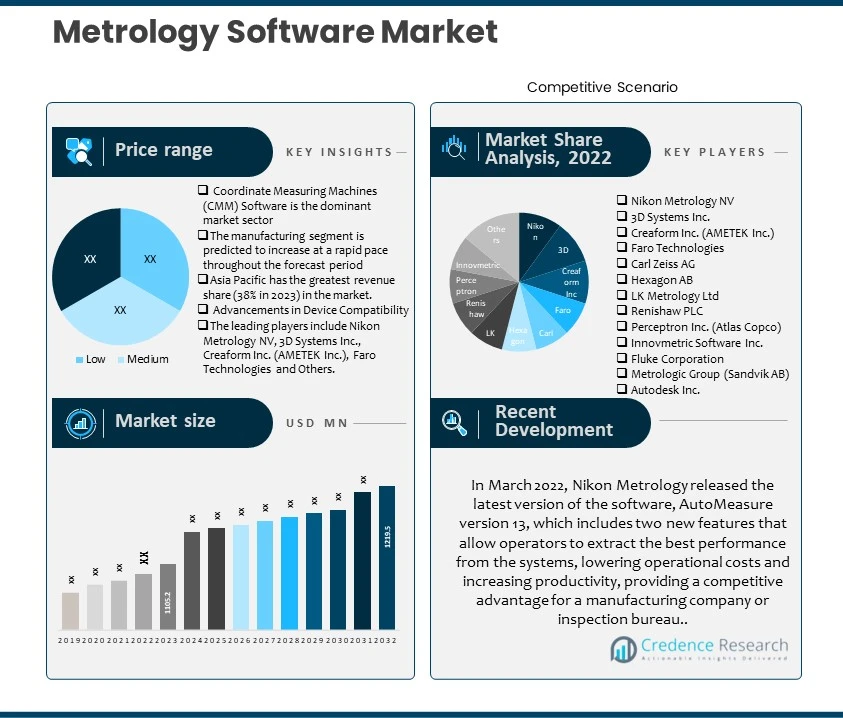
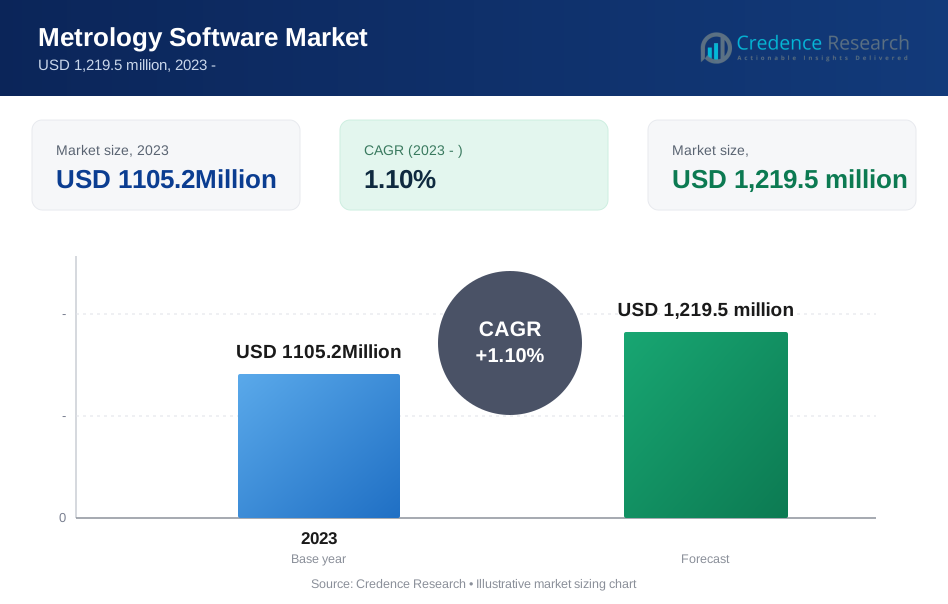
- The global demand for metrology software was valued at USD 1105.2 million in 2023 and is expected to reach USD 1219.5 million in 2032, growing at a CAGR of 1.10% between 2024 and 2032.
- The Online/Cloud-based Metrology Software industry and the offline metrology category are expected to increase significantly throughout the projection period.
- The reverse engineering industry is predicted to increase at a quick pace throughout the projection period. The quality control and inspection application sector drove the metrology software market.
- The manufacturing segment is expected to grow rapidly over the forecast period. The automotive sector contributes the most to the market and is estimated to grow at a CAGR of 6.11% over the forecast period.
- Data Analysis accounts for a significant portion of the metrology software market.
- Coordinate Measuring Machine (CMM) Software is the major market sector, and Portable Measuring Arms Software is another important component.
- The most prominent segment of the metrology software market is cloud-based software.
- ISO 9001 has a stronger market demand in the metrology software industry.
- 3D measurement has a significant share of the metrology software market.
- Asia Pacific has the biggest revenue share (38% in 2023), and North America is predicted to enjoy the quickest growth in the metrology software market.
- Increased push for process automation in the industrial business.
- Lack of awareness to impede market growth
Executive Summary
Market Definition
The Metrology Software Market refers to the market for metrology-related software solutions. Metrology is the science of measurement, which involves precisely and accurately measuring physical quantities. In the Metrology Software Market, these software solutions are intended to simplify and improve measuring procedures, data analysis, and quality control in a variety of industries, including manufacturing, automotive, aerospace, and healthcare. The program often includes capabilities for data collection, processing, visualization, and reporting, which assist enterprises in ensuring the accuracy and reliability of their measures and meeting quality standards.
Market Overview
The global Metrology Software Market has witnessed steady growth in recent years and is expected to grow at a CAGR of 1.10% between 2024 and 2032. The market was valued at USD 1105.2 million in 2023 and is expected to reach USD 1219.5 million in 2032.
The metrology software market is rapidly increasing and is likely to continue so in the future years. With the growing demand for precision and quality in numerous industries, modern metrology solutions have become critical. Metrology software helps to streamline measuring procedures, increase efficiency, and ensure measurement accuracy. It includes functions like data analysis, visualization, and reporting, allowing organizations to make informed decisions based on accurate measurements. Technological developments, automation, and increased use of Industry 4.0 techniques are all driving factors in the market. Key market participants are always innovating to create software solutions tailored to the specific needs of various sectors.
Segmentation by Type
- The Online/Cloud-based Metrology Software sector is likely to grow at a rapid pace during the forecast period, owing to the availability of data silos on cloud platforms and advances in big data analytics. Cloud platforms improve manufacturers' feasibility and flexibility in measurement applications.
- The Offline Metrology category is expected to grow rapidly during the projected period due to the convenience and flexibility provided by web-based metrology software solutions.
Segmentation by Application
- The reverse engineering industry is expected to grow at a rapid pace over the forecast period because to the high precision and accuracy provided by metrology software.
- The metrology software market was dominated by the quality control and inspection application sector, which is expected to remain during the projection period. Several industries, including automotive, aerospace, and military, as well as semiconductor, have implemented quality control and inspection systems in response to rising competitiveness and the need for safety improvements.
Segmentation by End-User
- The manufacturing segment is predicted to increase at a rapid pace throughout the forecast period. The segment's rise is attributed to increased industrialization as a result of economic liberalization, as well as the following requirement for sophisticated measuring systems for quality assurance in the manufacturing sector. The manufacturing sector is competitive due to the increasing number of new entrants.
- The automotive category contributes the most to the market and is expected to increase at a CAGR of 6.11% over the projected period.
Segmentation by Function
- Data Analysis holds a major share of the Metrology Software Market. Data analysis is important in metrology software because it includes processing and interpreting collected data to gain relevant insights and make educated decisions. It aids in finding patterns, trends, and anomalies in measurements, allowing businesses to optimise processes and assure quality control.
Segmentation by Device Compatibility
- Coordinate Measuring Machines (CMM) Software is the dominant market sector. CMM software is frequently used in many industries to make precise and accurate measurements. It has comprehensive tools for data collection, processing, and reporting, making it a popular choice among enterprises.
- Portable Measuring Arms Software is another key part that allows for flexibility and portability during on-site measurements. It enables users to take measurements in a variety of settings, making it an invaluable tool in industries like aerospace and automotive.
Segmentation by Deployment
- The most prominent segment of the Metrology Software Market is Cloud-Based software. The multiple benefits of cloud-based metrology software have led to its adoption. It provides flexibility, scalability, and accessibility, enabling users to view and evaluate measurement data from any location with an internet connection.
Segmentation by Industry Standards
- The ISO 9001 category has a higher market demand in the metrology software industry. ISO 9001 is a well-known quality management standard that focuses on maintaining consistent quality in products and services. Many organizations in numerous industries aim to acquire ISO 9001 certification, which frequently necessitates the use of metrology software to meet the standard's measurement and quality control criteria.
Segmentation by Measurement Type
- 3D Measurement holds a considerable share of the metrology software industry. It entails collecting and interpreting three-dimensional data to precisely measure objects and surfaces. It is widely utilized in the manufacturing, automotive, and aerospace industries for quality control and inspection.
Segmentation by Region
- Asia Pacific has the greatest revenue share (38% in 2023) in the market.
- North America is expected to experience the fastest growth in the Metrology Software Market
- The rest of the world, including Latin America, the Middle East, and Africa, supplies the remaining demand for Metrology Software.
Asia Pacific is estimated to lead the market during the forecast period due to the expansion of the industrial sector as a result of favorable government policies and the implementation of smart manufacturing methods. Also, the Asia Pacific region's manufacturing industry is expanding rapidly as consumer demand for diverse industrial products rises. The region has the most people and is rapidly increasing in terms of urbanization, manufacturing, infrastructure, and Device Compatibility. Manufacturers are implementing metrology software systems in order to develop high-quality products and remain competitive in the market.
On the other hand, The North American market is expected to grow rapidly over the projected period due to the widespread use of high-precision measuring systems in industrial and healthcare settings. Metrology software solutions are used in industrial Functions to produce high-precision components in complex machinery, and in healthcare Functions to measure cuts during surgery precisely.
Key Highlights of the Report
Type, Application, Test Type, Function, Method, Deployment, Industry Standards, Measurement Type, and Region segment of the global Metrology Software Market. Data Analysis dominates the Metrology Software Market, with Coordinate Measuring Machines (CMM) Software taking the lead. Furthermore, the market's most prominent section is cloud-based software, and the ISO 9001 category has a greater market demand. Additionally, 3D measurement has a significant proportion, with Asia Pacific leading the market growth.
The market is driven by increasing demand for accuracy and quality in various industries, technological improvements in metrology software solutions, and the growing acceptance of Industry 4.0 techniques. Furthermore, high initial investment and installation costs, complexity in integrating metrology software with existing systems, and a lack of qualified specialists in employing modern metrology software are the main restraints of the market.
Asia Pacific is expected to lead the market during the projected period due to increased industrial activity as a consequence of favorable government policies and the use of smart manufacturing practices. Furthermore, the North American market is likely to rise fast during the projected time.
What Are The Main Drivers Of The Global Metrology Software Market?
Several factors drive the Metrology Software Market. There is an increasing demand for precision and quality in various industries. Businesses are striving to ensure accurate measurements and maintain high-quality standards, and metrology software plays a crucial role in achieving this. Also, technological advancements in metrology software solutions have significantly contributed to market growth. These advancements have led to the development of more sophisticated and efficient software tools that enhance measurement processes and data analysis.
What Are The Major Challenges Faced By The Global Metrology Software Market?
Despite the positive growth prospects, there are certain restraints in the Metrology Software Market. One major restraint is the high initial investment and implementation costs associated with metrology software. The acquisition and integration of advanced software solutions can be expensive, especially for small and medium-sized businesses. Another restraint is the complexity of integrating metrology software with existing systems. Compatibility issues and the need for customization can pose challenges during the implementation phase.
What Are The Growth Opportunities In The Global Metrology Software Market?
The Metrology Software Market presents several opportunities for future growth and development. One significant opportunity lies in emerging markets and untapped industries that are yet to fully adopt metrology software solutions. These markets offer potential for expansion and increased adoption of advanced measurement technologies. Another opportunity arises from the integration of metrology software with Internet of Things (IoT) devices. By connecting metrology software with IoT devices, businesses can achieve real-time data collection, analysis, and remote monitoring, leading to improved efficiency and decision-making.
Market Drivers
Several factors drive the global Metrology Software Market. The following are the key drivers of the global Metrology Software Market:
Increased Drive Toward Process Automation in the Manufacturing Industry
Many machine tool controllers now provide bidirectional and fast interface capabilities, which can be utilized with metrology software to process measurement data and derive sophisticated geometrical and tolerance aspects of components as they are made. Having metrology calculations available as a feedback loop allows for significant adjustments to be performed during the manufacturing cycle. 'Adaptive manufacturing' is enabled by strategically implementing measurement programs throughout the manufacturing process. This minimizes the overall manufacturing cycle time while increasing part quality. Then, using specialized software such as North Star Imaging (NSI) efX-CT, a 3D model of the scanned part is generated, emphasizing both internal and external aspects. Furthermore, various industry providers are increasingly using technological breakthroughs to improve the accuracy of their products. AI is one such Device Compatibility that helps these vendors speed up procedures while maintaining accuracy.
Market Restraints
The global Metrology Software Market faces some challenges that may hinder its growth. These include the following:
Lack of Awareness to Challenge Market Growth
Organizations' reliance on manual procedures and informal risk management methods impedes the adoption of metrology software for measurement. Dozens of manufacturers now operate the devices, hundreds of different types of CMMs, and a diverse set of software Functions. This makes software exchange among coordinate measurement equipment more difficult. Businesses in the semiconductor manufacturing business may require additional metrology support. Because of technological improvements, these companies must continue to hire engineers and operate cutting-edge measuring labs. However, if the firm wished to adapt the metrology process to the shift in semiconductor equipment, it would have to invest a significant amount of money in the relevant systems. The costs associated with creating the metrology department make it difficult to achieve a targeted ROI that fits the business plan. A significant charge is paid for recruiting metrologists, maintaining and calibrating 3D metrology equipment, software, and software upgrades, and providing ongoing training.
Opportunities
The global Metrology Software Market offers significant growth opportunities. These include the following:
Consumers Demand High-quality Products
Metrology software users have raised their quest for higher product quality in order to optimize their manufacturing processes and reduce costs while maintaining efficiency and profitability. Long structural components, such as rails or support beams, are frequently the foundation for much larger and more sophisticated commodities, such as automobiles, trains, ships, or building support components. Because of their large physical dimensions, such structural objects are often inspected manually by quality-control personnel who utilize gauge fixtures or CMMs to measure the main features physically. However, because manual quality control is based on pass/fail criteria, comprehensive traceability and 100% in-line inspection are typically unavailable. The preference for near-line or in-line measurement techniques over off-line quality inspection in the automobile industry, which allows for larger sample rates and shorter inspection periods, is expected to drive the growth of metrology software in the sector. Furthermore, increasing demand for electric vehicles is projected to promote the growth of metrology software in the near future.
Competitive Landscape
Key Players
The global Metrology Software Market is highly competitive, with several key players. Some of the major players in the market and their market share are as follows:
- Nikon Metrology NV
- 3D Systems Inc.
- Creaform Inc. (AMETEK Inc.)
- Faro Technologies
- Carl Zeiss AG
- Hexagon AB
- LK Metrology Ltd
- Renishaw PLC
- Perceptron Inc. (Atlas Copco)
- Innovmetric Software Inc.
- Fluke Corporation
- Metrologic Group (Sandvik AB)
- Autodesk Inc.
These organizations prioritize product innovation, Deployment expansion, and mergers and acquisitions to stay competitive.
The global Metrology Software Market's key players continually seek to stay ahead by offering new products and developments.
In August, 2022, 3D Infotech has released updated versions of its Streamline and Spotlight AR++ tools as part of the Universal Metrology Automation (UMA) platform. The new Spotlight AR++ expands 3D Infotech's capabilities from guided metrology workflows to guided assembly Functions, while the new version of Streamline provides additional compatibility with advanced settings for devices from LMI Technologies, Cognex, Universal Robots, and others.
In August, 2022, LK Metrology Ltd released an upgraded version of TouchDMIS software and exhibited the most recent CAMIO programming and measuring software.
Summary of Key Findings
- Consumers expect high-quality products.
- Type, Application, End-User, Function, Device Compatibility, Deployment, Industry Standards, Measurement Type, and Region segment of the market.
- 3D measurement has a substantial share of the metrology software industry.
- Cloud-based software is the most dominant section of the metrology software market.
- Asia Pacific is leading market growth. The market is highly competitive, with key players including Nikon Metrology NV, 3D Systems Inc., Creaform Inc. (AMETEK Inc.), Faro Technologies and Others.
Future Outlook
- Continued growth and expansion
- Increasing demand for precision and quality
- Advancements in Device Compatibility
- Adoption of Industry 4.0 practices
- Innovation and development of specialized software solutions
- Opportunities for advancements in measurement Device Compatibility
How CXOs Can Benefit from the Credence Research Metrology Software Market Report
The Credence Research Metrology Software Market Report provides CXOs with a comprehensive overview of the market, including:
- Market Application and growth forecast: The report provides detailed estimates of the global Metrology Software Market Application, segmented by Type, Application, End-User, Function, Device Compatibility, Deployment, Industry Standards, Measurement Type, and Region. It also includes forecasts for the market through 2032 based on key trends and drivers.
- Market segmentation: The report segments the Metrology Software Market by Type, Type, Application, End-User, Function, Device Compatibility, Deployment, Industry Standards, Measurement Type, and Region. This segmentation provides CXOs with a granular understanding of the market and the opportunities in each segment.
- Competitive Landscape: The report profiles the key players in the Metrology Software Market and provides insights into their strategies, product offerings, and financial performance. This information can help CXOs to identify and assess their competition.
- Key trends and drivers: The report identifies and analyzes the key trends and drivers shaping the Metrology Software Market. This information can help CXOs make informed decisions about their investments and strategies.
CXOs can use the insights from the Credence Research Metrology Software Market Report to:
- Identify growth opportunities: The report can help CXOs identify new growth opportunities in the Metrology Software Market. For example, it can highlight emerging trends, market segments with high growth potential, and innovative software solutions that can enhance measurement and quality control processes.
- Make informed investment decisions: The report can help CXOs to make informed investment decisions about Metrology Software. For example, it can provide valuable insights into market trends, competitive landscape, and growth projections of different software solutions.
- Develop competitive strategies: The report can help CXOs develop competitive strategies for their Metrology Software businesses. For example, the report identifies the key strategies that dark fiber providers are using to differentiate themselves from their competitors.
- Track market developments: The report can help CXOs track market developments and stay ahead of the curve. For example, it provides insights into the latest trends and innovations in the Metrology Software Market.
Overall, the Credence Research Metrology Software Market Report is a valuable resource for CXOs who are looking to gain a deeper understanding of the market and identify opportunities for growth.
Segmentation
By Type:- Offline Metrology Software
- Online/Cloud-based Metrology Software
- Quality Control and Inspection
- Reverse Engineering
- Virtual Simulation
- Others
- Automotive
- Aerospace
- Manufacturing
- Electronics
- Medical
- Energy and Power
- Others
- Data Acquisition
- Data Analysis
- Reporting
- Others
- Coordinate Measuring Machines (CMM) Software
- Optical Digitizers and Scanners (ODS) Software
- 3D Laser Scanners Software
- Portable Measuring Arms Software
- Others
- On-Premises
- Cloud-Based
- ISO 9001
- ISO/IEC 17025
- AS9100
- Others
- 3D Measurement
- 2D Measurement
- 4D Measurement
- North America
- The U.S.
- Canada
- Mexico
- Europe
- Germany
- France
- The U.K.
- Italy
- Spain
- Rest of Europe
- Asia Pacific
- China
- Japan
- India
- South Korea
- South-east Asia
- Rest of Asia Pacific
- Latin America
- Brazil
- Argentina
- Rest of Latin America
- Middle East & Africa
- GCC Countries
- South Africa
- Rest of the Middle East and Africa
Request a Free Sample
Fill in your details and we'll send you a free sample report.
- Sample data tables & charts
- Research methodology
Need a Custom Version of This Report?
Tailor the scope, geography, or segments to your exact requirements.
- Custom geography or segment scope
- Direct access to our analyst team
Frequently Asked Questions
What is the current Application of the global Metrology Software Market?
What is the expected growth rate of the Metrology Software Market between 2024 and 2032?
Which segment is leading the market share in terms of Device Compatibility?
Which Application segment is expected to post the highest CAGR during the forecast period?
Who are the major players in the global Metrology Software Market?
Table of Content
Chapter 1. Report Introduction
- 1.1 Report Description & Purpose
- 1.1.1 Report Title & Market Definition
- 1.1.2 Unique Selling Propositions (USP) & Key Differentiators
- 1.1.3 Value Proposition for Stakeholders
- 1.2 Research Objectives
- 1.2.1 Market Sizing Objectives (Volume & Revenue)
- 1.2.2 Segmentation Objectives
- 1.2.3 Competitive Intelligence Objectives
- 1.2.4 Forecast & Scenario Objectives
- 1.3 Report Scope
- 1.3.1 Metrology Software Scope – Types & Subtypes Covered
- 1.3.2 Geographic Scope – Regions & Countries Covered
- 1.3.3 Historical Period, Base Year & Forecast Period (2023; forecast to the forecast period)
- 1.3.4 Inclusions & Exclusions
- 1.4 HS Code & Classification Framework
- 1.5 Currency, Units & Pricing Basis
- 1.6 Target Stakeholders
- 1.7 Limitations & Assumptions
Chapter 2. Executive Summary
- 2.1 Global Metrology Software Market Snapshot
- 2.1.1 Market Size – Historical (2023) & Forecast (the forecast period) (2023: USD 1105.2Million → forecast year: USD 1,219.5 million)
- 2.1.2 Volume & Revenue – Global Totals
- 2.1.3 Key Market Highlights – Top Five Facts
- 2.2 Metrology Software Market Segmentation Snapshot
- 2.2.1 Market Split by Region – 2023 vs.
- 2.3 Competitive Snapshot
- 2.3.1 Top 10 Players by Revenue Share – 2023
- 2.3.2 Top 10 Players by Volume Share – 2023
- 2.3.3 Recent Strategic Developments (18-Month Summary)
- 2.4 Key Investment Highlights & Strategic Conclusions
Chapter 3. Metrology Software Market Dynamics & Industry Analysis
- 3.1 Market Overview & Context
- 3.1.1 Metrology Software Market Position in the Broader Automotive Value Chain
- 3.1.2 OEM vs. Replacement Market Dynamics
- 3.1.3 Market Maturity & Development Stage by Region
- 3.2 Metrology Software Market Drivers
- 3.3 Metrology Software Market Restraints & Challenges
- 3.4 Metrology Software Market Opportunities
- 3.5 Porter's Five Forces Analysis
- 3.5.1 Threat of New Entrants
- 3.5.2 Bargaining Power of Suppliers
- 3.5.3 Bargaining Power of Buyers
- 3.5.4 Threat of Substitutes
- 3.5.5 Competitive Rivalry – Intensity Assessment
- 3.6 Metrology Software Value Chain Analysis
- 3.6.1 Upstream – Raw Material/Input Suppliers
- 3.6.1.1 Raw Material/Input 1
- 3.6.1.2 Raw Material/Input 2
- 3.6.1.3 Raw Material/Input 3
- 3.6.2 Midstream – Production/Manufacturing/Service Delivery
- 3.6.2.1 Production/Process Overview
- 3.6.2.2 Key Facility Locations & Capacity by Manufacturer
- 3.6.3 Downstream – Distribution & End Consumer
- 3.6.3.1 Primary Channel – B2B/OEM
- 3.6.3.2 Secondary Channels – Dealer, Retail, Online, Direct
- 3.6.4 Value Chain Profitability Analysis
- 3.6.1 Upstream – Raw Material/Input Suppliers
- 3.7 PESTEL Analysis
- 3.7.1 Political Factors
- 3.7.2 Economic Factors
- 3.7.3 Social Factors
- 3.7.4 Technological Factors
- 3.7.5 Environmental Factors
- 3.7.6 Legal Factors
- 3.8 Metrology Software Supply Chain Analysis
- 3.8.1 Raw Material/Input Supply Risk Assessment
- 3.8.2 Manufacturing Concentration Risk (Geographic Exposure)
- 3.8.3 Trade Disruption Impact Analysis
- 3.9 Regulatory & Policy Landscape
Note: The regulatory and policy landscape section covers regulations based on their applicability to the market, Metrology Software category, geography, and scope of the study. Only regulatory frameworks with a material impact on operations, compliance, trade, sustainability, or market access are analyzed in detail.
Chapter 4. Key Investment Pockets & Opportunity Analysis
- 4.1 Metrology Software Market Attractiveness Analysis
- 4.1.1 By Region – Investment Attractiveness Matrix (Volume × CAGR)
- 4.2 Absolute Revenue Growth Opportunity
- 4.2.1 By Region – Absolute USD Growth Through the forecast period
- 4.3 Incremental Volume Opportunity
- 4.3.1 By Region – Incremental Volume Through the forecast period
- 4.3.2 Segment – Incremental Volume
- 4.4 Emerging Submarket Opportunity Deep Dive (Subject to Applicability)
- 4.5 Emerging Market Opportunity Scorecards
- 4.5.1 United States
- 4.5.2 Europe
- 4.5.3 Asia
- 4.5.4 Middle East & Africa
Note: Emerging Market Opportunity Scorecards will be included based on relevance and strategic importance. Regions listed are indicative and may vary depending on data availability and market dynamics.
Chapter 5. Metrology Software Import-Export Analysis & Trade Flows
- 5.1 Global Trade Overview
- 5.1.1 Global Export Value by Country (2023)
- 5.1.2 Global Export Volume by Country (2023)
- 5.1.3 Global Import Value by Country (2023)
- 5.1.4 Global Import Volume by Country (2023)
- 5.1.5 Net Trade Balance by Country (2023)
- 5.2 Export Analysis – Segment
- 5.2.1 Type 1 (HS Code)
- 5.2.2 Type 2 (HS Code)
- 5.2.3 Type 3 (HS Code)
- 5.2.4 Type 4 (HS Code)
- 5.2.5 Type 5 (HS Code)
- 5.3 Import Analysis – Segment
- 5.3.1 Type 1 (HS Code)
- 5.3.2 Type 2 (HS Code)
- 5.3.3 Type 3 (HS Code)
- 5.3.4 Type 4 (HS Code)
- 5.3.5 Type 5 (HS Code)
- 5.4 Average Unit Trade Prices
- 5.4.1 Average Export Price – Segment & Country
- 5.4.2 Average Import Price – Segment & Source Country
- 5.4.3 Price Trends (2023)
- 5.5 Key Trade Route Analysis
- 5.5.1 Trade Route 1
- 5.5.2 Trade Route 2
- 5.5.3 Trade Route 3
- 5.5.4 Trade Route 4
- 5.5.5 Trade Route 5
- 5.6 Trade Policy Impact Assessment
- 5.6.1 US Anti-Dumping & Section 301 Tariffs
- 5.6.2 EU Customs Union Impact
- 5.6.3 Major Free Trade Agreements
- 5.6.4 USMCA Rules of Origin
Note: Trade policy analysis will be included only where relevant to the Metrology Software market.
Chapter 6. Competitive Landscape & Company Benchmarking
- 6.1 Metrology Software Market Concentration & Structure
- 6.1.1 Herfindahl-Hirschman Index (HHI) – vs. 2023
- 6.1.2 Tier 1, Tier 2 & Tier 3 Market Structure
- 6.1.3 Global, Regional & Local Player Dynamics
- 6.2 Metrology Software Market Share Analysis – 2023
- 6.2.1 Global Revenue Share by Company
- 6.2.2 Global Volume Share by Company
- 6.2.3 Regional Revenue Share
- 6.2.4 Market Share Evolution ( vs. 2023)
- 6.2.5 OEM Segment Share by Company
- 6.2.6 Replacement Segment Share by Company
- 6.3 Production/Delivery Capacity & Facility Analysis
- 6.3.1 Global Installed Capacity
- 6.3.2 Capacity Utilization Rates
- 6.3.3 Production/Output Volume
- 6.3.4 Facility Locations & Capacity Map
- 6.3.5 Planned Capacity Additions
- 6.4 Metrology Software Competitive Benchmarking Matrix
- 6.4.1 Revenue, Volume, CAGR & Profitability Comparison
- 6.4.2 Channel Revenue Mix
- 6.4.3 Geographic Revenue Exposure
- 6.4.4 R&D Intensity
- 6.4.5 Sustainability Maturity
- 6.5 Strategic Developments in Metrology Software (Last 24 Months)
- 6.5.1 Mergers, Acquisitions & Divestments
- 6.5.2 New Metrology Software Launches
- 6.5.3 Facility Expansions
- 6.5.4 Strategic Alliances, Joint Ventures & Partnerships
- 6.5.5 Distribution Expansion & Market Entry
- 6.5.6 Sustainability & ESG Initiatives
- 6.6 Competitive Strategy Mapping
- 6.6.1 Leader, Challenger, Follower & Niche Classification
- 6.6.2 Pricing Strategy Comparison
- 6.6.3 Channel Strategy Matrix
Note: Strategic developments are included based on their materiality and the availability of reliable information.
Chapter 7. Global Metrology Software Market – By Distribution Channel
- 7.1 Segment Overview
- 7.1.1 Volume & Revenue Split by Channel (2023 & )
- 7.1.2 Channel Mix Evolution (the forecast period)
Chapter 8. Regional Market Analysis – Global Overview
- 8.1 Global Regional Overview
- 8.1.1 Regional Volume Share
- 8.1.2 Regional Revenue Share
- 8.1.3 Regional Volume by Region
- 8.1.4 Regional Revenue by Region
- 8.1.5 Regional Forecast Through the forecast period
- 8.2 Cross-Regional Segment Analysis
- 8.2.1 By Distribution Channel
- 8.2.2 By Brand/Price Tier
Chapter 9. North America Metrology Software Market
- 9.1 United States
- 9.2 Canada
- 9.3 Mexico
Chapter 10. Europe Metrology Software Market
- 10.1 Germany
- 10.2 France
- 10.3 Italy
- 10.4 United Kingdom
- 10.5 Spain
- 10.6 Poland
- 10.7 Russia
- 10.8 Netherlands
- 10.9 Belgium
- 10.10 Sweden
- 10.11 Denmark
- 10.12 Norway
- 10.13 Rest of Europe
Chapter 11. Asia Pacific Metrology Software Market
- 11.1 China
- 11.2 India
- 11.3 Japan
- 11.4 South Korea
- 11.5 Thailand
- 11.6 Indonesia
- 11.7 Vietnam
- 11.8 Malaysia
- 11.9 Australia
- 11.10 Rest of Asia Pacific
Chapter 12. Latin America Metrology Software Market
- 12.1 Brazil
- 12.2 Argentina
- 12.3 Colombia
- 12.4 Chile
- 12.5 Rest of Latin America
Chapter 13. Middle East Metrology Software Market
- 13.1 Saudi Arabia
- 13.2 United Arab Emirates
- 13.3 Turkey
- 13.4 Israel
- 13.5 Iran
- 13.6 Rest of the Middle East
Chapter 14. Africa Metrology Software Market
- 14.1 South Africa
- 14.2 Egypt
- 14.3 Nigeria
- 14.4 Morocco
- 14.5 Rest of Africa
Chapter 15. Metrology Software Company Profiles
- 15.1 [Company 01]
- 15.1.1 Company Overview
- 15.1.2 Key Management Personnel
- 15.1.3 Products & Services Portfolio
- 15.1.4 Financial Performance
- 15.1.5 Key Market Focus & Geographic Presence
- 15.1.6 Recent Developments & Strategic Initiatives
Note: The company profile list is preliminary and may change based on research findings, market developments, data availability, and client requirements.
Chapter 16. Appendices
- Appendix A – List of Abbreviations & Acronyms
- Appendix B – Industry Classification Code Reference – Full Series
- Appendix C – Production & Capacity Data Tables
- Appendix D – End-Use & Demand Base Tables
- Appendix E – Consumption & Replacement Rate Assumptions
- Appendix F – ASP Reference Tables
- Appendix G – Manufacturing & Facility Database
- Appendix H – Import-Export Data Tables
- Appendix I – Regulatory Summary Tables
- Appendix J – Primary Research Participant List (Anonymized)
- Appendix K – Primary Research Questionnaire Framework
- Appendix L – Data Sources & Bibliography
- Appendix M – Market Size Divergence & Source Comparison
Chapter 17. Research Methodology
- 17.1 Research Framework & Philosophy
- 17.2 Secondary Research – Sources, Hierarchy & Data Extraction
- 17.3 Data Modeling – Bottom-Up & Top-Down Market Sizing
- 17.4 Primary Research – Stakeholder Framework, LOI & Sample Sizes
- 17.5 Forecast Methodology – Regression, Scenario & Sensitivity Analysis
- 17.6 Quality Control – Four-Layer Validation Framework
- 17.7 Limitations & Standard Assumptions
- 17.8 Disclaimer
