
| REPORT ATTRIBUTE | DETAILS |
|---|---|
| Historical Period | 2019-2022 |
| Base Year | 2023 |
| Forecast Period | 2024-2032 |
| Mining Chemicals market Size 2023 | USD 11,345.95 million |
| Mining Chemicals market, CAGR | 6.20% |
| Mining Chemicals market Size 2032 | USD 19,496.72 million |
Market Overview
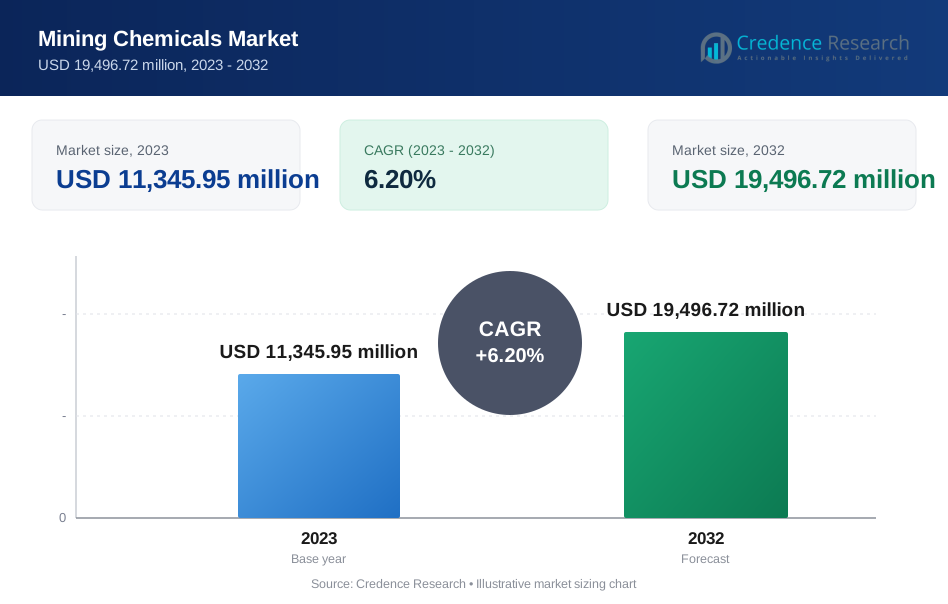
The Mining Chemicals market is projected to grow from USD 11,345.95 million in 2023 to an estimated USD 19,496.72 million by 2032, reflecting a compound annual growth rate (CAGR) of 6.20% from 2024 to 2032. This significant growth is driven by increasing demand for minerals and metals across industries such as construction, automotive, and electronics.
The rising global demand for metal and mineral-based products, combined with technological advancements in mining and mineral processing, serves as a key market driver. Increased adoption of environment-friendly mining chemicals, driven by stricter environmental regulations, is also a prominent trend. Additionally, companies are investing in research and development to produce customized and high-performance chemicals, further enhancing market growth prospects.
Geographically, the Asia-Pacific region dominates the mining chemicals market due to extensive mining activities and increasing industrialization in countries like China, India, and Australia. North America and Europe also contribute significantly to market share due to technological advancements and sustainable mining initiatives. Key players in this market include BASF SE, The Dow Chemical Company, Clariant AG, Solvay SA, and Akzo Nobel NV, among others, who focus on expanding their product portfolios and strategic partnerships to gain a competitive edge.
Market Drivers
Rising Global Demand for Minerals and Metals
The increasing global demand for minerals and metals across diverse industries is a primary driver of the mining chemicals market. The construction, electronics, automotive, and energy sectors, among others, have a growing reliance on these raw materials. Construction remains a dominant consumer due to the rising demand for infrastructure development and urbanization. The automotive industry is another key contributor, with the increasing production of vehicles, including electric cars, which require a substantial amount of mined metals like lithium and nickel for batteries. For instance, in 2023, the demand for nickel for electric vehicle (EV) batteries reached nearly 370 kilotons, marking a significant increase compared to the previous year. This surge in demand is primarily driven by the growing production of EVs, which require critical metals like lithium and nickel for their batteries. As a result, mining operations are expanding, leading to greater use of mining chemicals that enhance extraction and processing efficiency. These chemicals are instrumental in maximizing metal recovery rates, reducing processing time, and ensuring cost-effective and sustainable mining practices. The high demand for high-purity minerals has driven mining companies to invest in innovative chemical solutions, which further accelerates market growth.
Technological Advancements and Process Optimization
Mining chemicals play a crucial role in optimizing and enhancing the efficiency of mining processes. With technological advancements such as froth flotation, leaching, and solvent extraction, mining operations have become more sophisticated and environmentally sustainable. Innovations in chemical formulations have significantly improved ore processing efficiency, separation, and the overall extraction process. Advanced chemicals, such as flocculants, collectors, and dispersants, are increasingly adopted to achieve superior recovery rates, reduce waste, and improve productivity. The demand for high-performance mining chemicals is also driven by the need to process lower-grade ores efficiently, owing to the depletion of high-grade reserves. As miners are compelled to dig deeper and explore more complex deposits, mining chemicals that can improve productivity and offer a competitive edge gain strong traction in the industry.
Stricter Environmental Regulations and Sustainability Initiatives
Stringent environmental regulations and the increasing focus on sustainable mining practices are major factors driving the mining chemicals market. Governments and regulatory bodies across the globe have implemented policies and guidelines to minimize the environmental impact of mining activities. Companies are compelled to adopt more sustainable and eco-friendly practices, which include the use of non-toxic and biodegradable chemicals. This has led to a surge in demand for greener alternatives to traditional mining chemicals that can meet compliance standards without compromising operational performance. For instance, cyanide-free extraction methods for gold mining have gained popularity due to their reduced environmental impact and lower health hazards. Companies are increasingly investing in the development of environmentally friendly chemical solutions, which is shaping the market landscape. Moreover, sustainable practices such as minimizing waste generation and improving water recycling further drive the demand for specialized chemicals that support such initiatives.
Increasing Focus on Customized Chemical Solutions and R&D Investments
The growing complexity of mining operations and diverse ore types necessitates the development of customized chemical solutions tailored to specific requirements. Mining companies are increasingly collaborating with chemical manufacturers to create bespoke products that address unique challenges in extraction, mineral processing, and separation processes. The demand for customization stems from the variability in ore composition, mining conditions, and the need for consistent and high recovery rates. This trend has prompted manufacturers to prioritize research and development (R&D) efforts to develop innovative products that can cater to different mining applications and environments. Companies are also leveraging advanced technologies like data analytics and AI-driven optimization to design chemicals that improve performance while minimizing costs. R&D investments in the development of multi-functional chemicals and solutions that enhance operational efficiency, reduce environmental impact, and comply with regulations further bolster market growth. The increasing need for specialized chemicals ensures that companies offering innovation-driven solutions maintain a competitive advantage in this evolving market.
Market Trends
Increasing Adoption of Sustainable and Eco-Friendly Chemicals
The shift towards environmentally sustainable practices in the mining industry is a key trend driving the adoption of eco-friendly mining chemicals. With mounting regulatory pressure to reduce environmental impact and enhance worker safety, companies are increasingly moving away from traditional, often hazardous chemicals, opting for non-toxic, biodegradable, and less environmentally disruptive alternatives. Chemicals such as bio-based collectors, cyanide-free leaching agents, and biodegradable frothers are gaining traction as they minimize ecological impact while maintaining performance. This trend is fueled by the industry's commitment to corporate social responsibility and sustainability initiatives, as well as government incentives for green practices. Moreover, the focus on water conservation and waste reduction has prompted mining companies to invest in chemicals that enable closed-loop systems and minimize tailings. As a result, innovation and research efforts have accelerated to develop products that meet stringent environmental standards without compromising operational efficiency, positioning sustainability as a competitive differentiator within the market.
Technological Integration for Process Optimization and Efficiency Enhancement
The integration of advanced technologies, such as artificial intelligence (AI), data analytics, and automation, with chemical applications in mining operations is emerging as a significant trend. These technological tools enable precision mining, optimizing the application of chemicals and enhancing ore recovery rates while reducing wastage. By leveraging data-driven insights, mining companies can make informed decisions about chemical usage, leading to better process control, lower costs, and improved productivity. For instance, AI-driven systems in the mining industry have demonstrated the ability to predict mineral recovery outcomes, allowing operators to adjust chemical dosages in real-time, which enhances ore recovery rates and reduces chemical wastage significantly. Additionally, innovations in reagent formulations have improved the selectivity and effectiveness of mining chemicals, leading to enhanced separation and recovery efficiencies. This trend is driven by the need to process lower-grade ores and tackle more complex mineral deposits. As a result, mining chemicals that offer superior performance and adaptability to varying mining conditions are increasingly in demand, fostering a more data-centric and technology-oriented approach within the industry.
Market Restraints and Challenges
Stringent Environmental Regulations and Compliance Requirements
One of the significant restraints on the mining chemicals market is the increasingly stringent environmental regulations imposed by governments and regulatory bodies across the globe. Mining operations, known for their potential environmental impact, face heightened scrutiny, leading to stricter guidelines governing chemical use, waste disposal, water management, and emissions control. Compliance with these regulations often requires the adoption of greener, eco-friendly chemical alternatives and the implementation of more complex waste management systems, driving up operational costs. Many traditional mining chemicals, such as certain collectors, frothers, and flocculants, are under review or banned due to environmental and health concerns. This regulatory pressure not only increases compliance costs for mining companies but also creates challenges for chemical manufacturers, who must invest heavily in research and development to create innovative and environmentally acceptable products. This dynamic makes it difficult for smaller market players to compete effectively, potentially limiting market growth.
Volatility in Raw Material Prices and Supply Chain Disruptions
The mining chemicals market is susceptible to fluctuations in raw material prices, which pose a significant challenge to market stability and profitability. The production of mining chemicals relies heavily on key raw materials, the prices of which can be influenced by geopolitical tensions, trade policies, and supply chain disruptions. Such price volatility can directly impact the profitability of chemical manufacturers and mining companies, particularly during economic downturns or crises. Furthermore, supply chain disruptions caused by factors such as transportation bottlenecks, global pandemics, or geopolitical conflicts exacerbate the challenge of maintaining consistent product availability. As mining operations require a reliable supply of chemicals for uninterrupted production, any disruptions can lead to increased costs, production delays, and inefficiencies. This unpredictability in raw material costs and supply reliability forces market participants to develop resilient strategies, such as long-term supply agreements and diversification of raw material sources, which may increase operational complexity.
Market Segmentation Analysis
By Type
The Mining Chemicals market is segmented by type, including Powder Gold, Iron, Copper, Phosphate, and Others. The Powder Gold segment focuses on chemicals specifically formulated for gold extraction, such as cyanide and collectors, which significantly enhance recovery rates and operational efficiency. The Iron segment involves mining chemicals like flocculants and dispersants that improve the separation and recovery of iron, driven by the increasing demand for steel and iron products. In the Copper segment, chemicals are essential for flotation processes, aiding in the separation of copper from other minerals, with growth fueled by rising demand from electrical wiring and renewable energy sectors. The Phosphate segment encompasses chemicals used in extracting phosphate rock, vital for fertilizer production, which is growing due to heightened food production needs. Lastly, the Others category includes chemicals for various mineral extractions, including rare earth and industrial minerals, showcasing the diverse applications of mining chemicals across different sectors.
By Application
The Mining Chemicals market is segmented by application, with mineral processing being the largest segment, where chemicals such as flotation agents, thickeners, and pH regulators are essential for enhancing the extraction and purification of minerals, optimizing recovery rates, and improving overall efficiency. The explosives and drilling segment relies on chemicals like emulsifiers and stabilizers for rock fragmentation and mineral extraction, making it a significant area of application. Additionally, the need for effective water treatment solutions arises from the large volumes of wastewater generated during mining activities; chemicals in this category help treat and recycle process water, thereby minimizing environmental impact and ensuring regulatory compliance. Lastly, a variety of niche applications also exist, such as specialized mineral flotation processes, demonstrating the diverse utility of mining chemicals across different sectors within the industry.
Segments
Based on Type
- Powder Gold
- Iron
- Copper
- Phosphate
- Others
Based on Application
- Mineral Processing
- Explosives and Drilling
- Water Treatment
- Others
Based on Region
- North America
- U.S.
- Canada
- Mexico
- Europe
- Germany
- France
- U.K.
- Italy
- Spain
- Rest of Europe
- Asia Pacific
- China
- Japan
- India
- South Korea
- South-east Asia
- Rest of Asia Pacific
- Latin America
- Brazil
- Argentina
- Rest of Latin America
- Middle East & Africa
- GCC Countries
- South Africa
- Rest of the Middle East and Africa
Regional Analysis
North America (25%)
North America accounts for approximately 25% of the global Mining Chemicals market. The United States and Canada are the primary contributors, with a well-established mining sector focused on gold, copper, and iron extraction. The region benefits from advanced mining technologies and stringent environmental regulations that promote the use of sustainable and efficient mining chemicals. Additionally, the increasing emphasis on eco-friendly practices drives demand for innovative chemical solutions that comply with regulatory standards. Major mining companies in this region are investing heavily in research and development to enhance their operational efficiency and reduce environmental impact.
Asia-Pacific (40%)
The Asia-Pacific region holds the largest share of the Mining Chemicals market, accounting for about 40%. China, Australia, and India are at the forefront of mineral extraction, significantly contributing to the region's dominance. The growing demand for metals and minerals in construction, electronics, and renewable energy sectors propels this growth. Australia, known for its rich mineral resources, remains a leading producer of iron ore and gold, while China's extensive industrial base creates substantial demand for various mining chemicals. The region's rapid urbanization and industrialization further enhance the need for efficient mining chemicals.
Key players
- AECI Mining Chemicals
- BASF SE
- Ashland
- Dow
- Kimleigh Chemicals SA (Pty) Ltd
- Cytec Solvay Group
- Arkema
- Clariant
- Nowata
- Kemira
- Shell Chemicals
- Quaker Chemical Corporation
- Akzo Nobel N.V.
- Solenis
Competitive Analysis
The Mining Chemicals market is characterized by a competitive landscape featuring several key players, each vying for market share through innovation, product diversification, and strategic partnerships. Companies such as BASF SE and Dow leverage their extensive research and development capabilities to create advanced chemical solutions tailored for mineral processing, positioning themselves as leaders in sustainability. Meanwhile, AECI Mining Chemicals and Clariant focus on regional strengths, offering customized products that cater to specific mining needs. The competitive environment is further intensified by the presence of specialized firms like Nowata and Kemira, which emphasize niche applications and eco-friendly alternatives. Collaboration and acquisitions among these companies are common strategies employed to enhance product offerings and expand geographic reach, fostering a dynamic marketplace that continuously evolves to meet industry demands.
Recent Developments
- In November 2023, AECI announced plans to divest from non-core assets and focus on its core mining and chemicals capabilities. This strategic shift aims to double profitability by 2026 and position AECI as a top-three global mining explosives and chemicals solutions provider by 2030.
- In July 2024, BASF signed an agreement to sell its flocculants business for mining applications to Solenis. This acquisition will allow Solenis to offer a complete solution for mining and mineral processing customers, pending regulatory approvals.
- In 2024, Quaker Chemical completed the acquisition of a range of steel chemical products, including cleaners and wet temper fluids, enhancing its product offerings for European steel producers.
Market Concentration and Characteristics
The Mining Chemicals market exhibits a moderate level of concentration, characterized by a mix of established global players and regional companies. Leading firms such as BASF SE, Dow, and AECI Mining Chemicals dominate the market, leveraging their extensive product portfolios and research capabilities to develop innovative solutions tailored for mineral processing and extraction. These companies often engage in strategic partnerships and acquisitions to enhance their offerings and expand their geographic presence. The market is further characterized by a growing emphasis on sustainability, with many players investing in eco-friendly and biodegradable chemicals to meet stringent environmental regulations. Additionally, the competitive landscape is marked by the need for customization in chemical solutions, as mining operations vary widely in their mineral compositions and extraction methods. This dynamic environment encourages ongoing innovation and adaptation among market participants, ensuring a continual evolution of products and strategies to address emerging challenges and opportunities.
Report Coverage
The research report offers an in-depth analysis based on Type, Application, and Region. It details leading market players, providing an overview of their business, product offerings, investments, revenue streams, and key applications. Additionally, the report includes insights into the competitive environment, SWOT analysis, current market trends, as well as the primary drivers and constraints. Furthermore, it discusses various factors that have driven market expansion in recent years. The report also explores market dynamics, regulatory scenarios, and technological advancements that are shaping the industry. It assesses the impact of external factors and global economic changes on market growth. Lastly, it provides strategic recommendations for new entrants and established companies to navigate the complexities of the market.
Future Outlook
- The mining chemicals market is expected to witness a significant shift towards sustainable practices, with increased demand for eco-friendly and biodegradable chemicals. Companies will prioritize products that minimize environmental impact while maintaining operational efficiency.
- Ongoing technological advancements will drive the development of innovative chemical solutions, improving extraction processes and efficiency. Automation and AI will increasingly influence the formulation and application of mining chemicals, leading to enhanced performance.
- The global demand for metals, particularly from the renewable energy and electric vehicle sectors, will fuel growth in the mining chemicals market. This demand will necessitate the development of advanced chemicals to extract and process these critical minerals.
- Stricter environmental regulations will continue to shape the market, compelling companies to invest in compliant chemical solutions. Adhering to these regulations will be essential for maintaining operational licenses and market competitiveness.
- Emerging markets, particularly in Asia-Pacific and Latin America, will see increased mining activities, driving demand for mining chemicals. This trend will create opportunities for both established and new players to expand their market presence in these regions.
- The need for tailored chemical solutions will grow as mining operations become more complex. Companies will focus on developing specialized chemicals that meet the unique requirements of various minerals and extraction methods.
- Increased investment in research and development will be crucial for innovation in the mining chemicals market. Companies will seek to enhance product efficacy and develop next-generation chemicals that can address evolving industry challenges.
- The adoption of digital technologies will transform how mining chemicals are developed and applied. Data analytics and machine learning will enable more precise chemical applications, optimizing performance and reducing waste.
- Strategic partnerships and collaborations will become more common as companies look to leverage each other's strengths. Such alliances will foster innovation, enhance product offerings, and expand market reach.
- The mining chemicals market will increasingly align with circular economy principles, emphasizing waste reduction and resource efficiency. Companies will seek to develop chemicals that support recycling and reuse, contributing to sustainable mining practices.
Request a Free Sample
Fill in your details and we'll send you a free sample report.
- Sample data tables & charts
- Research methodology
Need a Custom Version of This Report?
Tailor the scope, geography, or segments to your exact requirements.
- Custom geography or segment scope
- Direct access to our analyst team
Frequently Asked Questions
What is the projected market size of the Mining Chemicals market in 2023 and 2032?
What is the expected CAGR for the Mining Chemicals market from 2024 to 2032?
What factors are driving the growth of the Mining Chemicals market?
Which regions dominate the Mining Chemicals market?
Who are the key players in the Mining Chemicals market?
Table of Content
Chapter 1 Market Segmentation
- 1.1 Segmentation Framework
- 1.1.1 Product and Service Classification
- 1.1.2 Application and End-Use Classification
- 1.1.3 Technology and Solution Classification
- 1.1.4 Customer and Distribution Channel Classification
- 1.1.5 Geographic Segmentation
- 1.1.6 Market Segment Definitions and Boundaries
Chapter 2 Introduction
- 2.1 Report Objectives and Scope
- 2.2 Product Definition and Industry Terminology
- 2.3 Market Inclusions and Exclusions
- 2.4 Research Process
- 2.4.1 Primary Research and Expert Interviews
- 2.4.2 Secondary Research and Source Review
- 2.4.3 Top-Down and Bottom-Up Estimation
- 2.4.4 Data Triangulation and Verification
- 2.5 Market Size Measurement Basis
- 2.5.1 2023: USD 11,345.95 million → 2032: USD 19,496.72 million
- 2.6 Historical and Forecast Reference Periods
- 2.6.1 Base Year: 2023
- 2.6.2 Forecast Period: 2023-2032
- 2.7 Research Assumptions and Limitations
Chapter 3 Executive Summary
- 3.1 Market Snapshot and Key Findings
- 3.2 Base-Year Market Size, 2023
- 3.3 Forecast Market Size, 2032
- 3.4 Revenue and Volume Growth Outlook
- 3.5 Key Demand and Supply Indicators
- 3.6 Leading Market Segments
- 3.7 Fastest-Growing Market Opportunities
- 3.8 Regional Performance Highlights
- 3.9 Technology and Industry Transformation
- 3.10 Competitive Landscape Summary
- 3.11 Analyst View and Strategic Implications
Chapter 4 Global Mining Chemicals Market Trends and Developments
- 4.1 Historical Industry Development
- 4.2 Recent Market Trends and Developments
- 4.3 Demand and Customer Behavior Trends
- 4.4 Technology and Product Innovation
- 4.5 Artificial Intelligence, Automation and Digitalization
- 4.6 Local Manufacturing and Supply Chain Realignment
- 4.7 Industry Partnerships, Mergers and Acquisitions
- 4.8 Sustainability and Circular Economy Developments
- 4.9 Government and Private Sector Investment Trends
- 4.10 Emerging Business Models and Commercialization
- 4.11 Industry Developments and Announcements
Chapter 5 Global Mining Chemicals Market Production, Supply and Demand Analysis
- 5.1 Demand Trend and Consumption Analysis
- 5.2 Demand Forecast, 2023-2032
- 5.3 Production and Output Trend
- 5.4 Production and Output Forecast, 2023-2032
- 5.5 Installed Capacity and Capacity Utilization
- 5.6 Company-Wise Production Plants and Statistics
- 5.6.1 Installed Production Capacity
- 5.6.2 Actual Production
- 5.6.3 Planned Capacity and Expansion Targets
- 5.7 Supply Chain Structure and Procurement Trends
- 5.8 Supply-Demand Gap and Bottlenecks
- 5.9 Import Dependence and Sourcing Structure
- 5.10 Contract Manufacturing and Outsourcing
- 5.11 Regional Supply and Demand Concentration
Chapter 6 Global Mining Chemicals Market Pricing Analysis
- 6.1 Pricing Structure and Measurement
- 6.2 Historical Pricing Trends
- 6.3 Pricing Outlook, 2023-2032
- 6.4 Average Selling Price and Unit Economics
- 6.5 Pricing by Product and Market Segment
- 6.6 Geographic Pricing Differences
- 6.7 Key Input, Energy, Labor and Logistics Costs
- 6.8 Contract Pricing and Purchasing Models
- 6.9 Pricing Sensitivity and Competitive Positioning
- 6.10 Price, Margin and Profitability Implications
Chapter 7 Global Mining Chemicals Market Dynamics
- 7.1 Market Growth Drivers
- 7.1.1 Demand-Side Drivers
- 7.1.2 Technology and Innovation Drivers
- 7.1.3 Infrastructure and Investment Drivers
- 7.1.4 Regulatory and Policy Drivers
- 7.2 Market Restraints
- 7.2.1 Cost and Affordability Constraints
- 7.2.2 Technology and Adoption Barriers
- 7.2.3 Supply Chain and Operational Constraints
- 7.3 Market Challenges
- 7.3.1 Competitive Pressure and Margin Erosion
- 7.3.2 Skills, Infrastructure and Implementation Gaps
- 7.4 Emerging Market Opportunities
- 7.5 Market Dynamics Impact and Time-Horizon Assessment
Chapter 8 Global Mining Chemicals Value Chain Analysis
- 8.1 Industry Value Chain Overview
- 8.2 Upstream Suppliers and Critical Inputs
- 8.3 Technology and Component Providers
- 8.4 Manufacturing or Service Delivery
- 8.5 Distribution, Channel Partners and Integrators
- 8.6 Downstream Applications and End Users
- 8.7 Value Addition and Profit Pools
- 8.8 Vertical Integration and Outsourcing
- 8.9 Supplier Concentration and Risk
- 8.10 Supply Chain Localization and Resilience
Chapter 9 Global Mining Chemicals Market Regulations and Policies
- 9.1 Relevant Laws, Standards and Compliance Frameworks
- 9.2 Product, Service, Safety and Quality Requirements
- 9.3 Government Policies, Incentives and Subsidies
- 9.4 Imports, Exports and Trade Barriers
- 9.5 Public Procurement and Local Content Requirements
- 9.6 Environmental and Sustainability Compliance
- 9.7 Upcoming Policy Changes and Market Implications
Chapter 10 Global Mining Chemicals Market Hotspots and Opportunities
- 10.1 Market Opportunity Mapping and Growth Hotspots
- 10.2 High-Growth Applications and Customer Groups
- 10.3 Underserved Markets and White-Space Opportunities
- 10.4 Emerging Technology and Product Opportunities
- 10.5 New Capacity and Investment Hotspots
- 10.6 Market Entry and Expansion Opportunities
- 10.7 Distribution and Partnership Opportunities
- 10.8 Near-Term and Long-Term Commercial Potential
- 10.9 Opportunity Attractiveness and Execution Risks
Chapter 11 Global Mining Chemicals Market Outlook, 2023-2032
- 11.1 Market Size and Analysis
- 11.1.1 Revenue (Market Measurement: 2023: USD 11,345.95 million → 2032: USD 19,496.72 million)
- 11.1.2 Market Volume and Quantity Sold
- 11.1.3 Historical Market Size
- 11.1.4 Base-Year Market Size, 2023
- 11.2 Market Forecast, 2023-2032
- 11.2.1 Revenue Forecast to 2032
- 11.2.2 Volume Forecast to 2032
- 11.2.3 CAGR and Year-on-Year Growth
- 11.2.4 Incremental Revenue Opportunity
- 11.3 Forecast Assumptions and Scenario Analysis
- 11.3.1 Base-Case Forecast
- 11.3.2 Optimistic and Conservative Scenarios
- 11.3.3 Technology, Pricing and Policy Sensitivities
- 11.4 Market Attractiveness and Growth Outlook
Chapter 12 Global Mining Chemicals Market Segmentation and Outlook
- 12.1 Segmentation Summary and Market Shares, 2023
- 12.2 Largest and Fastest-Growing Segments
- 12.3 Segment Growth Comparison
- 12.4 Segment Attractiveness and Priority Matrix
Chapter 13 Global Mining Chemicals Geographic Market Outlook, 2023-2032
- 13.1 Regional Market Size and Share, 2023
- 13.2 Regional Market Forecast, 2023-2032
- 13.3 Regional Pricing, Production and Demand Differences
- 13.4 North America
- 13.4.1 United States
- 13.4.2 Canada
- 13.4.3 Mexico
- 13.5 Europe
- 13.5.1 Germany
- 13.5.2 France
- 13.5.3 Italy
- 13.5.4 United Kingdom
- 13.5.5 Spain
- 13.5.6 Poland
- 13.5.7 Russia
- 13.5.8 Netherlands
- 13.5.9 Belgium
- 13.5.10 Sweden
- 13.5.11 Denmark
- 13.5.12 Norway
- 13.5.13 Rest of Europe
- 13.6 Asia Pacific
- 13.6.1 China
- 13.6.2 India
- 13.6.3 Japan
- 13.6.4 South Korea
- 13.6.5 Thailand
- 13.6.6 Indonesia
- 13.6.7 Vietnam
- 13.6.8 Malaysia
- 13.6.9 Australia
- 13.6.10 Rest of Asia Pacific
- 13.7 Latin America
- 13.7.1 Brazil
- 13.7.2 Argentina
- 13.7.3 Colombia
- 13.7.4 Chile
- 13.7.5 Rest of Latin America
- 13.8 Middle East
- 13.8.1 Saudi Arabia
- 13.8.2 United Arab Emirates
- 13.8.3 Turkey
- 13.8.4 Israel
- 13.8.5 Iran
- 13.8.6 Rest of the Middle East
- 13.9 Africa
- 13.9.1 South Africa
- 13.9.2 Egypt
- 13.9.3 Nigeria
- 13.9.4 Morocco
- 13.9.5 Rest of Africa
- 13.10 Regional Investment, Policy and Supply Chain Differences
- 13.11 Regional Competitive Landscape
- 13.12 Geographic Growth Hotspots
Chapter 14 Global Mining Chemicals Technology, Innovation and Sustainability Outlook
- 14.1 Technology Landscape and Maturity
- 14.2 Product, Process and Service Innovation
- 14.3 AI, Automation and Digital Tools in the Industry
- 14.4 Technology Adoption and Performance Benchmarking
- 14.5 Innovation Pipeline and R&D Investment
- 14.6 Patent and Intellectual Property Trends
- 14.7 Energy Efficiency and Resource Management
- 14.8 Sustainability, Recycling and Circularity
- 14.9 Technology Roadmap, 2023-2032
- 14.10 Risks of Obsolescence and Technology Substitution
Chapter 15 Global Mining Chemicals Market Key Strategic Imperatives
- 15.1 Growth and Market Entry Priorities
- 15.2 High-Return Products and Segments
- 15.3 Pricing, Profitability and Cost Optimization
- 15.4 Technology Investment and Product Differentiation
- 15.5 Supply Chain Localization and Resilience
- 15.6 Distribution and Customer Acquisition
- 15.7 Partnership, Acquisition and Capacity Strategy
- 15.8 Regional Expansion Priorities
- 15.9 Short-, Medium- and Long-Term Actions
Chapter 16 Competition Outlook
- 16.1 Industry Competition Characteristics
- 16.2 Market Structure and Concentration
- 16.3 Market Share and Competitive Positioning, 2023
- 16.4 Company-Wise Revenue and Product Benchmarking
- 16.5 Production and Service Capacity Benchmarking
- 16.6 Technology, Pricing and Differentiation
- 16.7 Regional Footprint and Distribution Strength
- 16.8 Mergers, Acquisitions and Strategic Alliances
- 16.9 New Entrants and Competitive Threats
- 16.10 Porter's Five Forces and Industry Attractiveness
- 16.11 Competitive Outlook, 2023-2032
Chapter 17 Company Profiles
- 17.1 Company Coverage and Selection Criteria
- 17.2 Leading Market Participants – Standard Profile Structure
- 17.2.1 Business Description
- 17.2.2 Company Ownership and Geographic Presence
- 17.2.3 Product and Service Portfolio
- 17.2.4 Manufacturing and Operating Footprint
- 17.2.5 Production Capacity and Expansion Plans
- 17.2.6 Financial Performance and Investment
- 17.2.7 Market Share and Competitive Position
- 17.2.8 Technology and Innovation Capabilities
- 17.2.9 Strategic Alliances or Partnerships
- 17.2.10 Recent Developments
- 17.2.11 Growth Strategy and Outlook
- 17.3 Other Relevant Market Participants
Note: Every listed company is profiled on the structure shown under the first company. The company list is preliminary and may change based on research findings, market developments, data availability and client requirements.
Chapter 18 Disclaimer
- 18.1 Research and Forecast Disclaimer
- 18.2 Data Source and Estimation Limitations
Note: The depth of individual sections depends on data availability for this market. Volume, capacity, trade and other unit-based metrics are included where applicable.
