
| REPORT ATTRIBUTE | DETAILS |
|---|---|
| Historical Period | 2019-2022 |
| Base Year | 2023 |
| Forecast Period | 2024-2032 |
| Molded Case Circuit Breaker Market Size 2023 | USD 8,365.23 Million |
| Molded Case Circuit Breaker Market, CAGR | 6.02% |
| Molded Case Circuit Breaker Market Size 2032 | USD 14,156.90 Million |
Market Overview
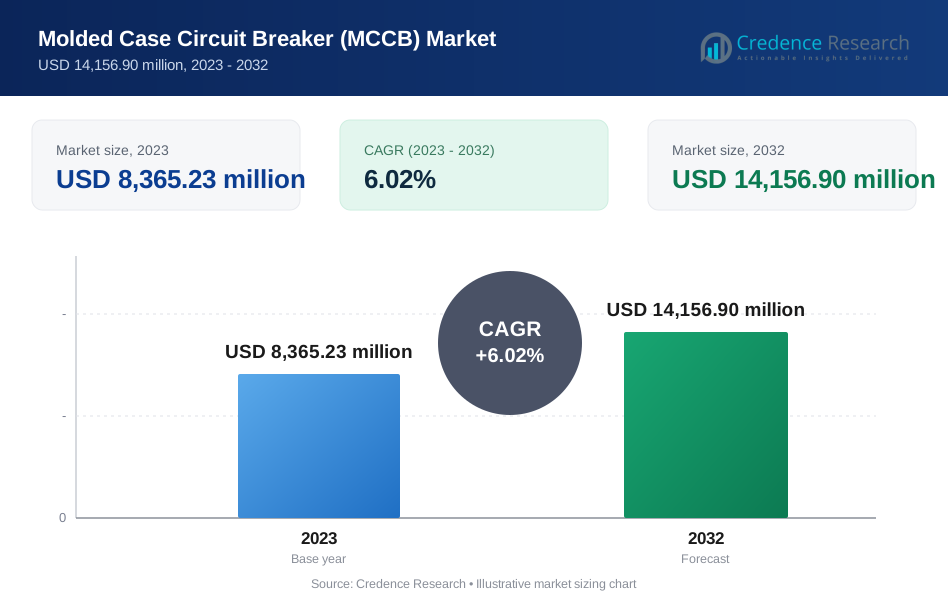
The Molded Case Circuit Breaker Market is projected to grow from USD 8,365.23 million in 2023 to USD 14,156.90 million by 2032, reflecting a compound annual growth rate (CAGR) of 6.02%.
The Molded Case Circuit Breaker Market is driven by increasing industrialization and urbanization, which demand robust electrical infrastructure. The push towards renewable energy integration requires advanced circuit protection solutions, further fueling market growth. Technological advancements are leading to the development of smarter, more efficient circuit breakers that enhance safety and connectivity, catering to the evolving needs of modern electrical systems. These trends, alongside regulatory pressures for safety and energy efficiency, position molded case circuit breakers as essential components in both existing and new electrical installations globally.
The Global Molded Case Circuit Breaker Market is geographically segmented into key regions such as North America, Europe, Asia Pacific, and Latin America. Asia Pacific leads the market due to rapid industrial growth and infrastructure development, particularly in China and India. Key players dominating this market include Siemens AG, Schneider Electric, and General Electric, each contributing with robust product portfolios and extensive geographic reach. These companies are pivotal in driving innovation and addressing the diverse needs of the market through advanced circuit protection solutions tailored for various industrial, commercial, and residential applications.Top of Form
Market Drivers
Technological Enhancements and Safety Standards
With the global rise in energy consumption driven by economic growth and an increase in consumer electronics, the need for effective electrical protection devices like MCCBs is more pronounced. For instance, Siemens AG released SENTRON 3VA molded case circuit breakers (MCCBs) in 2023, which is one effectively modified, versatile and highly adaptable solution inclusive of over five hundred accessory parts. Schneider Electric announced the release of its updated PowerPacT Molded Case Circuit Breaker (MCCB) series in November 2022. These advancements provide end-users with greater control and visibility over their electrical systems, enhancing safety and efficiency. The market is also responding to rigorous safety regulations and standards that mandate the use of such circuit breakers to safeguard electrical systems and prevent accidents. On the technological front, the integration of MCCBs with the Internet of Things (IoT) and their evolution towards digitalization are setting new standards in remote monitoring and control capabilities, pushing the boundaries of what these devices can achieve in modern electrical infrastructures.
Industrialization and Infrastructure Development
The Global Molded Case Circuit Breaker (MCCB) market thrives on the backbone of rapid urbanization and industrialization. As cities grow, the demand for efficient electricity distribution in residential, commercial, and industrial sectors escalates, necessitating advanced electrical infrastructure. For instance, the demand for MCCBs rises as they protect an electrical circuit from short circuits, and also safely connect and disconnect loads from the electrical source. This expansion is not limited to urban settings; infrastructure projects including roads, bridges, and buildings also require robust electrical protection solutions, thereby boosting the demand for MCCBs.
Renewable Energy Integration
The shift towards sustainable energy sources like solar and wind power necessitates reliable circuit breakers to handle power fluctuations and enhance safety within electrical grids. Additionally, the development of microgrids, particularly in remote and underserved areas, underscores the importance of MCCBs. These systems ensure that local electrical networks are protected against overloads and short circuits, facilitating stable and efficient energy distribution.
Advancements in Smart Grid Technologies
The evolution of smart grid technologies marks a significant driver for the MCCB market. These grids utilize advanced monitoring and control mechanisms that often incorporate intelligent MCCBs, optimizing energy efficiency and system reliability. The integration of MCCBs in smart grids helps in preventing power disruptions, thus maintaining continuous and efficient energy distribution across various sectors.
Market Trends
Enhancements in Energy Efficiency, Miniaturization, and Customization
Efficiency improvements in MCCBs are pivotal in reducing energy losses and promoting sustainable energy practices. For example, the expansion of the electric power distribution network has led to a rise in the demand for MCCBs, as they protect an electrical circuit from short circuits and safely connect and disconnect loads from the electrical source. The trend of miniaturization addresses space constraints in modern electrical setups, enabling the development of compact MCCBs that do not compromise on functionality or performance. Furthermore, customization in MCCB manufacturing is becoming increasingly prevalent. For instance, customization alternatives, consisting of various present-day rankings and breaking capacities, have become more customary to meet application necessities. These customized MCCBs are designed to optimize efficiency and functionality, meeting the specific demands of various industries and applications.
Integration of Smart Technologies and Modular Design in MCCBs
The molded case circuit breaker (MCCB) market is witnessing significant transformation through the integration of smart technologies. IoT capabilities in MCCBs enable remote monitoring, control, and predictive maintenance, optimizing operational efficiencies and enhancing system reliability. This shift towards digitalization not only meets the demand for advanced features such as digital displays and communication protocols but also facilitates extensive data analytics. Concurrently, the adoption of modular MCCB designs is reshaping installation and maintenance paradigms. These modular systems offer unmatched flexibility, allowing for easy customization to meet specific requirements, and significantly reduce costs by simplifying modifications and upgrades.
Market Challenges Analysis
Addressing Supply Chain Disruptions and Regulatory Compliance
Global supply chain disruptions pose significant risks to the MCCB market, influenced by factors such as pandemics, geopolitical tensions, and other international issues. For instance, the COVID-19 pandemic has caused significant disruptions in the global supply chain, affecting the availability of essential raw materials and components. This has led to manufacturing delays and escalated costs. These disruptions can hinder the availability of essential raw materials and components, leading to manufacturing delays and escalated costs. Concurrently, the MCCB industry must navigate an ever-changing regulatory landscape. Electrical safety standards and regulations are continuously evolving, requiring manufacturers to stay abreast of new requirements and undergo rigorous certification processes. These processes are not only time-consuming but also incur substantial financial expenditures, further straining the resources of MCCB manufacturers.
Economic Sensitivity and Environmental Accountability
Economic fluctuations significantly impact the MCCB market. During economic downturns, industries that are particularly sensitive to these fluctuations may reduce their demand for MCCBs, affecting overall market growth. The uncertainty brought about by these economic conditions makes it challenging for companies to plan future investments and expansions effectively. Moreover, increasing environmental concerns are pressing manufacturers to adopt more sustainable practices and reduce their carbon footprint. This shift necessitates sourcing materials from sustainable suppliers, which can be both more difficult and expensive, presenting additional hurdles for MCCB manufacturers in their quest to align with contemporary environmental standards.
Market Segmentation Analysis:
By Type:
The Global Molded Case Circuit Breaker Market is segmented into two primary types: Miniature Circuit Breakers (MCBs) and Molded Case Circuit Breakers (MCCBs). MCBs, designed for low current capacities, are widely used in residential and small commercial applications due to their cost-effectiveness and compact size. In contrast, MCCBs cater to higher current requirements and offer more robust features, making them suitable for industrial and large commercial environments. This distinction addresses diverse electrical safety needs across different applications, with MCCBs often being the choice for systems requiring higher capacity and more durable solutions.
By Rated Current:
In terms of rated current, the market delineates several segments: Up to 20A, 21A–75A, 76A–250A, 251A–800A, and Above 800A. The 'Up to 20A' segment predominantly serves low-power applications in residential settings, while the '21A–75A' range finds its place in both commercial and light industrial environments. As the current rating increases, from '76A–250A' to '251A–800A', the MCCBs are increasingly employed in heavy industrial applications that demand higher electrical load management. The 'Above 800A' segment is tailored for very high-capacity environments, such as large-scale manufacturing plants and power stations, where superior circuit protection is crucial. This segmentation allows for targeted solutions across a broad spectrum of power requirements, ensuring both safety and efficiency in electrical circuit management.
Segments:
Based on Type:
- Miniature Circuit Breaker
- Moulded Case Circuit Breaker
Based on Rated Current:
- Up to 20A
- 21A–75A
- 76A–250A
- 251A–800A
- Above 800A
Based on End-User:
- Transportation
- Manufacturing & Process Industry
- Residential & Commercial
- Transmission & Distribution
- Power Generation and Others
Based on the Geography:
- North America
- U.S.
- Canada
- Mexico
- Europe
- Germany
- France
- U.K.
- Italy
- Spain
- Rest of Europe
- Asia Pacific
- China
- Japan
- India
- South Korea
- South-east Asia
- Rest of Asia Pacific
- Latin America
- Brazil
- Argentina
- Rest of Latin America
- Middle East & Africa
- GCC Countries
- South Africa
- Rest of the Middle East and Africa
Regional Analysis
Asia-Pacific
Asia-Pacific commands the largest market share in the global molded case circuit breaker (MCCB) market, accounting for approximately 40% of the global market value. This dominance is driven by rapid urbanization, industrial growth, and increasing investments in power infrastructure. For instance, the demand for MCCBs rises as they protect an electrical circuit from short circuits, and also safely connect and disconnect loads from the electrical source. Countries like China, India, and Japan are witnessing a surge in electricity demand, prompting substantial investments in power distribution networks. This has led to increased adoption of MCCBs for efficient circuit protection and power management. The region's focus on renewable energy sources and smart grid initiatives is further driving the demand for advanced MCCB solutions.
North America
North America follows Asia-Pacific in the global MCCB market, capturing around 25% of the market share. This significant position is propelled by the need for infrastructure upgrades and stringent safety regulations in the electrical sector. The North American MCCB market is characterized by a strong emphasis on technological advancements and energy efficiency. The region's aging power infrastructure and the need for modernization are key factors fueling market growth. Additionally, the increasing adoption of electric vehicles and the expansion of data centers are creating new opportunities for MCCB manufacturers. North American countries are also implementing stricter safety standards and energy efficiency regulations, which is boosting the demand for sophisticated MCCB products with enhanced protection features and smart monitoring capabilities.
Key Player Analysis
- Siemens AG
- Schneider Electric
- General Electric
- Eaton Corporation plc
- Rockwell Automation, Inc.
- Mitsubishi Electric Corporation
- Legrand SA
- Hitachi Industrial Equipment System
- Fuji Electric Co, Ltd.
- Havells India Ltd.
- Huayi Electric Co, Ltd.
- Toshiba Corporation
- Noark Electric Inc.
- Chint Group
- Maxguard
Competitive Analysis
In the Global Molded Case Circuit Breaker Market, leading players such as Siemens AG, Schneider Electric, General Electric, Eaton Corporation plc, and Mitsubishi Electric Corporation are at the forefront of competition. These companies excel in leveraging their global distribution networks, comprehensive product lines, and strong brand reputations to maintain and expand their market share. They invest heavily in R&D to innovate and integrate advanced technologies like IoT and digitalization within their offerings, enhancing functionality and energy efficiency. Their competitive strategies often include mergers, acquisitions, and partnerships, allowing them to broaden their technological capabilities and penetrate new geographic and sectoral markets. By adapting to regulatory standards and evolving market demands, these firms effectively cater to a broad spectrum of industrial, commercial, and residential needs, solidifying their positions as market leaders.
Recent Developments
- In April 2023, Havells India introduced revolutionary solid-state circuit breakers (SSCB) in the Indian sub-continent in association with Swedish tech start-up BLIXT.
- In August 2022, Siemens launched new 3VA UL large frame molded case circuit breakers. These circuit breakers are highly flexible and designed for high current applications.
Market Concentration & Characteristics
The Global Molded Case Circuit Breaker Market exhibits a moderate to high level of market concentration, with a few major players controlling a significant share of the industry. This concentration is characterized by the presence of established companies such as Siemens AG, Schneider Electric, and General Electric, which dominate due to their extensive product portfolios, global brand recognition, and widespread distribution networks. These market leaders continuously enhance their offerings through technological advancements and innovation, ensuring compliance with international safety standards and meeting the diverse needs of various sectors. The market is also marked by a competitive environment where players engage in strategic alliances, acquisitions, and research collaborations to expand their technological capabilities and geographical footprint. These characteristics foster a dynamic market landscape, where continuous innovation and adaptation are crucial for maintaining competitive advantage.
Report Coverage
The research report offers an in-depth analysis based on Type, Rated Current, End-User and Geography. It details leading market players, providing an overview of their business, product offerings, investments, revenue streams, and key applications. Additionally, the report includes insights into the competitive environment, SWOT analysis, current market trends, as well as the primary drivers and constraints. Furthermore, it discusses various factors that have driven market expansion in recent years. The report also explores market dynamics, regulatory scenarios, and technological advancements that are shaping the industry. It assesses the impact of external factors and global economic changes on market growth. Lastly, it provides strategic recommendations for new entrants and established companies to navigate the complexities of the market.
Future Outlook
- Increased adoption of smart and connected MCCBs driven by advancements in IoT and digital technologies.
- Expansion in renewable energy sectors will necessitate enhanced circuit protection solutions like MCCBs.
- Continued urbanization and industrialization in emerging markets will drive demand for MCCBs.
- Regulatory changes pushing for enhanced electrical safety will spur innovations within the MCCB market.
- Strategic mergers and acquisitions to expand product offerings and geographic reach by key players.
- Greater emphasis on energy efficiency and sustainability will influence MCCB design and functionality.
- Development of more compact and efficient MCCBs to accommodate modern space constraints.
- Growing investment in infrastructure projects will increase the demand for robust circuit protection.
- Technological integration in MCCBs to support remote monitoring and predictive maintenance.
- Rising demand for customized MCCB solutions tailored to specific industry needs.
Request a Free Sample
Fill in your details and we'll send you a free sample report.
- Sample data tables & charts
- Research methodology
Need a Custom Version of This Report?
Tailor the scope, geography, or segments to your exact requirements.
- Custom geography or segment scope
- Direct access to our analyst team
Frequently Asked Questions
What is the current size of the Global Molded Case Circuit Breaker Market?
What factors are driving the growth of the Global Molded Case Circuit Breaker Market?
What are the key segments within the Global Molded Case Circuit Breaker Market?
What are some challenges faced by the Global Molded Case Circuit Breaker Market?
Who are the major players in the Global Molded Case Circuit Breaker Market?
Table of Content
Chapter 1. Report Introduction
- 1.1 Report Description & Purpose
- 1.1.1 Report Title & Market Definition
- 1.1.2 Unique Selling Propositions (USP) & Key Differentiators
- 1.1.3 Value Proposition for Stakeholders
- 1.2 Research Objectives
- 1.2.1 Market Sizing Objectives (Volume & Revenue) (Volume Where Applicable)
- 1.2.2 Segmentation Objectives
- 1.2.3 Competitive Intelligence Objectives
- 1.2.4 Forecast & Scenario Objectives
- 1.3 Report Scope
- 1.3.1 Molded Case Circuit Breaker (MCCB) Scope – Segments & Subsegments Covered
- 1.3.2 Geographic Scope – Regions & Countries Covered
- 1.3.3 Historical Period, Base Year & Forecast Period (2023; forecast to 2032)
- 1.3.4 Inclusions & Exclusions
- 1.4 Industry Classification & Applicable Codes
- 1.5 Currency, Measurement Units & Valuation Basis
- 1.6 Target Stakeholders
- 1.7 Limitations & Assumptions
Chapter 2. Executive Summary
- 2.1 Global Molded Case Circuit Breaker (MCCB) Market Snapshot
- 2.1.1 Market Size – Historical (2023) & Forecast (2023-2032) (2023: USD 8,365.23 million → 2032: USD 14,156.90 million)
- 2.1.2 Volume & Revenue – Global Totals (Volume Where Applicable)
- 2.1.3 Key Market Highlights – Top Five Facts
- 2.2 Molded Case Circuit Breaker (MCCB) Market Segmentation Snapshot
- 2.2.1 Market Split by Region – 2023 vs. 2032
- 2.3 Competitive Snapshot
- 2.3.1 Top 10 Players by Revenue Share – 2023
- 2.3.2 Top 10 Players by Volume Share – 2023 (Volume Where Applicable)
- 2.3.3 Recent Strategic Developments (18-Month Summary)
- 2.4 Key Investment Highlights & Strategic Conclusions
Chapter 3. Molded Case Circuit Breaker (MCCB) Market Dynamics & Industry Analysis
- 3.1 Market Overview & Context
- 3.1.1 Molded Case Circuit Breaker (MCCB) Market Position in the Broader Industry Value Chain
- 3.1.2 Demand Structure & Purchasing Dynamics
- 3.1.3 Market Maturity & Development Stage by Region
- 3.2 Molded Case Circuit Breaker (MCCB) Market Drivers
- 3.3 Molded Case Circuit Breaker (MCCB) Market Restraints & Challenges
- 3.4 Molded Case Circuit Breaker (MCCB) Market Opportunities
- 3.5 Porter's Five Forces Analysis
- 3.5.1 Threat of New Entrants
- 3.5.2 Bargaining Power of Suppliers
- 3.5.3 Bargaining Power of Buyers
- 3.5.4 Threat of Substitutes
- 3.5.5 Competitive Rivalry – Intensity Assessment
- 3.6 Molded Case Circuit Breaker (MCCB) Value Chain Analysis
- 3.6.1 Upstream – Key Inputs, Resources & Suppliers
- 3.6.1.1 Key Input/Resource 1
- 3.6.1.2 Key Input/Resource 2
- 3.6.1.3 Key Input/Resource 3
- 3.6.2 Midstream – Core Operations & Value Creation
- 3.6.2.1 Operating Model & Process Overview
- 3.6.2.2 Key Operating Locations & Capabilities by Company
- 3.6.3 Downstream – Market Channels & End Users
- 3.6.3.1 Direct Sales & Customer Engagement Channels
- 3.6.3.2 Indirect Sales, Intermediaries & Partner Channels
- 3.6.4 Value Chain Profitability Analysis
- 3.6.1 Upstream – Key Inputs, Resources & Suppliers
- 3.7 PESTEL Analysis
- 3.7.1 Political Factors
- 3.7.2 Economic Factors
- 3.7.3 Social Factors
- 3.7.4 Technological Factors
- 3.7.5 Environmental Factors
- 3.7.6 Legal Factors
- 3.8 Molded Case Circuit Breaker (MCCB) Supply Chain Analysis
- 3.8.1 Critical Input & Resource Availability Risk Assessment
- 3.8.2 Supplier & Operational Concentration Risk (Geographic Exposure)
- 3.8.3 Supply & Service Disruption Impact Analysis
- 3.9 Regulatory & Policy Landscape
Note: The regulatory and policy landscape section covers regulations based on their applicability to the market, Molded Case Circuit Breaker (MCCB) category, geography, and scope of the study. Only regulatory frameworks with a material impact on operations, compliance, trade, sustainability, or market access are analyzed in detail.
Chapter 4. Key Investment Pockets & Opportunity Analysis
- 4.1 Molded Case Circuit Breaker (MCCB) Market Attractiveness Analysis
- 4.1.1 By Region – Investment Attractiveness Matrix (Market Size × CAGR)
- 4.2 Absolute Revenue Growth Opportunity
- 4.2.1 By Region – Absolute Revenue Growth Through 2032
- 4.3 Incremental Demand Opportunity
- 4.3.1 By Region – Incremental Demand Through 2032
- 4.3.2 Segment – Incremental Demand
- 4.4 Emerging Submarket Opportunity Deep Dive (Subject to Applicability)
- 4.5 Priority Market Opportunity Scorecards
- 4.5.1 United States
- 4.5.2 Europe
- 4.5.3 Asia
- 4.5.4 Middle East & Africa
Note: Priority market opportunity scorecards reflect the geographic scope and strategic relevance of the study. Listed markets are indicative and may be adapted to the industry.
Chapter 5. Molded Case Circuit Breaker (MCCB) Cross-Border Trade & Market Access Analysis
- 5.1 International Trade & Cross-Border Activity Overview
- 5.1.1 Global Export Value by Country (2023)
- 5.1.2 Global Export Volume by Country (2023) (Volume Where Applicable)
- 5.1.3 Global Import Value by Country (2023)
- 5.1.4 Global Import Volume by Country (2023) (Volume Where Applicable)
- 5.1.5 Net Trade Balance by Country (2023)
- 5.2 Export Analysis – Segment
- 5.2.1 Category 1 (Applicable Classification Code)
- 5.2.2 Category 2 (Applicable Classification Code)
- 5.2.3 Category 3 (Applicable Classification Code)
- 5.2.4 Category 4 (Applicable Classification Code)
- 5.2.5 Category 5 (Applicable Classification Code)
- 5.3 Import Analysis – Segment
- 5.3.1 Category 1 (Applicable Classification Code)
- 5.3.2 Category 2 (Applicable Classification Code)
- 5.3.3 Category 3 (Applicable Classification Code)
- 5.3.4 Category 4 (Applicable Classification Code)
- 5.3.5 Category 5 (Applicable Classification Code)
- 5.4 Cross-Border Pricing & Transaction Benchmarks
- 5.4.1 Export Pricing – Segment & Country
- 5.4.2 Import Pricing – Segment & Source Country
- 5.4.3 Price Trends (2023)
- 5.5 Key Cross-Border Trade & Delivery Routes
- 5.5.1 Cross-Border Trade/Delivery Route 1
- 5.5.2 Cross-Border Trade/Delivery Route 2
- 5.5.3 Cross-Border Trade/Delivery Route 3
- 5.5.4 Cross-Border Trade/Delivery Route 4
- 5.5.5 Cross-Border Trade/Delivery Route 5
- 5.6 Trade Policy & Market Access Impact Assessment
- 5.6.1 Tariff & Non-Tariff Barriers
- 5.6.2 Regional Trade & Economic Integration Frameworks
- 5.6.3 Bilateral & Multilateral Trade Agreements
- 5.6.4 Cross-Border Operating, Licensing & Localization Requirements
Note: This chapter applies where cross-border trade or delivery is relevant to Molded Case Circuit Breaker (MCCB). Goods, services, and digital offerings are assessed using applicable classifications and transaction measures. Import-export volumes, trade balances, and route analyses are included only where meaningful to the market.
Chapter 6. Competitive Landscape & Company Benchmarking
- 6.1 Molded Case Circuit Breaker (MCCB) Market Concentration & Structure
- 6.1.1 Herfindahl-Hirschman Index (HHI) – vs. 2023
- 6.1.2 Leading, Mid-Sized & Emerging Player Structure
- 6.1.3 Global, Regional & Local Player Dynamics
- 6.2 Molded Case Circuit Breaker (MCCB) Market Share Analysis – 2023
- 6.2.1 Global Revenue Share by Company
- 6.2.2 Global Volume Share by Company (Volume Where Applicable)
- 6.2.3 Regional Revenue Share
- 6.2.4 Market Share Evolution ( vs. 2023)
- 6.2.5 Company Market Share by Key Segment
- 6.2.6 Company Market Share by Customer Group
- 6.3 Operating Scale, Capacity & Infrastructure Analysis
- 6.3.1 Global Operating Scale & Supply Capacity
- 6.3.2 Resource Utilization & Operating Efficiency
- 6.3.3 Output, Service Delivery & Activity Metrics
- 6.3.4 Operating Footprint & Infrastructure Map
- 6.3.5 Planned Operational & Capacity Expansion
- 6.4 Molded Case Circuit Breaker (MCCB) Competitive Benchmarking Matrix
- 6.4.1 Revenue, Growth, Profitability & Operating Metric Comparison
- 6.4.2 Channel Revenue Mix
- 6.4.3 Geographic Revenue Exposure
- 6.4.4 R&D Intensity
- 6.4.5 Sustainability Maturity
- 6.5 Strategic Developments in Molded Case Circuit Breaker (MCCB) (Last 24 Months)
- 6.5.1 Mergers, Acquisitions & Divestments
- 6.5.2 New Products, Services & Solutions in Molded Case Circuit Breaker (MCCB)
- 6.5.3 Operational & Infrastructure Expansions
- 6.5.4 Strategic Alliances, Joint Ventures & Partnerships
- 6.5.5 Distribution Expansion & Market Entry
- 6.5.6 Sustainability & ESG Initiatives
- 6.6 Competitive Strategy Mapping
- 6.6.1 Leader, Challenger, Follower & Niche Classification
- 6.6.2 Pricing Strategy Comparison
- 6.6.3 Channel Strategy Matrix
Note: Strategic developments are included based on their materiality and the availability of reliable information.
Chapter 7. Global Molded Case Circuit Breaker (MCCB) Market – By Sales & Delivery Channel
- 7.1 Segment Overview
- 7.1.1 Volume & Revenue Split by Channel (2023 & 2032) (Volume Where Applicable)
- 7.1.2 Channel Mix Evolution (2023-2032)
Chapter 8. Regional Market Analysis – Global Overview
- 8.1 Global Regional Overview
- 8.1.1 Regional Volume Share (Volume Where Applicable)
- 8.1.2 Regional Revenue Share
- 8.1.3 Regional Volume by Region (Volume Where Applicable)
- 8.1.4 Regional Revenue by Region
- 8.1.5 Regional Forecast Through 2032
- 8.2 Cross-Regional Segment Analysis
- 8.2.1 By Sales & Delivery Channel
- 8.2.2 By Competitive Positioning & Price Tier
Chapter 9. North America Molded Case Circuit Breaker (MCCB) Market
- 9.1 United States
- 9.2 Canada
- 9.3 Mexico
Chapter 10. Europe Molded Case Circuit Breaker (MCCB) Market
- 10.1 Germany
- 10.2 France
- 10.3 Italy
- 10.4 United Kingdom
- 10.5 Spain
- 10.6 Poland
- 10.7 Russia
- 10.8 Netherlands
- 10.9 Belgium
- 10.10 Sweden
- 10.11 Denmark
- 10.12 Norway
- 10.13 Rest of Europe
Chapter 11. Asia Pacific Molded Case Circuit Breaker (MCCB) Market
- 11.1 China
- 11.2 India
- 11.3 Japan
- 11.4 South Korea
- 11.5 Thailand
- 11.6 Indonesia
- 11.7 Vietnam
- 11.8 Malaysia
- 11.9 Australia
- 11.10 Rest of Asia Pacific
Chapter 12. Latin America Molded Case Circuit Breaker (MCCB) Market
- 12.1 Brazil
- 12.2 Argentina
- 12.3 Colombia
- 12.4 Chile
- 12.5 Rest of Latin America
Chapter 13. Middle East Molded Case Circuit Breaker (MCCB) Market
- 13.1 Saudi Arabia
- 13.2 United Arab Emirates
- 13.3 Turkey
- 13.4 Israel
- 13.5 Iran
- 13.6 Rest of the Middle East
Chapter 14. Africa Molded Case Circuit Breaker (MCCB) Market
- 14.1 South Africa
- 14.2 Egypt
- 14.3 Nigeria
- 14.4 Morocco
- 14.5 Rest of Africa
Chapter 15. Molded Case Circuit Breaker (MCCB) Company Profiles
- 15.1 [Company 01]
- 15.1.1 Company Overview
- 15.1.2 Key Management Personnel
- 15.1.3 Products & Services Portfolio
- 15.1.4 Financial Performance
- 15.1.5 Key Market Focus & Geographic Presence
- 15.1.6 Recent Developments & Strategic Initiatives
Note: The company profile list is preliminary and may change based on research findings, market developments, data availability, and client requirements.
Chapter 16. Appendices
- Appendix A – List of Abbreviations & Acronyms
- Appendix B – Industry Classification Code Reference – Full Series
- Appendix C – Supply, Output & Operating Capacity Data Tables
- Appendix D – End-Use & Demand Base Tables
- Appendix E – Demand, Adoption & Usage Assumptions
- Appendix F – Pricing & Revenue Metric Reference Tables
- Appendix G – Company Operations & Infrastructure Database
- Appendix H – Cross-Border Trade & Activity Data Tables (Where Applicable)
- Appendix I – Regulatory Summary Tables
- Appendix J – Primary Research Participant List (Anonymized)
- Appendix K – Primary Research Questionnaire Framework
- Appendix L – Data Sources & Bibliography
- Appendix M – Market Size Divergence & Source Comparison
Chapter 17. Research Methodology
- 17.1 Research Framework & Philosophy
- 17.2 Secondary Research – Sources, Hierarchy & Data Extraction
- 17.3 Data Modeling – Bottom-Up & Top-Down Market Sizing
- 17.4 Primary Research – Stakeholder Framework, LOI & Sample Sizes
- 17.5 Forecast Methodology – Regression, Scenario & Sensitivity Analysis
- 17.6 Quality Control – Four-Layer Validation Framework
- 17.7 Limitations & Standard Assumptions
- 17.8 Disclaimer
