
Market Overview
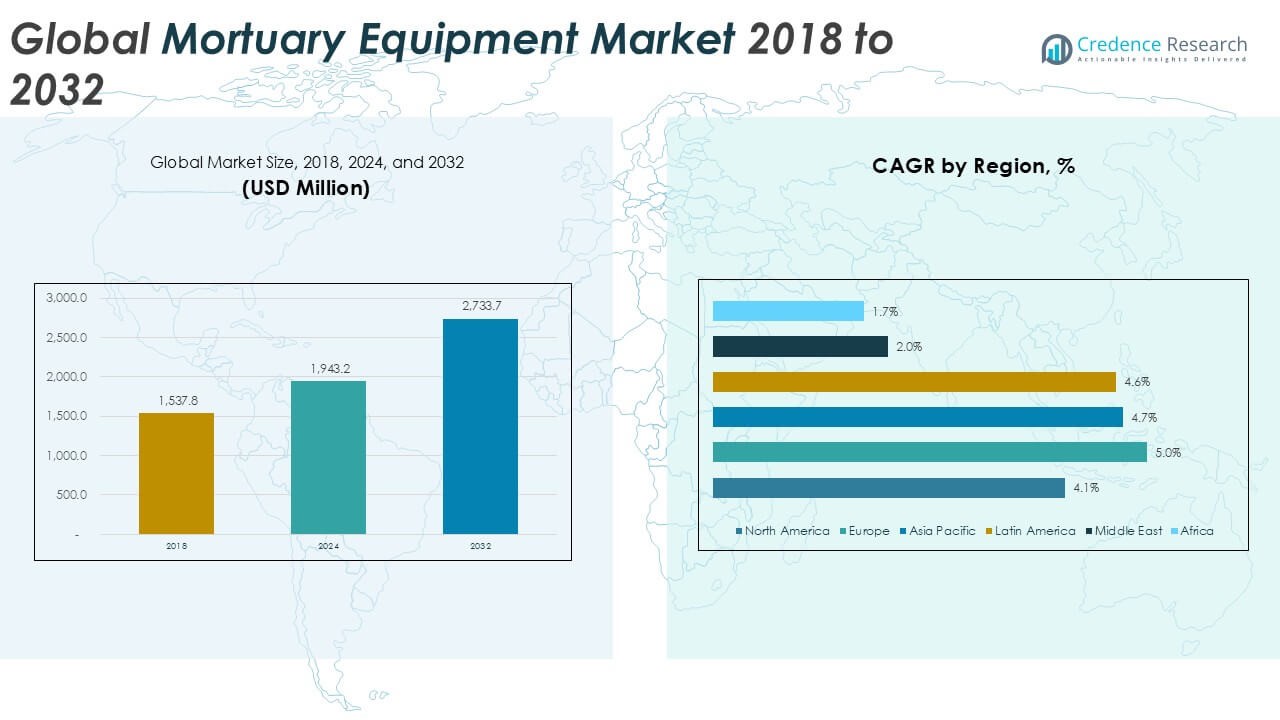
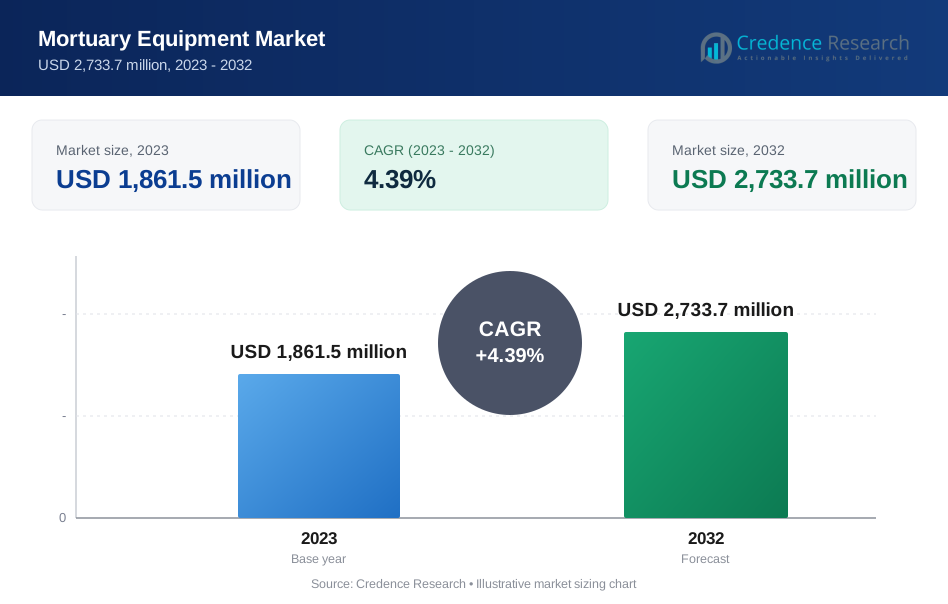
The Global Mortuary Equipment Market is projected to grow from USD 1,943.2 million in 2024 to an estimated USD 2,733.7 million by 2032, with a compound annual growth rate (CAGR) of 4.39% from 2025 to 2032.
| REPORT ATTRIBUTE | DETAILS |
|---|---|
| Historical Period | 2020-2023 |
| Base Year | 2024 |
| Forecast Period | 2025-2032 |
| Mortuary Equipment Market Size 2024 | USD 1,943.2 Million |
| Mortuary Equipment Market, CAGR | 4.39% |
| Mortuary Equipment Market Size 2032 | USD 2,733.7 Million |
The market growth is driven by the rising demand for modern mortuary facilities with advanced equipment and improved hygiene standards. Increasing investments in healthcare infrastructure, especially in emerging economies, are further accelerating the adoption of high-quality mortuary equipment. Additionally, trends such as the growing preference for eco-friendly and energy-efficient mortuary solutions are shaping the industry landscape. The increasing number of unclaimed bodies and deaths due to infectious diseases also necessitates the use of advanced mortuary systems for proper preservation and handling.
Geographically, North America holds a significant share of the Mortuary Equipment Market due to its well-established healthcare system, high mortality rates, and growing focus on technological advancements. Europe follows closely with steady demand driven by increasing investments in hospital infrastructure and funeral services. The Asia Pacific region is expected to witness the fastest growth during the forecast period, supported by rising healthcare expenditure and expanding mortuary facilities. Key players in this market include LEEC Limited, Flexmort, Mopec, Mortech Manufacturing, and Kugel Medical GmbH.
Market Insights
- The Global Mortuary Equipment Market is projected to grow from USD 1,943.2 million in 2024 to USD 2,733.7 million by 2032, at a CAGR of 4.39% from 2025 to 2032.
- Rising global mortality rates and the growing aging population are key drivers fueling consistent demand for advanced mortuary equipment.
- Expansion of healthcare infrastructure and increasing investments in modern hospital mortuary facilities are accelerating market growth.
- The growing preference for energy-efficient and eco-friendly mortuary solutions is shaping purchasing decisions and product development.
- High initial costs of automated and advanced mortuary equipment limit adoption in low-income regions and smaller healthcare facilities.
- Shortage of skilled personnel and complex maintenance requirements for advanced mortuary systems pose operational challenges.
- North America holds a significant market share, Europe shows steady growth, and Asia Pacific is expected to be the fastest-growing region during the forecast period.
Market Drivers
Rising Global Mortality Rates and Aging Population Drive Market Demand
The Global Mortuary Equipment Market is significantly driven by the increasing global mortality rates and the rapidly aging population. Many countries are experiencing higher death rates due to chronic diseases, accidents, and pandemics. The growing elderly population further contributes to the market by increasing the number of deaths requiring proper mortuary handling. Governments and healthcare providers are investing in expanding mortuary facilities to meet the rising demand. The need for efficient storage, handling, and transportation of deceased bodies is creating a continuous requirement for advanced mortuary equipment. The market responds to these demographic pressures by offering more reliable and hygienic solutions.
- For instance, the United States reported a crude death rate of 8.5 deaths per 1,000 people in 2024, translating to roughly 2,800,000 deaths that year
Expansion of Healthcare Infrastructure Supports Market Growth
The Global Mortuary Equipment Market benefits from the ongoing expansion of hospitals, clinics, and forensic laboratories worldwide. Governments and private organizations are increasing their focus on improving healthcare infrastructure, especially in developing regions. This expansion creates a higher demand for mortuary chambers, autopsy tables, and body lifting equipment. The market is witnessing growth in the installation of modern mortuary solutions within hospital settings to maintain safety and hygiene standards. It is gaining significant traction in urban and semi-urban areas where new medical facilities are being constructed. This infrastructure development directly increases the need for high-performance mortuary equipment.
- For instance, survey respondents in 2025 reported that nearly 80% of healthcare facilities commissioned new construction projects, including the addition of new mortuary and autopsy facilities, to meet growing patient and operational demands
Technological Advancements Improve Efficiency and Safety
Innovations in the Global Mortuary Equipment Market are driving the adoption of modern, automated, and energy-efficient solutions. The market is offering improved refrigeration units, mobile storage systems, and hydraulic body lifters that enhance operational efficiency. Manufacturers are focusing on designing equipment that simplifies handling and ensures worker safety during body transportation and storage. It provides better temperature control, easier maintenance, and superior hygiene management compared to traditional systems. These advancements align with the growing demand for precision, reliability, and safety in mortuary operations. The market continues to evolve by integrating technology to meet professional and regulatory standards.
Increasing Demand for Customized and Eco-Friendly Equipment
The Global Mortuary Equipment Market is witnessing a rise in demand for customized and eco-friendly solutions. Healthcare providers and funeral homes are seeking equipment that meets specific size, capacity, and functionality requirements. It is also responding to environmental concerns by offering energy-efficient refrigeration units and sustainable materials. Consumers and institutions are showing preference for solutions that minimize environmental impact and reduce energy consumption. The market is increasingly focusing on green technologies and long-lasting equipment to address these preferences. This shift toward sustainability is reshaping purchasing decisions and supplier offerings. It drives manufacturers to develop products that balance functionality with environmental responsibility.
Market Trends
Increasing Preference for Automated Mortuary Systems
The Global Mortuary Equipment Market is experiencing a growing trend toward automated systems that simplify body handling and storage. Hospitals and funeral homes are adopting hydraulic body lifters, automated stretchers, and motorized trolleys to improve efficiency. It reduces manual labor, enhances workplace safety, and supports faster processing of mortuary tasks. Automated mortuary solutions are gaining popularity for their ability to handle large volumes while maintaining strict hygiene standards. The trend is strong in regions with limited workforce availability where automation can significantly improve operations. The market is responding by offering versatile, user-friendly automated equipment to meet this rising demand.
- For instance, in 2023, automated mortuary equipment accounted for approximately 75 out of every 100 units sold in the global mortuary equipment market, reflecting the dominance of automation in new installations. In the United States alone, there were over 3,400,000 death cases in 2023, driving demand for automated mortuary solutions in hospitals and funeral homes
Growing Adoption of Eco-Friendly and Energy-Efficient Solutions
The Global Mortuary Equipment Market is steadily shifting toward eco-friendly and energy-efficient products. Healthcare institutions and mortuary facilities are actively seeking equipment that minimizes energy consumption and environmental impact. It is driving manufacturers to develop refrigeration units with advanced insulation and low-energy compressors. There is an increasing demand for equipment made from sustainable and recyclable materials that meet green building standards. This trend reflects a broader industry focus on reducing carbon footprints and meeting regulatory requirements. The market is adapting to these preferences by offering solutions that combine functionality with sustainability.
- For instance, as of November 2024, there were 470 green burial cemeteries operating in the U.S. and Canada, supporting the adoption of sustainable caskets and coffins. Additionally, 91 out of every 100 people surveyed considered the environmental impact of funerals important, and 84 would opt for a green funeral if available
Rising Customization Requirements Across Mortuary Facilities
Customization is becoming a key trend in the Global Mortuary Equipment Market, with clients requesting equipment tailored to specific space and capacity needs. Hospitals, morgues, and funeral homes are demanding flexible designs that fit unique facility layouts. It encourages manufacturers to offer modular storage systems, adjustable autopsy tables, and mobile refrigeration units. Custom-built solutions help optimize workflow efficiency and ensure better utilization of available space. The growing complexity of mortuary operations is fueling this demand for specialized equipment. The market is moving toward greater product variety to address diverse operational challenges.
Growing Investment in Forensic and Pathology Infrastructure
The Global Mortuary Equipment Market is seeing increased investment in forensic labs and pathology centers. Governments and healthcare organizations are expanding these facilities to handle rising caseloads and complex post-mortem procedures. It is driving the demand for high-precision autopsy equipment, dissection tables, and specialized storage solutions. This trend is particularly strong in urban centers where crime rates and medico-legal cases are rising. The market is supporting these infrastructure upgrades by supplying advanced mortuary solutions designed for forensic applications. The focus on accuracy, efficiency, and hygiene is shaping product development across this segment.
Market Challenges
High Equipment Costs and Budget Constraints Limit Market Penetration
The Global Mortuary Equipment Market faces significant challenges due to the high cost of advanced equipment. Many healthcare facilities, particularly in low-income regions, struggle to afford modern mortuary solutions. It restricts market growth in areas where budget allocations for non-critical medical infrastructure remain low. The high initial investment required for automated and energy-efficient equipment creates barriers for smaller hospitals and rural mortuaries. Limited financial resources lead many institutions to continue using outdated systems despite their inefficiencies. The market finds it difficult to expand uniformly across regions with varying economic capabilities.
- For instance, a 2025 industry report highlights that the price of a single advanced mortuary refrigeration unit can range from 10,000 to 50,000 units, while automated autopsy stations may require over 100,000 units, making such investments prohibitive for small hospitals and rural facilities.
Lack of Skilled Personnel and Maintenance Complexity
The Global Mortuary Equipment Market also encounters operational challenges due to the lack of skilled personnel to handle complex mortuary systems. Many regions face shortages of trained technicians capable of maintaining and operating advanced mortuary equipment. It results in higher downtime and limits the efficiency of these installations. Complex maintenance procedures and the need for regular servicing create additional burdens on healthcare facilities. Delays in repairs and lack of timely technical support further disrupt mortuary operations. The market must address these skill gaps and maintenance challenges to achieve sustainable growth across all regions.
Market Opportunities
Expanding Healthcare Infrastructure in Emerging Economies Creates New Opportunities
The Global Mortuary Equipment Market holds significant growth opportunities in emerging economies where healthcare infrastructure is rapidly developing. Governments and private organizations are increasing investments in new hospitals, mortuaries, and forensic centers. It presents a strong potential for the market to supply advanced mortuary solutions to these growing facilities. Rising urbanization and healthcare awareness are driving demand for modern mortuary equipment in both public and private sectors. Expanding healthcare access in rural areas also opens new avenues for market penetration. The market can achieve broader reach by offering affordable, durable, and region-specific solutions to meet these growing needs.
Rising Demand for Mobile and Compact Mortuary Solutions Offers Growth Potential
The Global Mortuary Equipment Market is well-positioned to capitalize on the growing interest in mobile and compact mortuary systems. Hospitals, disaster response teams, and military units require portable solutions that provide flexibility in limited spaces. It encourages manufacturers to develop mobile refrigeration units, modular autopsy tables, and easily transportable storage systems. The increasing focus on quick deployment during emergencies supports the demand for such adaptable equipment. Urban healthcare facilities with space constraints are also seeking compact designs that maximize efficiency without sacrificing functionality. The market can leverage this demand by offering space-efficient, transportable mortuary equipment.
Market Segmentation Analysis
By Product
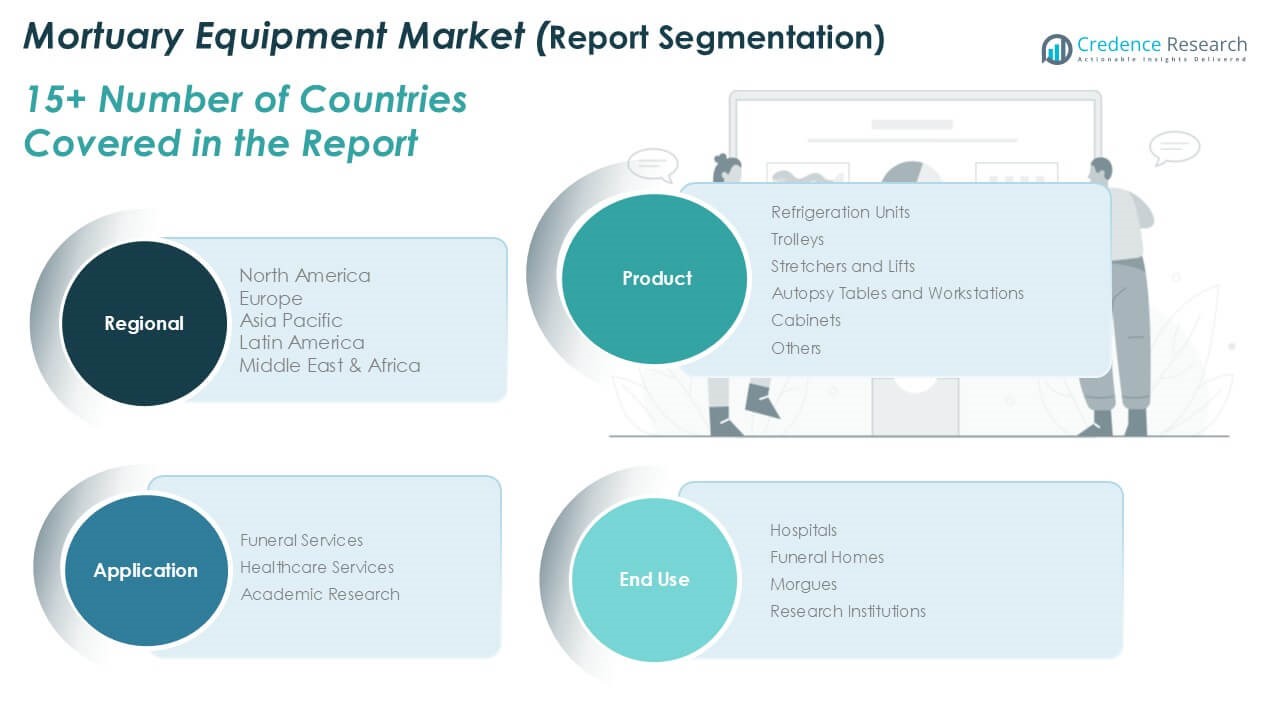
The Global Mortuary Equipment Market is segmented into refrigeration units, trolleys, stretchers and lifts, autopsy tables and workstations, cabinets, and others. Refrigeration units hold a major share due to their essential role in preserving bodies under controlled temperatures. Trolleys and stretchers are widely used for safe and efficient body transportation within facilities. Stretchers and lifts reduce manual handling and improve safety during body movement. Autopsy tables and workstations are important for post-mortem examinations and are in demand across hospitals and forensic centers. Cabinets provide organized and secure storage, supporting hygienic mortuary operations. The market continues to expand product diversity to meet the growing needs of modern mortuary facilities.
- For instance, a survey of hospital mortuaries in the United States found that a typical mid-sized hospital maintains 6–10 refrigeration units, 4–6 trolleys, and 2–4 autopsy tables to support daily operations.
By Application
The Global Mortuary Equipment Market is categorized into funeral services, healthcare services, and academic research. Funeral services hold a significant share due to the continuous demand for proper body handling and storage during ceremonies. Healthcare services contribute substantially to the market due to the growing number of hospital-based mortuary facilities. Academic research applications focus on autopsy procedures and medical studies, creating steady demand for specialized mortuary equipment. It addresses the need for high-precision tools and hygienic workstations within research institutions. The market supports these applications by providing safe, efficient, and customized solutions.
- For instance, in 2022, over 5,000 hospitals in the United States operated on-site mortuary facilities, with each facility processing an average of 250–400 bodies annually for healthcare and research purposes.
By End Use
The Global Mortuary Equipment Market is divided into hospitals, funeral homes, morgues, and research institutions. Hospitals account for a large portion of market demand due to increasing mortality rates and the need for modern mortuary installations. Funeral homes require reliable equipment to ensure proper body preparation and storage. Morgues depend on durable and space-efficient mortuary systems to handle both routine and high-volume cases. Research institutions use specialized equipment for forensic and medical studies. It provides tailored solutions for each end-user to support operational efficiency and regulatory compliance.
Segments
Based on Product
- Refrigeration Units
- Trolleys
- Stretchers and Lifts
- Autopsy Tables and Workstations
- Cabinets
- Others
Based on Application
- Funeral Services
- Healthcare Services
- Academic Research
Based on End Use
- Hospitals
- Funeral Homes
- Morgues
- Research Institutions
Based on Region
- North America
- U.S.
- Canada
- Mexico
- Europe
- UK
- France
- Germany
- Italy
- Spain
- Russia
- Belgium
- Netherlands
- Austria
- Sweden
- Poland
- Denmark
- Switzerland
- Rest of Europe
- Asia Pacific
- China
- Japan
- South Korea
- India
- Australia
- Thailand
- Indonesia
- Vietnam
- Malaysia
- Philippines
- Taiwan
- Rest of Asia Pacific
- Latin America
- Brazil
- Argentina
- Peru
- Chile
- Colombia
- Rest of Latin America
- Middle East
- UAE
- KSA
- Israel
- Turkey
- Iran
- Rest of Middle East
- Africa
- Egypt
- Nigeria
- Algeria
- Morocco
- Rest of Africa
Regional Analysis
North America Mortuary Equipment Market
The North America Mortuary Equipment Market is projected to grow from USD 334.50 million in 2024 to USD 458.72 million by 2032, expanding at a CAGR of 4.1% from 2025 to 2032. It holds a regional market share of approximately 17.2% in 2024. Strong healthcare infrastructure, rising hospital numbers, and increasing investments in advanced mortuary systems support market growth. The United States drives most of the regional demand due to its large network of hospitals and funeral service providers. Canada contributes steadily, supported by its growing healthcare facilities and increasing preference for automated mortuary equipment. The market benefits from rising adoption of eco-friendly and energy-efficient products across North America.
Europe Mortuary Equipment Market
The Europe Mortuary Equipment Market is expected to grow from USD 438.96 million in 2024 to USD 647.08 million by 2032, registering a CAGR of 5.0% from 2025 to 2032. It represents about 22.6% of the global market share in 2024, making it a key revenue contributor. Countries like Germany, the United Kingdom, and France are expanding their hospital and mortuary infrastructure. The market benefits from rising demand for energy-efficient refrigeration units and customized mortuary equipment. Increasing mortality rates and aging population trends in Europe continue to drive demand. The region consistently upgrades mortuary facilities to maintain high hygiene and operational standards.
Asia Pacific Mortuary Equipment Market
The Asia Pacific Mortuary Equipment Market is forecasted to grow from USD 715.83 million in 2024 to USD 1,033.63 million by 2032, at a CAGR of 4.7% from 2025 to 2032. It holds the largest market share of approximately 36.8% in 2024. China, Japan, and India are major contributors due to their large populations and rapidly growing healthcare sectors. The market responds to rising investments in hospital infrastructure and expanding funeral service networks. Urbanization and changing consumer preferences support demand for compact and automated mortuary solutions. The region is becoming a focus area for manufacturers introducing affordable, advanced equipment.
Latin America Mortuary Equipment Market
The Latin America Mortuary Equipment Market is projected to grow from USD 247.73 million in 2024 to USD 355.39 million by 2032, with a CAGR of 4.6% from 2025 to 2032. It accounts for around 12.7% of the global market share in 2024. Brazil and Mexico lead the regional demand with increasing hospital establishments and growing funeral home businesses. The market sees gradual adoption of modern mortuary equipment supported by government healthcare spending. Rising demand for mobile and cost-effective mortuary solutions is driving growth. The region continues to upgrade traditional mortuary practices with more efficient and safer equipment.
Middle East Mortuary Equipment Market
The Middle East Mortuary Equipment Market is set to grow from USD 93.27 million in 2024 to USD 109.35 million by 2032, at a modest CAGR of 2.0% from 2025 to 2032. It holds a regional market share of about 4.8% in 2024. Saudi Arabia and the United Arab Emirates are the primary markets supported by expanding healthcare facilities. Limited investments in advanced mortuary equipment restrict faster growth. It faces challenges in market expansion due to relatively low adoption of modern mortuary solutions. However, the increasing focus on hospital infrastructure upgrades presents steady demand across key countries.
Africa Mortuary Equipment Market
The Africa Mortuary Equipment Market is expected to grow from USD 112.87 million in 2024 to USD 129.58 million by 2032, registering a CAGR of 1.7% from 2025 to 2032. It contributes approximately 5.8% to the global market share in 2024. The market remains underdeveloped in many countries due to budget constraints and limited healthcare infrastructure. South Africa is the leading contributor with rising healthcare investments and growing awareness of modern mortuary practices. It relies heavily on basic mortuary systems with slow adoption of advanced technologies. Improving hospital networks across select regions is expected to offer gradual growth opportunities.
Key players
- AB Enzymes
- Ferno-Washington, Inc.
- Hygeco Lear
- Kugel Medical
- Leec Ltd
- Mopec
- Mortech Manufacturing Company Inc.
- SM Scientific Instruments Pvt. Ltd.
- Fiocchetti Scientific S.R.L.
- Mortuary Lift Company
- Organic Dyes and Pigments
Competitive Analysis
The Global Mortuary Equipment Market is highly competitive with several established players offering diverse and specialized product portfolios. It features strong participation from companies like Ferno-Washington, Inc., Hygeco Lear, Kugel Medical, and Mopec, which lead with advanced mortuary systems and reliable service networks. Regional players such as SM Scientific Instruments Pvt. Ltd. and Fiocchetti Scientific S.R.L. cater to local demands with cost-effective solutions. AB Enzymes and Organic Dyes and Pigments bring niche product offerings that support mortuary processes. The market focuses on innovation, product customization, and operational efficiency to gain competitive advantage. Companies invest in expanding distribution channels, improving energy efficiency, and introducing automated equipment to strengthen their positions. It remains dynamic with continuous efforts to meet evolving healthcare standards and regulatory requirements across regions.
Recent Developments
- In March 2025, AB Enzymes unveiled a refreshed corporate identity to reflect the full integration of Roal Oy into its global operations. This integration means AB Enzymes now operates as a single, unified entity. The new corporate design emphasizes AB Enzymes' heritage, growth, and commitment to innovation
- In June 2025, Mopec expanded its Guardian Systems line with the Safe Seal MassPack semi‑trailer solutions for mass‑fatality events, including racks, trays, lifts, and body bags
Market Concentration and Characteristics
The Global Mortuary Equipment Market shows a moderately fragmented structure with the presence of both international and regional players. It features a competitive mix of large companies offering advanced mortuary solutions and smaller firms providing region-specific products. The market focuses on technological advancements, energy efficiency, and customization to meet the diverse needs of hospitals, funeral homes, and forensic centers. It responds to increasing demand for automated and eco-friendly equipment across key regions. Product quality, after-sales support, and pricing remain critical factors influencing purchasing decisions. The market continues to evolve with rising investments in research and development to address operational efficiency and regulatory compliance.
Report Coverage
The research report offers an in-depth analysis based on Product, Application, End Use and Region. It details leading market players, providing an overview of their business, product offerings, investments, revenue streams, and key applications. Additionally, the report includes insights into the competitive environment, SWOT analysis, current market trends, as well as the primary drivers and constraints. Furthermore, it discusses various factors that have driven market expansion in recent years. The report also explores market dynamics, regulatory scenarios, and technological advancements that are shaping the industry. It assesses the impact of external factors and global economic changes on market growth. Lastly, it provides strategic recommendations for new entrants and established companies to navigate the complexities of the market.
Future Outlook
- The Global Mortuary Equipment Market is projected to witness consistent growth driven by rising global mortality rates and increasing healthcare infrastructure investments.
- Automated mortuary equipment, including hydraulic lifts and motorized trolleys, will see rising adoption due to their efficiency, safety, and ability to reduce manual labor.
- Energy-efficient refrigeration units and eco-friendly equipment will gain traction as facilities prioritize sustainability and compliance with green standards.
- Emerging markets in Asia Pacific, Latin America, and parts of Africa will present strong growth opportunities supported by hospital expansion and improving healthcare access.
- Customized mortuary solutions tailored to specific facility sizes, capacities, and operational needs will dominate future product strategies across the market.
- There will be growing preference for mobile mortuary units and compact designs that support emergency response, military operations, and space-constrained facilities.
- Forensic laboratories and academic research centers will increase their investments in specialized mortuary equipment, driving demand for precision autopsy tools.
- Integration of smart controls, digital monitoring, and automation in mortuary equipment will improve temperature management and operational efficiency.
- Strict hygiene and safety regulations will continue to shape product selection, encouraging facilities to invest in advanced, compliant mortuary systems.
- Competitive pressures among key players will push companies to innovate, improve after-sales services, and offer flexible pricing to secure long-term market positions.
Request a Free Sample
Fill in your details and we'll send you a free sample report.
- Sample data tables & charts
- Research methodology
Need a Custom Version of This Report?
Tailor the scope, geography, or segments to your exact requirements.
- Custom geography or segment scope
- Direct access to our analyst team
Frequently Asked Questions
What is the market size of the Global Mortuary Equipment Market in 2023, and what is its forecast for 2032?
What are the key factors driving the growth of the Global Mortuary Equipment Market?
Which regions are expected to dominate the Global Mortuary Equipment Market?
Why is there a growing preference for eco-friendly mortuary equipment?
Who are the major players in the Global Mortuary Equipment Market?
Table of Content
Chapter 1. Report Introduction
- 1.1 Report Description & Purpose
- 1.1.1 Report Title & Market Definition
- 1.1.2 Unique Selling Propositions (USP) & Key Differentiators
- 1.1.3 Value Proposition for Stakeholders
- 1.2 Research Objectives
- 1.2.1 Market Sizing Objectives (Volume & Revenue) (Volume Where Applicable)
- 1.2.2 Segmentation Objectives
- 1.2.3 Competitive Intelligence Objectives
- 1.2.4 Forecast & Scenario Objectives
- 1.3 Report Scope
- 1.3.1 Mortuary Equipment Scope – Segments & Subsegments Covered
- 1.3.2 Geographic Scope – Regions & Countries Covered
- 1.3.3 Historical Period, Base Year & Forecast Period (2023; forecast to 2032)
- 1.3.4 Inclusions & Exclusions
- 1.4 Industry Classification & Applicable Codes
- 1.5 Currency, Measurement Units & Valuation Basis
- 1.6 Target Stakeholders
- 1.7 Limitations & Assumptions
Chapter 2. Executive Summary
- 2.1 Global Mortuary Equipment Market Snapshot
- 2.1.1 Market Size – Historical (2023) & Forecast (2023-2032) (2023: USD 1,861.5 million → 2032: USD 2,733.7 million)
- 2.1.2 Volume & Revenue – Global Totals (Volume Where Applicable)
- 2.1.3 Key Market Highlights – Top Five Facts
- 2.2 Mortuary Equipment Market Segmentation Snapshot
- 2.2.1 Market Split by Region – 2023 vs. 2032
- 2.3 Competitive Snapshot
- 2.3.1 Top 10 Players by Revenue Share – 2023
- 2.3.2 Top 10 Players by Volume Share – 2023 (Volume Where Applicable)
- 2.3.3 Recent Strategic Developments (18-Month Summary)
- 2.4 Key Investment Highlights & Strategic Conclusions
Chapter 3. Mortuary Equipment Market Dynamics & Industry Analysis
- 3.1 Market Overview & Context
- 3.1.1 Mortuary Equipment Market Position in the Broader Industry Value Chain
- 3.1.2 Demand Structure & Purchasing Dynamics
- 3.1.3 Market Maturity & Development Stage by Region
- 3.2 Mortuary Equipment Market Drivers
- 3.3 Mortuary Equipment Market Restraints & Challenges
- 3.4 Mortuary Equipment Market Opportunities
- 3.5 Porter's Five Forces Analysis
- 3.5.1 Threat of New Entrants
- 3.5.2 Bargaining Power of Suppliers
- 3.5.3 Bargaining Power of Buyers
- 3.5.4 Threat of Substitutes
- 3.5.5 Competitive Rivalry – Intensity Assessment
- 3.6 Mortuary Equipment Value Chain Analysis
- 3.6.1 Upstream – Key Inputs, Resources & Suppliers
- 3.6.1.1 Key Input/Resource 1
- 3.6.1.2 Key Input/Resource 2
- 3.6.1.3 Key Input/Resource 3
- 3.6.2 Midstream – Core Operations & Value Creation
- 3.6.2.1 Operating Model & Process Overview
- 3.6.2.2 Key Operating Locations & Capabilities by Company
- 3.6.3 Downstream – Market Channels & End Users
- 3.6.3.1 Direct Sales & Customer Engagement Channels
- 3.6.3.2 Indirect Sales, Intermediaries & Partner Channels
- 3.6.4 Value Chain Profitability Analysis
- 3.6.1 Upstream – Key Inputs, Resources & Suppliers
- 3.7 PESTEL Analysis
- 3.7.1 Political Factors
- 3.7.2 Economic Factors
- 3.7.3 Social Factors
- 3.7.4 Technological Factors
- 3.7.5 Environmental Factors
- 3.7.6 Legal Factors
- 3.8 Mortuary Equipment Supply Chain Analysis
- 3.8.1 Critical Input & Resource Availability Risk Assessment
- 3.8.2 Supplier & Operational Concentration Risk (Geographic Exposure)
- 3.8.3 Supply & Service Disruption Impact Analysis
- 3.9 Regulatory & Policy Landscape
Note: The regulatory and policy landscape section covers regulations based on their applicability to the market, Mortuary Equipment category, geography, and scope of the study. Only regulatory frameworks with a material impact on operations, compliance, trade, sustainability, or market access are analyzed in detail.
Chapter 4. Key Investment Pockets & Opportunity Analysis
- 4.1 Mortuary Equipment Market Attractiveness Analysis
- 4.1.1 By Region – Investment Attractiveness Matrix (Market Size × CAGR)
- 4.2 Absolute Revenue Growth Opportunity
- 4.2.1 By Region – Absolute Revenue Growth Through 2032
- 4.3 Incremental Demand Opportunity
- 4.3.1 By Region – Incremental Demand Through 2032
- 4.3.2 Segment – Incremental Demand
- 4.4 Emerging Submarket Opportunity Deep Dive (Subject to Applicability)
- 4.5 Priority Market Opportunity Scorecards
- 4.5.1 United States
- 4.5.2 Europe
- 4.5.3 Asia
- 4.5.4 Middle East & Africa
Note: Priority market opportunity scorecards reflect the geographic scope and strategic relevance of the study. Listed markets are indicative and may be adapted to the industry.
Chapter 5. Mortuary Equipment Cross-Border Trade & Market Access Analysis
- 5.1 International Trade & Cross-Border Activity Overview
- 5.1.1 Global Export Value by Country (2023)
- 5.1.2 Global Export Volume by Country (2023) (Volume Where Applicable)
- 5.1.3 Global Import Value by Country (2023)
- 5.1.4 Global Import Volume by Country (2023) (Volume Where Applicable)
- 5.1.5 Net Trade Balance by Country (2023)
- 5.2 Export Analysis – Segment
- 5.2.1 Category 1 (Applicable Classification Code)
- 5.2.2 Category 2 (Applicable Classification Code)
- 5.2.3 Category 3 (Applicable Classification Code)
- 5.2.4 Category 4 (Applicable Classification Code)
- 5.2.5 Category 5 (Applicable Classification Code)
- 5.3 Import Analysis – Segment
- 5.3.1 Category 1 (Applicable Classification Code)
- 5.3.2 Category 2 (Applicable Classification Code)
- 5.3.3 Category 3 (Applicable Classification Code)
- 5.3.4 Category 4 (Applicable Classification Code)
- 5.3.5 Category 5 (Applicable Classification Code)
- 5.4 Cross-Border Pricing & Transaction Benchmarks
- 5.4.1 Export Pricing – Segment & Country
- 5.4.2 Import Pricing – Segment & Source Country
- 5.4.3 Price Trends (2023)
- 5.5 Key Cross-Border Trade & Delivery Routes
- 5.5.1 Cross-Border Trade/Delivery Route 1
- 5.5.2 Cross-Border Trade/Delivery Route 2
- 5.5.3 Cross-Border Trade/Delivery Route 3
- 5.5.4 Cross-Border Trade/Delivery Route 4
- 5.5.5 Cross-Border Trade/Delivery Route 5
- 5.6 Trade Policy & Market Access Impact Assessment
- 5.6.1 Tariff & Non-Tariff Barriers
- 5.6.2 Regional Trade & Economic Integration Frameworks
- 5.6.3 Bilateral & Multilateral Trade Agreements
- 5.6.4 Cross-Border Operating, Licensing & Localization Requirements
Note: This chapter applies where cross-border trade or delivery is relevant to Mortuary Equipment. Goods, services, and digital offerings are assessed using applicable classifications and transaction measures. Import-export volumes, trade balances, and route analyses are included only where meaningful to the market.
Chapter 6. Competitive Landscape & Company Benchmarking
- 6.1 Mortuary Equipment Market Concentration & Structure
- 6.1.1 Herfindahl-Hirschman Index (HHI) – vs. 2023
- 6.1.2 Leading, Mid-Sized & Emerging Player Structure
- 6.1.3 Global, Regional & Local Player Dynamics
- 6.2 Mortuary Equipment Market Share Analysis – 2023
- 6.2.1 Global Revenue Share by Company
- 6.2.2 Global Volume Share by Company (Volume Where Applicable)
- 6.2.3 Regional Revenue Share
- 6.2.4 Market Share Evolution ( vs. 2023)
- 6.2.5 Company Market Share by Key Segment
- 6.2.6 Company Market Share by Customer Group
- 6.3 Operating Scale, Capacity & Infrastructure Analysis
- 6.3.1 Global Operating Scale & Supply Capacity
- 6.3.2 Resource Utilization & Operating Efficiency
- 6.3.3 Output, Service Delivery & Activity Metrics
- 6.3.4 Operating Footprint & Infrastructure Map
- 6.3.5 Planned Operational & Capacity Expansion
- 6.4 Mortuary Equipment Competitive Benchmarking Matrix
- 6.4.1 Revenue, Growth, Profitability & Operating Metric Comparison
- 6.4.2 Channel Revenue Mix
- 6.4.3 Geographic Revenue Exposure
- 6.4.4 R&D Intensity
- 6.4.5 Sustainability Maturity
- 6.5 Strategic Developments in Mortuary Equipment (Last 24 Months)
- 6.5.1 Mergers, Acquisitions & Divestments
- 6.5.2 New Products, Services & Solutions in Mortuary Equipment
- 6.5.3 Operational & Infrastructure Expansions
- 6.5.4 Strategic Alliances, Joint Ventures & Partnerships
- 6.5.5 Distribution Expansion & Market Entry
- 6.5.6 Sustainability & ESG Initiatives
- 6.6 Competitive Strategy Mapping
- 6.6.1 Leader, Challenger, Follower & Niche Classification
- 6.6.2 Pricing Strategy Comparison
- 6.6.3 Channel Strategy Matrix
Note: Strategic developments are included based on their materiality and the availability of reliable information.
Chapter 7. Global Mortuary Equipment Market – By Sales & Delivery Channel
- 7.1 Segment Overview
- 7.1.1 Volume & Revenue Split by Channel (2023 & 2032) (Volume Where Applicable)
- 7.1.2 Channel Mix Evolution (2023-2032)
Chapter 8. Regional Market Analysis – Global Overview
- 8.1 Global Regional Overview
- 8.1.1 Regional Volume Share (Volume Where Applicable)
- 8.1.2 Regional Revenue Share
- 8.1.3 Regional Volume by Region (Volume Where Applicable)
- 8.1.4 Regional Revenue by Region
- 8.1.5 Regional Forecast Through 2032
- 8.2 Cross-Regional Segment Analysis
- 8.2.1 By Sales & Delivery Channel
- 8.2.2 By Competitive Positioning & Price Tier
Chapter 9. North America Mortuary Equipment Market
- 9.1 United States
- 9.2 Canada
- 9.3 Mexico
Chapter 10. Europe Mortuary Equipment Market
- 10.1 Germany
- 10.2 France
- 10.3 Italy
- 10.4 United Kingdom
- 10.5 Spain
- 10.6 Poland
- 10.7 Russia
- 10.8 Netherlands
- 10.9 Belgium
- 10.10 Sweden
- 10.11 Denmark
- 10.12 Norway
- 10.13 Rest of Europe
Chapter 11. Asia Pacific Mortuary Equipment Market
- 11.1 China
- 11.2 India
- 11.3 Japan
- 11.4 South Korea
- 11.5 Thailand
- 11.6 Indonesia
- 11.7 Vietnam
- 11.8 Malaysia
- 11.9 Australia
- 11.10 Rest of Asia Pacific
Chapter 12. Latin America Mortuary Equipment Market
- 12.1 Brazil
- 12.2 Argentina
- 12.3 Colombia
- 12.4 Chile
- 12.5 Rest of Latin America
Chapter 13. Middle East Mortuary Equipment Market
- 13.1 Saudi Arabia
- 13.2 United Arab Emirates
- 13.3 Turkey
- 13.4 Israel
- 13.5 Iran
- 13.6 Rest of the Middle East
Chapter 14. Africa Mortuary Equipment Market
- 14.1 South Africa
- 14.2 Egypt
- 14.3 Nigeria
- 14.4 Morocco
- 14.5 Rest of Africa
Chapter 15. Mortuary Equipment Company Profiles
- 15.1 [Company 01]
- 15.1.1 Company Overview
- 15.1.2 Key Management Personnel
- 15.1.3 Products & Services Portfolio
- 15.1.4 Financial Performance
- 15.1.5 Key Market Focus & Geographic Presence
- 15.1.6 Recent Developments & Strategic Initiatives
Note: The company profile list is preliminary and may change based on research findings, market developments, data availability, and client requirements.
Chapter 16. Appendices
- Appendix A – List of Abbreviations & Acronyms
- Appendix B – Industry Classification Code Reference – Full Series
- Appendix C – Supply, Output & Operating Capacity Data Tables
- Appendix D – End-Use & Demand Base Tables
- Appendix E – Demand, Adoption & Usage Assumptions
- Appendix F – Pricing & Revenue Metric Reference Tables
- Appendix G – Company Operations & Infrastructure Database
- Appendix H – Cross-Border Trade & Activity Data Tables (Where Applicable)
- Appendix I – Regulatory Summary Tables
- Appendix J – Primary Research Participant List (Anonymized)
- Appendix K – Primary Research Questionnaire Framework
- Appendix L – Data Sources & Bibliography
- Appendix M – Market Size Divergence & Source Comparison
Chapter 17. Research Methodology
- 17.1 Research Framework & Philosophy
- 17.2 Secondary Research – Sources, Hierarchy & Data Extraction
- 17.3 Data Modeling – Bottom-Up & Top-Down Market Sizing
- 17.4 Primary Research – Stakeholder Framework, LOI & Sample Sizes
- 17.5 Forecast Methodology – Regression, Scenario & Sensitivity Analysis
- 17.6 Quality Control – Four-Layer Validation Framework
- 17.7 Limitations & Standard Assumptions
- 17.8 Disclaimer
