
| REPORT ATTRIBUTE | DETAILS |
|---|---|
| Historical Period | 2019-2022 |
| Base Year | 2023 |
| Forecast Period | 2024-2032 |
| Motor Gasoline Market Size 2023 | USD 41251.5 million |
| Motor Gasoline Market, CAGR | 2.50% |
| Motor Gasoline Market Size 2032 | USD 51517.47 million |
Market Insights
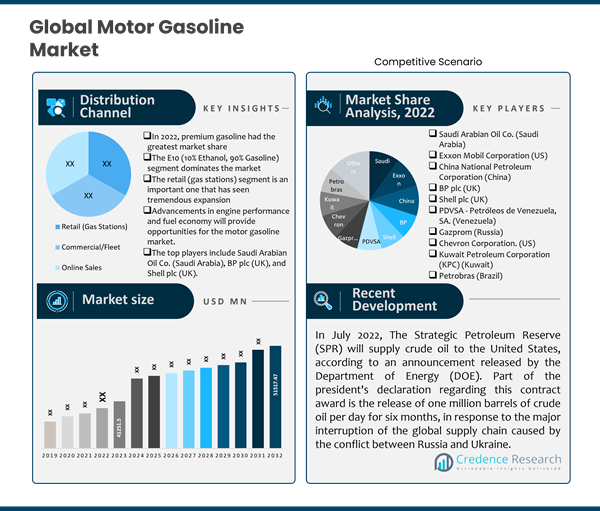
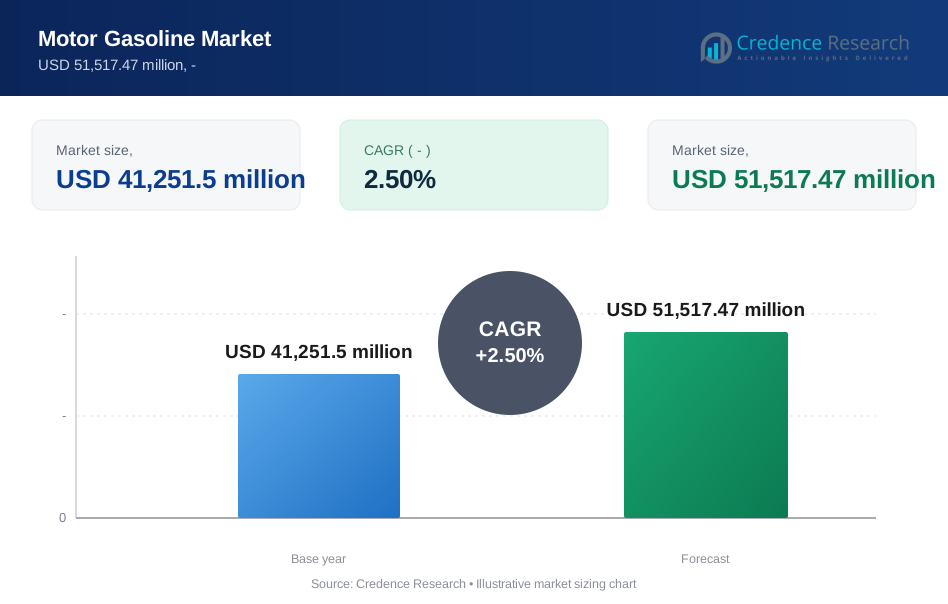
- Between 2024 and 2032, the global market for motor gasoline is projected to expand at a compound annual growth rate (CAGR) of 2.50%, from an estimated USD 41251.5 million in 2023 to USD 51517.47 million in 2032.
- The largest category is premium gasoline. Mid-grade gasoline, on the other hand, is expected to grow at a strong CAGR.
- The E10 (10% Ethanol, 90% Gasoline) category will expand rapidly.
- Throughout the projected period, the CAGR for retail (gas stations) is anticipated to be the highest.
- Throughout the projection period, the passenger vehicles should have the largest compound annual growth rate.
- Asia Pacific controlled the motor gasoline market.
- Regarding the market share of motor gasoline, Europe is expected to come second.
- North America is expected to experience the fastest growth in the motor gasoline industry.
- The expansion of the global market is being driven by the accessibility and effectiveness of refineries as well as the rise in the number of people who use gasoline.
- The market for motor gasoline may benefit from developments in driving behaviors and preferences, the shift toward urban living, and changes in transportation needs.
Executive Summary
Market Definition
The motor gasoline market includes the production, sales, and distribution of gasoline used largely as fuel for internal combustion engines in automobiles, motorcycles, and light trucks. Economic factors, seasonal fluctuations, and technological developments in the automotive and energy industries all impact the supply and demand of motor gasoline.
Market Overview
It is predicted that the motor gasoline industry will continue its upward trajectory between 2024 and 2032, growing at a compound annual growth rate (CAGR) of 2.50%. From its projected USD 41251.5 million in 2023 to USD 51517.47 million in 2032, the market will continue to grow.
The transportation industry needs a significant quantity of energy to run smoothly and effectively. Secondary fuels like gasoline, diesel, or jet fuel are needed for the majority of vehicles. Utilizing technology, primary fuels like natural gas or crude oil are transformed into fuels that may be used. Gasoline, a petroleum-based fuel intended for engines with four to six cylinders, which is common in many motor vehicles, is one of the most used fuels in automobiles. There are many benefits that gasoline has to offer drivers of cars. Motor vehicles driven by gasoline typically start up faster than those powered by other fuels because of their high combustibility. Gasoline accelerates far more swiftly than other fuels.
Moreover, two-wheelers are extensively accessible globally, exhibiting diverse demand and acceptance across different geographical areas. In addition, a lot of Asian nations, like China, India, Indonesia, Vietnam, Thailand, and others, utilize two-wheelers for personal transportation. 19.45 million two-wheelers, or 9.1% higher than the previous year, were created in India in FY 2023, according to the Society of Indian Automobile Manufacturers. Additionally, the production of two-wheelers accounted for approximately 75% of all automobiles manufactured in FY 2023. Motor gasoline demand is therefore anticipated to rise globally during the projection period in the transportation sector.
Segmentation by Type of Gasoline
- Premium gasoline is the market leader in terms of type of gasoline. Despite being more expensive than ordinary gasoline, owners of high-performance and luxury vehicles who want to improve engine performance and economy, as well as manufacturer recommendations for specific models, are the main drivers of premium gasoline demand in the motor gasoline industry.
- The mid-grade gasoline category will exhibit a sizable CAGR during the projected period. The need for mid-grade gasoline in the motor gasoline market is caused by cars that don't need premium gas but do require higher octane levels than normal. It was selected because it strikes a cost-performance balance, making it desirable to older car owners and drivers who are performance-conscious.
- Other types of gasoline, including regular gasoline, also support the need for motor gasoline.
Segmentation by Blend
- E10 (10% Ethanol, 90% Gasoline) is considered the best type of blend. Due to its increased octane rating and lower emissions compared to regular gasoline, E10 is highly sought after in the motor gasoline industry due to its environmental benefits, regulatory regulations for renewable fuels, and its compatibility with the majority of automobiles.
- The E15 (15% Ethanol, 85% Gasoline) category will likely register a significant CAGR during forecasting. Government subsidies, lower emissions, and a higher octane rating make E15 fuel more popular among consumers searching for greener options in the motor gasoline market. However, compared to E10, E15 fuel demand is constrained by infrastructure issues and vehicle compatibility issues.
- The need for motor gasoline is further enhanced by other blends, such as E85 (85% Ethanol, 15% Gasoline).
Segmentation by Distribution Channel
- The retail (gas stations) category is projected to grow faster over the projection period. Consumer car refueling needs, which are impacted by variables like fuel pricing, convenience, station locations, and service quality, drive retail demand in the motor gasoline industry. In order to draw and keep consumers, gas stations compete on price, features, and extra services.
- Other distribution channels, including commercial/fleet and online sales, also influence the need for motor gasoline.
Segmentation by Application
- The passenger vehicles category is probably going to have the greatest CAGR throughout the forecast period. Widespread vehicle ownership, everyday commuting, and individual travel requirements are the main drivers of passenger vehicle demand in the motor gasoline industry. The way that passenger vehicle owners use gasoline is influenced by various factors, including the existence of alternative fuels, economic conditions, and fuel efficiency.
- Other applications, such as commercial vehicles, industrial machinery, marine, and aviation (small aircraft), also contribute to the demand for motor gasoline.
Segmentation by Region
- Asia Pacific leads the motor gasoline industry. This is due to the rising demand for motor gasoline from the Asia Pacific countries such as China, India, Australia, and other countries.
- Europe is estimated to rank second in motor gasoline market size.
- It is anticipated that the motor gasoline market in North America will grow quickly.
- The remaining need for motor gasoline is met by regions including Latin America, the Middle East, and Africa.
Motor gasoline is mostly needed by Europe's industrial machinery industry for machinery used in manufacturing, agriculture, and construction. The necessity for dependable fuel sources to run large gear and vehicles essential to industrial operations is driving this demand. In the European market, the choice of gasoline as a fuel for these applications is also influenced by efficiency standards and regulatory compliance.
It is anticipated that motor gasoline sales in Asia Pacific will surpass those in the entire world. The region's greater focus on research and development is the reason for this. In the upcoming years, the growing use of motor gasoline products in dry cleaning operations will support the growth of the regional market. The quick rise in the number of gasoline-powered cars in China and India is one of the main drivers of the demand for motor gasoline in the Asia Pacific market.
It is projected that the motor gasoline market will develop at the fastest rate in the North American region. The US is the largest market for motor gasoline due to high ownership of vehicles and less stringent efficiency standards than consumers in emerging nations and Europe. Compared to kerosene, diesel, jet fuel (naphtha), and heating oil with numerous additions and chemicals, motor gasoline is more flammable. Expanding oil production, particularly in the US and Canada, has also contributed to the development of the regional market. The most popular fuel for transportation in the US is motor gasoline. 62% of the energy used for transportation in the US in 2020 came from finished motor gasoline.
Key Highlights of the Report
The global motor gasoline market is segmented by type of gasoline, blend, distribution channel, application, and region. As far as the type of gasoline is concerned, premium gasoline is the market spearhead. E10 (10% Ethanol, 90% Gasoline) is the top blend category. Throughout the forecast period, the category of retail (gas stations) is expected to grow at the greatest CAGR. During the predicted period, the category with the highest CAGR will be the passenger vehicles. Asia Pacific is seeing the most growth in the motor gasoline market.
Living in suburbs and rural areas more often promotes using personal cars for daily trips, errands, and commuting. There are fewer options for public transportation when people move into these locations, which increases the need for car ownership. Due to the need for fuel for home automobiles, this trend increases the demand for gasoline. In order to address the transportation needs of these growing residential regions, the motor gasoline market is developing in direct proportion to the growth in suburban and rural populations.
It is anticipated that Asia Pacific will hold the biggest global market share for motor gasoline. Delivery, logistics, and transportation services primarily encourage the appetite for motor gasoline among commercial vehicles in the Asia Pacific region. Because of limited infrastructure and financial concerns, commercial vehicles like trucks and vans run on gasoline, which contributes to the region's motor gasoline market's continuous expansion. In addition, it is projected that the market in North America will grow at the quickest rate. The small aircraft and general aviation sectors in North America are the main consumers of motor gasoline for aviation. In piston-engine aircraft, gasoline-powered engines are utilized for aerial applications, flight instruction, and private and leisure flying. The total amount of motor gasoline consumed in the area is influenced by this specialized demand.
Which Key Factors Are Driving The Global Motor Gasoline Market?
The demand for motor gasoline is being driven by the availability and the appeal of public transportation, the need for logistics and commodities movement, and the expansion of suburban regions, which is increasing commuting.
What Are The Main Challenges Confronting The Global Motor Gasoline Market?
Rising fuel costs and the expansion of ride-hailing services like Uber and Lyft, which can reduce the number of cars on the road, are the biggest challenges affecting the motor gasoline industry.
What Market Opportunities Exist For Motor Gasoline Globally?
Investment in infrastructure, regulations governing the composition and quality of gasoline, and changes in consumer buying power are some of the reasons for the growth of the motor gasoline market.
Market Drivers
An Increase in Vehicle Sales, Especially in Developing Nations
The motor gasoline market grows mostly due to rising vehicle sales, especially in emerging countries. There are multiple causes for this. First, increased rates of car ownership result from rising earnings and faster urbanization. Considering the growing popularity of personal mobility, this rise in automotive ownership is directly correlated with rising gasoline consumption. The development of transportation networks and road networks is frequently given priority in developing countries, which further encourages the use of automobiles and increases the need for gasoline.
Furthermore, these areas' industrialization and economic expansion increase the fleets of commercial vehicles and logistics activities, which increases gasoline consumption. Governments may also help the growth of the automotive industry by promoting car ownership as a sign of economic advancement. Overall, the motor gasoline market in developing countries is growing at a healthy rate due to a combination of societal goals, infrastructural investment, and economic factors.
Market Restraints
Insufficient Infrastructure for the Distribution and Sale of Gasoline
The absence of infrastructure for selling and distributing gasoline might limit consumer accessibility and convenience, which can impede the expansion of the motor gasoline market. Longer travel times are needed to replenish the fuel because there are fewer gas stations and storage facilities in underdeveloped or rural areas, which discourages the use of vehicles. Furthermore, inadequate infrastructure can result in inefficient supply chains, increased transportation expenses, and unstable fuel supply, all of which might discourage investments in developing new gasoline distribution networks and impede the growth of markets in underserved areas.
Opportunities
Fuel Economy and Refining Innovations Can Increase the Appeal of Gasoline
Refinement and fuel efficiency discoveries improve gasoline's performance and environmental credentials, making it more appealing. More efficient engines and cleaner, higher-octane gasoline are produced by advanced refining methods, which also fulfill stricter emissions regulations. These improvements support worldwide trends toward sustainability and lower carbon footprints while also lowering vehicle running expenses. Such developments position gasoline as a competitive and viable option in the energy market, especially as consumers and authorities prioritize greener fuels. This presents prospects for the motor gasoline industry to increase its market share and efficiently satisfy changing consumer demands and legal obligations.
Competitive Landscape
Key Players
The highly competitive global market for motor gasoline is dominated by a number of significant players. A handful of the top market players are shown below, together with their respective market shares:
- Saudi Arabian Oil Co. (Saudi Arabia)
- Exxon Mobil Corporation (US)
- China National Petroleum Corporation (China)
- BP plc (UK)
- Shell plc (UK)
- PDVSA - Petróleos de Venezuela, SA. (Venezuela)
- Gazprom (Russia)
- Chevron Corporation. (US)
- Kuwait Petroleum Corporation (KPC) (Kuwait)
- Petrobras (Brazil)
- LUKOIL (Russia)
- ROSNEFT (Russia)
- Abu Dhabi National Oil Company (UAE)
- China Petrochemical Corporation. (China)
- Petroliam Nasional Berhad (PETRONAS) (Malaysia)
- Eni S.p.A. (Italy)
- ENOC Company (UAE)
- NNPC (Nigeria)
- EGPC (Egypt)
- Equinor ASA (Norway)
- Oil and Natural Gas Corporation (India)
- PT Pertamina Gas (Indonesia)
- Others
In order to stay competitive, these organizations give priority to product innovation, expansion of their distribution channels, and mergers and acquisitions.
By creating cutting-edge ideas and goods, the foremost manufacturers in the global market for motor gasoline consistently strive to stay one step ahead of the competition.
In October 2023, The energy and water companies of NEOM, ENOWA, and Aramco concluded a cooperative development agreement to build and establish the world's first synthetic electro-fuel (e-fuel) demonstration plant. The plant's goal is to produce 35 barrels per day of low-carbon, synthetic gasoline using hydrogen derived from renewable sources and carbon dioxide (CO2), demonstrating both technological and commercial viability.
In February 2023, Wärtsilä and Ørsted agreed to supply a 290 MW balancing power plant to Denmark. Ten Wärtsilä 31SG engines, including installation and delivery, will be provided by this arrangement to the new natural gas-fired balancing plant, which will help integrate renewable energy sources into the Danish power system.
In December 2022, Siemens Energy bought the bulk of ELIN, a well-known supplier of gas-powered engines for distributed power generation. Siemens Energy's position in the distributed power production industry is strengthened by this acquisition, especially for applications involving biogas and renewable energy.
How are Companies Performing in the Motor Gasoline Market?
Due to a number of significant factors, companies in the motor gasoline sector are performing well. Companies in the motor gasoline industry are implementing new product improvements in order to maintain their market share. In March 2022, for example, the US-based biobased diesel manufacturer Renewable Energy Group Inc. declared the debut of its fuel solutions under the EnDura Fuels name. The Renewable Energy Group's continued efforts to support the transportation industry are enhanced by this product introduction. These developments enable the rail, aviation, maritime, and transportation sectors to achieve their sustainability targets by using fuels with lower emissions and cleaner burns.
To obtain a competitive advantage in the motor gasoline industry, significant companies are creating novel technologies like deposit-eradicating technologies. Technology that eliminates or removes deposits that may build up in a particular system or component is referred to as deposit-eradicating technology. One example is the improved formulation of Shell V-Power NiTRO+ Premium Gasoline, which was introduced by US-based oil refining company Equilon Enterprises LLC in May 2023. Fuel injectors are a crucial engine component that can lose up to 100% of performance-robbing deposits. This high-performance fuel has a special deposit-eradicating technology that targets them and protects against continued build-up. Customers can expect a premium fuel experience with the new V-Power NiTRO+, which was developed with an emphasis on maximum engine performance.
The US-based gasoline and related petroleum product company World Fuel Services Corporation purchased Lykins Energy Solutions in October 2021 for an unknown sum. The purchase of Lykins Energy Solutions' bulk fuel branch is anticipated to give World Fuel Services Corporation access to 25,000 additional commercial, industrial, and residential clients as well as a larger, exclusive operating footprint in Ohio.
Summary of Key Findings
- Advancements in engine performance and fuel economy, as well as easier access to financing for car purchases, influence the demand for motor gasoline.
- The market is segmented by type of gasoline, blend, distribution channel, application, and region.
- In the market, the most prevalent type of gasoline is premium gasoline.
- E10 (10% Ethanol, 90% Gasoline) is the foremost blend category.
- Retail (gas stations) are expected to grow fastest in terms of CAGR during the forecast period.
- During the course of the predicted period, passenger vehicles are probably going to have the greatest CAGR.
- In terms of market development, Asia Pacific is a leader; the market is highly competitive with key players including Saudi Arabian Oil Co. (Saudi Arabia), Exxon Mobil Corporation (US), China National Petroleum Corporation (China), BP plc (UK), Shell plc (UK), PDVSA - Petróleos de Venezuela, SA. (Venezuela), Gazprom (Russia), Chevron Corporation. (US), Kuwait Petroleum Corporation (KPC) (Kuwait), Petrobras (Brazil), LUKOIL (Russia), ROSNEFT (Russia), Abu Dhabi National Oil Company (UAE), and China Petrochemical Corporation. (China), Petroliam Nasional Berhad (PETRONAS) (Malaysia), Eni S.p.A. (Italy), ENOC Company (UAE), NNPC (Nigeria), EGPC (Egypt), Equinor ASA (Norway), Oil and Natural Gas Corporation (India), PT Pertamina Gas (Indonesia), and Others.
Future Outlook
- The motor gasoline industry is expected to increase significantly in Asia Pacific, and its outlook is positive worldwide.
- The market will continue to expand due to several factors, including the increasing industrial activity and the frequent usage of gasoline by trucks and SUVs.
- Reliance on gasoline is declining due to consumer choices and government regulations favoring renewable energy sources.
- Developing new products, reaching a wider market, and maintaining competitive prices are all necessary for major businesses to stay ahead of the competition.
How the Credence Research Motor Gasoline Market Report Can Help CXOs
The Credence Research Motor Gasoline Market Report provides CXOs with an extensive market overview and comprises the following:
- Market size and growth forecast: The study offers comprehensive market estimations for motor gasoline globally, broken down by type of gasoline, blend, distribution channel, application, and region. Furthermore, the report includes market forecasts through 2032, derived from key drivers and trends.
- Market segmentation: The motor gasoline market is divided into segments by type of gasoline, blend, distribution channel, application, and region in the research report. This segmentation helps CXOs understand the market and the opportunities inside each area in great depth.
- Competitive landscape: The study report provides a thorough analysis of the leading businesses in the motor gasoline sector, together with details on their revenue streams, product lines, and business strategies. With this information, CXOs can assess and identify their competitors.
- Key trends and drivers: The study report analyzes and highlights the key developments and elements driving the market for motor gasoline. CXOs can utilize this information to make well-informed choices regarding their plans and investments.
The Credence Research Motor Gasoline Market Report provides CXOs with insights that they may utilize to:
- Identify growth opportunities: This analysis is likely to help CXOs find fresh growth prospects in the motor gasoline sector. For example, the research recognizes the increasing requirement for motor gasoline from gas stations as a crucial opportunity.
- Make informed investment decisions: The study aids CXOs in making informed decisions about motor gasoline. For example, it delivers information on the key variables to consider while picking motor gasoline solutions and evaluating suppliers.
- Develop competitive strategies: CXOs can utilize the research report to establish competitive strategies for their motor gasoline firms. The study paper explores the primary tactics employed by motor gasoline providers to set themselves apart from their rivals.
- Track market developments: By tracking market advancements, this research report could assist CXOs in remaining ahead of the curve. For example, it provides information about the latest advancements and patterns in the motor gasoline industry.
The Credence Research Motor Gasoline Market Report is helpful for CXOs who want to learn more about the market and identify potential opportunities.
Segmentation
-
By Type of Gasoline
- Regular Gasoline
- Mid-Grade Gasoline
- Premium Gasoline
-
By Blend
- E10 (10% Ethanol, 90% Gasoline)
- E15 (15% Ethanol, 85% Gasoline)
- E85 (85% Ethanol, 15% Gasoline)
- Other Blends
-
By Distribution Channel
- Retail (Gas Stations)
- Commercial/Fleet
- Online Sales
-
By Application
- Passenger Vehicles
- Commercial Vehicles
- Industrial Machinery
- Marine
- Aviation (Small Aircraft)
-
By Region
- North America
- U.S
- Canada
- Mexico
- Europe
- Germany
- France
- UK
- Italy
- Spain
- Rest of Europe
- Asia Pacific
- China
- Japan
- India
- South Korea
- South-east Asia
- Rest of Asia Pacific
- Latin America
- Brazil
- Argentina
- Rest of Latin America
- Middle East & Africa
- GCC Countries
- South Africa
- The Rest of the Middle East and Africa
- North America
Adjacent Markets
Several adjacent markets in the motor gasoline market have high revenue growth opportunities. The key adjacent markets for the motor gasoline market
Adjacent Markets |
||
| Crude Oil Market | Diesel Fuel Market | Electric Vehicle (EV) Market |
| Biofuels Market | Natural Gas Market | Retail Fuel Market |
| Petrochemicals Market | Aviation Fuel Market | Renewable Energy Market |
Request a Free Sample
Fill in your details and we'll send you a free sample report.
- Sample data tables & charts
- Research methodology
Need a Custom Version of This Report?
Tailor the scope, geography, or segments to your exact requirements.
- Custom geography or segment scope
- Direct access to our analyst team
Frequently Asked Questions
How much does the global market currently hold for motor gasoline (SOFC)?
What is the motor gasoline market's projected growth rate between 2024 and 2032?
In terms of the type of gasoline, which market category is leading?
Regarding the distribution channel, which market category is in the lead?
Which application category is anticipated to grow at the fastest rate throughout the course of the projected period?
In which region is the market for motor gasoline expanding?
Who are the main players in the global motor gasoline industry?
Which market factors are the primary drivers of the motor gasoline industry?
What main market challenges prevent the growth of the motor gasoline sector?
What are the main market opportunities for the motor gasoline sector?
Table of Content
Chapter 1. Report Introduction
- 1.1 Report Description & Purpose
- 1.1.1 Report Title & Market Definition
- 1.1.2 Unique Selling Propositions (USP) & Key Differentiators
- 1.1.3 Value Proposition for Stakeholders
- 1.2 Research Objectives
- 1.2.1 Market Sizing Objectives (Volume & Revenue) (Volume Where Applicable)
- 1.2.2 Segmentation Objectives
- 1.2.3 Competitive Intelligence Objectives
- 1.2.4 Forecast & Scenario Objectives
- 1.3 Report Scope
- 1.3.1 Motor Gasoline Scope – Segments & Subsegments Covered
- 1.3.2 Geographic Scope – Regions & Countries Covered
- 1.3.3 Historical Period, Base Year & Forecast Period (the historical period; forecast to the forecast period)
- 1.3.4 Inclusions & Exclusions
- 1.4 Industry Classification & Applicable Codes
- 1.5 Currency, Measurement Units & Valuation Basis
- 1.6 Target Stakeholders
- 1.7 Limitations & Assumptions
Chapter 2. Executive Summary
- 2.1 Global Motor Gasoline Market Snapshot
- 2.1.1 Market Size – Historical (the historical period) & Forecast (the forecast period) (base year: USD 41,251.5 million → forecast year: USD 51,517.47 million)
- 2.1.2 Volume & Revenue – Global Totals (Volume Where Applicable)
- 2.1.3 Key Market Highlights – Top Five Facts
- 2.2 Motor Gasoline Market Segmentation Snapshot
- 2.2.1 Market Split by Region – vs.
- 2.3 Competitive Snapshot
- 2.3.1 Top 10 Players by Revenue Share –
- 2.3.2 Top 10 Players by Volume Share – (Volume Where Applicable)
- 2.3.3 Recent Strategic Developments (18-Month Summary)
- 2.4 Key Investment Highlights & Strategic Conclusions
Chapter 3. Motor Gasoline Market Dynamics & Industry Analysis
- 3.1 Market Overview & Context
- 3.1.1 Motor Gasoline Market Position in the Broader Industry Value Chain
- 3.1.2 Demand Structure & Purchasing Dynamics
- 3.1.3 Market Maturity & Development Stage by Region
- 3.2 Motor Gasoline Market Drivers
- 3.3 Motor Gasoline Market Restraints & Challenges
- 3.4 Motor Gasoline Market Opportunities
- 3.5 Porter's Five Forces Analysis
- 3.5.1 Threat of New Entrants
- 3.5.2 Bargaining Power of Suppliers
- 3.5.3 Bargaining Power of Buyers
- 3.5.4 Threat of Substitutes
- 3.5.5 Competitive Rivalry – Intensity Assessment
- 3.6 Motor Gasoline Value Chain Analysis
- 3.6.1 Upstream – Key Inputs, Resources & Suppliers
- 3.6.1.1 Key Input/Resource 1
- 3.6.1.2 Key Input/Resource 2
- 3.6.1.3 Key Input/Resource 3
- 3.6.2 Midstream – Core Operations & Value Creation
- 3.6.2.1 Operating Model & Process Overview
- 3.6.2.2 Key Operating Locations & Capabilities by Company
- 3.6.3 Downstream – Market Channels & End Users
- 3.6.3.1 Direct Sales & Customer Engagement Channels
- 3.6.3.2 Indirect Sales, Intermediaries & Partner Channels
- 3.6.4 Value Chain Profitability Analysis
- 3.6.1 Upstream – Key Inputs, Resources & Suppliers
- 3.7 PESTEL Analysis
- 3.7.1 Political Factors
- 3.7.2 Economic Factors
- 3.7.3 Social Factors
- 3.7.4 Technological Factors
- 3.7.5 Environmental Factors
- 3.7.6 Legal Factors
- 3.8 Motor Gasoline Supply Chain Analysis
- 3.8.1 Critical Input & Resource Availability Risk Assessment
- 3.8.2 Supplier & Operational Concentration Risk (Geographic Exposure)
- 3.8.3 Supply & Service Disruption Impact Analysis
- 3.9 Regulatory & Policy Landscape
Note: The regulatory and policy landscape section covers regulations based on their applicability to the market, Motor Gasoline category, geography, and scope of the study. Only regulatory frameworks with a material impact on operations, compliance, trade, sustainability, or market access are analyzed in detail.
Chapter 4. Key Investment Pockets & Opportunity Analysis
- 4.1 Motor Gasoline Market Attractiveness Analysis
- 4.1.1 By Region – Investment Attractiveness Matrix (Market Size × CAGR)
- 4.2 Absolute Revenue Growth Opportunity
- 4.2.1 By Region – Absolute Revenue Growth Through the forecast period
- 4.3 Incremental Demand Opportunity
- 4.3.1 By Region – Incremental Demand Through the forecast period
- 4.3.2 Segment – Incremental Demand
- 4.4 Emerging Submarket Opportunity Deep Dive (Subject to Applicability)
- 4.5 Priority Market Opportunity Scorecards
- 4.5.1 United States
- 4.5.2 Europe
- 4.5.3 Asia
- 4.5.4 Middle East & Africa
Note: Priority market opportunity scorecards reflect the geographic scope and strategic relevance of the study. Listed markets are indicative and may be adapted to the industry.
Chapter 5. Motor Gasoline Cross-Border Trade & Market Access Analysis
- 5.1 International Trade & Cross-Border Activity Overview
- 5.1.1 Global Export Value by Country (the historical period)
- 5.1.2 Global Export Volume by Country (the historical period) (Volume Where Applicable)
- 5.1.3 Global Import Value by Country (the historical period)
- 5.1.4 Global Import Volume by Country (the historical period) (Volume Where Applicable)
- 5.1.5 Net Trade Balance by Country (the historical period)
- 5.2 Export Analysis – Segment
- 5.2.1 Category 1 (Applicable Classification Code)
- 5.2.2 Category 2 (Applicable Classification Code)
- 5.2.3 Category 3 (Applicable Classification Code)
- 5.2.4 Category 4 (Applicable Classification Code)
- 5.2.5 Category 5 (Applicable Classification Code)
- 5.3 Import Analysis – Segment
- 5.3.1 Category 1 (Applicable Classification Code)
- 5.3.2 Category 2 (Applicable Classification Code)
- 5.3.3 Category 3 (Applicable Classification Code)
- 5.3.4 Category 4 (Applicable Classification Code)
- 5.3.5 Category 5 (Applicable Classification Code)
- 5.4 Cross-Border Pricing & Transaction Benchmarks
- 5.4.1 Export Pricing – Segment & Country
- 5.4.2 Import Pricing – Segment & Source Country
- 5.4.3 Price Trends (the historical period)
- 5.5 Key Cross-Border Trade & Delivery Routes
- 5.5.1 Cross-Border Trade/Delivery Route 1
- 5.5.2 Cross-Border Trade/Delivery Route 2
- 5.5.3 Cross-Border Trade/Delivery Route 3
- 5.5.4 Cross-Border Trade/Delivery Route 4
- 5.5.5 Cross-Border Trade/Delivery Route 5
- 5.6 Trade Policy & Market Access Impact Assessment
- 5.6.1 Tariff & Non-Tariff Barriers
- 5.6.2 Regional Trade & Economic Integration Frameworks
- 5.6.3 Bilateral & Multilateral Trade Agreements
- 5.6.4 Cross-Border Operating, Licensing & Localization Requirements
Note: This chapter applies where cross-border trade or delivery is relevant to Motor Gasoline. Goods, services, and digital offerings are assessed using applicable classifications and transaction measures. Import-export volumes, trade balances, and route analyses are included only where meaningful to the market.
Chapter 6. Competitive Landscape & Company Benchmarking
- 6.1 Motor Gasoline Market Concentration & Structure
- 6.1.1 Herfindahl-Hirschman Index (HHI) – vs.
- 6.1.2 Leading, Mid-Sized & Emerging Player Structure
- 6.1.3 Global, Regional & Local Player Dynamics
- 6.2 Motor Gasoline Market Share Analysis –
- 6.2.1 Global Revenue Share by Company
- 6.2.2 Global Volume Share by Company (Volume Where Applicable)
- 6.2.3 Regional Revenue Share
- 6.2.4 Market Share Evolution ( vs. )
- 6.2.5 Company Market Share by Key Segment
- 6.2.6 Company Market Share by Customer Group
- 6.3 Operating Scale, Capacity & Infrastructure Analysis
- 6.3.1 Global Operating Scale & Supply Capacity
- 6.3.2 Resource Utilization & Operating Efficiency
- 6.3.3 Output, Service Delivery & Activity Metrics
- 6.3.4 Operating Footprint & Infrastructure Map
- 6.3.5 Planned Operational & Capacity Expansion
- 6.4 Motor Gasoline Competitive Benchmarking Matrix
- 6.4.1 Revenue, Growth, Profitability & Operating Metric Comparison
- 6.4.2 Channel Revenue Mix
- 6.4.3 Geographic Revenue Exposure
- 6.4.4 R&D Intensity
- 6.4.5 Sustainability Maturity
- 6.5 Strategic Developments in Motor Gasoline (Last 24 Months)
- 6.5.1 Mergers, Acquisitions & Divestments
- 6.5.2 New Products, Services & Solutions in Motor Gasoline
- 6.5.3 Operational & Infrastructure Expansions
- 6.5.4 Strategic Alliances, Joint Ventures & Partnerships
- 6.5.5 Distribution Expansion & Market Entry
- 6.5.6 Sustainability & ESG Initiatives
- 6.6 Competitive Strategy Mapping
- 6.6.1 Leader, Challenger, Follower & Niche Classification
- 6.6.2 Pricing Strategy Comparison
- 6.6.3 Channel Strategy Matrix
Note: Strategic developments are included based on their materiality and the availability of reliable information.
Chapter 7. Global Motor Gasoline Market – By Sales & Delivery Channel
- 7.1 Segment Overview
- 7.1.1 Volume & Revenue Split by Channel ( & ) (Volume Where Applicable)
- 7.1.2 Channel Mix Evolution (the forecast period)
Chapter 8. Regional Market Analysis – Global Overview
- 8.1 Global Regional Overview
- 8.1.1 Regional Volume Share (Volume Where Applicable)
- 8.1.2 Regional Revenue Share
- 8.1.3 Regional Volume by Region (Volume Where Applicable)
- 8.1.4 Regional Revenue by Region
- 8.1.5 Regional Forecast Through the forecast period
- 8.2 Cross-Regional Segment Analysis
- 8.2.1 By Sales & Delivery Channel
- 8.2.2 By Competitive Positioning & Price Tier
Chapter 9. North America Motor Gasoline Market
- 9.1 United States
- 9.2 Canada
- 9.3 Mexico
Chapter 10. Europe Motor Gasoline Market
- 10.1 Germany
- 10.2 France
- 10.3 Italy
- 10.4 United Kingdom
- 10.5 Spain
- 10.6 Poland
- 10.7 Russia
- 10.8 Netherlands
- 10.9 Belgium
- 10.10 Sweden
- 10.11 Denmark
- 10.12 Norway
- 10.13 Rest of Europe
Chapter 11. Asia Pacific Motor Gasoline Market
- 11.1 China
- 11.2 India
- 11.3 Japan
- 11.4 South Korea
- 11.5 Thailand
- 11.6 Indonesia
- 11.7 Vietnam
- 11.8 Malaysia
- 11.9 Australia
- 11.10 Rest of Asia Pacific
Chapter 12. Latin America Motor Gasoline Market
- 12.1 Brazil
- 12.2 Argentina
- 12.3 Colombia
- 12.4 Chile
- 12.5 Rest of Latin America
Chapter 13. Middle East Motor Gasoline Market
- 13.1 Saudi Arabia
- 13.2 United Arab Emirates
- 13.3 Turkey
- 13.4 Israel
- 13.5 Iran
- 13.6 Rest of the Middle East
Chapter 14. Africa Motor Gasoline Market
- 14.1 South Africa
- 14.2 Egypt
- 14.3 Nigeria
- 14.4 Morocco
- 14.5 Rest of Africa
Chapter 15. Motor Gasoline Company Profiles
- 15.1 [Company 01]
- 15.1.1 Company Overview
- 15.1.2 Key Management Personnel
- 15.1.3 Products & Services Portfolio
- 15.1.4 Financial Performance
- 15.1.5 Key Market Focus & Geographic Presence
- 15.1.6 Recent Developments & Strategic Initiatives
Note: The company profile list is preliminary and may change based on research findings, market developments, data availability, and client requirements.
Chapter 16. Appendices
- Appendix A – List of Abbreviations & Acronyms
- Appendix B – Industry Classification Code Reference – Full Series
- Appendix C – Supply, Output & Operating Capacity Data Tables
- Appendix D – End-Use & Demand Base Tables
- Appendix E – Demand, Adoption & Usage Assumptions
- Appendix F – Pricing & Revenue Metric Reference Tables
- Appendix G – Company Operations & Infrastructure Database
- Appendix H – Cross-Border Trade & Activity Data Tables (Where Applicable)
- Appendix I – Regulatory Summary Tables
- Appendix J – Primary Research Participant List (Anonymized)
- Appendix K – Primary Research Questionnaire Framework
- Appendix L – Data Sources & Bibliography
- Appendix M – Market Size Divergence & Source Comparison
Chapter 17. Research Methodology
- 17.1 Research Framework & Philosophy
- 17.2 Secondary Research – Sources, Hierarchy & Data Extraction
- 17.3 Data Modeling – Bottom-Up & Top-Down Market Sizing
- 17.4 Primary Research – Stakeholder Framework, LOI & Sample Sizes
- 17.5 Forecast Methodology – Regression, Scenario & Sensitivity Analysis
- 17.6 Quality Control – Four-Layer Validation Framework
- 17.7 Limitations & Standard Assumptions
- 17.8 Disclaimer
