
Market Overview
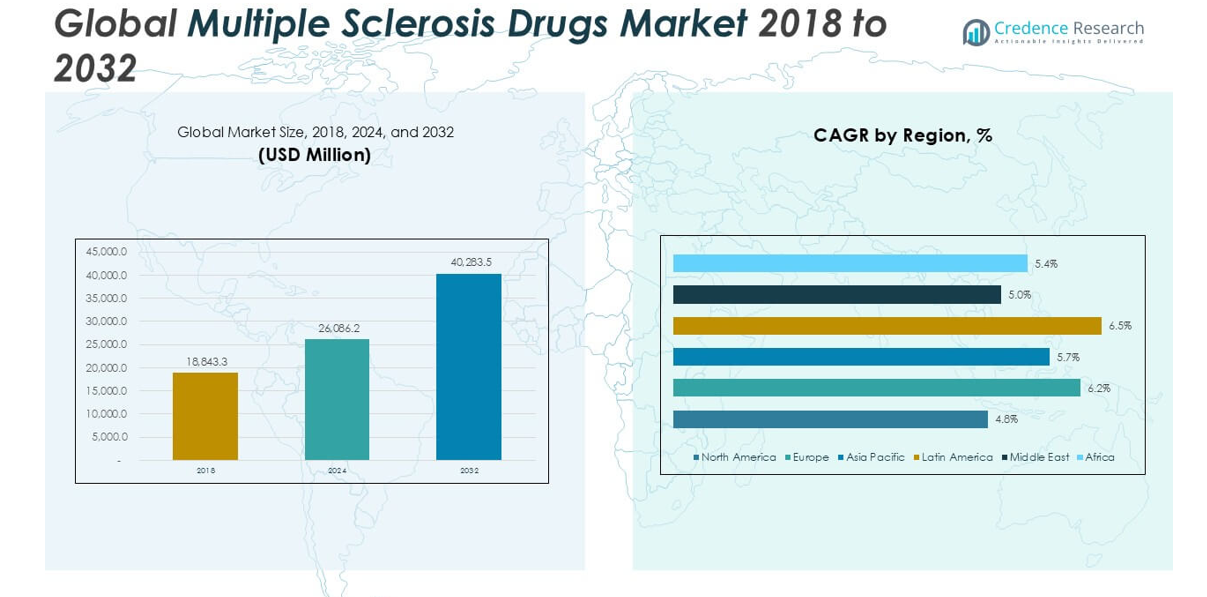
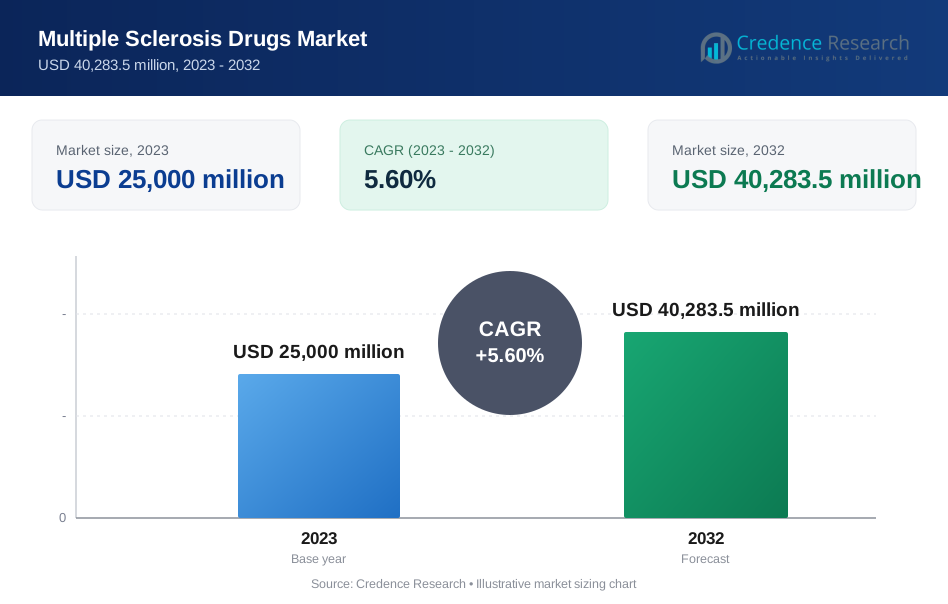
The Global Multiple Sclerosis Drugs Market is projected to grow from USD 26,086.2 million in 2024 to an estimated USD 40,283.5 million by 2032, with a compound annual growth rate (CAGR) of 5.60% from 2025 to 2032.
| REPORT ATTRIBUTE | DETAILS |
|---|---|
| Historical Period | 2020-2023 |
| Base Year | 2024 |
| Forecast Period | 2025-2032 |
| Multiple Sclerosis Drugs Market Size 2024 | USD 26,086.2 million |
| Multiple Sclerosis Drugs Market, CAGR | 5.60% |
| Multiple Sclerosis Drugs Market Size 2032 | USD 40,283.5 million |
Key market drivers include the rising global burden of MS, especially in North America and Europe, and the growing pipeline of novel drug candidates under clinical trials. Pharmaceutical companies are investing heavily in R&D to develop high-efficacy and low-risk therapies. Trends such as increased FDA approvals for monoclonal antibodies and immunomodulators, along with the integration of AI in drug discovery and patient management, are transforming the treatment landscape. Moreover, early diagnosis and improved reimbursement policies are supporting increased drug adoption.
Geographically, North America dominates the market due to high disease prevalence, advanced healthcare infrastructure, and strong presence of leading pharmaceutical companies. Europe follows closely with robust government funding for neurological diseases. Meanwhile, the Asia-Pacific region is expected to witness the fastest growth due to rising healthcare access and awareness. Key players in the market include Biogen Inc., Novartis AG, F. Hoffmann-La Roche Ltd., Sanofi S.A., Teva Pharmaceutical Industries Ltd., and Merck KGaA
Market Insights
- The global Multiple Sclerosis Drugs Market was valued at USD 26,086.2 million in 2024 and is projected to reach USD 40,283.5 million by 2032, growing at a CAGR of 5.60%.
- Increasing global incidence of multiple sclerosis and improved diagnostic capabilities are driving demand for effective and long-term therapies.
- Ongoing R\&D in disease-modifying therapies, monoclonal antibodies, and oral drugs is fueling market expansion and improving treatment outcomes.
- The adoption of personalized treatment approaches and the integration of AI in drug development are transforming patient care strategies.
- Elevated prices of MS drugs limit access, especially in low-income regions, creating disparities in treatment availability and adoption.
- Lengthy approval processes and stringent safety requirements challenge new drug entries and slow market penetration.
- North America holds the largest share, while Asia-Pacific shows the highest growth rate due to expanding healthcare access and rising awareness.
Market Drivers
Rising Prevalence of Multiple Sclerosis and Increasing Disease Awareness
The growing number of individuals diagnosed with multiple sclerosis (MS) significantly contributes to the expansion of the Global Multiple Sclerosis Drugs Market. Early diagnosis and increasing public awareness have led to higher treatment-seeking behavior. Governments and healthcare organizations have launched education campaigns to improve understanding of MS symptoms and progression. This has resulted in improved patient engagement and demand for advanced therapeutic options. Better diagnostic tools and wider availability of neurologists also support early intervention. The market benefits from the growing recognition of MS as a chronic neurological condition requiring long-term care and pharmaceutical management.
- For instance, as of 2023, about 2.9 million people worldwide live with MS, with nearly 1 million in the United States alone. Approximately 25,000 people are newly diagnosed with MS annually in the U.S., and more than 30,000 children are living with MS around the world
Strong Focus on Research and Development of Innovative Therapies
The development of novel disease-modifying therapies (DMTs) remains a core driver for the Global Multiple Sclerosis Drugs Market. Pharmaceutical companies are focusing on innovation to improve efficacy and minimize adverse effects. It continues to see investment in monoclonal antibodies, selective immunosuppressants, and cell-based therapies. Biotech firms are using cutting-edge technologies such as mRNA platforms and gene therapy to create next-generation treatments. Clinical trials for pipeline drugs have accelerated, supported by regulatory fast-tracking in key markets. These efforts aim to expand treatment options for both relapsing and progressive forms of MS.
- For instance, as of February 2025, there were approximately 908 active clinical trials for multiple sclerosis therapies worldwide, and individual phase 3 trials are enrolling several hundred participants each to evaluate new approaches in relapsing and progressive MS.
Favorable Reimbursement Policies and Regulatory Support
Government and private payers play a crucial role in supporting access to high-cost MS treatments. The Global Multiple Sclerosis Drugs Market benefits from structured reimbursement frameworks in North America and Europe. Health agencies have approved several high-efficacy drugs with favorable pricing models to ensure affordability. It gains further traction from orphan drug designations and extended patent protection. Regulatory agencies such as the FDA and EMA provide incentives for MS drug development through priority review and breakthrough designations. These initiatives help shorten approval timelines and encourage investment.
Shift Toward Oral Therapies and Personalized Medicine Approaches
Patients and providers are showing increased preference for oral MS therapies due to convenience and compliance. The Global Multiple Sclerosis Drugs Market is responding to this shift by advancing the development of oral DMTs with improved safety profiles. It is also seeing momentum in precision medicine, where biomarkers and genetic profiling guide treatment decisions. Personalized approaches offer better outcomes by aligning therapies with patient-specific disease patterns. This trend helps minimize side effects and optimize long-term treatment plans. Market players are incorporating AI-driven tools to support individualized drug development and patient monitoring.
Market Trends
Expansion of Disease-Modifying Therapies and Broadening Treatment Landscape
The treatment landscape for multiple sclerosis has evolved with the introduction of new disease-modifying therapies (DMTs). The Global Multiple Sclerosis Drugs Market is witnessing the entry of high-efficacy therapies that target specific immune pathways. It includes monoclonal antibodies, S1P receptor modulators, and selective B-cell depleting agents. These therapies offer extended dosing intervals and reduced relapse rates. Healthcare professionals are adopting them to manage relapsing-remitting and progressive forms of MS more effectively. The market continues to broaden its portfolio to address unmet needs across all stages of the disease.
- For instance, more than 10 new DMTs were approved in the U.S. for MS treatment over the past two decades, expanding available therapy options from only 2 in 2000 to over 15 by 2023
Increased Adoption of Oral Drugs Over Injectables and Infusions
There is a visible shift in patient and provider preferences from injectable and infusion therapies toward oral alternatives. The Global Multiple Sclerosis Drugs Market reflects this change through the growing uptake of convenient oral medications with favorable safety profiles. It improves patient adherence and reduces dependence on hospital-based treatment. Oral drugs such as dimethyl fumarate and fingolimod have gained strong market presence due to ease of administration. This trend supports outpatient care models and aligns with patient-centered treatment protocols. New oral formulations under development are expected to strengthen this segment further.
- For instance, a study using commercial claims data from over 100,000 MS patients in the U.S. showed that by 2020, oral therapies became the predominant treatment, while injectables' share fell to about a quarter of all prescriptions
Integration of Advanced Technologies in Drug Development and Patient Management
Technological advancements are playing a growing role in shaping drug discovery and clinical trial processes. The Global Multiple Sclerosis Drugs Market is leveraging artificial intelligence, real-world data, and digital biomarkers to accelerate innovation. It helps pharmaceutical companies design targeted therapies and streamline clinical outcomes. Wearable devices and mobile health platforms support continuous monitoring and early detection of relapses. These tools enhance patient engagement and generate valuable insights into treatment response. Digital health integration supports the transition toward personalized, data-driven care in MS management.
Focus on Long-Term Efficacy, Safety, and Combination Therapies
Stakeholders are prioritizing long-term treatment outcomes and overall quality of life for MS patients. The Global Multiple Sclerosis Drugs Market is placing greater emphasis on safety monitoring and durability of drug effects. It encourages the development of therapies that offer neuroprotection and disease progression control. Researchers are evaluating combination therapies to enhance efficacy without compromising tolerability. Long-term registries and observational studies provide critical insights into drug performance beyond clinical trials. This focus is guiding regulatory strategies and influencing clinical decision-making across regions.
Market Challenges
High Treatment Costs and Limited Access in Low-Income Regions
The cost of multiple sclerosis drugs remains a major barrier to treatment access, especially in low- and middle-income countries. The Global Multiple Sclerosis Drugs Market faces constraints due to the high prices of disease-modifying therapies and biologics. It limits availability for patients without robust insurance coverage or national reimbursement programs. Healthcare systems in developing regions struggle to accommodate the long-term financial burden associated with MS management. This creates disparities in treatment outcomes and delays in early intervention. Addressing affordability remains a critical challenge for market expansion across diverse geographies.
- For instance, more than 2,800,000 people were living with MS globally in 2020, up from 2,300,000 in 2013, according to the Multiple Sclerosis International Federation. In the United States alone, the prevalence is estimated at 288 cases per 100,000 people, while direct annual costs for MS patients can range from 16,614 to 72,744 USD per patient, with DMTs accounting for over half of those expenses.
Complex Drug Development and Stringent Regulatory Requirements
Developing effective and safe MS drugs involves lengthy research, high investment, and strict regulatory oversight. The Global Multiple Sclerosis Drugs Market encounters delays due to complex trial designs and uncertain clinical endpoints. It often requires long follow-up periods to demonstrate efficacy in slowing disease progression. Regulatory agencies demand substantial safety data, which increases development time and cost. Failed clinical trials and safety concerns can disrupt pipelines and discourage investment. This environment creates uncertainty for manufacturers and slows the introduction of innovative therapies.
Market Opportunities
Emerging Markets and Growing Demand for Affordable Therapies
Expanding healthcare infrastructure and rising awareness in emerging economies create significant growth potential. The Global Multiple Sclerosis Drugs Market can tap into unmet needs in Asia-Pacific, Latin America, and the Middle East, where diagnosis rates are improving. It benefits from policy reforms that promote access to essential neurological treatments. Pharmaceutical companies have opportunities to introduce cost-effective generics and biosimilars tailored to regional affordability. Partnerships with local healthcare providers and governments can strengthen distribution channels and patient reach. Rising disposable incomes and better insurance coverage support market entry in these regions.
Innovation in Biomarkers, Personalized Medicine, and Combination Therapy
Advances in molecular diagnostics and biomarker discovery offer new directions for targeted treatment approaches. The Global Multiple Sclerosis Drugs Market can leverage these innovations to enhance therapy precision and patient outcomes. It supports development of personalized medicine based on individual disease profiles and genetic markers. Combining therapies that address both inflammation and neurodegeneration holds promise for long-term disease control. Research into remyelination and neuroprotective agents opens pathways for novel treatment categories. These opportunities enable differentiation and sustained growth in a competitive landscape.
Market Segmentation Analysis
By Drug Class
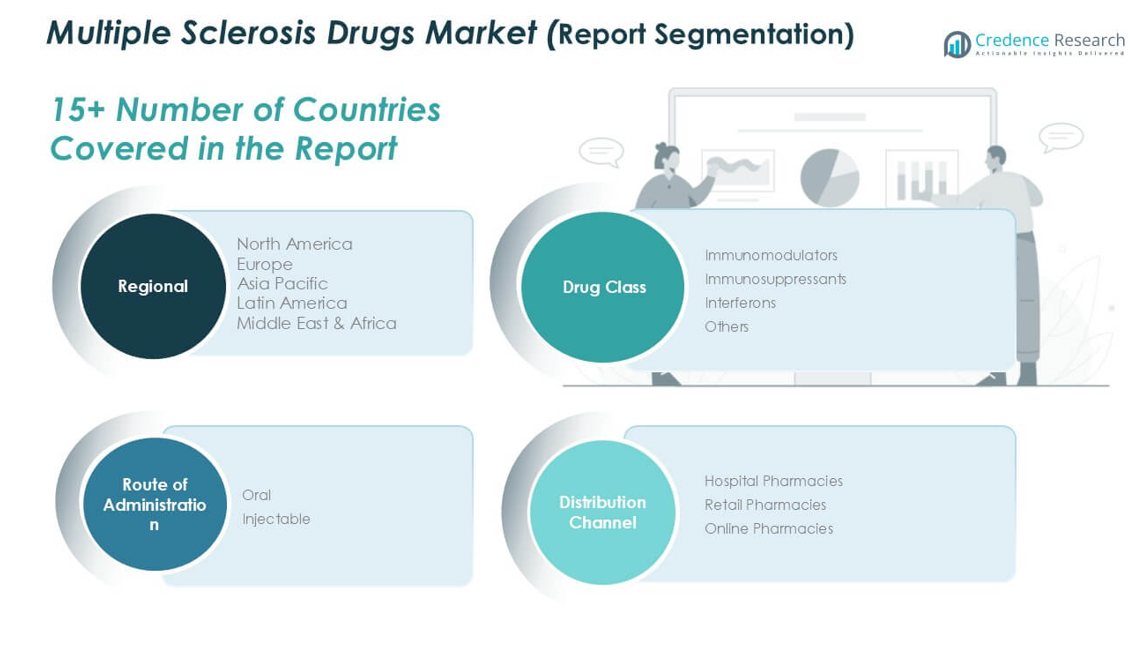
The Global Multiple Sclerosis Drugs Market is segmented into immunomodulators, immunosuppressants, interferons, and others. Immunomodulators hold the largest revenue share due to their ability to modify disease progression and reduce relapse frequency. These drugs are widely prescribed for relapsing-remitting MS and have shown consistent clinical efficacy. Immunosuppressants are gaining traction due to their targeted action on the immune system, offering effective control in aggressive disease forms. Interferons, although earlier considered first-line therapy, are gradually losing share due to newer alternatives with improved safety and convenience. The "others" category includes emerging therapies and symptomatic treatments that support the overall management of MS.
- For instance, a patient survey involving 1,380 individuals with MS found that 1,201 had used injectable disease-modifying therapies, with 377 patients having used intramuscular interferon beta-1a, 469 using glatiramer acetate, and the remainder distributed among other injectables
By Route of Administration
The market is categorized into oral and injectable routes of administration. Oral drugs are witnessing growing preference due to ease of use, improved patient compliance, and favorable dosing schedules. The Global Multiple Sclerosis Drugs Market reflects this shift through increasing adoption of oral disease-modifying therapies. It allows patients greater flexibility and reduces dependency on healthcare facilities. Injectable therapies remain relevant, especially in cases requiring high-efficacy treatments or when oral alternatives are contraindicated. Subcutaneous and intramuscular formulations are commonly used, though their demand is gradually being outpaced by oral drugs.
- For instance, analysis of claims data from over 100,000 MS patients in the United States between 2001 and 2020 revealed that oral medications have become the preferred choice: nearly 100% of patients were on injectables in 2001, but by 2020, about 75,000 patients used oral therapies while the number on platform injectable therapies declined to about 25,000
By Distribution Channel
Distribution channels include hospital pharmacies, retail pharmacies, and online pharmacies. Hospital pharmacies dominate the segment due to frequent prescription of high-cost and specialized MS treatments. Retail pharmacies cater to patients on long-term maintenance therapies, offering convenience and accessibility. Online pharmacies are growing steadily, driven by digital health trends and improved logistics. The Global Multiple Sclerosis Drugs Market is adapting to changing consumer behavior with an expanding digital presence and partnerships with e-pharmacy platforms. It supports broader access to both branded and generic drugs across regions.
Segments
Based on Drug Class
- Immunomodulators
- Immunosuppressants
- Interferons
- Others
Based on Route of Administration
- Oral
- Injectable
Based on Distribution Channel
- Hospital Pharmacies
- Retail Pharmacies
- Online Pharmacies
Based on Region
- North America
- U.S.
- Canada
- Mexico
- Europe
- UK
- France
- Germany
- Italy
- Spain
- Russia
- Belgium
- Netherlands
- Austria
- Sweden
- Poland
- Denmark
- Switzerland
- Rest of Europe
- Asia Pacific
- China
- Japan
- South Korea
- India
- Australia
- Thailand
- Indonesia
- Vietnam
- Malaysia
- Philippines
- Taiwan
- Rest of Asia Pacific
- Latin America
- Brazil
- Argentina
- Peru
- Chile
- Colombia
- Rest of Latin America
- Middle East
- UAE
- KSA
- Israel
- Turkey
- Iran
- Rest of Middle East
- Africa
- Egypt
- Nigeria
- Algeria
- Morocco
- Rest of Africa
Regional Analysis
North America Multiple Sclerosis Drugs Market
North America holds a significant share in the global Multiple Sclerosis Drugs Market, contributing USD 8,525.72 million in 2024 and projected to reach USD 12,399.26 million by 2032. It accounts for approximately 32.7% of the global market share in 2024. Strong healthcare infrastructure, high awareness, and favorable reimbursement policies support market dominance. The United States leads the region, driven by the presence of major pharmaceutical companies, continuous innovation, and early adoption of advanced therapies. The market benefits from a large diagnosed patient population and robust clinical research activity. With a CAGR of 4.8% from 2025 to 2032, the region maintains steady growth, backed by expanding access to oral therapies.
Europe Multiple Sclerosis Drugs Market
Europe is the second-largest regional market, valued at USD 5,892.88 million in 2024 and expected to grow to USD 9,535.10 million by 2032. It represents 22.6% of the global market share in 2024. Countries such as Germany, the UK, and France are key contributors due to well-established healthcare systems and strong regulatory frameworks. The market benefits from centralized drug approval processes through the EMA and broad access to advanced therapies. High disease prevalence and rising government funding for neurological disorders drive regional demand. Europe is projected to grow at a CAGR of 6.2%, supported by aging demographics and focus on neurodegenerative research.
Asia Pacific Multiple Sclerosis Drugs Market
Asia Pacific is emerging as a high-growth region in the Multiple Sclerosis Drugs Market, with a 2024 value of USD 6,979.18 million and an expected rise to USD 10,892.66 million by 2032. It accounts for 26.7% of the global market share in 2024, making it a major growth driver. Countries like China, Japan, and India are increasing investments in healthcare infrastructure and expanding access to MS therapies. The market benefits from improving diagnosis rates and rising awareness campaigns led by governments and non-profits. Growing partnerships between local and global pharmaceutical firms support regional drug availability. With a CAGR of 5.7%, the region shows strong momentum.
Latin America Multiple Sclerosis Drugs Market
Latin America’s market size is expected to grow from USD 2,792.72 million in 2024 to USD 4,632.60 million by 2032. It captures around 10.7% of the global market share in 2024. Brazil and Mexico are the primary contributors, supported by growing public health initiatives and improving access to neurology specialists. The region faces challenges such as unequal healthcare distribution but is making progress through healthcare reforms and generic drug approvals. International drug manufacturers are expanding operations in Latin America to meet rising demand. The market is set to expand at a CAGR of 6.5%, the highest among all regions.
Middle East Multiple Sclerosis Drugs Market
The Middle East market is valued at USD 1,363.94 million in 2024 and forecast to reach USD 2,014.17 million by 2032. It represents 5.2% of the global market share in 2024. Gulf countries like Saudi Arabia and the UAE are leading investments in neurology care and specialty drug access. The region benefits from government-funded healthcare systems and growing partnerships with global drug developers. Public awareness initiatives and support groups for MS patients are increasing across urban centers. With a CAGR of 5.0%, the Middle East shows steady progress in enhancing patient access and therapeutic options.
Africa Multiple Sclerosis Drugs Market
Africa is the smallest regional market but shows growth potential, moving from USD 531.79 million in 2024 to USD 809.70 million by 2032. It accounts for 2.0% of the global market share in 2024. Countries such as South Africa and Egypt are improving healthcare access through digital health platforms and international aid. The market faces limitations due to low diagnosis rates and limited neurologist availability. However, awareness programs and affordable generics are gradually improving treatment accessibility. With a CAGR of 5.4%, the region is expected to grow steadily, supported by expanding public health efforts and regional policy reforms.
Key players
- Biogen Inc.
- Hoffmann-La Roche Ltd.
- Novartis AG
- Teva Pharmaceutical Industries Ltd.
- Sanofi S.A.
- Merck KGaA
- Bristol-Myers Squibb Company
- Bayer AG
- Johnson & Johnson Services, Inc.
- Pfizer Inc.
- AbbVie Inc.
- Acorda Therapeutics, Inc.
- Mylan N.V.
- Sun Pharma
- Cipla Ltd.
Competitive Analysis
The global Multiple Sclerosis Drugs Market features a concentrated competitive landscape led by a few dominant pharmaceutical players. Biogen Inc., F. Hoffmann-La Roche Ltd., and Novartis AG hold strong market positions due to their well-established portfolios and continuous R\&D investments. It is characterized by aggressive product development, patent extensions, and global regulatory strategies. Companies compete on the basis of clinical efficacy, drug safety, and delivery innovation. Strategic mergers, licensing agreements, and partnerships with biotech firms enhance market presence. Firms also expand their reach through biosimilars and pricing strategies in emerging markets, intensifying competition across geographies.
Recent Developments
- In February 2025, Biogen forecasted a mid-single-digit percentage revenue decline for the year, primarily due to increased competition in its multiple sclerosis (MS) portfolio, specifically impacting sales of Tecfidera and Tysabri. This decline was anticipated despite the company's efforts to offset these losses with new product launches. The revenue forecast was part of Biogen's overall financial outlook for 2025, which also included a projected non-GAAP EPS range of $15.25 to $16.25.
- In March 2025, Novartis presented seven-year disability and safety data from the ALITHIOS extension study of Kesimpta (ofatumumab) at the American Academy of Neurology (AAN) 2025 Annual Meeting. The presentation included data on patients with relapsing multiple sclerosis (RMS). Novartis also highlighted other data on Kesimpta and its pipeline assets, including remibrutinib and iptacopan. The AAN meeting took place in San Diego from April 5-9, 2025.
Market Concentration and Characteristics
The global Multiple Sclerosis Drugs Market is moderately concentrated, with a few multinational pharmaceutical companies controlling a significant portion of the market share. It features a mix of branded biologics, small-molecule drugs, and an emerging presence of generics and biosimilars. The market is characterized by high research intensity, long product life cycles, and strict regulatory oversight. Leading companies differentiate through innovation in drug delivery, efficacy, and safety profiles. Barriers to entry remain high due to complex clinical trials and patent protections. Strategic collaborations and acquisitions play a key role in shaping competitive dynamics and expanding geographic reach.
Report Coverage
The research report offers an in-depth analysis based on Drug Class, Route of Administration, Distribution Channel and Region. It details leading market players, providing an overview of their business, product offerings, investments, revenue streams, and key applications. Additionally, the report includes insights into the competitive environment, SWOT analysis, current market trends, as well as the primary drivers and constraints. Furthermore, it discusses various factors that have driven market expansion in recent years. The report also explores market dynamics, regulatory scenarios, and technological advancements that are shaping the industry. It assesses the impact of external factors and global economic changes on market growth. Lastly, it provides strategic recommendations for new entrants and established companies to navigate the complexities of the market.
Future Outlook
- The number of multiple sclerosis cases is expected to rise due to improved diagnosis and increased awareness, creating sustained demand for long-term treatment options.
- Patients and healthcare providers are likely to prefer oral therapies over injectables due to ease of administration, better compliance, and favorable safety profiles.
- Advancements in genetic profiling and biomarker identification will support the development of personalized therapies, improving treatment precision and patient outcomes.
- Pharmaceutical companies will focus on developing neuroprotective and remyelinating agents aimed at slowing disease progression and preserving neurological function.
- The use of wearable devices, mobile apps, and AI-driven platforms will strengthen real-time disease tracking and enable personalized care adjustments.
- As patents for major drugs expire, biosimilars will enter the market, offering cost-effective alternatives and expanding access, particularly in emerging economies.
- Strategic alliances between pharmaceutical companies, research institutions, and tech firms will boost drug development and help penetrate underserved markets.
- With rising healthcare investments, improved diagnostic capabilities, and growing patient awareness, Asia Pacific is set to become a major contributor to market growth.
- Global regulatory bodies are expected to streamline approval processes and support accelerated pathways for high-efficacy therapies and orphan drug candidates.
- Researchers and healthcare providers will prioritize drugs with proven long-term safety profiles and sustained efficacy to support chronic disease management.
Request a Free Sample
Fill in your details and we'll send you a free sample report.
- Sample data tables & charts
- Research methodology
Need a Custom Version of This Report?
Tailor the scope, geography, or segments to your exact requirements.
- Custom geography or segment scope
- Direct access to our analyst team
Frequently Asked Questions
What was the market size of the global Multiple Sclerosis Drugs Market in 2023 and what is it projected to reach by 2032?
Which region currently dominates the global Multiple Sclerosis Drugs Market?
Which drug types are gaining popularity in the treatment of multiple sclerosis?
Who are the key players operating in the global Multiple Sclerosis Drugs Market?
Table of Content
Chapter 1. Report Introduction
- 1.1 Report Description & Purpose
- 1.1.1 Report Title & Market Definition
- 1.1.2 Unique Selling Propositions (USP) & Key Differentiators
- 1.1.3 Value Proposition for Stakeholders
- 1.2 Research Objectives
- 1.2.1 Market Sizing Objectives (Volume & Revenue)
- 1.2.2 Segmentation Objectives
- 1.2.3 Competitive Intelligence Objectives
- 1.2.4 Forecast & Scenario Objectives
- 1.3 Report Scope
- 1.3.1 Multiple Sclerosis Drugs Scope – Types & Subtypes Covered
- 1.3.2 Geographic Scope – Regions & Countries Covered
- 1.3.3 Historical Period, Base Year & Forecast Period (2023; forecast to 2032)
- 1.3.4 Inclusions & Exclusions
- 1.4 HS Code & Classification Framework
- 1.5 Currency, Units & Pricing Basis
- 1.6 Target Stakeholders
- 1.7 Limitations & Assumptions
Chapter 2. Executive Summary
- 2.1 Global Multiple Sclerosis Drugs Market Snapshot
- 2.1.1 Market Size – Historical (2023) & Forecast (2023-2032) (2023: USD 25,000 million → 2032: USD 40,283.5 million)
- 2.1.2 Volume & Revenue – Global Totals
- 2.1.3 Key Market Highlights – Top Five Facts
- 2.2 Multiple Sclerosis Drugs Market Segmentation Snapshot
- 2.2.1 Market Split by Region – 2023 vs. 2032
- 2.3 Competitive Snapshot
- 2.3.1 Top 10 Players by Revenue Share – 2023
- 2.3.2 Top 10 Players by Volume Share – 2023
- 2.3.3 Recent Strategic Developments (18-Month Summary)
- 2.4 Key Investment Highlights & Strategic Conclusions
Chapter 3. Multiple Sclerosis Drugs Market Dynamics & Industry Analysis
- 3.1 Market Overview & Context
- 3.1.1 Multiple Sclerosis Drugs Market Position in the Broader Automotive Value Chain
- 3.1.2 OEM vs. Replacement Market Dynamics
- 3.1.3 Market Maturity & Development Stage by Region
- 3.2 Multiple Sclerosis Drugs Market Drivers
- 3.3 Multiple Sclerosis Drugs Market Restraints & Challenges
- 3.4 Multiple Sclerosis Drugs Market Opportunities
- 3.5 Porter's Five Forces Analysis
- 3.5.1 Threat of New Entrants
- 3.5.2 Bargaining Power of Suppliers
- 3.5.3 Bargaining Power of Buyers
- 3.5.4 Threat of Substitutes
- 3.5.5 Competitive Rivalry – Intensity Assessment
- 3.6 Multiple Sclerosis Drugs Value Chain Analysis
- 3.6.1 Upstream – Raw Material/Input Suppliers
- 3.6.1.1 Raw Material/Input 1
- 3.6.1.2 Raw Material/Input 2
- 3.6.1.3 Raw Material/Input 3
- 3.6.2 Midstream – Production/Manufacturing/Service Delivery
- 3.6.2.1 Production/Process Overview
- 3.6.2.2 Key Facility Locations & Capacity by Manufacturer
- 3.6.3 Downstream – Distribution & End Consumer
- 3.6.3.1 Primary Channel – B2B/OEM
- 3.6.3.2 Secondary Channels – Dealer, Retail, Online, Direct
- 3.6.4 Value Chain Profitability Analysis
- 3.6.1 Upstream – Raw Material/Input Suppliers
- 3.7 PESTEL Analysis
- 3.7.1 Political Factors
- 3.7.2 Economic Factors
- 3.7.3 Social Factors
- 3.7.4 Technological Factors
- 3.7.5 Environmental Factors
- 3.7.6 Legal Factors
- 3.8 Multiple Sclerosis Drugs Supply Chain Analysis
- 3.8.1 Raw Material/Input Supply Risk Assessment
- 3.8.2 Manufacturing Concentration Risk (Geographic Exposure)
- 3.8.3 Trade Disruption Impact Analysis
- 3.9 Regulatory & Policy Landscape
Note: The regulatory and policy landscape section covers regulations based on their applicability to the market, Multiple Sclerosis Drugs category, geography, and scope of the study. Only regulatory frameworks with a material impact on operations, compliance, trade, sustainability, or market access are analyzed in detail.
Chapter 4. Key Investment Pockets & Opportunity Analysis
- 4.1 Multiple Sclerosis Drugs Market Attractiveness Analysis
- 4.1.1 By Region – Investment Attractiveness Matrix (Volume × CAGR)
- 4.2 Absolute Revenue Growth Opportunity
- 4.2.1 By Region – Absolute USD Growth Through 2032
- 4.3 Incremental Volume Opportunity
- 4.3.1 By Region – Incremental Volume Through 2032
- 4.3.2 Segment – Incremental Volume
- 4.4 Emerging Submarket Opportunity Deep Dive (Subject to Applicability)
- 4.5 Emerging Market Opportunity Scorecards
- 4.5.1 United States
- 4.5.2 Europe
- 4.5.3 Asia
- 4.5.4 Middle East & Africa
Note: Emerging Market Opportunity Scorecards will be included based on relevance and strategic importance. Regions listed are indicative and may vary depending on data availability and market dynamics.
Chapter 5. Multiple Sclerosis Drugs Import-Export Analysis & Trade Flows
- 5.1 Global Trade Overview
- 5.1.1 Global Export Value by Country (2023)
- 5.1.2 Global Export Volume by Country (2023)
- 5.1.3 Global Import Value by Country (2023)
- 5.1.4 Global Import Volume by Country (2023)
- 5.1.5 Net Trade Balance by Country (2023)
- 5.2 Export Analysis – Segment
- 5.2.1 Type 1 (HS Code)
- 5.2.2 Type 2 (HS Code)
- 5.2.3 Type 3 (HS Code)
- 5.2.4 Type 4 (HS Code)
- 5.2.5 Type 5 (HS Code)
- 5.3 Import Analysis – Segment
- 5.3.1 Type 1 (HS Code)
- 5.3.2 Type 2 (HS Code)
- 5.3.3 Type 3 (HS Code)
- 5.3.4 Type 4 (HS Code)
- 5.3.5 Type 5 (HS Code)
- 5.4 Average Unit Trade Prices
- 5.4.1 Average Export Price – Segment & Country
- 5.4.2 Average Import Price – Segment & Source Country
- 5.4.3 Price Trends (2023)
- 5.5 Key Trade Route Analysis
- 5.5.1 Trade Route 1
- 5.5.2 Trade Route 2
- 5.5.3 Trade Route 3
- 5.5.4 Trade Route 4
- 5.5.5 Trade Route 5
- 5.6 Trade Policy Impact Assessment
- 5.6.1 US Anti-Dumping & Section 301 Tariffs
- 5.6.2 EU Customs Union Impact
- 5.6.3 Major Free Trade Agreements
- 5.6.4 USMCA Rules of Origin
Note: Trade policy analysis will be included only where relevant to the Multiple Sclerosis Drugs market.
Chapter 6. Competitive Landscape & Company Benchmarking
- 6.1 Multiple Sclerosis Drugs Market Concentration & Structure
- 6.1.1 Herfindahl-Hirschman Index (HHI) – vs. 2023
- 6.1.2 Tier 1, Tier 2 & Tier 3 Market Structure
- 6.1.3 Global, Regional & Local Player Dynamics
- 6.2 Multiple Sclerosis Drugs Market Share Analysis – 2023
- 6.2.1 Global Revenue Share by Company
- 6.2.2 Global Volume Share by Company
- 6.2.3 Regional Revenue Share
- 6.2.4 Market Share Evolution ( vs. 2023)
- 6.2.5 OEM Segment Share by Company
- 6.2.6 Replacement Segment Share by Company
- 6.3 Production/Delivery Capacity & Facility Analysis
- 6.3.1 Global Installed Capacity
- 6.3.2 Capacity Utilization Rates
- 6.3.3 Production/Output Volume
- 6.3.4 Facility Locations & Capacity Map
- 6.3.5 Planned Capacity Additions
- 6.4 Multiple Sclerosis Drugs Competitive Benchmarking Matrix
- 6.4.1 Revenue, Volume, CAGR & Profitability Comparison
- 6.4.2 Channel Revenue Mix
- 6.4.3 Geographic Revenue Exposure
- 6.4.4 R&D Intensity
- 6.4.5 Sustainability Maturity
- 6.5 Strategic Developments in Multiple Sclerosis Drugs (Last 24 Months)
- 6.5.1 Mergers, Acquisitions & Divestments
- 6.5.2 New Multiple Sclerosis Drugs Launches
- 6.5.3 Facility Expansions
- 6.5.4 Strategic Alliances, Joint Ventures & Partnerships
- 6.5.5 Distribution Expansion & Market Entry
- 6.5.6 Sustainability & ESG Initiatives
- 6.6 Competitive Strategy Mapping
- 6.6.1 Leader, Challenger, Follower & Niche Classification
- 6.6.2 Pricing Strategy Comparison
- 6.6.3 Channel Strategy Matrix
Note: Strategic developments are included based on their materiality and the availability of reliable information.
Chapter 7. Global Multiple Sclerosis Drugs Market – By Distribution Channel
- 7.1 Segment Overview
- 7.1.1 Volume & Revenue Split by Channel (2023 & 2032)
- 7.1.2 Channel Mix Evolution (2023-2032)
Chapter 8. Regional Market Analysis – Global Overview
- 8.1 Global Regional Overview
- 8.1.1 Regional Volume Share
- 8.1.2 Regional Revenue Share
- 8.1.3 Regional Volume by Region
- 8.1.4 Regional Revenue by Region
- 8.1.5 Regional Forecast Through 2032
- 8.2 Cross-Regional Segment Analysis
- 8.2.1 By Distribution Channel
- 8.2.2 By Brand/Price Tier
Chapter 9. North America Multiple Sclerosis Drugs Market
- 9.1 United States
- 9.2 Canada
- 9.3 Mexico
Chapter 10. Europe Multiple Sclerosis Drugs Market
- 10.1 Germany
- 10.2 France
- 10.3 Italy
- 10.4 United Kingdom
- 10.5 Spain
- 10.6 Poland
- 10.7 Russia
- 10.8 Netherlands
- 10.9 Belgium
- 10.10 Sweden
- 10.11 Denmark
- 10.12 Norway
- 10.13 Rest of Europe
Chapter 11. Asia Pacific Multiple Sclerosis Drugs Market
- 11.1 China
- 11.2 India
- 11.3 Japan
- 11.4 South Korea
- 11.5 Thailand
- 11.6 Indonesia
- 11.7 Vietnam
- 11.8 Malaysia
- 11.9 Australia
- 11.10 Rest of Asia Pacific
Chapter 12. Latin America Multiple Sclerosis Drugs Market
- 12.1 Brazil
- 12.2 Argentina
- 12.3 Colombia
- 12.4 Chile
- 12.5 Rest of Latin America
Chapter 13. Middle East Multiple Sclerosis Drugs Market
- 13.1 Saudi Arabia
- 13.2 United Arab Emirates
- 13.3 Turkey
- 13.4 Israel
- 13.5 Iran
- 13.6 Rest of the Middle East
Chapter 14. Africa Multiple Sclerosis Drugs Market
- 14.1 South Africa
- 14.2 Egypt
- 14.3 Nigeria
- 14.4 Morocco
- 14.5 Rest of Africa
Chapter 15. Multiple Sclerosis Drugs Company Profiles
- 15.1 [Company 01]
- 15.1.1 Company Overview
- 15.1.2 Key Management Personnel
- 15.1.3 Products & Services Portfolio
- 15.1.4 Financial Performance
- 15.1.5 Key Market Focus & Geographic Presence
- 15.1.6 Recent Developments & Strategic Initiatives
Note: The company profile list is preliminary and may change based on research findings, market developments, data availability, and client requirements.
Chapter 16. Appendices
- Appendix A – List of Abbreviations & Acronyms
- Appendix B – Industry Classification Code Reference – Full Series
- Appendix C – Production & Capacity Data Tables
- Appendix D – End-Use & Demand Base Tables
- Appendix E – Consumption & Replacement Rate Assumptions
- Appendix F – ASP Reference Tables
- Appendix G – Manufacturing & Facility Database
- Appendix H – Import-Export Data Tables
- Appendix I – Regulatory Summary Tables
- Appendix J – Primary Research Participant List (Anonymized)
- Appendix K – Primary Research Questionnaire Framework
- Appendix L – Data Sources & Bibliography
- Appendix M – Market Size Divergence & Source Comparison
Chapter 17. Research Methodology
- 17.1 Research Framework & Philosophy
- 17.2 Secondary Research – Sources, Hierarchy & Data Extraction
- 17.3 Data Modeling – Bottom-Up & Top-Down Market Sizing
- 17.4 Primary Research – Stakeholder Framework, LOI & Sample Sizes
- 17.5 Forecast Methodology – Regression, Scenario & Sensitivity Analysis
- 17.6 Quality Control – Four-Layer Validation Framework
- 17.7 Limitations & Standard Assumptions
- 17.8 Disclaimer
