
| REPORT ATTRIBUTE | DETAILS |
|---|---|
| Historical Period | 2019-2022 |
| Base Year | 2023 |
| Forecast Period | 2024-2032 |
| Natural Alternative Sweeteners Market Size 2023 | USD 3154.20 million |
| Natural Alternative Sweeteners Market, CAGR | 6.60% |
| Natural Alternative Sweeteners Market Size 2032 | USD 5606.66 million |
Market Insights
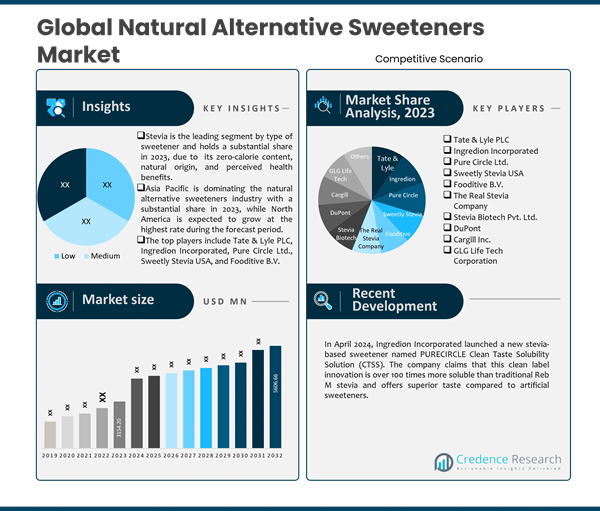
- The global demand for natural alternative sweetener products was valued at USD 3154.20 million in 2023 and is expected to reach USD 5606.66 million in 2032, growing at a CAGR of 6.60% between 2024 and 2032.
- The stevia segment was the market leader by type of sweetener, accounting for the highest share in value in 2023, and the monk fruit extract (luo han guo) segment is expected to grow rapidly throughout the forecast period.
- The dietary supplements segment is predicted to grow fastest over the projection period, while food and beverages had the largest share by application in 2023.
- Over the projection period, the households and consumers segment is expected to expand at the fastest rate, and the food and beverage manufacturers segment dominated the market share by end-users in 2023.
- Asia Pacific is dominating the natural alternative sweeteners industry, with over one-third of the market in 2023.
- The market's primary possibilities include technological advancements, regulatory initiatives, expanding application scope, and environmental sustainability.
Executive Summary
Market Definition
Natural alternative sweeteners are plant-based or naturally occurring substances used to replace sugar, offering sweetness without the high-calorie content. These sweeteners are typically derived from plants through extraction and purification processes.
The advantages of natural alternative sweeteners include lower calorie content, making them suitable for weight management, and a lower glycemic index, which helps in managing blood sugar levels. Additionally, they are often preferred by those seeking more natural food ingredients over synthetic sweeteners.
Market Overview
The global natural alternative sweeteners market has witnessed steady growth in recent years and is expected to grow at a CAGR of 6.60% between 2024 and 2032. The market was valued at USD 3154.20 million in 2023 and is expected to reach USD 5606.66 million in 2032.
The natural alternative sweeteners market is driven by the increasing consumer awareness and demand for healthier food and beverage options. As health consciousness rises globally, consumers are becoming more wary of the negative impacts of excessive sugar consumption, such as obesity, diabetes, and other metabolic disorders. This shift in consumer behavior is encouraging food manufacturers to reformulate their products by replacing traditional sugars with natural sweeteners like stevia, monk fruit, and agave syrup, which are perceived as healthier alternatives due to their lower glycemic indices and natural origins.
Moreover, several governments are implementing sugar taxes and stricter regulations on sugar content in processed foods to combat rising public health issues. These regulatory measures are compelling manufacturers to explore and adopt alternative sweeteners to avoid penalties and meet compliance standards. Additionally, several countries are supporting the cultivation and production of natural sweeteners, which is enhancing their availability and reducing costs, further boosting market growth.
Additionally, the ongoing trend towards natural and clean label products fuel the growth of the natural alternative sweeteners market. Consumers are increasingly seeking foods and beverages with simple, easily recognizable ingredients, free from artificial additives and synthetic chemicals. Natural sweeteners fit well within this trend, offering a more natural appeal compared to artificial sweeteners like aspartame and sucralose.
Furthermore, the rise in incidences of lifestyle-related diseases, such as diabetes and cardiovascular conditions, which are closely linked to high sugar consumption, is increasing the demand for natural alternative sweeteners market. As these health issues become more prevalent, there is a stronger push from healthcare professionals and public health campaigns advocating for reduced sugar intake. This has led consumers to seek healthier alternatives, bolstering the demand for natural sweeteners, including stevia, erythritol, and xylitol, which provide sweetness without the associated health risks.
Segmentation by Type of Sweetener
- Stevia is the leading segment by type of sweetener and held the dominant share in value in 2023. Stevia's dominance is due to several factors, such as its zero-calorie content, natural origin, and perceived health benefits. Stevia's is derived from the leaves of the Stevia rebaudiana plant, making it a natural product that appeals to health-conscious consumers and those looking for low-calorie alternatives. Additionally, Stevia is up to 300 times sweeter than sugar, allowing for a significant reduction in sugar intake without sacrificing sweetness. Its widespread use in various food and beverage products, coupled with its approval by major health authorities like the FDA and EFSA, supports its leading market position.
- The monk fruit extract (luo han guo) segment is expected to exhibit the highest CAGR during the forecast period. Monk fruit extract is gaining rapid popularity due to its natural origin and zero-calorie content. It is becoming increasingly favored for its ability to provide sweetness without the bitter aftertaste that can be associated with some other natural sweeteners like Stevia. The demand for Monk Fruit Extract is also driven by its use in a growing number of low-carb, keto, and diabetic-friendly products, as well as its acceptance by health-conscious consumers and its recognition by regulatory bodies.
- The erythritol, xylitol, allulose, agave, nectar, coconut, sugar, maple, syrup, and honey segment is anticipated to grow moderately compared to the monk fruit extract (luo han guo) segment during the forecasted period.
Segmentation by Application
- The food and beverages held the largest market share by application in terms of value in 2023. This dominance is driven by the extensive use of natural alternative sweeteners in a wide array of products such as beverages, baked goods, confectionery, dairy products, and more. The food and beverage industry is increasingly incorporating natural sweeteners like Stevia, Monk Fruit Extract, and Erythritol to meet consumer demand for healthier, low-calorie, and natural ingredient-based products. The shift towards healthier lifestyles and the rising prevalence of lifestyle diseases such as diabetes and obesity further propel the use of natural sweeteners in this segment.
- The dietary supplements segment is expected to be the fastest-growing segment during the forecasted period. Natural sweeteners are being used extensively in dietary supplements to enhance flavor without adding calories, which is particularly important for health-conscious consumers. The rise in demand for natural and organic products, coupled with the growing trend of functional foods and supplements, is driving the rapid growth of natural sweeteners in this segment.
- The personal care products and pharmaceuticals segments are projected to grow at a moderate CAGR and hold a lower share than the food and beverages segment.
Segmentation by End-User
- The food and beverage manufacturers segment held the largest market share in terms of value in 2023. This is driven by the widespread adoption of natural sweeteners in various food and beverage products to meet consumer demands for healthier, low-calorie, and natural ingredient-based products. Major food and beverage companies are increasingly using natural sweeteners like Stevia, Monk Fruit Extract, and Erythritol in their product formulations to cater to health-conscious consumers and comply with regulatory standards on sugar reduction.
- The household and consumer segment is anticipated to be the fastest-growing segment in terms of end-users. This growth is fueled by the rising awareness of the health benefits associated with natural sweeteners and the increasing trend of home baking and cooking. Consumers are becoming more health-conscious and are looking to reduce their sugar intake by using natural sweeteners in their daily diets. The convenience of purchasing these sweeteners through various retail and online channels also contributes to their rapid adoption in households.
- The retailers & distributors and foodservice industry segments are anticipated to contribute significantly to the market growth during the forecasted period.
Segmentation by Region
- Asia Pacific dominated the natural alternative sweeteners industry in 2023, fueled by the region's increasing health consciousness, rising prevalence of lifestyle diseases such as diabetes and obesity, and consumer preference for natural and organic products.
- North America is anticipated to showcase the highest growth rate during the forecasted period, propelled by increasing consumer awareness of health issues related to sugar consumption, stringent regulations promoting healthier food options, and a growing preference for natural and clean-label products among the population.
- The rest of the world, including Latin America, the Middle East, and Africa, supplies the remaining demand for retail inventory management software.
Asia Pacific holds the dominant share of the natural alternative sweeteners market and is expected to maintain its dominance during the forecast period. This dominance is attributed to several factors, including the high prevalence of diabetes and obesity, increasing health awareness, and the growing trend of natural and organic products among consumers in countries like China, Japan, and India. As per the International Diabetes Federation's report in 2021, the Southeast Asia (SEA) Region currently hosts 90 million individuals living with diabetes. Projections indicate a substantial surge of 68% in this figure, reaching 152 million by the year 2045.
Additionally, the region's robust food and beverage industry has been increasingly incorporating natural sweeteners such as stevia, monk fruit, and agave syrup into products to cater to health-conscious consumers. For instance, in December 2023, Ingredion Incorporated expanded PureCircle by Ingredion's stevia production facility in Malaysia. This expansion project is set to significantly boost PureCircle's bioconversion technology capacity, four times the current capability for producing stevia ingredients. The investment is strategically aimed at catering to the escalating demand from food and beverage brands for high-quality stevia leaf ingredients. These ingredients serve as an ideal substitute for sugar and artificial sweeteners in various products, aligning with the evolving preferences of consumers seeking healthier alternatives.
On the other hand, North America is anticipated to be the fastest-growing market for natural alternative sweeteners during the forecast period. This rapid growth can be attributed to the increasing incidence of lifestyle-related diseases such as diabetes and obesity, which has heightened the demand for low-calorie and natural sweeteners. According to the Centers for Disease Control and Prevention (CDC), about 98 million Americans have prediabetes as of 2023, while more than 8 in 10 adults do not know they have it.
Moreover, the rising trend of clean-label products is propelling the market in North America. Consumers are increasingly seeking products with natural ingredients and minimal processing, leading food and beverage manufacturers to incorporate natural sweeteners. For instance, Angry Angel produces a healthier alternative to traditional energy drinks. Its drinks have no artificial sweeteners such as sucralose and aspartame but rather use organic monk fruit, which is actually sweeter than sugar.
Furthermore, several companies in North America have been at the forefront of innovation and development in the natural alternative sweeteners market, introducing new products and technologies to meet the evolving demands of consumers. For instance, in June 2023, Wisdom Natural Brands broadened its SweetLeaf product range by introducing two zero-calorie sweeteners and three 50% reduced-calorie sugars. These alternatives are designed to mimic the taste, baking qualities, browning, and caramelization of sugar. The addition of these product lines provides consumers with fresh choices in their quest for natural sugar substitutes, including reduced-calorie options such as coconut and date sugars.
Key Highlights of the Report
The global Natural Alternative Sweeteners Market is segmented by type of sweetener, application, end-user, and region. The Stevia segment dominated the market in 2023, holding the largest value share. However, dietary supplements are expected to see the fastest growth, and food and beverage manufacturers remain the primary end-users, with North America leading the market growth.
The natural alternative sweeteners market is driven by the rise in incidences of lifestyle-related diseases, such as diabetes and cardiovascular conditions, which are closely linked to high sugar consumption. Moreover, heightened health awareness and the demand for natural and clean-label products are propelling the market growth. Additionally, supportive regulatory frameworks and a growing emphasis on sustainability are further driving the growth of the market.
Nonetheless, while Asia Pacific led growth in the natural alternative sweeteners industry in 2023, driven by rising health consciousness, diabetes and obesity rates, and a preference for natural products, North America is set for the highest forecasted growth, spurred by health concerns over sugar consumption, regulatory push for healthier foods, and rising demand for natural, clean-label products.
What Are The Main Drivers Of The Global Natural Alternative Sweeteners Market?
The natural alternative sweeteners market is fueled by the increasing prevalence of lifestyle-related diseases, such as diabetes and cardiovascular conditions, which are closely associated with high sugar intake. Furthermore, rising health awareness and the demand for natural, clean-label products are accelerating market growth. Additionally, supportive regulatory frameworks and a growing focus on sustainability are further propelling the market's expansion.
What are The Major Challenges Faced By The Global Natural Alternative Sweeteners Market?
The high cost associated with the production and extraction of natural alternative sweeteners poses significant challenges to the growth of the natural alternative sweeteners market. Natural sweeteners such as stevia, monk fruit, and agave require extensive processing and refinement to achieve the desired levels of sweetness and purity. These processes are often costly, resulting in higher prices for the final products compared to traditional sugars and artificial sweeteners. This cost disparity can deter price-sensitive consumers and limit the widespread adoption of natural sweeteners, particularly in developing regions where affordability is a critical consideration.
What Are The Growth Opportunities In The Global Natural Alternative Sweeteners Market?
Technological advancements in food processing and sweetener extraction are creating significant opportunities for the natural alternative sweeteners market. These innovations are improving the quality, taste, and cost-effectiveness of natural sweeteners, enabling their wider adoption across diverse food and beverage applications. By enhancing production methods and developing new sweetener compounds, technology is playing a crucial role in meeting consumer demand for healthier, more natural sweetening options and driving the market's growth.
Market Drivers
Growing Prevalence of Chronic and Cardiovascular Diseases
The rising incidence of chronic and cardiovascular diseases, which are closely linked to high sugar consumption, is a major factor in the expansion of the natural alternative sweeteners market. According to a report published by the Institute for Health Metrics and Evaluation in 2023, more than half a billion people are living with diabetes worldwide, affecting men, women, and children of all ages in every country. This number is projected to more than double to 1.3 billion people in the next 30 years. The latest and most comprehensive calculations show the current global prevalence rate is 6.1%, making diabetes one of the top 10 leading causes of death and disability.
Moreover, according to the World Health Organization, cardiovascular diseases (CVDs) are the leading cause of death globally, taking an estimated 17.9 million lives each year. In response, healthcare professionals and public health campaigns intensify their advocacy for reduced sugar intake, creating a heightened demand for healthier alternatives. This shift towards health-conscious choices is palpable among consumers, prompting a surge in the search for safer options. Natural sweeteners such as stevia, erythritol, and xylitol emerge as attractive solutions, offering sweetness without the associated health risks of traditional sugars.
Market Restraints
High Cost of Production and Extraction Associated with Natural Alternative Sweeteners
The high cost of production and extraction associated with natural alternative sweeteners poses significant restraints for the growth of the natural alternative sweeteners industry. The processes involved in producing natural sweeteners like stevia, monk fruit, and agave are complex and resource-intensive. For example, stevia glycosides, the sweet components of the stevia plant, must be extracted and purified through a multi-step process that includes water extraction, filtration, and crystallization. This intricate procedure demands advanced technology and significant energy input, driving up production costs.
These high production costs translate to higher prices for the end products. Natural sweeteners are often more expensive than traditional sugar and artificial sweeteners, making them less attractive to price-sensitive consumers. This price disparity is particularly pronounced in developing regions, where budget constraints are a significant factor in purchasing decisions. In these markets, the higher cost of natural sweeteners can be a substantial barrier to their adoption.
Moreover, the higher prices of natural sweeteners can limit their use in large-scale food and beverage manufacturing. Manufacturers often operate on tight margins and seek cost-effective ingredients to keep their products affordable and competitive. The additional cost of using natural sweeteners can lead to higher product prices, potentially reducing consumer demand and making it difficult for manufacturers to justify the switch from cheaper sweetening options. Addressing these cost issues is crucial for the broader adoption and expansion of the natural alternative sweeteners market.
Opportunities
Advancements in Technology
Technological advancements in food processing and sweetener extraction are creating opportunities for the growth of the natural alternative sweeteners market in the future. Recent innovations in extraction and refinement techniques are enhancing the efficiency, taste, and cost-effectiveness of natural sweeteners, making them more attractive to both manufacturers and consumers. For example, advancements in enzymatic processes and fermentation technology have revolutionized the production of stevia and monk fruit sweeteners.
Moreover, biotechnological innovations have enabled the production of steviol glycosides through microbial fermentation. This method allows for the scalable and sustainable production of high-purity stevia at lower costs. This approach can be replicated for other natural sweeteners, providing a consistent and reliable supply chain, which is critical for meeting growing market demands.
Furthermore, advancements in microencapsulation techniques are improving the stability and functionality of natural sweeteners in various food and beverage applications. Microencapsulation helps protect sweeteners from environmental factors, such as moisture and heat, during processing and storage. This ensures that natural sweeteners maintain their sweetness and quality over longer periods, making them more versatile and suitable for a broader range of products, from beverages to baked goods.
Additionally, technological progress is also facilitating the development of novel natural sweeteners and sweetener blends. Researchers are exploring new sources of sweetness from fruits, leaves, and other natural materials, identifying compounds that can be used either as standalone sweeteners or in combination with existing ones to enhance sweetness and reduce aftertaste. For instance, blending stevia with monk fruit or erythritol can create a more balanced sweetness profile, catering to consumer preferences for better-tasting natural sweeteners.
Competitive Landscape
Key Players
The global natural alternative sweeteners market is highly competitive, with several key players. Some of the major players in the market:
- Tate & Lyle PLC
- Ingredion Incorporated
- Pure Circle Ltd.
- Sweetly Stevia USA
- Fooditive B.V.
- The Real Stevia Company
- Stevia Biotech Pvt. Ltd.
- DuPont
- Cargill Inc.
- GLG Life Tech Corporation
These organizations prioritize product innovation, distribution channel expansion, collaborations, and mergers & acquisitions to stay competitive.
The global natural alternative sweeteners market's key players continually seek to stay ahead by launching new products.
In April 2024, Ingredion Incorporated launched a new stevia-based sweetener nammed PURECIRCLE Clean Taste Solubility Solution (CTSS). The company claims that this clean label innovation is over 100 times more soluble than traditional Reb M stevia and offers superior taste compared to artificial sweeteners.
In September 2023, Tate & Lyle expanded its sustainable stevia program with Earthwatch Europe, a partnership aimed at ensuring the stevia industry grows sustainably. The program supports participating farmers in China to implement best practices identified in Tate & Lyle's 2019 stevia life-cycle analysis and verified in its 2021 on-farm pilot. The initiative is part of Tate & Lyle's broader commitment to understanding and reducing the environmental impact of its stevia supply chain.
How are Companies Performing in the Natural Alternative Sweeteners Market?
The global Natural Alternative Sweeteners Market is highly competitive, with several key players.
Startups are playing a pivotal role in driving innovation and growth within the natural alternative sweeteners industry. These agile and forward-thinking companies are leveraging technological advancements, consumer demand for healthier options, and changing regulatory landscapes to revolutionize the market. Startups are contributing to the industry through the development of novel extraction techniques and formulations. For instance, PureCircle is pioneering advancements in stevia extraction methods, enabling the production of high-purity stevia extracts with improved taste profiles. By investing in research and development, these startups are addressing taste and quality concerns associated with natural sweeteners, making them more appealing to consumers.
Moreover, startups are leveraging biotechnology to enhance the production and scalability of natural sweeteners. By engineering yeast strains to produce specific sweet compounds, companies such as Evolva are creating sustainable and cost-effective alternatives to traditional sweeteners. These innovations not only address supply chain challenges but also pave the way for the development of new sweetening solutions with improved functionality and taste.
Furthermore, startups are capitalizing on consumer preferences for clean-label products by offering transparent and traceable sweetener options. For example, DouxMatok has developed a proprietary technology that enhances the sweetness perception of sugars, allowing food manufacturers to use less sugar while maintaining the same level of sweetness. This innovation aligns with consumer demands for reduced sugar content without sacrificing taste, driving the adoption of natural alternative sweeteners. As these companies continue to innovate and scale, they are reshaping the market landscape and contributing to the broader shift towards healthier and more sustainable food choices.
Summary of Key Findings
- The natural alternative sweeteners market is fueled by the increasing prevalence of lifestyle-related diseases, such as diabetes and cardiovascular conditions, which are closely associated with high sugar intake. Furthermore, rising health awareness and the demand for natural, clean-label products are accelerating market growth. Additionally, supportive regulatory frameworks and a growing focus on sustainability are further propelling the market's expansion.
- Market segmented by type of sweetener, application, end-user, and region.
- Stevia is the most popular, with food and beverage manufacturers remaining the primary end-user segment.
- Asia Pacific is leading market growth; the market is highly competitive, with key players including Tate & Lyle PLC, Ingredion Incorporated, Pure Circle Ltd., Sweetly Stevia USA, Fooditive B.V., The Real Stevia Company, Stevia Biotech Pvt. Ltd., DuPont, Cargill Inc., and GLG Life Tech Corporation.
Future Outlook
- Positive outlook for the global natural alternative sweeteners market with significant growth potential in the North American region.
- The key drivers accelerating the growth of the Natural Alternative Sweeteners Market include the increasing prevalence of lifestyle-related diseases, such as diabetes and cardiovascular conditions, which are closely associated with high sugar intake.
- During the forecast period, the high cost associated with the production and extraction of natural alternative sweeteners is expected to restrain the market growth.
- Key firms must focus on product innovation, growing market reach, and maintaining competitive pricing to keep ahead of the competition.
How CXOs Can Benefit from the Credence Research Natural Alternative Sweeteners Market Report
The Credence Research Natural Alternative Sweeteners Market Report provides CXOs with a comprehensive overview of the market, including:
- Market size and growth forecast:The report provides detailed estimates of the global natural alternative sweeteners market size, segmented by type of sweetener, application, end-user, and region. It also includes forecasts for the market through 2032 based on key trends and drivers.
- Market segmentation:The report segments the natural alternative sweeteners market by type of sweetener, application, end-user, and region. This segmentation provides CXOs with a granular understanding of the market and the opportunities in each segment.
- Competitive Landscape:The report profiles the key players in the natural alternative sweeteners market and provides insights into their strategies, product offerings, and financial performance. This information can help CXOs to identify and assess their competition.
- Key trends and drivers:The report identifies and analyzes the key trends and drivers shaping the natural alternative sweeteners market. This information can help CXOs make informed decisions about their investments and strategies.
CXOs can use the insights from the Credence Research Natural Alternative Sweeteners Market Report to:
- Identify growth opportunities:The report can help CXOs identify new growth opportunities in the natural alternative sweeteners market. For example, it identifies the growing demand for natural alternative sweeteners in the beverage industry, driven by health-conscious consumers seeking low-calorie and natural ingredient options.
- Make informed investment decisions:The report can help CXOs make informed investment decisions about natural alternative sweeteners. For example, it provides insights into the key factors to consider when evaluating natural alternative sweeteners providers.
- Develop competitive strategies:The report can help CXOs develop competitive strategies for their natural alternative sweeteners businesses. For example, it identifies the key strategies that natural alternative sweetener providers are using to differentiate themselves from their competitors.
- Track market developments:The report can help CXOs monitor market developments and stay ahead of the curve. For example, it provides insights into the latest trends and innovations in the Natural Alternative Sweeteners Market.
Overall, the Credence Research Natural Alternative Sweeteners Market Report is a valuable resource for CXOs who are looking to gain a deeper understanding of the market and identify opportunities for growth.
Segmentation
-
By Type of Sweetener
- Stevia
- Monk Fruit Extract (Luo Han Guo)
- Erythritol
- Xylitol
- Allulose
- Agave Nectar
- Coconut Sugar
- Maple Syrup
- Honey
-
By Application
- Food and Beverages
- Dietary Supplements
- Personal Care Products
- Pharmaceuticals
-
By End-User
- Food and Beverage Manufacturers
- Retailers and Distributors
- Foodservice Industry
- Households and Consumers
-
By Region
- North America
- US
- Canada
- Mexico
- Europe
- Germany
- France
- UK.
- Italy
- Spain
- Rest of Europe
- Asia Pacific
- China
- Japan
- India
- South Korea
- South-east Asia
- Rest of Asia Pacific
- Latin America
- Brazil
- Argentina
- Rest of Latin America
- Middle East & Africa
- GCC Countries
- South Africa
- Rest of the Middle East and Africa
- North America
Adjacent Markets
In the natural alternative sweeteners market, several adjacent markets have high revenue growth opportunities. The key adjacent markets for natural alternative sweeteners are-
Adjacent Markets |
||
| Functional Foods Market | Sugar-Free Confectionery Market | Dietary Supplements Market |
| Sports Nutrition Market | Functional Beverages Market | Diabetic Food Market |
| Organic Food Market | Allulose Market | Stevia Market |

Request a Free Sample
Fill in your details and we'll send you a free sample report.
- Sample data tables & charts
- Research methodology
Market Dynamics
Rising Prevalence of Lifestyle-Related Diseases
The increasing rates of diabetes, obesity, and cardiovascular diseases globally are pushing consumers and manufacturers to seek healthier alternatives to traditional sugar, directly boosting demand for natural alternative sweeteners.
Regulatory Push for Sugar Reduction
Governments are implementing sugar taxes and stricter regulations on sugar content in processed foods, compelling manufacturers to reformulate products with natural sweeteners to comply with new standards and avoid penalties.
Consumer Shift Toward Clean Label and Natural Products
Growing health consciousness and preference for natural, minimally processed ingredients are driving consumers to choose products with natural alternative sweeteners over artificial options, supporting market growth.
Technological Advancements in Extraction and Processing
Innovations in extraction, purification, and formulation technologies are improving the taste, cost-effectiveness, and scalability of natural sweeteners, making them more accessible and appealing for both manufacturers and consumers.
Expansion of Application Scope
Natural alternative sweeteners are increasingly being used in a wider range of products, including dietary supplements, personal care, and pharmaceuticals, expanding the market beyond traditional food and beverage applications.
Need a Custom Version of This Report?
Tailor the scope, geography, or segments to your exact requirements.
- Custom geography or segment scope
- Direct access to our analyst team
Frequently Asked Questions
What is the current size of the global natural alternative sweeteners market?
What is the expected growth rate of the natural alternative sweeteners market between 2024 and 2032?
Which segment is leading the market share in terms of type of sweetener?
Which application governs the demand for natural alternative sweeteners globally?
Which end-user is expected to post the highest CAGR during the forecast period?
Which region is fueling the growth of the natural alternative sweeteners industry?
Who are the major players in the global natural alternative sweeteners market?
What are the major market drivers of the natural alternative sweeteners industry?
What are the major market restraints of the natural alternative sweeteners industry?
What are the major market opportunities of the natural alternative sweeteners industry?
Table of Content
Chapter 1 Market Segmentation
- 1.1 Segmentation Framework
- 1.1.1 Product and Service Classification
- 1.1.2 Application and End-Use Classification
- 1.1.3 Technology and Solution Classification
- 1.1.4 Customer and Distribution Channel Classification
- 1.1.5 Geographic Segmentation
- 1.1.6 Market Segment Definitions and Boundaries
- 1.2 By End-User
- 1.2.1 Food and Beverage Manufacturers
- 1.2.2 Retailers and Distributors
- 1.2.3 Foodservice Industry
- 1.2.4 Households and Consumers
- 1.3 By Application
- 1.3.1 Food and Beverages
- 1.3.2 Dietary Supplements
- 1.3.3 Personal Care Products
- 1.3.4 Pharmaceuticals
- 1.4 By Type of Sweetener
- 1.4.1 Stevia
- 1.4.2 Monk Fruit Extract (Luo Han Guo)
- 1.4.3 Erythritol
- 1.4.4 Xylitol
- 1.4.5 Allulose
- 1.4.6 Agave Nectar
- 1.4.7 Coconut Sugar
- 1.4.8 Maple Syrup
- 1.4.9 Honey
Chapter 2 Introduction
- 2.1 Report Objectives and Scope
- 2.2 Product Definition and Industry Terminology
- 2.3 Market Inclusions and Exclusions
- 2.4 Research Process
- 2.4.1 Primary Research and Expert Interviews
- 2.4.2 Secondary Research and Source Review
- 2.4.3 Top-Down and Bottom-Up Estimation
- 2.4.4 Data Triangulation and Verification
- 2.5 Market Size Measurement Basis
- 2.5.1 2023: USD 3154.20 million → 2032: USD 5,606.66 million
- 2.6 Historical and Forecast Reference Periods
- 2.6.1 Base Year: 2023
- 2.6.2 Forecast Period: 2023-2032
- 2.7 Research Assumptions and Limitations
Chapter 3 Executive Summary
- 3.1 Market Snapshot and Key Findings
- 3.2 Base-Year Market Size, 2023
- 3.3 Forecast Market Size, 2032
- 3.4 Revenue and Volume Growth Outlook
- 3.5 Key Demand and Supply Indicators
- 3.6 Leading Market Segments
- 3.7 Fastest-Growing Market Opportunities
- 3.8 Regional Performance Highlights
- 3.9 Technology and Industry Transformation
- 3.10 Competitive Landscape Summary
- 3.11 Analyst View and Strategic Implications
Chapter 4 Global Natural Alternative Sweeteners Market Trends and Developments
- 4.1 Historical Industry Development
- 4.2 Recent Market Trends and Developments
- 4.3 Demand and Customer Behavior Trends
- 4.4 Technology and Product Innovation
- 4.5 Artificial Intelligence, Automation and Digitalization
- 4.6 Local Manufacturing and Supply Chain Realignment
- 4.7 Industry Partnerships, Mergers and Acquisitions
- 4.8 Sustainability and Circular Economy Developments
- 4.9 Government and Private Sector Investment Trends
- 4.10 Emerging Business Models and Commercialization
- 4.11 Industry Developments and Announcements
Chapter 5 Global Natural Alternative Sweeteners Market Production, Supply and Demand Analysis
- 5.1 Demand Trend and Consumption Analysis
- 5.2 Demand Forecast, 2023-2032
- 5.3 Production and Output Trend
- 5.4 Production and Output Forecast, 2023-2032
- 5.5 Installed Capacity and Capacity Utilization
- 5.6 Company-Wise Production Plants and Statistics
- 5.6.1 Installed Production Capacity
- 5.6.2 Actual Production
- 5.6.3 Planned Capacity and Expansion Targets
- 5.7 Supply Chain Structure and Procurement Trends
- 5.8 Supply-Demand Gap and Bottlenecks
- 5.9 Import Dependence and Sourcing Structure
- 5.10 Contract Manufacturing and Outsourcing
- 5.11 Regional Supply and Demand Concentration
Chapter 6 Global Natural Alternative Sweeteners Market Pricing Analysis
- 6.1 Pricing Structure and Measurement
- 6.2 Historical Pricing Trends
- 6.3 Pricing Outlook, 2023-2032
- 6.4 Average Selling Price and Unit Economics
- 6.5 Pricing by Product and Market Segment
- 6.6 Geographic Pricing Differences
- 6.7 Key Input, Energy, Labor and Logistics Costs
- 6.8 Contract Pricing and Purchasing Models
- 6.9 Pricing Sensitivity and Competitive Positioning
- 6.10 Price, Margin and Profitability Implications
Chapter 7 Global Natural Alternative Sweeteners Market Dynamics
- 7.1 Market Growth Drivers
- 7.1.1 Demand-Side Drivers
- 7.1.2 Technology and Innovation Drivers
- 7.1.3 Infrastructure and Investment Drivers
- 7.1.4 Regulatory and Policy Drivers
- 7.2 Market Restraints
- 7.2.1 Cost and Affordability Constraints
- 7.2.2 Technology and Adoption Barriers
- 7.2.3 Supply Chain and Operational Constraints
- 7.3 Market Challenges
- 7.3.1 Competitive Pressure and Margin Erosion
- 7.3.2 Skills, Infrastructure and Implementation Gaps
- 7.4 Emerging Market Opportunities
- 7.5 Market Dynamics Impact and Time-Horizon Assessment
Chapter 8 Global Natural Alternative Sweeteners Value Chain Analysis
- 8.1 Industry Value Chain Overview
- 8.2 Upstream Suppliers and Critical Inputs
- 8.3 Technology and Component Providers
- 8.4 Manufacturing or Service Delivery
- 8.5 Distribution, Channel Partners and Integrators
- 8.6 Downstream Applications and End Users
- 8.7 Value Addition and Profit Pools
- 8.8 Vertical Integration and Outsourcing
- 8.9 Supplier Concentration and Risk
- 8.10 Supply Chain Localization and Resilience
Chapter 9 Global Natural Alternative Sweeteners Market Regulations and Policies
- 9.1 Relevant Laws, Standards and Compliance Frameworks
- 9.2 Product, Service, Safety and Quality Requirements
- 9.3 Government Policies, Incentives and Subsidies
- 9.4 Imports, Exports and Trade Barriers
- 9.5 Public Procurement and Local Content Requirements
- 9.6 Environmental and Sustainability Compliance
- 9.7 Upcoming Policy Changes and Market Implications
Chapter 10 Global Natural Alternative Sweeteners Market Hotspots and Opportunities
- 10.1 Market Opportunity Mapping and Growth Hotspots
- 10.2 High-Growth Applications and Customer Groups
- 10.3 Underserved Markets and White-Space Opportunities
- 10.4 Emerging Technology and Product Opportunities
- 10.5 New Capacity and Investment Hotspots
- 10.6 Market Entry and Expansion Opportunities
- 10.7 Distribution and Partnership Opportunities
- 10.8 Near-Term and Long-Term Commercial Potential
- 10.9 Opportunity Attractiveness and Execution Risks
Chapter 11 Global Natural Alternative Sweeteners Market Outlook, 2023-2032
- 11.1 Market Size and Analysis
- 11.1.1 Revenue (Market Measurement: 2023: USD 3154.20 million → 2032: USD 5,606.66 million)
- 11.1.2 Market Volume and Quantity Sold
- 11.1.3 Historical Market Size
- 11.1.4 Base-Year Market Size, 2023
- 11.2 Market Forecast, 2023-2032
- 11.2.1 Revenue Forecast to 2032
- 11.2.2 Volume Forecast to 2032
- 11.2.3 CAGR and Year-on-Year Growth
- 11.2.4 Incremental Revenue Opportunity
- 11.3 Forecast Assumptions and Scenario Analysis
- 11.3.1 Base-Case Forecast
- 11.3.2 Optimistic and Conservative Scenarios
- 11.3.3 Technology, Pricing and Policy Sensitivities
- 11.4 Market Attractiveness and Growth Outlook
Chapter 12 Global Natural Alternative Sweeteners Market Segmentation and Outlook
- 12.1 Segmentation Summary and Market Shares, 2023
- 12.2 Largest and Fastest-Growing Segments
- 12.3 By End-User - Market Size and Forecast, 2023-2032
- 12.3.1 Segment Definition and Scope
- 12.3.2 Historical Market Size
- 12.3.3 Revenue Forecast, 2023-2032
- 12.3.4 Volume Forecast, 2023-2032
- 12.3.5 Base-Year Market Share, 2023
- 12.3.6 Segment CAGR and Growth Drivers
- 12.3.7 Subsegment Market Size and Forecast
- 12.3.7.1 Food and Beverage Manufacturers
- 12.3.7.2 Retailers and Distributors
- 12.3.7.3 Foodservice Industry
- 12.3.7.4 Households and Consumers
- 12.3.8 Subsegment Pricing and Adoption Trends
- 12.3.9 Leading Suppliers and Competition
- 12.3.10 Regional Demand and Opportunities
- 12.4 By Application - Market Size and Forecast, 2023-2032
- 12.4.1 Segment Definition and Scope
- 12.4.2 Historical Market Size
- 12.4.3 Revenue Forecast, 2023-2032
- 12.4.4 Volume Forecast, 2023-2032
- 12.4.5 Base-Year Market Share, 2023
- 12.4.6 Segment CAGR and Growth Drivers
- 12.4.7 Subsegment Market Size and Forecast
- 12.4.7.1 Food and Beverages
- 12.4.7.2 Dietary Supplements
- 12.4.7.3 Personal Care Products
- 12.4.7.4 Pharmaceuticals
- 12.4.8 Subsegment Pricing and Adoption Trends
- 12.4.9 Leading Suppliers and Competition
- 12.4.10 Regional Demand and Opportunities
- 12.5 By Type of Sweetener - Market Size and Forecast, 2023-2032
- 12.5.1 Segment Definition and Scope
- 12.5.2 Historical Market Size
- 12.5.3 Revenue Forecast, 2023-2032
- 12.5.4 Volume Forecast, 2023-2032
- 12.5.5 Base-Year Market Share, 2023
- 12.5.6 Segment CAGR and Growth Drivers
- 12.5.7 Subsegment Market Size and Forecast
- 12.5.7.1 Stevia
- 12.5.7.2 Monk Fruit Extract (Luo Han Guo)
- 12.5.7.3 Erythritol
- 12.5.7.4 Xylitol
- 12.5.7.5 Allulose
- 12.5.7.6 Agave Nectar
- 12.5.7.7 Coconut Sugar
- 12.5.7.8 Maple Syrup
- 12.5.7.9 Honey
- 12.5.8 Subsegment Pricing and Adoption Trends
- 12.5.9 Leading Suppliers and Competition
- 12.5.10 Regional Demand and Opportunities
- 12.6 Segment Growth Comparison
- 12.7 Segment Attractiveness and Priority Matrix
Chapter 13 Global Natural Alternative Sweeteners End-Use and Application Market Outlook
- 13.1 End-Use Industry and Customer Demand Structure
- 13.2 Leading Applications and Customer Groups
- 13.3 End-Use Market Size, Share and Forecast
- 13.4 Major End-Use Industry Deep Dives
- 13.4.1 Customer Requirements and Use Cases
- 13.4.2 Demand and Replacement Cycles
- 13.4.3 Technical and Regulatory Considerations
- 13.4.4 Purchasing and Procurement Models
- 13.4.5 Leading Vendors and Distribution Channels
- 13.4.6 Forecast and Commercial Opportunities
- 13.5 Emerging Applications and Cross-Segment Demand
- 13.6 End-Use Industry Investment Priorities
Chapter 14 Global Natural Alternative Sweeteners Geographic Market Outlook, 2023-2032
- 14.1 Regional Market Size and Share, 2023
- 14.2 Regional Market Forecast, 2023-2032
- 14.3 Regional Pricing, Production and Demand Differences
- 14.4 North America
- 14.4.1 United States
- 14.4.2 Canada
- 14.4.3 Mexico
- 14.5 Europe
- 14.5.1 Germany
- 14.5.2 France
- 14.5.3 Italy
- 14.5.4 United Kingdom
- 14.5.5 Spain
- 14.5.6 Poland
- 14.5.7 Russia
- 14.5.8 Netherlands
- 14.5.9 Belgium
- 14.5.10 Sweden
- 14.5.11 Denmark
- 14.5.12 Norway
- 14.5.13 Rest of Europe
- 14.6 Asia Pacific
- 14.6.1 China
- 14.6.2 India
- 14.6.3 Japan
- 14.6.4 South Korea
- 14.6.5 Thailand
- 14.6.6 Indonesia
- 14.6.7 Vietnam
- 14.6.8 Malaysia
- 14.6.9 Australia
- 14.6.10 Rest of Asia Pacific
- 14.7 Latin America
- 14.7.1 Brazil
- 14.7.2 Argentina
- 14.7.3 Colombia
- 14.7.4 Chile
- 14.7.5 Rest of Latin America
- 14.8 Middle East
- 14.8.1 Saudi Arabia
- 14.8.2 United Arab Emirates
- 14.8.3 Turkey
- 14.8.4 Israel
- 14.8.5 Iran
- 14.8.6 Rest of the Middle East
- 14.9 Africa
- 14.9.1 South Africa
- 14.9.2 Egypt
- 14.9.3 Nigeria
- 14.9.4 Morocco
- 14.9.5 Rest of Africa
- 14.10 Regional Investment, Policy and Supply Chain Differences
- 14.11 Regional Competitive Landscape
- 14.12 Geographic Growth Hotspots
Chapter 15 Global Natural Alternative Sweeteners Technology, Innovation and Sustainability Outlook
- 15.1 Technology Landscape and Maturity
- 15.2 Product, Process and Service Innovation
- 15.3 AI, Automation and Digital Tools in the Industry
- 15.4 Technology Adoption and Performance Benchmarking
- 15.5 Innovation Pipeline and R&D Investment
- 15.6 Patent and Intellectual Property Trends
- 15.7 Energy Efficiency and Resource Management
- 15.8 Sustainability, Recycling and Circularity
- 15.9 Technology Roadmap, 2023-2032
- 15.10 Risks of Obsolescence and Technology Substitution
Chapter 16 Global Natural Alternative Sweeteners Market Key Strategic Imperatives
- 16.1 Growth and Market Entry Priorities
- 16.2 High-Return Products and Segments
- 16.3 Pricing, Profitability and Cost Optimization
- 16.4 Technology Investment and Product Differentiation
- 16.5 Supply Chain Localization and Resilience
- 16.6 Distribution and Customer Acquisition
- 16.7 Partnership, Acquisition and Capacity Strategy
- 16.8 Regional Expansion Priorities
- 16.9 Short-, Medium- and Long-Term Actions
Chapter 17 Competition Outlook
- 17.1 Industry Competition Characteristics
- 17.2 Market Structure and Concentration
- 17.3 Market Share and Competitive Positioning, 2023
- 17.4 Company-Wise Revenue and Product Benchmarking
- 17.5 Production and Service Capacity Benchmarking
- 17.6 Technology, Pricing and Differentiation
- 17.7 Regional Footprint and Distribution Strength
- 17.8 Mergers, Acquisitions and Strategic Alliances
- 17.9 New Entrants and Competitive Threats
- 17.10 Porter's Five Forces and Industry Attractiveness
- 17.11 Competitive Outlook, 2023-2032
Chapter 18 Company Profiles
- 18.1 Company Coverage and Selection Criteria
- 18.2 Tate & Lyle PLC
- 18.2.1 Business Description
- 18.2.2 Company Ownership and Geographic Presence
- 18.2.3 Product and Service Portfolio
- 18.2.4 Manufacturing and Operating Footprint
- 18.2.5 Production Capacity and Expansion Plans
- 18.2.6 Financial Performance and Investment
- 18.2.7 Market Share and Competitive Position
- 18.2.8 Technology and Innovation Capabilities
- 18.2.9 Strategic Alliances or Partnerships
- 18.2.10 Recent Developments
- 18.2.11 Growth Strategy and Outlook
- 18.3 Ingredion Incorporated
- 18.4 PureCircle Ltd.
- 18.5 Sweetly Stevia USA
- 18.6 Fooditive B.V.
- 18.7 The Real Stevia Company
- 18.8 Stevia Biotech Pvt. Ltd.
- 18.9 DuPont
- 18.10 Cargill Inc.
- 18.11 GLG Life Tech Corporation
- 18.12 Other Relevant Market Participants
Note: Every listed company is profiled on the structure shown under the first company. The company list is preliminary and may change based on research findings, market developments, data availability and client requirements.
Chapter 19 Disclaimer
- 19.1 Research and Forecast Disclaimer
- 19.2 Data Source and Estimation Limitations
Note: The depth of individual sections depends on data availability for this market. Volume, capacity, trade and other unit-based metrics are included where applicable.

