
| REPORT ATTRIBUTE | DETAILS |
|---|---|
| Historical Period | 2020-2023 |
| Base Year | 2024 |
| Forecast Period | 2025-2032 |
| North America Safety Eyewear Market Size 2024 | USD 1,451.03 million |
| North America Safety Eyewear Market, CAGR | 6% |
| North America Safety Eyewear Market Size 2032 | USD 2,313.11 million |
Market Overview
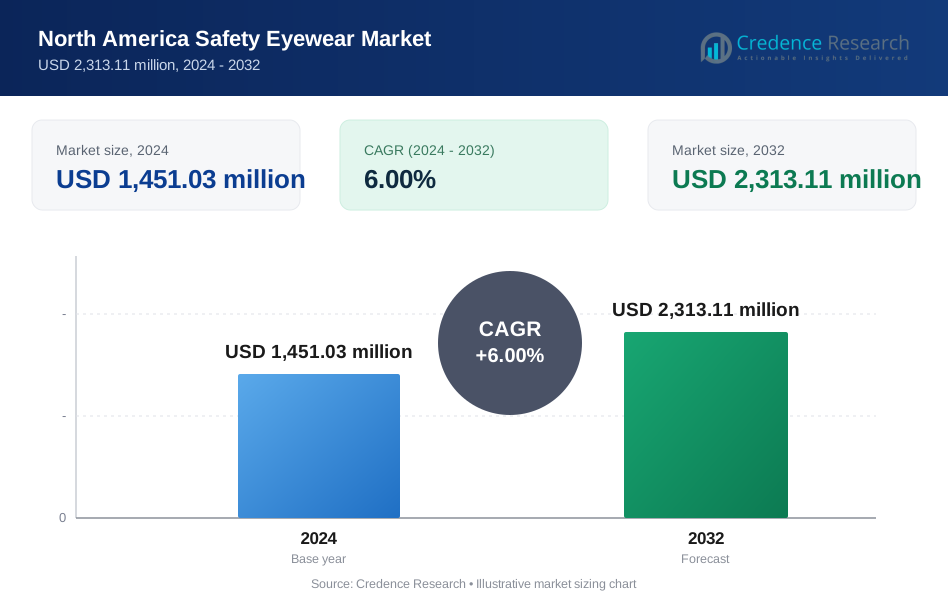
The North America Safety Eyewear market size was valued at USD 1,451.03 million in 2024 and is anticipated to reach USD 2,313.11 million by 2032, at a CAGR of 6.00% during the forecast period (2024-2032).
The North America Safety Eyewear market is driven by stringent workplace safety regulations across industries such as construction, manufacturing, and healthcare, which mandate the use of protective gear to prevent eye injuries. Growing awareness about occupational hazards and the importance of eye protection further fuels demand. Employers increasingly prioritize employee safety, leading to higher adoption of compliant and durable eyewear. In addition, technological advancements in lens materials and coatings, including anti-fog, anti-scratch, and UV protection, enhance product performance and user comfort. A rising trend toward stylish, ergonomically designed eyewear that combines safety with aesthetics appeals to younger workers and professionals. Furthermore, the integration of smart features such as heads-up displays and real-time monitoring in safety eyewear is gaining momentum, reflecting the growing influence of Industry 4.0. E-commerce platforms and direct-to-consumer sales channels also support market expansion by offering a wider product range and improved accessibility for end users.
The North America Safety Eyewear market shows strong geographical presence across the U.S., Canada, and Mexico, driven by industrial growth, regulatory compliance, and rising safety awareness. The U.S. leads in adoption due to stringent workplace safety standards and high demand from manufacturing, construction, and oil & gas sectors. Canada supports steady growth through mining, energy, and public infrastructure projects, while Mexico is emerging as a promising market with expanding industrial operations and foreign investments. The market features a competitive landscape with key players focusing on innovation, comfort, and distribution efficiency. Leading companies include Kimberly-Clark Corp., MCR Safety, Honeywell International, Inc., 3M, and Radians, Inc., all of which offer a wide range of certified safety eyewear tailored to diverse applications. These players invest in smart technology, ergonomic design, and direct-to-consumer platforms to meet evolving user needs and regulatory standards across North America. It continues to attract attention for its safety-first approach and product development.
Market Insights
- The North America Safety Eyewear market was valued at USD 1,451.03 million in 2024 and is projected to reach USD 2,313.11 million by 2032, growing at a CAGR of 6.00% during the forecast period.
- The Global Safety Eyewear Market was valued at USD 4,244.64 million in 2024 and is projected to reach USD 6,806.27 million by 2032, growing at a CAGR of 6.08% during the forecast period.
- Stringent government regulations and workplace safety standards drive the consistent demand for safety eyewear across industries such as construction, manufacturing, and oil & gas.
- Rising integration of smart features, including heads-up displays and environmental sensors, enhances worker safety and operational efficiency, marking a significant market trend.
- Competitive players like Kimberly-Clark Corp., MCR Safety, Honeywell International, 3M, and Radians, Inc. focus on innovation, product quality, and expanding distribution networks to maintain strong market positions.
- The high cost of advanced safety eyewear and discomfort issues limit widespread adoption, particularly among small and medium enterprises and cost-sensitive buyers.
- The U.S. leads the regional market with the largest share, fueled by strict OSHA regulations and robust industrial activity, while Canada and Mexico present stable and emerging opportunities driven by mining, energy, and manufacturing sectors.
- Growth in direct-to-consumer sales channels and e-commerce platforms improves product accessibility and convenience, creating new opportunities for market expansion and consumer engagement.
Report Scope
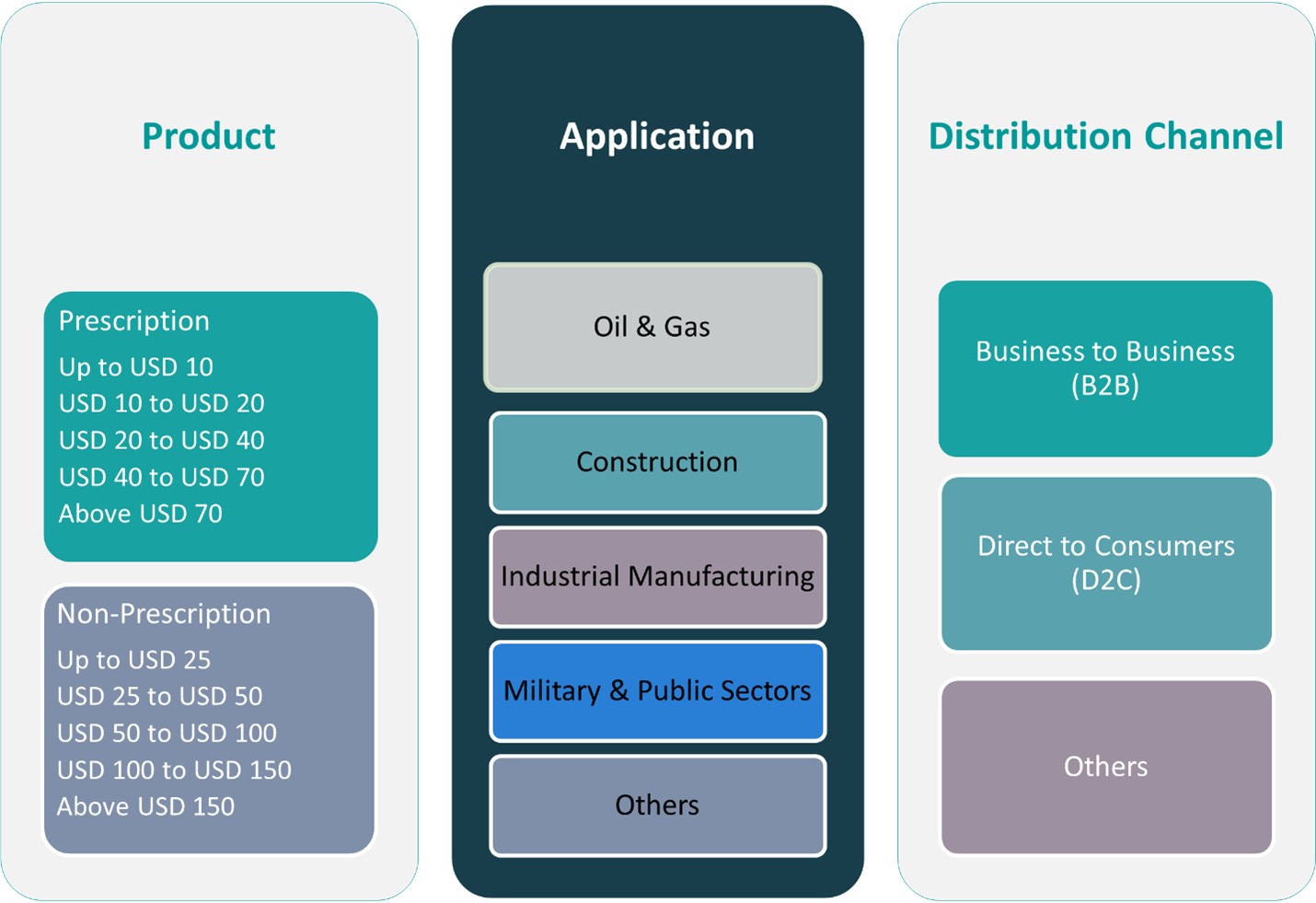
This report segments the North America Safety Eyewear Market as follows:
Market Drivers
Stringent Occupational Safety Regulations Support Consistent Product Demand
Government mandates and regulatory frameworks across North America play a vital role in driving the demand for safety eyewear. Agencies such as OSHA in the U.S. and CSA in Canada enforce strict guidelines for eye protection in workplaces where there is a risk of injury. These rules require employers to provide certified safety eyewear to employees, creating a consistent need across high-risk sectors. The North America Safety Eyewear Market benefits from periodic updates in safety standards, which encourage businesses to invest in upgraded eyewear solutions. Compliance with these standards remains critical to avoiding legal penalties and ensuring workforce safety. The constant reinforcement of such regulations sustains product relevance and market stability.
- For instance, OSHA regulations in the U.S. require employers to provide certified safety eyewear to workers in hazardous environments, ensuring compliance with workplace safety standards.
Increased Industrialization and Construction Activities Accelerate Market Growth
Rapid industrial expansion and rising construction projects across North America are creating new opportunities for safety eyewear providers. Industries such as oil and gas, mining, and heavy manufacturing contribute to high demand for protective gear, especially in labor-intensive environments. The market continues to grow as companies aim to reduce workplace injuries and improve operational efficiency. The North America Safety Eyewear Market sees strong traction in regions undergoing infrastructure upgrades and industrial modernization. Expansion of manufacturing facilities and investments in public infrastructure further strengthen the need for quality eye protection. Growing employer liability concerns also prompt proactive adoption of safety solutions.
- For instance, the U.S. Bureau of Labor Statistics reports that over 20,000 eye injuries occur annually in workplaces, underscoring the importance of safety eyewear.
Growing Awareness of Eye Safety Among Workers Enhances Adoption Rates
Employees and employers alike are becoming more conscious of the risks associated with inadequate eye protection. Training programs, workplace safety campaigns, and rising access to information drive home the importance of safety eyewear. It influences buying decisions and encourages compliance with safety protocols across various sectors. The North America Safety Eyewear Market sees higher product adoption where worker education levels and safety culture are well established. Companies increasingly invest in protective equipment to boost employee confidence and lower incident rates. Improved workplace safety records also contribute to positive brand reputations and workforce retention.
Innovation in Product Design Increases Appeal and Usage Compliance
Modern safety eyewear incorporates features that go beyond basic protection, enhancing comfort and visual clarity. Anti-fog lenses, UV coatings, and lightweight materials increase usage compliance among workers. Stylish designs and customizable fits make eyewear more appealing, especially among younger workers. The North America Safety Eyewear Market evolves with consumer preferences, focusing on both functionality and aesthetics. Innovations that reduce discomfort and fatigue during long shifts significantly improve acceptance rates. Employers prefer advanced models that meet both safety requirements and employee satisfaction metrics.
Market Trends
Rising Integration of Smart Features into Safety Eyewear Enhances Workplace Efficiency
Smart technology is transforming traditional safety eyewear by integrating digital capabilities such as heads-up displays, real-time alerts, and sensors for monitoring environmental conditions. These features support industrial safety and efficiency, especially in manufacturing and construction sectors. The North America Safety Eyewear Market is experiencing a shift from basic protective equipment to intelligent solutions that improve situational awareness. Companies adopt smart eyewear to reduce errors, improve communication, and support hands-free access to data. It enables quicker response to hazards and enhances compliance with safety protocols. This trend aligns with the broader adoption of Industry 4.0 technologies across North American industries.
- For instance, technological advancements in lens coatings, anti-fog solutions, and impact-resistant materials are improving the durability and usability of safety eyewear.
Rising Popularity of Direct-to-Consumer (DTC) Channels and Online Sales Platforms
The expansion of e-commerce and DTC channels has made safety eyewear more accessible to individual consumers and small businesses. Digital platforms offer wide product selections, size guides, and virtual try-on features, making it easier to choose suitable protective gear. The North America Safety Eyewear Market benefits from online visibility and faster delivery models that reduce dependency on traditional distributors. Consumers now expect convenience, competitive pricing, and personalized experiences when shopping for safety products. It encourages brands to invest in online marketing, SEO strategies, and user-friendly platforms. This trend increases market penetration and boosts brand loyalty.
- For instance, e-commerce & direct-to-consumer (DTC) platforms account for 50% of the safety eyewear market, driven by the convenience of online shopping and bulk purchasing.
Increased Demand for Ergonomically Designed and Fashion-Forward Safety Eyewear
User comfort and style are becoming critical factors in product design, especially among younger workers entering industrial jobs. Manufacturers focus on lightweight materials, adjustable fittings, and visually appealing designs that resemble everyday eyewear. The North America Safety Eyewear Market is seeing growing consumer interest in protective gear that combines safety with aesthetics. Workers prefer gear they feel comfortable wearing for long hours, which boosts usage compliance. It supports a culture of safety without compromising personal style or comfort. Brands that offer diverse styles and customizable options continue to gain market traction.
Shift Toward Eco-Friendly and Sustainable Manufacturing Practices
Growing environmental awareness among consumers and companies is encouraging the use of sustainable materials and eco-conscious production methods. Brands introduce recyclable frames, biodegradable packaging, and low-impact manufacturing processes. The North America Safety Eyewear Market is aligning with these sustainability goals by adopting greener practices across its value chain. Companies that demonstrate environmental responsibility often attract more business from large enterprises focused on ESG compliance. It reflects a broader market trend favoring sustainable innovation without compromising performance. These practices also help reduce waste and appeal to environmentally conscious buyers.
Market Challenges Analysis
High Cost of Advanced Safety Eyewear Limits Widespread Adoption
The increasing use of advanced materials, smart features, and customized designs significantly raises the price of safety eyewear. Small and medium-sized enterprises often struggle to justify the investment, especially when managing large workforces or operating on tight budgets. The North America Safety Eyewear Market faces resistance from cost-sensitive buyers who prefer basic, low-cost alternatives that meet only minimal compliance standards. It reduces demand for premium products and slows innovation adoption. Limited insurance coverage for protective equipment in some sectors also adds financial pressure on employers. Price sensitivity remains a key barrier to upgrading safety gear across all industry levels.
- For instance, procurement teams in small and medium enterprises across North America allocate limited funds across multiple safety needs, delaying purchase approvals and reducing order volumes.
Low User Compliance Due to Discomfort and Aesthetic Concerns Affects Market Performance
Despite regulatory mandates, many workers avoid wearing safety eyewear due to discomfort, poor fit, or unattractive designs. This non-compliance increases workplace risk and undermines the purpose of safety programs. The North America Safety Eyewear Market must address these behavioral challenges to improve product usage. It requires consistent investment in ergonomic design, lightweight materials, and stylish options that appeal to a wider workforce. Lack of awareness and training on proper eyewear use also contributes to low adoption in some sectors. Market players need to prioritize user-centric designs and targeted education to enhance long-term compliance.
Market Opportunities
Growing Industrial Automation and Infrastructure Projects Create New Demand Channels
The rapid growth of industrial automation and expansion of infrastructure projects across North America is generating new opportunities for safety eyewear manufacturers. These sectors involve high-risk environments where eye protection is critical to prevent injuries. The North America Safety Eyewear Market stands to benefit from increased investment in smart factories, transportation systems, and energy infrastructure. It opens new channels for product deployment, especially in sectors prioritizing safety and operational efficiency. Companies that offer certified, durable, and application-specific eyewear can capture demand from evolving industrial needs. Partnerships with construction and engineering firms further support long-term growth.
Rising Adoption in Non-Traditional Sectors Expands Market Reach
Beyond manufacturing and construction, sectors such as healthcare, pharmaceuticals, and laboratories are showing increased adoption of protective eyewear. This shift creates fresh opportunities for market players to develop niche products tailored to specific working conditions. The North America Safety Eyewear Market is positioned to expand its reach by addressing protective needs in education, retail, and public safety sectors. It requires product diversification and awareness campaigns to highlight the importance of eye safety across broader professional settings. Companies that respond quickly to these emerging demands can establish brand loyalty and increase market share. Expanding product accessibility through online channels also supports this opportunity.
Market Segmentation Analysis:
By Product:
The North America Safety Eyewear market is segmented by product, application, and distribution channel. By product, the market includes prescription and non-prescription eyewear. The prescription segment is gaining traction, especially in the USD 20 to USD 40 and USD 40 to USD 70 ranges, where demand is driven by workers seeking both vision correction and eye protection. High-end categories above USD 70 are expanding due to growing interest in comfort and customization. Non-prescription eyewear remains dominant in industries requiring standard protection, with the USD 25 to USD 50 range leading sales due to affordability and durability.
By Application:
By application, industrial manufacturing holds a major share due to consistent safety regulations and high worker volumes. The oil & gas and construction segments follow closely, supported by increased project activity and regulatory enforcement. The military and public sectors create steady demand through government procurement contracts, while the “others” category includes laboratories and education, contributing to niche growth.
By Distribution Channel:
Based on distribution, the B2B segment leads due to bulk purchases by companies for employee safety. The Direct to Consumer (D2C) channel is expanding as more professionals buy safety eyewear online for personal use. It reflects a shift toward convenience, broader selection, and faster delivery across the region.
Segments:
Based on Product:
- Prescription
- Up to USD 10
- USD 10 to USD 20
- USD 20 to USD 40
- USD 40 to USD 70
- Above USD 70
- Non-Prescription
- Up to USD 25
- USD 25 to USD 50
- USD 50 to USD 100
- USD 100 to USD 150
- Above USD 150
Based on Application:
- Oil & Gas
- Construction
- Industrial Manufacturing
- Military & Public Sectors
- Others
Based on Distribution Channel:
- Business to Business (B2B)
- Direct to Consumers (D2C)
- Others
Based on the Geography:
- S.
- Canada
- Mexico
Regional Analysis
United States
The United States dominates the North America Safety Eyewear Market, accounting for over 75% of the total regional revenue in 2024. High workplace safety awareness, strict enforcement of OSHA regulations, and continuous industrial activity support strong product demand. The U.S. construction and manufacturing sectors lead in consumption, while growing investments in smart factories and infrastructure projects add to long-term market stability. Companies based in the U.S. focus on innovation, offering advanced eyewear with smart features and improved comfort. It benefits from strong B2B networks and a rapidly expanding D2C segment driven by e-commerce. The presence of key players and local production capabilities further strengthens the U.S. market position.
Canada
Canada holds a smaller but stable share of the regional market, contributing around 12% to 14% in 2024. The market benefits from consistent demand across oil & gas, mining, and construction industries, particularly in provinces with high resource activity. Canadian workplace safety regulations, enforced under CSA standards, support ongoing demand for certified protective eyewear. It emphasizes product quality and compliance, with steady procurement from public sector and utility companies. Local distributors and safety gear suppliers maintain strong partnerships with manufacturers, ensuring steady market flow. Rising awareness about eye protection across healthcare and laboratory environments also adds to segment expansion.
Mexico
Mexico represents an emerging market in the region, holding approximately 10% to 12% share in 2024. Rapid industrial development, expansion of automotive and manufacturing facilities, and government-led infrastructure projects are driving demand for safety eyewear. The North America Safety Eyewear Market sees growing participation from Mexican buyers seeking affordable yet compliant products. It faces challenges related to inconsistent regulatory enforcement and low adoption in informal sectors. However, foreign investments and export-driven industries are encouraging businesses to adopt international safety standards. Growth in local e-commerce platforms and partnerships with global suppliers are also improving product availability and market access.
Key Player Analysis
- Kimberly-Clark Corp.
- MCR Safety
- Honeywell International, Inc.
- 3M
- Radians, Inc.
Competitive Analysis
The North America Safety Eyewear market features a competitive landscape dominated by key players such as Kimberly-Clark Corp., MCR Safety, Honeywell International, Inc., 3M, and Radians, Inc. These companies leverage strong brand recognition, extensive product portfolios, and advanced technological innovations to maintain leadership positions. They focus on developing high-quality eyewear that meets stringent safety standards while enhancing user comfort and functionality. Continuous investment in research and development allows them to introduce smart safety eyewear with integrated features such as impact resistance, anti-fog coatings, and digital connectivity. Market leaders also emphasize expanding distribution networks, including direct-to-consumer channels and partnerships with industrial suppliers, to increase market penetration. Their business strategies include mergers, acquisitions, and collaborations to diversify offerings and address specific industry needs such as construction, manufacturing, and oil & gas. Competitive pricing and customer service further differentiate their products in a price-sensitive market. Despite challenges like high production costs and evolving regulatory requirements, these companies sustain growth by focusing on innovation, product customization, and sustainability initiatives. Their ability to adapt quickly to changing market demands and regulatory landscapes solidifies their position in the North America Safety Eyewear market.
Recent Developments
- In April 2024, Popticals, a premium eyewear brand, launched the POPZULU Ops Edition, a line of ballistic glasses and safety eyewear. POPZULU is designed for tactical and industrial environments, offering full-scale defense with lenses engineered to shield and a frame that can collapse into a pocket-sized hard-shell case. The POPZULU sunglasses feature an innovative frame design and patented FL2 Micro-Rail System technology for collapsibility. They are crafted using high-quality materials like Hydrophobic Ri-Pel coating, Grilamid TR90 for lightweight and durability, and Impacto lenses from Carl Zeiss Vision that are 5X more resistant to hits and stresses than polycarbonate.
- In April 2024, Innovative Eyewear, Inc. announced filing two new U.S. patent applications related to its new Lucyd Armor smart safety glasses product, which is planned for introduction in mid-2024. The utility patent application covers the product's functional aspects, while the design patent application covers its ornamental design.
- In March 2024, Protective Industrial Products (PIP), a leader in personal protective equipment, acquired Scope Optics Pty Ltd., a safety eyewear company based in Australia. By incorporating Scope Optics' safety eyewear into its existing portfolio of eye protection brands, PIP is adding a wider selection of premium designs, advanced lens technologies, and exceptional value to serve its customers better. The acquisition of Scope Optics is another example of PIP's proven acquisition strategy to strengthen its portfolio of head-to-toe PPE solutions.
Market Concentration & Characteristics
The North America Safety Eyewear Market exhibits moderate concentration and strong regulatory compliance. Stringent regulatory standards under OSHA and ANSI spur demand for certified protective eyewear across industrial, construction, and healthcare sectors. Major global manufacturers and specialized regional suppliers command the largest market shares, and it features balanced competition among Honeywell, 3M, MCR Safety, Uvex, and Bollé Safety. Product portfolios differentiate by lens coatings, ergonomic frame design, and integration of smart hazard-detection features. Distribution channels include industrial supply distributors, e-commerce platforms, and direct OEM partnerships, which ensure wide geographic coverage and rapid product availability. High entry barriers arise from certification requirements and investment in R&D. Price competition remains moderate, and focus on sustainable materials and lightweight construction expands, while niche innovators drive specialized applications
Report Coverage
The research report offers an in-depth analysis based on Product, Application, Distribution Channel and Geography. It details leading market players, providing an overview of their business, product offerings, investments, revenue streams, and key applications. Additionally, the report includes insights into the competitive environment, SWOT analysis, current market trends, as well as the primary drivers and constraints. Furthermore, it discusses various factors that have driven market expansion in recent years. The report also explores market dynamics, regulatory scenarios, and technological advancements that are shaping the industry. It assesses the impact of external factors and global economic changes on market growth. Lastly, it provides strategic recommendations for new entrants and established companies to navigate the complexities of the market.
Future Outlook
- The North America safety eyewear market will grow steadily due to increasing workplace safety regulations.
- Rising awareness about eye protection among workers will drive higher demand for safety eyewear.
- Technological advancements will lead to more durable and comfortable eyewear designs.
- Growth in industries such as construction, manufacturing, and healthcare will boost market expansion.
- Integration of smart features like augmented reality in safety eyewear will gain traction.
- Increasing investment in employee safety programs will encourage adoption of advanced eyewear solutions.
- The market will see a rise in demand for lightweight and impact-resistant eyewear materials.
- E-commerce platforms will expand accessibility, enhancing product availability to a wider audience.
- Government initiatives promoting occupational health and safety will support market growth.
- Collaboration between eyewear manufacturers and safety organizations will improve product standards and innovation.
Request a Free Sample
Fill in your details and we'll send you a free sample report.
- Sample data tables & charts
- Research methodology
Need a Custom Version of This Report?
Tailor the scope, geography, or segments to your exact requirements.
- Custom geography or segment scope
- Direct access to our analyst team
Frequently Asked Questions
What is the current size of the North America Safety Eyewear market?
What factors are driving the growth of the North America Safety Eyewear market?
What are some challenges faced by the North America Safety Eyewear market?
Who are the major players in the North America Safety Eyewear market?
Table of Content
Chapter 1. Report Introduction
- 1.1 Report Description & Purpose
- 1.1.1 Report Title & Market Definition
- 1.1.2 Unique Selling Propositions (USP) & Key Differentiators
- 1.1.3 Value Proposition for Stakeholders
- 1.2 Research Objectives
- 1.2.1 Market Sizing Objectives (Volume & Revenue) (Volume Where Applicable)
- 1.2.2 Segmentation Objectives
- 1.2.3 Competitive Intelligence Objectives
- 1.2.4 Forecast & Scenario Objectives
- 1.3 Report Scope
- 1.3.1 North America Safety Eyewear Scope – Segments & Subsegments Covered
- 1.3.2 Geographic Scope – Regions & Countries Covered
- 1.3.3 Historical Period, Base Year & Forecast Period (2024; forecast to 2032)
- 1.3.4 Inclusions & Exclusions
- 1.4 Industry Classification & Applicable Codes
- 1.5 Currency, Measurement Units & Valuation Basis
- 1.6 Target Stakeholders
- 1.7 Limitations & Assumptions
Chapter 2. Executive Summary
- 2.1 Global North America Safety Eyewear Market Snapshot
- 2.1.1 Market Size – Historical (2024) & Forecast (2024-2032) (2024: USD 1,451.03 million → 2032: USD 2,313.11 million)
- 2.1.2 Volume & Revenue – Global Totals (Volume Where Applicable)
- 2.1.3 Key Market Highlights – Top Five Facts
- 2.2 North America Safety Eyewear Market Segmentation Snapshot
- 2.2.1 Market Split by Region – 2024 vs. 2032
- 2.3 Competitive Snapshot
- 2.3.1 Top 10 Players by Revenue Share – 2024
- 2.3.2 Top 10 Players by Volume Share – 2024 (Volume Where Applicable)
- 2.3.3 Recent Strategic Developments (18-Month Summary)
- 2.4 Key Investment Highlights & Strategic Conclusions
Chapter 3. North America Safety Eyewear Market Dynamics & Industry Analysis
- 3.1 Market Overview & Context
- 3.1.1 North America Safety Eyewear Market Position in the Broader Industry Value Chain
- 3.1.2 Demand Structure & Purchasing Dynamics
- 3.1.3 Market Maturity & Development Stage by Region
- 3.2 North America Safety Eyewear Market Drivers
- 3.3 North America Safety Eyewear Market Restraints & Challenges
- 3.4 North America Safety Eyewear Market Opportunities
- 3.5 Porter's Five Forces Analysis
- 3.5.1 Threat of New Entrants
- 3.5.2 Bargaining Power of Suppliers
- 3.5.3 Bargaining Power of Buyers
- 3.5.4 Threat of Substitutes
- 3.5.5 Competitive Rivalry – Intensity Assessment
- 3.6 North America Safety Eyewear Value Chain Analysis
- 3.6.1 Upstream – Key Inputs, Resources & Suppliers
- 3.6.1.1 Key Input/Resource 1
- 3.6.1.2 Key Input/Resource 2
- 3.6.1.3 Key Input/Resource 3
- 3.6.2 Midstream – Core Operations & Value Creation
- 3.6.2.1 Operating Model & Process Overview
- 3.6.2.2 Key Operating Locations & Capabilities by Company
- 3.6.3 Downstream – Market Channels & End Users
- 3.6.3.1 Direct Sales & Customer Engagement Channels
- 3.6.3.2 Indirect Sales, Intermediaries & Partner Channels
- 3.6.4 Value Chain Profitability Analysis
- 3.6.1 Upstream – Key Inputs, Resources & Suppliers
- 3.7 PESTEL Analysis
- 3.7.1 Political Factors
- 3.7.2 Economic Factors
- 3.7.3 Social Factors
- 3.7.4 Technological Factors
- 3.7.5 Environmental Factors
- 3.7.6 Legal Factors
- 3.8 North America Safety Eyewear Supply Chain Analysis
- 3.8.1 Critical Input & Resource Availability Risk Assessment
- 3.8.2 Supplier & Operational Concentration Risk (Geographic Exposure)
- 3.8.3 Supply & Service Disruption Impact Analysis
- 3.9 Regulatory & Policy Landscape
Note: The regulatory and policy landscape section covers regulations based on their applicability to the market, North America Safety Eyewear category, geography, and scope of the study. Only regulatory frameworks with a material impact on operations, compliance, trade, sustainability, or market access are analyzed in detail.
Chapter 4. Key Investment Pockets & Opportunity Analysis
- 4.1 North America Safety Eyewear Market Attractiveness Analysis
- 4.1.1 By Region – Investment Attractiveness Matrix (Market Size × CAGR)
- 4.2 Absolute Revenue Growth Opportunity
- 4.2.1 By Region – Absolute Revenue Growth Through 2032
- 4.3 Incremental Demand Opportunity
- 4.3.1 By Region – Incremental Demand Through 2032
- 4.3.2 Segment – Incremental Demand
- 4.4 Emerging Submarket Opportunity Deep Dive (Subject to Applicability)
- 4.5 Priority Market Opportunity Scorecards
- 4.5.1 United States
- 4.5.2 Europe
- 4.5.3 Asia
- 4.5.4 Middle East & Africa
Note: Priority market opportunity scorecards reflect the geographic scope and strategic relevance of the study. Listed markets are indicative and may be adapted to the industry.
Chapter 5. North America Safety Eyewear Cross-Border Trade & Market Access Analysis
- 5.1 International Trade & Cross-Border Activity Overview
- 5.1.1 Global Export Value by Country (2024)
- 5.1.2 Global Export Volume by Country (2024) (Volume Where Applicable)
- 5.1.3 Global Import Value by Country (2024)
- 5.1.4 Global Import Volume by Country (2024) (Volume Where Applicable)
- 5.1.5 Net Trade Balance by Country (2024)
- 5.2 Export Analysis – Segment
- 5.2.1 Category 1 (Applicable Classification Code)
- 5.2.2 Category 2 (Applicable Classification Code)
- 5.2.3 Category 3 (Applicable Classification Code)
- 5.2.4 Category 4 (Applicable Classification Code)
- 5.2.5 Category 5 (Applicable Classification Code)
- 5.3 Import Analysis – Segment
- 5.3.1 Category 1 (Applicable Classification Code)
- 5.3.2 Category 2 (Applicable Classification Code)
- 5.3.3 Category 3 (Applicable Classification Code)
- 5.3.4 Category 4 (Applicable Classification Code)
- 5.3.5 Category 5 (Applicable Classification Code)
- 5.4 Cross-Border Pricing & Transaction Benchmarks
- 5.4.1 Export Pricing – Segment & Country
- 5.4.2 Import Pricing – Segment & Source Country
- 5.4.3 Price Trends (2024)
- 5.5 Key Cross-Border Trade & Delivery Routes
- 5.5.1 Cross-Border Trade/Delivery Route 1
- 5.5.2 Cross-Border Trade/Delivery Route 2
- 5.5.3 Cross-Border Trade/Delivery Route 3
- 5.5.4 Cross-Border Trade/Delivery Route 4
- 5.5.5 Cross-Border Trade/Delivery Route 5
- 5.6 Trade Policy & Market Access Impact Assessment
- 5.6.1 Tariff & Non-Tariff Barriers
- 5.6.2 Regional Trade & Economic Integration Frameworks
- 5.6.3 Bilateral & Multilateral Trade Agreements
- 5.6.4 Cross-Border Operating, Licensing & Localization Requirements
Note: This chapter applies where cross-border trade or delivery is relevant to North America Safety Eyewear. Goods, services, and digital offerings are assessed using applicable classifications and transaction measures. Import-export volumes, trade balances, and route analyses are included only where meaningful to the market.
Chapter 6. Competitive Landscape & Company Benchmarking
- 6.1 North America Safety Eyewear Market Concentration & Structure
- 6.1.1 Herfindahl-Hirschman Index (HHI) – vs. 2024
- 6.1.2 Leading, Mid-Sized & Emerging Player Structure
- 6.1.3 Global, Regional & Local Player Dynamics
- 6.2 North America Safety Eyewear Market Share Analysis – 2024
- 6.2.1 Global Revenue Share by Company
- 6.2.2 Global Volume Share by Company (Volume Where Applicable)
- 6.2.3 Regional Revenue Share
- 6.2.4 Market Share Evolution ( vs. 2024)
- 6.2.5 Company Market Share by Key Segment
- 6.2.6 Company Market Share by Customer Group
- 6.3 Operating Scale, Capacity & Infrastructure Analysis
- 6.3.1 Global Operating Scale & Supply Capacity
- 6.3.2 Resource Utilization & Operating Efficiency
- 6.3.3 Output, Service Delivery & Activity Metrics
- 6.3.4 Operating Footprint & Infrastructure Map
- 6.3.5 Planned Operational & Capacity Expansion
- 6.4 North America Safety Eyewear Competitive Benchmarking Matrix
- 6.4.1 Revenue, Growth, Profitability & Operating Metric Comparison
- 6.4.2 Channel Revenue Mix
- 6.4.3 Geographic Revenue Exposure
- 6.4.4 R&D Intensity
- 6.4.5 Sustainability Maturity
- 6.5 Strategic Developments in North America Safety Eyewear (Last 24 Months)
- 6.5.1 Mergers, Acquisitions & Divestments
- 6.5.2 New Products, Services & Solutions in North America Safety Eyewear
- 6.5.3 Operational & Infrastructure Expansions
- 6.5.4 Strategic Alliances, Joint Ventures & Partnerships
- 6.5.5 Distribution Expansion & Market Entry
- 6.5.6 Sustainability & ESG Initiatives
- 6.6 Competitive Strategy Mapping
- 6.6.1 Leader, Challenger, Follower & Niche Classification
- 6.6.2 Pricing Strategy Comparison
- 6.6.3 Channel Strategy Matrix
Note: Strategic developments are included based on their materiality and the availability of reliable information.
Chapter 7. Global North America Safety Eyewear Market – By Sales & Delivery Channel
- 7.1 Segment Overview
- 7.1.1 Volume & Revenue Split by Channel (2024 & 2032) (Volume Where Applicable)
- 7.1.2 Channel Mix Evolution (2024-2032)
Chapter 8. Regional Market Analysis – Global Overview
- 8.1 Global Regional Overview
- 8.1.1 Regional Volume Share (Volume Where Applicable)
- 8.1.2 Regional Revenue Share
- 8.1.3 Regional Volume by Region (Volume Where Applicable)
- 8.1.4 Regional Revenue by Region
- 8.1.5 Regional Forecast Through 2032
- 8.2 Cross-Regional Segment Analysis
- 8.2.1 By Sales & Delivery Channel
- 8.2.2 By Competitive Positioning & Price Tier
Chapter 9. North America North America Safety Eyewear Market
- 9.1 United States
- 9.2 Canada
- 9.3 Mexico
Chapter 10. Europe North America Safety Eyewear Market
- 10.1 Germany
- 10.2 France
- 10.3 Italy
- 10.4 United Kingdom
- 10.5 Spain
- 10.6 Poland
- 10.7 Russia
- 10.8 Netherlands
- 10.9 Belgium
- 10.10 Sweden
- 10.11 Denmark
- 10.12 Norway
- 10.13 Rest of Europe
Chapter 11. Asia Pacific North America Safety Eyewear Market
- 11.1 China
- 11.2 India
- 11.3 Japan
- 11.4 South Korea
- 11.5 Thailand
- 11.6 Indonesia
- 11.7 Vietnam
- 11.8 Malaysia
- 11.9 Australia
- 11.10 Rest of Asia Pacific
Chapter 12. Latin America North America Safety Eyewear Market
- 12.1 Brazil
- 12.2 Argentina
- 12.3 Colombia
- 12.4 Chile
- 12.5 Rest of Latin America
Chapter 13. Middle East North America Safety Eyewear Market
- 13.1 Saudi Arabia
- 13.2 United Arab Emirates
- 13.3 Turkey
- 13.4 Israel
- 13.5 Iran
- 13.6 Rest of the Middle East
Chapter 14. Africa North America Safety Eyewear Market
- 14.1 South Africa
- 14.2 Egypt
- 14.3 Nigeria
- 14.4 Morocco
- 14.5 Rest of Africa
Chapter 15. North America Safety Eyewear Company Profiles
- 15.1 [Company 01]
- 15.1.1 Company Overview
- 15.1.2 Key Management Personnel
- 15.1.3 Products & Services Portfolio
- 15.1.4 Financial Performance
- 15.1.5 Key Market Focus & Geographic Presence
- 15.1.6 Recent Developments & Strategic Initiatives
Note: The company profile list is preliminary and may change based on research findings, market developments, data availability, and client requirements.
Chapter 16. Appendices
- Appendix A – List of Abbreviations & Acronyms
- Appendix B – Industry Classification Code Reference – Full Series
- Appendix C – Supply, Output & Operating Capacity Data Tables
- Appendix D – End-Use & Demand Base Tables
- Appendix E – Demand, Adoption & Usage Assumptions
- Appendix F – Pricing & Revenue Metric Reference Tables
- Appendix G – Company Operations & Infrastructure Database
- Appendix H – Cross-Border Trade & Activity Data Tables (Where Applicable)
- Appendix I – Regulatory Summary Tables
- Appendix J – Primary Research Participant List (Anonymized)
- Appendix K – Primary Research Questionnaire Framework
- Appendix L – Data Sources & Bibliography
- Appendix M – Market Size Divergence & Source Comparison
Chapter 17. Research Methodology
- 17.1 Research Framework & Philosophy
- 17.2 Secondary Research – Sources, Hierarchy & Data Extraction
- 17.3 Data Modeling – Bottom-Up & Top-Down Market Sizing
- 17.4 Primary Research – Stakeholder Framework, LOI & Sample Sizes
- 17.5 Forecast Methodology – Regression, Scenario & Sensitivity Analysis
- 17.6 Quality Control – Four-Layer Validation Framework
- 17.7 Limitations & Standard Assumptions
- 17.8 Disclaimer
