
| REPORT ATTRIBUTE | DETAILS |
|---|---|
| Historical Period | 2019-2022 |
| Base Year | 2023 |
| Forecast Period | 2024-2032 |
| Oil & Gas Separation Equipment Market Size 2023 | USD 1725.8 million |
| Oil & Gas Separation Equipment Market CAGR | 32.30% |
| Oil & Gas Separation Equipment Market Size 2032 | USD 21430.34 million |
Market Insights
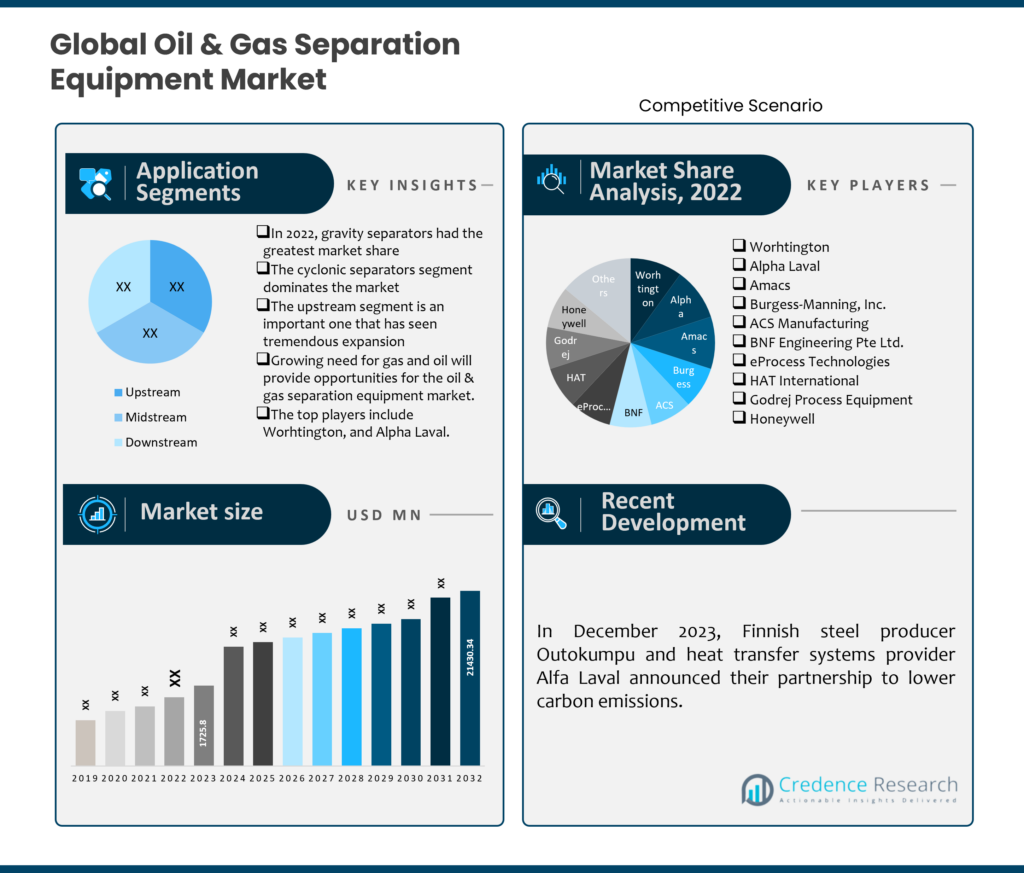
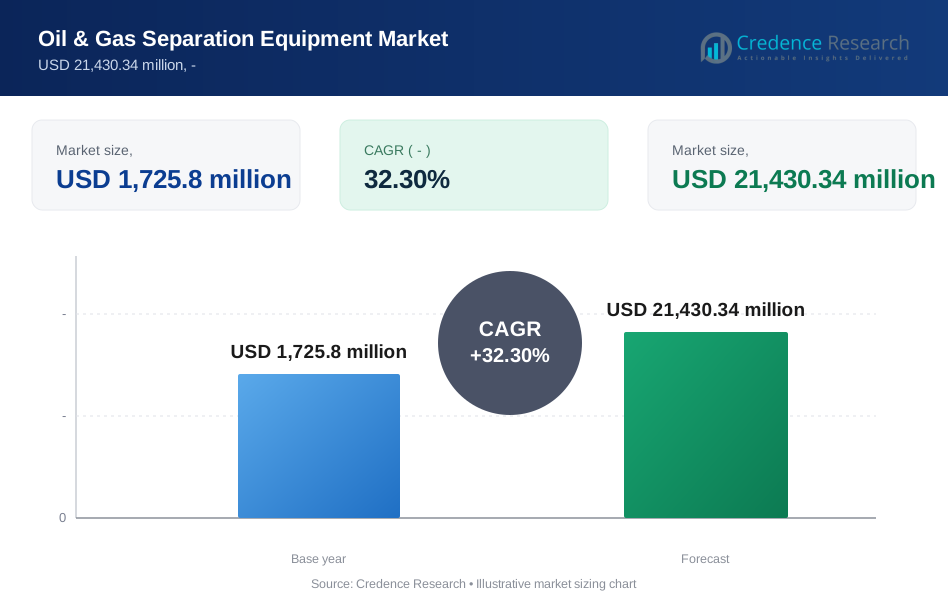
- Between 2024 and 2032, the global market for oil & gas separation equipment is projected to rise at a compound annual growth rate (CAGR) of 32.30%, from an estimated USD 1725.8 million in 2023 to USD 21430.34 million in 2032.
- The largest category is gravity separators. Cyclonic separators, on the other hand, are expected to grow at a strong CAGR.
- The upstream category will expand at a rapid rate of growth.
- North America governed the market for oil & gas separation equipment.
- Regarding the market share of oil & gas separation equipment, Europe is expected to come second.
- In the oil & gas separation equipment market, Asia Pacific is anticipated to grow fastest.
- The need for energy on a worldwide scale, rising exploration and production efforts, and ongoing advancements in separation technologies are driving the market for oil and gas separation equipment.
- The requirement to capture and treat emissions from methane leaks and greenhouse gas emissions is driving the deployment of sophisticated separation technology.
Executive Summary
Market Definition
A global market for machinery and apparatus used in the extraction, manufacturing, and treatment of natural gas, crude oil, and related fluids is known as the oil and gas separation equipment sector. In order to separate and eliminate pollutants, impurities, and other undesired elements from the streams of water, gas, and oil produced during upstream, midstream, and downstream activities, a broad range of systems and equipment are included in this market.
Market Overview
The oil & gas separation equipment sector is predicted to continue its upward trend between 2024 and 2032, growing at a compound annual growth rate (CAGR) of 32.30%. From its projected USD 1725.8 million in 2023 to USD 21430.34 million in 2032, the market will continue to grow.
Environmental concerns and energy transition are driving significant changes in the worldwide economy. More stringent rules intended to reduce the emission of greenhouse gases and diminish their harmful impact on the environment are contributing to this shift, as is the growing desire for cleaner energy sources. To improve the effectiveness and sustainability of oil and gas processes, more attention is being paid to the development of more ecologically friendly and efficient separation technologies, such as sophisticated filtration and membrane systems.
A pressure vessel called an oil and gas separator is used to separate solid sediments such as sand, salts, water, and oil from other materials. To extract the desired water and sediments from the oil and gas, a separation stage is necessary. The separator is utilized in the upstream section as soon as the gas and crude oil are produced from the well and rise to the surface. Group gathering stations (GGS) must be installed at the locations of the growing number of wells in new fields and deepwater explorations. Hydrocarbons must, therefore, be separated before being stored or transported, necessitating the use of more separators. The amount of crude oil produced globally in 2020 was 88391 thousand barrels per day, more than the 92568 thousand barrels per day produced in 2017. A larger installation capacity of separators may be necessary to avoid overloading the current ones and causing their breakdown, as indicated by the rise in production. These factors support the growth of the global oil & gas separation equipment market.
Segmentation by Type of Separation Equipment
- The gravity separator category is the market leader in terms of type of separation equipment. A gravity separator machine separates products from impurities, such as products that were previously separated and were weak, damaged, lost moisture, or discolored. This cleaning procedure improves the quality.
- The cyclonic separators category will exhibit a sizable CAGR during the projected period. An affordable tool for eliminating particulate matter from a fluid system is a cyclone separator. Centrifugal force is used in cyclone separators to separate solid particles from a carrier gas.
- Other types of separation equipment, including centrifugal separators and membrane separators, also support the need for oil & gas separation equipment.
Segmentation by Application Segments
- The finest application is thought to be an upstream category. In the upstream sector of the oil and gas business, which involves both drilling and exploitation duties, equipment for oil and gas separation is essential.
- The midstream category will likely register a significant CAGR during forecasting. Gas processing plants, which separate raw natural gas to eliminate impurities like water, hydrogen sulfide (H2S), carbon dioxide (CO2), and other contaminants, are frequently found in midstream facilities. Separation apparatus like distillation columns, scrubbers, and absorbers are utilized for this.
- Other application segments, such as downstream, also contribute to the demand for oil & gas separation equipment.
Segmentation by Region
- North America leads the oil & gas separation equipment industry. This is due to the rising demand for oil & gas separation equipment from North American countries such as the US, Canada, and Mexico.
- Europe is estimated to rank second in oil & gas separation equipment market size.
- The oil & gas separation equipment industry is predicted to flourish rapidly in Asia Pacific.
- The remaining need for oil & gas separation equipment is covered by regions including Latin America, Africa, and the Middle East.
MEA countries have changed their expenditure habits and started investing significant sums of money in their oil and gas refineries. Growing government efforts to ecologically exploit hydrocarbon reserves through financial assistance in the form of foreign direct investment (FDI) and tax breaks are expected to propel market expansion. The state-owned oil company of the United Arab Emirates, Abu Dhabi National Oil Company, was awarded an investment program worth USD 122 billion by the Supreme Petroleum Council of Abu Dhabi in November 2020. The program is scheduled to run from 2021 to 2025.
Based on projections, North America is anticipated to control the oil & gas separation equipment market. With a 36.9% revenue share in the global market for oil and gas separation equipment in 2022, North America was the market leader. The oil and gas sector in North America stands out by a high level of asset capitalization in both onshore and offshore reserves. During the projected period, rising shale plays and coal bed methane manufacturing in the area are expected to support equipment demand.
Throughout the projected period, Asia Pacific's oil and gas separation equipment market is anticipated to expand quickly. Due to an increase in exploration and production (E&P) activities in nations including China, Indonesia, Taiwan, Vietnam, and India, Asia Pacific is expected to grow in the upcoming years. In the coming years, it is expected that government measures to use hydrocarbon assets sustainably—particularly in China and India—will intensify and provide financial aid in the form of foreign direct investment and tax credits. This will accelerate market penetration in these regions.
Key Highlights of the Report
The global oil & gas separation equipment market is segmented by type of separation equipment, application segments, and region. The gravity separators category is the market spearhead in terms of the type of separation equipment, and upstream is the top application. The oil & gas separation equipment market is expanding mostly in North America.
Companies in the market are creating separation equipment that is both compact and modular, allowing for flexibility in both installation and operation. These designs need less space, are more mobile, and save money. Technologies for separation, including centrifugal, electrostatic, and membrane separation, have advanced significantly in the sector. Growth in the market is encouraged by these developments, which improve the efficacy and efficiency of separation procedures.
North America is expected to account for the largest oil & gas separation equipment market globally. In the coming years, rising offshore E&P and fresh exploration in Baken oilfields are anticipated to drive market expansion in North America. It is also anticipated that the market will develop at the fastest rate in the Asia Pacific region. During the projection period, it is anticipated that significant untapped hydrocarbon reserves and the discovery of shale reserves in China will drive the oil and gas separation equipment market.
Which Key Factors Are Driving The Global Oil & Gas Separation Equipment Market?
The oil and gas separation equipment market is expanding as a result of several factors, including a greater focus on emissions reduction, the increasing acceptance of environmentally friendly procedures by enterprises, and advancements in automation and control systems.
What Are The Main Challenges Confronting The Global Oil & Gas Separation Equipment Market?
The oil and gas separation equipment sector faces several significant challenges, such as fierce competition from manufacturers, delayed or overbudget projects, and quick technological improvements that could render the equipment currently in service outdated.
What Market Opportunities Exist For Oil & Gas Separation Equipment Globally?
The upstream sector's expanding investment, the expansion of long-term infrastructure, and the growing emphasis on produced water management present growth opportunities for oil and gas separation equipment.
Market Drivers
Growing Need for Gas and Oil
Due to population growth, urbanization, and industrialization, the world's energy consumption is continuously rising. As a result, the need for oil and gas extraction is expanding, which is encouraging the use of separation equipment to enhance production procedures and satisfy consumer demands. Global gas consumption is expected to increase by 140 billion cubic meters between 2021 and 2025. According to the International Energy Agency, by 2023, the world's oil consumption is expected to reach 101.7 million barrels per day, up 2.3 mb/d from the year before. Thus, the substantial need for gas and oil, together with increased production, is anticipated to propel the market's expansion on a global level.
Market Restraints
Fluctuating Prices for Oil
Global demand, geopolitical tensions, decisions made by organizations of petroleum exporting countries, and economic conditions are just a few of the many variables that influence oil prices. Oil and gas companies may decide to postpone or forgo making investments as a result of market uncertainty caused by price volatility. Furthermore, as businesses may decide to put off projects or cut back on capital expenditures until prices stabilize, the volatility of oil and gas prices can have a direct impact on the market for oil and gas separation equipment. This is anticipated to limit market expansion.
Opportunities
Reconstruction of Developed Oil Wells
Mature fields are those where there has been a consistent decrease in oil production. These fields were to the point of no longer having the capacity to produce. Despite the fact that these sectors are often the focus of attention, fresh discoveries and advancements are considered the "backbone" of the industry. Likewise, mature fields provide around 60% of the world's daily oil production. Mature oil wells often produce higher proportions of gas and water in addition to oil. To properly separate these components and extract oil, operators need separation equipment. The need for separation tools, such as separators, treaters, and skimmers, rises as a result.
Furthermore, the extraction of fully developed oil fields has become more attractive due to the use of mature oil wells and reservoir engineering techniques. Because of their need to maintain existing oil production levels and worries about profitability, many corporations place a high priority on creating innovative strategies for redeveloping oil fields. For example, in May 2019, the American engineering and construction company KBR, Inc. reached an agreement with the Spanish oil and gas company Cepsa and the Algerian government-owned company Sonatrach to revive oil fields in the Hassi Messaoud region of Algeria. It is anticipated that these variables would generate opportunities for market expansion.
Competitive Landscape
Key Players
In the highly competitive global oil & gas separation equipment market, there are a number of significant rivals. A few of the top market players are shown below, together with their respective market shares:
- Worhtington
- Alpha Laval
- Amacs
- Burgess-Manning, Inc.
- ACS Manufacturing
- BNF Engineering Pte Ltd.
- eProcess Technologies
- HAT International
- Godrej Process Equipment
- Honeywell
- Fenix Process Technolgies Pvt. Ltd.
- CAT Tecgnologies
- Doyle Dryers LLC
- ATLAS Oil & Gas Process Systems Inc.
- Valerus
- SLB
- Others
To stay competitive, these businesses give priority to product innovation, expanding their distribution networks, and completing mergers and acquisitions.
By developing innovative concepts and goods, the largest suppliers in the global market for oil and gas separation equipment constantly aim to stay one step ahead of the competition.
In September 2023, The UK government approved BP's intention to develop the Murlach oil and gas development in the UK North Sea. The purpose of the Murlach Field Development is to redevelop the Murlach Field, which is a part of Marnock-Skua. Approximately 203 km from the Aberdeenshire coast and 27 km from the UK/Norway median line, the field is located in the Central North Sea.
In January 2022, Woodside granted a contract to McDermott International for engineering, procurement, construction, installation, and commissioning services (EPCIC), acting as the Scarborough Joint Venture's operator for the building and commissioning of an FPU (Floating Production Unit) in the offshore region of Western Australia. Design, fabrication, gas separation, transportation, and other activities are included in the integrated scope.
How are Companies Performing in the Oil & Gas Separation Equipment Market?
The substantial performance of companies in the oil & gas separation equipment market can be attributed to some noteworthy reasons. Major multinational companies are expanding the range of products they offer and making significant investments in research and development to create complicated, multifunctional equipment that can handle a wide variety of fluids. In the upcoming years, this is expected to improve their industry preference and, hence, grow their market share.
The renowned company Schlumberger Establishes a Dedicated Business to Remove Methane and Regular Flare Emissions from the Oil and Gas Industry. Schlumberger declared the opening of Schlumberger End-to-end Emissions Solutions (SEES) in March 2022. The company delivers an extensive range of services together with state-of-the-art technologies that are intended to provide operators with a reliable and scalable way to measure, monitor, report, and eventually remove routine flare emissions and methane from their operations.
Furthermore, Schlumberger announced in March 2022 that Saudi Aramco had awarded a significant contract to provide integrated drilling and well-building services for a gas drilling project. Schlumberger aims to optimize integrated drilling performance through the utilization of digital technologies. One such solution is the DrillOps* on-target well delivery system, which utilizes automation, learning systems, and data analysis to carry out a digital well plan, thereby enhancing drilling efficiency, consistency, and performance.
The major company, Schlumberger, declared in March 2022 that TotalEnergies has given it a large contract for production services, drilling, and completions for the Tilenga onshore oil development in Uganda. Strategically, the Tilenga project is important for Uganda's faster economic growth. Schlumberger has pledged to help TotalEnergies with environmental, social, and governance (ESG) activities and domestic value creation as part of an extensive national content development plan.
Summary of Key Findings
- Investment in NGL separation equipment is driven by the growing demand for natural gas liquids (NGLs) as feedstock for petrochemicals and fuels.
- The market is segmented by type of separation equipment, application segments, and region.
- In the market, gravity separators are the most widely used type of separation equipment.
- The upstream category is the foremost application category.
- North America is leading market development. The market is highly competitive, with key players including Worhtington, Alpha Laval, Amacs, Burgess-Manning, Inc., ACS Manufacturing, BNF Engineering Pte Ltd., eProcess Technologies, HAT International, Godrej Process Equipment, Honeywell, Fenix Process Technolgies Pvt. Ltd., CAT Tecgnologies, Doyle Dryers LLC, ATLAS Oil & Gas Process Systems Inc., Valerus, SLB, and Others.
Future Outlook
- The oil & gas separation equipment industry is expected to increase significantly in North America, and its outlook is positive worldwide.
- The need for offshore separation equipment is driven by the growth of offshore drilling and exploitation operations for oil and gas, especially in deepwater and ultra-deepwater regions.
- Market expansion may be hampered by resistance to implementing new separation technologies because of perceived hazards or practical difficulties.
- Major organizations need to create novel offerings, reach a wider audience, and maintain competitive pricing in order to stay ahead of other businesses.
How the Credence Research Oil & Gas Separation Equipment Market Report Can Help CXOs
The Credence Research Oil & Gas Separation Equipment Market Report provides CXOs with an extensive market overview and comprises the following:
- Market size and growth forecast: The study offers comprehensive market estimations for oil & gas separation equipment globally, broken down by type of separation equipment, application segments, and region. In addition, projections for the market through 2032 based on significant drivers and trends are included.
- Market segmentation: The oil & gas separation equipment market is divided into segments by type of separation equipment, application segments, and region in the research report. CXOs are given a detailed grasp of the market and the potential inside each sector due to this segmentation.
- Competitive landscape: The study report provides a thorough analysis of the leading businesses in the oil and gas separation equipment sector, together with details on their revenue streams, product lines, and business strategies. This information can help CXOs assess and identify their competitors.
- Key trends and drivers: The study report analyzes and highlights the key developments and elements driving the market for oil & gas separation equipment. CXOs can utilize this information to make well-informed choices regarding their plans and investments.
The Credence Research Oil & Gas Separation Equipment Market Report provides CXOs with insights that they may utilize to:
- Identify growth opportunities: This analysis is likely to help CXOs find fresh growth prospects in the oil and gas separation equipment sector. For example, the research recognizes the increasing requirement for oil and gas separation equipment from the onshore sector as a crucial opportunity.
- Make informed investment decisions: The study aids CXOs in making informed decisions about oil & gas separation equipment. For example, it delivers information on the key variables to consider while picking oil & gas separation equipment solutions and evaluating suppliers.
- Develop competitive strategies: CXOs can utilize the research report to establish competitive strategies for their oil & gas separation equipment firms. The study paper explores the primary tactics employed by oil & gas separation equipment providers to set themselves apart from their rivals.
- Track market developments: By tracking market advancements, this research report could assist CXOs in remaining ahead of the curve. For example, it provides information about the latest advancements and patterns in the oil & gas separation equipment industry.
The Credence Research Oil & Gas Separation Equipment Market Report is helpful for CXOs who want to learn more about the market and identify potential opportunities.
Segmentation
By Type of Separation Equipment
-
- Gravity Separators
- Three-Phase Separators
- Two-Phase Separators
- Cyclonic Separators
- Hydrocyclones
- Gas Cyclones
- Centrifugal Separators
- Decanter Centrifuges
- Disk Stack Centrifuges
- Membrane Separators
- Reverse Osmosis (RO) Systems
- Membrane Filtration Systems
- Gravity Separators
By Application Segments
- Upstream
- Primary Separation
- Secondary Separation
- Midstream
- Gas-Liquid Separation
- Oil-Water Separation
- Downstream
- Fractionation Towers
- Desalting Units
- Amine Gas Treating Units
By Region
- North America
- The U.S.
- Canada
- Mexico
-
- Europe
- Germany
- France
- UK.
- Italy
- Spain
- Rest of Europe
- Asia Pacific
- China
- Japan
- India
- South Korea
- South-east Asia
- Rest of Asia Pacific
- Latin America
- Brazil
- Argentina
- The rest of Latin America
- Middle East & Africa
- GCC Countries
- South Africa
- The Rest of the Middle East and Africa
- Europe
Adjacent Markets
Several adjacent markets in the oil & gas separation equipment market have high revenue growth opportunities. The key adjacent markets for the oil & gas separation equipment market -
|
Adjacent Markets |
||
| Oil and Gas Exploration and Production (E&P) Services | Oilfield Equipment Manufacturing | Petrochemical Industry |
| Refining Industry | Pipeline Transportation | Natural Gas Processing |
| Water Treatment Equipment | Energy Storage Systems | Environmental Remediation Services |
Request a Free Sample
Fill in your details and we'll send you a free sample report.
- Sample data tables & charts
- Research methodology
Need a Custom Version of This Report?
Tailor the scope, geography, or segments to your exact requirements.
- Custom geography or segment scope
- Direct access to our analyst team
Frequently Asked Questions
How much does the global market currently hold for oil & gas separation equipment?
What is the oil & gas separation equipment market's projected growth rate between 2024 and 2032?
In terms of the type of separation equipment, which market category is the most important?
Regarding the application, which market category is in the lead?
Which type of separation equipment is anticipated to grow at the fastest rate throughout the projected period?
In which region is the market for oil & gas separation equipment expanding?
Who are the main players in the global oil & gas separation equipment industry?
Which market factors are the primary drivers of the oil & gas separation equipment industry?
What main market challenges prevent the growth of the oil & gas separation equipment sector?
What are the main market opportunities for the oil & gas separation equipment sector?
Table of Content
Chapter 1. Report Introduction
- 1.1 Report Description & Purpose
- 1.1.1 Report Title & Market Definition
- 1.1.2 Unique Selling Propositions (USP) & Key Differentiators
- 1.1.3 Value Proposition for Stakeholders
- 1.2 Research Objectives
- 1.2.1 Market Sizing Objectives (Volume & Revenue)
- 1.2.2 Segmentation Objectives
- 1.2.3 Competitive Intelligence Objectives
- 1.2.4 Forecast & Scenario Objectives
- 1.3 Report Scope
- 1.3.1 Oil & Gas Separation Equipment Scope – Types & Subtypes Covered
- 1.3.2 Geographic Scope – Regions & Countries Covered
- 1.3.3 Historical Period, Base Year & Forecast Period (the historical period; forecast to the forecast period)
- 1.3.4 Inclusions & Exclusions
- 1.4 HS Code & Classification Framework
- 1.5 Currency, Units & Pricing Basis
- 1.6 Target Stakeholders
- 1.7 Limitations & Assumptions
Chapter 2. Executive Summary
- 2.1 Global Oil & Gas Separation Equipment Market Snapshot
- 2.1.1 Market Size – Historical (the historical period) & Forecast (the forecast period) (base year: USD 1,725.8 million → forecast year: USD 21,430.34 million)
- 2.1.2 Volume & Revenue – Global Totals
- 2.1.3 Key Market Highlights – Top Five Facts
- 2.2 Oil & Gas Separation Equipment Market Segmentation Snapshot
- 2.2.1 Market Split by Region – vs.
- 2.3 Competitive Snapshot
- 2.3.1 Top 10 Players by Revenue Share –
- 2.3.2 Top 10 Players by Volume Share –
- 2.3.3 Recent Strategic Developments (18-Month Summary)
- 2.4 Key Investment Highlights & Strategic Conclusions
Chapter 3. Oil & Gas Separation Equipment Market Dynamics & Industry Analysis
- 3.1 Market Overview & Context
- 3.1.1 Oil & Gas Separation Equipment Market Position in the Broader Automotive Value Chain
- 3.1.2 OEM vs. Replacement Market Dynamics
- 3.1.3 Market Maturity & Development Stage by Region
- 3.2 Oil & Gas Separation Equipment Market Drivers
- 3.3 Oil & Gas Separation Equipment Market Restraints & Challenges
- 3.4 Oil & Gas Separation Equipment Market Opportunities
- 3.5 Porter's Five Forces Analysis
- 3.5.1 Threat of New Entrants
- 3.5.2 Bargaining Power of Suppliers
- 3.5.3 Bargaining Power of Buyers
- 3.5.4 Threat of Substitutes
- 3.5.5 Competitive Rivalry – Intensity Assessment
- 3.6 Oil & Gas Separation Equipment Value Chain Analysis
- 3.6.1 Upstream – Raw Material/Input Suppliers
- 3.6.1.1 Raw Material/Input 1
- 3.6.1.2 Raw Material/Input 2
- 3.6.1.3 Raw Material/Input 3
- 3.6.2 Midstream – Production/Manufacturing/Service Delivery
- 3.6.2.1 Production/Process Overview
- 3.6.2.2 Key Facility Locations & Capacity by Manufacturer
- 3.6.3 Downstream – Distribution & End Consumer
- 3.6.3.1 Primary Channel – B2B/OEM
- 3.6.3.2 Secondary Channels – Dealer, Retail, Online, Direct
- 3.6.4 Value Chain Profitability Analysis
- 3.6.1 Upstream – Raw Material/Input Suppliers
- 3.7 PESTEL Analysis
- 3.7.1 Political Factors
- 3.7.2 Economic Factors
- 3.7.3 Social Factors
- 3.7.4 Technological Factors
- 3.7.5 Environmental Factors
- 3.7.6 Legal Factors
- 3.8 Oil & Gas Separation Equipment Supply Chain Analysis
- 3.8.1 Raw Material/Input Supply Risk Assessment
- 3.8.2 Manufacturing Concentration Risk (Geographic Exposure)
- 3.8.3 Trade Disruption Impact Analysis
- 3.9 Regulatory & Policy Landscape
Note: The regulatory and policy landscape section covers regulations based on their applicability to the market, Oil & Gas Separation Equipment category, geography, and scope of the study. Only regulatory frameworks with a material impact on operations, compliance, trade, sustainability, or market access are analyzed in detail.
Chapter 4. Key Investment Pockets & Opportunity Analysis
- 4.1 Oil & Gas Separation Equipment Market Attractiveness Analysis
- 4.1.1 By Region – Investment Attractiveness Matrix (Volume × CAGR)
- 4.2 Absolute Revenue Growth Opportunity
- 4.2.1 By Region – Absolute USD Growth Through the forecast period
- 4.3 Incremental Volume Opportunity
- 4.3.1 By Region – Incremental Volume Through the forecast period
- 4.3.2 Segment – Incremental Volume
- 4.4 Emerging Submarket Opportunity Deep Dive (Subject to Applicability)
- 4.5 Emerging Market Opportunity Scorecards
- 4.5.1 United States
- 4.5.2 Europe
- 4.5.3 Asia
- 4.5.4 Middle East & Africa
Note: Emerging Market Opportunity Scorecards will be included based on relevance and strategic importance. Regions listed are indicative and may vary depending on data availability and market dynamics.
Chapter 5. Oil & Gas Separation Equipment Import-Export Analysis & Trade Flows
- 5.1 Global Trade Overview
- 5.1.1 Global Export Value by Country (the historical period)
- 5.1.2 Global Export Volume by Country (the historical period)
- 5.1.3 Global Import Value by Country (the historical period)
- 5.1.4 Global Import Volume by Country (the historical period)
- 5.1.5 Net Trade Balance by Country (the historical period)
- 5.2 Export Analysis – Segment
- 5.2.1 Type 1 (HS Code)
- 5.2.2 Type 2 (HS Code)
- 5.2.3 Type 3 (HS Code)
- 5.2.4 Type 4 (HS Code)
- 5.2.5 Type 5 (HS Code)
- 5.3 Import Analysis – Segment
- 5.3.1 Type 1 (HS Code)
- 5.3.2 Type 2 (HS Code)
- 5.3.3 Type 3 (HS Code)
- 5.3.4 Type 4 (HS Code)
- 5.3.5 Type 5 (HS Code)
- 5.4 Average Unit Trade Prices
- 5.4.1 Average Export Price – Segment & Country
- 5.4.2 Average Import Price – Segment & Source Country
- 5.4.3 Price Trends (the historical period)
- 5.5 Key Trade Route Analysis
- 5.5.1 Trade Route 1
- 5.5.2 Trade Route 2
- 5.5.3 Trade Route 3
- 5.5.4 Trade Route 4
- 5.5.5 Trade Route 5
- 5.6 Trade Policy Impact Assessment
- 5.6.1 US Anti-Dumping & Section 301 Tariffs
- 5.6.2 EU Customs Union Impact
- 5.6.3 Major Free Trade Agreements
- 5.6.4 USMCA Rules of Origin
Note: Trade policy analysis will be included only where relevant to the Oil & Gas Separation Equipment market.
Chapter 6. Competitive Landscape & Company Benchmarking
- 6.1 Oil & Gas Separation Equipment Market Concentration & Structure
- 6.1.1 Herfindahl-Hirschman Index (HHI) – vs.
- 6.1.2 Tier 1, Tier 2 & Tier 3 Market Structure
- 6.1.3 Global, Regional & Local Player Dynamics
- 6.2 Oil & Gas Separation Equipment Market Share Analysis –
- 6.2.1 Global Revenue Share by Company
- 6.2.2 Global Volume Share by Company
- 6.2.3 Regional Revenue Share
- 6.2.4 Market Share Evolution ( vs. )
- 6.2.5 OEM Segment Share by Company
- 6.2.6 Replacement Segment Share by Company
- 6.3 Production/Delivery Capacity & Facility Analysis
- 6.3.1 Global Installed Capacity
- 6.3.2 Capacity Utilization Rates
- 6.3.3 Production/Output Volume
- 6.3.4 Facility Locations & Capacity Map
- 6.3.5 Planned Capacity Additions
- 6.4 Oil & Gas Separation Equipment Competitive Benchmarking Matrix
- 6.4.1 Revenue, Volume, CAGR & Profitability Comparison
- 6.4.2 Channel Revenue Mix
- 6.4.3 Geographic Revenue Exposure
- 6.4.4 R&D Intensity
- 6.4.5 Sustainability Maturity
- 6.5 Strategic Developments in Oil & Gas Separation Equipment (Last 24 Months)
- 6.5.1 Mergers, Acquisitions & Divestments
- 6.5.2 New Oil & Gas Separation Equipment Launches
- 6.5.3 Facility Expansions
- 6.5.4 Strategic Alliances, Joint Ventures & Partnerships
- 6.5.5 Distribution Expansion & Market Entry
- 6.5.6 Sustainability & ESG Initiatives
- 6.6 Competitive Strategy Mapping
- 6.6.1 Leader, Challenger, Follower & Niche Classification
- 6.6.2 Pricing Strategy Comparison
- 6.6.3 Channel Strategy Matrix
Note: Strategic developments are included based on their materiality and the availability of reliable information.
Chapter 7. Global Oil & Gas Separation Equipment Market – By Distribution Channel
- 7.1 Segment Overview
- 7.1.1 Volume & Revenue Split by Channel ( & )
- 7.1.2 Channel Mix Evolution (the forecast period)
Chapter 8. Regional Market Analysis – Global Overview
- 8.1 Global Regional Overview
- 8.1.1 Regional Volume Share
- 8.1.2 Regional Revenue Share
- 8.1.3 Regional Volume by Region
- 8.1.4 Regional Revenue by Region
- 8.1.5 Regional Forecast Through the forecast period
- 8.2 Cross-Regional Segment Analysis
- 8.2.1 By Distribution Channel
- 8.2.2 By Brand/Price Tier
Chapter 9. North America Oil & Gas Separation Equipment Market
- 9.1 United States
- 9.2 Canada
- 9.3 Mexico
Chapter 10. Europe Oil & Gas Separation Equipment Market
- 10.1 Germany
- 10.2 France
- 10.3 Italy
- 10.4 United Kingdom
- 10.5 Spain
- 10.6 Poland
- 10.7 Russia
- 10.8 Netherlands
- 10.9 Belgium
- 10.10 Sweden
- 10.11 Denmark
- 10.12 Norway
- 10.13 Rest of Europe
Chapter 11. Asia Pacific Oil & Gas Separation Equipment Market
- 11.1 China
- 11.2 India
- 11.3 Japan
- 11.4 South Korea
- 11.5 Thailand
- 11.6 Indonesia
- 11.7 Vietnam
- 11.8 Malaysia
- 11.9 Australia
- 11.10 Rest of Asia Pacific
Chapter 12. Latin America Oil & Gas Separation Equipment Market
- 12.1 Brazil
- 12.2 Argentina
- 12.3 Colombia
- 12.4 Chile
- 12.5 Rest of Latin America
Chapter 13. Middle East Oil & Gas Separation Equipment Market
- 13.1 Saudi Arabia
- 13.2 United Arab Emirates
- 13.3 Turkey
- 13.4 Israel
- 13.5 Iran
- 13.6 Rest of the Middle East
Chapter 14. Africa Oil & Gas Separation Equipment Market
- 14.1 South Africa
- 14.2 Egypt
- 14.3 Nigeria
- 14.4 Morocco
- 14.5 Rest of Africa
Chapter 15. Oil & Gas Separation Equipment Company Profiles
- 15.1 [Company 01]
- 15.1.1 Company Overview
- 15.1.2 Key Management Personnel
- 15.1.3 Products & Services Portfolio
- 15.1.4 Financial Performance
- 15.1.5 Key Market Focus & Geographic Presence
- 15.1.6 Recent Developments & Strategic Initiatives
Note: The company profile list is preliminary and may change based on research findings, market developments, data availability, and client requirements.
Chapter 16. Appendices
- Appendix A – List of Abbreviations & Acronyms
- Appendix B – Industry Classification Code Reference – Full Series
- Appendix C – Production & Capacity Data Tables
- Appendix D – End-Use & Demand Base Tables
- Appendix E – Consumption & Replacement Rate Assumptions
- Appendix F – ASP Reference Tables
- Appendix G – Manufacturing & Facility Database
- Appendix H – Import-Export Data Tables
- Appendix I – Regulatory Summary Tables
- Appendix J – Primary Research Participant List (Anonymized)
- Appendix K – Primary Research Questionnaire Framework
- Appendix L – Data Sources & Bibliography
- Appendix M – Market Size Divergence & Source Comparison
Chapter 17. Research Methodology
- 17.1 Research Framework & Philosophy
- 17.2 Secondary Research – Sources, Hierarchy & Data Extraction
- 17.3 Data Modeling – Bottom-Up & Top-Down Market Sizing
- 17.4 Primary Research – Stakeholder Framework, LOI & Sample Sizes
- 17.5 Forecast Methodology – Regression, Scenario & Sensitivity Analysis
- 17.6 Quality Control – Four-Layer Validation Framework
- 17.7 Limitations & Standard Assumptions
- 17.8 Disclaimer
