
| REPORT ATTRIBUTE | DETAILS |
|---|---|
| Historical Period | 2019-2022 |
| Base Year | 2023 |
| Forecast Period | 2024-2032 |
| Oil Storage Market Size 2023 | USD 12522.6 million |
| Oil Storage Market, CAGR | 5.00% |
| Oil Storage Market Size 2032 | USD 19426.7 million |
Market Insights
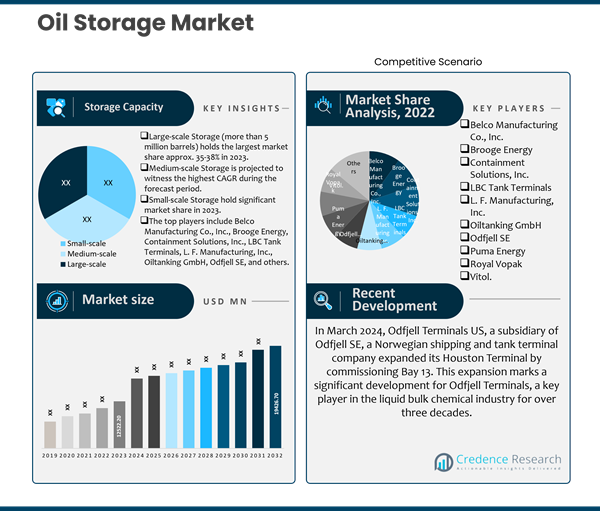
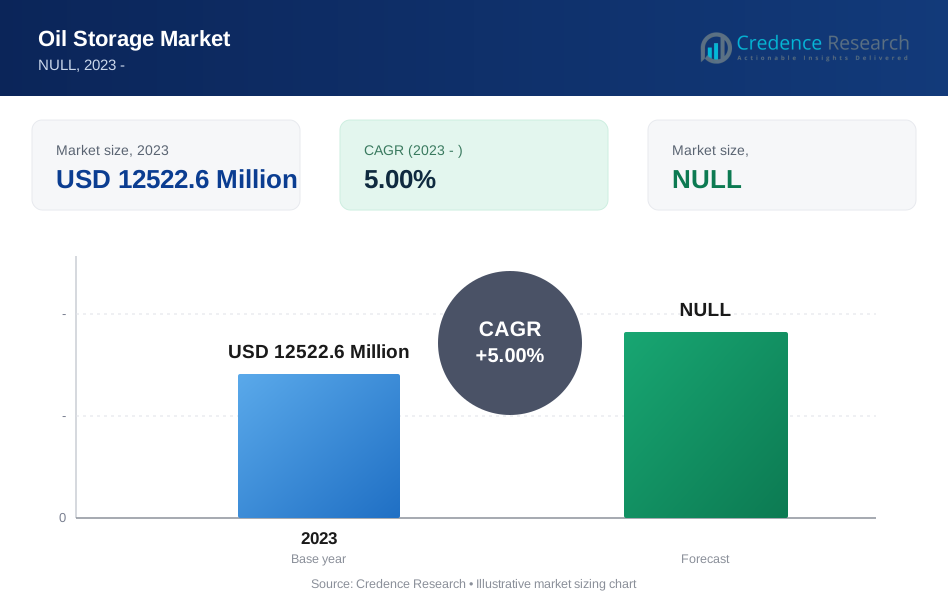
- The Oil Storage Market has exhibited steady growth and is anticipated to maintain a robust Compound Annual Growth Rate (CAGR) of 5.00% from 2024 to 2032. Valued at USD 12522.6 million in 2023, this market is forecasted to reach USD 19426.7 million by 2032.
- Among the key segments, Aboveground Storage Tanks (AST) emerged as the market leader by type of storage facility, comprising approximately 38-42% of the total market share in 2023. However, Floating Roof Tanks are projected to experience the highest CAGR during the forecast period.
- Steel Tanks currently hold the largest market share, accounting for approximately 35-38% in 2023, in terms of material used. Fiberglass Tanks are anticipated to witness the highest CAGR during the forecast period.
- Crude Oil Storage currently dominates the market, holding the largest market share of around 40-42% in 2023 by end-use industry. Biofuel Storage is expected to witness the highest CAGR during the forecast period.
- Large-scale Storage (more than 5 million barrels) holds the largest market share, approximately 35-38% in 2023, in terms of storage capacity. Medium-scale Storage is projected to experience the highest CAGR during the forecast period.
- Asia Pacific secured the largest share, around 38-42% of the market in 2023. North America and Europe collectively contribute just under 55% share in 2023.
- The increasing energy demand, geopolitical tensions, environmental regulations, and ongoing investments in new reserves and expansion of existing ones, particularly in regions like Saudi Arabia, UAE, Iran, Iraq, Nigeria, and Angola, are also significant contributors to market growth.
- Key opportunities in the market include the adoption of advanced technologies, such as automation and IoT, the shift towards renewable energy, and diversification into ancillary industries like blending and tank leasing, enabling market expansion.
Executive Summary
Market Definition
The oil storage market refers to the services and products of crude oil storage and bulk refined oil storage. This can include underground tanks, underground caverns, pipelines, and ships. Factors such as global oil demand, geopolitical events, and changes in production and consumption habits drive market growth. Key players in the market include oil producers, traders, and retailers large, using warehouses to manage their inventories, ensure the continuous supply of customers available, as well as provide related services like logistics, transport, etc. With increasing concerns about energy security and environmental protection, regulations and standards aimed at ensuring safe responsible, and supportive flows of some critical materials.
Market Overview
The Oil Storage Market has exhibited steady growth and is anticipated to maintain a robust Compound Annual Growth Rate (CAGR) of 5.00% from 2024 to 2032. Valued at USD 12522.6 million in 2023, this market is forecasted to reach USD 19426.7 million by 2032.
Among the primary segments, Aboveground Storage Tanks (AST) dominated the market landscape by type of storage facility, comprising approximately 38-42% of the total market share in 2023. However, Floating Roof Tanks are anticipated to observe the highest CAGR over the forecast period.
Steel Tanks currently hold the largest market share, accounting for approximately 35-38% in 2023, in terms of material used. Fiberglass Tanks are expected to witness the highest CAGR during the forecast period.
Crude Oil Storage currently dominates the market, holding the largest market share of around 40-42% in 2023 by end-use industry. Biofuel Storage is projected to witness the highest CAGR during the forecast period.
Large-scale Storage (more than 5 million barrels) holds the largest market share, approximately 35-38% in 2023, in terms of storage capacity. Medium-scale Storage is projected to experience the highest CAGR during the forecast period.
Asia Pacific constituted a significant portion of the market in 2023, followed by North America and Europe, collectively representing just under 55% of the market share.
The surge in demand for Oil Storage services, driven by factors such as increasing energy demand, geopolitical tensions, and environmental regulations, fosters market growth, especially in regions like Asia Pacific.
Rapid advancement in Oil Storage technology, including the adoption of advanced technologies such as automation and IoT, is driving market demand, especially in regions like Asia Pacific where the growth of the Oil Storage industry is significant.
Segmentation by Type of Storage Facility
- Aboveground Storage Tanks (AST) currently hold the largest market share approx. 38-42% in 2023. ASTs are popular because they are easy and inexpensive to construct, maintain, and inspect compared to underground tanks. They are widely used because of their versatility and their ability to handle different types of fluids.
- Floating Roof Tanks is projected to witness the highest CAGR during the forecast period. By minimizing the space above the stored liquid, these tanks reduce evaporation significantly, which is both economically beneficial and better for the environment.
Segmentation by Material Used
- Steel Tanks currently hold the largest market share approx. 35-38% in 2023. Steel tanks are widely used for their durability, reliability, and versatility. They are resistant to harsh environmental conditions and are suitable for the preservation of various Petroleum products.
- Fiberglass Tanks are projected to witness the highest CAGR during the forecast period owing to corrosion resistance, lightweight construction, and ease of installation.
Segmentation by End-Use Industry
- Crude Oil Storage currently holds the largest market share approx. 40-42% in 2023 owing to crude oil is the main raw material for various downstream industries such as refineries and gas stations.
- Biofuel Storage is projected to witness the highest CAGR during the forecast period owing to factors such as technological advancements, regulatory changes, and market demand.
Segmentation by Storage Capacity
- Large-scale Storage (more than 5 million barrels) holds the largest market share approx. 35-38% in 2023 due to its cost efficiency and wide applications.
- Medium-scale Storage is projected to witness the highest CAGR during the forecast period driven primarily by emerging economies rapid industrialization.
Segmentation by Region
- Asia Pacific held largest share around 38-42% of the market in 2023. This is due to the rapid industrialization, urbanization and economic growth in countries such as China and India has contributed to increased demand for oil storage.
- North America and Europe collectively account for just under 55% share in 2023, with North America holding over 20% share in the same year.
- The rest of the world, including Latin America, the Middle East, and Africa, supplies the remaining demand for Oil Storage.
Increasing energy demand, geopolitical tensions, environmental regulations, and ongoing investment in new reserves and expansion of existing ones, especially in Saudi Arabia, UAE, Iran, Iraq, Nigeria, Angola etc., are also contributing to the market growth.
Asia Pacific region holds the largest market share in the Oil Storage market for several reasons. The main reason is the rapid industrialization and urbanization of countries such as China and India, which has increased the demand for energy and oil storage. Besides, the region is the world’s largest supplier and producer of oil including China, Japan, and South Korea. For instance, according to the China National Bureau of Statistics, China's crude oil processing, or refinery runs, reached a record high of 14.8 million barrels per day (b/d) in 2023. Another factor contributing to the growth of the oil storage market in the Asia Pacific is the implementation of government regulations aimed at ensuring energy security and reducing dependence on imports. This has given many companies to invest in new oil storage systems or expand existing ones. For instance, in March 2024, the Indian government allowed the Abu Dhabi National Oil Company (Adnoc) to export crude oil that it has stored in India's strategic petroleum reserves at Mangalore. This decision gives Adnoc more operational flexibility, as crude oil exports are typically restricted in India except through the state-owned Indian Oil Corporation. Additionally, the well-established ports and export facilities in the region make it easier for companies to transport and store large quantities of oil. Furthermore, increasing offshore exploration and production activities are also expected to increase the demand for oil reservoirs and terminals boosting the market in APAC.
Middle East, and Africa (MEA) hold a significant market share of the global Oil Storage market, mainly due to their large oil reserves and huge capacity production. For instance, according to the U.S. Energy Information Administration, the UAE was the 7th largest total liquid fuel producer in the world in 2022, and the 3rd largest among OPEC countries. The UAE held an estimated 111 billion barrels of proven crude oil reserves at the beginning of 2023, up from 107 billion barrels the previous year. Countries in this region, especially Saudi Arabia, Iraq, Iran, and the United Arab Emirates (UAE) are traditional heavyweights in the oil industry enabling them to dominate their global supply and consequently have large reserves to look at their well-preserved material. In addition, MEA countries are investing heavily in modernizing and expanding their oil reserves to ensure long-term sustainability and maintain competitiveness in an ever-improving environment. For instance, in April 2024, UAE and Oman agreed to form $35.12 billion investment partnerships spanning various industries, including renewables, green metals, railways, digital infrastructure, and technology, bolstering their trade relations and fostering development in both nations. Moreover, African countries such as Nigeria and Angola have significant oil reserves, making them important players in regional and global markets. These developments contribute significantly to the overall growth of oil reserves in the MEA.
Key Highlights of the Report
The Oil Storage Market is segmented by Type of Storage Facility, Material Used, End-Use Industry, Storage Capacity, and Region. The growing demand for oil storage is propelled by factors such as increasing energy demand, geopolitical tensions, and environmental regulations, particularly in regions with rapid industrialization and urbanization.
Aboveground Storage Tanks (AST) dominate the segment, offering versatile and cost-effective storage solutions suitable for various types of fluids. Steel Tanks hold a significant market share, providing durable and reliable storage options for petroleum products.
Crude Oil Storage dominates the end-use industry segment, serving as the main raw material for downstream industries such as refineries and gas stations. Large-scale Storage (more than 5 million barrels) holds the largest market share, driven by cost efficiency and wide applications.
Asia Pacific held the largest share of the oil storage market, supported by rapid industrialization and urbanization in countries like China and India. Government regulations and investments in new reserves and expansion of existing ones contribute to the region's dominance in the market.
Key players like Gpi Group, Belco Manufacturing Co., Inc., and Brooge Energy compete in the market, focusing on product innovation, distribution network expansion, and strategic alliances to maintain competitiveness. Collaborations and technological advancements contribute to Asia Pacific's leadership in the Oil Storage Market, with major players expanding their offerings to meet diverse customer needs in the region.
What Are The Main Drivers Of The Global Oil Storage Market?
The global Oil Storage market is driven by various factors such as fluctuations in oil supply and demand, geopolitical pressures affecting production and distribution, regulatory requirements for storage a strategic implementation, and infrastructure projects in developing countries. Furthermore, environmental concerns such as regulations aimed at reducing emissions, technological advancements in storage facilities, and innovations in logistics are contributing to the growth.
What Are The Major Challenges Faced By The Global Oil Storage Market?
The global Oil Storage market is mainly challenged by oversupply leading to storage capacity constraints, fluctuating oil prices impacting investment decisions, and regulatory uncertainties affecting storage operations. Additionally, aging infrastructure and inadequate maintenance increase operational risks and safety risks also hinder the market growth.
What Are The Growth Opportunities In The Global Oil Storage Market?
The global Oil Storage market presents numerous growth opportunities including the expansion of storage facilities to accommodate rising oil production and refining activities, especially in emerging markets with growing energy demand. Investments in advanced technologies, such as automation, IoT, and digitization in emerging markets with increasing energy demand. In addition, the shift towards renewable energy provides opportunities to repurpose existing storage facilities for alternative fuels and energy storage solutions. Diversification into ancillary industries such as blending, heating, and tank leasing also offer mechanisms for market expansion.
Market Drivers
Fluctuations In Oil Supply And Demand
Fluctuations in oil supply and demand drive the global oil storage market. Changes in oil supply or demand can cause prices to change, resulting in changes in inventory management practices used by refineries, trading companies, and domestic oil companies. Oil prices generally fall during periods of oversupply, encouraging consumers to stockpile more barrels for future use when prices may improve rebound. In contrast, in times of limited supply, decreased supply leads to increased costs, forcing consumers to deplete their inventories, and thereby supporting price increases. The recent boom in the US in shale oil production, and the subsequent surge in American oil exports created new competition among oil exporters vying for market share in key oil-consuming regions such as Europe and Asia. In response to the changing conditions, participants in the oil storage market remain vigilant in adjusting their operations accordingly. To maximize returns, they can choose to expand or hedge their inventories based on prevailing market conditions. Additionally, advances in technology that facilitate more efficient use of storage facilities help reduce operating costs and improve return on investment.
Market Restraints
Regulatory Uncertainties
Regulatory uncertainties create challenges for the Oil Storage market. Regulatory uncertainty poses challenges leading to challenges in planning, decision-making, and compliance. Changing laws, standards, and guidelines relating to environmental protection, health and safety, zoning, and restrictions further create challenges in the market. For instance, in January 2024, U.S. President Joe Biden announced a temporary pause on approving new U.S. LNG export projects that do not have a Free Trade Agreement (non-FTA) with the U.S. Biden's announcement temporarily leaves open bidding for the currency without U.S. approval facing policy changes with uncertainty hampers long-term planning, potentially discouraging investment in oil reserves policy and market.
Opportunities
Adoption Of Various Strategies Among Market Players
Adoption of various strategies among market players creates significant opportunity for the Oil Storage market. The major companies serving the global Oil Storage Market are Gpi Group, Belco Manufacturing Co., Inc., Brooge Energy, Containment Solutions, Inc., LBC Tank Terminals, among others. The market players are considerably contributing to the market growth by the adoption of various strategies including mergers & acquisitions, collaborations, funding, and new product launches, to stay competitive in the market. For instance, in March 2020, Gpi Group introduced larger stainless steel storage tanks called Gpi Tanks XL in 2020 to meet the growing demand for high-capacity tanks (up to 15,000 m³). Gpi Tanks XL operates independently, leveraging the expertise and innovation of the broader Gpi Group, to provide dedicated service and focus solely on bigger tank projects, while benefiting from the Gpi Group's reputation for excellence and commitment to meeting customers' specific requirements.
Competitive Landscape
Key Players
The global Oil Storage market is highly competitive, with several key players. Some of the major players in the market and their market share are as follows:
- Belco Manufacturing Co., Inc.
- Brooge Energy
- Containment Solutions, Inc.
- LBC Tank Terminals
- L. F. Manufacturing, Inc.
- Oiltanking GmbH
- Odfjell SE
- Puma Energy
- Royal Vopak
- Vitol
- Others
These organizations prioritize product innovation, distribution channel expansion, and mergers and acquisitions to stay competitive.
The global Oil Storage market's key players continually seek to stay ahead by offering new products and developments.
In March 2024, Odfjell Terminals US, a subsidiary of Odfjell SE, a Norwegian shipping and tank terminal company expanded its Houston Terminal by commissioning Bay 13. This expansion marks a significant development for Odfjell Terminals, a key player in the liquid bulk chemical industry for over three decades.
In February 2024, The LBC Tank expanded its terminal in Rotterdam by adding 98,000 cubic meters of storage capacity, aiming to reach a total capacity of 280,000 cubic meters by 2026. This expansion is part of a larger multi-year program to meet the increasing demand for chemical storage in northwestern Europe.
Summary of Key Findings
- The Oil Storage Market is experiencing significant growth driven by increasing energy demand, geopolitical tensions, and environmental regulations. This growth is supported by factors such as rapid industrialization, urbanization, and investments in new reserves and expansion of existing ones.
- Market segmentation encompasses various factors including type of storage facility, material used, end-use industry, storage capacity, and region, reflecting the diverse requirements and dynamics within the oil storage industry.
- Aboveground Storage Tanks (AST) emerge as the dominant segment, providing versatile and cost-effective storage solutions for various types of fluids. Fiberglass Tanks are expected to witness the highest growth, driven by their corrosion resistance and ease of installation.
- Crude Oil Storage leads the market by end-use industry, serving as the primary raw material for downstream industries such as refineries and gas stations. Medium-scale Storage is projected to experience the highest growth, fueled by emerging economies' rapid industrialization.
- Asia Pacific holds the largest share of the market, propelled by rapid industrialization and urbanization in countries like China and India. Major players like Gpi Group, Belco Manufacturing Co., Inc., and Brooge Energy are competing in the market, focusing on innovation and strategic alliances to maintain competitiveness.
Future Outlook
- The Oil Storage Market presents promising growth opportunities, particularly in regions like Asia Pacific and the Middle East, where energy demand and production are on the rise. Anticipated challenges include oversupply leading to storage capacity constraints and regulatory uncertainties.
- Strategies for maintaining competitiveness include continuous investment in technology, expansion of storage facilities, and diversification into ancillary industries such as blending and tank leasing. Collaborations with government entities and adoption of environmentally friendly practices are essential to sustain growth in the dynamic Oil Storage Market.
How CXOs Can Benefit from the Credence Research Oil Storage Networks Market Report
The Credence Research Oil Storage Networks Market Report provides CXOs with a comprehensive overview of the market, including:
- Market size and growth forecast: The report provides detailed estimates of the global Oil Storage networks market size, segmented by type of storage facility, material used, end-use industry, storage capacity, and region. It also includes forecasts for the market through 2032, based on key trends and drivers.
- Market segmentation: The report segments the Oil Storage networks market by type of storage facility, material used, end-use industry, storage capacity, and region. The increasing demand for advanced solutions is driven. This segmentation provides CXOs with a granular understanding of the market and the opportunities in each segment.
- Competitive landscape: The report profiles the key players in the Oil Storage networks market and provides insights into their strategies, product offerings, and financial performance. This information can help CXOs to identify and assess their competition.
- Key trends and drivers: The report identifies and analyzes the key trends and drivers that are shaping the Oil Storage networks market. This information can help CXOs to make informed decisions about their investments and strategies.
CXOs can use the insights from the Credence Research Oil Storage Networks Market Report to:
- Identify growth opportunities: The report can help CXOs to identify new growth opportunities in the Oil Storage networks market. For example, the report identifies the growing demand for Oil Storage networks from cloud computing providers and telecom companies as a key opportunity.
- Make informed investment decisions: The report can help CXOs to make informed investment decisions about Oil Storage networks. For example, the report provides insights into the key factors to consider when evaluating Oil Storage providers and selecting Oil Storage solutions.
- Develop competitive strategies: The report can help CXOs to develop competitive strategies for their Oil Storage networks businesses. For example, the report identifies the key strategies that Oil Storage providers are using to differentiate themselves from their competitors.
- Track market developments: The report can help CXOs to track market developments and stay ahead of the curve. For example, the report provides insights into the latest trends and innovations in the Oil Storage networks market.
Overall, the Credence Research Oil Storage Networks Market Report is a valuable resource for CXOs who are looking to gain a deeper understanding of the market and identify opportunities for growth.
Segmentation
-
By Type of Storage Facility:
- Aboveground Storage Tanks (AST)
- Underground Storage Tanks (UST)
- Floating Roof Tanks
- Fixed Roof Tanks
- Spherical Tanks
- Horizontal Tanks
- Vertical Tanks
- Others
-
By Material Used:
- Steel Tanks
- Concrete Tanks
- Fiberglass Tanks
- Others
-
By Storage Capacity:
- Small-scale Storage (less than 1 million barrels)
- Medium-scale Storage (1 - 5 million barrels)
- Large-scale Storage (more than 5 million barrels)
-
By End-Use Industry:
- Crude Oil Storage
- Refined Petroleum Products Storage (e.g., gasoline, diesel, jet fuel)
- Chemical Storage (e.g., petrochemicals, lubricants)
- Biofuel Storage
- Others
-
By Region
- North America
- US
- Canada
- Mexico
- Europe
- Germany
- France
- UK
- Italy
- Spain
- Rest of Europe
- Asia Pacific
- China
- Japan
- India
- South Korea
- South-east Asia
- Rest of Asia Pacific
- Latin America
- Brazil
- Argentina
- Rest of Latin America
- Middle East & Africa
- GCC Countries
- South Africa
- Rest of Middle East and Africa
- North America
Adjacent Markets
In the oil storage market, there are several adjacent markets which has high revenue growth opportunities. The key adjacent markets for oil storage market -
Adjacent Markets |
||
| Tank Cleaning Services | Oil Tank Construction and Engineering | Oil Market Analysis and Consulting |
| Oil Tank Monitoring Systems | Oil Transportation and Logistics | Environmental Remediation Services |
| Oil Tank Inspection Services | Oil Trading Platforms | Renewable Energy Storage |
Request a Free Sample
Fill in your details and we'll send you a free sample report.
- Sample data tables & charts
- Research methodology
Need a Custom Version of This Report?
Tailor the scope, geography, or segments to your exact requirements.
- Custom geography or segment scope
- Direct access to our analyst team
Frequently Asked Questions
What is the current size of the global Oil Storage market?
What is the expected growth rate of the Oil Storage market between 2024 and 2032?
Which segment is leading the market share in terms of Type of Storage Facility?
Which Material Used governs the demand for Oil Storages in the world?
Which Storage Capacity segment is expected to post the highest CAGR during the forecast period?
Which region is fueling the growth of the Oil Storage industry?
Who are the major players in the global Oil Storage market?
What are the major market drivers of the Oil Storage industry?
What are the major market restraints of the Oil Storage industry?
What are the major market opportunities of the Oil Storage industry?
Table of Content
Chapter 1. Report Introduction
- 1.1 Report Description & Purpose
- 1.1.1 Report Title & Market Definition
- 1.1.2 Unique Selling Propositions (USP) & Key Differentiators
- 1.1.3 Value Proposition for Stakeholders
- 1.2 Research Objectives
- 1.2.1 Market Sizing Objectives (Volume & Revenue)
- 1.2.2 Segmentation Objectives
- 1.2.3 Competitive Intelligence Objectives
- 1.2.4 Forecast & Scenario Objectives
- 1.3 Report Scope
- 1.3.1 Oil Storage Scope – Types & Subtypes Covered
- 1.3.2 Geographic Scope – Regions & Countries Covered
- 1.3.3 Historical Period, Base Year & Forecast Period (2023; forecast to the forecast period)
- 1.3.4 Inclusions & Exclusions
- 1.4 HS Code & Classification Framework
- 1.5 Currency, Units & Pricing Basis
- 1.6 Target Stakeholders
- 1.7 Limitations & Assumptions
Chapter 2. Executive Summary
- 2.1 Global Oil Storage Market Snapshot
- 2.1.1 Market Size – Historical (2023) & Forecast (the forecast period) (2023: USD 12522.6 Million → forecast year: NULL)
- 2.1.2 Volume & Revenue – Global Totals
- 2.1.3 Key Market Highlights – Top Five Facts
- 2.2 Oil Storage Market Segmentation Snapshot
- 2.2.1 Market Split by Region – 2023 vs.
- 2.3 Competitive Snapshot
- 2.3.1 Top 10 Players by Revenue Share – 2023
- 2.3.2 Top 10 Players by Volume Share – 2023
- 2.3.3 Recent Strategic Developments (18-Month Summary)
- 2.4 Key Investment Highlights & Strategic Conclusions
Chapter 3. Oil Storage Market Dynamics & Industry Analysis
- 3.1 Market Overview & Context
- 3.1.1 Oil Storage Market Position in the Broader Automotive Value Chain
- 3.1.2 OEM vs. Replacement Market Dynamics
- 3.1.3 Market Maturity & Development Stage by Region
- 3.2 Oil Storage Market Drivers
- 3.3 Oil Storage Market Restraints & Challenges
- 3.4 Oil Storage Market Opportunities
- 3.5 Porter's Five Forces Analysis
- 3.5.1 Threat of New Entrants
- 3.5.2 Bargaining Power of Suppliers
- 3.5.3 Bargaining Power of Buyers
- 3.5.4 Threat of Substitutes
- 3.5.5 Competitive Rivalry – Intensity Assessment
- 3.6 Oil Storage Value Chain Analysis
- 3.6.1 Upstream – Raw Material/Input Suppliers
- 3.6.1.1 Raw Material/Input 1
- 3.6.1.2 Raw Material/Input 2
- 3.6.1.3 Raw Material/Input 3
- 3.6.2 Midstream – Production/Manufacturing/Service Delivery
- 3.6.2.1 Production/Process Overview
- 3.6.2.2 Key Facility Locations & Capacity by Manufacturer
- 3.6.3 Downstream – Distribution & End Consumer
- 3.6.3.1 Primary Channel – B2B/OEM
- 3.6.3.2 Secondary Channels – Dealer, Retail, Online, Direct
- 3.6.4 Value Chain Profitability Analysis
- 3.6.1 Upstream – Raw Material/Input Suppliers
- 3.7 PESTEL Analysis
- 3.7.1 Political Factors
- 3.7.2 Economic Factors
- 3.7.3 Social Factors
- 3.7.4 Technological Factors
- 3.7.5 Environmental Factors
- 3.7.6 Legal Factors
- 3.8 Oil Storage Supply Chain Analysis
- 3.8.1 Raw Material/Input Supply Risk Assessment
- 3.8.2 Manufacturing Concentration Risk (Geographic Exposure)
- 3.8.3 Trade Disruption Impact Analysis
- 3.9 Regulatory & Policy Landscape
Note: The regulatory and policy landscape section covers regulations based on their applicability to the market, Oil Storage category, geography, and scope of the study. Only regulatory frameworks with a material impact on operations, compliance, trade, sustainability, or market access are analyzed in detail.
Chapter 4. Key Investment Pockets & Opportunity Analysis
- 4.1 Oil Storage Market Attractiveness Analysis
- 4.1.1 By Region – Investment Attractiveness Matrix (Volume × CAGR)
- 4.2 Absolute Revenue Growth Opportunity
- 4.2.1 By Region – Absolute USD Growth Through the forecast period
- 4.3 Incremental Volume Opportunity
- 4.3.1 By Region – Incremental Volume Through the forecast period
- 4.3.2 Segment – Incremental Volume
- 4.4 Emerging Submarket Opportunity Deep Dive (Subject to Applicability)
- 4.5 Emerging Market Opportunity Scorecards
- 4.5.1 United States
- 4.5.2 Europe
- 4.5.3 Asia
- 4.5.4 Middle East & Africa
Note: Emerging Market Opportunity Scorecards will be included based on relevance and strategic importance. Regions listed are indicative and may vary depending on data availability and market dynamics.
Chapter 5. Oil Storage Import-Export Analysis & Trade Flows
- 5.1 Global Trade Overview
- 5.1.1 Global Export Value by Country (2023)
- 5.1.2 Global Export Volume by Country (2023)
- 5.1.3 Global Import Value by Country (2023)
- 5.1.4 Global Import Volume by Country (2023)
- 5.1.5 Net Trade Balance by Country (2023)
- 5.2 Export Analysis – Segment
- 5.2.1 Type 1 (HS Code)
- 5.2.2 Type 2 (HS Code)
- 5.2.3 Type 3 (HS Code)
- 5.2.4 Type 4 (HS Code)
- 5.2.5 Type 5 (HS Code)
- 5.3 Import Analysis – Segment
- 5.3.1 Type 1 (HS Code)
- 5.3.2 Type 2 (HS Code)
- 5.3.3 Type 3 (HS Code)
- 5.3.4 Type 4 (HS Code)
- 5.3.5 Type 5 (HS Code)
- 5.4 Average Unit Trade Prices
- 5.4.1 Average Export Price – Segment & Country
- 5.4.2 Average Import Price – Segment & Source Country
- 5.4.3 Price Trends (2023)
- 5.5 Key Trade Route Analysis
- 5.5.1 Trade Route 1
- 5.5.2 Trade Route 2
- 5.5.3 Trade Route 3
- 5.5.4 Trade Route 4
- 5.5.5 Trade Route 5
- 5.6 Trade Policy Impact Assessment
- 5.6.1 US Anti-Dumping & Section 301 Tariffs
- 5.6.2 EU Customs Union Impact
- 5.6.3 Major Free Trade Agreements
- 5.6.4 USMCA Rules of Origin
Note: Trade policy analysis will be included only where relevant to the Oil Storage market.
Chapter 6. Competitive Landscape & Company Benchmarking
- 6.1 Oil Storage Market Concentration & Structure
- 6.1.1 Herfindahl-Hirschman Index (HHI) – vs. 2023
- 6.1.2 Tier 1, Tier 2 & Tier 3 Market Structure
- 6.1.3 Global, Regional & Local Player Dynamics
- 6.2 Oil Storage Market Share Analysis – 2023
- 6.2.1 Global Revenue Share by Company
- 6.2.2 Global Volume Share by Company
- 6.2.3 Regional Revenue Share
- 6.2.4 Market Share Evolution ( vs. 2023)
- 6.2.5 OEM Segment Share by Company
- 6.2.6 Replacement Segment Share by Company
- 6.3 Production/Delivery Capacity & Facility Analysis
- 6.3.1 Global Installed Capacity
- 6.3.2 Capacity Utilization Rates
- 6.3.3 Production/Output Volume
- 6.3.4 Facility Locations & Capacity Map
- 6.3.5 Planned Capacity Additions
- 6.4 Oil Storage Competitive Benchmarking Matrix
- 6.4.1 Revenue, Volume, CAGR & Profitability Comparison
- 6.4.2 Channel Revenue Mix
- 6.4.3 Geographic Revenue Exposure
- 6.4.4 R&D Intensity
- 6.4.5 Sustainability Maturity
- 6.5 Strategic Developments in Oil Storage (Last 24 Months)
- 6.5.1 Mergers, Acquisitions & Divestments
- 6.5.2 New Oil Storage Launches
- 6.5.3 Facility Expansions
- 6.5.4 Strategic Alliances, Joint Ventures & Partnerships
- 6.5.5 Distribution Expansion & Market Entry
- 6.5.6 Sustainability & ESG Initiatives
- 6.6 Competitive Strategy Mapping
- 6.6.1 Leader, Challenger, Follower & Niche Classification
- 6.6.2 Pricing Strategy Comparison
- 6.6.3 Channel Strategy Matrix
Note: Strategic developments are included based on their materiality and the availability of reliable information.
Chapter 7. Global Oil Storage Market – By Distribution Channel
- 7.1 Segment Overview
- 7.1.1 Volume & Revenue Split by Channel (2023 & )
- 7.1.2 Channel Mix Evolution (the forecast period)
Chapter 8. Regional Market Analysis – Global Overview
- 8.1 Global Regional Overview
- 8.1.1 Regional Volume Share
- 8.1.2 Regional Revenue Share
- 8.1.3 Regional Volume by Region
- 8.1.4 Regional Revenue by Region
- 8.1.5 Regional Forecast Through the forecast period
- 8.2 Cross-Regional Segment Analysis
- 8.2.1 By Distribution Channel
- 8.2.2 By Brand/Price Tier
Chapter 9. North America Oil Storage Market
- 9.1 United States
- 9.2 Canada
- 9.3 Mexico
Chapter 10. Europe Oil Storage Market
- 10.1 Germany
- 10.2 France
- 10.3 Italy
- 10.4 United Kingdom
- 10.5 Spain
- 10.6 Poland
- 10.7 Russia
- 10.8 Netherlands
- 10.9 Belgium
- 10.10 Sweden
- 10.11 Denmark
- 10.12 Norway
- 10.13 Rest of Europe
Chapter 11. Asia Pacific Oil Storage Market
- 11.1 China
- 11.2 India
- 11.3 Japan
- 11.4 South Korea
- 11.5 Thailand
- 11.6 Indonesia
- 11.7 Vietnam
- 11.8 Malaysia
- 11.9 Australia
- 11.10 Rest of Asia Pacific
Chapter 12. Latin America Oil Storage Market
- 12.1 Brazil
- 12.2 Argentina
- 12.3 Colombia
- 12.4 Chile
- 12.5 Rest of Latin America
Chapter 13. Middle East Oil Storage Market
- 13.1 Saudi Arabia
- 13.2 United Arab Emirates
- 13.3 Turkey
- 13.4 Israel
- 13.5 Iran
- 13.6 Rest of the Middle East
Chapter 14. Africa Oil Storage Market
- 14.1 South Africa
- 14.2 Egypt
- 14.3 Nigeria
- 14.4 Morocco
- 14.5 Rest of Africa
Chapter 15. Oil Storage Company Profiles
- 15.1 [Company 01]
- 15.1.1 Company Overview
- 15.1.2 Key Management Personnel
- 15.1.3 Products & Services Portfolio
- 15.1.4 Financial Performance
- 15.1.5 Key Market Focus & Geographic Presence
- 15.1.6 Recent Developments & Strategic Initiatives
Note: The company profile list is preliminary and may change based on research findings, market developments, data availability, and client requirements.
Chapter 16. Appendices
- Appendix A – List of Abbreviations & Acronyms
- Appendix B – Industry Classification Code Reference – Full Series
- Appendix C – Production & Capacity Data Tables
- Appendix D – End-Use & Demand Base Tables
- Appendix E – Consumption & Replacement Rate Assumptions
- Appendix F – ASP Reference Tables
- Appendix G – Manufacturing & Facility Database
- Appendix H – Import-Export Data Tables
- Appendix I – Regulatory Summary Tables
- Appendix J – Primary Research Participant List (Anonymized)
- Appendix K – Primary Research Questionnaire Framework
- Appendix L – Data Sources & Bibliography
- Appendix M – Market Size Divergence & Source Comparison
Chapter 17. Research Methodology
- 17.1 Research Framework & Philosophy
- 17.2 Secondary Research – Sources, Hierarchy & Data Extraction
- 17.3 Data Modeling – Bottom-Up & Top-Down Market Sizing
- 17.4 Primary Research – Stakeholder Framework, LOI & Sample Sizes
- 17.5 Forecast Methodology – Regression, Scenario & Sensitivity Analysis
- 17.6 Quality Control – Four-Layer Validation Framework
- 17.7 Limitations & Standard Assumptions
- 17.8 Disclaimer
