
Orthopedic Oncology Treatment Market Overview:
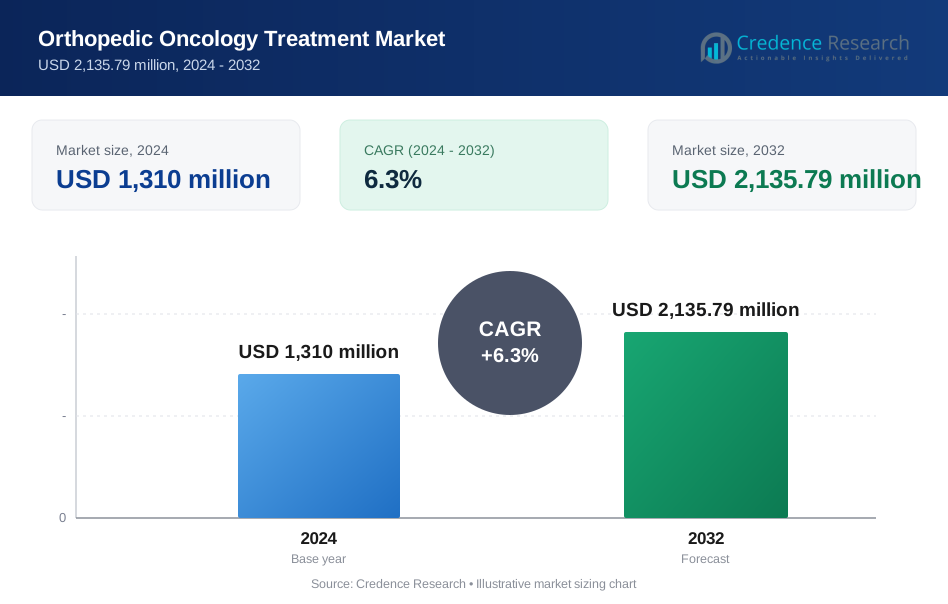
Orthopedic Oncology Treatment Market size was valued USD 1310 million in 2024 and is anticipated to reach USD 2135.79 million by 2032, at a CAGR of 6.3% during the forecast period.
| REPORT ATTRIBUTE | DETAILS |
|---|---|
| Historical Period | 2020-2023 |
| Base Year | 2024 |
| Forecast Period | 2025-2032 |
| Orthopedic Oncology Treatment Market Size 2024 | USD 1310 million |
| Orthopedic Oncology Treatment Market, CAGR | 6.3% |
| Orthopedic Oncology Treatment Market Size 2032 | USD 2135.79 million |
Orthopedic Oncology Treatment Market Insights
- Market growth is primarily driven by increasing adoption of targeted therapies, immunotherapies, and limb-salvage surgical procedures, with targeted and immuno-oncology treatments accounting for an estimated 46% segment share due to improved survival outcomes and reduced recurrence rates.
- Ongoing market trends include integration of advanced imaging, precision diagnostics, and personalized treatment planning, alongside growing use of minimally invasive and robotic-assisted orthopedic oncology surgeries in specialized centers.
- The competitive landscape is shaped by strong oncology pipelines, global clinical trials, and strategic collaborations, while high treatment costs, limited access to specialized care, and complex regulatory pathways act as key market restraints.
- Regionally, North America leads with an exact 42% market share, followed by Europe and Asia-Pacific, with emerging regions showing gradual improvement in access to advanced orthopedic oncology treatments.
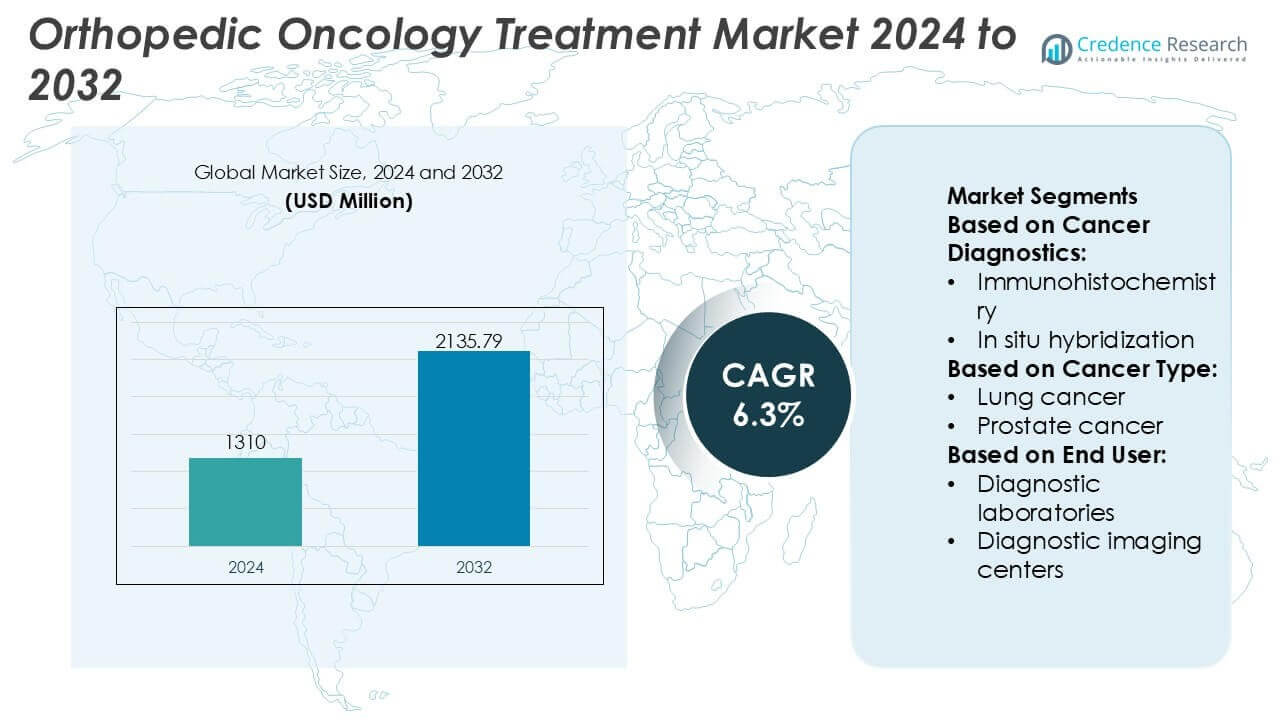
Orthopedic Oncology Treatment Market Segmentation Analysis:
By Cancer Diagnostics
Within the orthopedic oncology treatment market, cancer diagnostics and treatment form a critical segment, with imaging-based diagnostics emerging as the dominant sub-segment, holding an estimated 36% market share. Advanced imaging modalities such as MRI, CT, PET, and bone scintigraphy are essential for detecting bone tumors, assessing tumor margins, and planning surgical or radiotherapy interventions. Imaging dominance is driven by its non-invasive nature, high spatial resolution, and ability to monitor treatment response over time. Complementary diagnostic methods, including biopsy, immunohistochemistry, tumor biomarker testing, and liquid biopsy, support definitive diagnosis and molecular characterization, while chemotherapy and targeted therapies remain central treatment approaches alongside immunotherapy for metastatic or recurrent disease.
- For instance, Merck & Co. has advanced molecular diagnostics and companion diagnostic development aligned with its oncology portfolio, supporting immunohistochemistry assays validated across thousands of tumor samples and clinical programs that have enrolled more than 20,000 patients globally, generating robust datasets that integrate imaging, biomarker profiling, and therapeutic response to optimize precision oncology workflows.
By Cancer Type
By cancer type, breast cancer-associated bone metastases represent the dominant sub-segment in orthopedic oncology, accounting for approximately 28% market share. This dominance is driven by the high prevalence of skeletal metastases in advanced breast cancer and the frequent need for orthopedic interventions to manage pathological fractures, spinal compression, and bone pain. Lung and prostate cancers also contribute significantly due to their strong propensity for bone involvement, necessitating combined oncologic and orthopedic management. Colon, rectal, gastric, esophageal, liver, and other cancers form smaller but clinically relevant segments, supported by rising diagnostic accuracy and improved survival rates that increase the need for long-term skeletal complication management.
- For instance, AstraZeneca has redefined metastatic breast cancer treatment through its industry-leading ADC platform, with the DESTINY-Breast clinical program enrolling thousands of patients globally. Trials such as DESTINY-Breast03 have provided over 3 years of follow-up data, demonstrating that targeted therapies like Enhertu significantly improve progression-free survival compared to previous standards of care, indirectly reducing the risk of systemic complications in advanced disease.
By End User
By end user, hospitals dominate the orthopedic oncology treatment market with an estimated 47% market share, supported by their integrated infrastructure for diagnostics, surgery, systemic cancer therapy, and post-operative rehabilitation. Hospitals serve as primary referral centers for complex bone tumor cases, offering multidisciplinary teams that include orthopedic oncologists, radiologists, pathologists, and medical oncologists. Diagnostic laboratories and imaging centers play a supporting role in early detection and disease monitoring, while specialty clinics focus on follow-up care and minimally invasive interventions. Academic institutions contribute through clinical research and innovation, but hospitals remain the central hub for comprehensive orthopedic oncology care.
Key Growth Drivers
Rising Incidence of Primary and Metastatic Bone Tumors
The increasing global incidence of primary bone cancers and metastatic bone lesions remains a core growth driver for the orthopedic oncology treatment market. Aging populations, longer cancer survival rates, and improved diagnostic capabilities have led to higher detection of skeletal metastases originating from breast, lung, prostate, and renal cancers. As tumor-related skeletal complications increase, demand for limb-salvage surgeries, reconstructive implants, and targeted orthopedic interventions rises. This trend reinforces sustained adoption of specialized surgical procedures, advanced fixation systems, and multimodal treatment approaches across tertiary care hospitals.
- For instance, GE HealthCare Technologies has strengthened skeletal oncology diagnostics through advanced imaging platforms such as PET/CT and MRI systems capable of sub-millimeter spatial resolution and whole-body scan times under 20 minutes, with its oncology imaging solutions deployed in more than 10,000 hospitals worldwide, supporting earlier bone lesion detection and more accurate surgical planning across complex orthopedic oncology cases.
Advancements in Surgical Techniques and Implant Technologies
Continuous advancements in orthopedic surgical techniques and implant technologies strongly support market expansion. Innovations in modular tumor prostheses, patient-specific implants, and advanced biomaterials improve surgical precision, functional outcomes, and long-term durability. Image-guided surgery, 3D-printed implants, and improved fixation designs enable effective limb preservation while minimizing post-operative complications. These technological improvements enhance surgeon confidence and broaden treatment eligibility, increasing procedural volumes and driving demand for specialized orthopedic oncology solutions in both developed and emerging healthcare markets.
- For instance, Gilead Sciences has supported oncology innovation through its cell-therapy and solid-tumor research platforms, with manufacturing capabilities exceeding 300,000 square feet dedicated to advanced therapies and clinical programs that have generated data from more than 12,000 oncology patients, enabling integration of precise surgical interventions with systemic therapies that improve local tumor control and long-term skeletal stability in complex cancer cases.
Integration of Multidisciplinary Cancer Care Models
The growing adoption of multidisciplinary cancer care models significantly accelerates growth in orthopedic oncology treatments. Integrated collaboration among orthopedic surgeons, medical oncologists, radiologists, and radiation specialists enables more comprehensive treatment planning and personalized care pathways. This approach improves patient outcomes by aligning surgical interventions with chemotherapy, radiotherapy, and targeted therapies. As cancer centers increasingly emphasize coordinated care frameworks, the demand for specialized orthopedic oncology services rises, strengthening procedural uptake and expanding the role of orthopedic interventions within holistic cancer management strategies.
Key Trends & Opportunities
Expansion of Limb-Salvage and Function-Preserving Procedures
Limb-salvage procedures are emerging as a dominant trend, replacing traditional amputations in many orthopedic oncology cases. Improved surgical planning, advanced imaging, and durable reconstructive implants allow surgeons to preserve limb function while achieving effective tumor control. This shift creates strong opportunities for manufacturers offering modular prostheses, custom implants, and biologically compatible materials. Increasing patient preference for quality-of-life–focused outcomes further reinforces adoption, positioning limb-salvage solutions as a critical growth avenue within the market.
- For instance, Johnson & Johnson has strengthened limb-salvage capabilities through its DePuy Synthes oncology portfolio, supporting modular limb reconstruction systems available in more than 1,500 component configurations and validated through clinical use in over 250,000 complex orthopedic procedures worldwide, with implant fatigue testing exceeding 10 million load cycles to ensure long-term durability in weight-bearing cancer reconstructions.
Growing Adoption of Personalized and Precision-Based Treatments
Personalized treatment strategies are gaining traction in orthopedic oncology, driven by advances in tumor profiling, imaging analytics, and customized implant design. Precision-based approaches enable tailored surgical margins, optimized implant geometry, and individualized rehabilitation planning. This trend opens opportunities for technology providers offering patient-specific solutions, digital surgical planning tools, and data-driven treatment platforms. As healthcare systems emphasize precision medicine, orthopedic oncology treatments increasingly align with individualized care models, enhancing clinical effectiveness and long-term patient satisfaction.
- For instance, Amgen has advanced precision oncology through large-scale molecular profiling programs, generating genomic datasets from more than 40,000 tumor samples and supporting clinical trials with patient cohorts exceeding 10,000 individuals, enabling biomarker-driven therapy selection that complements personalized surgical decision-making and improves alignment between systemic treatment and orthopedic intervention planning.
Rising Demand in Emerging Healthcare Markets
Emerging economies present significant growth opportunities due to improving healthcare infrastructure, increasing cancer awareness, and expanding access to specialized surgical care. Investments in oncology centers, rising adoption of advanced imaging systems, and growing availability of trained orthopedic oncologists support market penetration. As public and private healthcare spending increases, demand for standardized orthopedic oncology procedures and implants grows, creating opportunities for global and regional players to expand their presence through partnerships, training programs, and localized manufacturing strategies.
Key Challenges
High Cost of Treatment and Limited Reimbursement Coverage
The high cost associated with orthopedic oncology treatments poses a major challenge to market growth. Complex surgical procedures, advanced implants, and prolonged rehabilitation significantly increase overall treatment expenses. In many regions, limited reimbursement coverage and inconsistent insurance policies restrict patient access to specialized care. These financial barriers can delay treatment decisions, reduce procedural volumes, and limit adoption of advanced technologies, particularly in cost-sensitive healthcare systems and low- to middle-income countries.
Shortage of Specialized Expertise and Infrastructure
A limited number of trained orthopedic oncologists and specialized treatment centers constrains market expansion. Orthopedic oncology requires highly specialized surgical skills, multidisciplinary coordination, and advanced infrastructure, which are unevenly distributed across regions. Many hospitals lack dedicated tumor boards, advanced imaging tools, or experienced surgical teams, leading to referral delays and suboptimal care. Addressing this challenge requires long-term investments in training, education, and infrastructure development to ensure broader access to high-quality orthopedic oncology services.
Regional Analysis
North America
North America dominates the orthopedic oncology treatment market with an estimated 42% market share, supported by advanced healthcare infrastructure, high cancer diagnosis rates, and strong adoption of innovative surgical and biologic therapies. The region benefits from widespread availability of specialized oncology centers, high penetration of limb-salvage surgeries, and rapid uptake of targeted therapies and immunotherapies. Favorable reimbursement frameworks and strong R&D investments by leading pharmaceutical and medical device companies further strengthen market growth. In addition, early adoption of advanced imaging, robotic-assisted surgery, and personalized treatment protocols improves clinical outcomes, reinforcing North America’s leadership position.
Europe
Europe accounts for approximately 28% of the orthopedic oncology treatment market, driven by well-established public healthcare systems and rising incidence of bone and soft tissue cancers. Countries such as Germany, France, and the UK lead regional demand due to strong clinical expertise, access to multidisciplinary cancer care, and steady adoption of advanced diagnostics and minimally invasive surgical techniques. Increasing use of targeted therapies, combined with government-backed cancer control programs, supports consistent growth. However, pricing regulations and reimbursement variations across countries moderately limit faster expansion compared to North America.
Asia-Pacific
Asia-Pacific holds around 21% market share and represents the fastest-growing region in the orthopedic oncology treatment market. Growth is fueled by a large patient population, rising cancer awareness, and expanding access to healthcare services in countries such as China, India, and Japan. Rapid improvements in hospital infrastructure, increasing adoption of advanced imaging and surgical techniques, and growing availability of chemotherapy and targeted therapies support market expansion. Additionally, rising healthcare investments and medical tourism in select countries enhance treatment accessibility, positioning Asia-Pacific as a key growth engine.
Latin America
Latin America contributes nearly 6% of the global orthopedic oncology treatment market, with growth driven by gradual improvements in healthcare infrastructure and increasing cancer diagnosis rates. Brazil and Mexico dominate regional demand due to higher healthcare spending, expanding oncology services, and growing adoption of limb-salvage procedures. Public–private partnerships and international collaborations improve access to advanced diagnostics and treatment options. However, limited reimbursement coverage, uneven access to specialized oncology centers, and economic constraints continue to restrict broader market penetration across several countries.
Middle East & Africa
The Middle East & Africa region accounts for about 3% market share, reflecting early-stage but steadily developing market dynamics. Growth is supported by rising cancer awareness, improving diagnostic capabilities, and increasing investments in tertiary care hospitals, particularly in the Gulf Cooperation Council countries. Adoption of advanced surgical techniques and targeted therapies is gradually increasing in urban centers. However, limited access to specialized oncology care, shortage of trained professionals, and disparities in healthcare infrastructure across Africa restrain faster market growth, keeping the region comparatively smaller.
Orthopedic Oncology Treatment Market Segmentations:
By Cancer Diagnostics:
- Immunohistochemistry
- In situ hybridization
By Cancer Type:
- Lung cancer
- Prostate cancer
By End User:
- Diagnostic laboratories
- Diagnostic imaging centers
By Geography
- North America
- U.S.
- Canada
- Mexico
- Europe
- Germany
- France
- U.K.
- Italy
- Spain
- Rest of Europe
- Asia Pacific
- China
- Japan
- India
- South Korea
- South-east Asia
- Rest of Asia Pacific
- Latin America
- Brazil
- Argentina
- Rest of Latin America
- Middle East & Africa
- GCC Countries
- South Africa
- Rest of the Middle East and Africa
Competitive Landscape
The orthopedic oncology treatment market players such as Merck & Co; AstraZeneca; GE HealthCare Technologies; Gilead Sciences; Johnson & Johnson; Amgen; GlaxoSmithKline; Eli Lilly and Company; Bristol-Myers Squibb Company; AbbVie. The orthopedic oncology treatment market is characterized by a competitive landscape driven by continuous innovation, expanding therapeutic pipelines, and increasing integration of diagnostics with treatment planning. Market participants compete primarily on clinical efficacy, breadth of oncology portfolios, and the ability to deliver comprehensive solutions spanning diagnosis, surgery, and systemic therapies. Strong emphasis is placed on targeted therapies, immuno-oncology approaches, and combination regimens to improve survival outcomes and reduce recurrence rates. In parallel, advancements in imaging, precision diagnostics, and minimally invasive surgical techniques enhance treatment accuracy and support personalized care models. Strategic collaborations, licensing agreements, and global clinical trial programs remain central to strengthening market positioning and accelerating product development. Companies also focus on expanding geographic reach, particularly in emerging markets, while navigating regulatory complexity and reimbursement pressures. Overall, sustained R&D investment and technology-driven differentiation continue to intensify competition and shape long-term market evolution.
Key Player Analysis
- Merck & Co
- AstraZeneca
- GE HealthCare Technologies
- Gilead Sciences
- Johnson & Johnson
- Amgen
- GlaxoSmithKline
- Eli Lilly and Company
- Bristol-Myers Squibb Company
- AbbVie
Recent Developments
- In May 2025, 'Kang Bang Cancer Right-Alert Week' campaign was declared last week by the Korean Society of Oncology and the Korean Society of Urology at Samsung Medical Center's Seminar Room 1 on the 23rd of May.
- In May 2025, Metropolis Healthcare Limited, led by Ameera Shah, which is India's second-largest and most respected diagnostic laboratory chain, to deal with the rising cancer threat has launched a comprehensive screening panel named as TruHealth Cancer Screen 360, with a goal to transform preventive oncology in India.
- In May 2025, Imaging Core Lab Services was launched by Bayer under the brand name Centafore. Furthermore, the Centafore, technology, and services of Bayer will be presented in Annual Meeting of the American Society of Clinical Oncology in Chicago.
- In May 2024, Palatin Technologies announced the FDA cleared their Investigational New Drug (IND) application for a Phase 2 study combining bremelanotide (an MC4R agonist) with tirzepatide (a GLP-1/GIP drug) for obesity, with enrollment starting mid-2024 and data anticipated by year-end, showing this combo enhances weight loss beyond tirzepatide alone and helps prevent weight regain.
Report Coverage
The research report offers an in-depth analysis based on Cancer Diagnostics, Cancer Type, End-User and Geography. It details leading market players, providing an overview of their business, product offerings, investments, revenue streams, and key applications. Additionally, the report includes insights into the competitive environment, SWOT analysis, current market trends, as well as the primary drivers and constraints. Furthermore, it discusses various factors that have driven market expansion in recent years. The report also explores market dynamics, regulatory scenarios, and technological advancements that are shaping the industry. It assesses the impact of external factors and global economic changes on market growth. Lastly, it provides strategic recommendations for new entrants and established companies to navigate the complexities of the market.
Future Outlook
- Adoption of targeted therapies and immunotherapies will continue to expand across bone and soft-tissue cancer indications.
- Integration of advanced imaging and molecular diagnostics will improve early detection and precise treatment planning.
- Limb-salvage procedures will increasingly replace amputations due to improvements in surgical techniques and implants.
- Personalized treatment protocols based on tumor genetics will gain wider clinical acceptance.
- Multidisciplinary care models will strengthen coordination between oncology, orthopedics, radiology, and pathology teams.
- Use of minimally invasive and robotic-assisted surgeries will increase to reduce recovery time and complications.
- Clinical trial activity will intensify to evaluate combination therapies and novel biologics.
- Expansion of specialized oncology centers in emerging regions will improve patient access to advanced care.
- Digital health tools will support treatment monitoring, follow-up, and outcome tracking.
- Regulatory focus on rare cancers will encourage faster approvals and innovation in orthopedic oncology treatments.
Request a Free Sample
Fill in your details and we'll send you a free sample report.
- Sample data tables & charts
- Research methodology
Need a Custom Version of This Report?
Tailor the scope, geography, or segments to your exact requirements.
- Custom geography or segment scope
- Direct access to our analyst team
Frequently Asked Questions
What is the current market size for Orthopedic Oncology Treatment Market, and what is its projected size in 2032?
At what Compound Annual Growth Rate is the Orthopedic Oncology Treatment Market projected to grow between 2024 and 2032?
Which Orthopedic Oncology Treatment Market segment held the largest share in 2024?
What are the primary factors fueling the growth of the Orthopedic Oncology Treatment Market?
Who are the leading companies in the Orthopedic Oncology Treatment Market?
Which region commanded the largest share of the Orthopedic Oncology Treatment Market in 2024?
Table of Content
Chapter 1. Report Introduction
- 1.1 Report Description & Purpose
- 1.1.1 Report Title & Market Definition
- 1.1.2 Unique Selling Propositions (USP) & Key Differentiators
- 1.1.3 Value Proposition for Stakeholders
- 1.2 Research Objectives
- 1.2.1 Market Sizing Objectives (Volume & Revenue)
- 1.2.2 Segmentation Objectives
- 1.2.3 Competitive Intelligence Objectives
- 1.2.4 Forecast & Scenario Objectives
- 1.3 Report Scope
- 1.3.1 Orthopedic Oncology Treatment Scope – Types & Subtypes Covered
- 1.3.2 Geographic Scope – Regions & Countries Covered
- 1.3.3 Historical Period, Base Year & Forecast Period (2024; forecast to 2032)
- 1.3.4 Inclusions & Exclusions
- 1.4 HS Code & Classification Framework
- 1.5 Currency, Units & Pricing Basis
- 1.6 Target Stakeholders
- 1.7 Limitations & Assumptions
Chapter 2. Executive Summary
- 2.1 Global Orthopedic Oncology Treatment Market Snapshot
- 2.1.1 Market Size – Historical (2024) & Forecast (2024-2032) (2024: USD 1,310 million → 2032: USD 2,135.79 million)
- 2.1.2 Volume & Revenue – Global Totals
- 2.1.3 Key Market Highlights – Top Five Facts
- 2.2 Orthopedic Oncology Treatment Market Segmentation Snapshot
- 2.2.1 Market Split by Region – 2024 vs. 2032
- 2.3 Competitive Snapshot
- 2.3.1 Top 10 Players by Revenue Share – 2024
- 2.3.2 Top 10 Players by Volume Share – 2024
- 2.3.3 Recent Strategic Developments (18-Month Summary)
- 2.4 Key Investment Highlights & Strategic Conclusions
Chapter 3. Orthopedic Oncology Treatment Market Dynamics & Industry Analysis
- 3.1 Market Overview & Context
- 3.1.1 Orthopedic Oncology Treatment Market Position in the Broader Automotive Value Chain
- 3.1.2 OEM vs. Replacement Market Dynamics
- 3.1.3 Market Maturity & Development Stage by Region
- 3.2 Orthopedic Oncology Treatment Market Drivers
- 3.3 Orthopedic Oncology Treatment Market Restraints & Challenges
- 3.4 Orthopedic Oncology Treatment Market Opportunities
- 3.5 Porter's Five Forces Analysis
- 3.5.1 Threat of New Entrants
- 3.5.2 Bargaining Power of Suppliers
- 3.5.3 Bargaining Power of Buyers
- 3.5.4 Threat of Substitutes
- 3.5.5 Competitive Rivalry – Intensity Assessment
- 3.6 Orthopedic Oncology Treatment Value Chain Analysis
- 3.6.1 Upstream – Raw Material/Input Suppliers
- 3.6.1.1 Raw Material/Input 1
- 3.6.1.2 Raw Material/Input 2
- 3.6.1.3 Raw Material/Input 3
- 3.6.2 Midstream – Production/Manufacturing/Service Delivery
- 3.6.2.1 Production/Process Overview
- 3.6.2.2 Key Facility Locations & Capacity by Manufacturer
- 3.6.3 Downstream – Distribution & End Consumer
- 3.6.3.1 Primary Channel – B2B/OEM
- 3.6.3.2 Secondary Channels – Dealer, Retail, Online, Direct
- 3.6.4 Value Chain Profitability Analysis
- 3.6.1 Upstream – Raw Material/Input Suppliers
- 3.7 PESTEL Analysis
- 3.7.1 Political Factors
- 3.7.2 Economic Factors
- 3.7.3 Social Factors
- 3.7.4 Technological Factors
- 3.7.5 Environmental Factors
- 3.7.6 Legal Factors
- 3.8 Orthopedic Oncology Treatment Supply Chain Analysis
- 3.8.1 Raw Material/Input Supply Risk Assessment
- 3.8.2 Manufacturing Concentration Risk (Geographic Exposure)
- 3.8.3 Trade Disruption Impact Analysis
- 3.9 Regulatory & Policy Landscape
Note: The regulatory and policy landscape section covers regulations based on their applicability to the market, Orthopedic Oncology Treatment category, geography, and scope of the study. Only regulatory frameworks with a material impact on operations, compliance, trade, sustainability, or market access are analyzed in detail.
Chapter 4. Key Investment Pockets & Opportunity Analysis
- 4.1 Orthopedic Oncology Treatment Market Attractiveness Analysis
- 4.1.1 By Region – Investment Attractiveness Matrix (Volume × CAGR)
- 4.2 Absolute Revenue Growth Opportunity
- 4.2.1 By Region – Absolute USD Growth Through 2032
- 4.3 Incremental Volume Opportunity
- 4.3.1 By Region – Incremental Volume Through 2032
- 4.3.2 Segment – Incremental Volume
- 4.4 Emerging Submarket Opportunity Deep Dive (Subject to Applicability)
- 4.5 Emerging Market Opportunity Scorecards
- 4.5.1 United States
- 4.5.2 Europe
- 4.5.3 Asia
- 4.5.4 Middle East & Africa
Note: Emerging Market Opportunity Scorecards will be included based on relevance and strategic importance. Regions listed are indicative and may vary depending on data availability and market dynamics.
Chapter 5. Orthopedic Oncology Treatment Import-Export Analysis & Trade Flows
- 5.1 Global Trade Overview
- 5.1.1 Global Export Value by Country (2024)
- 5.1.2 Global Export Volume by Country (2024)
- 5.1.3 Global Import Value by Country (2024)
- 5.1.4 Global Import Volume by Country (2024)
- 5.1.5 Net Trade Balance by Country (2024)
- 5.2 Export Analysis – Segment
- 5.2.1 Type 1 (HS Code)
- 5.2.2 Type 2 (HS Code)
- 5.2.3 Type 3 (HS Code)
- 5.2.4 Type 4 (HS Code)
- 5.2.5 Type 5 (HS Code)
- 5.3 Import Analysis – Segment
- 5.3.1 Type 1 (HS Code)
- 5.3.2 Type 2 (HS Code)
- 5.3.3 Type 3 (HS Code)
- 5.3.4 Type 4 (HS Code)
- 5.3.5 Type 5 (HS Code)
- 5.4 Average Unit Trade Prices
- 5.4.1 Average Export Price – Segment & Country
- 5.4.2 Average Import Price – Segment & Source Country
- 5.4.3 Price Trends (2024)
- 5.5 Key Trade Route Analysis
- 5.5.1 Trade Route 1
- 5.5.2 Trade Route 2
- 5.5.3 Trade Route 3
- 5.5.4 Trade Route 4
- 5.5.5 Trade Route 5
- 5.6 Trade Policy Impact Assessment
- 5.6.1 US Anti-Dumping & Section 301 Tariffs
- 5.6.2 EU Customs Union Impact
- 5.6.3 Major Free Trade Agreements
- 5.6.4 USMCA Rules of Origin
Note: Trade policy analysis will be included only where relevant to the Orthopedic Oncology Treatment market.
Chapter 6. Competitive Landscape & Company Benchmarking
- 6.1 Orthopedic Oncology Treatment Market Concentration & Structure
- 6.1.1 Herfindahl-Hirschman Index (HHI) – vs. 2024
- 6.1.2 Tier 1, Tier 2 & Tier 3 Market Structure
- 6.1.3 Global, Regional & Local Player Dynamics
- 6.2 Orthopedic Oncology Treatment Market Share Analysis – 2024
- 6.2.1 Global Revenue Share by Company
- 6.2.2 Global Volume Share by Company
- 6.2.3 Regional Revenue Share
- 6.2.4 Market Share Evolution ( vs. 2024)
- 6.2.5 OEM Segment Share by Company
- 6.2.6 Replacement Segment Share by Company
- 6.3 Production/Delivery Capacity & Facility Analysis
- 6.3.1 Global Installed Capacity
- 6.3.2 Capacity Utilization Rates
- 6.3.3 Production/Output Volume
- 6.3.4 Facility Locations & Capacity Map
- 6.3.5 Planned Capacity Additions
- 6.4 Orthopedic Oncology Treatment Competitive Benchmarking Matrix
- 6.4.1 Revenue, Volume, CAGR & Profitability Comparison
- 6.4.2 Channel Revenue Mix
- 6.4.3 Geographic Revenue Exposure
- 6.4.4 R&D Intensity
- 6.4.5 Sustainability Maturity
- 6.5 Strategic Developments in Orthopedic Oncology Treatment (Last 24 Months)
- 6.5.1 Mergers, Acquisitions & Divestments
- 6.5.2 New Orthopedic Oncology Treatment Launches
- 6.5.3 Facility Expansions
- 6.5.4 Strategic Alliances, Joint Ventures & Partnerships
- 6.5.5 Distribution Expansion & Market Entry
- 6.5.6 Sustainability & ESG Initiatives
- 6.6 Competitive Strategy Mapping
- 6.6.1 Leader, Challenger, Follower & Niche Classification
- 6.6.2 Pricing Strategy Comparison
- 6.6.3 Channel Strategy Matrix
Note: Strategic developments are included based on their materiality and the availability of reliable information.
Chapter 7. Global Orthopedic Oncology Treatment Market – By Distribution Channel
- 7.1 Segment Overview
- 7.1.1 Volume & Revenue Split by Channel (2024 & 2032)
- 7.1.2 Channel Mix Evolution (2024-2032)
Chapter 8. Regional Market Analysis – Global Overview
- 8.1 Global Regional Overview
- 8.1.1 Regional Volume Share
- 8.1.2 Regional Revenue Share
- 8.1.3 Regional Volume by Region
- 8.1.4 Regional Revenue by Region
- 8.1.5 Regional Forecast Through 2032
- 8.2 Cross-Regional Segment Analysis
- 8.2.1 By Distribution Channel
- 8.2.2 By Brand/Price Tier
Chapter 9. North America Orthopedic Oncology Treatment Market
- 9.1 United States
- 9.2 Canada
- 9.3 Mexico
Chapter 10. Europe Orthopedic Oncology Treatment Market
- 10.1 Germany
- 10.2 France
- 10.3 Italy
- 10.4 United Kingdom
- 10.5 Spain
- 10.6 Poland
- 10.7 Russia
- 10.8 Netherlands
- 10.9 Belgium
- 10.10 Sweden
- 10.11 Denmark
- 10.12 Norway
- 10.13 Rest of Europe
Chapter 11. Asia Pacific Orthopedic Oncology Treatment Market
- 11.1 China
- 11.2 India
- 11.3 Japan
- 11.4 South Korea
- 11.5 Thailand
- 11.6 Indonesia
- 11.7 Vietnam
- 11.8 Malaysia
- 11.9 Australia
- 11.10 Rest of Asia Pacific
Chapter 12. Latin America Orthopedic Oncology Treatment Market
- 12.1 Brazil
- 12.2 Argentina
- 12.3 Colombia
- 12.4 Chile
- 12.5 Rest of Latin America
Chapter 13. Middle East Orthopedic Oncology Treatment Market
- 13.1 Saudi Arabia
- 13.2 United Arab Emirates
- 13.3 Turkey
- 13.4 Israel
- 13.5 Iran
- 13.6 Rest of the Middle East
Chapter 14. Africa Orthopedic Oncology Treatment Market
- 14.1 South Africa
- 14.2 Egypt
- 14.3 Nigeria
- 14.4 Morocco
- 14.5 Rest of Africa
Chapter 15. Orthopedic Oncology Treatment Company Profiles
- 15.1 [Company 01]
- 15.1.1 Company Overview
- 15.1.2 Key Management Personnel
- 15.1.3 Products & Services Portfolio
- 15.1.4 Financial Performance
- 15.1.5 Key Market Focus & Geographic Presence
- 15.1.6 Recent Developments & Strategic Initiatives
Note: The company profile list is preliminary and may change based on research findings, market developments, data availability, and client requirements.
Chapter 16. Appendices
- Appendix A – List of Abbreviations & Acronyms
- Appendix B – Industry Classification Code Reference – Full Series
- Appendix C – Production & Capacity Data Tables
- Appendix D – End-Use & Demand Base Tables
- Appendix E – Consumption & Replacement Rate Assumptions
- Appendix F – ASP Reference Tables
- Appendix G – Manufacturing & Facility Database
- Appendix H – Import-Export Data Tables
- Appendix I – Regulatory Summary Tables
- Appendix J – Primary Research Participant List (Anonymized)
- Appendix K – Primary Research Questionnaire Framework
- Appendix L – Data Sources & Bibliography
- Appendix M – Market Size Divergence & Source Comparison
Chapter 17. Research Methodology
- 17.1 Research Framework & Philosophy
- 17.2 Secondary Research – Sources, Hierarchy & Data Extraction
- 17.3 Data Modeling – Bottom-Up & Top-Down Market Sizing
- 17.4 Primary Research – Stakeholder Framework, LOI & Sample Sizes
- 17.5 Forecast Methodology – Regression, Scenario & Sensitivity Analysis
- 17.6 Quality Control – Four-Layer Validation Framework
- 17.7 Limitations & Standard Assumptions
- 17.8 Disclaimer
