
| REPORT ATTRIBUTE | DETAILS |
|---|---|
| Historical Period | 2019-2022 |
| Base Year | 2023 |
| Forecast Period | 2024-2032 |
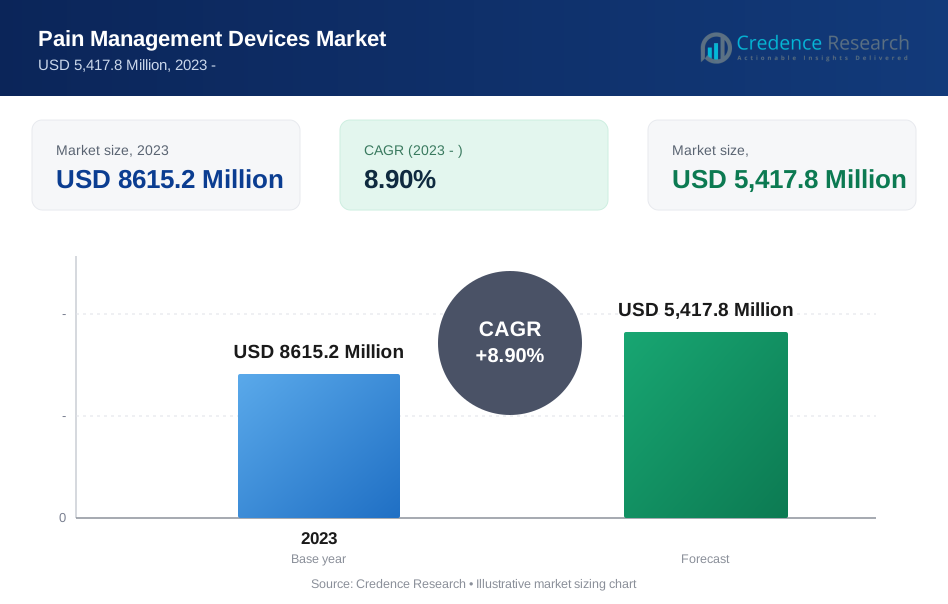
| Pain Management Devices Market Size 2023 | USD 8615.2 Million |
| Pain Management Devices Market, CAGR | 8.90% |
| Pain Management Devices Market Size 2032 | USD 5417.8 Million |
Market Insights
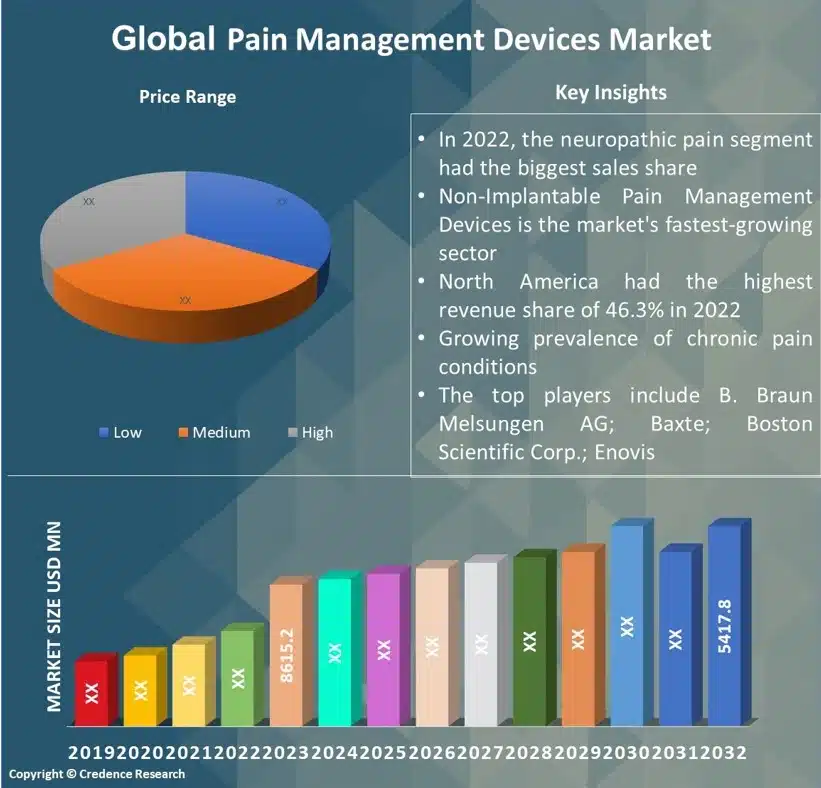
- The global demand for Pain Management Devices was valued at USD 8615.2 Million in 2023 and is expected to reach USD 5417.8 Million in 2032, growing at a CAGR of 8.90% between 2024 and 2032.
- In 2022, neurostimulation devices accounted for the largest revenue proportion of 57.7%, with Radiofrequency Ablation (RFA) predicted to have the greatest CAGR.
- In 2022, the neuropathic pain sector had the largest revenue share, accounting for around 31.9%, while the cancer segment is predicted to grow at the fastest CAGR.
- Over the projection period, hospitals are expected to lead the market, followed by clinics.
- Non-Implantable Pain Management Devices is the market's fastest growing segment.
- The Pain Management Devices Market is dominated by Over-the-Counter (OTC) Pain Management Devices, with Prescription-Based Pain Management Devices also being a significant market.
- Wearable Pain Management Devices are the most prominent market segment, while Smart Pain Management Devices are also in high demand.
- Pediatric Pain Management Devices is the market's most rapidly growing sector.
- Nociceptive Pain is the market's most dominant sector.
- North America had the biggest revenue share of 46.3% in 2022, while Asia Pacific is expected to grow at a CAGR of approximately 11.1% through 2030.
- Increasing the number of surgical procedures performed propels market expansion.
- Adverse effects of devices to limit market growth.
Executive Summary
Market Definition
The Pain Management Devices Market is the market for medical devices that help to manage and alleviate pain. These devices are intended to relieve acute or chronic pain by a variety of processes, including electrical stimulation, medication administration, and thermal therapy. They can be used to treat arthritis, back pain, migraines, and postoperative pain. The market for pain management devices is being pushed by the rising prevalence of pain-related diseases, as well as the growing need for non-invasive, drug-free pain treatment solutions.
Market Overview
The global Pain Management Devices Market has witnessed steady growth in recent years and is expected to grow at a CAGR of 8.90% between 2024 and 2032. The market was valued at USD 8615.2 million in 2023 and is expected to reach USD 5417.8 million in 2032.
The Pain Management Devices Market is a fast-growing sector that provides revolutionary pain management and treatment solutions. The market is expanding rapidly as chronic pain disorders become more common and non-pharmacological pain management methods become more popular. The market has a diverse spectrum of equipment, including transcutaneous electrical nerve stimulation (TENS) devices, spinal cord stimulators, neurostimulators, and drug delivery systems. These gadgets attempt to provide patients with excellent pain treatment while also improving their quality of life. The industry is being driven by technology breakthroughs, rising healthcare costs, and an aging population.
Segmentation by Device Type
- Neurostimulation devices accounted for the biggest revenue proportion of 57.7% in 2022. The dominance can be related to an increase in incidence of neurological disorders. These neurostimulators are important in treating Parkinson's, epilepsy, chronic pain, movement disorders, and depression.
- Radiofrequency Ablation (RFA) is expected to have the highest CAGR of 9.7% over the projected period because to its widespread use in pain management, gynecology, surgical cancer, cosmetology, cardiology, and cardiac rhythm management.
Segmentation by Application
- In 2022, the neuropathic pain segment had the biggest sales share, accounting for around 31.9%. The dominance can be linked to the increased endeavours of industry participants and the increasing predominance of the target individuals.
- The cancer segment is expected to expand at the quickest CAGR of 10.0% throughout the projection period.
Segmentation by End-User
- The hospital category is likely to lead the market over the forecast period, as medical facilities use more technology to monitor and treat pain.
- Another major category is clinics in the market
Segmentation by Technology
- Non-Implantable Pain Management Devices is the market's fastest-growing sector. Non-implantable technologies include transcutaneous electrical nerve stimulation (TENS) units, wearable pain management patches, and portable pain relief units. These devices are becoming increasingly popular among people looking for non-invasive pain treatment solutions since they are convenient, easy to use, and portable.
Segmentation by Mode of Purchase
- The Over-the-Counter (OTC) Pain Management Devices segment dominates the Pain Management Devices Market. Heating pads, cold packs, topical analgesics, and TENS devices are examples of over-the-counter pain management devices that do not require a prescription.
- Another key market area is Prescription-Based Pain Management Devices.
Segmentation by Product Innovation and Features
- The most prominent market sector is Wearable Pain Management Devices. These devices are intended to be worn on the body, delivering focused pain treatment and management. They are frequently small, lightweight, and unobtrusive, allowing people to go about their regular lives while getting pain treatment.
- Another high-demand area of the pain management device market is Smart Pain Management Devices.
Segmentation by Patient Age Group
- Pediatric Pain Management Devices is the market's fastest growing segment. This area focuses on devices and technology that are specifically developed to give pain treatment and management to children and infants. As the necessity of efficient pain management in juvenile patients becomes more widely recognized, there is a growing demand for specialized devices that address their specific needs.
Segmentation by Pain Source
- The most prominent sector in the market is Nociceptive Pain. Nociceptive pain is induced by the stimulation of particular nerve endings known as nociceptors, which respond to potentially damaging stimuli. This sort of pain is usually caused by tissue damage or inflammation and is described as acute, throbbing, or aching.
Segmentation by Region
- North America had the highest revenue share of 46.3% in 2022
- Asia Pacific is projected to increase at a CAGR of around 11.1% through 2030.
- The rest of the world, including Latin America, the Middle East, and Africa, supplies the remaining demand for Pain Management Devices.
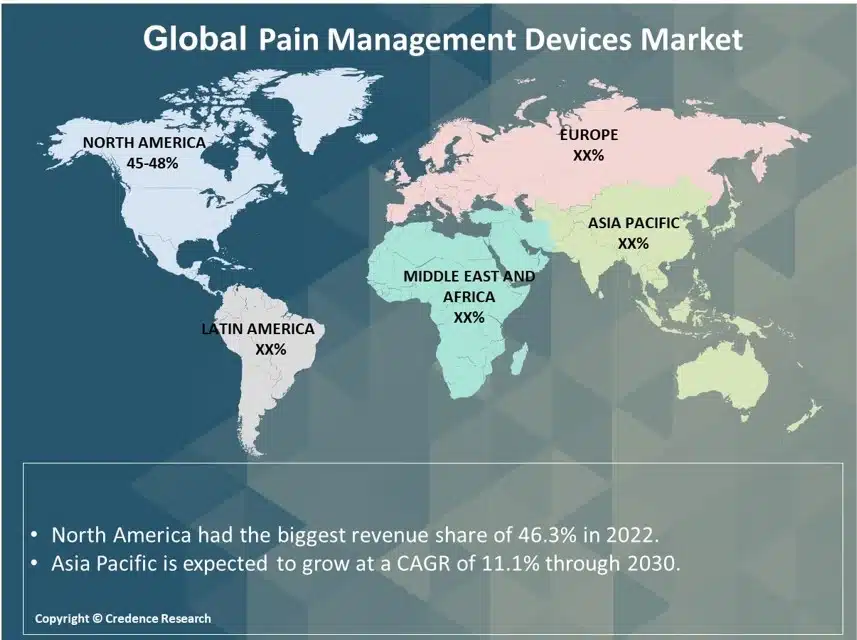
North America had the highest revenue share in 2022, because to strong healthcare infrastructure that allows easy access to cutting-edge pain treatment equipment. Furthermore, expanding government programs and schemes, such as the Precision Medicine and Affordable Care Act, together with a well-planned reimbursement scheme in this field, are driving market demand. Factors driving the regional market include the presence of established healthcare facilities, an increasing senior population, and a high incidence of stroke and hypertension. As the population of older persons grows, the market is predicted to increase faster because this group is more prone to chronic illnesses.
According to the Australian Institute of Health and Welfare, chronic musculoskeletal illnesses affect approximately 30% of the Australian population.Furthermore, the existence of major firms in the region, such as Boston Scientific Corp., Medtronic, Baxter International Inc., Abbott, and Stryker Corp., promotes market expansion. These companies launch a variety of strategic activities in order to increase their market share. The Asia Pacific area is predicted to grow at an attractive CAGR of 11.1% during the forecast period, owing to R&D investments in technologically advanced healthcare treatment alternatives.
Key Highlights of the Report
The global Pain Management Devices Market is segmented by Device Type, Application, End-Users, Technology, Mode of Purchase, Product Innovation and Features, Patient Age Group, Pain Source and region. In 2022, the neuropathic pain segment had the largest revenue share, with Non-Implantable Pain Management Devices being the fastest-growing sector. Furthermore, the most prominent market sector is Wearable Pain Management Devices, with Radiofrequency Ablation (RFA) projected to have the greatest CAGR. Smart Pain Management Devices are also a popular segment of the pain management device industry, with North America leading the market growth.
The market's key drivers include the growing prevalence of chronic pain illnesses, increased demand for non-pharmacological pain treatment solutions, and technical advancements in pain management devices. Furthermore, the key limitations of the market include the high cost of pain management devices, strict regulatory requirements for device approval, and limited reimbursement coverage for these devices.
Nonetheless, North America had the biggest revenue share in 2022, owing to its excellent healthcare infrastructure, which provides easy access to cutting-edge pain treatment equipment. Furthermore, the Asia Pacific region is expected to develop at an appealing CAGR of 11.1% during the forecast period, owing to R&D investments in technologically enhanced healthcare treatment choices.
What Are The Main Drivers Of The Global Pain Management Devices Market?
Several reasons drive the pain management devices market. Chronic pain problems such as arthritis and back pain are becoming more common, resulting in a greater demand for effective pain management treatments. There is also an increase in demand for non-pharmacological pain management methods as more people seek alternatives to medicine.
What Are The Major Challenges Faced By The Global Pain Management Devices Market?
While the Pain Management Devices Market has significant potential, there are some limitations that must be considered. One key limitation is the high cost of pain control devices. These gadgets frequently require advanced technology and manufacturing methods, making them costly for both healthcare professionals and patients. Furthermore, severe regulatory criteria for device certification can cause delays in product introductions.
What Are The Growth Opportunities In The Global Pain Management Devices Market?
The Pain Management Devices Market offers numerous potential for growth and development. Untapped markets, particularly those in emerging economies, represent a substantial opportunity. As healthcare infrastructure improves and disposable incomes rise, these regions may see an increase in the usage of pain management devices. Another potential arises from the integration of digital health technologies with pain management equipment. The utilization of internet, mobile apps, and data analytics can improve the efficiency and convenience of these devices.
Market Drivers
The global Pain Management Devices Market is driven by several factors. The following are the key drivers of the global Pain Management Devices Market:
Increasing The Amount Of Surgical Procedures Performed
The rising number of surgical procedures performed worldwide is a primary driver of the pain management device industry. The rising prevalence of chronic diseases, such as cancer and neurological illnesses, has raised demand for surgical procedures, which has fueled demand for pain management devices. Additionally, technical developments and the introduction of minimally invasive procedures have fueled demand for pain management equipment. Furthermore, the market is expected to develop due to an increased focus on early disease detection and treatment, increased knowledge of healthcare, increased availability of healthcare services, and increased government initiatives to promote healthcare.
Market Restraints
The global Pain Management Devices Market faces some challenges that may hinder its growth. These include the following:
High Growth In Emerging Markets
The pain management devices market is predicted to increase at an exponential rate in emerging markets as people become more aware of the benefits of pain management devices and have more disposable cash. As the need for pain management products grows, manufacturers are delivering improved products and services at competitive rates, which is projected to drive additional expansion in the worldwide pain management device market. Furthermore, government attempts to improve healthcare access and cost, such as the Affordable Care Act (ACA) in the United States, are expected to drive up demand for pain management devices in the region. In addition, technical improvements, such as the development of smart pain management devices, are projected to open up new market potential.
Opportunities
The global Pain Management Devices Market offers significant growth opportunities. These include the following:
Adverse Effects Of Devices
The potential harmful effects of pain management technologies could be a significant market barrier in the coming years. Some patients report painful prickling, buzzing, or tingling sensations induced by the TENS unit's electric impulses. Certain patients have allergies as a result of the sticky pads on their devices, including skin rashes, redness, and irritation.
When electrodes are placed on the front of the eyes or the neck, a variety of side effects have been recorded. For instance, electrodes put on the neck might trigger spasms by reducing blood pressure. Electrodes placed on the eyes can cause harm due to elevated intraocular pressure. These factors are expected to limit the market throughout the forecast period.
Competitive Landscape
Key Players
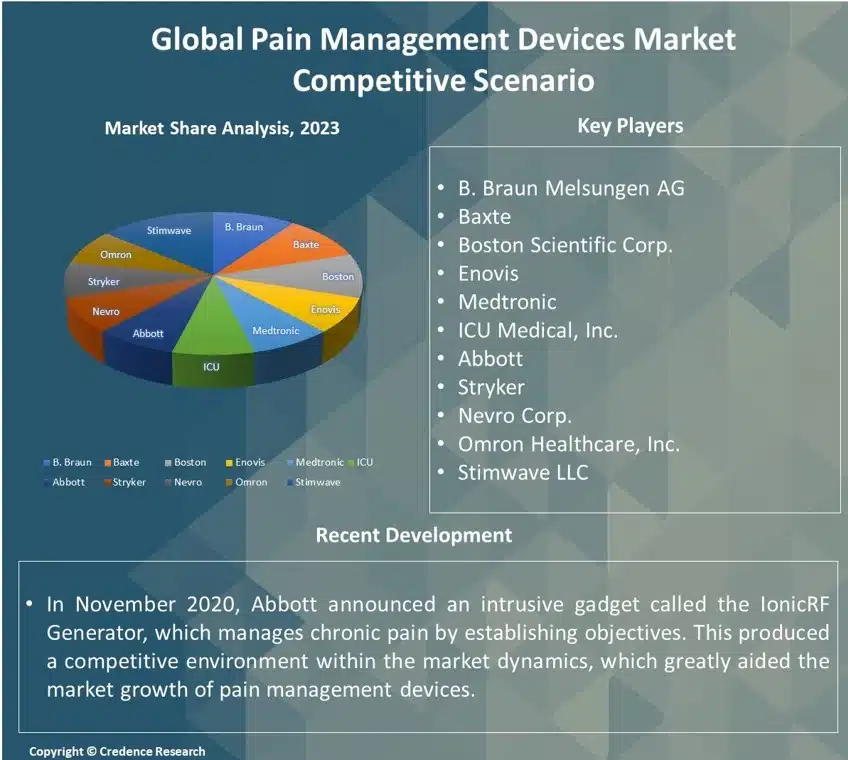
The global Pain Management Devices Market is highly competitive, with several key players. Some of the major players in the market and their market share are as follows:
- B. Braun Melsungen AG
- Baxte
- Boston Scientific Corp.
- Enovis
- Medtronic
- ICU Medical, Inc.
- Abbott
- Stryker
- Nevro Corp.
- Omron Healthcare, Inc.
- Stimwave LLC
These organizations prioritize product innovation, Pain Management Devices Centers expansion, and mergers and acquisitions to stay competitive.
The global Pain Management Devices Market's key players continually seek to stay ahead by offering new products and developments.
In January 2020, Medtronic released Efficio, a cloud-based data management software, which was used in the intrathecal drug delivery system.
In March 2022, BioElectronics Corporation stated that its distribution partner in Mexico has gained license from the Mexican FDA (Cofepris) to import the RecoveryRx device into Mexico. Novro Med S.A. de C.V. has secured exclusive distribution rights for RecoveryRx in Mexico.
In December 2022, Abbott stated that the U.S. Food and Drug Administration (FDA) has approved the company's Eterna spinal cord stimulation (SCS) device, the smallest implantable, rechargeable spinal cord stimulator currently available for the treatment of chronic pain. Eterna SCS uses Abbott's unique low-dose BurstDR stimulation, the only SCS waveform technology with the highest level of clinical proof (1A evidence), which has been shown to relieve pain by 23% more than typical waveform technology techniques.
Summary of Key Findings
- High growth in emerging markets reduces market growth.
- Market segmented by Device Type, Application, End-Users, Technology, Mode of Purchase, Product Innovation and Features, Patient Age Group, Pain Source and region.
- In 2022, the neuropathic pain sector had the highest sales share, accounting for around 31.9%
- The hospital category is projected to lead the market over the projection period.
- North America is leading market growth; the market is highly competitive with key players including B. Braun Melsungen AG; Baxte; Boston Scientific Corp.; Enovis; Medtronic; ICU Medical, Inc.; Abbott; Stryker; Nevro Corp.; Omron Healthcare, Inc.; Stimwave LLC and Others.
Future Outlook
- Continued technological advancements
- Increasing demand for non-invasive pain management options
- Growing prevalence of chronic pain conditions
- Rising healthcare expenditure
- Expansion of aging population
- Increasing awareness about pain management devices
- Emerging markets offering growth opportunities
- Focus on personalized and targeted pain management solutions
How CXOs Can Benefit from the Credence Research Pain Management Devices Market Report
The Credence Research Pain Management Devices Market Report provides CXOs with a comprehensive overview of the market, including:
- Market size and growth forecast: The report provides detailed estimates of the global Pain Management Devices Market size, segmented by Device Type, Application, End-Users, Technology, Mode of Purchase, Product Innovation and Features, Patient Age Group, Pain Source and region. It also includes forecasts for the market through 2032, based on key trends and drivers.
- Market segmentation: The report segments the Pain Management Devices Market by Device Type, Application, End-Users, Technology, Mode of Purchase, Product Innovation and Features, Patient Age Group, Pain Source and region. This segmentation provides CXOs with a granular understanding of the market and the opportunities in each segment.
- Competitive landscape: The report profiles the key players in the Pain Management Devices Market and provides insights into their strategies, product offerings, and financial performance. This information can help CXOs to identify and assess their competition.
- Key trends and drivers: The report identifies and analyzes the key trends and drivers that are shaping the Pain Management Devices Market. This information can help CXOs to make informed decisions about their investments and strategies.
CXOs can use the insights from the Credence Research Pain Management Devices Market Report to:
- Identify growth opportunities: The report can help CXOs to identify new growth opportunities in the Pain Management Devices Market. For example, it can provide insights on emerging technologies, market trends, and competitive landscape, enabling CXOs to make informed investment decisions and develop competitive strategies for their businesses.
- Make informed investment decisions: The report can help CXOs to make informed investment decisions about Pain Management Devices. For example, it provides market analysis, growth projections, and competitive intelligence, allowing CXOs to assess market potential and identify lucrative investment opportunities.
- Develop competitive strategies: The report can help CXOs to develop competitive strategies for their Pain Management Devices businesses. For example, it offers insights into market trends, customer preferences, and competitive landscape, empowering CXOs to differentiate their offerings, target specific market segments, and stay ahead of the competition.
- Track market developments: The report can help CXOs to track market developments and stay ahead of the curve. For example, the report provides insights into the latest trends and innovations in the Pain Management Devices Market.
Overall, the Credence Research Pain Management Devices Market Report is a valuable resource for CXOs who are looking to gain a deeper understanding of the market and identify opportunities for growth.
Segmentation
By Device Type-
- Neuromodulation Devices:
- Spinal Cord Stimulators (SCS)
- Peripheral Nerve Stimulators (PNS)
- Transcutaneous Electrical Nerve Stimulators (TENS)
- Peripheral Nerve Field Stimulators (PNFS)
- Analgesic Infusion Pumps
- Radiofrequency Ablation Devices
- Neurological Devices
- Acupuncture Devices
- Infrared and Near-Infrared Devices
- Magneto-Therapy Devices
- Ultrasound Devices
- Electrotherapy Devices
By Application Type
- Neuropathic Pain
- Cancer Pain
- Musculoskeletal Pain
- Migraine and Facial Pain
- Trauma Pain
- Postoperative Pain
- Others
By End-User Type
- Hospitals
- Clinics
- Ambulatory Surgical Centers (ASCs)
- Rehabilitation Centers
- Homecare Settings
By Technology Type
- Implantable Pain Management Devices
- Non-Implantable Pain Management Devices
By Mode of Purchase Type
- Over-the-Counter (OTC) Pain Management Devices
- Prescription-Based Pain Management Devices
By Product Innovation and Features Type
- Wireless Pain Management Devices
- Smart Pain Management Devices
- Wearable Pain Management Devices
By Product Innovation and Features Type
- Pediatric Pain Management Devices
- Adult Pain Management Devices
- Geriatric Pain Management Devices
By Patient Age Group Type
- Nociceptive Pain
- Neuropathic Pain
-
- North America
- The U.S.
- Canada
- Mexico
- Europe
- Germany
- France
- The U.K.
- Italy
- Spain
- Rest of Europe
- Asia Pacific
- China
- Japan
- India
- South Korea
- South-east Asia
- Rest of Asia Pacific
- Latin America
- Brazil
- Argentina
- Rest of Latin America
- Middle East & Africa
- GCC Countries
- South Africa
- Rest of Middle East and Africa
- North America
Request a Free Sample
Fill in your details and we'll send you a free sample report.
- Sample data tables & charts
- Research methodology
Need a Custom Version of This Report?
Tailor the scope, geography, or segments to your exact requirements.
- Custom geography or segment scope
- Direct access to our analyst team
Frequently Asked Questions
What is the current size of the global Pain Management Devices Market?
What is the expected growth rate of the Pain Management Devices Market between 2024 and 2032?
Which segment is leading the market share in terms of End-User?
Which Product Innovation and Features segment governs the demand for Mode of Purchase?
Who are the major players in the global Pain Management Devices Market?
Table of Content
Chapter 1. Report Introduction
- 1.1 Report Description & Purpose
- 1.1.1 Report Title & Market Definition
- 1.1.2 Unique Selling Propositions (USP) & Key Differentiators
- 1.1.3 Value Proposition for Stakeholders
- 1.2 Research Objectives
- 1.2.1 Market Sizing Objectives (Volume & Revenue) (Volume Where Applicable)
- 1.2.2 Segmentation Objectives
- 1.2.3 Competitive Intelligence Objectives
- 1.2.4 Forecast & Scenario Objectives
- 1.3 Report Scope
- 1.3.1 Pain Management Devices Scope – Segments & Subsegments Covered
- 1.3.2 Geographic Scope – Regions & Countries Covered
- 1.3.3 Historical Period, Base Year & Forecast Period (2023; forecast to the forecast period)
- 1.3.4 Inclusions & Exclusions
- 1.4 Industry Classification & Applicable Codes
- 1.5 Currency, Measurement Units & Valuation Basis
- 1.6 Target Stakeholders
- 1.7 Limitations & Assumptions
Chapter 2. Executive Summary
- 2.1 Global Pain Management Devices Market Snapshot
- 2.1.1 Market Size – Historical (2023) & Forecast (the forecast period) (2023: USD 8615.2 Million → forecast year: USD 5,417.8 Million)
- 2.1.2 Volume & Revenue – Global Totals (Volume Where Applicable)
- 2.1.3 Key Market Highlights – Top Five Facts
- 2.2 Pain Management Devices Market Segmentation Snapshot
- 2.2.1 Market Split by Region – 2023 vs.
- 2.3 Competitive Snapshot
- 2.3.1 Top 10 Players by Revenue Share – 2023
- 2.3.2 Top 10 Players by Volume Share – 2023 (Volume Where Applicable)
- 2.3.3 Recent Strategic Developments (18-Month Summary)
- 2.4 Key Investment Highlights & Strategic Conclusions
Chapter 3. Pain Management Devices Market Dynamics & Industry Analysis
- 3.1 Market Overview & Context
- 3.1.1 Pain Management Devices Market Position in the Broader Industry Value Chain
- 3.1.2 Demand Structure & Purchasing Dynamics
- 3.1.3 Market Maturity & Development Stage by Region
- 3.2 Pain Management Devices Market Drivers
- 3.3 Pain Management Devices Market Restraints & Challenges
- 3.4 Pain Management Devices Market Opportunities
- 3.5 Porter's Five Forces Analysis
- 3.5.1 Threat of New Entrants
- 3.5.2 Bargaining Power of Suppliers
- 3.5.3 Bargaining Power of Buyers
- 3.5.4 Threat of Substitutes
- 3.5.5 Competitive Rivalry – Intensity Assessment
- 3.6 Pain Management Devices Value Chain Analysis
- 3.6.1 Upstream – Key Inputs, Resources & Suppliers
- 3.6.1.1 Key Input/Resource 1
- 3.6.1.2 Key Input/Resource 2
- 3.6.1.3 Key Input/Resource 3
- 3.6.2 Midstream – Core Operations & Value Creation
- 3.6.2.1 Operating Model & Process Overview
- 3.6.2.2 Key Operating Locations & Capabilities by Company
- 3.6.3 Downstream – Market Channels & End Users
- 3.6.3.1 Direct Sales & Customer Engagement Channels
- 3.6.3.2 Indirect Sales, Intermediaries & Partner Channels
- 3.6.4 Value Chain Profitability Analysis
- 3.6.1 Upstream – Key Inputs, Resources & Suppliers
- 3.7 PESTEL Analysis
- 3.7.1 Political Factors
- 3.7.2 Economic Factors
- 3.7.3 Social Factors
- 3.7.4 Technological Factors
- 3.7.5 Environmental Factors
- 3.7.6 Legal Factors
- 3.8 Pain Management Devices Supply Chain Analysis
- 3.8.1 Critical Input & Resource Availability Risk Assessment
- 3.8.2 Supplier & Operational Concentration Risk (Geographic Exposure)
- 3.8.3 Supply & Service Disruption Impact Analysis
- 3.9 Regulatory & Policy Landscape
Note: The regulatory and policy landscape section covers regulations based on their applicability to the market, Pain Management Devices category, geography, and scope of the study. Only regulatory frameworks with a material impact on operations, compliance, trade, sustainability, or market access are analyzed in detail.
Chapter 4. Key Investment Pockets & Opportunity Analysis
- 4.1 Pain Management Devices Market Attractiveness Analysis
- 4.1.1 By Region – Investment Attractiveness Matrix (Market Size × CAGR)
- 4.2 Absolute Revenue Growth Opportunity
- 4.2.1 By Region – Absolute Revenue Growth Through the forecast period
- 4.3 Incremental Demand Opportunity
- 4.3.1 By Region – Incremental Demand Through the forecast period
- 4.3.2 Segment – Incremental Demand
- 4.4 Emerging Submarket Opportunity Deep Dive (Subject to Applicability)
- 4.5 Priority Market Opportunity Scorecards
- 4.5.1 United States
- 4.5.2 Europe
- 4.5.3 Asia
- 4.5.4 Middle East & Africa
Note: Priority market opportunity scorecards reflect the geographic scope and strategic relevance of the study. Listed markets are indicative and may be adapted to the industry.
Chapter 5. Pain Management Devices Cross-Border Trade & Market Access Analysis
- 5.1 International Trade & Cross-Border Activity Overview
- 5.1.1 Global Export Value by Country (2023)
- 5.1.2 Global Export Volume by Country (2023) (Volume Where Applicable)
- 5.1.3 Global Import Value by Country (2023)
- 5.1.4 Global Import Volume by Country (2023) (Volume Where Applicable)
- 5.1.5 Net Trade Balance by Country (2023)
- 5.2 Export Analysis – Segment
- 5.2.1 Category 1 (Applicable Classification Code)
- 5.2.2 Category 2 (Applicable Classification Code)
- 5.2.3 Category 3 (Applicable Classification Code)
- 5.2.4 Category 4 (Applicable Classification Code)
- 5.2.5 Category 5 (Applicable Classification Code)
- 5.3 Import Analysis – Segment
- 5.3.1 Category 1 (Applicable Classification Code)
- 5.3.2 Category 2 (Applicable Classification Code)
- 5.3.3 Category 3 (Applicable Classification Code)
- 5.3.4 Category 4 (Applicable Classification Code)
- 5.3.5 Category 5 (Applicable Classification Code)
- 5.4 Cross-Border Pricing & Transaction Benchmarks
- 5.4.1 Export Pricing – Segment & Country
- 5.4.2 Import Pricing – Segment & Source Country
- 5.4.3 Price Trends (2023)
- 5.5 Key Cross-Border Trade & Delivery Routes
- 5.5.1 Cross-Border Trade/Delivery Route 1
- 5.5.2 Cross-Border Trade/Delivery Route 2
- 5.5.3 Cross-Border Trade/Delivery Route 3
- 5.5.4 Cross-Border Trade/Delivery Route 4
- 5.5.5 Cross-Border Trade/Delivery Route 5
- 5.6 Trade Policy & Market Access Impact Assessment
- 5.6.1 Tariff & Non-Tariff Barriers
- 5.6.2 Regional Trade & Economic Integration Frameworks
- 5.6.3 Bilateral & Multilateral Trade Agreements
- 5.6.4 Cross-Border Operating, Licensing & Localization Requirements
Note: This chapter applies where cross-border trade or delivery is relevant to Pain Management Devices. Goods, services, and digital offerings are assessed using applicable classifications and transaction measures. Import-export volumes, trade balances, and route analyses are included only where meaningful to the market.
Chapter 6. Competitive Landscape & Company Benchmarking
- 6.1 Pain Management Devices Market Concentration & Structure
- 6.1.1 Herfindahl-Hirschman Index (HHI) – vs. 2023
- 6.1.2 Leading, Mid-Sized & Emerging Player Structure
- 6.1.3 Global, Regional & Local Player Dynamics
- 6.2 Pain Management Devices Market Share Analysis – 2023
- 6.2.1 Global Revenue Share by Company
- 6.2.2 Global Volume Share by Company (Volume Where Applicable)
- 6.2.3 Regional Revenue Share
- 6.2.4 Market Share Evolution ( vs. 2023)
- 6.2.5 Company Market Share by Key Segment
- 6.2.6 Company Market Share by Customer Group
- 6.3 Operating Scale, Capacity & Infrastructure Analysis
- 6.3.1 Global Operating Scale & Supply Capacity
- 6.3.2 Resource Utilization & Operating Efficiency
- 6.3.3 Output, Service Delivery & Activity Metrics
- 6.3.4 Operating Footprint & Infrastructure Map
- 6.3.5 Planned Operational & Capacity Expansion
- 6.4 Pain Management Devices Competitive Benchmarking Matrix
- 6.4.1 Revenue, Growth, Profitability & Operating Metric Comparison
- 6.4.2 Channel Revenue Mix
- 6.4.3 Geographic Revenue Exposure
- 6.4.4 R&D Intensity
- 6.4.5 Sustainability Maturity
- 6.5 Strategic Developments in Pain Management Devices (Last 24 Months)
- 6.5.1 Mergers, Acquisitions & Divestments
- 6.5.2 New Products, Services & Solutions in Pain Management Devices
- 6.5.3 Operational & Infrastructure Expansions
- 6.5.4 Strategic Alliances, Joint Ventures & Partnerships
- 6.5.5 Distribution Expansion & Market Entry
- 6.5.6 Sustainability & ESG Initiatives
- 6.6 Competitive Strategy Mapping
- 6.6.1 Leader, Challenger, Follower & Niche Classification
- 6.6.2 Pricing Strategy Comparison
- 6.6.3 Channel Strategy Matrix
Note: Strategic developments are included based on their materiality and the availability of reliable information.
Chapter 7. Global Pain Management Devices Market – By Sales & Delivery Channel
- 7.1 Segment Overview
- 7.1.1 Volume & Revenue Split by Channel (2023 & ) (Volume Where Applicable)
- 7.1.2 Channel Mix Evolution (the forecast period)
Chapter 8. Regional Market Analysis – Global Overview
- 8.1 Global Regional Overview
- 8.1.1 Regional Volume Share (Volume Where Applicable)
- 8.1.2 Regional Revenue Share
- 8.1.3 Regional Volume by Region (Volume Where Applicable)
- 8.1.4 Regional Revenue by Region
- 8.1.5 Regional Forecast Through the forecast period
- 8.2 Cross-Regional Segment Analysis
- 8.2.1 By Sales & Delivery Channel
- 8.2.2 By Competitive Positioning & Price Tier
Chapter 9. North America Pain Management Devices Market
- 9.1 United States
- 9.2 Canada
- 9.3 Mexico
Chapter 10. Europe Pain Management Devices Market
- 10.1 Germany
- 10.2 France
- 10.3 Italy
- 10.4 United Kingdom
- 10.5 Spain
- 10.6 Poland
- 10.7 Russia
- 10.8 Netherlands
- 10.9 Belgium
- 10.10 Sweden
- 10.11 Denmark
- 10.12 Norway
- 10.13 Rest of Europe
Chapter 11. Asia Pacific Pain Management Devices Market
- 11.1 China
- 11.2 India
- 11.3 Japan
- 11.4 South Korea
- 11.5 Thailand
- 11.6 Indonesia
- 11.7 Vietnam
- 11.8 Malaysia
- 11.9 Australia
- 11.10 Rest of Asia Pacific
Chapter 12. Latin America Pain Management Devices Market
- 12.1 Brazil
- 12.2 Argentina
- 12.3 Colombia
- 12.4 Chile
- 12.5 Rest of Latin America
Chapter 13. Middle East Pain Management Devices Market
- 13.1 Saudi Arabia
- 13.2 United Arab Emirates
- 13.3 Turkey
- 13.4 Israel
- 13.5 Iran
- 13.6 Rest of the Middle East
Chapter 14. Africa Pain Management Devices Market
- 14.1 South Africa
- 14.2 Egypt
- 14.3 Nigeria
- 14.4 Morocco
- 14.5 Rest of Africa
Chapter 15. Pain Management Devices Company Profiles
- 15.1 [Company 01]
- 15.1.1 Company Overview
- 15.1.2 Key Management Personnel
- 15.1.3 Products & Services Portfolio
- 15.1.4 Financial Performance
- 15.1.5 Key Market Focus & Geographic Presence
- 15.1.6 Recent Developments & Strategic Initiatives
Note: The company profile list is preliminary and may change based on research findings, market developments, data availability, and client requirements.
Chapter 16. Appendices
- Appendix A – List of Abbreviations & Acronyms
- Appendix B – Industry Classification Code Reference – Full Series
- Appendix C – Supply, Output & Operating Capacity Data Tables
- Appendix D – End-Use & Demand Base Tables
- Appendix E – Demand, Adoption & Usage Assumptions
- Appendix F – Pricing & Revenue Metric Reference Tables
- Appendix G – Company Operations & Infrastructure Database
- Appendix H – Cross-Border Trade & Activity Data Tables (Where Applicable)
- Appendix I – Regulatory Summary Tables
- Appendix J – Primary Research Participant List (Anonymized)
- Appendix K – Primary Research Questionnaire Framework
- Appendix L – Data Sources & Bibliography
- Appendix M – Market Size Divergence & Source Comparison
Chapter 17. Research Methodology
- 17.1 Research Framework & Philosophy
- 17.2 Secondary Research – Sources, Hierarchy & Data Extraction
- 17.3 Data Modeling – Bottom-Up & Top-Down Market Sizing
- 17.4 Primary Research – Stakeholder Framework, LOI & Sample Sizes
- 17.5 Forecast Methodology – Regression, Scenario & Sensitivity Analysis
- 17.6 Quality Control – Four-Layer Validation Framework
- 17.7 Limitations & Standard Assumptions
- 17.8 Disclaimer
