
| REPORT ATTRIBUTE | DETAILS |
|---|---|
| Historical Period | 2019-2022 |
| Base Year | 2023 |
| Forecast Period | 2024-2032 |
| Peracetic Acids Market Size 2023 | USD 1154.2 Million |
| Peracetic Acids Market, CAGR | 7.80% |
| Peracetic Acids Market Size 2032 | USD 2269.0 Million |
Market Insights
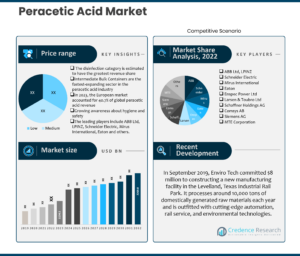
- The global demand for Peracetic Acids was valued at USD 1154.2 Million in 2023 and is expected to reach USD 2269.0 Million in 2032, growing at a CAGR of 7.80% between 2024 and 2032.
- Liquid peracetic acid is in more demand than solid peracetic acid.
- During the projected period, the disinfection category is expected to have the largest revenue share, while the sanitizer category is expected to experience rapid sales growth.
- The Food and Beverage segment is expected to have the biggest revenue share over the projection period. Throughout the forecast period, the healthcare category is expected to see continuous revenue growth.
- Peracetic acid solutions at 5% and 10% concentrations are widely used and available on the market.
- Intermediate Bulk Containers are the fastest-growing segment in the peracetic acid market.
- Spray treatments are more popular than dip and foam applications.
- Pharmaceutical-grade peracetic acid has risen dramatically, and the industrial grade category is another key player in the peracetic acid market.
- In 2023, the European market accounted for 40.7% of worldwide peracetic acid revenue, while the Asia Pacific market is likely to rise quickly during the forecast period.
- The growing use of peracetic acid in water treatment propels market expansion.
- Health hazards linked with peracetic acid impede market expansion.
Executive Summary
Market Definition
Peracetic acid is a very acidic liquid chemical. It is made from hydrogen peroxide and acetic acid. It is regarded as one of the most effective agents, following ozone. It is widely utilized in sterilizing applications and equipment cleaning in a variety of industries, particularly the food industry. It is also referred to as peroxyacetic acid. It is a white liquid with a pungent odor similar to acetic acid. It can be extremely corrosive.
Peracetic acid is also used in dairy and cheese industries, as well as food processing and pasteurization equipment in brewers, wineries, and beverage facilities. It is also used to sterilize medical supplies, prevent biofilm formation in the pulp industry, and as a water purifier and disinfectant. Peracetic acid can be used as a cooling tower water disinfectant to avoid biofilm formation and efficiently manage Legionella bacteria. NuCidex is the brand name for peracetic acid, which is an antibacterial agent. It has also been used to sterilize discarded food washes.
Market Overview
The global Peracetic Acid Market has witnessed steady growth in recent years and is expected to grow at a CAGR of 7.80% between 2024 and 2032. The market was valued at USD 1154.2 million in 2023 and is expected to reach USD 2269.0 million in 2032.
The key driver of market expansion is rising demand for peracetic acid from the water treatment industry. The market's growth is driven by rising demand for drinking water as the population grows and concerns about water scarcity grow. Rapid industrialization across the globe is increasing the demand for clean, treated water. The expansion of the paper, textile, and other manufacturing industries in both developed and emerging countries is likely to boost the Peracetic Acid Market.
Furthermore, as people become more aware of peracetic acid's environmental benefits, its popularity grows around the world. The rising demand for medical sector items for sterilizing surgical instruments and other medical devices is once again propelling the market forward. The expanding interest in infection control, as well as greater government investment in the healthcare business, are propelling the bull market further. Furthermore, increased health and hygiene awareness is driving market expansion.
Segmentation by Form
- Liquid peracetic acid is in more demand than solid peracetic acid. Liquid peracetic acid is more widely utilized due to its ease of handling, storage, and use in a variety of sectors. It is commonly used as a disinfectant, sanitizer, and sterilizing agent in industries such as healthcare, food processing, water treatment, and agriculture. The liquid form enables for easy and precise dosage, making it a popular choice for a variety of applications.
Segmentation by Application
- The disinfection category is estimated to have the greatest revenue share during the forecast period due to the widespread use of peracetic acid as a disinfectant chemical in the water treatment, healthcare, and food and beverage industries.
- The sanitizer category is predicted to have rapid sales growth throughout the forecast period as a result of the COVID-19 epidemic and increased hygiene awareness among people worldwide.
Segmentation by End-User
- The Food and Beverage segment is estimated to have the highest revenue share over the forecast period due to the increasing use of peracetic acid in the food and beverage industry due to its ability to destroy fungi, bacteria, yeast, and pathogens. Many food and bottling facilities use them as a sanitizer and disinfectant to reduce microbial contamination.
- Throughout the projection period, the healthcare category is expected to experience consistent revenue growth. Peracetic acid is an effective bactericide and fungicide that is widely used in hospitals. It is an effective way to eliminate pollution in hospitals and healthcare facilities.
Segmentation by Concentration
- Peracetic acid solutions of 5% and 10% concentrations are frequently used and available on the market. In industries such as healthcare, food processing, and water treatment, these concentrations are commonly used for disinfection, sanitization, and sterilization. The concentration used is determined by factors such as the target microorganisms, the surface or equipment being treated, and regulatory guidelines.
Segmentation by Packaging Type
- Intermediate Bulk Containers are the fastest-expanding sector in the peracetic acid industry. IBCs are commonly used for peracetic acid storage and transportation due to their convenience and safety features. They offer a cost-effective solution and are gaining appeal in a variety of industries, including food and beverage, healthcare, and water treatment.
Segmentation by Application Method
- Spray treatments are in higher demand than dip and foam applications. Spray enables the efficient and equal distribution of peracetic acid over surfaces, making it ideal for disinfection, sanitization, and sterilization in a variety of industries, including healthcare, food processing, and agriculture. It is both convenient and versatile in use, allowing for targeted and exact coverage.
Segmentation by Grade
- Pharmaceutical-grade peracetic acid has grown significantly. This is because the pharmaceutical sector places a greater premium on strict quality standards and regulations. Pharmaceutical grade peracetic acid is required for a variety of purposes, including medical equipment disinfection and pharmaceutical manufacture.
- The industrial grade category is another major player in the peracetic acid industry.
Segmentation by Region
- In 2023, the European market accounted for 40.7% of global peracetic acid revenue.
- The Asia Pacific market is expected to grow rapidly throughout the projected period.
- The rest of the world, including Latin America, the Middle East, and Africa, supplies the remaining demand for Peracetic Acid.
The European market had the greatest revenue share in the worldwide peracetic acid market. This is due to the expanding use of this chemical in the water treatment, health care, and food and beverage industries throughout the region, particularly in the United Kingdom, Germany, and France. Furthermore, the increasing expansion of these industries generates a strong demand for peracetic acid in this region. The food and beverage industry is Europe's largest manufacturing sector. In 2021, the EU food and beverage industry will employ 4.5 million people and earn Euro 1.1 trillion (about USD 1.25 trillion) in revenue, making it one of the EU's largest manufacturing industries. Furthermore, food safety is a key concern in the food sector, and microbial contamination poses the greatest hazard to the food supply. Peracetic acid is one of the most efficient techniques for controlling microbial contamination, making it in great demand in this region. Furthermore, water treatment businesses have examined using peracetic acid as a substitute for halogenated disinfection chemicals, and the European Union has allowed its usage in biocidal products.
The Asia Pacific market is predicted to grow at a rapid pace throughout the forecast period. This is due to increased industry and improving hygiene awareness among people in this region, particularly in China, Japan, and India. Furthermore, the expanding development of the food and beverage industry, as well as water treatment solutions, is driving up demand for peracetic acid in the region. According to the China National Bureau of Statistics, the country invested USD 81.6 billion in its municipal wastewater system between 2015 and 2020, which included the construction and maintenance of sewage pipelines as well as new treatment facilities. As of January 2020, China's 10,113 water treatment plants process 95% of municipal wastewater and 30% of rural wastewater. Furthermore, 39,000 new wastewater treatment facilities are being built, resulting in a significant demand for peracetic acid throughout China.
Key Highlights of the Report
Type, Application, End-User, Concentration, Type, Application Method, Grade, Power Rating and region segment of the global Peracetic Acid Market. The Food and Beverage category is expected to have the largest revenue share, while Intermediate Bulk Containers is the fastest growing sector in the peracetic acid industry. In addition, spray treatments are in higher demand than dip and foam applications, and pharmaceutical-grade peracetic acid production has increased significantly. In addition, the sanitizer sector is expected to have rapid sales development.with Europe leading the market growth.
The market is driven by rising demand for effective disinfectants and sanitizers across sectors, strict hygiene and safety laws and standards, and growing awareness of the significance of keeping clean and hygienic environments. Furthermore, potential health and safety concerns associated with the handling and exposure to peracetic acid, high production and operational expenses of peracetic acid, and restricted availability of raw materials necessary for peracetic acid production are the main restraints of the market.
Nonetheless, the European market has the largest revenue share of the global peracetic acid market. This is owing to the chemical's increasing use in the water treatment, health care, and food and beverage industries across the region, particularly in the United Kingdom, Germany, and France. Furthermore, the Asia Pacific market is expected to rise at a high pace over the forecast period. This is owing to expanded industry and improving hygiene awareness among individuals in this region, especially in China, Japan, and India.
What Are The Main Drivers Of The Global Peracetic Acid Market?
Several key factors are driving the Peracetic Acid Market. Firstly, there is an increasing demand for effective disinfectants and sanitizers across various industries. This is due to the growing emphasis on maintaining clean and hygienic environments, especially in sectors such as healthcare, food, and water treatment. Secondly, stringent regulations and standards regarding hygiene and safety have become more prevalent, leading to a higher adoption of peracetic acid as a reliable disinfectant.
What Are The Major Challenges Faced By The Global Peracetic Acid Market?
While the Peracetic Acid Market shows great potential, certain restraints need to be considered. One of the main challenges is the potential health and safety risks associated with the handling and exposure to peracetic acid. Proper precautions and safety measures need to be in place to ensure the well-being of workers and the surrounding environment. Additionally, the production and operational costs of peracetic acid can be relatively high, which may limit its affordability for some businesses. Moreover, the availability of raw materials required for peracetic acid production can be limited, posing a constraint on the market's growth.
What Are The Growth Opportunities In The Global Peracetic Acid Market?
The Peracetic Acid Market also presents several opportunities for growth and development. Emerging economies with growing healthcare and food industries offer significant expansion opportunities for the market. As these industries continue to develop, the demand for effective disinfectants like peracetic acid is expected to rise. Furthermore, advancements in production processes and technologies can lead to improved efficiency and cost-effectiveness, making peracetic acid more accessible to a wider range of businesses. Additionally, the increasing demand for water treatment solutions provides a valuable opportunity for peracetic acid to be utilized in this sector, ensuring clean and safe water for various applications.
Market Drivers
Increasing Use Of Peracetic Acid In Water Treatment
Peracetic acid has been popular in recent years for its application in wastewater purification. Utility companies largely use disinfectants to inactivate and eliminate harmful organisms that spread diseases through water. Any disease-causing germs, such as bacteria, helminths, spores, and protozoa, will be effectively treated by an adequate disinfectant. PAA concentrations typically range from 5% to 22%. When PAA decomposes in water, it generates free Hydrogen Peroxyl (HO2) and Hydroxyl (OH) radicals, which have a high oxidizing capacity and are significant in microbial disinfection. Because of its advantages over chlorine-based chemistries, peracetic acid has grown significantly in popularity for water treatment around the world in recent years.
These advantages include no trihalomethane formation, less influence on wastewater quality, lower aquatic toxicity, and reduced environmental impact. Recycling wastewater is an essential strategy for combating the worldwide water shortage. In December 2019, the Erie County Division of Sewerage Management, PeroxyChem, and researchers from the University of Buffalo's Civil, Structural, and Environmental Engineering Department collaborated to investigate the use of peracetic acid as a more environmentally friendly method of wastewater disinfection and oxidation.
Market Restraints
Health Risks Associated With Peracetic Acid
Peracetic acid has a strong stench and is highly corrosive. Short-term or long-term exposure to the chemical can result in a wide range of dangers. This chemical has the potential to injure the skin, eyes, and respiratory tract when exposed for a short period. However, in more extreme cases, large-scale risks such as explosions, fires, and reactivity difficulties are likely. The chemical is known to react aggressively with soft metals like brass, copper, iron, and zinc. Furthermore, the amount of damage caused by exposure to such a substance is a big impediment to revenue growth in the industry.
Opportunities
Growing Medical and Healthcare Industry
In the medical and healthcare industries, peracetic acid and ethylene oxide are used to sterilize surfaces. It is generated spontaneously by a sequence of processes involving formaldehyde and acetaldehyde liquid-phase oxidation. Peracetic acid is used to chemically sterilize medical, surgical, and dental devices such as endoscopes, arthroscopes, and others via an automated process. This acid deactivates both gram-positive and gram-negative bacteria, yeasts, and fungi. The medical and healthcare sectors are expanding. For instance, according to Invest India, the medical device sector has grown steadily at a CAGR of 15% over the last three years, and the medical devices industry in India is poised for significant growth, with the market size expected to reach $50 billion by 2025.
Furthermore, the United States Food and Drug Administration announced a $5 million increase in 2022 to strengthen medical device safety and security. Thus, with the rising medical device sector in the medical and healthcare industries, demand for peracetic acid is expected to rise more throughout the forecast period.
Competitive Landscape
Key Players
The global Peracetic Acid Market is highly competitive, with several key players. Some of the major players in the market and their market share are as follows:
- ABB Ltd, LPINZ
- Schneider Electric
- Mirus International
- Eaton
- Enspec Power Ltd
- Larsen & Toubro Ltd
- Schaffner Holdings AG
- Comsys AB
- Siemens AG
- MTE Corporation
- CC Power and Industrial Solutions Ltd.
- AVX Corporation
- TDK Corporation
- Arteche, and others.
These organizations prioritize product innovation, End-User expansion, and mergers and acquisitions to stay competitive.
The global Peracetic Acid Market's key players continually seek to stay ahead by offering new products and developments.
In February 2020, Evonik completed the acquisition of PeroxyChem (US) for $640 million. PeroxyChem is a manufacturer of hydrogen peroxide (H2O2) and peracetic acid (PAA), with a strong presence in high-margin niche applications. The acquisition opened up new growth potential for Evonik, particularly in the market for environmentally friendly disinfectants.
In April 2020, The US Environmental Protection Agency (EPA) licensed Solvay's PROXITANE AHC for use against SARS-CoV-2, the viral strain responsible for COVID-19. It has been added to the list of disinfectants produced from peracetic acid for use against SARS-CoV-2 (List N), with EPA Registration Number 68660-11.
Summary of Key Findings
- Expanding Medical and Healthcare Industry
- The market is segmented by Form, Application, End-User, Concentration, type, Application Method, Grade, and region.
- Intermediate Bulk Containers are the fastest-growing segment of the peracetic acid market.
- The Food and Beverage segment is expected to have the biggest revenue share over the projection period
- Europe is leading market growth; the market is highly competitive with key players including ABB Ltd, LPINZ, Schneider Electric, Mirus International, Eaton, Enspec Power Ltd and Others.
Future Outlook
- Increasing demand for effective disinfectants
- Growing awareness about hygiene and safety
- Stringent regulations driving adoption
- Expansion in healthcare and food industries
- Rising focus on water treatment
- Technological advancements in production processes
- Growing market opportunities in emerging economies
How CXOs Can Benefit from the Credence Research Peracetic Acid Market Report
The Credence Research Peracetic Acid Market Report provides CXOs with a comprehensive overview of the market, including:
- Market size and growth forecast:The report provides detailed estimates of the global Peracetic Acid Market size, segmented by Form, Application, End-User, Concentration, type, Application Method, Grade, and region. It also includes forecasts for the market through 2032 based on key trends and drivers.
- Market segmentation:The report segments the Peracetic Acid Market by Form, Application, End-User, Concentration, type, Application Method, Grade, and region. This segmentation provides CXOs with a granular understanding of the market and the opportunities in each segment.
- Competitive Landscape:The report profiles the key players in the Peracetic Acid Market and provides insights into their strategies, product offerings, and financial performance. This information can help CXOs to identify and assess their competition.
- Key trends and drivers:The report identifies and analyzes the key trends and drivers that are shaping the Peracetic Acid Market. This information can help CXOs to make informed decisions about their investments and strategies.
CXOs can use the insights from the Credence Research Peracetic Acid Market Report to:
- Identify growth opportunities:The report can help CXOs to identify new growth opportunities in the Peracetic Acid Market. For example, the report may highlight emerging applications of peracetic acid in industries like healthcare, food processing, and water treatment.
- Make informed investment decisions:The report can help CXOs to make informed investment decisions about Peracetic Acids. For example, it may highlight the increasing demand for Peracetic Acid in various sectors, such as healthcare, food processing, and water treatment, indicating potential areas for investment.
- Develop competitive strategies:The report can help CXOs to develop competitive strategies for their Peracetic Acid businesses. For example, the report identifies the key strategies that dark fiber providers are using to differentiate themselves from their competitors.
- Track market developments:The report can help CXOs to track market developments and stay ahead of the curve. For example, the report provides insights into the latest trends and innovations in the Peracetic Acid Market.
Overall, the Credence Research Peracetic Acid Market Report is a valuable resource for CXOs who are looking to gain a deeper understanding of the market and identify opportunities for growth.
Segmentation
By Form:- Active Peracetic Acids (AHFs)
- Passive Peracetic Acids (PHFs)
- Hybrid Peracetic Acids
- Low Voltage Peracetic Acids
- Medium Voltage Peracetic Acids
- High Voltage Peracetic Acids
- Single Phase Peracetic Acids
- Three Phase Peracetic Acids
- Industrial
- Manufacturing
- Automotive
- Petrochemical
- Commercial
- Data Centers
- Telecommunication
- Residential
- Variable Frequency Drives (VFDs)
- UPS
- HVAC
- Water Treatment
- Wind Power
- Others
- Linear Load
- Non-Linear Load
- Capacitors
- Inductors
- Resistors
- Sensors
- Others
- Up to 500 VAr
- 501 VAr to 2000 VAr
- Above 2000 VAr
- North America
- US
- Canada
- Mexico
- Europe
- Germany
- France
- UK
- Italy
- Spain
- Rest of Europe
- Asia Pacific
- China
- Japan
- India
- South Korea
- South-east Asia
- Rest of Asia Pacific
- Latin America
- Brazil
- Argentina
- Rest of Latin America
- Middle East & Africa
- GCC Countries
- South Africa
- Rest of Middle East and Africa
Adjacent Markets
In the Peracetic Acid Market, several adjacent markets have high revenue growth opportunities. The key adjacent markets for Peracetic Acid Market –
Adjacent Markets |
||
| Hydrogen Peroxide Market | Ethanol Market | Phenol Market |
| Chlorine Market | Quaternary Ammonium Compounds Market | Formaldehyde Market |
| Sodium Hypochlorite Market | Glutaraldehyde Market | Benzalkonium Chloride Market |

Request a Free Sample
Fill in your details and we'll send you a free sample report.
- Sample data tables & charts
- Research methodology
Market Dynamics
Expansion of Water Treatment Applications
Peracetic acid is increasingly used in municipal and industrial water treatment due to its effectiveness as a disinfectant and its environmental advantages over chlorine, such as no trihalomethane formation and lower aquatic toxicity.
Stringent Hygiene and Food Safety Regulations
Tighter regulations in food processing and healthcare sectors, especially in Europe and North America, are driving the adoption of peracetic acid for disinfection and sterilization to ensure compliance and reduce microbial contamination.
Growth in Healthcare and Medical Device Sterilization
The expanding healthcare industry and rising demand for effective sterilization of medical equipment are boosting peracetic acid consumption, as it is highly effective against a broad spectrum of pathogens and is compatible with automated sterilization systems.
Rising Demand for Convenient and Safe Packaging
The shift toward intermediate bulk containers (IBCs) for peracetic acid storage and transport is supporting market growth by improving safety, reducing costs, and enabling easier handling for large-scale industrial users.
Need a Custom Version of This Report?
Tailor the scope, geography, or segments to your exact requirements.
- Custom geography or segment scope
- Direct access to our analyst team
Frequently Asked Questions
What is the current size of the global Peracetic Acid Market?
What is the expected growth rate of the Peracetic Acid Market between 2024 and 2032?
Which segment is leading the market share in terms of End-User?
Which Application Method segment governs the demand for Peracetic Acid in the world?
Which Packaging Type segment is expected to post the fastest growth during theforecast period?
Which region is fueling the growth of the Peracetic Acid industry?
Who are the major players in the global Peracetic Acid Market?
What are the major market drivers of the Peracetic Acid industry?
Table of Content
Chapter 1 Market Segmentation
- 1.1 Segmentation Framework
- 1.1.1 Product and Service Classification
- 1.1.2 Application and End-Use Classification
- 1.1.3 Technology and Solution Classification
- 1.1.4 Customer and Distribution Channel Classification
- 1.1.5 Geographic Segmentation
- 1.1.6 Market Segment Definitions and Boundaries
- 1.2 By Form
- 1.2.1 Liquid Peracetic Acid
- 1.2.2 Solid Peracetic Acid
- 1.3 By End-User
- 1.3.1 Food & Beverage
- 1.3.2 Healthcare
- 1.3.3 Water Treatment
- 1.3.4 Pulp & Paper
- 1.3.5 Others
- 1.4 By Application
- 1.4.1 Disinfection
- 1.4.2 Sanitization
- 1.4.3 Sterilization
- 1.4.4 Water Treatment
- 1.4.5 Others
- 1.5 By Concentration
- 1.5.1 5% Solution
- 1.5.2 10% Solution
- 1.5.3 Above 10% Solution
Chapter 2 Introduction
- 2.1 Report Objectives and Scope
- 2.2 Product Definition and Industry Terminology
- 2.3 Market Inclusions and Exclusions
- 2.4 Research Process
- 2.4.1 Primary Research and Expert Interviews
- 2.4.2 Secondary Research and Source Review
- 2.4.3 Top-Down and Bottom-Up Estimation
- 2.4.4 Data Triangulation and Verification
- 2.5 Market Size Measurement Basis
- 2.5.1 2023: USD 1154.2 Million → 2032: USD 2,269.0 Million
- 2.6 Historical and Forecast Reference Periods
- 2.6.1 Base Year: 2023
- 2.6.2 Forecast Period: 2023-2032
- 2.7 Research Assumptions and Limitations
Chapter 3 Executive Summary
- 3.1 Market Snapshot and Key Findings
- 3.2 Base-Year Market Size, 2023
- 3.3 Forecast Market Size, 2032
- 3.4 Revenue and Volume Growth Outlook
- 3.5 Key Demand and Supply Indicators
- 3.6 Leading Market Segments
- 3.7 Fastest-Growing Market Opportunities
- 3.8 Regional Performance Highlights
- 3.9 Technology and Industry Transformation
- 3.10 Competitive Landscape Summary
- 3.11 Analyst View and Strategic Implications
Chapter 4 Global Peracetic Acid Market Trends and Developments
- 4.1 Historical Industry Development
- 4.2 Recent Market Trends and Developments
- 4.3 Demand and Customer Behavior Trends
- 4.4 Technology and Product Innovation
- 4.5 Artificial Intelligence, Automation and Digitalization
- 4.6 Local Manufacturing and Supply Chain Realignment
- 4.7 Industry Partnerships, Mergers and Acquisitions
- 4.8 Sustainability and Circular Economy Developments
- 4.9 Government and Private Sector Investment Trends
- 4.10 Emerging Business Models and Commercialization
- 4.11 Industry Developments and Announcements
Chapter 5 Global Peracetic Acid Market Production, Supply and Demand Analysis
- 5.1 Demand Trend and Consumption Analysis
- 5.2 Demand Forecast, 2023-2032
- 5.3 Production and Output Trend
- 5.4 Production and Output Forecast, 2023-2032
- 5.5 Installed Capacity and Capacity Utilization
- 5.6 Company-Wise Production Plants and Statistics
- 5.6.1 Installed Production Capacity
- 5.6.2 Actual Production
- 5.6.3 Planned Capacity and Expansion Targets
- 5.7 Supply Chain Structure and Procurement Trends
- 5.8 Supply-Demand Gap and Bottlenecks
- 5.9 Import Dependence and Sourcing Structure
- 5.10 Contract Manufacturing and Outsourcing
- 5.11 Regional Supply and Demand Concentration
Chapter 6 Global Peracetic Acid Market Pricing Analysis
- 6.1 Pricing Structure and Measurement
- 6.2 Historical Pricing Trends
- 6.3 Pricing Outlook, 2023-2032
- 6.4 Average Selling Price and Unit Economics
- 6.5 Pricing by Product and Market Segment
- 6.6 Geographic Pricing Differences
- 6.7 Key Input, Energy, Labor and Logistics Costs
- 6.8 Contract Pricing and Purchasing Models
- 6.9 Pricing Sensitivity and Competitive Positioning
- 6.10 Price, Margin and Profitability Implications
Chapter 7 Global Peracetic Acid Market Dynamics
- 7.1 Market Growth Drivers
- 7.1.1 Demand-Side Drivers
- 7.1.2 Technology and Innovation Drivers
- 7.1.3 Infrastructure and Investment Drivers
- 7.1.4 Regulatory and Policy Drivers
- 7.2 Market Restraints
- 7.2.1 Cost and Affordability Constraints
- 7.2.2 Technology and Adoption Barriers
- 7.2.3 Supply Chain and Operational Constraints
- 7.3 Market Challenges
- 7.3.1 Competitive Pressure and Margin Erosion
- 7.3.2 Skills, Infrastructure and Implementation Gaps
- 7.4 Emerging Market Opportunities
- 7.5 Market Dynamics Impact and Time-Horizon Assessment
Chapter 8 Global Peracetic Acid Value Chain Analysis
- 8.1 Industry Value Chain Overview
- 8.2 Upstream Suppliers and Critical Inputs
- 8.3 Technology and Component Providers
- 8.4 Manufacturing or Service Delivery
- 8.5 Distribution, Channel Partners and Integrators
- 8.6 Downstream Applications and End Users
- 8.7 Value Addition and Profit Pools
- 8.8 Vertical Integration and Outsourcing
- 8.9 Supplier Concentration and Risk
- 8.10 Supply Chain Localization and Resilience
Chapter 9 Global Peracetic Acid Market Regulations and Policies
- 9.1 Relevant Laws, Standards and Compliance Frameworks
- 9.2 Product, Service, Safety and Quality Requirements
- 9.3 Government Policies, Incentives and Subsidies
- 9.4 Imports, Exports and Trade Barriers
- 9.5 Public Procurement and Local Content Requirements
- 9.6 Environmental and Sustainability Compliance
- 9.7 Upcoming Policy Changes and Market Implications
Chapter 10 Global Peracetic Acid Market Hotspots and Opportunities
- 10.1 Market Opportunity Mapping and Growth Hotspots
- 10.2 High-Growth Applications and Customer Groups
- 10.3 Underserved Markets and White-Space Opportunities
- 10.4 Emerging Technology and Product Opportunities
- 10.5 New Capacity and Investment Hotspots
- 10.6 Market Entry and Expansion Opportunities
- 10.7 Distribution and Partnership Opportunities
- 10.8 Near-Term and Long-Term Commercial Potential
- 10.9 Opportunity Attractiveness and Execution Risks
Chapter 11 Global Peracetic Acid Market Outlook, 2023-2032
- 11.1 Market Size and Analysis
- 11.1.1 Revenue (Market Measurement: 2023: USD 1154.2 Million → 2032: USD 2,269.0 Million)
- 11.1.2 Market Volume and Quantity Sold
- 11.1.3 Historical Market Size
- 11.1.4 Base-Year Market Size, 2023
- 11.2 Market Forecast, 2023-2032
- 11.2.1 Revenue Forecast to 2032
- 11.2.2 Volume Forecast to 2032
- 11.2.3 CAGR and Year-on-Year Growth
- 11.2.4 Incremental Revenue Opportunity
- 11.3 Forecast Assumptions and Scenario Analysis
- 11.3.1 Base-Case Forecast
- 11.3.2 Optimistic and Conservative Scenarios
- 11.3.3 Technology, Pricing and Policy Sensitivities
- 11.4 Market Attractiveness and Growth Outlook
Chapter 12 Global Peracetic Acid Market Segmentation and Outlook
- 12.1 Segmentation Summary and Market Shares, 2023
- 12.2 Largest and Fastest-Growing Segments
- 12.3 By Form - Market Size and Forecast, 2023-2032
- 12.3.1 Segment Definition and Scope
- 12.3.2 Historical Market Size
- 12.3.3 Revenue Forecast, 2023-2032
- 12.3.4 Volume Forecast, 2023-2032
- 12.3.5 Base-Year Market Share, 2023
- 12.3.6 Segment CAGR and Growth Drivers
- 12.3.7 Subsegment Market Size and Forecast
- 12.3.7.1 Liquid Peracetic Acid
- 12.3.7.2 Solid Peracetic Acid
- 12.3.8 Subsegment Pricing and Adoption Trends
- 12.3.9 Leading Suppliers and Competition
- 12.3.10 Regional Demand and Opportunities
- 12.4 By End-User - Market Size and Forecast, 2023-2032
- 12.4.1 Segment Definition and Scope
- 12.4.2 Historical Market Size
- 12.4.3 Revenue Forecast, 2023-2032
- 12.4.4 Volume Forecast, 2023-2032
- 12.4.5 Base-Year Market Share, 2023
- 12.4.6 Segment CAGR and Growth Drivers
- 12.4.7 Subsegment Market Size and Forecast
- 12.4.7.1 Food & Beverage
- 12.4.7.2 Healthcare
- 12.4.7.3 Water Treatment
- 12.4.7.4 Pulp & Paper
- 12.4.7.5 Others
- 12.4.8 Subsegment Pricing and Adoption Trends
- 12.4.9 Leading Suppliers and Competition
- 12.4.10 Regional Demand and Opportunities
- 12.5 By Application - Market Size and Forecast, 2023-2032
- 12.5.1 Segment Definition and Scope
- 12.5.2 Historical Market Size
- 12.5.3 Revenue Forecast, 2023-2032
- 12.5.4 Volume Forecast, 2023-2032
- 12.5.5 Base-Year Market Share, 2023
- 12.5.6 Segment CAGR and Growth Drivers
- 12.5.7 Subsegment Market Size and Forecast
- 12.5.7.1 Disinfection
- 12.5.7.2 Sanitization
- 12.5.7.3 Sterilization
- 12.5.7.4 Water Treatment
- 12.5.7.5 Others
- 12.5.8 Subsegment Pricing and Adoption Trends
- 12.5.9 Leading Suppliers and Competition
- 12.5.10 Regional Demand and Opportunities
- 12.6 By Concentration - Market Size and Forecast, 2023-2032
- 12.6.1 Segment Definition and Scope
- 12.6.2 Historical Market Size
- 12.6.3 Revenue Forecast, 2023-2032
- 12.6.4 Volume Forecast, 2023-2032
- 12.6.5 Base-Year Market Share, 2023
- 12.6.6 Segment CAGR and Growth Drivers
- 12.6.7 Subsegment Market Size and Forecast
- 12.6.7.1 5% Solution
- 12.6.7.2 10% Solution
- 12.6.7.3 Above 10% Solution
- 12.6.8 Subsegment Pricing and Adoption Trends
- 12.6.9 Leading Suppliers and Competition
- 12.6.10 Regional Demand and Opportunities
- 12.7 Segment Growth Comparison
- 12.8 Segment Attractiveness and Priority Matrix
Chapter 13 Global Peracetic Acid End-Use and Application Market Outlook
- 13.1 End-Use Industry and Customer Demand Structure
- 13.2 Leading Applications and Customer Groups
- 13.3 End-Use Market Size, Share and Forecast
- 13.4 Major End-Use Industry Deep Dives
- 13.4.1 Customer Requirements and Use Cases
- 13.4.2 Demand and Replacement Cycles
- 13.4.3 Technical and Regulatory Considerations
- 13.4.4 Purchasing and Procurement Models
- 13.4.5 Leading Vendors and Distribution Channels
- 13.4.6 Forecast and Commercial Opportunities
- 13.5 Emerging Applications and Cross-Segment Demand
- 13.6 End-Use Industry Investment Priorities
Chapter 14 Global Peracetic Acid Geographic Market Outlook, 2023-2032
- 14.1 Regional Market Size and Share, 2023
- 14.2 Regional Market Forecast, 2023-2032
- 14.3 Regional Pricing, Production and Demand Differences
- 14.4 North America
- 14.4.1 United States
- 14.4.2 Canada
- 14.4.3 Mexico
- 14.5 Europe
- 14.5.1 Germany
- 14.5.2 France
- 14.5.3 Italy
- 14.5.4 United Kingdom
- 14.5.5 Spain
- 14.5.6 Poland
- 14.5.7 Russia
- 14.5.8 Netherlands
- 14.5.9 Belgium
- 14.5.10 Sweden
- 14.5.11 Denmark
- 14.5.12 Norway
- 14.5.13 Rest of Europe
- 14.6 Asia Pacific
- 14.6.1 China
- 14.6.2 India
- 14.6.3 Japan
- 14.6.4 South Korea
- 14.6.5 Thailand
- 14.6.6 Indonesia
- 14.6.7 Vietnam
- 14.6.8 Malaysia
- 14.6.9 Australia
- 14.6.10 Rest of Asia Pacific
- 14.7 Latin America
- 14.7.1 Brazil
- 14.7.2 Argentina
- 14.7.3 Colombia
- 14.7.4 Chile
- 14.7.5 Rest of Latin America
- 14.8 Middle East
- 14.8.1 Saudi Arabia
- 14.8.2 United Arab Emirates
- 14.8.3 Turkey
- 14.8.4 Israel
- 14.8.5 Iran
- 14.8.6 Rest of the Middle East
- 14.9 Africa
- 14.9.1 South Africa
- 14.9.2 Egypt
- 14.9.3 Nigeria
- 14.9.4 Morocco
- 14.9.5 Rest of Africa
- 14.10 Regional Investment, Policy and Supply Chain Differences
- 14.11 Regional Competitive Landscape
- 14.12 Geographic Growth Hotspots
Chapter 15 Global Peracetic Acid Technology, Innovation and Sustainability Outlook
- 15.1 Technology Landscape and Maturity
- 15.2 Product, Process and Service Innovation
- 15.3 AI, Automation and Digital Tools in the Industry
- 15.4 Technology Adoption and Performance Benchmarking
- 15.5 Innovation Pipeline and R&D Investment
- 15.6 Patent and Intellectual Property Trends
- 15.7 Energy Efficiency and Resource Management
- 15.8 Sustainability, Recycling and Circularity
- 15.9 Technology Roadmap, 2023-2032
- 15.10 Risks of Obsolescence and Technology Substitution
Chapter 16 Global Peracetic Acid Market Key Strategic Imperatives
- 16.1 Growth and Market Entry Priorities
- 16.2 High-Return Products and Segments
- 16.3 Pricing, Profitability and Cost Optimization
- 16.4 Technology Investment and Product Differentiation
- 16.5 Supply Chain Localization and Resilience
- 16.6 Distribution and Customer Acquisition
- 16.7 Partnership, Acquisition and Capacity Strategy
- 16.8 Regional Expansion Priorities
- 16.9 Short-, Medium- and Long-Term Actions
Chapter 17 Competition Outlook
- 17.1 Industry Competition Characteristics
- 17.2 Market Structure and Concentration
- 17.3 Market Share and Competitive Positioning, 2023
- 17.4 Company-Wise Revenue and Product Benchmarking
- 17.5 Production and Service Capacity Benchmarking
- 17.6 Technology, Pricing and Differentiation
- 17.7 Regional Footprint and Distribution Strength
- 17.8 Mergers, Acquisitions and Strategic Alliances
- 17.9 New Entrants and Competitive Threats
- 17.10 Porter's Five Forces and Industry Attractiveness
- 17.11 Competitive Outlook, 2023-2032
Chapter 18 Company Profiles
- 18.1 Company Coverage and Selection Criteria
- 18.2 Evonik Industries
- 18.2.1 Business Description
- 18.2.2 Company Ownership and Geographic Presence
- 18.2.3 Product and Service Portfolio
- 18.2.4 Manufacturing and Operating Footprint
- 18.2.5 Production Capacity and Expansion Plans
- 18.2.6 Financial Performance and Investment
- 18.2.7 Market Share and Competitive Position
- 18.2.8 Technology and Innovation Capabilities
- 18.2.9 Strategic Alliances or Partnerships
- 18.2.10 Recent Developments
- 18.2.11 Growth Strategy and Outlook
- 18.3 Solvay
- 18.4 PeroxyChem (now part of Evonik)
- 18.5 Kemira
- 18.6 Ecolab
- 18.7 Enviro Tech Chemical Services
- 18.8 Christeyns
- 18.9 Seitz GmbH
- 18.10 Airedale Chemical
- 18.11 Mitsubishi Gas Chemical Company
- 18.12 Other Relevant Market Participants
Note: Every listed company is profiled on the structure shown under the first company. The company list is preliminary and may change based on research findings, market developments, data availability and client requirements.
Chapter 19 Disclaimer
- 19.1 Research and Forecast Disclaimer
- 19.2 Data Source and Estimation Limitations
Note: The depth of individual sections depends on data availability for this market. Volume, capacity, trade and other unit-based metrics are included where applicable.

