
| REPORT ATTRIBUTE | DETAILS |
|---|---|
| Historical Period | 2019-2022 |
| Base Year | 2023 |
| Forecast Period | 2024-2032 |
| Pest Control Products and Services Market Size 2023 | USD 22514.2 Million |
| Pest Control Products and Services Market, CAGR | 6.60% |
| Pest Control Products and Services Market Size 2032 | USD 40019.4 Million |
Market Insights
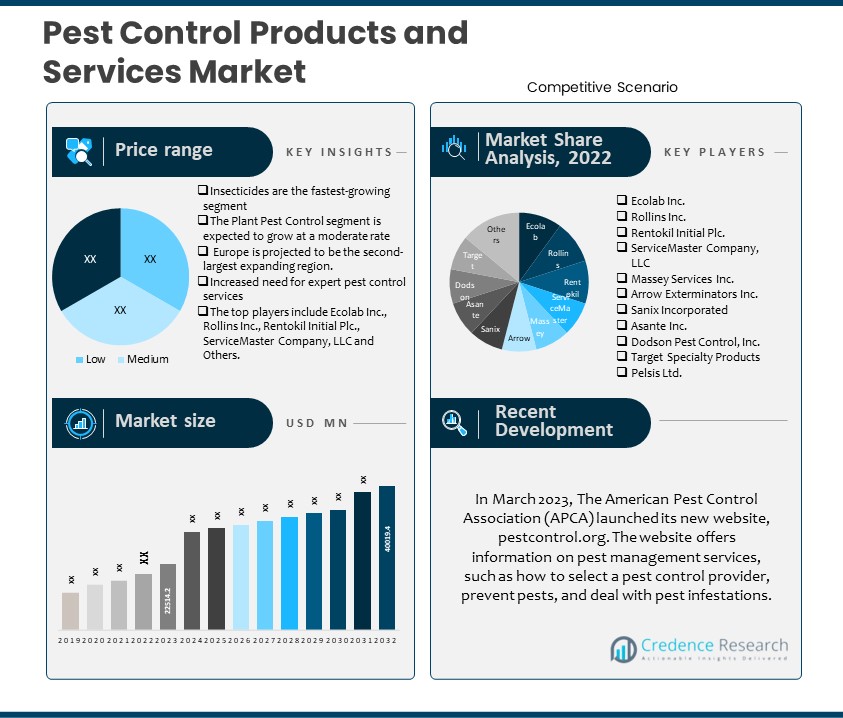
- The global demand for Pest Control Products and Services was valued at USD 22514.2 Million in 2023 and is expected to reach USD 40019.4 Million in 2032, growing at a CAGR of 6.60% between 2024 and 2032.
- Herbicides account for a significant portion of the Pest Control Products and Services Market, while insecticides are the fastest-growing segment.
- Commercial Pest Control Services is the largest segment in the global pest control products and services market, accounting for 42.30% in 2023. Agricultural Pest Control Services had a 31.40% market share in 2023.
- In 2023, the insect sector led the market, accounting for 42.0%, while the Plant Pest Control segment is expected to grow at a moderate rate throughout the projection period.
- In 2023, North America will account for 57.9% of the Pest Control Products Market, while Europe is projected to be the second-largest expanding region.
- Insects and pests are becoming more frequent, driving market expansion.
- Environmental and health risks of pest control products and services limit market expansion.
Executive Summary
Market Definition
Pest control is the practice of preventing, reducing, or eliminating unwanted insects and other pests from human-occupied environments. It is handled by a licensed pest professional who is an expert in the pests being treated.
Market Overview
The global X has witnessed steady growth in recent years and is expected to grow at a CAGR of 6.60% between 2024 and 2032. The market was valued at USD 22514.2 million in 2023 and is expected to reach USD 40019.4 million in 2032.
The growing presence of insects and pests around the world is causing a growth in the occurrence and spread of numerous diseases, emphasizing the need of pest management services and thereby expanding the simulation industry.Pest control service is the professional management and removal of pests from homes, companies, and other premises. Pests can pose health hazards and cause property damage. Thus, it is critical to keep the environment clean and safe. Pest control firms offer a wide range of treatments targeted to specific pest concerns. Inspection is an important aspect of pest control services. Pest control professionals conduct extensive examinations of the premises to detect pest infestations and assess the severity of the situation. They carefully inspect the pest-infested regions and determine the potential threats of the infestation. Following the inspection, pest control professionals start with pest identification.
Segmentation By Product Type
- Herbicides represent a considerable part of the Pest Control Products and Services Market. Herbicides are commonly used in agriculture and landscaping to manage undesired plants, making them an essential commodity in the pest control sector.
- On the other hand, Insecticides are the market's fastest-growing sector, owing to the increased demand for effective insect management solutions in various contexts, such as agriculture, households, and public health.
Segmentation By Service Type
- The Commercial Pest Control Services category is the largest segment in the worldwide pest control products and services market. This segment had a 42.30% market share in 2023. Pest control services are required by business hotels, restaurants, hospitals, schools, and businesses in order to maintain a clean atmosphere. Commercial pest control services are in high demand due to the necessity to comply with health and safety requirements as well as protect a business's reputation.
- Agricultural Pest Control Services had a 31.40% market share in 2023, as farmers and plantations require pesticides and other pest control products to safeguard their crops from pests and illnesses.
Segmentation by Target Pest
- In 2023, the insect sector led the market, accounting for 42.0%. The increased quantity of insects, particularly bed bugs, is a primary driver driving category growth. According to a 2018 National Pest Management Association (NPMA) survey, 97% of pest experts treated bed bugs, 69% thought the overall bed bug service was effective, and 66% indicated the demand for these services was increasing.
- The Plant Pest Control segment is predicted to develop at a moderate rate throughout the projection period.
Segmentation by Region
- North America will have 57.9% of the Pest Control Products Market in 2023.
- Europe is expected to be the second-largest expanding region in the Pest Control Products Market by 2023.
- The rest of the world, including Latin America, the Middle East, and Africa, supplies the remaining demand for Pest Control Products and Services.
North America currently dominates the Pest Control Products Market, accounting for 57.9% of the market in 2023. The region is predicted to increase over the forecast period and maintain its dominance through 2030. North America dominates the market due to increased awareness of pest-related issues, strict regulations, and public health concerns about diseases transmitted by pests, such as Lyme disease and West Nile virus, which drive market growth. Rapid urbanization provides new environments conducive to pest invasion. Increased construction activity and infrastructure development can damage natural habitats, exacerbate insect problems, and necessitate proactive pest control techniques, boosting market expansion.
Moreover, Europe will be the second-largest growing region in the Pest Control Products Market in 2023, with significant growth expected over the forecast period. A shift to preventative pest control tactics entails taking preventive measures to reduce the risk of a pest infestation before it occurs, resulting in continual demand for pest control services.
Key Highlights of the Report
Product Type, Service Type, Target Pest, and region segment of the global Pest Control Products and Services Market. In 2023, the insect sector dominated the market, and herbicides make up a sizable portion of the Pest Control Products and Services Market. In addition, insecticides are the market's fastest-growing sector, and the Plant Pest Control segment is expected to increase at a reasonable rate throughout the forecast period with North America driving its growth.
The pest control market is primarily driven by the growing use of organic pesticides, increased demand for environmentally friendly goods, a high demand for bio-based solutions, and global urbanization. The presence of elevated temperatures causes an increase in bug population. Hence, frequent changes in climatic circumstances are expected to fuel growth. Furthermore, growing market competition will limit pest control market growth. At the same time, the increased prevalence of pest-related diseases will drive people to seek pest management services.
North America currently dominates the Pest Control Products Market, in 2023. The region is expected to grow over the projected period and retain its dominance until 2030. Also, Europe will be the second-fastest growing region in the Pest Control Products Market by 2023, with a significant increase projected during the forecast period.
What Are The Main Drivers Of The Global Pest Control Products and Services Market?
The pest control market is primarily driven by the growing use of organic pesticides, increased demand for environmentally friendly goods, a high demand for bio-based solutions, and global urbanization. The presence of elevated temperatures causes an increase in bug population. Hence, frequent changes in climatic circumstances are expected to fuel growth. Furthermore, the ever-increasing urban population would create ideal dwelling circumstances for a variety of pests, including mosquitoes, cockroaches, and rodents.
What Are The Major Challenges Faced By The Global Pest Control Products and Services Market?
Despite market expansion, there are a few constraints to consider. Increased health concerns about the high levels of toxicity connected with pest control services may stymie expansion, as some chemicals can cause serious health issues. Furthermore, increased market rivalry would stifle pest control industry growth.
What Are The Growth Opportunities In The Global Pest Control Products and Services Market?
Despite the hurdles, there are numerous opportunities in the Pest Control Products and Services Market. Increased migration from rural to urban areas is expected to increase the pest control market share. Consumers worldwide have become increasingly health-conscious, particularly in the residential and commercial sectors. At the same time, the rising prevalence of various essential diseases related with pests would force individuals to seek pest management services.
Market Drivers
Several factors drive the global Pest Control Products and Services Market. The following are the key drivers of the global Pest Control Products and Services Market:
Insects And Pests Are Becoming Increasingly Prevalent
The expanding presence of insects around the world is increasing the prevalence and transmission of many diseases. Mosquitoes are a key disease carrier, carrying malaria, dengue, West Nile Virus, and yellow fever. They also spread lymphatic filariasis and Japanese encephalitis. Other insects produce or spread mild to significant infections and illnesses. For example, the tsetse fly (Glossina species) transmits sleeping sickness or African Trypanosomiasis; sandflies transmit Leishmaniasis, including Visceral Leishmaniasis and Mucocutaneous Leishmaniasis; blackflies transmit Onchocerciasis or river blindness; and fleas primarily transmit plague.
The increasing population of rats, cockroaches, fleas, flies, termites, fire ants, and mosquitoes is causing widespread concern among residential and commercial property owners as a result of severe climatic changes. In addition to causing significant psychological or emotional anguish in certain persons, cockroaches have been found to carry Salmonella typhimurium, Entamoeba histolytica, and the poliomyelitis virus. Higher cockroach infestations in warm climates have provided huge market prospects for pest control services in hot and humid areas.
Market Restraints
The global Pest Control Products and Services Market faces some challenges that may hinder its growth. These include the following:
Environmental And Health Hazards Of Pest Control Products And Services
Most pest control firms employ very toxic chemicals to eradicate or control pests such as insects, rodents, germs, fungi, and other microorganisms. These herbicides have been connected to the development of diseases like Parkinson's, Alzheimer's, brain cancer, infertility, and congenital impairments. Pesticides include chemicals used to transport the active agent as well as the active substance. These compounds are referred to be "inerts" in poisons because they do not cause illness in the pests they are intended to kill; however, some inerts can cause human health issues.
Pesticide exposure can cause a variety of health problems, including eye, nose, and throat irritation, central nervous system and kidney damage, and even cancer. Symptoms may include headaches, dizziness, muscle weakness, and nausea. Chronic pesticide exposure can harm the liver, kidneys, as well as endocrine and neurological systems.
Opportunities
The global Pest Control Products and Services Market offers significant growth opportunities. These include the following:
Rising Incidence And Prevalence Of Different Insect-Borne Diseases
The increasing frequency and prevalence of many insect-borne diseases opens up numerous prospects in the pest control service market. The recent surge of mosquito-borne infections can be ascribed to global warming. Hot, humid, and moist temperatures promote mosquito breeding, which can spread a variety of diseases caused by viruses, bacteria, and parasites. Rising consumer awareness of diseases caused and transmitted by insects in their homes creates opportunities for new entrants and local companies to build a footing in the industry. This might be due to the increasing number of awareness campaigns launched by governments and non-profit groups, which encourages consumer acceptance of pest control services. Increasing consumer awareness is also increasing the penetration of pest control services in rural areas and other underserved sectors.
The growing popularity of natural or herbal components in pesticides and other pest management products is another area for players to consider. The emergence of green pest management products and Integrated Pest Management (IPM) also provides enormous opportunities for expansion. IPM is a comprehensive strategy to pest control that aims to incorporate intelligent, proactive treatments to dissuade active populations. This includes preventing or inhibiting pest access and utilizing traps as needed rather than relying only on lethal chemical combinations. IPM is an environmentally benign and effective pest management solution that does not rely on synthetic pesticides.
Competitive Landscape
Key Players
The global Pest Control Products and Services Market is highly competitive, with several key players. Some of the major players in the market and their market share are as follows:
- Ecolab Inc.
- Rollins Inc.
- Rentokil Initial Plc.
- ServiceMaster Company, LLC
- Massey Services Inc.
- Arrow Exterminators Inc.
- Sanix Incorporated
- Asante Inc.
- Dodson Pest Control, Inc.
- Target Specialty Products
- Pelsis Ltd.
- Killgerm Ltd.
- WinField Solutions, LLC
- Univer Inc.
These organizations prioritize product innovation, Target Pest expansion, and mergers and acquisitions to stay competitive.
The global Pest Control Products and Services Market's key players continually seek to stay ahead by offering new products and developments.
In May 2021, Anticimex Group, a leading pest control company, has announced the acquisition of Palmera Junior, a Colombian-based company. Anticimex Group specializes in pest control, building environments, and hygiene. The company's goal is to promote a healthy indoor environment through prevention, technology, and sustainable solutions.
In January 2021, Badische Anilin und Soda Fabrik (BASF), a chemical firm that manufactures, markets, and sells chemicals, plastics, crop protection goods, and performance items, has launched an insecticide active component. The business has submitted regulatory dossiers for the Axalion pesticide in Australia and Korea. It is positioned itself to supply sustainable agricultural innovations.
In November 2020, Syngenta Crop Protection LLC, a major global crop protection organization, has announced the launch of Spiropidion, a new breakthrough technology that may be used to defend a variety of crops from the most damaging and difficult-to-control pests. Syngenta Crop Protection LLC offers crop protection chemicals and agricultural services. Fungicides, herbicides, insecticides, and seed care treatments are among the products produced by the company, which also provides farm management, seeds, and research and development services.
Summary of Key Findings
- Rising Incidence and Prevalence of several insect-borne diseases
- The market is segmented by Product Type, Service Type, Target Pest, and region.
- Herbicides account for a significant portion of the Pest Control Products and Services Market
- Plant Pest Control segment is expected to grow at a moderate rate throughout the projection period.
- North America is leading in market growth; the market is highly competitive, with key players including Ecolab Inc., Rollins Inc., Rentokil Initial Plc., ServiceMaster Company, LLC and Others.
Future Outlook
- Continued increase in demand for environmentally friendly pest control solutions
- Technological developments result in more efficient pest control approaches.
- Increasing emphasis on integrated pest management tactics.
- Increased need for expert pest control services.
How CXOs Can Benefit from the Credence Research Pest Control Products and Services Market Report
The Credence Research Pest Control Products and Services Market Report provides CXOs with a comprehensive overview of the market, including:
- Market size and growth forecast: The report provides detailed estimates of the global Pest Control Products and Services Market size, segmented By Product Type, Service Type, Target Pest, and region. It also includes forecasts for the market through 2032 based on key trends and drivers.
- Market segmentation: The report segments the Pest Control Products and Services Market By by Product Type, Service Type, Target Pest, and region. This segmentation provides CXOs with a granular understanding of the market and the opportunities in each segment.
- Competitive Landscape: The report profiles the key players in the Pest Control Products and Services Market and provides insights into their strategies, product offerings, and financial performance. This information can help CXOs identify and assess their competition.
- Key trends and drivers: The report identifies and analyzes the key trends and drivers that are shaping the Pest Control Products and Services Market. This information can help CXOs to make informed decisions about their investments and strategies.
CXOs can use the insights from the Credence Research Pest Control Products and Services Market Report to:
- Identify growth opportunities: The report can help CXOs identify new growth opportunities in the Pest Control Products and Services Market. By analyzing the data and trends in the report, they can make informed decisions about where to invest and expand their business.
- Make informed investment decisions: The report can help CXOs make informed investment decisions about Pest Control Products and Services. For example, it may provide useful insights into market trends, customer preferences, the competitive landscape, and growth prospects in the Pest Control Products and Services Market.
- Develop competitive strategies: The report can help CXOs develop competitive strategies for their Pest Control Products and Services businesses. For example, by analyzing market trends, client preferences, and the competitive environment mentioned in the report, CXOs can fine-tune their strategies, differentiate their offers, and effectively position their firms in the marketplace.
- Track market developments: The report can help CXOs monitor market developments and stay ahead of the curve. For example, it provides insights into the latest trends and innovations in the Pest Control Products and Services Market.
Overall, the Credence Research Pest Control Products and Services Market Report is a valuable reService Type for CXOs who want to gain a deeper understanding of the market and identify opportunities for growth.
Segmentation
- By Product Type:
- Insecticides
- Rodenticides
- Herbicides
- Fungicides
- Repellents
- Traps and Devices
- Biological Control Agents
- By Service Type:
- Residential Pest Control Services
- Commercial Pest Control Services
- Termite Control Services
- Agricultural Pest Control Services
- Vector Control Services
- Integrated Pest Management (IPM) Services
- By Target Pest:
- Insect Control
- Rodent Control
- Bird Control
- Wildlife Control
- Plant Pest Control
- By Region
- North America
- The U.S.
- Canada
- Mexico
- Europe
- Germany
- France
- The U.K.
- Italy
- Spain
- Rest of Europe
- Asia Pacific
- China
- Japan
- India
- South Korea
- South-east Asia
- Rest of Asia Pacific
- Latin America
- Brazil
- Argentina
- Rest of Latin America
- Middle East & Africa
- GCC Countries
- South Africa
- Rest of the Middle East and Africa
- North America

Request a Free Sample
Fill in your details and we'll send you a free sample report.
- Sample data tables & charts
- Research methodology
Market Dynamics
Increasing Prevalence of Insects and Pests
The global rise in insect and pest populations, driven by climate change and urbanization, is leading to greater incidences of pest-related diseases and property damage, fueling demand for pest control products and services.
Stringent Health and Safety Regulations
Regulatory requirements for hygiene and pest management in commercial establishments such as hotels, restaurants, and hospitals are compelling businesses to invest in professional pest control services to maintain compliance and protect reputations.
Shift Toward Environmentally Friendly Solutions
Growing consumer and regulatory emphasis on sustainability is accelerating the adoption of organic, bio-based, and integrated pest management solutions, expanding the market for eco-friendly pest control products and services.
Urbanization and Infrastructure Development
Rapid urban expansion and increased construction activities disrupt natural habitats, creating new environments for pests and necessitating proactive pest management strategies in both residential and commercial sectors.
Rising Incidence of Insect-Borne Diseases
The spread of diseases such as malaria, dengue, and West Nile virus due to increased insect populations is raising public awareness and driving both government and consumer investment in pest control solutions.
Need a Custom Version of This Report?
Tailor the scope, geography, or segments to your exact requirements.
- Custom geography or segment scope
- Direct access to our analyst team
Frequently Asked Questions
What is the current size of the global Pest Control Products and Services Market?
What is the expected growth rate of the Pest Control Products and Services Market between 2024 and 2032?
Which segment is leading the market share in terms of Target Pest?
Which Product Type segment governs the demand for Pest Control Products and Services in the world?
Who are the major players in the global Pest Control Products and Services Market?
Table of Content
Chapter 1 Market Segmentation
- 1.1 Segmentation Framework
- 1.1.1 Product and Service Classification
- 1.1.2 Application and End-Use Classification
- 1.1.3 Technology and Solution Classification
- 1.1.4 Customer and Distribution Channel Classification
- 1.1.5 Geographic Segmentation
- 1.1.6 Market Segment Definitions and Boundaries
- 1.2 By Target Pest
- 1.2.1 Insect Control
- 1.2.2 Rodent Control
- 1.2.3 Bird Control
- 1.2.4 Wildlife Control
- 1.2.5 Plant Pest Control
- 1.3 By Product Type
- 1.3.1 Insecticides
- 1.3.2 Rodenticides
- 1.3.3 Herbicides
- 1.3.4 Fungicides
- 1.3.5 Repellents
- 1.3.6 Traps and Devices
- 1.3.7 Biological Control Agents
- 1.4 By Service Type
- 1.4.1 Residential Pest Control Services
- 1.4.2 Commercial Pest Control Services
- 1.4.3 Termite Control Services
- 1.4.4 Agricultural Pest Control Services
- 1.4.5 Vector Control Services
- 1.4.6 Integrated Pest Management (IPM) Services
Chapter 2 Introduction
- 2.1 Report Objectives and Scope
- 2.2 Product Definition and Industry Terminology
- 2.3 Market Inclusions and Exclusions
- 2.4 Research Process
- 2.4.1 Primary Research and Expert Interviews
- 2.4.2 Secondary Research and Source Review
- 2.4.3 Top-Down and Bottom-Up Estimation
- 2.4.4 Data Triangulation and Verification
- 2.5 Market Size Measurement Basis
- 2.5.1 2023: USD 22514.2 Million → 2032: USD 40,019.4 Million
- 2.6 Historical and Forecast Reference Periods
- 2.6.1 Base Year: 2023
- 2.6.2 Forecast Period: 2023-2032
- 2.7 Research Assumptions and Limitations
Chapter 3 Executive Summary
- 3.1 Market Snapshot and Key Findings
- 3.2 Base-Year Market Size, 2023
- 3.3 Forecast Market Size, 2032
- 3.4 Revenue and Volume Growth Outlook
- 3.5 Key Demand and Supply Indicators
- 3.6 Leading Market Segments
- 3.7 Fastest-Growing Market Opportunities
- 3.8 Regional Performance Highlights
- 3.9 Technology and Industry Transformation
- 3.10 Competitive Landscape Summary
- 3.11 Analyst View and Strategic Implications
Chapter 4 Global Pest Control Products and Services Market Trends and Developments
- 4.1 Historical Industry Development
- 4.2 Recent Market Trends and Developments
- 4.3 Demand and Customer Behavior Trends
- 4.4 Technology and Product Innovation
- 4.5 Artificial Intelligence, Automation and Digitalization
- 4.6 Local Manufacturing and Supply Chain Realignment
- 4.7 Industry Partnerships, Mergers and Acquisitions
- 4.8 Sustainability and Circular Economy Developments
- 4.9 Government and Private Sector Investment Trends
- 4.10 Emerging Business Models and Commercialization
- 4.11 Industry Developments and Announcements
Chapter 5 Global Pest Control Products and Services Market Supply and Demand Analysis
- 5.1 Demand Trend and Consumption Analysis
- 5.2 Demand Forecast, 2023-2032
- 5.3 Supply Chain Structure and Procurement Trends
- 5.4 Supply-Demand Gap and Bottlenecks
- 5.5 Import Dependence and Sourcing Structure
- 5.6 Regional Supply and Demand Concentration
Chapter 6 Global Pest Control Products and Services Market Pricing Analysis
- 6.1 Pricing Structure and Measurement
- 6.2 Historical Pricing Trends
- 6.3 Pricing Outlook, 2023-2032
- 6.4 Pricing by Product and Market Segment
- 6.5 Geographic Pricing Differences
- 6.6 Key Input, Energy, Labor and Logistics Costs
- 6.7 Contract Pricing and Purchasing Models
- 6.8 Pricing Sensitivity and Competitive Positioning
- 6.9 Price, Margin and Profitability Implications
Chapter 7 Global Pest Control Products and Services Market Dynamics
- 7.1 Market Growth Drivers
- 7.1.1 Demand-Side Drivers
- 7.1.2 Technology and Innovation Drivers
- 7.1.3 Infrastructure and Investment Drivers
- 7.1.4 Regulatory and Policy Drivers
- 7.2 Market Restraints
- 7.2.1 Cost and Affordability Constraints
- 7.2.2 Technology and Adoption Barriers
- 7.2.3 Supply Chain and Operational Constraints
- 7.3 Market Challenges
- 7.3.1 Competitive Pressure and Margin Erosion
- 7.3.2 Skills, Infrastructure and Implementation Gaps
- 7.4 Emerging Market Opportunities
- 7.5 Market Dynamics Impact and Time-Horizon Assessment
Chapter 8 Global Pest Control Products and Services Value Chain Analysis
- 8.1 Industry Value Chain Overview
- 8.2 Upstream Suppliers and Critical Inputs
- 8.3 Technology and Component Providers
- 8.4 Manufacturing or Service Delivery
- 8.5 Distribution, Channel Partners and Integrators
- 8.6 Downstream Applications and End Users
- 8.7 Value Addition and Profit Pools
- 8.8 Vertical Integration and Outsourcing
- 8.9 Supplier Concentration and Risk
- 8.10 Supply Chain Localization and Resilience
Chapter 9 Global Pest Control Products and Services Market Regulations and Policies
- 9.1 Relevant Laws, Standards and Compliance Frameworks
- 9.2 Product, Service, Safety and Quality Requirements
- 9.3 Government Policies, Incentives and Subsidies
- 9.4 Imports, Exports and Trade Barriers
- 9.5 Public Procurement and Local Content Requirements
- 9.6 Data Protection, AI and Cybersecurity Compliance
- 9.7 Upcoming Policy Changes and Market Implications
Chapter 10 Global Pest Control Products and Services Market Hotspots and Opportunities
- 10.1 Market Opportunity Mapping and Growth Hotspots
- 10.2 High-Growth Applications and Customer Groups
- 10.3 Underserved Markets and White-Space Opportunities
- 10.4 Emerging Technology and Product Opportunities
- 10.5 New Capacity and Investment Hotspots
- 10.6 Market Entry and Expansion Opportunities
- 10.7 Distribution and Partnership Opportunities
- 10.8 Near-Term and Long-Term Commercial Potential
- 10.9 Opportunity Attractiveness and Execution Risks
Chapter 11 Global Pest Control Products and Services Market Outlook, 2023-2032
- 11.1 Market Size and Analysis
- 11.1.1 Revenue (Market Measurement: 2023: USD 22514.2 Million → 2032: USD 40,019.4 Million)
- 11.1.2 Historical Market Size
- 11.1.3 Base-Year Market Size, 2023
- 11.2 Market Forecast, 2023-2032
- 11.2.1 Revenue Forecast to 2032
- 11.2.2 CAGR and Year-on-Year Growth
- 11.2.3 Incremental Revenue Opportunity
- 11.3 Forecast Assumptions and Scenario Analysis
- 11.3.1 Base-Case Forecast
- 11.3.2 Optimistic and Conservative Scenarios
- 11.3.3 Technology, Pricing and Policy Sensitivities
- 11.4 Market Attractiveness and Growth Outlook
Chapter 12 Global Pest Control Products and Services Market Segmentation and Outlook
- 12.1 Segmentation Summary and Market Shares, 2023
- 12.2 Largest and Fastest-Growing Segments
- 12.3 By Target Pest - Market Size and Forecast, 2023-2032
- 12.3.1 Segment Definition and Scope
- 12.3.2 Historical Market Size
- 12.3.3 Revenue Forecast, 2023-2032
- 12.3.4 Base-Year Market Share, 2023
- 12.3.5 Segment CAGR and Growth Drivers
- 12.3.6 Subsegment Market Size and Forecast
- 12.3.6.1 Insect Control
- 12.3.6.2 Rodent Control
- 12.3.6.3 Bird Control
- 12.3.6.4 Wildlife Control
- 12.3.6.5 Plant Pest Control
- 12.3.7 Subsegment Pricing and Adoption Trends
- 12.3.8 Leading Suppliers and Competition
- 12.3.9 Regional Demand and Opportunities
- 12.4 By Product Type - Market Size and Forecast, 2023-2032
- 12.4.1 Segment Definition and Scope
- 12.4.2 Historical Market Size
- 12.4.3 Revenue Forecast, 2023-2032
- 12.4.4 Base-Year Market Share, 2023
- 12.4.5 Segment CAGR and Growth Drivers
- 12.4.6 Subsegment Market Size and Forecast
- 12.4.6.1 Insecticides
- 12.4.6.2 Rodenticides
- 12.4.6.3 Herbicides
- 12.4.6.4 Fungicides
- 12.4.6.5 Repellents
- 12.4.6.6 Traps and Devices
- 12.4.6.7 Biological Control Agents
- 12.4.7 Subsegment Pricing and Adoption Trends
- 12.4.8 Leading Suppliers and Competition
- 12.4.9 Regional Demand and Opportunities
- 12.5 By Service Type - Market Size and Forecast, 2023-2032
- 12.5.1 Segment Definition and Scope
- 12.5.2 Historical Market Size
- 12.5.3 Revenue Forecast, 2023-2032
- 12.5.4 Base-Year Market Share, 2023
- 12.5.5 Segment CAGR and Growth Drivers
- 12.5.6 Subsegment Market Size and Forecast
- 12.5.6.1 Residential Pest Control Services
- 12.5.6.2 Commercial Pest Control Services
- 12.5.6.3 Termite Control Services
- 12.5.6.4 Agricultural Pest Control Services
- 12.5.6.5 Vector Control Services
- 12.5.6.6 Integrated Pest Management (IPM) Services
- 12.5.7 Subsegment Pricing and Adoption Trends
- 12.5.8 Leading Suppliers and Competition
- 12.5.9 Regional Demand and Opportunities
- 12.6 Segment Growth Comparison
- 12.7 Segment Attractiveness and Priority Matrix
Chapter 13 Global Pest Control Products and Services Geographic Market Outlook, 2023-2032
- 13.1 Regional Market Size and Share, 2023
- 13.2 Regional Market Forecast, 2023-2032
- 13.3 Regional Pricing, Production and Demand Differences
- 13.4 North America
- 13.4.1 United States
- 13.4.2 Canada
- 13.4.3 Mexico
- 13.5 Europe
- 13.5.1 Germany
- 13.5.2 France
- 13.5.3 Italy
- 13.5.4 United Kingdom
- 13.5.5 Spain
- 13.5.6 Poland
- 13.5.7 Russia
- 13.5.8 Netherlands
- 13.5.9 Belgium
- 13.5.10 Sweden
- 13.5.11 Denmark
- 13.5.12 Norway
- 13.5.13 Rest of Europe
- 13.6 Asia Pacific
- 13.6.1 China
- 13.6.2 India
- 13.6.3 Japan
- 13.6.4 South Korea
- 13.6.5 Thailand
- 13.6.6 Indonesia
- 13.6.7 Vietnam
- 13.6.8 Malaysia
- 13.6.9 Australia
- 13.6.10 Rest of Asia Pacific
- 13.7 Latin America
- 13.7.1 Brazil
- 13.7.2 Argentina
- 13.7.3 Colombia
- 13.7.4 Chile
- 13.7.5 Rest of Latin America
- 13.8 Middle East
- 13.8.1 Saudi Arabia
- 13.8.2 United Arab Emirates
- 13.8.3 Turkey
- 13.8.4 Israel
- 13.8.5 Iran
- 13.8.6 Rest of the Middle East
- 13.9 Africa
- 13.9.1 South Africa
- 13.9.2 Egypt
- 13.9.3 Nigeria
- 13.9.4 Morocco
- 13.9.5 Rest of Africa
- 13.10 Regional Investment, Policy and Supply Chain Differences
- 13.11 Regional Competitive Landscape
- 13.12 Geographic Growth Hotspots
Chapter 14 Global Pest Control Products and Services Technology, Innovation and Sustainability Outlook
- 14.1 Technology Landscape and Maturity
- 14.2 Product, Process and Service Innovation
- 14.3 AI, Automation and Digital Tools in the Industry
- 14.4 Technology Adoption and Performance Benchmarking
- 14.5 Innovation Pipeline and R&D Investment
- 14.6 Energy Efficiency and Resource Management
- 14.7 Sustainability, Recycling and Circularity
- 14.8 Technology Roadmap, 2023-2032
- 14.9 Risks of Obsolescence and Technology Substitution
Chapter 15 Global Pest Control Products and Services Market Key Strategic Imperatives
- 15.1 Growth and Market Entry Priorities
- 15.2 High-Return Products and Segments
- 15.3 Pricing, Profitability and Cost Optimization
- 15.4 Technology Investment and Product Differentiation
- 15.5 Supply Chain Localization and Resilience
- 15.6 Distribution and Customer Acquisition
- 15.7 Partnership, Acquisition and Capacity Strategy
- 15.8 Regional Expansion Priorities
- 15.9 Short-, Medium- and Long-Term Actions
Chapter 16 Competition Outlook
- 16.1 Industry Competition Characteristics
- 16.2 Market Structure and Concentration
- 16.3 Market Share and Competitive Positioning, 2023
- 16.4 Company-Wise Revenue and Product Benchmarking
- 16.5 Production and Service Capacity Benchmarking
- 16.6 Technology, Pricing and Differentiation
- 16.7 Regional Footprint and Distribution Strength
- 16.8 Mergers, Acquisitions and Strategic Alliances
- 16.9 New Entrants and Competitive Threats
- 16.10 Porter's Five Forces and Industry Attractiveness
- 16.11 Competitive Outlook, 2023-2032
Chapter 17 Company Profiles
- 17.1 Company Coverage and Selection Criteria
- 17.2 Ecolab Inc.
- 17.2.1 Business Description
- 17.2.2 Company Ownership and Geographic Presence
- 17.2.3 Product and Service Portfolio
- 17.2.4 Manufacturing and Operating Footprint
- 17.2.5 Financial Performance and Investment
- 17.2.6 Market Share and Competitive Position
- 17.2.7 Technology and Innovation Capabilities
- 17.2.8 Strategic Alliances or Partnerships
- 17.2.9 Recent Developments
- 17.2.10 Growth Strategy and Outlook
- 17.3 Rollins Inc.
- 17.4 Rentokil Initial Plc.
- 17.5 ServiceMaster Company, LLC
- 17.6 Massey Services Inc.
- 17.7 Arrow Exterminators Inc.
- 17.8 Sanix Incorporated
- 17.9 Pelsis Ltd.
- 17.10 Killgerm Ltd.
- 17.11 Syngenta Crop Protection LLC
- 17.12 Other Relevant Market Participants
Note: Every listed company is profiled on the structure shown under the first company. The company list is preliminary and may change based on research findings, market developments, data availability and client requirements.
Chapter 18 Disclaimer
- 18.1 Research and Forecast Disclaimer
- 18.2 Data Source and Estimation Limitations
Note: The depth of individual sections depends on data availability for this market. Volume, capacity, trade and other unit-based metrics are included where applicable.

