
| REPORT ATTRIBUTE | DETAILS |
|---|---|
| Historical Period | 2019-2022 |
| Base Year | 2023 |
| Forecast Period | 2024-2032 |
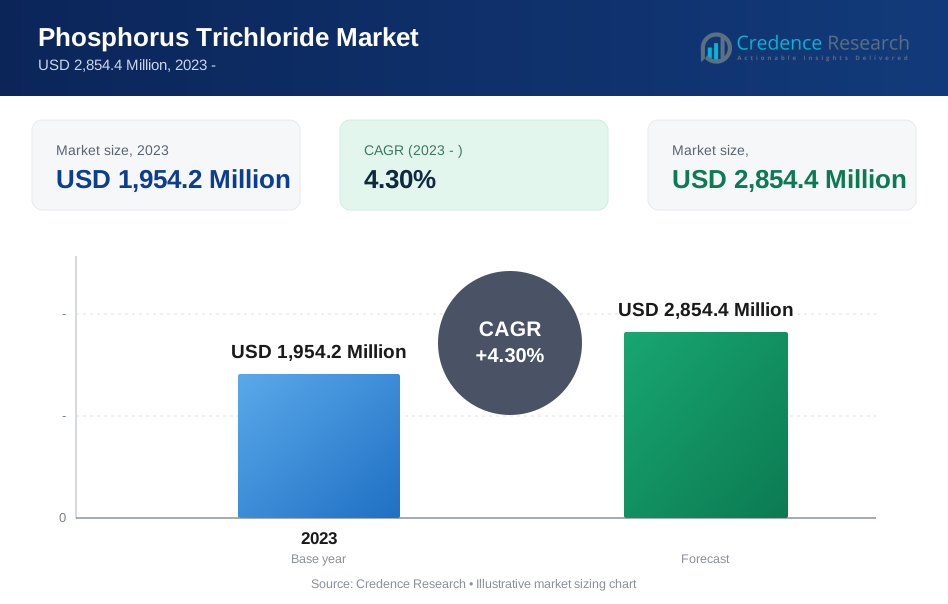
| Phosphorus Trichloride Market Size 2023 | USD 1,954.2 Million |
| Phosphorus Trichloride Market, CAGR | 4.30% |
| Phosphorus Trichloride Market Size 2032 | USD 2,854.4 Million |
Market Insights
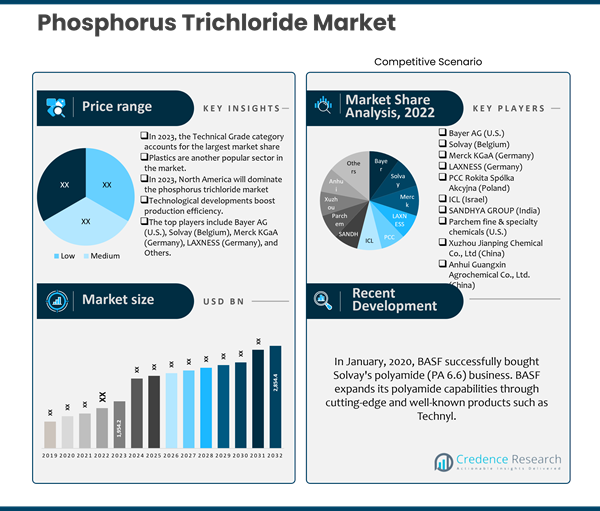
- The global demand for Phosphorus Trichlorides was valued at USD 1,954.2 Million in 2023 and is expected to reach USD 2,854.4 Million in 2032, growing at a CAGR of 4.30% between 2024 and 2032.
- In 2023, the Technical Grade category accounts for the largest market share, whereas the High-Purity Grade sector, albeit smaller in market share
- The Phosphorus Trichloride Market is dominated by agrochemicals, with pharmaceuticals being one of the fastest-expanding areas. Plastics are another popular area in the market.
- The global phosphorus trichloride market is dominated by the agrochemicals business, while the electronics industry is in high demand.
- In 2023, North America will dominate the phosphorus trichloride market, followed by Europe. Asia-Pacific is predicted to develop at the quickest CAGR between 2023 and 2032.
- Increasing manufacturing of agrochemicals and flame retardants.
- Stringent regulatory regulations affect the manufacturing and usage of phosphorus trichloride.
Executive Summary
Market Definition
Phosphorus trichloride (PCl3) is a chemical compound that is widely used in the chemical industry for a variety of applications. Its principal use is the synthesis of organophosphorus compounds, which are used to manufacture flame retardants, plasticizers, and agrochemicals. Demand for phosphorus trichloride is intrinsically connected to the growth of these end-use sectors. The agricultural business, in particular, drives agrochemical demand, and as the world's population expands, so will the demand for efficient and high-yield crop protection technologies. Furthermore, phosphorus trichloride is utilized in the production of pharmaceuticals, surfactants, and lubricants, increasing its overall market demand.
Market Overview
The global Phosphorus Trichloride market has witnessed steady growth in recent years and is expected to grow at a CAGR of 4.30% between 2024 and 2032. The market was valued at USD 1,954.2 million in 2023 and is expected to reach USD 2,854.4 million in 2032.
The global phosphorus trichloride sector is primarily driven by rising demand for commodity chemicals and agrochemicals. Organophosphonates are utilized in a variety of water treatment procedures, including cleansers, chelating agents, corrosion inhibitors, and scaling agents, which help to drive market expansion. Another major motivator is the growing demand for agrochemicals to suit the consumption needs of a rapidly growing population. Phosphorus trichloride is an important element in the production of gasoline additives, which are predicted to drive market expansion due to increased efficiency and fuel quality.
Furthermore, the high demand for phosphorus trichloride as a plasticizer, which is driven by its application in PVC for increased flexibility, plasticity, and durability, contributes to market expansion. The substance also serves as a raw material for the medicine Sulfadiazine, which is used to prevent diseases like rheumatic fever, chancroid, chlamydia, and Haemophilus influenzae. According to the New England Journal of Medicine, 33.4 million cases of rheumatic cardiac disease and 10.5 million disability-adjusted life years worldwide are caused by rheumatic cardiovascular disease, highlighting the growing sensitivity to cardiovascular and sexually transmitted conditions, which is driving market growth. Additionally, phosphorus trichloride is used in rubber-metal electrodeposition and flame retardant manufacturing.
Segmentation by Grade
- In 2023, The Technical Grade segment accounts for the greatest market share in the Phosphorus Trichloride Market. This category serves a wide range of industries and applications, including pesticide, herbicide, and chemical manufacturing.
- The High-Purity Grade segment, albeit smaller in market share, is critical in industries that demand highly pure Phosphorus Trichloride, such as electronics and semiconductors.
Segmentation by Applications
- Agrochemicals dominate the Phosphorus Trichloride Market. Phosphorus Trichloride is used by agrochemicals to make insecticides and fertilizers that are essential for increasing crop yield and protecting plants from pests and illnesses.
- Pharmaceuticals are one of the market's fastest-expanding segments. Phosphorus Trichloride is a critical step in the manufacture of active pharmaceutical ingredients (APIs) used in a variety of treatments.
- Another popular area in the Phosphorus Trichloride Market is Plastics. Phosphorus trichloride is used in the manufacturing of flame retardants for plastics, which improves their fire resistance.
Segmentation by End User
- The agrochemicals industry dominates the global trichloride phosphorus market and is projected to stay so throughout the forecast period. Because of the global increase in herbicide and pesticide usage, the agrochemicals sector is predicted to grow at a rapid pace during the forecast period.
- The Electronics Industry is in high demand in the Phosphorus Trichloride Market. Phosphorus Trichloride is used in the electronics industry to produce semiconductors and electronic components. The demand for Phosphorus Trichloride in the Electronics Industry originates from its involvement in the creation of high-purity chemicals required for electronic devices, which ensure the performance and dependability of electronic products.
Segmentation by Region
- In 2023, North American phosphorus trichloride market will lead this industry.
- Europe has the second-largest market for phosphorus trichloride.
- The Asia-Pacific phosphorus trichloride market is expected to grow at the fastest CAGR between 2023 and 2032.
- The rest of the world, including Latin America, the Middle East, and Africa, supplies the remaining demand for Phosphorus Trichloride.
The North American phosphorus trichloride market will lead this market due to the large number of chemical enterprises in the region that have a high demand for phosphorus trichloride. Customers' growing health concerns, as well as the requirement for food supply, are driving up demand. Furthermore, consumer demand has a positive impact on the US pharmaceutical industry.
Europe's phosphorus trichloride market is the second-largest, driven by rising demand from key end-use sectors such as chemicals, plastics, and polymers.The primary driver of this market is the production of fertilizers, insecticides, and pesticides with phosphorus trichloride. The market expansion in the next years is expected to be driven by increased demand for improved agricultural yields and an expanding population.
Furthermore, the Asia-Pacific phosphorus trichloride market is predicted to develop at the quickest CAGR between 2023 and 2032. The development of sectors such as medicines, agrochemicals, plasticizers, insecticides, and others has contributed significantly to the expansion of this market in Asia Pacific. The regional phosphorus trichloride market is growing due to rapid chemical industry, rising disposable income, and changing lifestyles. China has been designated as the region's largest market shareholder. Furthermore, China's phosphorus trichloride market had the highest market share, while India's phosphorus trichloride market was the fastest expanding in Asia-Pacific.
Key Highlights of the Report
The global Phosphorus Trichloride market is segmented by Grade, Applications, End Users, and region. In 2023, the Technical Grade sector will account for the largest market share, with Agrochemicals dominating the Phosphorus Trichloride Market. Furthermore, pharmaceuticals are one of the market's fastest-growing categories, while the electronics industry is in high demand. Plastics are also a major segment of the Phosphorus Trichloride Market, with North America leading the market growth.
The market's primary drivers are rising demand for agrochemicals, the expansion of the chemical manufacturing industry, and their use in pesticide and herbicide manufacture. Additionally, stringent chemical handling requirements, environmental issues related to production, and health and safety risks associated with handling are major market limitations. Expansion into new application areas, technological breakthroughs in manufacturing processes, and a growing focus on sustainable and eco-friendly practices are all major opportunities for the industry.
Nonetheless, The North American phosphorus trichloride market will dominate this market due to the region's huge number of chemical firms with a strong demand for phosphorus trichloride. Customers' increasing health concerns, combined with the need for food supply, are pushing rising demand. Furthermore, Europe's phosphorus trichloride market is the second-largest, owing to increased demand from key end-use industries such as chemicals, plastics, and polymers.Furthermore, the Asia-Pacific phosphorus trichloride market is expected to grow at the fastest CAGR between 2023 and 2032.
What Are The Main Drivers Of The Global Phosphorus Trichloride Market?
The growing demand for agrochemicals, the continued expansion of the chemical manufacturing industry, and its critical function in pesticide and herbicide production all have a favorable impact on the Phosphorus Trichloride Market.
What Are The Major Challenges Faced By The Global Phosphorus Trichloride Market?
The market faces obstacles due to tight chemical handling laws, environmental concerns related to its manufacturing methods, and the potential health and safety issues associated with its use.
What Are The Growth Opportunities In The Global Phosphorus Trichloride Market?
Despite these challenges, there are chances for growth in the Phosphorus Trichloride Market by diversifying into new application areas, capitalizing on technological advancements in manufacturing methods, and aligning with the industry's shift toward sustainable and eco-friendly practices.
Market Drivers
Increasing Usage In The Production Of Agrochemicals And Flame Retardants
The increasing use of phosphorus trichloride in agrochemical and flame retardant manufacture is considerably driving market expansion. Phosphorus Trichloride is used in the agrochemical sector to initiate or manufacture pesticides and herbicides, which are critical crop protection products that increase agricultural productivity. It is used in flame retardants to improve fire resistance in a variety of products, including textiles, plastics, and electronics. The increasing need for agrochemicals due to expanding food demands, as well as rapidly developing worries about fire safety standards across industries, are two main reasons driving market expansion, as these applications continue to fuel demand for Phosphorus Trichloride.
Market Restraints
Stringent Regulatory Measures Impacting The Production And Use Of Phosphorus Trichloride
Stringent regulatory restrictions have severely limited market expansion, negatively impacting the manufacture and subsequent use of Phosphorus Trichloride. The handling, storage, and disposal of certain chemicals, such as phosphorus trichloride, are also subject to tougher environmental and safety regulations. This compliance necessitates more investment in not only infrastructure and procedures but also safety features, raising the cost of manufacturing for enterprises. As a result, some compounds, such as phosphorus trichloride, have limited uses in certain applications, restricting market potential and innovation. In a word, it is exhausting for organizations operating in the Phosphorus Trichloride market to comply with regulatory requirements while also competing, which influences slow growth and development.
Opportunities
Exploration Of New Markets And Geographical Expansion For Phosphorus Trichloride
The opportunity presented by research into new markets and geographical expansion of Phosphorus Trichloride is most attractive for increasing the market. This helps companies to enter untapped markets and expand geographically, giving access to new customer bases, diversification of sources of revenue streams, and expansion opportunities in new markets. Introducing Phosphorus Trichloride to areas that show growing industrial sectors or increasing agricultural activities may open up fresh avenues of demand. Geographical expansion can also help hedge risks associated with market fluctuations in specific regions and build market resilience. Businesses can strategize entry into emerging markets that can leverage growing demand globally for chemicals like Phosphorus Trichloride and fuel business growth with an improved market presence. This will enhance market share and lead to revenue growth, assuring long-term viability in the competitive landscape that defines the chemical sector.
Competitive Landscape
Key Players
The global Phosphorus Trichloride market is highly competitive, with several key players. Some of the major players in the market and their market share are as follows:
- Bayer AG (U.S.)
- Solvay (Belgium)
- Merck KGaA (Germany)
- LAXNESS (Germany)
- PCC Rokita Spólka Akcyjna (Poland)
- ICL (Israel)
- SANDHYA GROUP (India)
- Parchem fine & specialty chemicals (U.S.)
- Xuzhou Jianping Chemical Co., Ltd (China)
- Anhui Guangxin Agrochemical Co., Ltd. (China)
- Excel Industries Ltd (India)
- Shandong Futong Chemical Co., Ltd. (China)
- Henan Qingshuiyuan Technology Co., Ltd. (China)
- Jiangsu Tianyuan Chemical Co., Ltd. (China)
- Jiangsu Yoke Technology Co., Ltd. (China)
- Shandong Yangmei Hengtong Chemical Co., Ltd. (China)
- UPL Limited (India)
- Xuzhou Jianping Chemical Co., Ltd. (China)
- Xuzhou Yongli Fine Chemical Co., Ltd. (China)
- Zhejiang Xinan Chemical Industrial Group Co., Ltd, (China)
- Others
These organizations prioritize product innovation, distribution channel expansion, and mergers and acquisitions to stay competitive.
The global Phosphorus Trichloride market's key players continually seek to stay ahead by offering new products and developments.
In January 2022, Syngenta Crop Protection AG has acquired two breakthrough bioinsecticides, NemaTrident® and UniSpore, from Bionema Limited, a leading developer of biocontrol technology. These purchases will strengthen Syngenta's portfolio by providing customers with new and complementary solutions for sustainable insect pest management. This acquisition allows Syngenta to address developing insect resistance and control a wide range of pests across horticulture and ornamentals, turf amenity, and forestry, giving clients more effective solutions.
In February 2022, The Mosaic Company's acquisition of Plant Response, Inc. was completed in December 2021. Scott Porter from Cascadia Capital served as the exclusive financial advisor to Plant Response for this transaction.
How are Companies Performing in the Phosphorus Trichloride Market?
The phosphorus trichloride market is focused on new advancements that improve sustainability and lower carbon emissions. Many companies are investing in R&D to create more environmentally friendly and efficient production processes. To reduce their environmental footprint, they employ sustainable manufacturing techniques such as resource optimization, cleaner technology, and waste minimization at plants. Aside from that, organizations place a strong emphasis on supply chain sustainability through responsible raw material sourcing and ecologically friendly production cycles. In the process of promoting sustainability, companies work not just to meet regulatory obligations but also to ensure a cleaner future for the sector.
Overall, synergies for companies operating in the phosphorus trichloride market indicate a stronger commitment to sustainability and lower carbon emissions through responsible business practices that align with global environmental goals while ensuring long-term competitiveness within the competitive landscape.
Summary of Key Findings
- Exploring new markets and global expansion for phosphorus trichloride
- Market segmented by Grade, Applications, End Users, Industry Vertical, and region.
- The global trichloride phosphorus market is dominated by the agrochemicals industry
- Pharmaceuticals are one of the market's fastest-expanding categories.
- North America is leading market growth; the market is highly competitive with key players including Bayer AG (U.S.), Solvay (Belgium), Merck KGaA (Germany), LAXNESS (Germany), PCC Rokita Spólka Akcyjna (Poland), ICL (Israel), SANDHYA GROUP (India) and Others.
Future Outlook
- Continued increase in demand from the agrochemical sector
- Technological developments boost production efficiency.
- Increasing emphasis on sustainable practices that influence market trends
- Expanding into new application areas.
- Regulatory compliance and environmental concerns influence market dynamics.
How CXOs Can Benefit from the Credence Research Phosphorus Trichloride Market Report
The Credence Research Phosphorus Trichloride Market Report provides CXOs with a comprehensive overview of the market, including:
- Market size and growth forecast: The report provides detailed estimates of the global Phosphorus Trichloride market size, segmented by Grade, Application, End User, and region. It also includes forecasts for the market through 2032 based on key trends and drivers.
- Market segmentation: The report segments the Phosphorus Trichloride market by Grade, Application, End User, and region. This segmentation provides CXOs with a granular understanding of the market and the opportunities in each segment.
- Competitive Landscape: The report profiles the key players in the Phosphorus Trichloride market and provides insights into their strategies, product offerings, and financial performance. This information can help CXOs to identify and assess their competition.
- Key trends and drivers: The report identifies and analyzes the key trends and drivers that are shaping the Phosphorus Trichloride market. This information can help CXOs to make informed decisions about their investments and strategies.
CXOs can use the insights from the Credence Research Phosphorus Trichloride Market Report to:
- Identify growth opportunities: The report can help CXOs identify new growth opportunities in the Phosphorus Trichloride market. For example, the report may shed light on the increasing demand for natural and sustainable products globally, emphasizing the potential for Phosphorus Trichloride in various industries.
- Make informed investment decisions: The report can help CXOs make informed investment decisions about Phosphorus Trichloride. For example, the report may highlight the increasing adoption of Phosphorus Trichlorides in various industries, the projected market growth rate, key players in the market, and regulatory factors affecting the industry
- Develop competitive strategies: The report can help CXOs develop competitive strategies for their Phosphorus Trichloride businesses. For example, the report may offer information on innovative use cases for Phosphorus Trichlorides, potential partnerships or collaborations with other industry players, and strategies to differentiate products or services in the market.
- Track market developments: The report can help CXOs track market developments and stay ahead of the curve. For example, the report provides insights into the latest trends and innovations in the Phosphorus Trichloride market.
Overall, the Credence Research Phosphorus Trichloride Market Report is a valuable resource for CXOs who are looking to gain a deeper understanding of the market and identify opportunities for growth.
Segmentation
-
Grade:
- Technical Grade
- High-Purity Grade
-
Application:
- Organophosphorus Compounds
- Intermediates
- Pharmaceuticals
- Agrochemicals
- Plastics
- Dyes and Pigments
- Surfactants
-
End User:
- Chemical Industry
- Pharmaceutical Industry
- Agrochemical Industry
- Plastics Industry
- Textile Industry
- Personal Care and Household Products Industry
- Electronics Industry
-
By Region
- North America
- US
- Canada
- Mexico
- Europe
- Germany
- France
- UK
- Italy
- Spain
- Rest of Europe
- Asia Pacific
- China
- Japan
- India
- South Korea
- South-east Asia
- Rest of Asia Pacific
- Latin America
- Brazil
- Argentina
- Rest of Latin America
- Middle East & Africa
- GCC Countries
- South Africa
- Rest of Middle East and Africa
- North America
Adjacent Markets
In the Phosphorus Trichloride market, there are several adjacent markets which has high revenue growth opportunities. The key adjacent markets for Phosphorus Trichloride market -
Adjacent Markets |
||
| Sulfuric Acid Market | Potassium Hydroxide Market | Methanol Market |
| Nitrogen Fertilizers Market | Ammonia Market | Sodium Hydroxide Market |
| Chlorine Market | Ethylene Market | Phosphoric Acid Market |
Request a Free Sample
Fill in your details and we'll send you a free sample report.
- Sample data tables & charts
- Research methodology
Need a Custom Version of This Report?
Tailor the scope, geography, or segments to your exact requirements.
- Custom geography or segment scope
- Direct access to our analyst team
Frequently Asked Questions
What is the current size of the global Phosphorus Trichloride market?
What is the expected growth rate of the Phosphorus Trichloride market between 2024 and 2032?
Which segment is leading the market share in terms of Grade?
Which End User segment governs the demand for Phosphorus Trichlorides in the world?
Which Application segment is expected to post the fastest growth rate during the forecast period?
Which region is fueling the growth of the Phosphorus Trichloride industry?
Who are the major players in the global Phosphorus Trichloride market?
What are the major market drivers of the Phosphorus Trichloride industry?
What are the major market restraints of the Phosphorus Trichloride industry?
What are the major market opportunities of the Phosphorus Trichloride industry?
Table of Content
Chapter 1. Report Introduction
- 1.1 Report Description & Purpose
- 1.1.1 Report Title & Market Definition
- 1.1.2 Unique Selling Propositions (USP) & Key Differentiators
- 1.1.3 Value Proposition for Stakeholders
- 1.2 Research Objectives
- 1.2.1 Market Sizing Objectives (Volume & Revenue)
- 1.2.2 Segmentation Objectives
- 1.2.3 Competitive Intelligence Objectives
- 1.2.4 Forecast & Scenario Objectives
- 1.3 Report Scope
- 1.3.1 Phosphorus Trichloride Scope – Types & Subtypes Covered
- 1.3.2 Geographic Scope – Regions & Countries Covered
- 1.3.3 Historical Period, Base Year & Forecast Period (2023; forecast to the forecast period)
- 1.3.4 Inclusions & Exclusions
- 1.4 HS Code & Classification Framework
- 1.5 Currency, Units & Pricing Basis
- 1.6 Target Stakeholders
- 1.7 Limitations & Assumptions
Chapter 2. Executive Summary
- 2.1 Global Phosphorus Trichloride Market Snapshot
- 2.1.1 Market Size – Historical (2023) & Forecast (the forecast period) (2023: USD 1,954.2 Million → forecast year: USD 2,854.4 Million)
- 2.1.2 Volume & Revenue – Global Totals
- 2.1.3 Key Market Highlights – Top Five Facts
- 2.2 Phosphorus Trichloride Market Segmentation Snapshot
- 2.2.1 Market Split by Region – 2023 vs.
- 2.3 Competitive Snapshot
- 2.3.1 Top 10 Players by Revenue Share – 2023
- 2.3.2 Top 10 Players by Volume Share – 2023
- 2.3.3 Recent Strategic Developments (18-Month Summary)
- 2.4 Key Investment Highlights & Strategic Conclusions
Chapter 3. Phosphorus Trichloride Market Dynamics & Industry Analysis
- 3.1 Market Overview & Context
- 3.1.1 Phosphorus Trichloride Market Position in the Broader Automotive Value Chain
- 3.1.2 OEM vs. Replacement Market Dynamics
- 3.1.3 Market Maturity & Development Stage by Region
- 3.2 Phosphorus Trichloride Market Drivers
- 3.3 Phosphorus Trichloride Market Restraints & Challenges
- 3.4 Phosphorus Trichloride Market Opportunities
- 3.5 Porter's Five Forces Analysis
- 3.5.1 Threat of New Entrants
- 3.5.2 Bargaining Power of Suppliers
- 3.5.3 Bargaining Power of Buyers
- 3.5.4 Threat of Substitutes
- 3.5.5 Competitive Rivalry – Intensity Assessment
- 3.6 Phosphorus Trichloride Value Chain Analysis
- 3.6.1 Upstream – Raw Material/Input Suppliers
- 3.6.1.1 Raw Material/Input 1
- 3.6.1.2 Raw Material/Input 2
- 3.6.1.3 Raw Material/Input 3
- 3.6.2 Midstream – Production/Manufacturing/Service Delivery
- 3.6.2.1 Production/Process Overview
- 3.6.2.2 Key Facility Locations & Capacity by Manufacturer
- 3.6.3 Downstream – Distribution & End Consumer
- 3.6.3.1 Primary Channel – B2B/OEM
- 3.6.3.2 Secondary Channels – Dealer, Retail, Online, Direct
- 3.6.4 Value Chain Profitability Analysis
- 3.6.1 Upstream – Raw Material/Input Suppliers
- 3.7 PESTEL Analysis
- 3.7.1 Political Factors
- 3.7.2 Economic Factors
- 3.7.3 Social Factors
- 3.7.4 Technological Factors
- 3.7.5 Environmental Factors
- 3.7.6 Legal Factors
- 3.8 Phosphorus Trichloride Supply Chain Analysis
- 3.8.1 Raw Material/Input Supply Risk Assessment
- 3.8.2 Manufacturing Concentration Risk (Geographic Exposure)
- 3.8.3 Trade Disruption Impact Analysis
- 3.9 Regulatory & Policy Landscape
Note: The regulatory and policy landscape section covers regulations based on their applicability to the market, Phosphorus Trichloride category, geography, and scope of the study. Only regulatory frameworks with a material impact on operations, compliance, trade, sustainability, or market access are analyzed in detail.
Chapter 4. Key Investment Pockets & Opportunity Analysis
- 4.1 Phosphorus Trichloride Market Attractiveness Analysis
- 4.1.1 By Region – Investment Attractiveness Matrix (Volume × CAGR)
- 4.2 Absolute Revenue Growth Opportunity
- 4.2.1 By Region – Absolute USD Growth Through the forecast period
- 4.3 Incremental Volume Opportunity
- 4.3.1 By Region – Incremental Volume Through the forecast period
- 4.3.2 Segment – Incremental Volume
- 4.4 Emerging Submarket Opportunity Deep Dive (Subject to Applicability)
- 4.5 Emerging Market Opportunity Scorecards
- 4.5.1 United States
- 4.5.2 Europe
- 4.5.3 Asia
- 4.5.4 Middle East & Africa
Note: Emerging Market Opportunity Scorecards will be included based on relevance and strategic importance. Regions listed are indicative and may vary depending on data availability and market dynamics.
Chapter 5. Phosphorus Trichloride Import-Export Analysis & Trade Flows
- 5.1 Global Trade Overview
- 5.1.1 Global Export Value by Country (2023)
- 5.1.2 Global Export Volume by Country (2023)
- 5.1.3 Global Import Value by Country (2023)
- 5.1.4 Global Import Volume by Country (2023)
- 5.1.5 Net Trade Balance by Country (2023)
- 5.2 Export Analysis – Segment
- 5.2.1 Type 1 (HS Code)
- 5.2.2 Type 2 (HS Code)
- 5.2.3 Type 3 (HS Code)
- 5.2.4 Type 4 (HS Code)
- 5.2.5 Type 5 (HS Code)
- 5.3 Import Analysis – Segment
- 5.3.1 Type 1 (HS Code)
- 5.3.2 Type 2 (HS Code)
- 5.3.3 Type 3 (HS Code)
- 5.3.4 Type 4 (HS Code)
- 5.3.5 Type 5 (HS Code)
- 5.4 Average Unit Trade Prices
- 5.4.1 Average Export Price – Segment & Country
- 5.4.2 Average Import Price – Segment & Source Country
- 5.4.3 Price Trends (2023)
- 5.5 Key Trade Route Analysis
- 5.5.1 Trade Route 1
- 5.5.2 Trade Route 2
- 5.5.3 Trade Route 3
- 5.5.4 Trade Route 4
- 5.5.5 Trade Route 5
- 5.6 Trade Policy Impact Assessment
- 5.6.1 US Anti-Dumping & Section 301 Tariffs
- 5.6.2 EU Customs Union Impact
- 5.6.3 Major Free Trade Agreements
- 5.6.4 USMCA Rules of Origin
Note: Trade policy analysis will be included only where relevant to the Phosphorus Trichloride market.
Chapter 6. Competitive Landscape & Company Benchmarking
- 6.1 Phosphorus Trichloride Market Concentration & Structure
- 6.1.1 Herfindahl-Hirschman Index (HHI) – vs. 2023
- 6.1.2 Tier 1, Tier 2 & Tier 3 Market Structure
- 6.1.3 Global, Regional & Local Player Dynamics
- 6.2 Phosphorus Trichloride Market Share Analysis – 2023
- 6.2.1 Global Revenue Share by Company
- 6.2.2 Global Volume Share by Company
- 6.2.3 Regional Revenue Share
- 6.2.4 Market Share Evolution ( vs. 2023)
- 6.2.5 OEM Segment Share by Company
- 6.2.6 Replacement Segment Share by Company
- 6.3 Production/Delivery Capacity & Facility Analysis
- 6.3.1 Global Installed Capacity
- 6.3.2 Capacity Utilization Rates
- 6.3.3 Production/Output Volume
- 6.3.4 Facility Locations & Capacity Map
- 6.3.5 Planned Capacity Additions
- 6.4 Phosphorus Trichloride Competitive Benchmarking Matrix
- 6.4.1 Revenue, Volume, CAGR & Profitability Comparison
- 6.4.2 Channel Revenue Mix
- 6.4.3 Geographic Revenue Exposure
- 6.4.4 R&D Intensity
- 6.4.5 Sustainability Maturity
- 6.5 Strategic Developments in Phosphorus Trichloride (Last 24 Months)
- 6.5.1 Mergers, Acquisitions & Divestments
- 6.5.2 New Phosphorus Trichloride Launches
- 6.5.3 Facility Expansions
- 6.5.4 Strategic Alliances, Joint Ventures & Partnerships
- 6.5.5 Distribution Expansion & Market Entry
- 6.5.6 Sustainability & ESG Initiatives
- 6.6 Competitive Strategy Mapping
- 6.6.1 Leader, Challenger, Follower & Niche Classification
- 6.6.2 Pricing Strategy Comparison
- 6.6.3 Channel Strategy Matrix
Note: Strategic developments are included based on their materiality and the availability of reliable information.
Chapter 7. Global Phosphorus Trichloride Market – By Distribution Channel
- 7.1 Segment Overview
- 7.1.1 Volume & Revenue Split by Channel (2023 & )
- 7.1.2 Channel Mix Evolution (the forecast period)
Chapter 8. Regional Market Analysis – Global Overview
- 8.1 Global Regional Overview
- 8.1.1 Regional Volume Share
- 8.1.2 Regional Revenue Share
- 8.1.3 Regional Volume by Region
- 8.1.4 Regional Revenue by Region
- 8.1.5 Regional Forecast Through the forecast period
- 8.2 Cross-Regional Segment Analysis
- 8.2.1 By Distribution Channel
- 8.2.2 By Brand/Price Tier
Chapter 9. North America Phosphorus Trichloride Market
- 9.1 United States
- 9.2 Canada
- 9.3 Mexico
Chapter 10. Europe Phosphorus Trichloride Market
- 10.1 Germany
- 10.2 France
- 10.3 Italy
- 10.4 United Kingdom
- 10.5 Spain
- 10.6 Poland
- 10.7 Russia
- 10.8 Netherlands
- 10.9 Belgium
- 10.10 Sweden
- 10.11 Denmark
- 10.12 Norway
- 10.13 Rest of Europe
Chapter 11. Asia Pacific Phosphorus Trichloride Market
- 11.1 China
- 11.2 India
- 11.3 Japan
- 11.4 South Korea
- 11.5 Thailand
- 11.6 Indonesia
- 11.7 Vietnam
- 11.8 Malaysia
- 11.9 Australia
- 11.10 Rest of Asia Pacific
Chapter 12. Latin America Phosphorus Trichloride Market
- 12.1 Brazil
- 12.2 Argentina
- 12.3 Colombia
- 12.4 Chile
- 12.5 Rest of Latin America
Chapter 13. Middle East Phosphorus Trichloride Market
- 13.1 Saudi Arabia
- 13.2 United Arab Emirates
- 13.3 Turkey
- 13.4 Israel
- 13.5 Iran
- 13.6 Rest of the Middle East
Chapter 14. Africa Phosphorus Trichloride Market
- 14.1 South Africa
- 14.2 Egypt
- 14.3 Nigeria
- 14.4 Morocco
- 14.5 Rest of Africa
Chapter 15. Phosphorus Trichloride Company Profiles
- 15.1 [Company 01]
- 15.1.1 Company Overview
- 15.1.2 Key Management Personnel
- 15.1.3 Products & Services Portfolio
- 15.1.4 Financial Performance
- 15.1.5 Key Market Focus & Geographic Presence
- 15.1.6 Recent Developments & Strategic Initiatives
Note: The company profile list is preliminary and may change based on research findings, market developments, data availability, and client requirements.
Chapter 16. Appendices
- Appendix A – List of Abbreviations & Acronyms
- Appendix B – Industry Classification Code Reference – Full Series
- Appendix C – Production & Capacity Data Tables
- Appendix D – End-Use & Demand Base Tables
- Appendix E – Consumption & Replacement Rate Assumptions
- Appendix F – ASP Reference Tables
- Appendix G – Manufacturing & Facility Database
- Appendix H – Import-Export Data Tables
- Appendix I – Regulatory Summary Tables
- Appendix J – Primary Research Participant List (Anonymized)
- Appendix K – Primary Research Questionnaire Framework
- Appendix L – Data Sources & Bibliography
- Appendix M – Market Size Divergence & Source Comparison
Chapter 17. Research Methodology
- 17.1 Research Framework & Philosophy
- 17.2 Secondary Research – Sources, Hierarchy & Data Extraction
- 17.3 Data Modeling – Bottom-Up & Top-Down Market Sizing
- 17.4 Primary Research – Stakeholder Framework, LOI & Sample Sizes
- 17.5 Forecast Methodology – Regression, Scenario & Sensitivity Analysis
- 17.6 Quality Control – Four-Layer Validation Framework
- 17.7 Limitations & Standard Assumptions
- 17.8 Disclaimer
