
| REPORT ATTRIBUTE | DETAILS |
|---|---|
| Historical Period | 2020-2023 |
| Base Year | 2024 |
| Forecast Period | 2025-2032 |
| Positive Displacement Sanitary Pumps Market Size 2024 | USD 8,961.4 million |
| Positive Displacement Sanitary Pumps Market, CAGR | 7.13% |
| Positive Displacement Sanitary Pumps Market Size 2032 | USD 15,577.3million |
Market Overview:
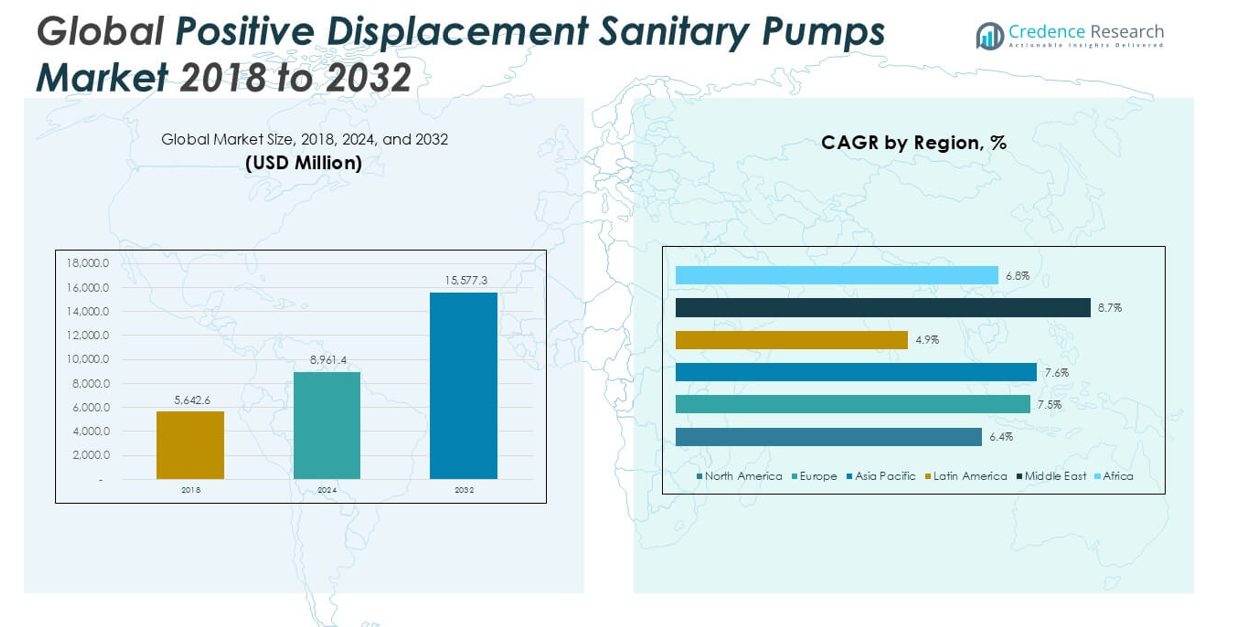
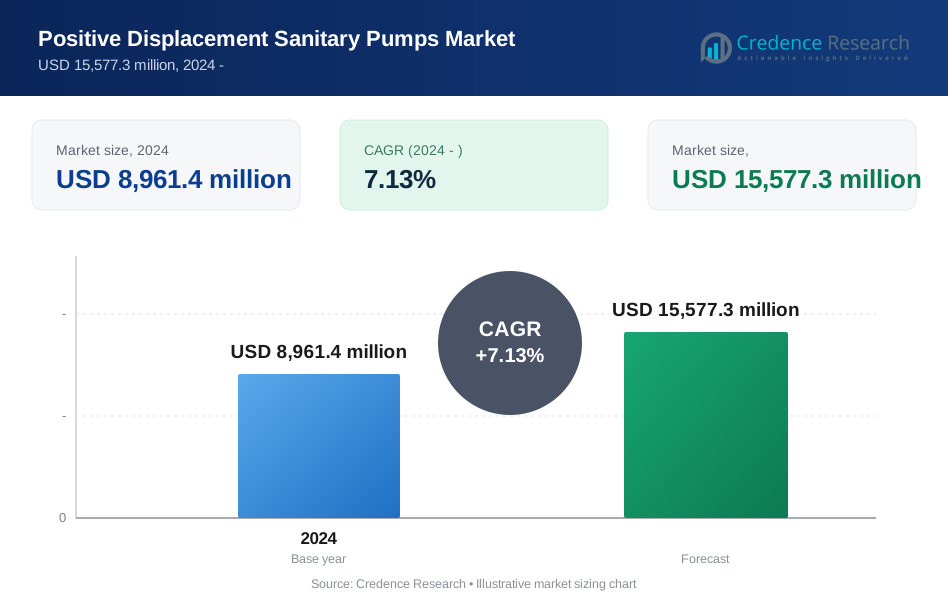
The Positive Displacement Sanitary Pumps market size was valued at USD 5,642.6 million in 2018, reached USD 8,961.4 million in 2024, and is anticipated to reach USD 15,577.3 million by 2032, at a CAGR of 7.13% during the forecast period.
The Positive Displacement Sanitary Pumps market is led by prominent players such as IDEX Corporation, SPX Corporation, Fristam Pumps USA, Xylem, Inc., PSG Dover, Alfa Laval AB, ITT Corporation, Ampco Pumps GmbH, Axiflow Technologies, Inc., and Sulzer Ltd. These companies maintain a competitive edge through innovative product offerings and robust global networks. Asia Pacific holds the leading regional position, capturing 35.7% of the global market share in 2024, driven by rapid industrialization and substantial investments in food processing, pharmaceuticals, and water treatment infrastructure. Europe and North America follow, benefitting from stringent hygiene regulations and established manufacturing sectors.
Market Insights
- The Positive Displacement Sanitary Pumps market reached USD 8,961.4 million in 2024 and is projected to achieve USD 15,577.3 million by 2032, reflecting a CAGR of 7.13% during the forecast period.
- Rising demand in the food and beverage sector, coupled with stringent hygiene regulations in pharmaceuticals and biotechnology, drives widespread adoption of sanitary pumps across key industries.
- Leading players such as IDEX Corporation, SPX Corporation, and Alfa Laval AB focus on innovation and digital integration to differentiate offerings, while consolidation through mergers and acquisitions enhances their global reach.
- High initial investment and ongoing maintenance costs, along with complex regulatory compliance, remain significant restraints for new entrants and small to mid-sized enterprises in the market.
- Asia Pacific dominates with a 35.7% market share in 2024, followed by Europe at 25.4% and North America at 20.8%, while the pumps segment remains the leading product category, especially rotary positive displacement pumps.
Market Segmentation Analysis:
By Product:
Within the Positive Displacement Sanitary Pumps market, the Pumps segment holds the dominant market share, driven by its widespread application in critical sanitary operations. Among pump types, Rotary Positive Displacement Sanitary Pumps account for the largest share, owing to their robust performance, efficient handling of viscous fluids, and superior hygiene compliance. These attributes make them a preferred choice in industries requiring stringent sanitary standards. The Components segment, while smaller, experiences steady demand from replacement and maintenance activities, supporting the overall functionality and reliability of pump systems.
- For instance, Alfa Laval’s SRU rotary lobe pump handles product viscosities up to 1,000,000 cP and operates at capacities up to 106 cubic meters per hour, supporting intensive applications in food and pharma manufacturing.
By Industry Vertical:
The Food & Beverages segment leads the Positive Displacement Sanitary Pumps market by industry vertical, representing the highest revenue share due to stringent hygiene requirements and the need for consistent, contamination-free fluid transfer. This dominance is supported by the growing demand for processed foods, dairy, and beverages, which require reliable sanitary pumping solutions. Other significant contributors include Pharmaceuticals and Biotechnology, where precise dosing and contamination control are critical drivers. Emerging demand in Water Treatment and Chemical Processing & Textiles further broadens the market’s application scope, reinforcing steady growth across diverse verticals.
- For instance, Fristam Pumps USA provides positive displacement pumps for cheese plants that process up to 454,000 liters of milk daily for cheese production, ensuring compliance with FDA and 3A Sanitary Standards.
Market Overview
Rising Demand in Food & Beverage Processing
Growth in the global food and beverage sector drives strong demand for positive displacement sanitary pumps. Manufacturers invest in advanced sanitary equipment to meet regulatory standards and consumer expectations for product safety. These pumps are preferred for their ability to handle viscous and sensitive food products without contamination, supporting automation and quality consistency. Expanding consumption of processed foods, dairy, and beverages worldwide further accelerates market adoption, making the food and beverage industry the primary growth engine for this segment.
- For instance, SPX FLOW’s Universal 3 Series pump supports continuous operation in production lines handling up to 3,800 liters per hour for confectionery applications.
Stringent Hygiene and Regulatory Requirements
Stringent hygiene standards and regulatory frameworks across pharmaceutical, biotechnology, and personal care sectors significantly boost the adoption of positive displacement sanitary pumps. Regulatory bodies enforce strict compliance for cleanliness, clean-in-place (CIP) capabilities, and material traceability. This pushes industries to replace older equipment with advanced sanitary pumps that minimize cross-contamination and ensure safe processing of critical fluids. The ongoing evolution of global safety standards continues to stimulate demand for reliable and certifiable pump technologies.
- For instance, ITT Bornemann’s SLH series achieves a surface finish of Ra 0.4 μm and supports full CIP and SIP protocols in pharmaceutical manufacturing.
Expansion of Water Treatment Infrastructure
The rapid development of water treatment facilities, especially in emerging economies, fuels demand for positive displacement sanitary pumps. These pumps are crucial for precise chemical dosing, sludge handling, and reliable fluid transfer under sanitary conditions. Growing investments in municipal and industrial water treatment, driven by population growth and environmental regulations, create opportunities for pump manufacturers. The ability to deliver performance in harsh environments further cements their importance in water and wastewater management systems.
Key Trends & Opportunities
Technological Advancements and Automation
The integration of automation and smart technologies into sanitary pump systems is a major trend transforming the market. Manufacturers are introducing pumps with digital monitoring, predictive maintenance, and remote control capabilities. This shift enhances operational efficiency, reduces downtime, and supports data-driven maintenance decisions. Automation also helps end-users comply with stringent sanitary protocols, creating growth opportunities for suppliers offering advanced, connected pump solutions.
- For instance, Xylem’s Smart Pump integrates real-time monitoring with up to 15 onboard sensors tracking vibration, temperature, and pressure, enabling advanced predictive maintenance scheduling.
Increasing Focus on Energy Efficiency and Sustainability
Sustainability initiatives and rising energy costs are prompting end-users to seek energy-efficient sanitary pump solutions. Innovative designs that minimize energy consumption and material waste are gaining traction, especially in environmentally conscious industries. The market sees opportunities for pumps constructed from recyclable materials and featuring energy-saving motors, supporting both regulatory compliance and corporate sustainability objectives. This trend is expected to drive long-term market evolution.
- For instance, PSG Dover’s Quattroflow QF1200 model consumes only 0.55 kW at full operation and utilizes replaceable diaphragms that are 100% recyclable, supporting sustainable manufacturing practices in the life sciences sector.
Key Challenges
High Initial Investment and Maintenance Costs
Positive displacement sanitary pumps often require significant upfront investment and ongoing maintenance, posing a barrier for small and medium enterprises. Advanced sanitary designs, specialized materials, and compliance features increase acquisition costs, while regular cleaning and component replacement add to operational expenses. These financial challenges may deter adoption in cost-sensitive sectors, particularly where budget constraints persist.
Complex Regulatory Compliance and Certification
Navigating the complex regulatory landscape across multiple industries and regions presents ongoing challenges for manufacturers. Securing certifications such as FDA, EHEDG, or 3A Sanitary Standards involves extensive testing, documentation, and periodic audits. Variations in local and international compliance requirements create added complexity, potentially delaying product launches and increasing administrative overhead for pump producers seeking to serve a global market.
Regional Analysis
North America
North America accounted for a market size of USD 1,172.53 million in 2018, rising to USD 1,793.82 million in 2024 and projected to reach USD 2,959.68 million by 2032, reflecting a CAGR of 6.4%. The region held approximately 20.8% market share in 2024, supported by well-established food and pharmaceutical industries, and a strong focus on regulatory compliance. Investment in advanced processing facilities and ongoing upgrades in sanitary standards continue to drive steady growth across the United States and Canada.
Europe
Europe’s market for positive displacement sanitary pumps reached USD 1,405.00 million in 2018, grew to USD 2,273.63 million in 2024, and is forecasted to achieve USD 4,050.09 million by 2032, registering a CAGR of 7.5%. With a 25.4% share in 2024, Europe remains a leading region, driven by strict hygiene regulations and advanced manufacturing in food, beverage, and pharmaceutical sectors. Countries such as Germany, France, and the UK remain key contributors, emphasizing sustainable and energy-efficient solutions.
Asia Pacific
Asia Pacific led the market with USD 1,962.48 million in 2018, expanding to USD 3,202.04 million in 2024 and estimated to reach USD 5,763.59 million by 2032, at a CAGR of 7.6%. Holding the highest regional market share at 35.7% in 2024, rapid industrialization, urbanization, and robust growth in the food, pharmaceutical, and water treatment sectors across China, India, and Southeast Asia fuel demand. Increasing infrastructure investments and expanding manufacturing bases underpin the region’s dominant position.
Latin America
Latin America reported a market value of USD 595.86 million in 2018, which rose to USD 848.00 million in 2024 and is expected to reach USD 1,246.18 million by 2032, with a CAGR of 4.9%. Representing about 9.5% of the global market in 2024, the region’s growth is primarily driven by modernization in the food processing industry and rising healthcare investments, especially in Brazil and Mexico. Ongoing improvements in water treatment infrastructure also support steady market expansion.
Middle East
The Middle East market size stood at USD 276.49 million in 2018, increasing to USD 485.20 million in 2024 and projected to reach USD 950.21 million by 2032, the fastest CAGR at 8.7%. With a 5.4% market share in 2024, the region benefits from significant investments in pharmaceuticals, water treatment, and food processing sectors. Growth in urban infrastructure and focus on hygiene standards are key drivers supporting increased adoption of sanitary pump technologies across the Gulf Cooperation Council countries.
Africa
Africa’s market reached USD 230.22 million in 2018, rising to USD 358.71 million in 2024 and forecast to hit USD 607.51 million by 2032, showing a CAGR of 6.8%. The region represented about 3.9% of the market in 2024, with growth supported by the expansion of food and beverage industries and investments in water sanitation projects. Increasing awareness of hygiene standards, combined with foreign investments in industrial development, is gradually driving the demand for positive displacement sanitary pumps in African markets.
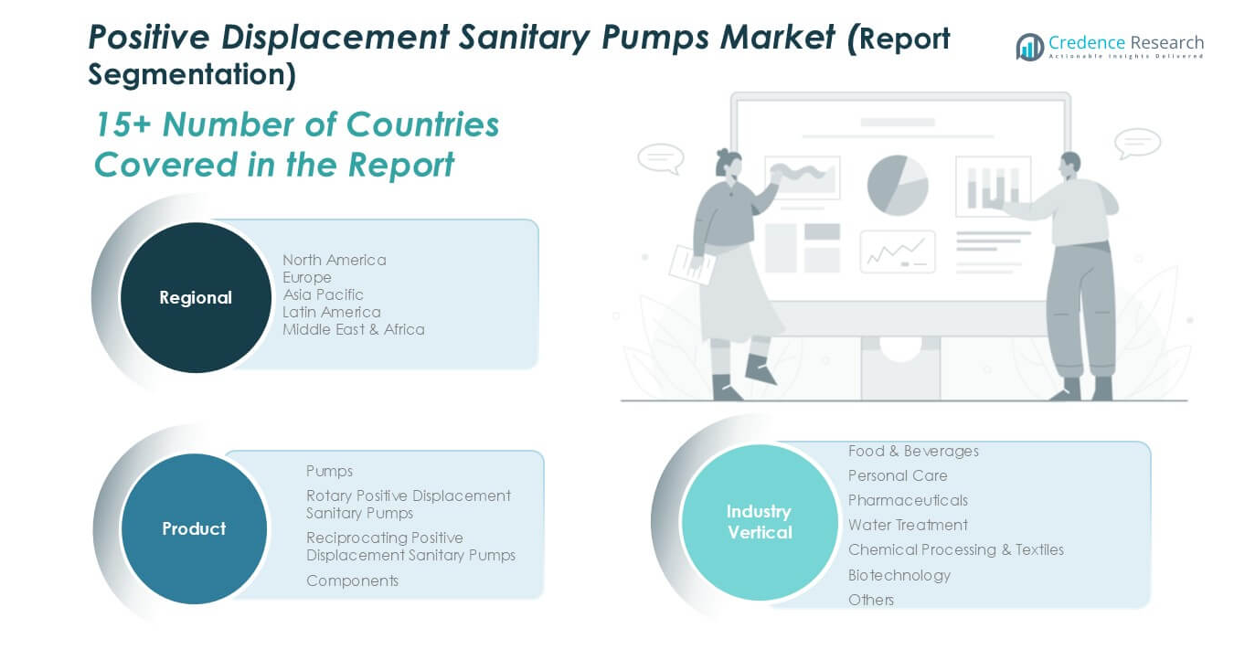
Market Segmentations:
By Product:
- Pumps
- Rotary Positive Displacement Sanitary Pumps
- Reciprocating Positive Displacement Sanitary Pumps
- Components
By Industry Vertical:
- Food & Beverages
- Personal Care
- Pharmaceuticals
- Water Treatment
- Chemical Processing & Textiles
- Biotechnology
- Others
By Geography:
- North America
- U.S.
- Canada
- Mexico
- Europe
- Germany
- France
- U.K.
- Italy
- Spain
- Rest of Europe
- Asia Pacific
- China
- Japan
- India
- South Korea
- South-east Asia
- Rest of Asia Pacific
- Latin America
- Brazil
- Argentina
- Rest of Latin America
- Middle East & Africa
- GCC Countries
- South Africa
- Rest of the Middle East and Africa
Competitive Landscape
The competitive landscape of the Positive Displacement Sanitary Pumps market features a mix of established multinational corporations and specialized regional players, resulting in moderate market concentration. Leading companies such as IDEX Corporation, SPX Corporation, Fristam Pumps USA, Xylem, Inc., PSG Dover, Alfa Laval AB, ITT Corporation, Ampco Pumps GmbH, Axiflow Technologies, Inc., and Sulzer Ltd. command significant market share through diversified product portfolios, global distribution networks, and strong brand recognition. These players continually invest in research and development to introduce advanced pump technologies that enhance energy efficiency, hygiene, and automation capabilities. Strategic mergers, acquisitions, and partnerships remain prevalent, enabling companies to expand their geographic presence and address evolving customer requirements in food processing, pharmaceuticals, and water treatment sectors. Competitive differentiation is increasingly shaped by the ability to offer reliable, compliant, and customized solutions, as well as responsive aftersales support and digital integration, strengthening customer loyalty and market position.
Key Player Analysis
- IDEX Corporation
- SPX Corporation
- Fristam Pumps USA
- Xylem, Inc.
- PSG Dover
- Alfa Laval AB
- ITT Corporation
- Ampco Pumps GmbH
- Axiflow Technologies, Inc.
- Sulzer Ltd.
Recent Developments
- In June 2025, Dover Corporation acquired ipp Pump Products GmbH, a specialized manufacturer of sanitary pump technologies, including hygienic lobe and progressive pumps. This acquisition significantly expands Dover's and PSG's capabilities in critical hygienic applications for food and beverage, cosmetics, pharmaceuticals, and other industries.
- In February 2025, SPX FLOW's APV brand launched the next generation of its DW Series. This new pump is engineered for high-value, high-viscosity products in food and beverage, personal care, pet food, and industrial applications. Key features include pulsation-free, low-shear operation, versatile configuration with interchangeable rotors, an integrated pressure relief valve, energy-efficient performance, and gentle product handling.
- In January 2025, Fristam introduced the FDS Nano Twin Screw Pump, specifically designed for low-flow, precise, and delicate fluid transfer applications. This launch highlights their ongoing commitment to innovation in twin-screw technology, particularly for sanitary applications within industries like pharmaceuticals, food, and cosmetics, according to Fristam Pumps India Pvt Ltd.and FOOD ENGINEERING Magazine. The pump's twin-screw design ensures gentle handling of viscous and sensitive fluids, minimizing shear and maintaining product integrity.
- In March 2024, ITT Inc. announced a $11 million investment to expand pump testing capabilities at its Industrial Process (IP) sites in Germany, India, and Saudi Arabia. This investment aims to enhance capacity for large project awards, particularly focusing on centrifugal, twin-screw, and positive displacement pumps, including those used in sanitary applications. The expansion is expected to be completed in the third quarter of 2024.
- In November 2023, PSG Biotech's Quattroflow (a sister brand to Quantex within PSG) launched a new single-use micropump, the QB2-SD, based on Quantex's single-use rotary pump technology. This is a significant development for biopharmaceutical applications where single-use solutions are increasingly preferred for hygiene and cross-contamination prevention.
Market Concentration & Characteristics
The Positive Displacement Sanitary Pumps market demonstrates a moderate to high degree of concentration, with a select group of global leaders accounting for a substantial portion of industry revenue. Multinational corporations such as IDEX Corporation, SPX Corporation, Alfa Laval AB, and Xylem, Inc. shape the competitive environment through strong brand presence, wide distribution networks, and robust investment in research and development. The market exhibits a strong emphasis on innovation, compliance with stringent hygiene standards, and customized solutions tailored to industry-specific requirements. Food and beverage, pharmaceuticals, and biotechnology sectors remain the primary demand generators, valuing reliability, energy efficiency, and minimal risk of contamination. Product portfolios feature advanced rotary and reciprocating pumps designed for clean-in-place processes and digital integration. Barriers to entry include high capital requirements, complex certification standards, and the need for specialized technical expertise. It rewards companies capable of offering advanced technological features and responsive aftersales support.
Report Coverage
The research report offers an in-depth analysis based on Product, Industry Vertical, and Geography. It details leading market players, providing an overview of their business, product offerings, investments, revenue streams, and key applications. Additionally, the report includes insights into the competitive environment, SWOT analysis, current market trends, as well as the primary drivers and constraints. Furthermore, it discusses various factors that have driven market expansion in recent years. The report also explores market dynamics, regulatory scenarios, and technological advancements that are shaping the industry. It assesses the impact of external factors and global economic changes on market growth. Lastly, it provides strategic recommendations for new entrants and established companies to navigate the complexities of the market.
Future Outlook
- Market demand will expand further into emerging economies driven by industrial and infrastructure development.
- Industry players will integrate digital technologies like IoT and predictive maintenance for enhanced operational efficiency.
- The shift toward energy-efficient and sustainable pump designs will gain traction among cost-conscious customers.
- Custom engineering solutions will become more common to address specific process requirements in pharmaceutical and biotech applications.
- Regulatory updates and hygiene standards will continue to prompt upgrades and equipment replacements across industries.
- Water treatment projects and urban sanitation initiatives will support steady pump market growth.
- Strategic acquisitions and partnerships will accelerate market consolidation and global reach for key manufacturers.
- Additive manufacturing and 3D printing may begin influencing component customization and lead time reduction.
- Remote monitoring and automated controls will increasingly differentiate premium pump offerings.
- Training programs and service networks will grow in importance to ensure reliable operations and customer satisfaction.
Request a Free Sample
Fill in your details and we'll send you a free sample report.
- Sample data tables & charts
- Research methodology
Need a Custom Version of This Report?
Tailor the scope, geography, or segments to your exact requirements.
- Custom geography or segment scope
- Direct access to our analyst team
Frequently Asked Questions
What is the current size of the Positive Displacement Sanitary Pumps Market?
What factors are driving the growth of the Positive Displacement Sanitary Pumps Market?
What are some challenges faced by the Positive Displacement Sanitary Pumps Market?
Who are the major players in the Positive Displacement Sanitary Pumps Market?
Who are the major players in this market?
Table of Content
Chapter 1. Report Introduction
- 1.1 Report Description & Purpose
- 1.1.1 Report Title & Market Definition
- 1.1.2 Unique Selling Propositions (USP) & Key Differentiators
- 1.1.3 Value Proposition for Stakeholders
- 1.2 Research Objectives
- 1.2.1 Market Sizing Objectives (Volume & Revenue) (Volume Where Applicable)
- 1.2.2 Segmentation Objectives
- 1.2.3 Competitive Intelligence Objectives
- 1.2.4 Forecast & Scenario Objectives
- 1.3 Report Scope
- 1.3.1 Positive Displacement Sanitary Pumps Scope – Segments & Subsegments Covered
- 1.3.2 Geographic Scope – Regions & Countries Covered
- 1.3.3 Historical Period, Base Year & Forecast Period (2024; forecast to the forecast period)
- 1.3.4 Inclusions & Exclusions
- 1.4 Industry Classification & Applicable Codes
- 1.5 Currency, Measurement Units & Valuation Basis
- 1.6 Target Stakeholders
- 1.7 Limitations & Assumptions
Chapter 2. Executive Summary
- 2.1 Global Positive Displacement Sanitary Pumps Market Snapshot
- 2.1.1 Market Size – Historical (2024) & Forecast (the forecast period) (2024: USD 8,961.4 million → forecast year: USD 15,577.3 million)
- 2.1.2 Volume & Revenue – Global Totals (Volume Where Applicable)
- 2.1.3 Key Market Highlights – Top Five Facts
- 2.2 Positive Displacement Sanitary Pumps Market Segmentation Snapshot
- 2.2.1 Market Split by Region – 2024 vs.
- 2.3 Competitive Snapshot
- 2.3.1 Top 10 Players by Revenue Share – 2024
- 2.3.2 Top 10 Players by Volume Share – 2024 (Volume Where Applicable)
- 2.3.3 Recent Strategic Developments (18-Month Summary)
- 2.4 Key Investment Highlights & Strategic Conclusions
Chapter 3. Positive Displacement Sanitary Pumps Market Dynamics & Industry Analysis
- 3.1 Market Overview & Context
- 3.1.1 Positive Displacement Sanitary Pumps Market Position in the Broader Industry Value Chain
- 3.1.2 Demand Structure & Purchasing Dynamics
- 3.1.3 Market Maturity & Development Stage by Region
- 3.2 Positive Displacement Sanitary Pumps Market Drivers
- 3.3 Positive Displacement Sanitary Pumps Market Restraints & Challenges
- 3.4 Positive Displacement Sanitary Pumps Market Opportunities
- 3.5 Porter's Five Forces Analysis
- 3.5.1 Threat of New Entrants
- 3.5.2 Bargaining Power of Suppliers
- 3.5.3 Bargaining Power of Buyers
- 3.5.4 Threat of Substitutes
- 3.5.5 Competitive Rivalry – Intensity Assessment
- 3.6 Positive Displacement Sanitary Pumps Value Chain Analysis
- 3.6.1 Upstream – Key Inputs, Resources & Suppliers
- 3.6.1.1 Key Input/Resource 1
- 3.6.1.2 Key Input/Resource 2
- 3.6.1.3 Key Input/Resource 3
- 3.6.2 Midstream – Core Operations & Value Creation
- 3.6.2.1 Operating Model & Process Overview
- 3.6.2.2 Key Operating Locations & Capabilities by Company
- 3.6.3 Downstream – Market Channels & End Users
- 3.6.3.1 Direct Sales & Customer Engagement Channels
- 3.6.3.2 Indirect Sales, Intermediaries & Partner Channels
- 3.6.4 Value Chain Profitability Analysis
- 3.6.1 Upstream – Key Inputs, Resources & Suppliers
- 3.7 PESTEL Analysis
- 3.7.1 Political Factors
- 3.7.2 Economic Factors
- 3.7.3 Social Factors
- 3.7.4 Technological Factors
- 3.7.5 Environmental Factors
- 3.7.6 Legal Factors
- 3.8 Positive Displacement Sanitary Pumps Supply Chain Analysis
- 3.8.1 Critical Input & Resource Availability Risk Assessment
- 3.8.2 Supplier & Operational Concentration Risk (Geographic Exposure)
- 3.8.3 Supply & Service Disruption Impact Analysis
- 3.9 Regulatory & Policy Landscape
Note: The regulatory and policy landscape section covers regulations based on their applicability to the market, Positive Displacement Sanitary Pumps category, geography, and scope of the study. Only regulatory frameworks with a material impact on operations, compliance, trade, sustainability, or market access are analyzed in detail.
Chapter 4. Key Investment Pockets & Opportunity Analysis
- 4.1 Positive Displacement Sanitary Pumps Market Attractiveness Analysis
- 4.1.1 By Region – Investment Attractiveness Matrix (Market Size × CAGR)
- 4.2 Absolute Revenue Growth Opportunity
- 4.2.1 By Region – Absolute Revenue Growth Through the forecast period
- 4.3 Incremental Demand Opportunity
- 4.3.1 By Region – Incremental Demand Through the forecast period
- 4.3.2 Segment – Incremental Demand
- 4.4 Emerging Submarket Opportunity Deep Dive (Subject to Applicability)
- 4.5 Priority Market Opportunity Scorecards
- 4.5.1 United States
- 4.5.2 Europe
- 4.5.3 Asia
- 4.5.4 Middle East & Africa
Note: Priority market opportunity scorecards reflect the geographic scope and strategic relevance of the study. Listed markets are indicative and may be adapted to the industry.
Chapter 5. Positive Displacement Sanitary Pumps Cross-Border Trade & Market Access Analysis
- 5.1 International Trade & Cross-Border Activity Overview
- 5.1.1 Global Export Value by Country (2024)
- 5.1.2 Global Export Volume by Country (2024) (Volume Where Applicable)
- 5.1.3 Global Import Value by Country (2024)
- 5.1.4 Global Import Volume by Country (2024) (Volume Where Applicable)
- 5.1.5 Net Trade Balance by Country (2024)
- 5.2 Export Analysis – Segment
- 5.2.1 Category 1 (Applicable Classification Code)
- 5.2.2 Category 2 (Applicable Classification Code)
- 5.2.3 Category 3 (Applicable Classification Code)
- 5.2.4 Category 4 (Applicable Classification Code)
- 5.2.5 Category 5 (Applicable Classification Code)
- 5.3 Import Analysis – Segment
- 5.3.1 Category 1 (Applicable Classification Code)
- 5.3.2 Category 2 (Applicable Classification Code)
- 5.3.3 Category 3 (Applicable Classification Code)
- 5.3.4 Category 4 (Applicable Classification Code)
- 5.3.5 Category 5 (Applicable Classification Code)
- 5.4 Cross-Border Pricing & Transaction Benchmarks
- 5.4.1 Export Pricing – Segment & Country
- 5.4.2 Import Pricing – Segment & Source Country
- 5.4.3 Price Trends (2024)
- 5.5 Key Cross-Border Trade & Delivery Routes
- 5.5.1 Cross-Border Trade/Delivery Route 1
- 5.5.2 Cross-Border Trade/Delivery Route 2
- 5.5.3 Cross-Border Trade/Delivery Route 3
- 5.5.4 Cross-Border Trade/Delivery Route 4
- 5.5.5 Cross-Border Trade/Delivery Route 5
- 5.6 Trade Policy & Market Access Impact Assessment
- 5.6.1 Tariff & Non-Tariff Barriers
- 5.6.2 Regional Trade & Economic Integration Frameworks
- 5.6.3 Bilateral & Multilateral Trade Agreements
- 5.6.4 Cross-Border Operating, Licensing & Localization Requirements
Note: This chapter applies where cross-border trade or delivery is relevant to Positive Displacement Sanitary Pumps. Goods, services, and digital offerings are assessed using applicable classifications and transaction measures. Import-export volumes, trade balances, and route analyses are included only where meaningful to the market.
Chapter 6. Competitive Landscape & Company Benchmarking
- 6.1 Positive Displacement Sanitary Pumps Market Concentration & Structure
- 6.1.1 Herfindahl-Hirschman Index (HHI) – vs. 2024
- 6.1.2 Leading, Mid-Sized & Emerging Player Structure
- 6.1.3 Global, Regional & Local Player Dynamics
- 6.2 Positive Displacement Sanitary Pumps Market Share Analysis – 2024
- 6.2.1 Global Revenue Share by Company
- 6.2.2 Global Volume Share by Company (Volume Where Applicable)
- 6.2.3 Regional Revenue Share
- 6.2.4 Market Share Evolution ( vs. 2024)
- 6.2.5 Company Market Share by Key Segment
- 6.2.6 Company Market Share by Customer Group
- 6.3 Operating Scale, Capacity & Infrastructure Analysis
- 6.3.1 Global Operating Scale & Supply Capacity
- 6.3.2 Resource Utilization & Operating Efficiency
- 6.3.3 Output, Service Delivery & Activity Metrics
- 6.3.4 Operating Footprint & Infrastructure Map
- 6.3.5 Planned Operational & Capacity Expansion
- 6.4 Positive Displacement Sanitary Pumps Competitive Benchmarking Matrix
- 6.4.1 Revenue, Growth, Profitability & Operating Metric Comparison
- 6.4.2 Channel Revenue Mix
- 6.4.3 Geographic Revenue Exposure
- 6.4.4 R&D Intensity
- 6.4.5 Sustainability Maturity
- 6.5 Strategic Developments in Positive Displacement Sanitary Pumps (Last 24 Months)
- 6.5.1 Mergers, Acquisitions & Divestments
- 6.5.2 New Products, Services & Solutions in Positive Displacement Sanitary Pumps
- 6.5.3 Operational & Infrastructure Expansions
- 6.5.4 Strategic Alliances, Joint Ventures & Partnerships
- 6.5.5 Distribution Expansion & Market Entry
- 6.5.6 Sustainability & ESG Initiatives
- 6.6 Competitive Strategy Mapping
- 6.6.1 Leader, Challenger, Follower & Niche Classification
- 6.6.2 Pricing Strategy Comparison
- 6.6.3 Channel Strategy Matrix
Note: Strategic developments are included based on their materiality and the availability of reliable information.
Chapter 7. Global Positive Displacement Sanitary Pumps Market – By Sales & Delivery Channel
- 7.1 Segment Overview
- 7.1.1 Volume & Revenue Split by Channel (2024 & ) (Volume Where Applicable)
- 7.1.2 Channel Mix Evolution (the forecast period)
Chapter 8. Regional Market Analysis – Global Overview
- 8.1 Global Regional Overview
- 8.1.1 Regional Volume Share (Volume Where Applicable)
- 8.1.2 Regional Revenue Share
- 8.1.3 Regional Volume by Region (Volume Where Applicable)
- 8.1.4 Regional Revenue by Region
- 8.1.5 Regional Forecast Through the forecast period
- 8.2 Cross-Regional Segment Analysis
- 8.2.1 By Sales & Delivery Channel
- 8.2.2 By Competitive Positioning & Price Tier
Chapter 9. North America Positive Displacement Sanitary Pumps Market
- 9.1 United States
- 9.2 Canada
- 9.3 Mexico
Chapter 10. Europe Positive Displacement Sanitary Pumps Market
- 10.1 Germany
- 10.2 France
- 10.3 Italy
- 10.4 United Kingdom
- 10.5 Spain
- 10.6 Poland
- 10.7 Russia
- 10.8 Netherlands
- 10.9 Belgium
- 10.10 Sweden
- 10.11 Denmark
- 10.12 Norway
- 10.13 Rest of Europe
Chapter 11. Asia Pacific Positive Displacement Sanitary Pumps Market
- 11.1 China
- 11.2 India
- 11.3 Japan
- 11.4 South Korea
- 11.5 Thailand
- 11.6 Indonesia
- 11.7 Vietnam
- 11.8 Malaysia
- 11.9 Australia
- 11.10 Rest of Asia Pacific
Chapter 12. Latin America Positive Displacement Sanitary Pumps Market
- 12.1 Brazil
- 12.2 Argentina
- 12.3 Colombia
- 12.4 Chile
- 12.5 Rest of Latin America
Chapter 13. Middle East Positive Displacement Sanitary Pumps Market
- 13.1 Saudi Arabia
- 13.2 United Arab Emirates
- 13.3 Turkey
- 13.4 Israel
- 13.5 Iran
- 13.6 Rest of the Middle East
Chapter 14. Africa Positive Displacement Sanitary Pumps Market
- 14.1 South Africa
- 14.2 Egypt
- 14.3 Nigeria
- 14.4 Morocco
- 14.5 Rest of Africa
Chapter 15. Positive Displacement Sanitary Pumps Company Profiles
- 15.1 [Company 01]
- 15.1.1 Company Overview
- 15.1.2 Key Management Personnel
- 15.1.3 Products & Services Portfolio
- 15.1.4 Financial Performance
- 15.1.5 Key Market Focus & Geographic Presence
- 15.1.6 Recent Developments & Strategic Initiatives
Note: The company profile list is preliminary and may change based on research findings, market developments, data availability, and client requirements.
Chapter 16. Appendices
- Appendix A – List of Abbreviations & Acronyms
- Appendix B – Industry Classification Code Reference – Full Series
- Appendix C – Supply, Output & Operating Capacity Data Tables
- Appendix D – End-Use & Demand Base Tables
- Appendix E – Demand, Adoption & Usage Assumptions
- Appendix F – Pricing & Revenue Metric Reference Tables
- Appendix G – Company Operations & Infrastructure Database
- Appendix H – Cross-Border Trade & Activity Data Tables (Where Applicable)
- Appendix I – Regulatory Summary Tables
- Appendix J – Primary Research Participant List (Anonymized)
- Appendix K – Primary Research Questionnaire Framework
- Appendix L – Data Sources & Bibliography
- Appendix M – Market Size Divergence & Source Comparison
Chapter 17. Research Methodology
- 17.1 Research Framework & Philosophy
- 17.2 Secondary Research – Sources, Hierarchy & Data Extraction
- 17.3 Data Modeling – Bottom-Up & Top-Down Market Sizing
- 17.4 Primary Research – Stakeholder Framework, LOI & Sample Sizes
- 17.5 Forecast Methodology – Regression, Scenario & Sensitivity Analysis
- 17.6 Quality Control – Four-Layer Validation Framework
- 17.7 Limitations & Standard Assumptions
- 17.8 Disclaimer
