
| REPORT ATTRIBUTE | DETAILS |
|---|---|
| Historical Period | 2019-2022 |
| Base Year | 2023 |
| Forecast Period | 2024-2032 |
| Positive patient identification (PPID) Market Size 2023 | USD 1857.2 million |
| Positive patient identification (PPID) Market CAGR | 16.00% |
| Positive patient identification (PPID) Market Size 2032 | USD 7062.85 million |
Market Insights
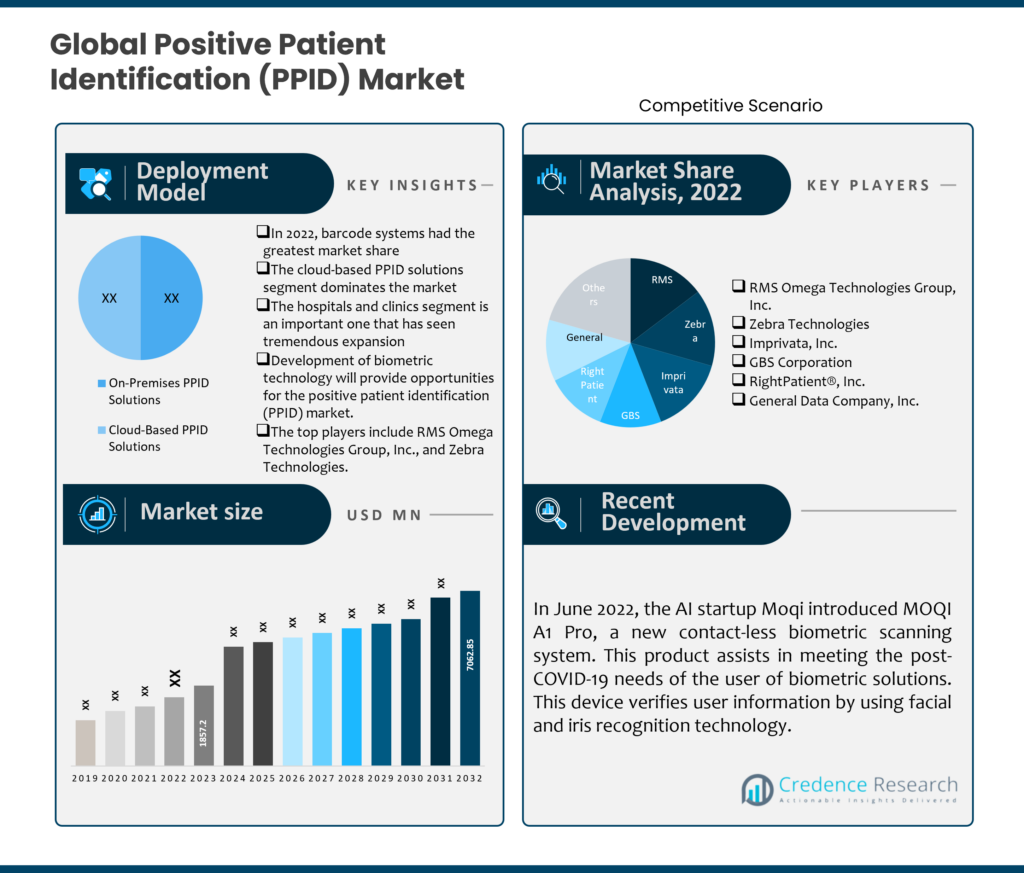
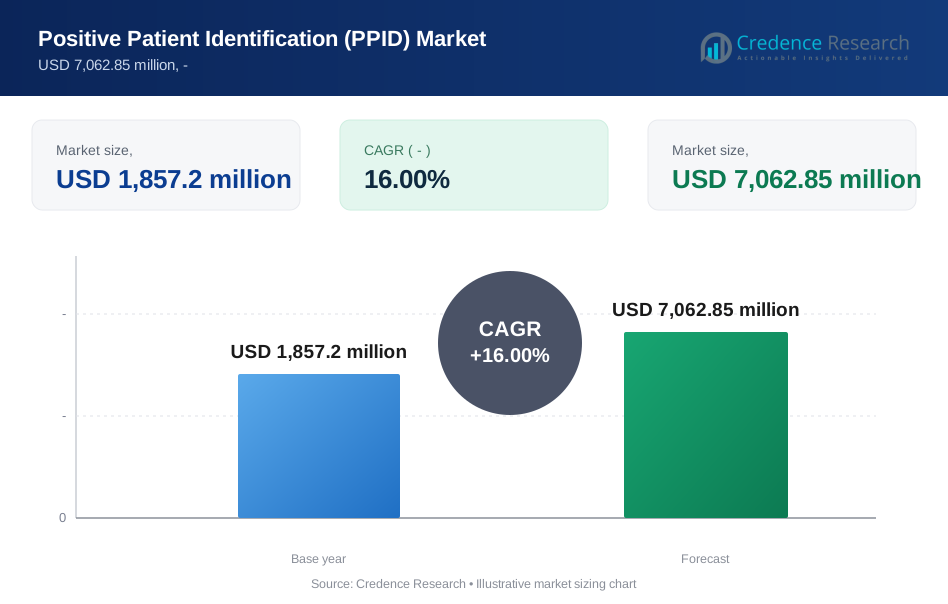
- The global market for positive patient identification (PPID) is expected to develop at a compound annual growth rate (CAGR) of 16.00% between 2024 and 2032, from its estimated USD 1857.2 million in 2023 to USD 7062.85 million in 2032.
- The largest category is barcode systems. RFID (Radio Frequency Identification) systems, on the other hand, are expected to grow at a strong CAGR.
- The cloud-based PPID solutions category will expand at a rapid rate of growth.
- The CAGR for patient admissions and registration is expected to be the highest during the projection period.
- The hospitals and clinics category will have the highest CAGR throughout the prediction period.
- North America dominated the positive patient identification (PPID) market.
- Regarding the market share of positive patient identification (PPID), Europe is expected to come second.
- In the positive patient identification (PPID) market, Asia Pacific is anticipated to grow fastest.
- The growing emphasis on patient safety, legal compliance needs, and the surge in healthcare data breaches influence the market for positive patient identification (PPID).
- The positive patient identification (PPID) industry has prospects due to the development of biometric technology and the digital transformation of healthcare.
Executive Summary
Market Definition
Positive patient identification (PPID) refers to the technique and tools used in healthcare settings to consistently and accurately identify patients at every stage of their treatment journey. By reducing errors, boosting patient safety, and enhancing overall healthcare results, PPID aims to guarantee that the appropriate care is given to the right patient at the right time.
Market Overview
The positive patient identification (PPID) sector is estimated to develop at a 16.00% compound annual growth rate (CAGR) between 2024 and 2032, maintaining its current upward trend. The market will continue to develop, rising from its estimated USD 1857.2 million in 2023 to USD 7062.85 million in 2032.
A major factor driving the Positive Patient Identification (PPID) market's expansion is quality improvement efforts. Errors in patient identification, like misidentifications or duplicate medical records, are greatly decreased by PPID systems. One important component of quality improvement programs is the reduction of medical errors, which is achieved by PPID systems by guaranteeing precise patient identification at several sites of treatment. For patient safety to be guaranteed, accurate patient identification is essential. Prescription errors, surgery performed at the wrong spot, or misdiagnosed illnesses are just a few of the unfavorable outcomes that PPID systems help avoid. PPID systems help hospitals meet their quality improvement objectives by enhancing patient safety results.
Standardizing patient identification procedures across healthcare facilities and departments is a common step in implementing PPID technologies. Standardization fosters uniformity, effectiveness, and dependability—all critical components of quality improvement programs. Patient-centered care, which stresses including patients in their care decisions and providing services that fit patients' needs and preferences, is becoming increasingly important in quality improvement projects. By establishing precise identification, improving communication, and fostering trust between patients and healthcare professionals, PPID systems support patient-centered care.
Segmentation by Technology Type
- Barcode systems dominate the market in terms of technology type. A barcode system is a hardware and software network that is mostly made up of infrastructure, supporting software, printers, mobile computers, and handheld scanners. In situations when manual recording is not efficient in terms of time or money, barcode systems are utilized to automate data capture.
- The RFID (radio frequency identification) systems category will exhibit a sizable CAGR during the projected period. RFID technology can be used for positive patient identification (PPI) applications, such as smart wristbands with passive RFID tags that can be read to identify patients and reveal details like name, date of birth, insurance coverage, allergies, blood type, and prescription needs.
- Other technologies, including biometric identification systems, smart cards, and tokens, influence the need for positive patient identification (PPID).
Segmentation by Deployment Model
- Cloud-based PPID solutions are considered the best deployment model category. PPID solutions lower the possibility of medical errors, including providing patients with incorrect medication or therapy, by assisting in ensuring accurate patient identification. Cloud-based technologies can provide real-time patient identity validation and verification across a range of healthcare settings.
- The on-premises PPID solutions category will likely register a significant CAGR during forecasting. Healthcare institutions have more control over patient data security and management with on-premises systems. Unlike cloud-based systems, patient data remains on the organization's network, lowering the possibility of data breaches or illegal access.
Segmentation by Application Area
- The patient admissions and registration category is projected to grow faster over the projection period. PPID systems provide precise patient identification for patient registration and admissions. Healthcare institutions can prevent errors related to misidentification and guarantee that patients receive the proper care by utilizing unique identifiers, such as biometric data, photo identification, or barcode scanning, to confirm patients' identities.
- Other application areas, including point of care verification, medication administration, surgical and procedural safety, and emergency department management, influence the need for positive patient identification (PPID).
Segmentation by End-User
- The hospitals and clinics category will likely have the highest CAGR during the projection period. PPID systems are essential to hospitals and clinics because they increase patient safety, optimize workflows, strengthen data security, and foster a favorable patient experience.
- Other end-users, such as nursing homes and long-term care facilities, ambulatory surgery centers, diagnostic laboratories, and imaging centers, also contribute to the demand for positive patient identification (PPID).
Segmentation by Region
- North America leads the positive patient identification (PPID) industry. Government-led initiatives in North America focused on updating healthcare systems and enhancing patient treatment have encouraged the widespread use of PPID technologies.
- Europe is estimated to rank second in market size for positive patient identification (PPID).
- The positive patient identification (PPID) industry is predicted to flourish rapidly in Asia Pacific.
- Regions such as Africa, the Middle East, and Latin America cover the remaining requirement for positive patient identification (PPID).
Healthcare providers, technology vendors, and industry stakeholders collaborate to promote innovation and expedite the creation and implementation of customized PPID solutions to meet healthcare institutions' changing requirements.
Based on projections, the positive patient identification (PPID) market is anticipated to be controlled by North America. Connectivity with PPID solutions is made possible by the United States established healthcare IT infrastructure and the country's high rate of adoption of electronic health record (EHR) systems. Efforts to decrease medical errors and improve results, including proper patient identification, are given top priority by hospitals and clinics.
The positive patient identification (PPID) market in Asia Pacific is anticipated to expand fastest throughout the forecast. The government's Digital India project and the growing healthcare IT sector in India offer prospects for PPID solution suppliers. Because of its reputation for cutting-edge technology, Japan offers potential for the adoption of creative PPID solutions that use RFID, biometrics, and other technologies.
Key Highlights of the Report
The global positive patient identification (PPID) market is segmented by technology type, deployment model, application area, end-user, and region. As far as the technology type is concerned, barcode systems are the market spearhead. Cloud-based PPID solutions are the top deployment model category. The patient admissions and registration category is anticipated to increase at the highest CAGR throughout the projection period. The hospitals and clinics category will experience the highest CAGR during the forecast period. The positive patient identification (PPID) market is expanding mostly in North America.
Healthcare businesses are investing in patient identification technologies that fulfill customer requests and improve patient experience as a result of rising consumer expectations for ease, accessibility, and transparency in healthcare services. Demand for PPID solutions is supported by ongoing education and awareness efforts that emphasize the significance of precise patient identification in healthcare environments and promote knowledge among patients, lawmakers, and healthcare providers.
North America is anticipated to have the top position in the global positive patient identification (PPID) market. The necessity for PPID systems that can easily interact with current infrastructure is spurred by efforts being made in North America to improve interoperability across various healthcare systems and providers. The Asia Pacific region is also assumed to have the market's sharpest growth. In the Asia-Pacific region, Australia's healthcare system maintains a strong emphasis on patient-centered assistance, which encourages the implementation of PPID solutions to raise standards of care and increase patient safety.
Which Key Factors Are Driving The Global Positive Patient Identification (PPID) Market?
The market for positive patient identification (PPID) is growing as a result of the aging population's increased need for healthcare, the growing need for mobile-friendly PPID solutions, and the growing need for interoperable PPID solutions.
What Are The Main Challenges Confronting The Global Positive Patient Identification (PPID) Market?
The main obstacles confronting the positive patient identification (PPID) industry are the unfavorable user experience with PPID systems, which includes usability problems and complicated interfaces, the risk of technological obsolescence, and the scalability limitations of PPID solutions, which may present difficulties for healthcare organizations.
What Market Opportunities Exist For Positive Patient Identification (PPID) Globally?
The market for positive patient identification (PPID) solutions has expanded as a result of patient-centered care being prioritized, increased healthcare spending, and value-based care models, which encourage healthcare providers to invest in PPID technologies.
Market Drivers
Growing Number of Patients
The market for Positive Patient Identification (PPID) is expanding due to the increasing number of patients. Growing older populations naturally result in a greater need for healthcare services; this demographic trend, along with scientific advancements extending life expectancy, creates a larger patient pool that necessitates medical attention; as a result, the delivery of healthcare becomes more complex. PPID solutions assist healthcare providers in managing this complexity by precisely identifying patients and matching them to their treatments, medications, and medical records; this lowers the risk of errors and improves patient safety. The possibility of medical errors, such as misdiagnosis, improper medicine administration, or conducting treatments on the incorrect patient, increases with the number of patients. By guaranteeing that healthcare practitioners get the correct patient information at the moment of service and lowering the likelihood of adverse occurrences, PPID systems help to manage these risks.
Market Restraints
For Healthcare Facilities, the Implementation of PPID Systems Requires Significant Upfront Investments
Adoption of Positive Patient Identification (PPID) systems is severely hampered by the upfront costs involved, which may also impede market expansion. Healthcare institutions frequently have limited resources. Thus, it cannot be easy to allocate money for innovative technological projects like PPID systems. Healthcare organizations may be forced to put other urgent requirements ahead of PPID implementation due to a lack of funding. Even though PPID systems have long-term advantages, including increased patient safety and operational effectiveness, healthcare providers could be reluctant to spend money on technology if they don't know exactly how much it will cost in return (ROI). Investing in PPID solutions may be discouraged by uncertainty regarding the ROI's timeliness and magnitude.
PPID installation requires continuing operational expenditures (OPEX) for upkeep, support, and training in addition to capital expenditures (CAPEX) for the purchase of hardware and software. Healthcare companies need to make sure these expenses are in line with their budgetary limits by considering their financial impact. Healthcare institutions must balance a number of conflicting demands, such as recruiting more staff to handle patient demand and updating medical equipment. If the benefits of PPID aren't considered urgent or compelling enough, implementation may have to wait for more pressing demands.
Opportunities
Increasing Investments in Healthcare IT
Healthcare facilities are adopting cutting-edge technologies like RFID, barcode scanning, and biometrics with greater funding. PPID systems offer a strong value proposition to healthcare providers by utilizing these technologies to improve accuracy and expedite patient identification procedures. A common focus of healthcare IT investments is the adoption or modernization of EHR systems. Accurate patient matching is made possible by PPID solutions that smoothly interact with EHR platforms. This guarantees that medical staff have access to full and current patient data, enhancing clinical decision-making and patient care. The goal of interoperability investments is to make it easier for patients to share their data with other healthcare providers and systems. Interoperability-compliant PPID systems facilitate easy data exchange, improving patient safety and care coordination throughout the patient journey.
Competitive Landscape
Key Players
Several major competitors exist in the fiercely competitive global positive patient identification (PPID) market. The following are a few of the leading market participants and their market shares:
- RMS Omega Technologies Group, Inc.
- Zebra Technologies
- Imprivata, Inc.
- GBS Corporation
- RightPatient®, Inc.
- General Data Company, Inc.
- Others
These companies prioritize product innovation, distribution channel expansion, mergers, and acquisitions to remain competitive.
The largest suppliers in the global positive patient identification (PPID) market continuously work to stay one step ahead of the competition by developing innovative concepts and products.
In January 2024, Leading automated solutions and tracking technology company RMS Omega Technologies announced that it had acquired ScanOnline, a creative systems integrator and managed service provider with headquarters in Charlotte, North Carolina. With the addition of ScanOnline's complementing technology, services, and expertise, this smart move enhances RMS Omega's standing in the automated identification and data capture sector and broadens its product offerings.
In September 2021, The data integrity solution business unit of Harris Healthcare, which comprises the industry leaders in patient data integrity, Just Associates, Inc. and QuadraMed® Corporation, announced that it has formed a strategic alliance with RightPatient® to incorporate biometric patient identification into its current master patient index (MPI) management solutions. This move will help to eliminate patient misidentification and safety concerns caused by "dirty" patient identification data. It will also offer significant protection against front-end contamination of the MPI and EMPI.
In April 2020, RMS Omega Technologies released a fast-deployable mobile solution for tracking the geographic spread of viruses, registering patients, and positively identifying them. Future immunization sites, as well as drive-through, mobile, and outdoor medical testing venues, can easily adopt the technology.
How are Companies Performing in the Positive Patient Identification (PPID) Market?
The substantial performance of companies in the positive patient identification (PPID) sector can be attributed to some noteworthy reasons. Significant companies in the market for positive patient identification (PPID) are forming alliances in order to provide biometric patient identification solutions. For example, In August 2017, RightPatient declared a new partnership with Caradigm. This GE Healthcare company offers a suite of broad identity and access management solutions to safeguard patient identities, secure patient information, and improve clinical and IT operational efficiency. This partnership was prompted by the growing urgency for healthcare providers to reduce security and compliance risks, secure data, protect privacy, and increase safety. The most adaptable biometric patient identification service in the market is combined with the only integrated identity and access management system by the RightPatient Caradigm alliance to offer a special package of healthcare solutions.
In addition, companies are introducing new technology to expand in the market. For example, at the 2023 MUSE Conference, PatientWorks, a major company, launched its patient self-booking of appointments feature associated with MEDITECH. MEDITECH's Community Wide Scheduling platform now allows patients to make appointments via the company's KioskWorks Cloud software. Additionally, they can see, modify, and confirm appointments. While making it simple for consumers to make appointments, patient self-booking lets physicians fill their calendars.
Companies in the positive patient identification (PPID) market are performing well because they are utilizing partnerships and technology improvements to drive expansion and provide value-added solutions that enhance patient safety and healthcare outcomes.
Summary of Key Findings
- The requirement for PPID solutions to provide safe patient identification in remote care settings is rising in tandem with the growing popularity of telemedicine services.
- The market is segmented by technology type, deployment model, application area, end-user, and region.
- In the market, barcode systems are the most widely used technology type.
- The cloud-based PPID solutions category is the foremost category.
- The patient admissions and registration category is expected to grow at the fastest CAGR during the forecast period.
- The hospitals and clinics category will likely see the highest CAGR during the anticipated time frame.
- North America is leading market development; the market is highly competitive with key players including RMS Omega Technologies Group, Inc., Zebra Technologies, Imprivata, Inc., GBS Corporation, RightPatient®, Inc., General Data Company, Inc., and Others.
Future Outlook
- The positive patient identification (PPID) industry is expected to increase significantly in North America, and its outlook is positive worldwide.
- The healthcare sector is witnessing a surge in demand for PPID solutions that facilitate unified operations and data management due to mergers and acquisitions.
- PPID systems might be challenging to install and manage for healthcare institutions with little IT resources. Inadequate instruction and training about the use of PPID technologies by healthcare personnel may hinder their efficient implementation.
- To stay ahead of the competition, key enterprises must develop new products, expand their market reach, and keep their prices competitive.
How CXOs Can Benefit from the Credence Research Positive Patient Identification (PPID) Market Report
CXOs may get a detailed picture of the market in the Credence Research Positive Patient Identification (PPID) Market Report, which includes:
- Market size and growth forecast: The report provides detailed estimates of the global market size of positive patient identification (PPID), segmented by technology type, deployment model, application area, end-user, and region. It also includes forecasts for the market through 2032 based on key trends and drivers.
- Market segmentation: The research report breaks down the positive patient identification (PPID) market into segments based on technology type, deployment model, application area, end-user, and region. This segmentation provides CXOs with a granular understanding of the market and the opportunities in each segment.
- Competitive landscape: The research report offers a detailed analysis of the major companies in the positive patient identification (PPID) industry, including information on their business plans, product lines, and earnings. CXOs can use this information to evaluate and identify their competitors.
- Key trends and drivers: The research report identifies and evaluates the main trends and factors influencing the positive patient identification (PPID) market. CXOs can use this information to make well-informed choices regarding their plans and investments.
CXOs can use the insights from the Credence Research Positive Patient Identification (PPID) Market Report to:
- Identify growth opportunities: This analysis may help CXOs identify new growth opportunities in the positive patient identification (PPID) sector. For example, the report identifies the growing demand for positive patient identification (PPID) from hospitals and clinics as a key opportunity.
- Make informed investment decisions: The report helps CXOs make wise choices regarding positive patient identification (PPID). For example, the research study provides information on the critical factors to consider when selecting positive patient identification (PPID) solutions and evaluating suppliers.
- Develop competitive strategies: CXOs can use the research report to develop competitive strategies for their positive patient identification (PPID) businesses. For example, the research paper outlines the main strategies that positive patient identification (PPID) suppliers utilize to differentiate themselves from competitors.
- Track market developments: This research report may help CXOs stay ahead of the curve by tracking market developments. For instance, it offers insights into the most recent developments and trends in the positive patient identification (PPID) market.
CXOs seeking to expand their industry knowledge and spot growth prospects will find the Credence Research Positive Patient Identification (PPID) Market Report useful.
Segmentation
-
By Technology Type
- Barcode Systems
- RFID (Radio Frequency Identification) Systems
- Biometric Identification Systems
- Smart Cards and Tokens
-
By Deployment Model
- On-Premises PPID Solutions
- Cloud-Based PPID Solutions
-
By Application Area
- Patient Admissions and Registration
- Point of Care Verification
- Medication Administration
- Surgical and Procedural Safety
- Emergency Department Management
-
By End-User
- Hospitals and Clinics
- Nursing Homes and Long-Term Care Facilities
- Ambulatory Surgery Centers
- Diagnostic Laboratories and Imaging Centers
-
By Region
- North America
- The U.S.
- Canada
- Mexico
- Europe
- Germany
- France
- UK.
- Italy
- Spain
- Rest of Europe
- Asia Pacific
- China
- Japan
- India
- South Korea
- South-east Asia
- Rest of Asia Pacific
- Latin America
- Brazil
- Argentina
- Rest of Latin America
- Middle East & Africa
- GCC Countries
- South Africa
- The Rest of the Middle East and Africa
- North America
Adjacent Markets
Several adjacent markets in the positive patient identification (PPID) market have high revenue growth opportunities. The key adjacent markets for the positive patient identification (PPID) market -
|
Adjacent Markets |
||
| Healthcare IT Solutions | Biometrics Technology | RFID (Radio-Frequency Identification) |
| Healthcare Analytics | Telemedicine and Remote Patient Monitoring | Medical Wearables and Devices |
| Healthcare Cybersecurity | Biomedical Engineering | Health Information Exchange (HIE) |
Request a Free Sample
Fill in your details and we'll send you a free sample report.
- Sample data tables & charts
- Research methodology
Need a Custom Version of This Report?
Tailor the scope, geography, or segments to your exact requirements.
- Custom geography or segment scope
- Direct access to our analyst team
Frequently Asked Questions
How much does the global market currently hold for positive patient identification (PPID)?
What is the projected growth rate of the positive patient identification (PPID) market between 2024 and 2032?
In terms of the technology type, which market category is leading?
Regarding the deployment model, which market category is in the lead?
Which application area segment is estimated to have the highest CAGR throughout the forecast period?
In which region is the market for positive patient identification (PPID) expanding?
Who are the main players in the global positive patient identification (PPID) industry?
Which market factors are the primary drivers of the positive patient identification (PPID) industry?
What main market challenges prevent the growth of the positive patient identification (PPID) sector?
What are the main market opportunities for the positive patient identification (PPID) sector?
Table of Content
Chapter 1. Report Introduction
- 1.1 Report Description & Purpose
- 1.1.1 Report Title & Market Definition
- 1.1.2 Unique Selling Propositions (USP) & Key Differentiators
- 1.1.3 Value Proposition for Stakeholders
- 1.2 Research Objectives
- 1.2.1 Market Sizing Objectives (Volume & Revenue)
- 1.2.2 Segmentation Objectives
- 1.2.3 Competitive Intelligence Objectives
- 1.2.4 Forecast & Scenario Objectives
- 1.3 Report Scope
- 1.3.1 Positive Patient Identification (PPID) Scope – Types & Subtypes Covered
- 1.3.2 Geographic Scope – Regions & Countries Covered
- 1.3.3 Historical Period, Base Year & Forecast Period (the historical period; forecast to the forecast period)
- 1.3.4 Inclusions & Exclusions
- 1.4 HS Code & Classification Framework
- 1.5 Currency, Units & Pricing Basis
- 1.6 Target Stakeholders
- 1.7 Limitations & Assumptions
Chapter 2. Executive Summary
- 2.1 Global Positive Patient Identification (PPID) Market Snapshot
- 2.1.1 Market Size – Historical (the historical period) & Forecast (the forecast period) (base year: USD 1,857.2 million → forecast year: USD 7,062.85 million)
- 2.1.2 Volume & Revenue – Global Totals
- 2.1.3 Key Market Highlights – Top Five Facts
- 2.2 Positive Patient Identification (PPID) Market Segmentation Snapshot
- 2.2.1 Market Split by Region – vs.
- 2.3 Competitive Snapshot
- 2.3.1 Top 10 Players by Revenue Share –
- 2.3.2 Top 10 Players by Volume Share –
- 2.3.3 Recent Strategic Developments (18-Month Summary)
- 2.4 Key Investment Highlights & Strategic Conclusions
Chapter 3. Positive Patient Identification (PPID) Market Dynamics & Industry Analysis
- 3.1 Market Overview & Context
- 3.1.1 Positive Patient Identification (PPID) Market Position in the Broader Automotive Value Chain
- 3.1.2 OEM vs. Replacement Market Dynamics
- 3.1.3 Market Maturity & Development Stage by Region
- 3.2 Positive Patient Identification (PPID) Market Drivers
- 3.3 Positive Patient Identification (PPID) Market Restraints & Challenges
- 3.4 Positive Patient Identification (PPID) Market Opportunities
- 3.5 Porter's Five Forces Analysis
- 3.5.1 Threat of New Entrants
- 3.5.2 Bargaining Power of Suppliers
- 3.5.3 Bargaining Power of Buyers
- 3.5.4 Threat of Substitutes
- 3.5.5 Competitive Rivalry – Intensity Assessment
- 3.6 Positive Patient Identification (PPID) Value Chain Analysis
- 3.6.1 Upstream – Raw Material/Input Suppliers
- 3.6.1.1 Raw Material/Input 1
- 3.6.1.2 Raw Material/Input 2
- 3.6.1.3 Raw Material/Input 3
- 3.6.2 Midstream – Production/Manufacturing/Service Delivery
- 3.6.2.1 Production/Process Overview
- 3.6.2.2 Key Facility Locations & Capacity by Manufacturer
- 3.6.3 Downstream – Distribution & End Consumer
- 3.6.3.1 Primary Channel – B2B/OEM
- 3.6.3.2 Secondary Channels – Dealer, Retail, Online, Direct
- 3.6.4 Value Chain Profitability Analysis
- 3.6.1 Upstream – Raw Material/Input Suppliers
- 3.7 PESTEL Analysis
- 3.7.1 Political Factors
- 3.7.2 Economic Factors
- 3.7.3 Social Factors
- 3.7.4 Technological Factors
- 3.7.5 Environmental Factors
- 3.7.6 Legal Factors
- 3.8 Positive Patient Identification (PPID) Supply Chain Analysis
- 3.8.1 Raw Material/Input Supply Risk Assessment
- 3.8.2 Manufacturing Concentration Risk (Geographic Exposure)
- 3.8.3 Trade Disruption Impact Analysis
- 3.9 Regulatory & Policy Landscape
Note: The regulatory and policy landscape section covers regulations based on their applicability to the market, Positive Patient Identification (PPID) category, geography, and scope of the study. Only regulatory frameworks with a material impact on operations, compliance, trade, sustainability, or market access are analyzed in detail.
Chapter 4. Key Investment Pockets & Opportunity Analysis
- 4.1 Positive Patient Identification (PPID) Market Attractiveness Analysis
- 4.1.1 By Region – Investment Attractiveness Matrix (Volume × CAGR)
- 4.2 Absolute Revenue Growth Opportunity
- 4.2.1 By Region – Absolute USD Growth Through the forecast period
- 4.3 Incremental Volume Opportunity
- 4.3.1 By Region – Incremental Volume Through the forecast period
- 4.3.2 Segment – Incremental Volume
- 4.4 Emerging Submarket Opportunity Deep Dive (Subject to Applicability)
- 4.5 Emerging Market Opportunity Scorecards
- 4.5.1 United States
- 4.5.2 Europe
- 4.5.3 Asia
- 4.5.4 Middle East & Africa
Note: Emerging Market Opportunity Scorecards will be included based on relevance and strategic importance. Regions listed are indicative and may vary depending on data availability and market dynamics.
Chapter 5. Positive Patient Identification (PPID) Import-Export Analysis & Trade Flows
- 5.1 Global Trade Overview
- 5.1.1 Global Export Value by Country (the historical period)
- 5.1.2 Global Export Volume by Country (the historical period)
- 5.1.3 Global Import Value by Country (the historical period)
- 5.1.4 Global Import Volume by Country (the historical period)
- 5.1.5 Net Trade Balance by Country (the historical period)
- 5.2 Export Analysis – Segment
- 5.2.1 Type 1 (HS Code)
- 5.2.2 Type 2 (HS Code)
- 5.2.3 Type 3 (HS Code)
- 5.2.4 Type 4 (HS Code)
- 5.2.5 Type 5 (HS Code)
- 5.3 Import Analysis – Segment
- 5.3.1 Type 1 (HS Code)
- 5.3.2 Type 2 (HS Code)
- 5.3.3 Type 3 (HS Code)
- 5.3.4 Type 4 (HS Code)
- 5.3.5 Type 5 (HS Code)
- 5.4 Average Unit Trade Prices
- 5.4.1 Average Export Price – Segment & Country
- 5.4.2 Average Import Price – Segment & Source Country
- 5.4.3 Price Trends (the historical period)
- 5.5 Key Trade Route Analysis
- 5.5.1 Trade Route 1
- 5.5.2 Trade Route 2
- 5.5.3 Trade Route 3
- 5.5.4 Trade Route 4
- 5.5.5 Trade Route 5
- 5.6 Trade Policy Impact Assessment
- 5.6.1 US Anti-Dumping & Section 301 Tariffs
- 5.6.2 EU Customs Union Impact
- 5.6.3 Major Free Trade Agreements
- 5.6.4 USMCA Rules of Origin
Note: Trade policy analysis will be included only where relevant to the Positive Patient Identification (PPID) market.
Chapter 6. Competitive Landscape & Company Benchmarking
- 6.1 Positive Patient Identification (PPID) Market Concentration & Structure
- 6.1.1 Herfindahl-Hirschman Index (HHI) – vs.
- 6.1.2 Tier 1, Tier 2 & Tier 3 Market Structure
- 6.1.3 Global, Regional & Local Player Dynamics
- 6.2 Positive Patient Identification (PPID) Market Share Analysis –
- 6.2.1 Global Revenue Share by Company
- 6.2.2 Global Volume Share by Company
- 6.2.3 Regional Revenue Share
- 6.2.4 Market Share Evolution ( vs. )
- 6.2.5 OEM Segment Share by Company
- 6.2.6 Replacement Segment Share by Company
- 6.3 Production/Delivery Capacity & Facility Analysis
- 6.3.1 Global Installed Capacity
- 6.3.2 Capacity Utilization Rates
- 6.3.3 Production/Output Volume
- 6.3.4 Facility Locations & Capacity Map
- 6.3.5 Planned Capacity Additions
- 6.4 Positive Patient Identification (PPID) Competitive Benchmarking Matrix
- 6.4.1 Revenue, Volume, CAGR & Profitability Comparison
- 6.4.2 Channel Revenue Mix
- 6.4.3 Geographic Revenue Exposure
- 6.4.4 R&D Intensity
- 6.4.5 Sustainability Maturity
- 6.5 Strategic Developments in Positive Patient Identification (PPID) (Last 24 Months)
- 6.5.1 Mergers, Acquisitions & Divestments
- 6.5.2 New Positive Patient Identification (PPID) Launches
- 6.5.3 Facility Expansions
- 6.5.4 Strategic Alliances, Joint Ventures & Partnerships
- 6.5.5 Distribution Expansion & Market Entry
- 6.5.6 Sustainability & ESG Initiatives
- 6.6 Competitive Strategy Mapping
- 6.6.1 Leader, Challenger, Follower & Niche Classification
- 6.6.2 Pricing Strategy Comparison
- 6.6.3 Channel Strategy Matrix
Note: Strategic developments are included based on their materiality and the availability of reliable information.
Chapter 7. Global Positive Patient Identification (PPID) Market – By Distribution Channel
- 7.1 Segment Overview
- 7.1.1 Volume & Revenue Split by Channel ( & )
- 7.1.2 Channel Mix Evolution (the forecast period)
Chapter 8. Regional Market Analysis – Global Overview
- 8.1 Global Regional Overview
- 8.1.1 Regional Volume Share
- 8.1.2 Regional Revenue Share
- 8.1.3 Regional Volume by Region
- 8.1.4 Regional Revenue by Region
- 8.1.5 Regional Forecast Through the forecast period
- 8.2 Cross-Regional Segment Analysis
- 8.2.1 By Distribution Channel
- 8.2.2 By Brand/Price Tier
Chapter 9. North America Positive Patient Identification (PPID) Market
- 9.1 United States
- 9.2 Canada
- 9.3 Mexico
Chapter 10. Europe Positive Patient Identification (PPID) Market
- 10.1 Germany
- 10.2 France
- 10.3 Italy
- 10.4 United Kingdom
- 10.5 Spain
- 10.6 Poland
- 10.7 Russia
- 10.8 Netherlands
- 10.9 Belgium
- 10.10 Sweden
- 10.11 Denmark
- 10.12 Norway
- 10.13 Rest of Europe
Chapter 11. Asia Pacific Positive Patient Identification (PPID) Market
- 11.1 China
- 11.2 India
- 11.3 Japan
- 11.4 South Korea
- 11.5 Thailand
- 11.6 Indonesia
- 11.7 Vietnam
- 11.8 Malaysia
- 11.9 Australia
- 11.10 Rest of Asia Pacific
Chapter 12. Latin America Positive Patient Identification (PPID) Market
- 12.1 Brazil
- 12.2 Argentina
- 12.3 Colombia
- 12.4 Chile
- 12.5 Rest of Latin America
Chapter 13. Middle East Positive Patient Identification (PPID) Market
- 13.1 Saudi Arabia
- 13.2 United Arab Emirates
- 13.3 Turkey
- 13.4 Israel
- 13.5 Iran
- 13.6 Rest of the Middle East
Chapter 14. Africa Positive Patient Identification (PPID) Market
- 14.1 South Africa
- 14.2 Egypt
- 14.3 Nigeria
- 14.4 Morocco
- 14.5 Rest of Africa
Chapter 15. Positive Patient Identification (PPID) Company Profiles
- 15.1 [Company 01]
- 15.1.1 Company Overview
- 15.1.2 Key Management Personnel
- 15.1.3 Products & Services Portfolio
- 15.1.4 Financial Performance
- 15.1.5 Key Market Focus & Geographic Presence
- 15.1.6 Recent Developments & Strategic Initiatives
Note: The company profile list is preliminary and may change based on research findings, market developments, data availability, and client requirements.
Chapter 16. Appendices
- Appendix A – List of Abbreviations & Acronyms
- Appendix B – Industry Classification Code Reference – Full Series
- Appendix C – Production & Capacity Data Tables
- Appendix D – End-Use & Demand Base Tables
- Appendix E – Consumption & Replacement Rate Assumptions
- Appendix F – ASP Reference Tables
- Appendix G – Manufacturing & Facility Database
- Appendix H – Import-Export Data Tables
- Appendix I – Regulatory Summary Tables
- Appendix J – Primary Research Participant List (Anonymized)
- Appendix K – Primary Research Questionnaire Framework
- Appendix L – Data Sources & Bibliography
- Appendix M – Market Size Divergence & Source Comparison
Chapter 17. Research Methodology
- 17.1 Research Framework & Philosophy
- 17.2 Secondary Research – Sources, Hierarchy & Data Extraction
- 17.3 Data Modeling – Bottom-Up & Top-Down Market Sizing
- 17.4 Primary Research – Stakeholder Framework, LOI & Sample Sizes
- 17.5 Forecast Methodology – Regression, Scenario & Sensitivity Analysis
- 17.6 Quality Control – Four-Layer Validation Framework
- 17.7 Limitations & Standard Assumptions
- 17.8 Disclaimer
