
Prebiotics In Animal Feed Market Overview:
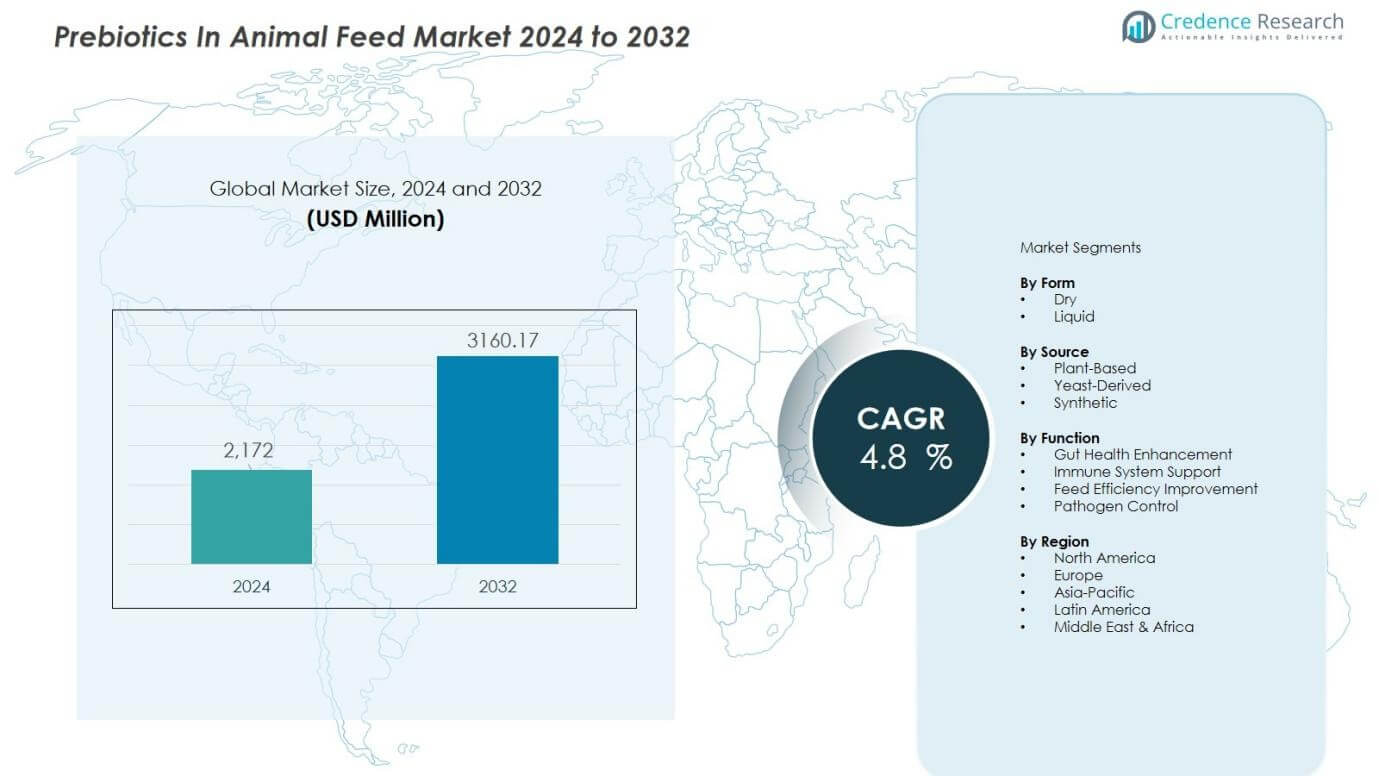
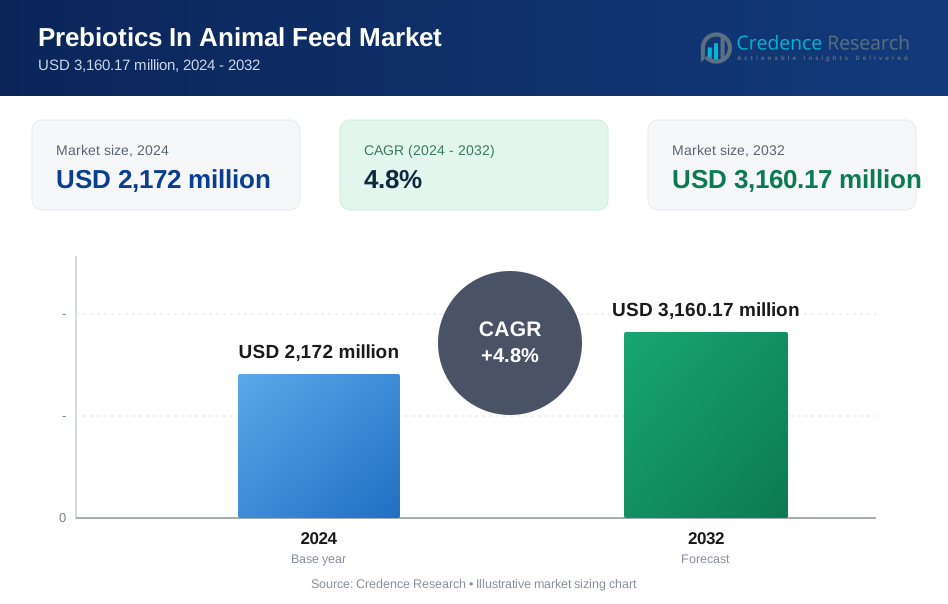
The Prebiotics In Animal Feed Market size was valued at USD 2,172 million in 2024 and is anticipated to reach USD 3160.17 million by 2032, at a CAGR of 4.8 % during the forecast period.
| REPORT ATTRIBUTE | DETAILS |
|---|---|
| Historical Period | 2020-2024 |
| Base Year | 2025 |
| Forecast Period | 2026-2032 |
| Prebiotics In Animal Feed Market Size 2024 | USD 2,172 million |
| Prebiotics In Animal Feed Market, CAGR | 4.8% |
| Prebiotics In Animal Feed Market Size 2032 | USD 3160.17 million |
Prebiotics In Animal Feed Market Insights:
- Asia-Pacific accounts for 38.5%, Europe for 27.4%, and North America for 22.1% of global demand, driven by large livestock populations and protein consumption in Asia-Pacific, strict feed regulations in Europe, and advanced feed manufacturing with high gut health awareness in North America.
- Asia-Pacific is the fastest-growing region with a 38.5% share, supported by rapid livestock commercialization, expanding poultry and aquaculture sectors, government focus on productivity, and rising demand for value-added feed formulations.
- By form, dry prebiotics hold approximately 71.8% share, supported by ease of handling, longer shelf life, and strong compatibility with pelleting and extrusion processes in compound feed production.
- By function, gut health enhancement represents about 46.2% share, reflecting strong demand for solutions that improve microbial balance, nutrient absorption, immunity, and feed conversion efficiency across poultry and swine systems.
Prebiotics In Animal Feed Market Drivers:
Rising Regulatory Pressure to Reduce Antibiotic Dependence in Livestock Production
The Prebiotics In Animal Feed Market benefits strongly from global regulatory action that restricts antibiotic growth promoters in animal diets. Governments and food safety authorities enforce stricter limits to address antimicrobial resistance risks. Feed producers respond by adopting prebiotics that support gut health without pharmacological intervention. It helps maintain animal productivity while aligning with compliance standards. This regulatory shift creates sustained demand across commercial livestock operations.
- For instance, Lallemand Animal Nutrition's prebiotic formulation delivered 18% reduction in diarrhea incidence in calves meeting EFSA authorization criteria.
Increasing Focus on Gut Health, Immunity, and Feed Efficiency Outcomes
Improved digestive health remains a core priority in modern animal nutrition programs. The Prebiotics In Animal Feed Market gains traction because prebiotics stimulate beneficial gut microflora and enhance nutrient absorption. Stronger intestinal balance supports immune function and reduces disease incidence. It enables producers to improve feed conversion ratios and reduce mortality. Economic benefits reinforce adoption across poultry, swine, and ruminant systems.
- For instance, Lallemand's microencapsulated probiotic formulations, such as live yeast (Saccharomyces cerevisiae boulardii) or lactic acid bacteria (Pediococcus acidilactici), enhance stability and bioavailability in poultry feed, reducing absolute mortality rates (e.g., from 4.0% to 2.4%) in challenged flocks.
Expansion of Commercial Livestock Farming and Protein Consumption
Rising global demand for meat, dairy, and aquaculture products accelerates structured livestock production. The Prebiotics In Animal Feed Market grows alongside expansion of intensive and semi-intensive farming models. Producers seek nutritional solutions that improve consistency and output quality at scale. It supports performance stability under high-density farming conditions. Growth in emerging economies amplifies volume demand for functional feed additives.
Advancements in Feed Formulation and Precision Nutrition Strategies
Ongoing innovation in animal nutrition strengthens functional additive integration. The Prebiotics In Animal Feed Market benefits from improved formulation techniques that enhance ingredient stability and targeted efficacy. Feed manufacturers design species-specific and life-stage-specific blends to optimize outcomes. It supports tailored nutrition strategies without reliance on synthetic inputs. Technical progress sustains long-term market momentum across developed and developing regions.
Prebiotics In Animal Feed Market Trends:
Shift Toward Functional Feed Solutions That Support Gut Health and Productivity
The Prebiotics In Animal Feed Market reflects a clear trend toward functional feed solutions that support digestive balance and overall animal performance. Producers prioritize prebiotics for their role in promoting beneficial gut microflora and improving nutrient absorption. Feed formulators focus on ingredients such as inulin and oligosaccharides that deliver consistent performance across species. Demand rises from poultry and swine sectors where feed efficiency directly influences profitability. It benefits from growing preference for preventive nutrition rather than corrective treatments. Commercial farms value measurable productivity gains linked to digestive stability. This trend supports wider integration of prebiotics into standard compound feed formulations.
- For instance, Kerry Group's oligosaccharide prebiotics reduced caecal pH by 0.5 units in swine trials, improving mineral solubility and gut stability.
Increasing Alignment With Antibiotic-Free and Sustainable Livestock Production
Sustainability goals shape product development and adoption patterns within the Prebiotics In Animal Feed Market. Livestock producers adopt prebiotics to support antibiotic-free production systems and meet regulatory expectations. Feed companies position these ingredients as natural tools that enhance immunity and resilience. Consumer pressure for clean-label meat and dairy products reinforces this shift. It aligns well with corporate sustainability commitments across global feed supply chains. Innovations in formulation improve heat stability and compatibility with pelleted feed. The trend strengthens long-term demand across intensive and semi-intensive farming models.
- For instance, Cargill's Delacon brand offers Biostrong® 510, a phytogenic feed additive that has demonstrated significant performance improvements in broiler chickens, while its Actifor® Boost solution for beef cattle has enabled an average daily gain of up to 5.5% in specialized trials.
Prebiotics In Animal Feed Market Challenges Analysis:
Cost Sensitivity and Price Volatility Across Feed Formulations
The Prebiotics In Animal Feed Market faces persistent challenges related to cost sensitivity across commercial feed formulations. Prebiotic ingredients often carry higher prices than conventional additives, which affects adoption in cost-driven farming systems. Feed producers operate under narrow margins and closely monitor raw material expenses. Price volatility in plant-derived inputs creates uncertainty for long-term procurement strategies. It complicates formulation planning for large-scale compound feed manufacturers. Smaller farms show reluctance when return on investment appears delayed. These factors constrain penetration in price-sensitive regions.
Variability in Efficacy and Limited Standardization Across Applications
Product performance variability presents a structural challenge for the Prebiotics In Animal Feed Market. Efficacy depends on animal species, diet composition, and farm management practices. Lack of universal dosage standards creates inconsistency in outcomes. It raises concerns among producers who seek predictable productivity improvements. Scientific validation varies across product types and sources. Regulatory approval processes differ by region and increase complexity for suppliers. These issues slow broader market confidence and uniform adoption.
Market Opportunities:
Expansion of Antibiotic-Free Production Systems Across Livestock Segments
The Prebiotics In Animal Feed Market holds strong opportunity through rapid expansion of antibiotic-free livestock production systems. Regulatory pressure encourages producers to replace growth-promoting antibiotics with functional feed additives. Prebiotics support gut health and immune strength without residue concerns. Poultry and swine producers show high readiness for adoption due to fast production cycles. It fits well within preventive nutrition strategies that enhance feed efficiency. Export-oriented farms adopt such solutions to meet international food safety standards. This shift opens sustained demand across developed and emerging economies.
Product Innovation and Penetration Into Emerging Livestock Markets
Innovation in formulation and delivery creates new pathways for the Prebiotics In Animal Feed Market. Encapsulation and heat-stable technologies improve performance in pelleted feeds. Suppliers develop species-specific blends tailored to ruminants, aquaculture, and young animals. It supports premium positioning within compound feed portfolios. Rising livestock commercialization in Asia-Pacific, Latin America, and Africa expands addressable demand. Local feed mills seek differentiated products to improve competitiveness. These dynamics strengthen long-term growth potential across regional markets.
Prebiotics In Animal Feed Market Segmentation Analysis:
By Form
The Prebiotics In Animal Feed Market shows clear differentiation by form, with dry formulations holding a strong position across commercial feed production. Powder and granule formats offer ease of handling, longer shelf life, and stable integration into compound feeds. Liquid forms gain selective use in specialty nutrition and on-farm supplementation where precise dosing matters. Feed manufacturers favor dry variants due to compatibility with pelleting and extrusion processes. It supports consistent nutrient distribution across large feed batches. Cost efficiency further strengthens adoption across intensive livestock operations.
- For instance, Beneo's BeneoCarb liquid functional syrup serves as a low-viscosity pellet binder in poultry feeds, reducing ash content by 15% while boosting carbohydrate digestibility.
By Source
By source, the Prebiotics In Animal Feed Market benefits from strong demand for plant-based prebiotics derived from chicory, cereals, and yeast substrates. Natural sourcing aligns with clean-label feed strategies and regulatory preferences. Synthetic sources maintain relevance where standardization and supply stability matter. Producers evaluate source selection based on bioavailability and cost control. It enables tailored formulations for different species and growth stages. Supplier focus on traceability improves buyer confidence across regions.
- For instance, Alltech's Yea-Sacc yeast-derived prebiotic stabilizes rumen pH by 0.2 units on average, boosting dairy cattle milk fat yield in high-production herds.
By Function
Functional segmentation defines value creation within the Prebiotics In Animal Feed Market, with gut health enhancement leading demand. Prebiotics support microbial balance and nutrient absorption across livestock categories. Immune support functions gain traction in antibiotic-free production systems. Feed efficiency improvement remains critical for profitability-focused producers. It delivers measurable performance benefits when applied within balanced nutrition programs. Functional clarity strengthens adoption across commercial farming models.
Segmentations:
By Form
- Dry
- Liquid
By Source
- Plant-Based
- Yeast-Derived
- Synthetic
By Function
- Gut Health Enhancement
- Immune System Support
- Feed Efficiency Improvement
- Pathogen Control
By Region
- North America
- U.S.
- Canada
- Mexico
- Europe
- Germany
- France
- U.K.
- Italy
- Spain
- Rest of Europe
- Asia Pacific
- China
- Japan
- India
- South Korea
- South-east Asia
- Rest of Asia Pacific
- Latin America
- Brazil
- Argentina
- Rest of Latin America
- Middle East & Africa
- GCC Countries
- South Africa
- Rest of the Middle East and Africa
Regional Analysis:
Strong Adoption Driven by Regulatory Standards in North America and Europe
The Prebiotics In Animal Feed Market shows steady maturity across North America and Europe due to advanced livestock systems and strict regulatory frameworks. Feed producers in these regions prioritize gut health solutions that support antibiotic-free production. Poultry and swine segments lead demand due to high feed efficiency requirements. It benefits from strong awareness of functional nutrition among commercial farmers. Europe demonstrates early adoption supported by feed additive approvals and sustainability mandates. North America records consistent uptake through integrated feed and meat production models. High-quality standards reinforce long-term demand stability.
Rapid Expansion Supported by Livestock Commercialization in Asia-Pacific
Asia-Pacific represents the fastest-expanding region within the Prebiotics In Animal Feed Market due to large livestock populations and rising protein consumption. Countries such as China, India, Vietnam, and Thailand expand commercial poultry and swine operations. Feed manufacturers increase capacity to meet demand for value-added formulations. It aligns with government efforts to improve animal productivity and biosecurity. Aquaculture feed demand further strengthens regional consumption. Rising farm consolidation supports broader adoption of functional feed additives. Regional growth maintains strong momentum through modernization of animal husbandry.
Emerging Growth Opportunities Across Latin America and Middle East & Africa
Latin America and the Middle East & Africa show developing potential in the Prebiotics In Animal Feed Market. Brazil and Mexico drive demand through expanding poultry and cattle sectors. Feed producers adopt prebiotics to improve herd health and export compliance. It gains traction in premium feed programs for intensive farms. Middle Eastern producers focus on efficiency due to feed cost pressures. African markets show gradual uptake through commercial feed penetration. These regions offer long-term expansion potential.
Key Player Analysis:
- ADM
- Evonik
- DSM
- Kerry
- Novonesis
- Cargill
- Orffa International Holding B.V.
- Alltech
- Lallemand
- Kemin
- Provita
Competitive Analysis:
The Prebiotics In Animal Feed Market features a moderately consolidated competitive landscape with a mix of global feed additive leaders and specialized nutrition suppliers. Key players compete through product efficacy, formulation stability, and species-specific solutions. Companies invest in research to validate gut health benefits and improve consistency across feed systems. It favors suppliers with strong distribution networks and technical support for feed mills. Strategic partnerships with compound feed manufacturers strengthen market reach. Product portfolios often integrate prebiotics with probiotics and organic acids to enhance value propositions. Competitive differentiation relies on raw material sourcing, traceability, and regulatory compliance across regions. Pricing strategies reflect cost pressures from feed producers and the need for measurable performance outcomes. Firms with strong presence in poultry and swine nutrition hold advantage due to volume demand. Ongoing innovation and regional expansion remain central to sustaining competitive positioning.
Recent Developments:
- In January 2025, Evonik announced Smart Effects as a strategic merger of its Silica and Silanes businesses, launching on January 1.
- In September 2025, Evonik entered a strategic partnership with Ethris to expand nucleic acid delivery offerings.
Report Coverage:
The research report offers an in-depth analysis based on Form, Source, Function and Region. It details leading Market players, providing an overview of their business, product offerings, investments, revenue streams, and key applications. Additionally, the report includes insights into the competitive environment, SWOT analysis, current Market trends, as well as the primary drivers and constraints. Furthermore, it discusses various factors that have driven Market expansion in recent years. The report also explores Market dynamics, regulatory scenarios, and technological advancements that are shaping the industry. It assesses the impact of external factors and global economic changes on Market growth. Lastly, it provides strategic recommendations for new entrants and established companies to navigate the complexities of the Market.
Future Outlook:
- The Prebiotics In Animal Feed Market will continue to benefit from sustained movement toward antibiotic-free livestock production across global farming systems.
- Feed manufacturers will increasingly integrate prebiotics into standard compound feed formulations to support gut health and productivity.
- Innovation in heat-stable and species-specific formulations will enhance product performance across poultry, swine, ruminant, and aquaculture segments.
- Regulatory focus on animal welfare and food safety will reinforce adoption of functional feed additives.
- Producers will prioritize preventive nutrition strategies that improve feed efficiency and reduce health-related losses.
- Emerging economies will expand demand through livestock commercialization and modernization of feed production.
- Integrated feed and protein producers will favor prebiotics that deliver measurable and consistent outcomes.
- Sustainability commitments across supply chains will support long-term use of plant-based and natural prebiotic sources.
- Advances in nutritional research will strengthen scientific validation and market confidence.
- Strategic collaborations between feed additive suppliers and feed mills will accelerate product penetration and regional growth.
Request a Free Sample
Fill in your details and we'll send you a free sample report.
- Sample data tables & charts
- Research methodology
Need a Custom Version of This Report?
Tailor the scope, geography, or segments to your exact requirements.
- Custom geography or segment scope
- Direct access to our analyst team
Frequently Asked Questions
What is the current market size of the Prebiotics In Animal Feed Market, and what is its projected value by 2032?
At what compound annual growth rate is the Prebiotics In Animal Feed Market expected to grow during the forecast period?
Which segment held a significant share of the Prebiotics In Animal Feed Market in 2024?
What are the key factors driving growth in the Prebiotics In Animal Feed Market?
Who are the leading companies operating in the Prebiotics In Animal Feed Market?
Which region dominated the Prebiotics In Animal Feed Market in 2024?
Table of Content
Chapter 1. Report Introduction
- 1.1 Report Description & Purpose
- 1.1.1 Report Title & Market Definition
- 1.1.2 Unique Selling Propositions (USP) & Key Differentiators
- 1.1.3 Value Proposition for Stakeholders
- 1.2 Research Objectives
- 1.2.1 Market Sizing Objectives (Volume & Revenue)
- 1.2.2 Segmentation Objectives
- 1.2.3 Competitive Intelligence Objectives
- 1.2.4 Forecast & Scenario Objectives
- 1.3 Report Scope
- 1.3.1 Prebiotics In Animal Feed Scope – Types & Subtypes Covered
- 1.3.2 Geographic Scope – Regions & Countries Covered
- 1.3.3 Historical Period, Base Year & Forecast Period (2024; forecast to 2032)
- 1.3.4 Inclusions & Exclusions
- 1.4 HS Code & Classification Framework
- 1.5 Currency, Units & Pricing Basis
- 1.6 Target Stakeholders
- 1.7 Limitations & Assumptions
Chapter 2. Executive Summary
- 2.1 Global Prebiotics In Animal Feed Market Snapshot
- 2.1.1 Market Size – Historical (2024) & Forecast (2024-2032) (2024: USD 2,172 million → 2032: USD 3,160.17 million)
- 2.1.2 Volume & Revenue – Global Totals
- 2.1.3 Key Market Highlights – Top Five Facts
- 2.2 Prebiotics In Animal Feed Market Segmentation Snapshot
- 2.2.1 Market Split by Region – 2024 vs. 2032
- 2.3 Competitive Snapshot
- 2.3.1 Top 10 Players by Revenue Share – 2024
- 2.3.2 Top 10 Players by Volume Share – 2024
- 2.3.3 Recent Strategic Developments (18-Month Summary)
- 2.4 Key Investment Highlights & Strategic Conclusions
Chapter 3. Prebiotics In Animal Feed Market Dynamics & Industry Analysis
- 3.1 Market Overview & Context
- 3.1.1 Prebiotics In Animal Feed Market Position in the Broader Automotive Value Chain
- 3.1.2 OEM vs. Replacement Market Dynamics
- 3.1.3 Market Maturity & Development Stage by Region
- 3.2 Prebiotics In Animal Feed Market Drivers
- 3.3 Prebiotics In Animal Feed Market Restraints & Challenges
- 3.4 Prebiotics In Animal Feed Market Opportunities
- 3.5 Porter's Five Forces Analysis
- 3.5.1 Threat of New Entrants
- 3.5.2 Bargaining Power of Suppliers
- 3.5.3 Bargaining Power of Buyers
- 3.5.4 Threat of Substitutes
- 3.5.5 Competitive Rivalry – Intensity Assessment
- 3.6 Prebiotics In Animal Feed Value Chain Analysis
- 3.6.1 Upstream – Raw Material/Input Suppliers
- 3.6.1.1 Raw Material/Input 1
- 3.6.1.2 Raw Material/Input 2
- 3.6.1.3 Raw Material/Input 3
- 3.6.2 Midstream – Production/Manufacturing/Service Delivery
- 3.6.2.1 Production/Process Overview
- 3.6.2.2 Key Facility Locations & Capacity by Manufacturer
- 3.6.3 Downstream – Distribution & End Consumer
- 3.6.3.1 Primary Channel – B2B/OEM
- 3.6.3.2 Secondary Channels – Dealer, Retail, Online, Direct
- 3.6.4 Value Chain Profitability Analysis
- 3.6.1 Upstream – Raw Material/Input Suppliers
- 3.7 PESTEL Analysis
- 3.7.1 Political Factors
- 3.7.2 Economic Factors
- 3.7.3 Social Factors
- 3.7.4 Technological Factors
- 3.7.5 Environmental Factors
- 3.7.6 Legal Factors
- 3.8 Prebiotics In Animal Feed Supply Chain Analysis
- 3.8.1 Raw Material/Input Supply Risk Assessment
- 3.8.2 Manufacturing Concentration Risk (Geographic Exposure)
- 3.8.3 Trade Disruption Impact Analysis
- 3.9 Regulatory & Policy Landscape
Note: The regulatory and policy landscape section covers regulations based on their applicability to the market, Prebiotics In Animal Feed category, geography, and scope of the study. Only regulatory frameworks with a material impact on operations, compliance, trade, sustainability, or market access are analyzed in detail.
Chapter 4. Key Investment Pockets & Opportunity Analysis
- 4.1 Prebiotics In Animal Feed Market Attractiveness Analysis
- 4.1.1 By Region – Investment Attractiveness Matrix (Volume × CAGR)
- 4.2 Absolute Revenue Growth Opportunity
- 4.2.1 By Region – Absolute USD Growth Through 2032
- 4.3 Incremental Volume Opportunity
- 4.3.1 By Region – Incremental Volume Through 2032
- 4.3.2 Segment – Incremental Volume
- 4.4 Emerging Submarket Opportunity Deep Dive (Subject to Applicability)
- 4.5 Emerging Market Opportunity Scorecards
- 4.5.1 United States
- 4.5.2 Europe
- 4.5.3 Asia
- 4.5.4 Middle East & Africa
Note: Emerging Market Opportunity Scorecards will be included based on relevance and strategic importance. Regions listed are indicative and may vary depending on data availability and market dynamics.
Chapter 5. Prebiotics In Animal Feed Import-Export Analysis & Trade Flows
- 5.1 Global Trade Overview
- 5.1.1 Global Export Value by Country (2024)
- 5.1.2 Global Export Volume by Country (2024)
- 5.1.3 Global Import Value by Country (2024)
- 5.1.4 Global Import Volume by Country (2024)
- 5.1.5 Net Trade Balance by Country (2024)
- 5.2 Export Analysis – Segment
- 5.2.1 Type 1 (HS Code)
- 5.2.2 Type 2 (HS Code)
- 5.2.3 Type 3 (HS Code)
- 5.2.4 Type 4 (HS Code)
- 5.2.5 Type 5 (HS Code)
- 5.3 Import Analysis – Segment
- 5.3.1 Type 1 (HS Code)
- 5.3.2 Type 2 (HS Code)
- 5.3.3 Type 3 (HS Code)
- 5.3.4 Type 4 (HS Code)
- 5.3.5 Type 5 (HS Code)
- 5.4 Average Unit Trade Prices
- 5.4.1 Average Export Price – Segment & Country
- 5.4.2 Average Import Price – Segment & Source Country
- 5.4.3 Price Trends (2024)
- 5.5 Key Trade Route Analysis
- 5.5.1 Trade Route 1
- 5.5.2 Trade Route 2
- 5.5.3 Trade Route 3
- 5.5.4 Trade Route 4
- 5.5.5 Trade Route 5
- 5.6 Trade Policy Impact Assessment
- 5.6.1 US Anti-Dumping & Section 301 Tariffs
- 5.6.2 EU Customs Union Impact
- 5.6.3 Major Free Trade Agreements
- 5.6.4 USMCA Rules of Origin
Note: Trade policy analysis will be included only where relevant to the Prebiotics In Animal Feed market.
Chapter 6. Competitive Landscape & Company Benchmarking
- 6.1 Prebiotics In Animal Feed Market Concentration & Structure
- 6.1.1 Herfindahl-Hirschman Index (HHI) – vs. 2024
- 6.1.2 Tier 1, Tier 2 & Tier 3 Market Structure
- 6.1.3 Global, Regional & Local Player Dynamics
- 6.2 Prebiotics In Animal Feed Market Share Analysis – 2024
- 6.2.1 Global Revenue Share by Company
- 6.2.2 Global Volume Share by Company
- 6.2.3 Regional Revenue Share
- 6.2.4 Market Share Evolution ( vs. 2024)
- 6.2.5 OEM Segment Share by Company
- 6.2.6 Replacement Segment Share by Company
- 6.3 Production/Delivery Capacity & Facility Analysis
- 6.3.1 Global Installed Capacity
- 6.3.2 Capacity Utilization Rates
- 6.3.3 Production/Output Volume
- 6.3.4 Facility Locations & Capacity Map
- 6.3.5 Planned Capacity Additions
- 6.4 Prebiotics In Animal Feed Competitive Benchmarking Matrix
- 6.4.1 Revenue, Volume, CAGR & Profitability Comparison
- 6.4.2 Channel Revenue Mix
- 6.4.3 Geographic Revenue Exposure
- 6.4.4 R&D Intensity
- 6.4.5 Sustainability Maturity
- 6.5 Strategic Developments in Prebiotics In Animal Feed (Last 24 Months)
- 6.5.1 Mergers, Acquisitions & Divestments
- 6.5.2 New Prebiotics In Animal Feed Launches
- 6.5.3 Facility Expansions
- 6.5.4 Strategic Alliances, Joint Ventures & Partnerships
- 6.5.5 Distribution Expansion & Market Entry
- 6.5.6 Sustainability & ESG Initiatives
- 6.6 Competitive Strategy Mapping
- 6.6.1 Leader, Challenger, Follower & Niche Classification
- 6.6.2 Pricing Strategy Comparison
- 6.6.3 Channel Strategy Matrix
Note: Strategic developments are included based on their materiality and the availability of reliable information.
Chapter 7. Global Prebiotics In Animal Feed Market – By Distribution Channel
- 7.1 Segment Overview
- 7.1.1 Volume & Revenue Split by Channel (2024 & 2032)
- 7.1.2 Channel Mix Evolution (2024-2032)
Chapter 8. Regional Market Analysis – Global Overview
- 8.1 Global Regional Overview
- 8.1.1 Regional Volume Share
- 8.1.2 Regional Revenue Share
- 8.1.3 Regional Volume by Region
- 8.1.4 Regional Revenue by Region
- 8.1.5 Regional Forecast Through 2032
- 8.2 Cross-Regional Segment Analysis
- 8.2.1 By Distribution Channel
- 8.2.2 By Brand/Price Tier
Chapter 9. North America Prebiotics In Animal Feed Market
- 9.1 United States
- 9.2 Canada
- 9.3 Mexico
Chapter 10. Europe Prebiotics In Animal Feed Market
- 10.1 Germany
- 10.2 France
- 10.3 Italy
- 10.4 United Kingdom
- 10.5 Spain
- 10.6 Poland
- 10.7 Russia
- 10.8 Netherlands
- 10.9 Belgium
- 10.10 Sweden
- 10.11 Denmark
- 10.12 Norway
- 10.13 Rest of Europe
Chapter 11. Asia Pacific Prebiotics In Animal Feed Market
- 11.1 China
- 11.2 India
- 11.3 Japan
- 11.4 South Korea
- 11.5 Thailand
- 11.6 Indonesia
- 11.7 Vietnam
- 11.8 Malaysia
- 11.9 Australia
- 11.10 Rest of Asia Pacific
Chapter 12. Latin America Prebiotics In Animal Feed Market
- 12.1 Brazil
- 12.2 Argentina
- 12.3 Colombia
- 12.4 Chile
- 12.5 Rest of Latin America
Chapter 13. Middle East Prebiotics In Animal Feed Market
- 13.1 Saudi Arabia
- 13.2 United Arab Emirates
- 13.3 Turkey
- 13.4 Israel
- 13.5 Iran
- 13.6 Rest of the Middle East
Chapter 14. Africa Prebiotics In Animal Feed Market
- 14.1 South Africa
- 14.2 Egypt
- 14.3 Nigeria
- 14.4 Morocco
- 14.5 Rest of Africa
Chapter 15. Prebiotics In Animal Feed Company Profiles
- 15.1 [Company 01]
- 15.1.1 Company Overview
- 15.1.2 Key Management Personnel
- 15.1.3 Products & Services Portfolio
- 15.1.4 Financial Performance
- 15.1.5 Key Market Focus & Geographic Presence
- 15.1.6 Recent Developments & Strategic Initiatives
Note: The company profile list is preliminary and may change based on research findings, market developments, data availability, and client requirements.
Chapter 16. Appendices
- Appendix A – List of Abbreviations & Acronyms
- Appendix B – Industry Classification Code Reference – Full Series
- Appendix C – Production & Capacity Data Tables
- Appendix D – End-Use & Demand Base Tables
- Appendix E – Consumption & Replacement Rate Assumptions
- Appendix F – ASP Reference Tables
- Appendix G – Manufacturing & Facility Database
- Appendix H – Import-Export Data Tables
- Appendix I – Regulatory Summary Tables
- Appendix J – Primary Research Participant List (Anonymized)
- Appendix K – Primary Research Questionnaire Framework
- Appendix L – Data Sources & Bibliography
- Appendix M – Market Size Divergence & Source Comparison
Chapter 17. Research Methodology
- 17.1 Research Framework & Philosophy
- 17.2 Secondary Research – Sources, Hierarchy & Data Extraction
- 17.3 Data Modeling – Bottom-Up & Top-Down Market Sizing
- 17.4 Primary Research – Stakeholder Framework, LOI & Sample Sizes
- 17.5 Forecast Methodology – Regression, Scenario & Sensitivity Analysis
- 17.6 Quality Control – Four-Layer Validation Framework
- 17.7 Limitations & Standard Assumptions
- 17.8 Disclaimer
