
Precision Medicine Market Overview:
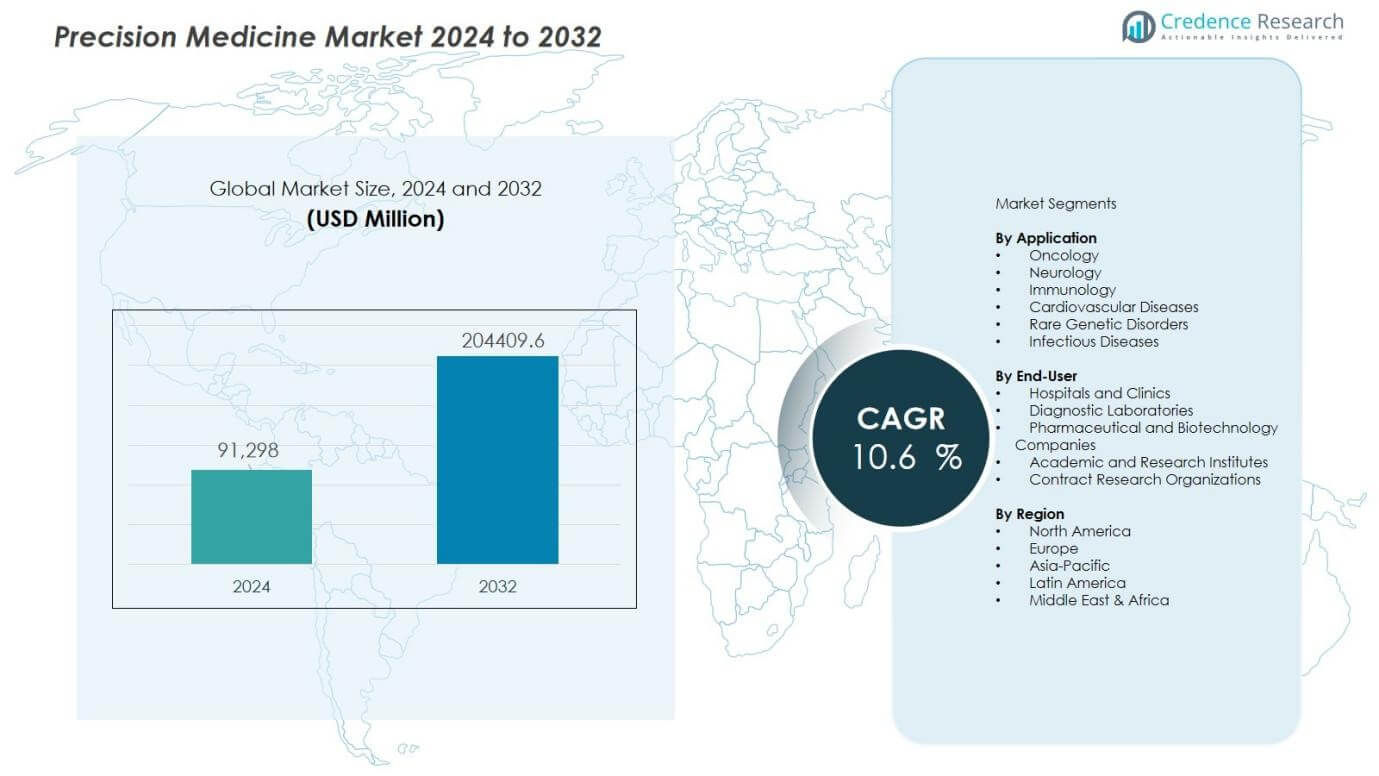
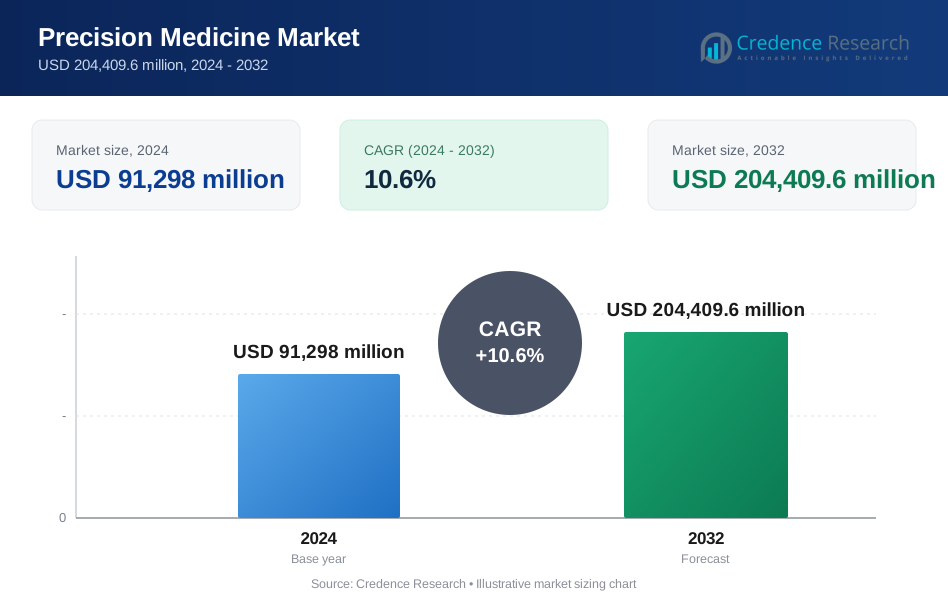
The Precision Medicine Market size was valued at USD 91,298 million in 2024 and is anticipated to reach USD 204409.6 million by 2032, at a CAGR of 10.6 % during the forecast period.
| REPORT ATTRIBUTE | DETAILS |
|---|---|
| Historical Period | 2020-2024 |
| Base Year | 2025 |
| Forecast Period | 2026-2032 |
| Precision Medicine Market Size 2024 | USD 91,298 million |
| Precision Medicine Market, CAGR | 10.6 % |
| Precision Medicine Market Size 2032 | USD 204409.6 million |
Precision Medicine Market Insights:
- North America accounted for approximately 42.5% share, Europe held nearly 29.0%, and Asia-Pacific represented about 21.0% share, supported by advanced genomics infrastructure, strong R&D funding, favorable regulations, and early adoption of precision diagnostics and therapeutics.
- Asia-Pacific is the fastest-growing region with an estimated 21.0% share, supported by expanding healthcare infrastructure, rising genomic research investments, large patient populations, and increasing clinician awareness in China, Japan, South Korea, and India.
- By application, oncology dominated with nearly 48.0% share due to high demand for biomarker-driven cancer therapies, while neurology and rare genetic disorders together accounted for around 27.5% share, supported by advances in genomic screening and targeted treatment options.
- By end-user, hospitals and clinics held approximately 39.0% share, driven by growing use of genomic testing in clinical decision-making, while pharmaceutical and biotechnology companies represented about 31.0% share due to strong focus on targeted drug development and precision-based clinical trials.
Precision Medicine Market Drivers:
Expanding Burden of Chronic and Genetic Diseases
The Precision Medicine Market benefits strongly from the rising global burden of cancer, cardiovascular disorders, and rare genetic conditions. Standardized treatment pathways often fail to address patient-level variability in disease progression and drug response. Precision-based approaches allow clinicians to stratify patients using molecular and genetic markers. It improves therapeutic accuracy and reduces trial-and-error prescribing. Growing awareness among healthcare providers strengthens clinical adoption across oncology and inherited disease management.
- For instance, Novartis' Gleevec (imatinib) targets the BCR-ABL fusion in chronic myeloid leukemia patients, achieving complete cytogenetic response in 87% of cases after 5 years of treatment.
Rapid Advances in Genomics and Molecular Diagnostics
Technological progress in sequencing platforms and molecular diagnostics significantly strengthens the Precision Medicine Market. Next-generation sequencing delivers faster, more accurate, and cost-efficient genomic analysis. These capabilities support early disease detection and therapy selection. It also enables continuous refinement of biomarkers used in clinical decision-making. Expanding diagnostic accessibility accelerates integration into routine clinical workflows.
- For Instance, Illumina's NovaSeq X Plus platform achieves up to 16 terabases per run, while the standard NovaSeq X system delivers up to 8 terabases per run for high-throughput genomic analysis.
Pharmaceutical Shift Toward Targeted and Personalized Therapies
Drug developers increasingly prioritize targeted therapies, reinforcing growth of the Precision Medicine Market. Precision-guided drug development improves clinical trial efficiency and success rates. Pharmaceutical pipelines now emphasize biomarker-driven oncology, immunology, and rare disease treatments. It supports higher therapeutic value and optimized patient outcomes. Regulatory agencies also encourage companion diagnostics aligned with targeted drugs.
Supportive Policy Frameworks and Data-Driven Healthcare Models
Healthcare systems adopt personalized care strategies, driving the Precision Medicine Market forward. Policy frameworks support genomic testing, data interoperability, and personalized treatment reimbursement. Integration of clinical data, genomics, and real-world evidence improves care planning. It aligns precision approaches with value-based healthcare objectives. Expanding public and private funding sustains long-term market development.
Precision Medicine Market Trends:
Integration of Artificial Intelligence and Advanced Data Analytics in Clinical Decision Pathways
The Precision Medicine Market shows a strong trend toward integration of artificial intelligence and advanced data analytics within clinical workflows. AI platforms process large genomic, proteomic, and clinical datasets with high speed and accuracy. These tools support patient stratification, therapy selection, and outcome prediction. It enhances diagnostic confidence and supports earlier intervention strategies. Health systems deploy machine learning models to interpret complex biomarker patterns. Pharmaceutical companies also apply predictive analytics to optimize clinical trial design. This trend strengthens evidence-based personalization across therapeutic areas.
- For Instance, Tempus AI utilizes its proprietary platform to analyze a library of more than 9 million de-identified patient records, integrated with over 40 million clinical records across its provider network.
Expansion of Companion Diagnostics and Biomarker-Driven Therapeutics
The Precision Medicine Market continues to advance through rapid expansion of companion diagnostics and biomarker-driven drug development. Regulatory agencies increasingly approve therapies alongside validated diagnostic tests. This alignment improves treatment precision and patient safety. It supports higher response rates and optimized dosing strategies. Oncology leads adoption, followed by immunology and rare disease segments. Diagnostic developers invest in multiplex assays and high-sensitivity platforms. This trend reinforces closer collaboration between diagnostics providers and pharmaceutical manufacturers.
- For instance, Roche's Herceptin (trastuzumab) pairs with a HER2 diagnostic test, targeting HER2-positive breast cancer patients.
Precision Medicine Market Challenges Analysis:
High Implementation Costs and Limited Reimbursement Coverage
The Precision Medicine Market faces persistent challenges related to high implementation costs across diagnostics, data infrastructure, and specialized clinical expertise. Advanced genomic testing and bioinformatics platforms require significant capital investment. Many healthcare systems struggle to justify upfront spending without clear short-term economic returns. It creates barriers for smaller hospitals and emerging markets. Reimbursement policies remain inconsistent across regions and payers. Limited coverage slows patient access to personalized therapies. Cost sensitivity continues to influence adoption rates.
Data Complexity, Interoperability, and Regulatory Constraints
The Precision Medicine Market encounters operational complexity due to fragmented data ecosystems and regulatory variation. Clinical, genomic, and real-world datasets often lack standardized formats. It complicates data integration and limits cross-platform usability. Privacy regulations restrict data sharing and increase compliance burden. Regulatory pathways for companion diagnostics and biomarker validation also remain lengthy. These factors delay product launches and clinical deployment. Operational inefficiencies continue to challenge scalable implementation.
Precision Medicine Market Opportunities:
Expansion Across Emerging Healthcare Systems and Untapped Patient Populations
The Precision Medicine Market presents strong opportunities across emerging healthcare systems that seek advanced diagnostic and therapeutic capabilities. Rapid expansion of healthcare infrastructure improves access to genomic testing and personalized care. Governments support precision initiatives through national genomics programs and research funding. It enables earlier disease detection and targeted intervention at scale. Rising awareness among clinicians and patients supports broader acceptance. Local partnerships accelerate technology transfer and skill development. These factors open new revenue pathways for diagnostics and therapeutics providers.
Innovation in Multi-Omics Platforms and Digital Health Integration
The Precision Medicine Market benefits from growing innovation in multi-omics platforms combined with digital health solutions. Integrated genomics, proteomics, and metabolomics provide deeper disease insights. It enhances treatment selection and therapy monitoring. Digital platforms support remote data capture and longitudinal patient tracking. Pharmaceutical developers leverage these tools to refine drug discovery and clinical trials. Technology convergence strengthens personalized care delivery. This opportunity supports long-term market differentiation.
Precision Medicine Market Segmentation Analysis:
By Application
The Precision Medicine Market shows strong differentiation across applications such as oncology, neurology, immunology, cardiovascular diseases, and rare genetic disorders. Oncology leads adoption due to high clinical demand for biomarker-driven therapies and companion diagnostics. Targeted cancer treatments improve response rates and reduce unnecessary toxicity. It supports personalized treatment planning based on tumor genetics and molecular profiling. Neurology and rare disease segments expand steadily due to improved genomic screening and earlier diagnosis. Immunology benefits from precision-guided biologics that enhance treatment specificity. Application diversity strengthens long-term market resilience.
- For instance, Roche's FoundationOne CDx test identifies actionable genomic alterations in over 300 cancer genes, enabling targeted therapies for 40% of advanced solid tumor patients.
By End-User
The Precision Medicine Market demonstrates varied adoption patterns across hospitals, diagnostic laboratories, pharmaceutical companies, and research institutions. Hospitals remain primary end-users due to rising use of genomic testing in clinical decision-making. Diagnostic laboratories support large-scale sequencing, biomarker validation, and companion diagnostics deployment. It enables integration of molecular data into routine care pathways. Pharmaceutical and biotechnology companies drive demand through targeted drug development and precision-based clinical trials. Academic and research institutes support innovation through translational research and biomarker discovery. End-user diversification accelerates commercialization and clinical uptake.
- For Instance, Mayo Clinic utilizes Illumina's NovaSeq high-throughput sequencing systems as a cornerstone of its genomic testing infrastructure. While Mayo Clinic Laboratories processes more than 27.6 million clinical tests annually across all medical specialties, its specialized MayoComplete next-generation sequencing panels are specifically deployed to identify genetic mutations and guide personalized oncology treatments.
Segmentations:
By Application
- Oncology
- Neurology
- Immunology
- Cardiovascular Diseases
- Rare Genetic Disorders
- Infectious Diseases
By End-User
- Hospitals and Clinics
- Diagnostic Laboratories
- Pharmaceutical and Biotechnology Companies
- Academic and Research Institutes
- Contract Research Organizations
By Region
- North America
- U.S.
- Canada
- Mexico
- Europe
- Germany
- France
- U.K.
- Italy
- Spain
- Rest of Europe
- Asia Pacific
- China
- Japan
- India
- South Korea
- South-east Asia
- Rest of Asia Pacific
- Latin America
- Brazil
- Argentina
- Rest of Latin America
- Middle East & Africa
- GCC Countries
- South Africa
- Rest of the Middle East and Africa
Regional Analysis:
North America: Advanced Genomics Infrastructure and Strong Commercial Adoption
The Precision Medicine Market in North America maintains leadership due to mature genomics infrastructure and high healthcare expenditure. The region benefits from widespread adoption of molecular diagnostics and targeted therapeutics. Strong collaboration between pharmaceutical firms, diagnostics developers, and research institutions accelerates clinical translation. It supports rapid uptake of companion diagnostics across oncology and rare disease care. Favorable reimbursement pathways improve patient access to precision-based therapies. Regulatory clarity encourages innovation and faster product approvals. Continuous investment in data analytics strengthens clinical outcomes.
Europe: Regulatory Support and Collaborative Research Ecosystems
The Precision Medicine Market in Europe grows through strong regulatory alignment and cross-border research collaboration. Public health systems increasingly integrate genomic testing into clinical pathways. National precision medicine initiatives support population-scale sequencing programs. It enhances early diagnosis and personalized treatment planning. Academic-industry partnerships drive biomarker discovery and translational research. Emphasis on data privacy shapes secure health data integration. Stable funding frameworks sustain long-term regional growth.
Asia-Pacific: Rapid Expansion Driven by Infrastructure and Awareness
The Precision Medicine Market in Asia-Pacific records the fastest growth due to expanding healthcare infrastructure and rising disease burden. Governments invest in genomics research, digital health platforms, and precision oncology programs. Growing clinician awareness improves adoption of molecular diagnostics. It supports wider access to targeted therapies in urban healthcare centers. Pharmaceutical companies increase regional clinical trial activity. Large patient populations enable robust genomic data generation. Market expansion accelerates across China, Japan, South Korea, and India.
Key Player Analysis:
- Hoffmann-La Roche Ltd.-(Foundation Medicine)
- Siemens
- Janssen Global Services, LLC
- Illumina, Inc.
- Quest Diagnostics Incorporated
- 23andMe, Inc.
- NeoDiagnostix
- Myriad Genetics
- Medtronic
- GE Healthcare
- Abbott
- QIAGEN
Competitive Analysis:
The Precision Medicine Market features a competitive landscape defined by strong participation from pharmaceutical companies, diagnostics providers, and biotechnology firms. Leading players focus on targeted therapeutics, companion diagnostics, and integrated data platforms to strengthen market position. It encourages continuous investment in genomics, biomarker validation, and advanced analytics. Strategic collaborations between drug developers and diagnostic companies accelerate clinical adoption. Mergers and acquisitions support portfolio expansion and technology access. Companies prioritize regulatory alignment and reimbursement readiness to secure faster market entry. Competitive differentiation relies on clinical evidence, scalability of platforms, and ability to support end-to-end precision workflows. Firms with robust R&D pipelines and global reach maintain advantage across oncology and rare disease segments.
Recent Developments:
- In December 2025, Siemens launched PAVE360 Automotive, a cloud-based digital twin platform for vehicle development.
- In September 2025, Quest Diagnostics announced a collaboration with Epic through Project Nova to improve laboratory testing experiences.
Report Coverage:
The research report offers an in-depth analysis based on Application, End-User and Region. It details leading Market players, providing an overview of their business, product offerings, investments, revenue streams, and key applications. Additionally, the report includes insights into the competitive environment, SWOT analysis, current Market trends, as well as the primary drivers and constraints. Furthermore, it discusses various factors that have driven Market expansion in recent years. The report also explores Market dynamics, regulatory scenarios, and technological advancements that are shaping the industry. It assesses the impact of external factors and global economic changes on Market growth. Lastly, it provides strategic recommendations for new entrants and established companies to navigate the complexities of the Market.
Future Outlook:
- The Precision Medicine Market will advance through deeper integration of genomics, proteomics, and clinical data to support individualized care pathways.
- Artificial intelligence adoption will improve diagnostic accuracy, therapy selection, and clinical workflow efficiency across healthcare systems.
- Companion diagnostics will gain broader regulatory acceptance, strengthening alignment between targeted therapies and validated biomarkers.
- Oncology will remain the primary innovation hub, while immunology, neurology, and rare diseases will show accelerating adoption.
- Pharmaceutical pipelines will emphasize biomarker-driven drug development to improve trial success and patient outcomes.
- Healthcare providers will expand precision approaches within routine care, supported by digital health infrastructure and data interoperability.
- Public and private investment in national genomics initiatives will enhance population-scale precision programs.
- Emerging markets will see faster uptake due to improving healthcare access and growing clinician awareness.
- Data privacy frameworks will evolve to balance patient protection with secure data sharing for research and care delivery.
- Long-term growth will depend on clinical evidence generation, cost optimization, and integration into value-based healthcare models.
Request a Free Sample
Fill in your details and we'll send you a free sample report.
- Sample data tables & charts
- Research methodology
Need a Custom Version of This Report?
Tailor the scope, geography, or segments to your exact requirements.
- Custom geography or segment scope
- Direct access to our analyst team
Frequently Asked Questions
What is the current market size of the Precision Medicine Market, and what is its projected value by 2032?
What growth rate is expected for the Precision Medicine Market during the forecast period?
Which application segment holds the largest share in the Precision Medicine Market?
What are the key factors driving growth of the Precision Medicine Market?
Who are the major participants operating in the Precision Medicine Market?
Which region accounted for the largest market share in 2024?
Table of Content
Chapter 1. Report Introduction
- 1.1 Report Description & Purpose
- 1.1.1 Report Title & Market Definition
- 1.1.2 Unique Selling Propositions (USP) & Key Differentiators
- 1.1.3 Value Proposition for Stakeholders
- 1.2 Research Objectives
- 1.2.1 Market Sizing Objectives (Volume & Revenue)
- 1.2.2 Segmentation Objectives
- 1.2.3 Competitive Intelligence Objectives
- 1.2.4 Forecast & Scenario Objectives
- 1.3 Report Scope
- 1.3.1 Precision Medicine Scope – Types & Subtypes Covered
- 1.3.2 Geographic Scope – Regions & Countries Covered
- 1.3.3 Historical Period, Base Year & Forecast Period (2024; forecast to 2032)
- 1.3.4 Inclusions & Exclusions
- 1.4 HS Code & Classification Framework
- 1.5 Currency, Units & Pricing Basis
- 1.6 Target Stakeholders
- 1.7 Limitations & Assumptions
Chapter 2. Executive Summary
- 2.1 Global Precision Medicine Market Snapshot
- 2.1.1 Market Size – Historical (2024) & Forecast (2024-2032) (2024: USD 91,298 million → 2032: USD 204,409.6 million)
- 2.1.2 Volume & Revenue – Global Totals
- 2.1.3 Key Market Highlights – Top Five Facts
- 2.2 Precision Medicine Market Segmentation Snapshot
- 2.2.1 Market Split by Region – 2024 vs. 2032
- 2.3 Competitive Snapshot
- 2.3.1 Top 10 Players by Revenue Share – 2024
- 2.3.2 Top 10 Players by Volume Share – 2024
- 2.3.3 Recent Strategic Developments (18-Month Summary)
- 2.4 Key Investment Highlights & Strategic Conclusions
Chapter 3. Precision Medicine Market Dynamics & Industry Analysis
- 3.1 Market Overview & Context
- 3.1.1 Precision Medicine Market Position in the Broader Automotive Value Chain
- 3.1.2 OEM vs. Replacement Market Dynamics
- 3.1.3 Market Maturity & Development Stage by Region
- 3.2 Precision Medicine Market Drivers
- 3.3 Precision Medicine Market Restraints & Challenges
- 3.4 Precision Medicine Market Opportunities
- 3.5 Porter's Five Forces Analysis
- 3.5.1 Threat of New Entrants
- 3.5.2 Bargaining Power of Suppliers
- 3.5.3 Bargaining Power of Buyers
- 3.5.4 Threat of Substitutes
- 3.5.5 Competitive Rivalry – Intensity Assessment
- 3.6 Precision Medicine Value Chain Analysis
- 3.6.1 Upstream – Raw Material/Input Suppliers
- 3.6.1.1 Raw Material/Input 1
- 3.6.1.2 Raw Material/Input 2
- 3.6.1.3 Raw Material/Input 3
- 3.6.2 Midstream – Production/Manufacturing/Service Delivery
- 3.6.2.1 Production/Process Overview
- 3.6.2.2 Key Facility Locations & Capacity by Manufacturer
- 3.6.3 Downstream – Distribution & End Consumer
- 3.6.3.1 Primary Channel – B2B/OEM
- 3.6.3.2 Secondary Channels – Dealer, Retail, Online, Direct
- 3.6.4 Value Chain Profitability Analysis
- 3.6.1 Upstream – Raw Material/Input Suppliers
- 3.7 PESTEL Analysis
- 3.7.1 Political Factors
- 3.7.2 Economic Factors
- 3.7.3 Social Factors
- 3.7.4 Technological Factors
- 3.7.5 Environmental Factors
- 3.7.6 Legal Factors
- 3.8 Precision Medicine Supply Chain Analysis
- 3.8.1 Raw Material/Input Supply Risk Assessment
- 3.8.2 Manufacturing Concentration Risk (Geographic Exposure)
- 3.8.3 Trade Disruption Impact Analysis
- 3.9 Regulatory & Policy Landscape
Note: The regulatory and policy landscape section covers regulations based on their applicability to the market, Precision Medicine category, geography, and scope of the study. Only regulatory frameworks with a material impact on operations, compliance, trade, sustainability, or market access are analyzed in detail.
Chapter 4. Key Investment Pockets & Opportunity Analysis
- 4.1 Precision Medicine Market Attractiveness Analysis
- 4.1.1 By Region – Investment Attractiveness Matrix (Volume × CAGR)
- 4.2 Absolute Revenue Growth Opportunity
- 4.2.1 By Region – Absolute USD Growth Through 2032
- 4.3 Incremental Volume Opportunity
- 4.3.1 By Region – Incremental Volume Through 2032
- 4.3.2 Segment – Incremental Volume
- 4.4 Emerging Submarket Opportunity Deep Dive (Subject to Applicability)
- 4.5 Emerging Market Opportunity Scorecards
- 4.5.1 United States
- 4.5.2 Europe
- 4.5.3 Asia
- 4.5.4 Middle East & Africa
Note: Emerging Market Opportunity Scorecards will be included based on relevance and strategic importance. Regions listed are indicative and may vary depending on data availability and market dynamics.
Chapter 5. Precision Medicine Import-Export Analysis & Trade Flows
- 5.1 Global Trade Overview
- 5.1.1 Global Export Value by Country (2024)
- 5.1.2 Global Export Volume by Country (2024)
- 5.1.3 Global Import Value by Country (2024)
- 5.1.4 Global Import Volume by Country (2024)
- 5.1.5 Net Trade Balance by Country (2024)
- 5.2 Export Analysis – Segment
- 5.2.1 Type 1 (HS Code)
- 5.2.2 Type 2 (HS Code)
- 5.2.3 Type 3 (HS Code)
- 5.2.4 Type 4 (HS Code)
- 5.2.5 Type 5 (HS Code)
- 5.3 Import Analysis – Segment
- 5.3.1 Type 1 (HS Code)
- 5.3.2 Type 2 (HS Code)
- 5.3.3 Type 3 (HS Code)
- 5.3.4 Type 4 (HS Code)
- 5.3.5 Type 5 (HS Code)
- 5.4 Average Unit Trade Prices
- 5.4.1 Average Export Price – Segment & Country
- 5.4.2 Average Import Price – Segment & Source Country
- 5.4.3 Price Trends (2024)
- 5.5 Key Trade Route Analysis
- 5.5.1 Trade Route 1
- 5.5.2 Trade Route 2
- 5.5.3 Trade Route 3
- 5.5.4 Trade Route 4
- 5.5.5 Trade Route 5
- 5.6 Trade Policy Impact Assessment
- 5.6.1 US Anti-Dumping & Section 301 Tariffs
- 5.6.2 EU Customs Union Impact
- 5.6.3 Major Free Trade Agreements
- 5.6.4 USMCA Rules of Origin
Note: Trade policy analysis will be included only where relevant to the Precision Medicine market.
Chapter 6. Competitive Landscape & Company Benchmarking
- 6.1 Precision Medicine Market Concentration & Structure
- 6.1.1 Herfindahl-Hirschman Index (HHI) – vs. 2024
- 6.1.2 Tier 1, Tier 2 & Tier 3 Market Structure
- 6.1.3 Global, Regional & Local Player Dynamics
- 6.2 Precision Medicine Market Share Analysis – 2024
- 6.2.1 Global Revenue Share by Company
- 6.2.2 Global Volume Share by Company
- 6.2.3 Regional Revenue Share
- 6.2.4 Market Share Evolution ( vs. 2024)
- 6.2.5 OEM Segment Share by Company
- 6.2.6 Replacement Segment Share by Company
- 6.3 Production/Delivery Capacity & Facility Analysis
- 6.3.1 Global Installed Capacity
- 6.3.2 Capacity Utilization Rates
- 6.3.3 Production/Output Volume
- 6.3.4 Facility Locations & Capacity Map
- 6.3.5 Planned Capacity Additions
- 6.4 Precision Medicine Competitive Benchmarking Matrix
- 6.4.1 Revenue, Volume, CAGR & Profitability Comparison
- 6.4.2 Channel Revenue Mix
- 6.4.3 Geographic Revenue Exposure
- 6.4.4 R&D Intensity
- 6.4.5 Sustainability Maturity
- 6.5 Strategic Developments in Precision Medicine (Last 24 Months)
- 6.5.1 Mergers, Acquisitions & Divestments
- 6.5.2 New Precision Medicine Launches
- 6.5.3 Facility Expansions
- 6.5.4 Strategic Alliances, Joint Ventures & Partnerships
- 6.5.5 Distribution Expansion & Market Entry
- 6.5.6 Sustainability & ESG Initiatives
- 6.6 Competitive Strategy Mapping
- 6.6.1 Leader, Challenger, Follower & Niche Classification
- 6.6.2 Pricing Strategy Comparison
- 6.6.3 Channel Strategy Matrix
Note: Strategic developments are included based on their materiality and the availability of reliable information.
Chapter 7. Global Precision Medicine Market – By Distribution Channel
- 7.1 Segment Overview
- 7.1.1 Volume & Revenue Split by Channel (2024 & 2032)
- 7.1.2 Channel Mix Evolution (2024-2032)
Chapter 8. Regional Market Analysis – Global Overview
- 8.1 Global Regional Overview
- 8.1.1 Regional Volume Share
- 8.1.2 Regional Revenue Share
- 8.1.3 Regional Volume by Region
- 8.1.4 Regional Revenue by Region
- 8.1.5 Regional Forecast Through 2032
- 8.2 Cross-Regional Segment Analysis
- 8.2.1 By Distribution Channel
- 8.2.2 By Brand/Price Tier
Chapter 9. North America Precision Medicine Market
- 9.1 United States
- 9.2 Canada
- 9.3 Mexico
Chapter 10. Europe Precision Medicine Market
- 10.1 Germany
- 10.2 France
- 10.3 Italy
- 10.4 United Kingdom
- 10.5 Spain
- 10.6 Poland
- 10.7 Russia
- 10.8 Netherlands
- 10.9 Belgium
- 10.10 Sweden
- 10.11 Denmark
- 10.12 Norway
- 10.13 Rest of Europe
Chapter 11. Asia Pacific Precision Medicine Market
- 11.1 China
- 11.2 India
- 11.3 Japan
- 11.4 South Korea
- 11.5 Thailand
- 11.6 Indonesia
- 11.7 Vietnam
- 11.8 Malaysia
- 11.9 Australia
- 11.10 Rest of Asia Pacific
Chapter 12. Latin America Precision Medicine Market
- 12.1 Brazil
- 12.2 Argentina
- 12.3 Colombia
- 12.4 Chile
- 12.5 Rest of Latin America
Chapter 13. Middle East Precision Medicine Market
- 13.1 Saudi Arabia
- 13.2 United Arab Emirates
- 13.3 Turkey
- 13.4 Israel
- 13.5 Iran
- 13.6 Rest of the Middle East
Chapter 14. Africa Precision Medicine Market
- 14.1 South Africa
- 14.2 Egypt
- 14.3 Nigeria
- 14.4 Morocco
- 14.5 Rest of Africa
Chapter 15. Precision Medicine Company Profiles
- 15.1 [Company 01]
- 15.1.1 Company Overview
- 15.1.2 Key Management Personnel
- 15.1.3 Products & Services Portfolio
- 15.1.4 Financial Performance
- 15.1.5 Key Market Focus & Geographic Presence
- 15.1.6 Recent Developments & Strategic Initiatives
Note: The company profile list is preliminary and may change based on research findings, market developments, data availability, and client requirements.
Chapter 16. Appendices
- Appendix A – List of Abbreviations & Acronyms
- Appendix B – Industry Classification Code Reference – Full Series
- Appendix C – Production & Capacity Data Tables
- Appendix D – End-Use & Demand Base Tables
- Appendix E – Consumption & Replacement Rate Assumptions
- Appendix F – ASP Reference Tables
- Appendix G – Manufacturing & Facility Database
- Appendix H – Import-Export Data Tables
- Appendix I – Regulatory Summary Tables
- Appendix J – Primary Research Participant List (Anonymized)
- Appendix K – Primary Research Questionnaire Framework
- Appendix L – Data Sources & Bibliography
- Appendix M – Market Size Divergence & Source Comparison
Chapter 17. Research Methodology
- 17.1 Research Framework & Philosophy
- 17.2 Secondary Research – Sources, Hierarchy & Data Extraction
- 17.3 Data Modeling – Bottom-Up & Top-Down Market Sizing
- 17.4 Primary Research – Stakeholder Framework, LOI & Sample Sizes
- 17.5 Forecast Methodology – Regression, Scenario & Sensitivity Analysis
- 17.6 Quality Control – Four-Layer Validation Framework
- 17.7 Limitations & Standard Assumptions
- 17.8 Disclaimer
