
| REPORT ATTRIBUTE | DETAILS |
|---|---|
| Historical Period | 2019-2022 |
| Base Year | 2023 |
| Forecast Period | 2024-2032 |
| Protective Eyewear Market Size 2023 | USD 4458.20 Million |
| Protective Eyewear Market, CAGR | 4.80% |
| Protective Eyewear Market Size 2032 | USD 6798.47 Million |
Market Insights
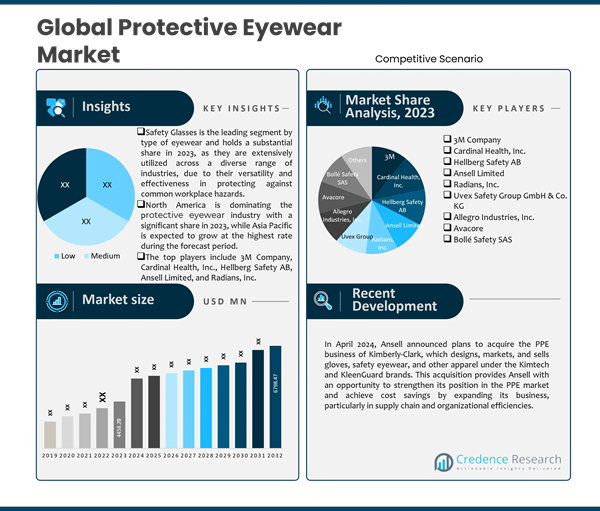
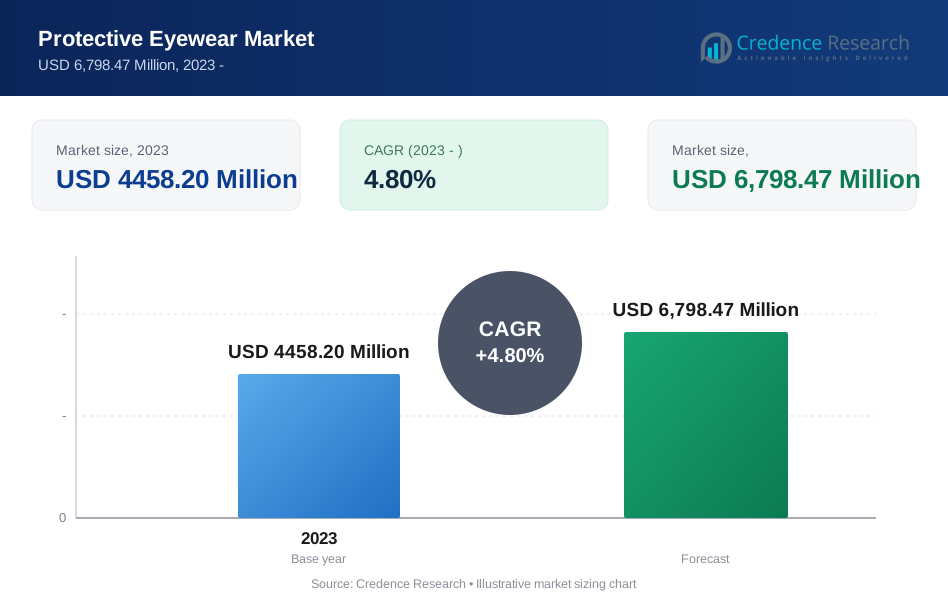
- The global demand for Protective Eyewear was valued at USD 4458.20 Million in 2023 and is expected to reach USD 6798.47 Million in 2032, growing at a CAGR of 4.80% between 2024 and 2032.
- The Safety Glasses is the market leader by type of eyewear, accounting for a significant portion of total value in 2023, while the safety goggles segment is expected to grow rapidly throughout the forecast period.
- The Construction segment dominates the global need by end-user industries, accounting for a significant portion in 2023. The healthcare segment is predicted to expand at a high CAGR.
- Over the projection period, UV Protection is expected to expand at the highest rate, while General Eye Protection dominates the market in 2023 with a substantial share.
- North America is dominating the Protective Eyewear industry with a substantial share in 2023, while Asia Pacific is expected to grow at the highest rate during the forecast period.
- The market's primary possibilities include the integration of smart technologies, increasing customization, sustainability trends, and expanding industrialization in emerging markets.
Executive Summary
Market Definition
Protective eyewear refers to a category of safety equipment designed to shield the eyes from potential hazards that could cause injury or damage. These hazards may include physical impacts, chemical splashes, biological contaminants, radiation, and intense light sources.
Protective eyewear encompasses a variety of forms, including safety glasses, goggles, face shields, and visors. Each type is tailored for specific environments and risks, ensuring adequate protection through features such as impact-resistant lenses, side shields, anti-fog coatings, UV protection, and adjustable frames for a secure fit. Protective eyewear is essential in numerous settings, including industrial workplaces, laboratories, healthcare facilities, and recreational activities, to maintain eye health and prevent accidents.
Market Overview
The global Protective Eyewear Market has witnessed steady growth in recent years and is expected to grow at a CAGR of 4.80% between 2024 and 2032. The market was valued at USD 4458.20 million in 2023 and is expected to reach USD 6798.47 million in 2032.
The protective eyewear market is experiencing significant growth due to increasing environmental factors such as pollution, dust, dirt, and harmful sunrays are contributing to the rising need for protective eyewear. The market for protective eyewear is also expanding into other sectors, such as military services, where it protects against dust and dirt generated during blasts. Manufacturers are increasingly focusing on providing customized safety eyewear to enhance worker acceptance and compliance, thus boosting market demand. For example, in April 2021, Pyramex Safety Products LLC introduced Ever Lite glasses, which are designed for shooting sports enthusiasts and offer lightweight, comfortable protection.
Moreover, to comply with stringent government regulations and ensure worker safety, manufacturers are developing various types of protective eyewear that fit closely to the eyes and cover the eye area completely, preventing any impurities from entering the eyes. Key industries, such as construction, chemical, welding, automotive, and transportation, necessitate the use of protective eyewear to safeguard workers from occupational hazards.
Additionally, the market for protective eyewear is also expanding into other sectors, such as military services and mining, where it protects against dust and dirt generated during blasts. Manufacturers are increasingly focusing on providing customized safety eyewear to enhance worker acceptance and compliance, thus boosting market demand. Furthermore, the surge in digital device usage is another factor driving market growth. Health issues associated with prolonged smartphone use, such as dry eyes, sleep disturbances, and chronic tiredness, are increasing the demand for protective eyewear.
Segmentation by Type of Eyewear
- Safety Glasses is the leading segment by type of eyewear and holds a substantial share in 2023. They are extensively utilized across a diverse range of industries, including construction, manufacturing, healthcare, and laboratories, due to their versatility and effectiveness in protecting against common workplace hazards such as flying debris, dust, and chemical splashes.
- Safety Goggles are the fastest-growing subsegment, driven by the need for enhanced protection, heightened safety awareness due to the pandemic, technological advancements, and increasing industrial activities.
- Other segments, such as face shields, welding helmets, and sunglasses, also contribute substantially to the market share.
Segmentation by End User Industry
- The construction industry boasts the dominating position in the Protective Eyewear industry, holding a massive share in 2023 due to the high risk of eye injuries associated with construction activities. Strict safety regulations and a large, diverse workforce further drive the demand for protective eyewear.
- The healthcare industry is expected to grow with the highest CAGR during the projected period due to the increased infection control measures, continuous technological advancements in protective eyewear, and the overall growth of the healthcare sector.
- The other end-user industries, including manufacturing, oil & gas, mining, chemical & pharmaceuticals, further contribute significantly to the growth of the market.
Segmentation by Application
- General eye protection boasts the dominating position in the Protective Eyewear industry, holding a massive share in 2023 due to its essential role in safeguarding workers across a diverse range of industries. Regulatory requirements, widespread use, and the versatility of these products ensure a broad and consistent demand. The growing safety culture and increased awareness about workplace hazards further reinforce the dominance of this segment.
- UV protection Eyewear is expected to grow at the highest rate, driven by heightened awareness of the risks associated with UV exposure and the increasing need for effective eye protection in outdoor and high-exposure environments.
- Chemical splash protection and welding protection contribute significantly to the growth of the market.
Segmentation by Region
- North America is fueling the growth of the Protective Eyewear industry with a massive share in 2023 due to its presence of a stringent regulatory framework surrounding occupational safety and Personal Protective Equipment (PPE). Moreover, the growth of the market is further fueled by the increasing number of workplace eye injuries, particularly in construction sites.
- The Asia Pacific market is expected to grow at the highest rate during the forecasted period.
- The rest of the world, including Latin America, the Middle East, and Africa, supplies the remaining demand for the Protective Eyewear industry.
In North America, the protective eyewear market is thriving due to the presence of a stringent regulatory framework surrounding occupational safety and Personal Protective Equipment (PPE). Federal agencies such as the Occupational Safety & Health Administration (OSHA) and the Bureau of Labor Statistics (BLS) play pivotal roles in enforcing laws and regulations related to safety codes and norms in workplaces. OSHA, in particular, mandates the use of eye and face protection whenever there is a reasonable probability of injury that could be prevented by such equipment. This requirement underscores the importance of personal protective eyewear, including goggles, face shields, safety glasses, or full-face respirators, in mitigating workplace hazards.
Moreover, the growth of the protective eyewear market in North America is further fueled by the increasing number of workplace eye injuries, particularly in construction sites. According to the Centers for Disease Control and Prevention (CDC), approximately 2,000 U.S. workers sustain work-related eye injuries each day, necessitating medical attention. This alarming statistic underscores the critical need for effective eye protection measures in hazardous work environments, such as construction sites. As a result, there is a growing market demand for high-quality protective eyewear that can mitigate the risk of eye injuries and ensure worker safety.
Additionally, the North American market benefits from the presence of a large number of reputable companies specializing in protective eyewear, such as Kimberly-Clark Corp., MCR Safety, Pyramex Safety Products LLC, Radians, Inc., Kentek Corporation, and 3M. These companies leverage their expertise and resources to develop advanced eyewear solutions that meet the stringent safety standards mandated by regulatory authorities. For example, Kentek's introduction of Rx Laser Safety Eyewear in April 2023, featuring its revolutionary POLY-Rx line, underscores the region's commitment to innovation and technological advancement in safety equipment.
On the other hand, the growth of the protective eyewear market in the Asia Pacific is reflected by the region’s rapid industrialization, evolving consumer preferences, and heightened awareness of workplace safety. The rise of online sales channels, particularly in China, has significantly contributed to market growth. Consumers in China are increasingly turning to e-commerce platforms for the convenience and accessibility they offer. For example, in April 2022, China-based start-up Nreal announced plans to launch the Nreal Air AR protective glasses, leveraging the growing trend of online sales channels in the region.
Furthermore, the rapid industrialization of countries including India, China, and Japan is fueling market growth. The expansion of industries such as manufacturing, construction, oil and gas, and mining creates a heightened demand for protective eyewear. These sectors involve tasks that expose workers to various risks, making it imperative to wear protective eyewear to prevent eye injuries. A review of eye trauma in a hospital in Taiwan found that 48.1% of cases were related to work trauma, according to the American Academy of Opthalmology, emphasizing the critical role of protective eyewear in ensuring worker safety. These factors highlight the immense potential for growth in the protective eyewear market across the Asia Pacific.
Key Highlights of the Report
The global Protective Eyewear Market is segmented by type of eyewear, end-user industries, application, and region. Safety Glasses is the most popular segment, while Construction is the primary segment in form. In addition, General Eye Protection is the most demanding application, with the North American region leading the market share.
The growth of the Protective Eyewear Market is propelled by environmental concerns, such as pollution and harmful sunrays, along with health issues from prolonged digital device use, leading to the demand for protective eyewear. Moreover, several keys such as construction, chemical, welding, and automotive, mandate the use of protective eyewear to meet safety regulations and shield workers from hazards. Additionally, innovations and customized designs are enhancing comfort and user acceptance, boosting market demand.
Nonetheless, North America is anticipated to have the greatest share of the worldwide Protective Eyewear Market due to the presence of a stringent regulatory framework surrounding occupational safety and Personal Protective Equipment (PPE). Moreover, the growth of the market is further fueled by the increasing number of workplace eye injuries, particularly in construction sites. Furthermore, the market is anticipated to expand at the highest rate in the Asia-Pacific region due to the rapid industrialization of countries including India, China, and Japan, along with the rise of online sales channels, particularly in China.
What Are the Main Drivers of the Global Protective Eyewear Market?
The growth of the Protective Eyewear Market is propelled by environmental concerns, such as pollution and harmful sunrays, along with health issues from prolonged digital device use, leading to the demand for protective eyewear. Moreover, several keys such as construction, chemical, welding, and automotive, mandate the use of protective eyewear to meet safety regulations and shield workers from hazards. Additionally, innovations and customized designs are enhancing comfort and user acceptance, boosting market demand.
What Are the Major Challenges Faced by the Global Protective Eyewear Market?
The presence of counterfeit and low-quality protective eyewear products significantly restrains the growth of the protective eyewear market. These products compromise user safety, erode consumer trust, and create financial burdens for businesses, highlighting the need for continued vigilance and stronger regulatory measures to protect the integrity of the market.
What Are the Growth Opportunities in the Global Protective Eyewear Market?
The integration of smart technologies and sensors into protective eyewear presents a promising opportunity for the market. These advancements enable real-time monitoring and alerts, enhancing hazard awareness and risk mitigation. Connected safety glasses, equipped with augmented reality (AR) displays and cameras, provide critical information within the wearer's field of vision and facilitate remote collaboration. By leveraging these innovations, companies can optimize safety measures, reduce accidents, and enhance overall operational performance, positioning smart protective eyewear as a key component of modern safety strategies.
Market Drivers
Increasing Incidence of Workplace Eye Injuries
A significant factor driving the growth of the protective eyewear market is the high frequency of workplace eye injuries. These injuries can result from various causes, including poor handling practices, exposure to harmful chemicals, and inadequate safety measures. According to the National Institute for Occupational Safety and Health (NIOSH), approximately 2,000 U.S. workers sustain job-related eye injuries that require medical treatment every day. These statistics underscore the critical need for effective eye protection in the workplace. Safety experts and eye doctors emphasize that proper eye protection can significantly reduce the severity or even prevent 90% of these injuries. Industries with a high risk of eye injuries include construction, chemical laboratories, scraping, and electrical work. These sectors often involve activities that expose workers to hazards such as chemical splashes, flying debris, sparks, and intense light sources.
The Bureau of Labor Statistics (BLS) further highlights that around 70% of eye injuries are caused by falling or flying objects and sparks striking the eye. This data indicates a substantial opportunity for protective eyewear manufacturers to address a critical safety need. In response, market players are increasingly focusing on developing and launching advanced protective glasses and spectacles specifically designed to mitigate these risks.
For example, in October 2021, the Uvex Group introduced the Uvex Rx cd5522, a new line of safety goggles certified and marked according to EN166 standards. These goggles are designed to provide superior protection in various hazardous work environments. The introduction of such innovative products demonstrates the growing importance of eye protection and the industry's commitment to enhancing worker safety.
The focus on compliance with safety standards such as ANSI (American National Standards Institute) and EN (European Norms) ensures that these protective eyewear products meet stringent quality and performance criteria. Employers and consumers are more inclined to select eyewear that complies with these established safety regulations, driving market expansion and ensuring product reliability and effectiveness.
Market Restraints
Easy Availability of Counterfeit and Low-Quality Protective Eyewear
A significant factor restraining the growth of the protective eyewear market is the presence of counterfeit and low-quality protective eyewear products. The proliferation of these substandard items poses a substantial challenge to market expansion and consumer trust. Counterfeit protective eyewear often fails to meet the rigorous safety standards established by authoritative bodies. Low-quality products, frequently sold at reduced prices, can deceive consumers into believing they are purchasing adequate protection. However, when these products are subjected to real-world conditions, they often fail to perform effectively, leading to potential eye injuries and undermining the perceived reliability of protective eyewear.
The market is particularly vulnerable to these issues due to the increasing availability of counterfeit goods through online retail platforms. The ease of access to global marketplaces has allowed unscrupulous manufacturers to distribute low-quality products widely, making it challenging for consumers and businesses to distinguish between genuine, certified protective eyewear and counterfeit alternatives. This situation not only poses a risk to user safety but also damages the reputation of legitimate manufacturers who invest significantly in research, development, and certification to ensure their products meet high safety standards.
Opportunities
Integration of Smart Technologies and Sensors
An emerging opportunity for the protective eyewear market lies in the integration of smart technologies and sensors into eyewear for monitoring and alerts. This innovative approach holds the potential to revolutionize workplace safety by providing real-time data and insights to enhance hazard awareness and mitigate risks effectively. The integration of smart technologies, such as sensors and connectivity features, enables protective eyewear to collect and analyze data on environmental conditions, wearer behavior, and potential hazards in the work environment. This data can be used to provide timely alerts and notifications to workers and supervisors, enabling proactive risk management and injury prevention.
Moreover, connected safety glasses, equipped with augmented reality (AR) technology, have the capability to display critical information, instructions, and warnings directly within the worker's field of vision. This hands-free access to essential data enhances situational awareness and ensures that workers have the information they need to perform tasks safely and efficiently. Additionally, cameras integrated into the glasses can capture and transmit images for remote assistance or documentation purposes. This enables real-time collaboration between workers and experts, facilitating quick decision-making and troubleshooting, particularly in complex or hazardous situations.
Competitive Landscape
Key Players
The global Protective Eyewear Market is highly competitive, with several key players. Some of the major players in the market are as follows:
- 3M Company
- Cardinal Health, Inc.
- Hellberg Safety
- Ansell Ltd.
- Radians
- Uvex Group
- Allegro Industries
- Avacore Sp. Z O.O
- Bollé Safety.
- Others
These organizations prioritize product innovation and acquisition to stay competitive.
The global Protective Eyewear Market's key players continually seek to stay ahead by offering new products and developments.
In April 2024, Ansell announced plans to acquire the PPE business of Kimberly-Clark, which designs, markets, and sells gloves, safety eyewear, and other apparel under the Kimtech and KleenGuard brands. This acquisition provides Ansell with an opportunity to strengthen its position in the PPE market and achieve cost savings by expanding its business, particularly in supply chain and organizational efficiencies.
In February 2024, Bollé Safety announced the launch of the SWIFT industrial collection. This new line includes safety glasses and over-the-glasses goggles designed to exceed essential safety standards while offering eco-friendly and cost-effective solutions for the evolving industrial workforce. The collection, featuring the SWIFT and SWIFT OTG (over-the-glasses) models, combines durability, comfort, and style to meet the demands of modern industrial environments.
How Companies are Performing in the Protective Eyewear Market?
The global Protective Eyewear Market is highly competitive, with several key players.
Startups are playing a pivotal role in shaping the landscape of the protective eyewear industry, bringing innovation, agility, and fresh perspectives to the market. These emerging companies are leveraging advanced technologies, creative designs, and sustainable practices to address evolving consumer needs and industry challenges. Startups are significantly focusing on integrating cutting-edge technologies into protective eyewear. For instance, ClearVue Optics focuses on producing protective eyewear with advanced anti-fogging and anti-glare coatings. Their products are designed to ensure clear vision in challenging conditions, such as extreme temperatures or high humidity, improving worker safety and productivity.
Moreover, startups are prioritizing sustainability and eco-friendliness in their product development processes. For example, Norton Point, a US-based startup, is known for producing protective eyewear made from recycled ocean plastic. By repurposing materials that would otherwise pollute the environment, Norton Point is not only creating high-quality eyewear but also contributing to environmental conservation efforts.
Additionally, startups are reimagining the design and functionality of protective eyewear to cater to diverse consumer preferences and needs. For instance, 100% PURE, a California-based startup, offers protective eyewear with stylish frames made from sustainable materials such as bamboo and recycled plastics. By combining fashion with function, startups, including 100% PURE, are making protective eyewear more appealing and accessible to a broader audience.
Furthermore, startups are embracing digitalization and customization to enhance user experience and safety. Companies such as XYZPrinting, a Taiwan-based 3D printing startup, are exploring the use of 3D printing technology to create personalized eyewear tailored to individual facial profiles. This customization not only ensures a better fit and comfort but also maximizes protection and minimizes the risk of injuries. These entrepreneurial ventures are pushing boundaries and redefining standards in safety and style.
Summary of Key Findings
- The growth of the Protective Eyewear Market is propelled by environmental concerns, such as pollution and harmful sunrays, along with health issues from prolonged digital device use, leading to the demand for protective eyewear. Moreover, several keys such as construction, chemical, welding, and automotive, mandate the use of protective eyewear to meet safety regulations and shield workers from hazards. Additionally, innovations and customized designs are enhancing comfort and user acceptance, boosting market demand.
- Market segmented by type of eyewear, end-user industries, application, and region.
- Safety Glasses is the leading segment by type of eyewear and holds a substantial share due to their extensive utilization across a diverse range of industries, including construction, manufacturing, healthcare, and laboratories.
- The construction industry boasts the dominating position in the Protective Eyewear industry, holding a massive share in 2023 due to the high risk of eye injuries associated with construction activities. Strict safety regulations and a large, diverse workforce further drive the demand for protective eyewear.
- North America is leading market growth; the market is highly competitive with key players, including 3M Company, Cardinal Health, Inc., Hellberg Safety, Ansell Ltd., Radians, Uvex Group, Allegro Industries, Avacore Sp. Z O.O, Bollé Safety, and Others.
Future Outlook
- Positive outlook for the global Protective Eyewear Market with significant growth potential in the Asia Pacific region.
- One of the main factors promoting the market's expansion is environmental concerns, such as pollution and harmful sunrays, along with health issues from prolonged digital device use, leading to the demand for protective eyewear.
- During the forecast period, the presence of counterfeit and low-quality protective eyewear products is expected to act as a significant factor restraining the growth of the Protective Eyewear Market
- To stay competitive, key firms in the Protective Eyewear Market should prioritize the integration of smart technologies, increasing customization, sustainability trends, and expanding industrialization in emerging markets.
How CXOs Can Benefit from the Credence Research Protective Eyewear Market Report
The Credence Research Protective Eyewear Market Report provides CXOs with a comprehensive overview of the market, including:
- Market size and growth forecast:The report provides detailed estimates of the global Protective Eyewear Market size, segmented by type of eyewear, end-user industries, application, and region. It also includes forecasts for the market through 2032 based on key trends and drivers.
- Market segmentation:The report segments the Protective Eyewear Market by type of eyewear, end-user industries, application, and region. This segmentation provides CXOs with a granular understanding of the market and the opportunities in each segment.
- Competitive Landscape:The report profiles the key players in the Protective Eyewear Market and provides insights into their strategies, product offerings, and financial performance. This information can help CXOs to identify and assess their competition.
- Key trends and drivers:The report identifies and analyses the key trends and drivers shaping the Protective Eyewear Market. This information can help CXOs make informed decisions about their investments and strategies.
CXOs can use the insights from the Credence Research Protective Eyewear Market Report to:
- Identify growth opportunities:The report can help CXOs to identify new growth opportunities in the Protective Eyewear Market. For example, the report identifies environmental concerns, such as pollution and harmful sunrays, health issues from prolonged digital device use, along government regulations related to work safety.
- Make informed investment decisions:The report can help CXOs make informed investment decisions about the Protective Eyewear industry. For example, it provides insights into the key factors to consider when evaluating and selecting Protective Eyewear providers.
- Develop competitive strategies:The report can help CXOs develop competitive strategies for their Protective Eyewear businesses. For example, the report identifies the key strategies that Protective Eyewear providers are using to differentiate themselves from their competitors.
- Track market developments:The report can help CXOs monitor market developments and stay ahead of the curve. For example, it provides insights into the latest trends and innovations in the Protective Eyewear Market.
Overall, the Credence Research Protective Eyewear Market Report is a valuable resource for CXOs who are looking to gain a deeper understanding of the market and identify opportunities for growth.
Segmentation
-
By Type of Eyewear
- Safety Glasses
- Safety Goggles
- Face Shields
- Welding Helmets
- Sunglasses
-
By End-User Industries
- Construction
- Manufacturing
- Healthcare
- Oil & Gas
- Mining
- Chemical & Pharmaceuticals
-
By Application
- General Eye Protection
- Chemical Splash Protection
- UV Protection
- Welding Protection
-
By Region
- North America
- US
- Canada
- Mexico
- Europe
- Germany
- France
- UK.
- Italy
- Spain
- Rest of Europe
- Asia Pacific
- China
- Japan
- India
- South Korea
- South-east Asia
- Rest of Asia Pacific
- Latin America
- Brazil
- Argentina
- Rest of Latin America
- Middle East & Africa
- GCC Countries
- South Africa
- Rest of the Middle East and Africa
- North America
Adjacent Markets
In the Protective Eyewear Market, several adjacent markets have high revenue growth opportunities. The key adjacent markets for Protective Eyewear Market -
Adjacent Markets |
||
| Personal Protective Equipment (PPE) Market | Eye Care Products Market | Pharmaceutical Safety Market |
| Healthcare Personal Protective Equipment | Laboratory Safety Equipment Market Report | Construction Worker Safety Market |
| Sports Protective Gear Market | Sunglasses Market | Workplace Safety Market |
Request a Free Sample
Fill in your details and we'll send you a free sample report.
- Sample data tables & charts
- Research methodology
Need a Custom Version of This Report?
Tailor the scope, geography, or segments to your exact requirements.
- Custom geography or segment scope
- Direct access to our analyst team
Frequently Asked Questions
What is the current size of the global Protective Eyewear Market?
What is the expected growth rate of the Protective Eyewear Market between 2024 and 2032?
Which segment is leading the market share in terms of type of eyewear?
Which segment is leading the market share in terms of End-User Industries?
Which segment is expected to post the highest CAGR during the forecast period in terms of Application?
Which region is dominating the Protective Eyewear Market share?
Who are the major players in the global Protective Eyewear Market?
What are the major market drivers of the global Protective Eyewear Market?
What is the major market restraint of the Protective Eyewear Market?
What are the major market opportunities of the global Protective Eyewear Market?
Table of Content
Chapter 1. Report Introduction
- 1.1 Report Description & Purpose
- 1.1.1 Report Title & Market Definition
- 1.1.2 Unique Selling Propositions (USP) & Key Differentiators
- 1.1.3 Value Proposition for Stakeholders
- 1.2 Research Objectives
- 1.2.1 Market Sizing Objectives (Volume & Revenue) (Volume Where Applicable)
- 1.2.2 Segmentation Objectives
- 1.2.3 Competitive Intelligence Objectives
- 1.2.4 Forecast & Scenario Objectives
- 1.3 Report Scope
- 1.3.1 Protective Eyewear Scope – Segments & Subsegments Covered
- 1.3.2 Geographic Scope – Regions & Countries Covered
- 1.3.3 Historical Period, Base Year & Forecast Period (2023; forecast to the forecast period)
- 1.3.4 Inclusions & Exclusions
- 1.4 Industry Classification & Applicable Codes
- 1.5 Currency, Measurement Units & Valuation Basis
- 1.6 Target Stakeholders
- 1.7 Limitations & Assumptions
Chapter 2. Executive Summary
- 2.1 Global Protective Eyewear Market Snapshot
- 2.1.1 Market Size – Historical (2023) & Forecast (the forecast period) (2023: USD 4458.20 Million → forecast year: USD 6,798.47 Million)
- 2.1.2 Volume & Revenue – Global Totals (Volume Where Applicable)
- 2.1.3 Key Market Highlights – Top Five Facts
- 2.2 Protective Eyewear Market Segmentation Snapshot
- 2.2.1 Market Split by Region – 2023 vs.
- 2.3 Competitive Snapshot
- 2.3.1 Top 10 Players by Revenue Share – 2023
- 2.3.2 Top 10 Players by Volume Share – 2023 (Volume Where Applicable)
- 2.3.3 Recent Strategic Developments (18-Month Summary)
- 2.4 Key Investment Highlights & Strategic Conclusions
Chapter 3. Protective Eyewear Market Dynamics & Industry Analysis
- 3.1 Market Overview & Context
- 3.1.1 Protective Eyewear Market Position in the Broader Industry Value Chain
- 3.1.2 Demand Structure & Purchasing Dynamics
- 3.1.3 Market Maturity & Development Stage by Region
- 3.2 Protective Eyewear Market Drivers
- 3.3 Protective Eyewear Market Restraints & Challenges
- 3.4 Protective Eyewear Market Opportunities
- 3.5 Porter's Five Forces Analysis
- 3.5.1 Threat of New Entrants
- 3.5.2 Bargaining Power of Suppliers
- 3.5.3 Bargaining Power of Buyers
- 3.5.4 Threat of Substitutes
- 3.5.5 Competitive Rivalry – Intensity Assessment
- 3.6 Protective Eyewear Value Chain Analysis
- 3.6.1 Upstream – Key Inputs, Resources & Suppliers
- 3.6.1.1 Key Input/Resource 1
- 3.6.1.2 Key Input/Resource 2
- 3.6.1.3 Key Input/Resource 3
- 3.6.2 Midstream – Core Operations & Value Creation
- 3.6.2.1 Operating Model & Process Overview
- 3.6.2.2 Key Operating Locations & Capabilities by Company
- 3.6.3 Downstream – Market Channels & End Users
- 3.6.3.1 Direct Sales & Customer Engagement Channels
- 3.6.3.2 Indirect Sales, Intermediaries & Partner Channels
- 3.6.4 Value Chain Profitability Analysis
- 3.6.1 Upstream – Key Inputs, Resources & Suppliers
- 3.7 PESTEL Analysis
- 3.7.1 Political Factors
- 3.7.2 Economic Factors
- 3.7.3 Social Factors
- 3.7.4 Technological Factors
- 3.7.5 Environmental Factors
- 3.7.6 Legal Factors
- 3.8 Protective Eyewear Supply Chain Analysis
- 3.8.1 Critical Input & Resource Availability Risk Assessment
- 3.8.2 Supplier & Operational Concentration Risk (Geographic Exposure)
- 3.8.3 Supply & Service Disruption Impact Analysis
- 3.9 Regulatory & Policy Landscape
Note: The regulatory and policy landscape section covers regulations based on their applicability to the market, Protective Eyewear category, geography, and scope of the study. Only regulatory frameworks with a material impact on operations, compliance, trade, sustainability, or market access are analyzed in detail.
Chapter 4. Key Investment Pockets & Opportunity Analysis
- 4.1 Protective Eyewear Market Attractiveness Analysis
- 4.1.1 By Region – Investment Attractiveness Matrix (Market Size × CAGR)
- 4.2 Absolute Revenue Growth Opportunity
- 4.2.1 By Region – Absolute Revenue Growth Through the forecast period
- 4.3 Incremental Demand Opportunity
- 4.3.1 By Region – Incremental Demand Through the forecast period
- 4.3.2 Segment – Incremental Demand
- 4.4 Emerging Submarket Opportunity Deep Dive (Subject to Applicability)
- 4.5 Priority Market Opportunity Scorecards
- 4.5.1 United States
- 4.5.2 Europe
- 4.5.3 Asia
- 4.5.4 Middle East & Africa
Note: Priority market opportunity scorecards reflect the geographic scope and strategic relevance of the study. Listed markets are indicative and may be adapted to the industry.
Chapter 5. Protective Eyewear Cross-Border Trade & Market Access Analysis
- 5.1 International Trade & Cross-Border Activity Overview
- 5.1.1 Global Export Value by Country (2023)
- 5.1.2 Global Export Volume by Country (2023) (Volume Where Applicable)
- 5.1.3 Global Import Value by Country (2023)
- 5.1.4 Global Import Volume by Country (2023) (Volume Where Applicable)
- 5.1.5 Net Trade Balance by Country (2023)
- 5.2 Export Analysis – Segment
- 5.2.1 Category 1 (Applicable Classification Code)
- 5.2.2 Category 2 (Applicable Classification Code)
- 5.2.3 Category 3 (Applicable Classification Code)
- 5.2.4 Category 4 (Applicable Classification Code)
- 5.2.5 Category 5 (Applicable Classification Code)
- 5.3 Import Analysis – Segment
- 5.3.1 Category 1 (Applicable Classification Code)
- 5.3.2 Category 2 (Applicable Classification Code)
- 5.3.3 Category 3 (Applicable Classification Code)
- 5.3.4 Category 4 (Applicable Classification Code)
- 5.3.5 Category 5 (Applicable Classification Code)
- 5.4 Cross-Border Pricing & Transaction Benchmarks
- 5.4.1 Export Pricing – Segment & Country
- 5.4.2 Import Pricing – Segment & Source Country
- 5.4.3 Price Trends (2023)
- 5.5 Key Cross-Border Trade & Delivery Routes
- 5.5.1 Cross-Border Trade/Delivery Route 1
- 5.5.2 Cross-Border Trade/Delivery Route 2
- 5.5.3 Cross-Border Trade/Delivery Route 3
- 5.5.4 Cross-Border Trade/Delivery Route 4
- 5.5.5 Cross-Border Trade/Delivery Route 5
- 5.6 Trade Policy & Market Access Impact Assessment
- 5.6.1 Tariff & Non-Tariff Barriers
- 5.6.2 Regional Trade & Economic Integration Frameworks
- 5.6.3 Bilateral & Multilateral Trade Agreements
- 5.6.4 Cross-Border Operating, Licensing & Localization Requirements
Note: This chapter applies where cross-border trade or delivery is relevant to Protective Eyewear. Goods, services, and digital offerings are assessed using applicable classifications and transaction measures. Import-export volumes, trade balances, and route analyses are included only where meaningful to the market.
Chapter 6. Competitive Landscape & Company Benchmarking
- 6.1 Protective Eyewear Market Concentration & Structure
- 6.1.1 Herfindahl-Hirschman Index (HHI) – vs. 2023
- 6.1.2 Leading, Mid-Sized & Emerging Player Structure
- 6.1.3 Global, Regional & Local Player Dynamics
- 6.2 Protective Eyewear Market Share Analysis – 2023
- 6.2.1 Global Revenue Share by Company
- 6.2.2 Global Volume Share by Company (Volume Where Applicable)
- 6.2.3 Regional Revenue Share
- 6.2.4 Market Share Evolution ( vs. 2023)
- 6.2.5 Company Market Share by Key Segment
- 6.2.6 Company Market Share by Customer Group
- 6.3 Operating Scale, Capacity & Infrastructure Analysis
- 6.3.1 Global Operating Scale & Supply Capacity
- 6.3.2 Resource Utilization & Operating Efficiency
- 6.3.3 Output, Service Delivery & Activity Metrics
- 6.3.4 Operating Footprint & Infrastructure Map
- 6.3.5 Planned Operational & Capacity Expansion
- 6.4 Protective Eyewear Competitive Benchmarking Matrix
- 6.4.1 Revenue, Growth, Profitability & Operating Metric Comparison
- 6.4.2 Channel Revenue Mix
- 6.4.3 Geographic Revenue Exposure
- 6.4.4 R&D Intensity
- 6.4.5 Sustainability Maturity
- 6.5 Strategic Developments in Protective Eyewear (Last 24 Months)
- 6.5.1 Mergers, Acquisitions & Divestments
- 6.5.2 New Products, Services & Solutions in Protective Eyewear
- 6.5.3 Operational & Infrastructure Expansions
- 6.5.4 Strategic Alliances, Joint Ventures & Partnerships
- 6.5.5 Distribution Expansion & Market Entry
- 6.5.6 Sustainability & ESG Initiatives
- 6.6 Competitive Strategy Mapping
- 6.6.1 Leader, Challenger, Follower & Niche Classification
- 6.6.2 Pricing Strategy Comparison
- 6.6.3 Channel Strategy Matrix
Note: Strategic developments are included based on their materiality and the availability of reliable information.
Chapter 7. Global Protective Eyewear Market – By Sales & Delivery Channel
- 7.1 Segment Overview
- 7.1.1 Volume & Revenue Split by Channel (2023 & ) (Volume Where Applicable)
- 7.1.2 Channel Mix Evolution (the forecast period)
Chapter 8. Regional Market Analysis – Global Overview
- 8.1 Global Regional Overview
- 8.1.1 Regional Volume Share (Volume Where Applicable)
- 8.1.2 Regional Revenue Share
- 8.1.3 Regional Volume by Region (Volume Where Applicable)
- 8.1.4 Regional Revenue by Region
- 8.1.5 Regional Forecast Through the forecast period
- 8.2 Cross-Regional Segment Analysis
- 8.2.1 By Sales & Delivery Channel
- 8.2.2 By Competitive Positioning & Price Tier
Chapter 9. North America Protective Eyewear Market
- 9.1 United States
- 9.2 Canada
- 9.3 Mexico
Chapter 10. Europe Protective Eyewear Market
- 10.1 Germany
- 10.2 France
- 10.3 Italy
- 10.4 United Kingdom
- 10.5 Spain
- 10.6 Poland
- 10.7 Russia
- 10.8 Netherlands
- 10.9 Belgium
- 10.10 Sweden
- 10.11 Denmark
- 10.12 Norway
- 10.13 Rest of Europe
Chapter 11. Asia Pacific Protective Eyewear Market
- 11.1 China
- 11.2 India
- 11.3 Japan
- 11.4 South Korea
- 11.5 Thailand
- 11.6 Indonesia
- 11.7 Vietnam
- 11.8 Malaysia
- 11.9 Australia
- 11.10 Rest of Asia Pacific
Chapter 12. Latin America Protective Eyewear Market
- 12.1 Brazil
- 12.2 Argentina
- 12.3 Colombia
- 12.4 Chile
- 12.5 Rest of Latin America
Chapter 13. Middle East Protective Eyewear Market
- 13.1 Saudi Arabia
- 13.2 United Arab Emirates
- 13.3 Turkey
- 13.4 Israel
- 13.5 Iran
- 13.6 Rest of the Middle East
Chapter 14. Africa Protective Eyewear Market
- 14.1 South Africa
- 14.2 Egypt
- 14.3 Nigeria
- 14.4 Morocco
- 14.5 Rest of Africa
Chapter 15. Protective Eyewear Company Profiles
- 15.1 [Company 01]
- 15.1.1 Company Overview
- 15.1.2 Key Management Personnel
- 15.1.3 Products & Services Portfolio
- 15.1.4 Financial Performance
- 15.1.5 Key Market Focus & Geographic Presence
- 15.1.6 Recent Developments & Strategic Initiatives
Note: The company profile list is preliminary and may change based on research findings, market developments, data availability, and client requirements.
Chapter 16. Appendices
- Appendix A – List of Abbreviations & Acronyms
- Appendix B – Industry Classification Code Reference – Full Series
- Appendix C – Supply, Output & Operating Capacity Data Tables
- Appendix D – End-Use & Demand Base Tables
- Appendix E – Demand, Adoption & Usage Assumptions
- Appendix F – Pricing & Revenue Metric Reference Tables
- Appendix G – Company Operations & Infrastructure Database
- Appendix H – Cross-Border Trade & Activity Data Tables (Where Applicable)
- Appendix I – Regulatory Summary Tables
- Appendix J – Primary Research Participant List (Anonymized)
- Appendix K – Primary Research Questionnaire Framework
- Appendix L – Data Sources & Bibliography
- Appendix M – Market Size Divergence & Source Comparison
Chapter 17. Research Methodology
- 17.1 Research Framework & Philosophy
- 17.2 Secondary Research – Sources, Hierarchy & Data Extraction
- 17.3 Data Modeling – Bottom-Up & Top-Down Market Sizing
- 17.4 Primary Research – Stakeholder Framework, LOI & Sample Sizes
- 17.5 Forecast Methodology – Regression, Scenario & Sensitivity Analysis
- 17.6 Quality Control – Four-Layer Validation Framework
- 17.7 Limitations & Standard Assumptions
- 17.8 Disclaimer
