| REPORT ATTRIBUTE | DETAILS |
|---|---|
| Historical Period | 2020-2023 |
| Base Year | 2024 |
| Forecast Period | 2025-2032 |
| Pulmonary Drug Delivery Devices Market Size 2024 | USD 54,865.9 million |
| Pulmonary Drug Delivery Devices Market, CAGR | 4.43% |
| Pulmonary Drug Delivery Devices Market Size 2032 | USD 77,432.5 million |
Market Overview:
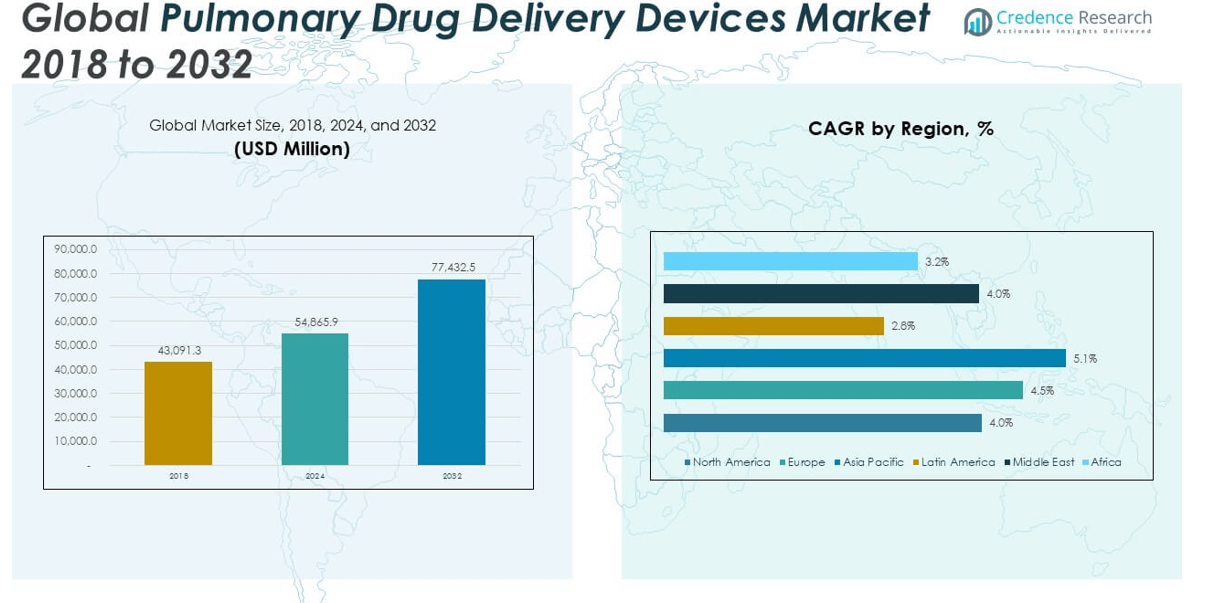
The Pulmonary Drug Delivery Devices Market size was valued at USD 43,091.3 million in 2018 to USD 54,865.9 million in 2024 and is anticipated to reach USD 77,432.5 million by 2032, at a CAGR of 4.43% during the forecast period.
The pulmonary drug delivery devices market is experiencing sustained growth due to the rising global prevalence of respiratory diseases such as asthma, chronic obstructive pulmonary disease (COPD), cystic fibrosis, and allergic rhinitis. These conditions are driven by factors including air pollution, smoking, occupational hazards, and aging populations. The increasing adoption of user-friendly, portable, and smart drug delivery devices is enhancing patient adherence to treatment protocols and improving outcomes. Technological advancements, particularly in dry powder inhalers (DPIs), metered-dose inhalers (MDIs), and vibrating mesh nebulizers, are significantly improving drug deposition efficiency and ease of use. Additionally, the trend toward self-administered and home-based care, especially after the COVID-19 pandemic, has accelerated the demand for compact and remote-enabled pulmonary drug delivery solutions. Investments in research and development, particularly around digital inhalers and targeted drug delivery, continue to expand therapeutic applications, including for systemic diseases.
North America holds the largest share of the pulmonary drug delivery devices market, driven by a high burden of respiratory diseases, established healthcare infrastructure, and early adoption of innovative medical technologies. The United States leads the regional market due to favorable reimbursement policies and strong demand for digital inhalers and smart nebulizers. Europe follows closely, supported by growing awareness of respiratory health, rising healthcare expenditures, and regulatory support for advanced drug delivery methods. Countries like Germany, the U.K., and France are leading contributors to regional revenue. Asia-Pacific is expected to witness the fastest growth over the forecast period, propelled by urbanization, increasing air pollution levels, and improved access to healthcare in countries such as China, India, and Japan. Latin America, the Middle East, and Africa represent emerging markets with untapped potential, where increasing healthcare awareness and gradual infrastructure development are laying the foundation for long-term growth.
Market Insights
- The Pulmonary Drug Delivery Devices Market was valued at USD 54,865.9 million in 2024 and is projected to reach USD 77,432.5 million by 2032, growing at a CAGR of 4.43% during the forecast period.
- Rising prevalence of respiratory diseases such as asthma, COPD, and cystic fibrosis is driving steady demand for inhalers, nebulizers, and portable pulmonary drug delivery systems.
- Technological advancements in dry powder inhalers (DPIs), metered dose inhalers (MDIs), and mesh nebulizers are improving drug delivery efficiency and patient usability.
- Home-based care is gaining momentum, accelerating the demand for self-administered, lightweight, and digitally connected inhalation devices across all age groups.
- Government reimbursement programs and fast-track regulatory approvals in regions like North America and Europe are encouraging innovation and expanding patient access.
- Device misuse and patient non-compliance remain key challenges, particularly in populations with low health literacy and limited access to healthcare education.
- North America holds the largest market share, while Asia-Pacific is expected to witness the fastest growth, driven by urbanization, pollution, and improved healthcare infrastructure.
Market Drivers:
Rising Prevalence of Respiratory Diseases Increases Demand for Targeted Pulmonary Therapies
The Pulmonary Drug Delivery Devices Market is primarily driven by the global increase in chronic respiratory diseases such as asthma, chronic obstructive pulmonary disease (COPD), cystic fibrosis, and pulmonary arterial hypertension. Urbanization, environmental pollution, tobacco use, and occupational exposures continue to contribute to the escalating disease burden. The market benefits from a rising awareness of early diagnosis and sustained therapy for respiratory conditions. Pulmonary devices offer targeted drug delivery directly to the lungs, reducing systemic side effects and improving therapeutic efficacy. Patients and physicians increasingly prefer inhalers and nebulizers over oral or injectable routes for long-term respiratory care. The growing patient population requires efficient and user-friendly solutions, creating a robust demand pipeline for inhalation-based drug delivery systems.
- For instance, according to the World Health Organization (WHO) and leading global health estimates, over 384 million people worldwide are affected by chronic obstructive pulmonary disease (COPD), while asthma impacts more than 339 million individuals.
Technological Advancements in Inhalation Devices Support Market Expansion
The integration of smart technologies into drug delivery platforms has significantly strengthened product capabilities and user compliance. Innovative inhalers with dose counters, breath-actuated triggers, and feedback mechanisms are enhancing treatment precision and reducing user error. The Pulmonary Drug Delivery Devices Market is evolving with the adoption of digital health solutions such as Bluetooth-enabled inhalers and mobile applications for adherence monitoring. Manufacturers are investing in the development of mesh nebulizers and dual-function delivery systems that improve drug particle deposition and minimize wastage. These innovations improve usability for patients across age groups, especially children and the elderly. The emphasis on portability and connectivity is making pulmonary devices more accessible for home use and remote monitoring.
- For example, Teva Pharmaceuticals launched the Digihaler family, the first FDA-approved inhalers with built-in sensors that record inhalation data and wirelessly transmit it to a mobile app.
Growing Preference for Home-Based Treatment Fuels Demand for Portable Devices
The shift toward decentralized healthcare and patient-centric treatment models is amplifying demand for portable and self-administered pulmonary devices. Rising healthcare costs, combined with the convenience of at-home management, have led patients to opt for personal inhalers and compact nebulizers. The Pulmonary Drug Delivery Devices Market benefits from this transition by offering solutions tailored for use outside of clinical settings. Product designs now emphasize ease of handling, reduced dosing complexity, and lightweight construction. The increase in elderly patients with chronic respiratory illnesses has further increased demand for home-compatible drug delivery options. This trend aligns with broader public health goals of reducing hospital readmissions and managing long-term conditions in community settings.
Regulatory Support and Market Access Strategies Encourage Innovation
Governments and health organizations are supporting the adoption of pulmonary drug delivery technologies through favorable policies and public health initiatives. Several countries have introduced reimbursement models that promote the use of advanced inhalation therapies, especially for chronic conditions like COPD and asthma. The Pulmonary Drug Delivery Devices Market is also influenced by growing investment in respiratory research and strategic partnerships among pharmaceutical and medical device companies. Regulatory frameworks in developed markets encourage innovation through fast-track approvals and data-driven performance evaluations. Companies are leveraging these frameworks to introduce novel products with improved safety, efficacy, and patient adherence. Continuous advancements in formulation science and device engineering will further strengthen the commercial viability of next-generation pulmonary solutions.
Market Trends:
Increasing Adoption of Biologic Therapies via Inhalation Platforms
Biologic drugs are gaining traction in respiratory care, with a growing interest in developing inhalable formulations of monoclonal antibodies and peptides. The trend stems from the need to improve patient compliance by replacing intravenous delivery with non-invasive inhalation routes. Companies are exploring dry powder and nebulized forms of biologics for diseases such as pulmonary arterial hypertension, cystic fibrosis, and severe asthma. The Pulmonary Drug Delivery Devices Market is witnessing new product development efforts aimed at optimizing delivery mechanisms for large-molecule therapies. It supports the integration of biologics into advanced inhaler platforms by ensuring appropriate particle size distribution and pulmonary deposition. This trend is reshaping the conventional boundaries of inhalation therapy and expanding its therapeutic potential beyond traditional bronchodilators and corticosteroids.
Growing Role of Artificial Intelligence and Predictive Analytics in Inhaler Monitoring
Artificial intelligence and data analytics are playing an increasingly strategic role in personalizing respiratory treatment plans. Smart inhalers equipped with sensors now generate real-time usage data, which can be analyzed using AI algorithms to detect patterns, predict exacerbations, and support clinical decision-making. The Pulmonary Drug Delivery Devices Market is evolving to accommodate digital ecosystems that integrate inhaler data with electronic health records (EHRs) and telemedicine platforms. This convergence improves patient engagement, ensures timely interventions, and enhances disease management outcomes. AI-based insights also help in identifying non-compliant patients and tailoring adherence strategies. The growing use of predictive analytics represents a significant shift toward evidence-based, tech-driven pulmonary care.
Customization of Inhaler Devices Based on Demographic and Behavioral Profiles
Manufacturers are increasingly designing drug delivery devices to address the unique needs of specific patient populations, such as pediatrics, geriatrics, and patients with physical or cognitive impairments. Customization in design, dosing, and actuation techniques is becoming a key trend in the Pulmonary Drug Delivery Devices Market. It includes features like color-coded packaging for children, ergonomic grips for arthritis patients, and simplified interfaces for older adults. The focus is on enhancing patient usability and satisfaction while minimizing training requirements. Behavioral research is also influencing product development, encouraging devices that accommodate variable inhalation techniques. These design innovations contribute to improved therapy adherence and long-term clinical outcomes.
- For example, Cipla offers the Huf Puf kit, a spacer device designed to help children up to four years old use inhalers effectively. The kit includes color-coded components that simplify dosage and enhance delivery.
Environmental Sustainability Drives Development of Eco-Friendly Inhalers
Environmental regulations and growing consumer awareness are encouraging the transition toward eco-friendly inhaler technologies. Pressurized metered-dose inhalers (pMDIs), which use hydrofluoroalkane (HFA) propellants, are under scrutiny for their carbon footprint. The Pulmonary Drug Delivery Devices Market is adapting by promoting propellant-free alternatives such as dry powder inhalers (DPIs) and soft mist inhalers (SMIs). Leading manufacturers are investing in sustainable packaging materials and recyclable components to align with global climate commitments. Regulatory agencies in Europe and North America are supporting low-emission inhaler initiatives by updating approval frameworks and encouraging green innovations. The emphasis on sustainability is expected to influence device portfolios and reshape competitive positioning across the market.
- For example, AstraZeneca’s Trixeo Aerosphere has become the world’s first pressurized metered-dose inhaler (pMDI) respiratory treatment approved with a near-zero global warming potential (GWP) propellant, cutting device emissions by 99.9%.
Market Challenges Analysis:
Complexity in Device Usage Reduces Patient Compliance and Treatment Efficacy
Improper inhaler technique remains a significant barrier to optimal treatment outcomes in the Pulmonary Drug Delivery Devices Market. Many patients struggle with correct usage, including issues such as insufficient inhalation force, incorrect timing of dose actuation, and failure to shake the device. These errors lead to suboptimal drug delivery and reduced therapeutic effectiveness, particularly in populations with limited health literacy or physical impairments. It faces challenges in ensuring consistent and accurate drug deposition across diverse user groups. While manufacturers are introducing user-friendly designs and digital aids, patient education and training still lag behind. Healthcare providers often lack time or resources to reinforce inhalation techniques, making device misuse a persistent issue across both developed and emerging markets.
Regulatory Complexity and Cost Pressures Limit Market Penetration
Navigating the regulatory landscape remains a challenge for manufacturers developing new pulmonary drug delivery systems. The Pulmonary Drug Delivery Devices Market must comply with stringent device and drug combination regulations, which vary across geographies and involve lengthy approval processes. Meeting evolving standards for safety, environmental impact, and digital functionality increases development costs and extends time-to-market. It also faces pricing pressure due to cost-containment measures by governments and insurance providers, particularly in low- and middle-income countries. These financial and regulatory hurdles limit the scalability of advanced inhalers and digital devices, especially among smaller players. Sustaining innovation while managing compliance and affordability poses a constant tension in the competitive landscape.
Market Opportunities:
Expansion into Emerging Markets Unlocks Untapped Demand Potential
Rapid urbanization, growing pollution levels, and increasing healthcare access in developing countries are creating fertile ground for the expansion of the Pulmonary Drug Delivery Devices Market. Governments in Asia-Pacific, Latin America, and parts of Africa are investing in respiratory disease screening and public health infrastructure. It can capitalize on these initiatives by offering affordable, portable, and easy-to-use inhalation devices. Collaborations with local healthcare providers and public-private partnerships can accelerate market penetration. Rising awareness of asthma and COPD, along with improved diagnosis rates, is driving steady demand for inhalers and nebulizers in these regions. Customized solutions adapted to regional preferences and affordability thresholds will enhance competitiveness.
Integration of Inhalation Platforms with Digital Health Ecosystems
The shift toward digital healthcare presents new growth avenues for smart pulmonary drug delivery solutions. Wearable integration, remote monitoring, and cloud-based data analytics are transforming patient engagement and treatment adherence. The Pulmonary Drug Delivery Devices Market can leverage these technologies to deliver personalized care and enhance clinical outcomes. Real-time tracking and AI-enabled alerts allow providers to intervene early in cases of non-compliance or disease exacerbation. Pharmaceutical and tech collaborations can generate value-added offerings that go beyond traditional inhalers. These connected devices also support the transition toward value-based care and evidence-driven reimbursement models.
Market Segmentation Analysis:
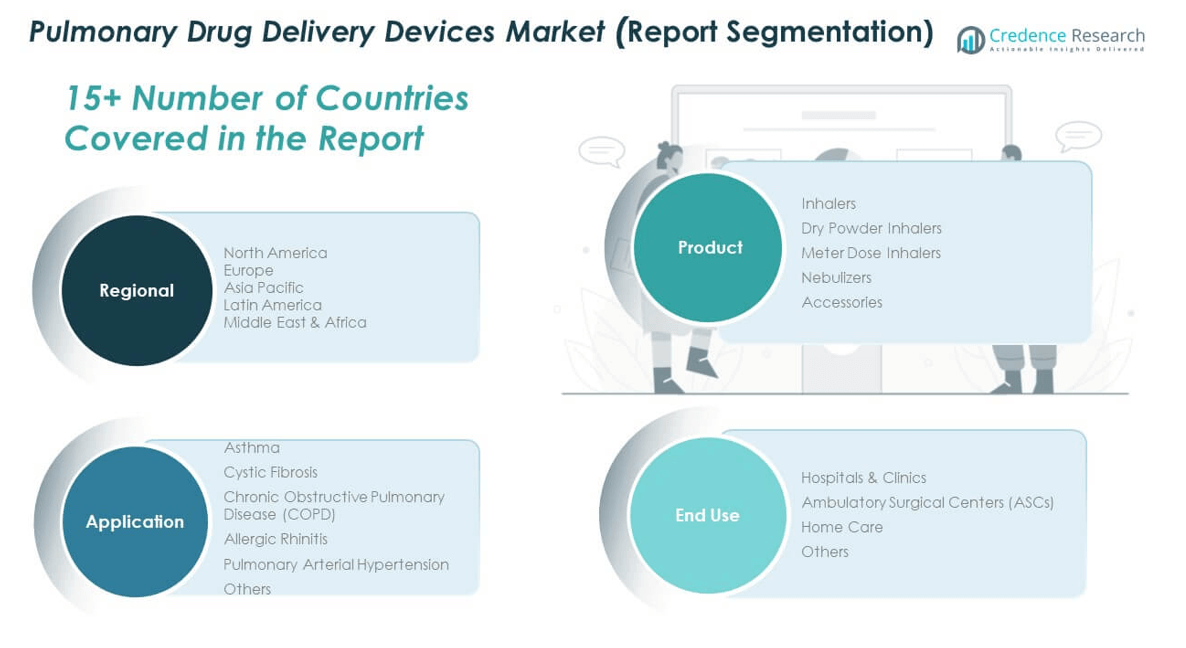
The Pulmonary Drug Delivery Devices Market is segmented by product, application, and end use.
By product, inhalers dominate the market, with dry powder inhalers (DPIs) and metered dose inhalers (MDIs) holding significant shares due to their portability and ease of use. Nebulizers continue to serve critical care and pediatric patients, while accessories such as spacers and holding chambers support drug delivery efficiency.
- For example, Philips’ InnoSpire Go mesh nebulizer, launched in 2022, delivers a typical 2.5 mL dose in under 4 minutes, catering to pediatric and critical care settings.
By application, asthma and chronic obstructive pulmonary disease (COPD) are the leading segments, driven by rising global prevalence and the need for long-term respiratory management. Cystic fibrosis, allergic rhinitis, and pulmonary arterial hypertension form smaller but steadily expanding niches with growing treatment innovations.
- For exampale, Boehringer Ingelheim’s Spiriva Respimat (tiotropium) received regulatory approval in over 100 countries and is backed by the TIOSPIR trial, which enrolled more than 17,000 COPD patients. The large-scale TIOSPIR study, conducted across 50 countries, demonstrated that tiotropium delivered via Respimat offers efficacy and safety comparable to the HandiHaler form confirming its role in reducing COPD exacerbations and maintaining lung function over long-term treatment.
By end use, with hospitals and clinics accounting for the highest demand due to high patient volume and availability of advanced infrastructure. Home care is gaining traction, especially post-pandemic, driven by demand for remote care and user-friendly devices. Ambulatory surgical centers (ASCs) and other settings support specific outpatient or chronic care needs.
Segmentation:
By Product:
- Inhalers
- Dry Powder Inhalers
- Metered Dose Inhalers
- Nebulizers
- Accessories
By Application:
- Asthma
- Cystic Fibrosis
- Chronic Obstructive Pulmonary Disease (COPD)
- Allergic Rhinitis
- Pulmonary Arterial Hypertension
- Others
By End Use:
- Hospitals & Clinics
- Ambulatory Surgical Centers (ASCs)
- Home Care
- Others
By Region:
- North America
- U.S.
- Canada
- Mexico
- Europe
- Germany
- France
- U.K.
- Italy
- Spain
- Rest of Europe
- Asia Pacific
- China
- Japan
- India
- South Korea
- South-east Asia
- Rest of Asia Pacific
- Latin America
- Brazil
- Argentina
- Rest of Latin America
- Middle East & Africa
- GCC Countries
- South Africa
- Rest of the Middle East and Africa
Regional Analysis:
North America
The North America Pulmonary Drug Delivery Devices Market size was valued at USD 9,768.81 million in 2018 to USD 12,151.23 million in 2024 and is anticipated to reach USD 16,609.27 million by 2032, at a CAGR of 4.0% during the forecast period. North America holds the largest share of the global market, accounting for nearly 30% of the total revenue. This dominance stems from a high prevalence of chronic respiratory diseases, robust healthcare infrastructure, and strong reimbursement frameworks. The U.S. drives most of the regional demand with widespread access to advanced inhalation therapies and growing adoption of smart inhalers. It also benefits from continuous R&D investments and early regulatory approvals that support the introduction of novel technologies. Canada contributes steadily, with expanding public health initiatives focused on asthma and COPD management. The region remains a key innovation hub for device manufacturers.
Europe
The Europe Pulmonary Drug Delivery Devices Market size was valued at USD 10,678.03 million in 2018 to USD 13,675.72 million in 2024 and is anticipated to reach USD 19,451.04 million by 2032, at a CAGR of 4.5% during the forecast period. Europe represents the second-largest regional market, capturing approximately 28% of the global share. Countries like Germany, the U.K., and France lead adoption, driven by aging populations and increasing cases of chronic pulmonary conditions. The region benefits from well-established healthcare systems and proactive regulatory support for advanced drug delivery systems. It also shows strong demand for propellant-free and eco-friendly inhalers due to stringent environmental regulations. Public awareness campaigns and physician training programs support high rates of correct inhaler use. Digital health integration is gaining momentum, particularly in Western Europe.
Asia Pacific
The Asia Pacific Pulmonary Drug Delivery Devices Market size was valued at USD 14,987.17 million in 2018 to USD 19,839.51 million in 2024 and is anticipated to reach USD 29,424.34 million by 2032, at a CAGR of 5.1% during the forecast period. Asia Pacific is the fastest-growing region, holding 32% of the global market share. Rapid urbanization, increasing pollution, and rising respiratory disease incidence fuel demand across countries like China, India, and Japan. It is witnessing increased investments in healthcare infrastructure and diagnostic capabilities. Local manufacturers are entering the market with cost-effective and portable inhalers suited for mass deployment. Government-led initiatives to raise awareness and expand access to respiratory treatments further support market growth. Telehealth and digital solutions are emerging in urban centers.
Latin America
The Latin America Pulmonary Drug Delivery Devices Market size was valued at USD 3,619.67 million in 2018 to USD 4,232.51 million in 2024 and is anticipated to reach USD 5,265.41 million by 2032, at a CAGR of 2.8% during the forecast period. Latin America holds a moderate 7% share of the global market, with Brazil and Mexico leading regional adoption. Growing healthcare investments, increasing diagnosis of chronic diseases, and gradual expansion of medical infrastructure are contributing to market growth. It shows demand for low-cost and portable inhalers, especially in public hospitals and rural clinics. Patient education programs are helping improve inhaler usage techniques. Regulatory barriers and uneven access to advanced treatments pose challenges to rapid growth. Local distribution partnerships are playing a critical role in device availability.
Middle East
The Middle East Pulmonary Drug Delivery Devices Market size was valued at USD 3,063.79 million in 2018 to USD 3,804.56 million in 2024 and is anticipated to reach USD 5,187.98 million by 2032, at a CAGR of 4.0% during the forecast period. The Middle East accounts for roughly 6% of the global market share and is steadily expanding due to increased focus on non-communicable diseases and healthcare modernization. Countries such as Saudi Arabia and the UAE are investing in digital healthcare infrastructure and respiratory care services. It benefits from a growing private healthcare sector and high demand for home-based treatments. Adoption of smart nebulizers and inhalers is increasing in urban centers. Cross-border collaborations and regulatory reforms are supporting the introduction of international products. Air quality concerns are also raising awareness around respiratory health.
Africa
The Africa Pulmonary Drug Delivery Devices Market size was valued at USD 973.86 million in 2018 to USD 1,162.37 million in 2024 and is anticipated to reach USD 1,494.45 million by 2032, at a CAGR of 3.2% during the forecast period. Africa holds the smallest share in the global market, contributing nearly 3% of total revenue. Limited access to healthcare, low diagnosis rates, and affordability constraints hinder rapid market expansion. However, it is witnessing gradual improvements in healthcare delivery and growing interest from international health organizations. Countries such as South Africa, Kenya, and Nigeria are focal points for pilot programs in respiratory care. Mobile health initiatives and donation-based device distribution support incremental growth. Educational outreach and public health partnerships will be key to unlocking market potential in the region.
Key Player Analysis:
- 3M
- AstraZeneca plc
- GSK plc
- Koninklijke Philips N.V.
- OMRON Healthcare, Inc.
- PARI GmbH
- Cipla Ltd
- Bristol-Myers Squibb Company
- AptarGroup, Inc.
- Chiesi Farmaceutici S.p.A.
- Nypro Healthcare Inc.
- Hovione
- Other Key Players
Competitive Analysis:
The Pulmonary Drug Delivery Devices Market is highly competitive, with leading players focusing on innovation, strategic collaborations, and product diversification to strengthen their market presence. Key companies such as GSK plc, AstraZeneca, Boehringer Ingelheim, Teva Pharmaceutical Industries, and Novartis AG dominate the space with extensive portfolios of inhalers and nebulized therapies. It is witnessing intensified competition due to the entry of digital health companies integrating smart features into traditional devices. Emerging players are targeting niche segments with low-cost, patient-centric designs. Mergers, acquisitions, and licensing agreements remain common strategies to expand global reach and pipeline capabilities. Companies are investing in research and development to improve drug delivery efficiency, reduce dosage errors, and enhance patient adherence. Regulatory compliance and patent protection play a critical role in maintaining competitive advantage. The emphasis on eco-friendly and connected devices is reshaping the innovation landscape and driving new product launches across the industry.
Recent Developments:
- In July 2025, Merck & Co. agreed to acquire Verona Pharma for approximately $10 billion, securing access to Ohtuvayre a novel inhaled therapy for COPD.
- In May 2025, Philips partnered with Polarean to integrate advanced Xenon MRI technology into its MRI systems, enabling safer and more precise pulmonary imaging for children with chronic lung diseases. This partnership aims to transform how clinicians diagnose and monitor lung function, offering radiation-free imaging solutions.
- In July 2023, Viatris and Kindeva launched Breyna™, the first FDA-approved generic version of Symbicort (budesonide/formoterol inhalation aerosol) designed for asthma and COPD patients. This drug-device combination became available immediately in two dosage strengths (80/4.5 µg and 160/4.5 µg).
Market Concentration & Characteristics:
The Pulmonary Drug Delivery Devices Market exhibits moderate to high market concentration, with a few multinational pharmaceutical and medical device companies controlling a significant share of global revenue. It is characterized by strong brand loyalty, extensive patent portfolios, and high barriers to entry due to regulatory and technological complexities. The market favors companies with integrated capabilities in drug formulation and device engineering. Innovation cycles are frequent, driven by advancements in inhaler design, digital connectivity, and patient-centric features. The market structure supports long-term contracts, especially in institutional and government procurement. Cost-efficiency, clinical efficacy, and ease of use remain critical factors influencing product success.
Report Coverage:
The research report offers an in-depth analysis based on product, application, and end use. It details leading market players, providing an overview of their business, product offerings, investments, revenue streams, and key applications. Additionally, the report includes insights into the competitive environment, SWOT analysis, current market trends, as well as the primary drivers and constraints. Furthermore, it discusses various factors that have driven market expansion in recent years. The report also explores market dynamics, regulatory scenarios, and technological advancements that are shaping the industry. It assesses the impact of external factors and global economic changes on market growth. Lastly, it provides strategic recommendations for new entrants and established companies to navigate the complexities of the market.
Future Outlook:
- Rising global burden of asthma and COPD will continue to drive consistent demand for advanced inhalation devices.
- Increasing adoption of smart inhalers and connected devices will reshape patient engagement and monitoring.
- Biologic drug delivery through inhalation platforms is expected to expand treatment applications beyond traditional therapies.
- Emerging markets in Asia and Africa offer significant untapped growth opportunities due to expanding healthcare access.
- Technological advancements in mesh nebulizers and soft mist inhalers will enhance drug delivery efficiency.
- Sustainability concerns will accelerate the shift toward eco-friendly, propellant-free inhaler options.
- Integration of AI and data analytics will support personalized respiratory care and predictive interventions.
- Growing preference for home-based treatment will boost demand for compact, user-friendly pulmonary devices.
- Regulatory support for digital health solutions will encourage faster adoption of innovative delivery systems.
- Strategic partnerships between pharma and medtech companies will drive portfolio diversification and market expansion.

Request a Free Sample
Fill in your details and we'll send you a free sample report.
- Sample data tables & charts
- Research methodology
Market Dynamics
Rising Prevalence of Respiratory Diseases
The increasing global incidence of asthma, COPD, cystic fibrosis, and other respiratory conditions - driven by pollution, smoking, and aging populations - is fueling demand for targeted pulmonary drug delivery devices that offer effective, localized treatment.
Technological Advancements in Inhalation Devices
Innovations such as smart inhalers, mesh nebulizers, and digital connectivity are improving drug delivery efficiency, patient adherence, and ease of use, making these devices more attractive for both patients and healthcare providers.
Shift Toward Home-Based and Self-Administered Care
Growing preference for home-based treatment, especially post-pandemic, is boosting demand for portable, user-friendly, and remotely monitored pulmonary drug delivery devices, supporting better disease management outside clinical settings.
Regulatory and Reimbursement Support
Favorable government policies, reimbursement programs, and fast-track regulatory approvals in key markets like North America and Europe are encouraging the adoption of advanced inhalation therapies and supporting market expansion.
Expansion in Emerging Markets
Rapid urbanization, increasing air pollution, and improved healthcare infrastructure in Asia Pacific, Latin America, and Africa are creating new opportunities for market growth as awareness and diagnosis of respiratory diseases rise.
Need a Custom Version of This Report?
Tailor the scope, geography, or segments to your exact requirements.
- Custom geography or segment scope
- Direct access to our analyst team
Frequently Asked Questions
What is the current size of the Pulmonary Drug Delivery Devices Market?
What are the key segments within the Pulmonary Drug Delivery Devices Market?
What are some challenges faced by the Pulmonary Drug Delivery Devices Market?
Who are the major players in the Pulmonary Drug Delivery Devices Market?
Table of Content
Chapter 1 Market Segmentation
- 1.1 Segmentation Framework
- 1.1.1 Product and Service Classification
- 1.1.2 Application and End-Use Classification
- 1.1.3 Technology and Solution Classification
- 1.1.4 Customer and Distribution Channel Classification
- 1.1.5 Geographic Segmentation
- 1.1.6 Market Segment Definitions and Boundaries
- 1.2 By End Use
- 1.2.1 Hospitals & Clinics
- 1.2.2 Home Care
- 1.2.3 Ambulatory Surgical Centers (ASCs)
- 1.2.4 Others
- 1.3 By Product
- 1.3.1 Dry Powder Inhalers (DPIs)
- 1.3.2 Metered Dose Inhalers (MDIs)
- 1.3.3 Nebulizers
- 1.3.4 Accessories
- 1.4 By Application
- 1.4.1 Asthma
- 1.4.2 Chronic Obstructive Pulmonary Disease (COPD)
- 1.4.3 Cystic Fibrosis
- 1.4.4 Allergic Rhinitis
- 1.4.5 Pulmonary Arterial Hypertension
- 1.4.6 Others
Chapter 2 Introduction
- 2.1 Report Objectives and Scope
- 2.2 Product Definition and Industry Terminology
- 2.3 Market Inclusions and Exclusions
- 2.4 Research Process
- 2.4.1 Primary Research and Expert Interviews
- 2.4.2 Secondary Research and Source Review
- 2.4.3 Top-Down and Bottom-Up Estimation
- 2.4.4 Data Triangulation and Verification
- 2.5 Market Size Measurement Basis
- 2.5.1 2024: USD 54,865.9 million → 2032: USD 77,432.5 million
- 2.6 Historical and Forecast Reference Periods
- 2.6.1 Base Year: 2024
- 2.6.2 Forecast Period: 2024-2032
- 2.7 Research Assumptions and Limitations
Chapter 3 Executive Summary
- 3.1 Market Snapshot and Key Findings
- 3.2 Base-Year Market Size, 2024
- 3.3 Forecast Market Size, 2032
- 3.4 Revenue and Volume Growth Outlook
- 3.5 Key Demand and Supply Indicators
- 3.6 Leading Market Segments
- 3.7 Fastest-Growing Market Opportunities
- 3.8 Regional Performance Highlights
- 3.9 Technology and Industry Transformation
- 3.10 Competitive Landscape Summary
- 3.11 Analyst View and Strategic Implications
Chapter 4 Global Pulmonary Drug Delivery Devices Market Trends and Developments
- 4.1 Historical Industry Development
- 4.2 Recent Market Trends and Developments
- 4.3 Demand and Customer Behavior Trends
- 4.4 Technology and Product Innovation
- 4.5 Artificial Intelligence, Automation and Digitalization
- 4.6 Local Manufacturing and Supply Chain Realignment
- 4.7 Industry Partnerships, Mergers and Acquisitions
- 4.8 Sustainability and Circular Economy Developments
- 4.9 Government and Private Sector Investment Trends
- 4.10 Emerging Business Models and Commercialization
- 4.11 Industry Developments and Announcements
Chapter 5 Global Pulmonary Drug Delivery Devices Market Production, Supply and Demand Analysis
- 5.1 Demand Trend and Consumption Analysis
- 5.2 Demand Forecast, 2024-2032
- 5.3 Production and Output Trend
- 5.4 Production and Output Forecast, 2024-2032
- 5.5 Installed Capacity and Capacity Utilization
- 5.6 Company-Wise Production Plants and Statistics
- 5.6.1 Installed Production Capacity
- 5.6.2 Actual Production
- 5.6.3 Planned Capacity and Expansion Targets
- 5.7 Supply Chain Structure and Procurement Trends
- 5.8 Supply-Demand Gap and Bottlenecks
- 5.9 Import Dependence and Sourcing Structure
- 5.10 Contract Manufacturing and Outsourcing
- 5.11 Regional Supply and Demand Concentration
Chapter 6 Global Pulmonary Drug Delivery Devices Market Pricing Analysis
- 6.1 Pricing Structure and Measurement
- 6.2 Historical Pricing Trends
- 6.3 Pricing Outlook, 2024-2032
- 6.4 Average Selling Price and Unit Economics
- 6.5 Pricing by Product and Market Segment
- 6.6 Geographic Pricing Differences
- 6.7 Key Input, Energy, Labor and Logistics Costs
- 6.8 Contract Pricing and Purchasing Models
- 6.9 Pricing Sensitivity and Competitive Positioning
- 6.10 Price, Margin and Profitability Implications
Chapter 7 Global Pulmonary Drug Delivery Devices Market Dynamics
- 7.1 Market Growth Drivers
- 7.1.1 Demand-Side Drivers
- 7.1.2 Technology and Innovation Drivers
- 7.1.3 Infrastructure and Investment Drivers
- 7.1.4 Regulatory and Policy Drivers
- 7.2 Market Restraints
- 7.2.1 Cost and Affordability Constraints
- 7.2.2 Technology and Adoption Barriers
- 7.2.3 Supply Chain and Operational Constraints
- 7.3 Market Challenges
- 7.3.1 Competitive Pressure and Margin Erosion
- 7.3.2 Skills, Infrastructure and Implementation Gaps
- 7.4 Emerging Market Opportunities
- 7.5 Market Dynamics Impact and Time-Horizon Assessment
Chapter 8 Global Pulmonary Drug Delivery Devices Value Chain Analysis
- 8.1 Industry Value Chain Overview
- 8.2 Upstream Suppliers and Critical Inputs
- 8.3 Technology and Component Providers
- 8.4 Manufacturing or Service Delivery
- 8.5 Distribution, Channel Partners and Integrators
- 8.6 Downstream Applications and End Users
- 8.7 Value Addition and Profit Pools
- 8.8 Vertical Integration and Outsourcing
- 8.9 Supplier Concentration and Risk
- 8.10 Supply Chain Localization and Resilience
Chapter 9 Global Pulmonary Drug Delivery Devices Market Regulations and Policies
- 9.1 Relevant Laws, Standards and Compliance Frameworks
- 9.2 Product, Service, Safety and Quality Requirements
- 9.3 Government Policies, Incentives and Subsidies
- 9.4 Imports, Exports and Trade Barriers
- 9.5 Public Procurement and Local Content Requirements
- 9.6 Environmental and Sustainability Compliance
- 9.7 Upcoming Policy Changes and Market Implications
Chapter 10 Global Pulmonary Drug Delivery Devices Market Hotspots and Opportunities
- 10.1 Market Opportunity Mapping and Growth Hotspots
- 10.2 High-Growth Applications and Customer Groups
- 10.3 Underserved Markets and White-Space Opportunities
- 10.4 Emerging Technology and Product Opportunities
- 10.5 New Capacity and Investment Hotspots
- 10.6 Market Entry and Expansion Opportunities
- 10.7 Distribution and Partnership Opportunities
- 10.8 Near-Term and Long-Term Commercial Potential
- 10.9 Opportunity Attractiveness and Execution Risks
Chapter 11 Global Pulmonary Drug Delivery Devices Market Outlook, 2024-2032
- 11.1 Market Size and Analysis
- 11.1.1 Revenue (Market Measurement: 2024: USD 54,865.9 million → 2032: USD 77,432.5 million)
- 11.1.2 Market Volume and Quantity Sold
- 11.1.3 Historical Market Size
- 11.1.4 Base-Year Market Size, 2024
- 11.2 Market Forecast, 2024-2032
- 11.2.1 Revenue Forecast to 2032
- 11.2.2 Volume Forecast to 2032
- 11.2.3 CAGR and Year-on-Year Growth
- 11.2.4 Incremental Revenue Opportunity
- 11.3 Forecast Assumptions and Scenario Analysis
- 11.3.1 Base-Case Forecast
- 11.3.2 Optimistic and Conservative Scenarios
- 11.3.3 Technology, Pricing and Policy Sensitivities
- 11.4 Market Attractiveness and Growth Outlook
Chapter 12 Global Pulmonary Drug Delivery Devices Market Segmentation and Outlook
- 12.1 Segmentation Summary and Market Shares, 2024
- 12.2 Largest and Fastest-Growing Segments
- 12.3 By End Use - Market Size and Forecast, 2024-2032
- 12.3.1 Segment Definition and Scope
- 12.3.2 Historical Market Size
- 12.3.3 Revenue Forecast, 2024-2032
- 12.3.4 Volume Forecast, 2024-2032
- 12.3.5 Base-Year Market Share, 2024
- 12.3.6 Segment CAGR and Growth Drivers
- 12.3.7 Subsegment Market Size and Forecast
- 12.3.7.1 Hospitals & Clinics
- 12.3.7.2 Home Care
- 12.3.7.3 Ambulatory Surgical Centers (ASCs)
- 12.3.7.4 Others
- 12.3.8 Subsegment Pricing and Adoption Trends
- 12.3.9 Leading Suppliers and Competition
- 12.3.10 Regional Demand and Opportunities
- 12.4 By Product - Market Size and Forecast, 2024-2032
- 12.4.1 Segment Definition and Scope
- 12.4.2 Historical Market Size
- 12.4.3 Revenue Forecast, 2024-2032
- 12.4.4 Volume Forecast, 2024-2032
- 12.4.5 Base-Year Market Share, 2024
- 12.4.6 Segment CAGR and Growth Drivers
- 12.4.7 Subsegment Market Size and Forecast
- 12.4.7.1 Dry Powder Inhalers (DPIs)
- 12.4.7.2 Metered Dose Inhalers (MDIs)
- 12.4.7.3 Nebulizers
- 12.4.7.4 Accessories
- 12.4.8 Subsegment Pricing and Adoption Trends
- 12.4.9 Leading Suppliers and Competition
- 12.4.10 Regional Demand and Opportunities
- 12.5 By Application - Market Size and Forecast, 2024-2032
- 12.5.1 Segment Definition and Scope
- 12.5.2 Historical Market Size
- 12.5.3 Revenue Forecast, 2024-2032
- 12.5.4 Volume Forecast, 2024-2032
- 12.5.5 Base-Year Market Share, 2024
- 12.5.6 Segment CAGR and Growth Drivers
- 12.5.7 Subsegment Market Size and Forecast
- 12.5.7.1 Asthma
- 12.5.7.2 Chronic Obstructive Pulmonary Disease (COPD)
- 12.5.7.3 Cystic Fibrosis
- 12.5.7.4 Allergic Rhinitis
- 12.5.7.5 Pulmonary Arterial Hypertension
- 12.5.7.6 Others
- 12.5.8 Subsegment Pricing and Adoption Trends
- 12.5.9 Leading Suppliers and Competition
- 12.5.10 Regional Demand and Opportunities
- 12.6 Segment Growth Comparison
- 12.7 Segment Attractiveness and Priority Matrix
Chapter 13 Global Pulmonary Drug Delivery Devices End-Use and Application Market Outlook
- 13.1 End-Use Industry and Customer Demand Structure
- 13.2 Leading Applications and Customer Groups
- 13.3 End-Use Market Size, Share and Forecast
- 13.4 Major End-Use Industry Deep Dives
- 13.4.1 Customer Requirements and Use Cases
- 13.4.2 Demand and Replacement Cycles
- 13.4.3 Technical and Regulatory Considerations
- 13.4.4 Purchasing and Procurement Models
- 13.4.5 Leading Vendors and Distribution Channels
- 13.4.6 Forecast and Commercial Opportunities
- 13.5 Emerging Applications and Cross-Segment Demand
- 13.6 End-Use Industry Investment Priorities
Chapter 14 Global Pulmonary Drug Delivery Devices Geographic Market Outlook, 2024-2032
- 14.1 Regional Market Size and Share, 2024
- 14.2 Regional Market Forecast, 2024-2032
- 14.3 Regional Pricing, Production and Demand Differences
- 14.4 North America
- 14.4.1 United States
- 14.4.2 Canada
- 14.4.3 Mexico
- 14.5 Europe
- 14.5.1 Germany
- 14.5.2 France
- 14.5.3 Italy
- 14.5.4 United Kingdom
- 14.5.5 Spain
- 14.5.6 Poland
- 14.5.7 Russia
- 14.5.8 Netherlands
- 14.5.9 Belgium
- 14.5.10 Sweden
- 14.5.11 Denmark
- 14.5.12 Norway
- 14.5.13 Rest of Europe
- 14.6 Asia Pacific
- 14.6.1 China
- 14.6.2 India
- 14.6.3 Japan
- 14.6.4 South Korea
- 14.6.5 Thailand
- 14.6.6 Indonesia
- 14.6.7 Vietnam
- 14.6.8 Malaysia
- 14.6.9 Australia
- 14.6.10 Rest of Asia Pacific
- 14.7 Latin America
- 14.7.1 Brazil
- 14.7.2 Argentina
- 14.7.3 Colombia
- 14.7.4 Chile
- 14.7.5 Rest of Latin America
- 14.8 Middle East
- 14.8.1 Saudi Arabia
- 14.8.2 United Arab Emirates
- 14.8.3 Turkey
- 14.8.4 Israel
- 14.8.5 Iran
- 14.8.6 Rest of the Middle East
- 14.9 Africa
- 14.9.1 South Africa
- 14.9.2 Egypt
- 14.9.3 Nigeria
- 14.9.4 Morocco
- 14.9.5 Rest of Africa
- 14.10 Regional Investment, Policy and Supply Chain Differences
- 14.11 Regional Competitive Landscape
- 14.12 Geographic Growth Hotspots
Chapter 15 Global Pulmonary Drug Delivery Devices Technology, Innovation and Sustainability Outlook
- 15.1 Technology Landscape and Maturity
- 15.2 Product, Process and Service Innovation
- 15.3 AI, Automation and Digital Tools in the Industry
- 15.4 Technology Adoption and Performance Benchmarking
- 15.5 Innovation Pipeline and R&D Investment
- 15.6 Patent and Intellectual Property Trends
- 15.7 Energy Efficiency and Resource Management
- 15.8 Sustainability, Recycling and Circularity
- 15.9 Technology Roadmap, 2024-2032
- 15.10 Risks of Obsolescence and Technology Substitution
Chapter 16 Global Pulmonary Drug Delivery Devices Market Key Strategic Imperatives
- 16.1 Growth and Market Entry Priorities
- 16.2 High-Return Products and Segments
- 16.3 Pricing, Profitability and Cost Optimization
- 16.4 Technology Investment and Product Differentiation
- 16.5 Supply Chain Localization and Resilience
- 16.6 Distribution and Customer Acquisition
- 16.7 Partnership, Acquisition and Capacity Strategy
- 16.8 Regional Expansion Priorities
- 16.9 Short-, Medium- and Long-Term Actions
Chapter 17 Competition Outlook
- 17.1 Industry Competition Characteristics
- 17.2 Market Structure and Concentration
- 17.3 Market Share and Competitive Positioning, 2024
- 17.4 Company-Wise Revenue and Product Benchmarking
- 17.5 Production and Service Capacity Benchmarking
- 17.6 Technology, Pricing and Differentiation
- 17.7 Regional Footprint and Distribution Strength
- 17.8 Mergers, Acquisitions and Strategic Alliances
- 17.9 New Entrants and Competitive Threats
- 17.10 Porter's Five Forces and Industry Attractiveness
- 17.11 Competitive Outlook, 2024-2032
Chapter 18 Company Profiles
- 18.1 Company Coverage and Selection Criteria
- 18.2 AstraZeneca plc
- 18.2.1 Business Description
- 18.2.2 Company Ownership and Geographic Presence
- 18.2.3 Product and Service Portfolio
- 18.2.4 Manufacturing and Operating Footprint
- 18.2.5 Production Capacity and Expansion Plans
- 18.2.6 Financial Performance and Investment
- 18.2.7 Market Share and Competitive Position
- 18.2.8 Technology and Innovation Capabilities
- 18.2.9 Strategic Alliances or Partnerships
- 18.2.10 Recent Developments
- 18.2.11 Growth Strategy and Outlook
- 18.3 GSK plc
- 18.4 Koninklijke Philips N.V.
- 18.5 OMRON Healthcare, Inc.
- 18.6 PARI GmbH
- 18.7 Cipla Ltd
- 18.8 Teva Pharmaceutical Industries Ltd.
- 18.9 Boehringer Ingelheim
- 18.10 Novartis AG
- 18.11 3M
- 18.12 Other Relevant Market Participants
Note: Every listed company is profiled on the structure shown under the first company. The company list is preliminary and may change based on research findings, market developments, data availability and client requirements.
Chapter 19 Disclaimer
- 19.1 Research and Forecast Disclaimer
- 19.2 Data Source and Estimation Limitations
Note: The depth of individual sections depends on data availability for this market. Volume, capacity, trade and other unit-based metrics are included where applicable.