
| REPORT ATTRIBUTE | DETAILS |
|---|---|
| Historical Period | 2019-2022 |
| Base Year | 2023 |
| Forecast Period | 2024-2032 |
| Regenerative Medicine Market Size 2023 | USD 30514.2 Million |
| Regenerative Medicine Market, CAGR | 17.00% |
| Regenerative Medicine Market Size 2032 | USD 125364.5 Million |
Market Insights
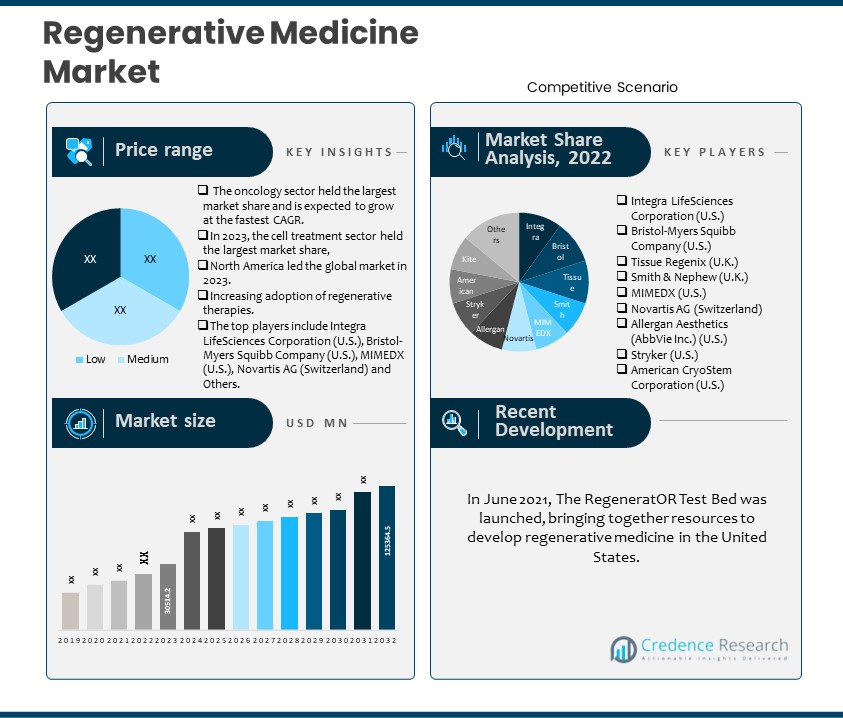
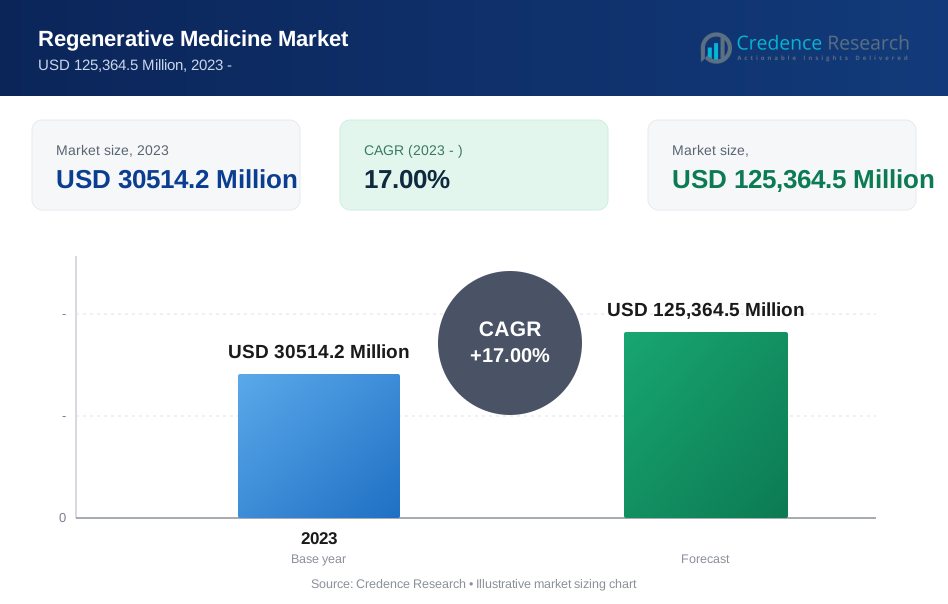
- The global demand for Regenerative Medicine was valued at USD 30514.2 Million in 2023 and is expected to reach USD 125364.5 Million in 2032, growing at a CAGR of 17.00% between 2024 and 2032.
- The cell treatment segment held the largest market share in 2023, and the gene therapy category is predicted to have the highest CAGR.
- In 2023, the orthopedics sector had the greatest global regenerative medicine market share, followed by oncology, which is expected to develop at the fastest CAGR.
- Biotechnology and pharmaceutical companies are important players in the Regenerative Medicine Market, while research institutions are another fast developing market category.
- North America led the global market in 2023, accounting for 48%, with Asia-Pacific expected to increase significantly during the projection period.
- The high use of stem cell technology drives market expansion.
- Costly treatments associated with regenerative medicine impede market expansion.
Executive Summary
Market Definition
Regenerative medicine is a cutting-edge field that focuses on harnessing the body's own healing and repair mechanisms. It entails applying advanced procedures to stimulate or replace damaged tissues and organs to restore normal function. One significant method is the use of stem cells, which have the unique ability to develop into several cell types. Scientists and doctors employ these cells in regenerative medicine to repair or replace tissues that have been damaged by injury, disease, or age.
Furthermore, regenerative medicine has a wide range of applications, including therapies for heart disease and joint damage, skin regeneration, and even organ transplants. The goal is to transform medical interventions by enhancing the body's natural healing abilities and providing innovative solutions to a variety of health conditions.
Market Overview
The global Regenerative Medicine Market has witnessed steady growth in recent years and is expected to grow at a CAGR of 17.00% between 2024 and 2032. The market was valued at USD 30514.2 million in 2023 and is expected to reach USD 125364.5 million in 2032.
Regenerative medicine is a branch of medicine that studies ways to replace, repair, or regenerate damaged or diseased tissues, organs, or cells. It entails the creation and application of tissue engineering, therapeutic stem cells, and artificial organs. The global market for regenerative therapies has expanded rapidly in recent years. The market is expected to rise due to advancements in healthcare technology, an increase in the prevalence of chronic diseases, enhanced technology in the regenerative medicine sector, and growth in stem cell technology. Furthermore, the expanding use of stem cell technologies, as well as the increasing number of global approvals and product launches, are expected to drive market expansion in the approaching years.
On the other hand, ethical concerns over the use of embryonic stem cells may hamper market expansion throughout the assessment period. Factors influencing the regenerative medicine market include advancements in healthcare technology, advanced technology in the market, rising prevalence of chronic diseases, and increased growth in stem cell technology.
Segmentation By Therapy Type
- The cell treatment segment held the greatest market share in 2023. The segment's growth is being driven by its increasing applications in the treatment of autoimmune diseases, malignancies, infectious diseases, musculoskeletal disorders, and joint injury repair, which has increased the acceptance of goods in this segment.
- The gene therapy category is expected to have the highest CAGR due to its advantages over traditional treatment approaches, such as enhanced clinical outcomes and targeting desirable locations.
Segmentation By Application
- The orthopedics sector had the largest worldwide regenerative medicine market share in 2023, owing to an increase in the prevalence of osteoarthritis and bone-related injuries. This has resulted in the adoption of these goods to speed up the healing process and alleviate pain and suffering, which is driving the segment's expansion.
- The oncology sector held the biggest market share in 2023 and is predicted to grow at the quickest CAGR of 17.62% from 2024 to 2030. The increasing prevalence of cancer is likely to have a favorable impact on the global market throughout the forecast period.
- The cardiovascular disease category is expected to experience a significant increase over the forecast period. Advances in cell-based therapeutics and regenerative medicine have increased the segment's growth.
Segmentation by End-User
- Biotechnology and pharmaceutical businesses are major players in the Regenerative Medicine Market. They play an important role in developing and commercializing regenerative medicines, which drives market growth.
- On the other hand, research institutions are another rapidly expanding market segment.
Segmentation by Region
- In 2023, North America led the global market, accounting for 48% of the market.
- Asia-Pacific is predicted to grow significantly over the projection period.
- The rest of the world, including Latin America, the Middle East, and Africa, supplies the remaining demand for Regenerative Medicines.
In 2023, North America led the global market. Regenerative medicine in North America is distinguished by pioneering research and academic prowess at schools such as Harvard and MIT, which is propelling advances in stem cell therapy and tissue engineering. The region's clinical trials, which are regulated by demanding regulatory organizations such as the US FDA, include a wide range of regenerative medicines, encouraging innovation. Robust cooperation among biotech enterprises, academia, and pharmaceutical companies hasten product development, notably in musculoskeletal and orthopedic applications.
Moreover, Asia-Pacific is predicted to grow significantly over the projection period. Asia is a key player in stem cell research, contributing significantly to the study of embryonic stem cells, induced pluripotent stem cells (iPSCs), and adult stem cells. This study focuses on understanding differentiation mechanisms for medicinal applications. Asia's governments, particularly Japan and South Korea, are aggressively supporting regenerative medicine through strategic initiatives and funding. This financing is beneficial to collaborations between academics, industry, and healthcare organizations.
Key Highlights of the Report
Therapy Type, Application, End-User, and region segment of the global Regenerative Medicine Market. The cell treatment segment held the most market share in 2023, while the oncology sector is expected to develop at the fastest CAGR. Moreover, biotechnology and pharmaceutical companies are key players, while research institutions are another rapidly developing market category, with North America driving its growth.
Advances in cell biology, genomics, and gene editing technologies are expected to propel the stem cell therapy market ahead. Furthermore, there is a lack of payment rules for cell-based therapy and barriers to regenerative medicine acceptance. Furthermore, the market opportunity for regenerative medicine is considerable, driven by a large and aging population.
In 2023, North America dominated the global market. Regenerative medicine in North America is defined by cutting-edge research and academic prowess at institutions such as Harvard and MIT, which is accelerating developments in stem cell therapy and tissue engineering. Furthermore, Asia-Pacific is expected to increase rapidly during the projection period. Asia is an important factor in stem cell research, contributing significantly to the study of embryonic stem cells, induced pluripotent stem cells (iPSCs), and adult stem cells.
What Are The Main Drivers Of The Global Regenerative Medicine Market?
Advances in cell biology, genomic research, and gene editing technology are projected to fuel the stem cell therapy business. Clinical trials are underway to investigate stem cell-based regenerative therapies for the restoration of damaged specialized cells in a variety of serious and fatal diseases, including cancer, Alzheimer's, neurodegenerative diseases, and spinal cord injuries. Furthermore, the increasing number of stem cell therapies in clinical trials for spinal cord injury, heart failure, and type 1 diabetes is projected to impact market growth.
What Are The Major Challenges Faced By The Global Regenerative Medicine Market?
Market barriers in the worldwide regenerative medicine market include variables such as commercialization and regulatory compliance, a lack of reimbursement policies for cell-based therapy, and limitations in the adoption of regenerative medicine due to its complex relationship with immunology. These issues are projected to limit market growth over the forecast period. Additionally, the presence of a high-quality healthcare system, skilled clinical research institutions, and a regulatory framework are projected to boost market expansion; nevertheless, the business faces obstacles due to a lack of reimbursement policies and adoption limits.
What Are The Growth Opportunities In The Global Regenerative Medicine Market?
The market opportunity for regenerative medicine is significant, driven by a big and aging population, rising rates of injuries and chronic diseases, and greater patient desire for individualized therapy.
Market Drivers
Several factors drive the global Regenerative Medicine Market. The following are the key drivers of the global Regenerative Medicine Market:
High Adoption Of Stem Cell Technology
Stem cell research is one of the most significant scientific advances in this field. It is essential in tissue regeneration and regenerative medicine studies. It affects not just nerve regeneration, but also whole organ reengineering and cardiovascular disease product development. The stem cell market is predicted to grow threefold over the next five years. Furthermore, advances in stem cell research are projected to drive the regenerative medicine market and hasten product development. Stem cells produced from embryonic, adult, and cord blood have the potential to accelerate the expansion of the regenerative medicine business.
Novel stem cell-derived medicines have accelerated the commercialization of stem cells in the tissue engineering and regenerative medicine markets. Cord blood stem cells are a possible source of stem cells for application in regenerative medicine and organ regeneration.
Market Restraints
The global Regenerative Medicine Market faces some challenges that may hinder its growth. These include the following:
Costly Treatment Associated with Regenerative Medicine
The high cost of tissue engineering and regenerative medicine hinders industry expansion. The developing tissue engineering sector faces obstacles due to a monopolistic environment and a scarcity of tissue engineering and regenerative medicine resources. These services result in higher costs due to reduced competition among vendors. Organ flaws and failures in the United States cost more than $400 billion each year, highlighting the market's potential. However, the tissue engineering and regenerative medicine business in underdeveloped nations has seen a decline due to high treatment costs that must be controlled.
Opportunities
The global Regenerative Medicine Market offers significant growth opportunities. These include the following:
Increase In Potential For Emerging Economies
Developing nations have promise in the regenerative medicine market due to the global increase in the occurrence of catastrophic injuries and organ transplants. The leading actors have strategically assessed the potential of tissue engineering and regenerative medicine in developing countries, and they have implemented a variety of development methods, including product launch, approval, agreement, collaboration, and merger. Although the market confronts ethical problems due to unfavorable norms, developing economies are projected to embrace tissue engineering and regeneration technology.
Competitive Landscape
Key Players
The global Regenerative Medicine Market is highly competitive, with several key players. Some of the major players in the market and their market share are as follows:
- Integra LifeSciences Corporation (U.S.)
- Bristol-Myers Squibb Company (U.S.)
- Tissue Regenix (U.K.)
- Smith & Nephew (U.K.)
- MIMEDX (U.S.)
- Novartis AG (Switzerland)
- Allergan Aesthetics (AbbVie Inc.) (U.S.)
- Stryker (U.S.)
- American CryoStem Corporation (U.S.)
- Kite (Gilead Sciences, Inc.) (U.S.)
- AlloSource (U.S.)
- bluebird bio, Inc. (U.S.)
- CRISPR Therapeutics (Switzerland)
- Janssen Global Services, LLC (Johnson & Johnson Services, Inc.) (Belgium)
- Tegoscience (South Korea)
These organizations prioritize product innovation, End-User expansion, and mergers and acquisitions to stay competitive.
The global Regenerative Medicine Market's key players continually seek to stay ahead by offering new products and developments.
In July 2022, Mogrify Limited and Astellas Pharma Inc. have established a collaborative research agreement to study regenerative medicine treatments for sensorineural hearing loss. Astellas Gene Therapies will fund the study and contribute expertise in AAV-based genetic therapy, while Mogrify will use its bioinformatic platform to analyze and validate possible therapeutic parameters. Their common goal is to enhance the lives of patients with hearing loss via novel regenerative medicines.
In April 2022, Autolus Therapeutics plc announced that its lead gene therapy, obecabatagene autoleucel, a CD19-directed autologous chimeric antigen receptor T therapy being investigated in the ongoing FELIX Phase 2 Leukemia study, has been designated as a Regenerative Medicine Advanced Therapy by the United States Food and Drug Administration.
Summary of Key Findings
- Increase in Potential for Emerging Economies
- The market is segmented by Therapy Type, Application, End-User, and region.
- the oncology sector owned the largest market share and is expected to develop at the fastest CAGR.
- Biotechnology and pharmaceutical companies are important players in the Regenerative Medicine Market
- North America is leading in market growth; the market is highly competitive, with key players including Integra LifeSciences Corporation (U.S.), Bristol-Myers Squibb Company (U.S.), Tissue Regenix (U.K.), Smith & Nephew (U.K.), MIMEDX (U.S.), Novartis AG (Switzerland) and Others.
Future Outlook
- Advances in tissue engineering
- Increasing adoption of regenerative therapies.
- Expansion of personalized medicine
- Growing investment in regenerative medicine.
- Development of 3D bioprinting technology.
How CXOs Can Benefit from the Credence Research Regenerative Medicine Market Report
The Credence Research Regenerative Medicine Market Report provides CXOs with a comprehensive overview of the market, including:
- Market size and growth forecast: The report provides detailed estimates of the global Regenerative Medicine Market size, segmented By Therapy Type, Application, End-User, and region. It also includes forecasts for the market through 2032 based on key trends and drivers.
- Market segmentation: The report segments the Regenerative Medicine Market By by Therapy Type, Application, End-User, and region. This segmentation provides CXOs with a granular understanding of the market and the opportunities in each segment.
- Competitive Landscape: The report profiles the key players in the Regenerative Medicine Market and provides insights into their strategies, product offerings, and financial performance. This information can help CXOs identify and assess their competition.
- Key trends and drivers: The report identifies and analyzes the key trends and drivers that are shaping the Regenerative Medicine Market. This information can help CXOs to make informed decisions about their investments and strategies.
CXOs can use the insights from the Credence Research Regenerative Medicine Market Report to:
- Identify growth opportunities: The report can help CXOs identify new growth opportunities in the Regenerative Medicine Market. By analyzing the data and trends in the report, they can make informed decisions about where to invest and expand their business.
- Make informed investment decisions: The report can help CXOs make informed investment decisions about Regenerative Medicine. For example, it may provide useful insights into market trends, customer preferences, the competitive landscape, and growth prospects in the Regenerative Medicine Market.
- Develop competitive strategies: The report can help CXOs develop competitive strategies for their Regenerative Medicine businesses. For example, by analyzing market trends, client preferences, and the competitive environment mentioned in the report, CXOs can fine-tune their strategies, differentiate their offers, and effectively position their firms in the marketplace.
- Track market developments: The report can help CXOs monitor market developments and stay ahead of the curve. For example, it provides insights into the latest trends and innovations in the Regenerative Medicine Market.
Overall, the Credence Research Regenerative Medicine Market Report is a valuable reApplication for CXOs who want to gain a deeper understanding of the market and identify opportunities for growth.
Segmentation
- By Therapy Type:
- Cell-Based Therapies
- Gene-Based Therapies
- Tissue Engineering and Biomaterials
- Small Molecules and Biologics
- By Application:
- Orthopedic Disorders
- Cardiovascular Diseases
- Neurological Disorders
- Dermatological Conditions
- Oncology
- Organ Transplantation
- Other Indications
- By End-User:
- Hospitals and Clinics
- Research Institutions
- Biotechnology and Pharmaceutical Companies
- Cell and Tissue Banks
- Contract Research Organizations (CROs)
- By Region
- North America
- The U.S.
- Canada
- Mexico
- Europe
- Germany
- France
- The U.K.
- Italy
- Spain
- Rest of Europe
- Asia Pacific
- China
- Japan
- India
- South Korea
- South-east Asia
- Rest of Asia Pacific
- Latin America
- Brazil
- Argentina
- Rest of Latin America
- Middle East & Africa
- GCC Countries
- South Africa
- Rest of the Middle East and Africa
- North America
Request a Free Sample
Fill in your details and we'll send you a free sample report.
- Sample data tables & charts
- Research methodology
Need a Custom Version of This Report?
Tailor the scope, geography, or segments to your exact requirements.
- Custom geography or segment scope
- Direct access to our analyst team
Frequently Asked Questions
What is the current size of the global Regenerative Medicine Market?
What is the expected growth rate of the Regenerative Medicine Market between 2024 and 2032?
Which segment is leading the market share in terms of Application?
Which End-User segment governs the demand for Regenerative Medicine in the world?
Who are the major players in the global Regenerative Medicine Market?
Table of Content
Chapter 1. Report Introduction
- 1.1 Report Description & Purpose
- 1.1.1 Report Title & Market Definition
- 1.1.2 Unique Selling Propositions (USP) & Key Differentiators
- 1.1.3 Value Proposition for Stakeholders
- 1.2 Research Objectives
- 1.2.1 Market Sizing Objectives (Volume & Revenue)
- 1.2.2 Segmentation Objectives
- 1.2.3 Competitive Intelligence Objectives
- 1.2.4 Forecast & Scenario Objectives
- 1.3 Report Scope
- 1.3.1 Regenerative Medicine Scope – Types & Subtypes Covered
- 1.3.2 Geographic Scope – Regions & Countries Covered
- 1.3.3 Historical Period, Base Year & Forecast Period (2023; forecast to the forecast period)
- 1.3.4 Inclusions & Exclusions
- 1.4 HS Code & Classification Framework
- 1.5 Currency, Units & Pricing Basis
- 1.6 Target Stakeholders
- 1.7 Limitations & Assumptions
Chapter 2. Executive Summary
- 2.1 Global Regenerative Medicine Market Snapshot
- 2.1.1 Market Size – Historical (2023) & Forecast (the forecast period) (2023: USD 30514.2 Million → forecast year: USD 125,364.5 Million)
- 2.1.2 Volume & Revenue – Global Totals
- 2.1.3 Key Market Highlights – Top Five Facts
- 2.2 Regenerative Medicine Market Segmentation Snapshot
- 2.2.1 Market Split by Region – 2023 vs.
- 2.3 Competitive Snapshot
- 2.3.1 Top 10 Players by Revenue Share – 2023
- 2.3.2 Top 10 Players by Volume Share – 2023
- 2.3.3 Recent Strategic Developments (18-Month Summary)
- 2.4 Key Investment Highlights & Strategic Conclusions
Chapter 3. Regenerative Medicine Market Dynamics & Industry Analysis
- 3.1 Market Overview & Context
- 3.1.1 Regenerative Medicine Market Position in the Broader Automotive Value Chain
- 3.1.2 OEM vs. Replacement Market Dynamics
- 3.1.3 Market Maturity & Development Stage by Region
- 3.2 Regenerative Medicine Market Drivers
- 3.3 Regenerative Medicine Market Restraints & Challenges
- 3.4 Regenerative Medicine Market Opportunities
- 3.5 Porter's Five Forces Analysis
- 3.5.1 Threat of New Entrants
- 3.5.2 Bargaining Power of Suppliers
- 3.5.3 Bargaining Power of Buyers
- 3.5.4 Threat of Substitutes
- 3.5.5 Competitive Rivalry – Intensity Assessment
- 3.6 Regenerative Medicine Value Chain Analysis
- 3.6.1 Upstream – Raw Material/Input Suppliers
- 3.6.1.1 Raw Material/Input 1
- 3.6.1.2 Raw Material/Input 2
- 3.6.1.3 Raw Material/Input 3
- 3.6.2 Midstream – Production/Manufacturing/Service Delivery
- 3.6.2.1 Production/Process Overview
- 3.6.2.2 Key Facility Locations & Capacity by Manufacturer
- 3.6.3 Downstream – Distribution & End Consumer
- 3.6.3.1 Primary Channel – B2B/OEM
- 3.6.3.2 Secondary Channels – Dealer, Retail, Online, Direct
- 3.6.4 Value Chain Profitability Analysis
- 3.6.1 Upstream – Raw Material/Input Suppliers
- 3.7 PESTEL Analysis
- 3.7.1 Political Factors
- 3.7.2 Economic Factors
- 3.7.3 Social Factors
- 3.7.4 Technological Factors
- 3.7.5 Environmental Factors
- 3.7.6 Legal Factors
- 3.8 Regenerative Medicine Supply Chain Analysis
- 3.8.1 Raw Material/Input Supply Risk Assessment
- 3.8.2 Manufacturing Concentration Risk (Geographic Exposure)
- 3.8.3 Trade Disruption Impact Analysis
- 3.9 Regulatory & Policy Landscape
Note: The regulatory and policy landscape section covers regulations based on their applicability to the market, Regenerative Medicine category, geography, and scope of the study. Only regulatory frameworks with a material impact on operations, compliance, trade, sustainability, or market access are analyzed in detail.
Chapter 4. Key Investment Pockets & Opportunity Analysis
- 4.1 Regenerative Medicine Market Attractiveness Analysis
- 4.1.1 By Region – Investment Attractiveness Matrix (Volume × CAGR)
- 4.2 Absolute Revenue Growth Opportunity
- 4.2.1 By Region – Absolute USD Growth Through the forecast period
- 4.3 Incremental Volume Opportunity
- 4.3.1 By Region – Incremental Volume Through the forecast period
- 4.3.2 Segment – Incremental Volume
- 4.4 Emerging Submarket Opportunity Deep Dive (Subject to Applicability)
- 4.5 Emerging Market Opportunity Scorecards
- 4.5.1 United States
- 4.5.2 Europe
- 4.5.3 Asia
- 4.5.4 Middle East & Africa
Note: Emerging Market Opportunity Scorecards will be included based on relevance and strategic importance. Regions listed are indicative and may vary depending on data availability and market dynamics.
Chapter 5. Regenerative Medicine Import-Export Analysis & Trade Flows
- 5.1 Global Trade Overview
- 5.1.1 Global Export Value by Country (2023)
- 5.1.2 Global Export Volume by Country (2023)
- 5.1.3 Global Import Value by Country (2023)
- 5.1.4 Global Import Volume by Country (2023)
- 5.1.5 Net Trade Balance by Country (2023)
- 5.2 Export Analysis – Segment
- 5.2.1 Type 1 (HS Code)
- 5.2.2 Type 2 (HS Code)
- 5.2.3 Type 3 (HS Code)
- 5.2.4 Type 4 (HS Code)
- 5.2.5 Type 5 (HS Code)
- 5.3 Import Analysis – Segment
- 5.3.1 Type 1 (HS Code)
- 5.3.2 Type 2 (HS Code)
- 5.3.3 Type 3 (HS Code)
- 5.3.4 Type 4 (HS Code)
- 5.3.5 Type 5 (HS Code)
- 5.4 Average Unit Trade Prices
- 5.4.1 Average Export Price – Segment & Country
- 5.4.2 Average Import Price – Segment & Source Country
- 5.4.3 Price Trends (2023)
- 5.5 Key Trade Route Analysis
- 5.5.1 Trade Route 1
- 5.5.2 Trade Route 2
- 5.5.3 Trade Route 3
- 5.5.4 Trade Route 4
- 5.5.5 Trade Route 5
- 5.6 Trade Policy Impact Assessment
- 5.6.1 US Anti-Dumping & Section 301 Tariffs
- 5.6.2 EU Customs Union Impact
- 5.6.3 Major Free Trade Agreements
- 5.6.4 USMCA Rules of Origin
Note: Trade policy analysis will be included only where relevant to the Regenerative Medicine market.
Chapter 6. Competitive Landscape & Company Benchmarking
- 6.1 Regenerative Medicine Market Concentration & Structure
- 6.1.1 Herfindahl-Hirschman Index (HHI) – vs. 2023
- 6.1.2 Tier 1, Tier 2 & Tier 3 Market Structure
- 6.1.3 Global, Regional & Local Player Dynamics
- 6.2 Regenerative Medicine Market Share Analysis – 2023
- 6.2.1 Global Revenue Share by Company
- 6.2.2 Global Volume Share by Company
- 6.2.3 Regional Revenue Share
- 6.2.4 Market Share Evolution ( vs. 2023)
- 6.2.5 OEM Segment Share by Company
- 6.2.6 Replacement Segment Share by Company
- 6.3 Production/Delivery Capacity & Facility Analysis
- 6.3.1 Global Installed Capacity
- 6.3.2 Capacity Utilization Rates
- 6.3.3 Production/Output Volume
- 6.3.4 Facility Locations & Capacity Map
- 6.3.5 Planned Capacity Additions
- 6.4 Regenerative Medicine Competitive Benchmarking Matrix
- 6.4.1 Revenue, Volume, CAGR & Profitability Comparison
- 6.4.2 Channel Revenue Mix
- 6.4.3 Geographic Revenue Exposure
- 6.4.4 R&D Intensity
- 6.4.5 Sustainability Maturity
- 6.5 Strategic Developments in Regenerative Medicine (Last 24 Months)
- 6.5.1 Mergers, Acquisitions & Divestments
- 6.5.2 New Regenerative Medicine Launches
- 6.5.3 Facility Expansions
- 6.5.4 Strategic Alliances, Joint Ventures & Partnerships
- 6.5.5 Distribution Expansion & Market Entry
- 6.5.6 Sustainability & ESG Initiatives
- 6.6 Competitive Strategy Mapping
- 6.6.1 Leader, Challenger, Follower & Niche Classification
- 6.6.2 Pricing Strategy Comparison
- 6.6.3 Channel Strategy Matrix
Note: Strategic developments are included based on their materiality and the availability of reliable information.
Chapter 7. Global Regenerative Medicine Market – By Distribution Channel
- 7.1 Segment Overview
- 7.1.1 Volume & Revenue Split by Channel (2023 & )
- 7.1.2 Channel Mix Evolution (the forecast period)
Chapter 8. Regional Market Analysis – Global Overview
- 8.1 Global Regional Overview
- 8.1.1 Regional Volume Share
- 8.1.2 Regional Revenue Share
- 8.1.3 Regional Volume by Region
- 8.1.4 Regional Revenue by Region
- 8.1.5 Regional Forecast Through the forecast period
- 8.2 Cross-Regional Segment Analysis
- 8.2.1 By Distribution Channel
- 8.2.2 By Brand/Price Tier
Chapter 9. North America Regenerative Medicine Market
- 9.1 United States
- 9.2 Canada
- 9.3 Mexico
Chapter 10. Europe Regenerative Medicine Market
- 10.1 Germany
- 10.2 France
- 10.3 Italy
- 10.4 United Kingdom
- 10.5 Spain
- 10.6 Poland
- 10.7 Russia
- 10.8 Netherlands
- 10.9 Belgium
- 10.10 Sweden
- 10.11 Denmark
- 10.12 Norway
- 10.13 Rest of Europe
Chapter 11. Asia Pacific Regenerative Medicine Market
- 11.1 China
- 11.2 India
- 11.3 Japan
- 11.4 South Korea
- 11.5 Thailand
- 11.6 Indonesia
- 11.7 Vietnam
- 11.8 Malaysia
- 11.9 Australia
- 11.10 Rest of Asia Pacific
Chapter 12. Latin America Regenerative Medicine Market
- 12.1 Brazil
- 12.2 Argentina
- 12.3 Colombia
- 12.4 Chile
- 12.5 Rest of Latin America
Chapter 13. Middle East Regenerative Medicine Market
- 13.1 Saudi Arabia
- 13.2 United Arab Emirates
- 13.3 Turkey
- 13.4 Israel
- 13.5 Iran
- 13.6 Rest of the Middle East
Chapter 14. Africa Regenerative Medicine Market
- 14.1 South Africa
- 14.2 Egypt
- 14.3 Nigeria
- 14.4 Morocco
- 14.5 Rest of Africa
Chapter 15. Regenerative Medicine Company Profiles
- 15.1 [Company 01]
- 15.1.1 Company Overview
- 15.1.2 Key Management Personnel
- 15.1.3 Products & Services Portfolio
- 15.1.4 Financial Performance
- 15.1.5 Key Market Focus & Geographic Presence
- 15.1.6 Recent Developments & Strategic Initiatives
Note: The company profile list is preliminary and may change based on research findings, market developments, data availability, and client requirements.
Chapter 16. Appendices
- Appendix A – List of Abbreviations & Acronyms
- Appendix B – Industry Classification Code Reference – Full Series
- Appendix C – Production & Capacity Data Tables
- Appendix D – End-Use & Demand Base Tables
- Appendix E – Consumption & Replacement Rate Assumptions
- Appendix F – ASP Reference Tables
- Appendix G – Manufacturing & Facility Database
- Appendix H – Import-Export Data Tables
- Appendix I – Regulatory Summary Tables
- Appendix J – Primary Research Participant List (Anonymized)
- Appendix K – Primary Research Questionnaire Framework
- Appendix L – Data Sources & Bibliography
- Appendix M – Market Size Divergence & Source Comparison
Chapter 17. Research Methodology
- 17.1 Research Framework & Philosophy
- 17.2 Secondary Research – Sources, Hierarchy & Data Extraction
- 17.3 Data Modeling – Bottom-Up & Top-Down Market Sizing
- 17.4 Primary Research – Stakeholder Framework, LOI & Sample Sizes
- 17.5 Forecast Methodology – Regression, Scenario & Sensitivity Analysis
- 17.6 Quality Control – Four-Layer Validation Framework
- 17.7 Limitations & Standard Assumptions
- 17.8 Disclaimer
