
Market Overview:
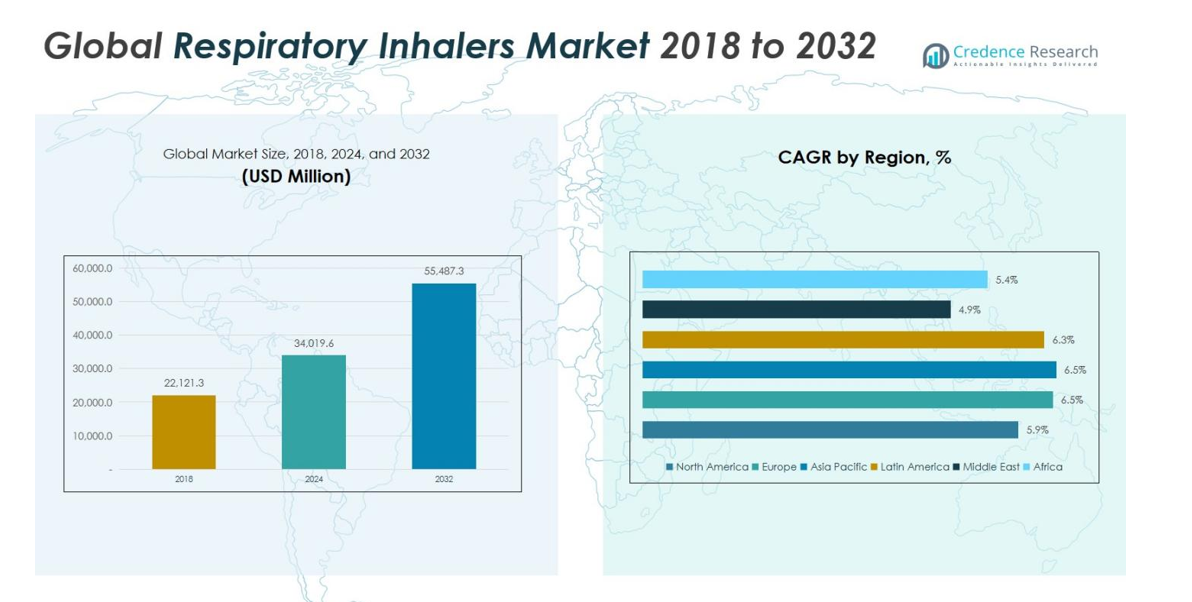
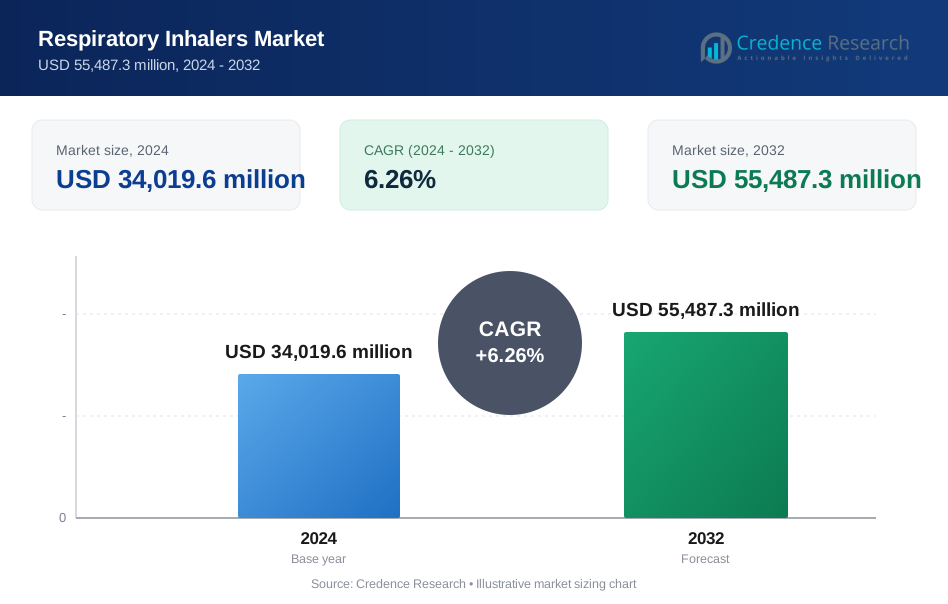
The Respiratory Inhalers Market size was valued at USD 22,121.3 million in 2018 and USD 34,019.6 million in 2024, and it is anticipated to reach USD 55,487.3 million by 2032, growing at a CAGR of 6.26% during the forecast period.
| REPORT ATTRIBUTE | DETAILS |
|---|---|
| Historical Period | 2020-2023 |
| Base Year | 2024 |
| Forecast Period | 2025-2032 |
| Respiratory Inhalers Market Size 2024 | USD 34,019.6 million |
| Respiratory Inhalers Market, CAGR | 6.26% |
| Respiratory Inhalers Market Size 2032 | USD 55,487.3 million |
The Respiratory Inhalers Market is dominated by key players including GlaxoSmithKline plc, AstraZeneca plc, Boehringer Ingelheim GmbH, Teva Pharmaceutical Industries Ltd., and Cipla Ltd., which maintain strong global presence through robust product portfolios, continuous R&D investment, and strategic collaborations. These companies focus on developing advanced inhaler technologies, including digital and breath-actuated devices, to improve patient adherence and clinical outcomes. Asia Pacific emerges as the leading region, capturing 32.6% of the global market share in 2024, driven by rising prevalence of respiratory disorders, urbanization, and improved healthcare access in countries like China, India, and Japan. The combination of technological innovation, regional demand, and expanding healthcare infrastructure positions these top players to maintain competitive dominance while capitalizing on growth opportunities in emerging markets.
Market Insights
- The Respiratory Inhalers Market was valued at USD 34,019.6 million in 2024 and is projected to reach USD 55,487.3 million by 2032, growing at a CAGR of 6.26%. Metered Dose Inhalers (MDIs) dominate the product segment with 47% market share, while asthma leads the application segment with 66% share.
- Market growth is driven by the rising prevalence of asthma, COPD, and other chronic respiratory diseases, coupled with increasing air pollution, smoking rates, and awareness of early respiratory disease management.
- Key trends include the adoption of digital and connected inhalers for adherence monitoring and personalized care, along with development of eco-friendly and propellant-free inhalers to meet sustainability goals.
- Competitive analysis highlights top players such as GlaxoSmithKline plc, AstraZeneca, Boehringer Ingelheim, Teva Pharmaceutical, and Cipla, focusing on R&D, digital innovations, and strategic collaborations to strengthen global presence.
- Regional analysis shows Asia Pacific leading with 6% market share, followed by Europe and North America, supported by urbanization, improved healthcare infrastructure, and increasing patient awareness.
Market Segmentation Analysis:
By Product
The Metered Dose Inhalers (MDIs) segment dominates the Respiratory Inhalers Market, accounting for around 47% of the total share in 2024. MDIs remain the preferred choice due to their affordability, consistent drug delivery, and broad availability across healthcare settings. Within this category, pressurized MDIs hold the largest sub-segment share, supported by robust clinical usage and established distribution channels. Growth is further driven by rising asthma and COPD prevalence and advancements in breath-actuated and digital-enabled devices designed to enhance patient adherence and minimize coordination challenges.
- For instance, Teva Pharmaceuticals’ FDA-approved QVAR® RediHaler™ breath-actuated inhaler eliminates hand-breath coordination challenges, enhancing ease of use for asthma patients.
By Application
The Asthma segment leads the market, contributing approximately 66% of total revenue in 2024, followed by Chronic Obstructive Pulmonary Disease (COPD). The dominance of asthma applications stems from its global prevalence and the necessity for long-term inhalation therapy. Increasing air pollution levels, smoking rates, and awareness of early respiratory disease management continue to propel inhaler adoption. Meanwhile, growing use of inhalers for COPD management and expanding therapeutic applications in cystic fibrosis and pulmonary arterial hypertension further strengthen overall market penetration.
- For instance, GlaxoSmithKline's Trelegy inhaler, prescribed for both asthma and COPD, saw a 26% sales growth in 2024 due to rising patient demand and market share gains.
By Technology
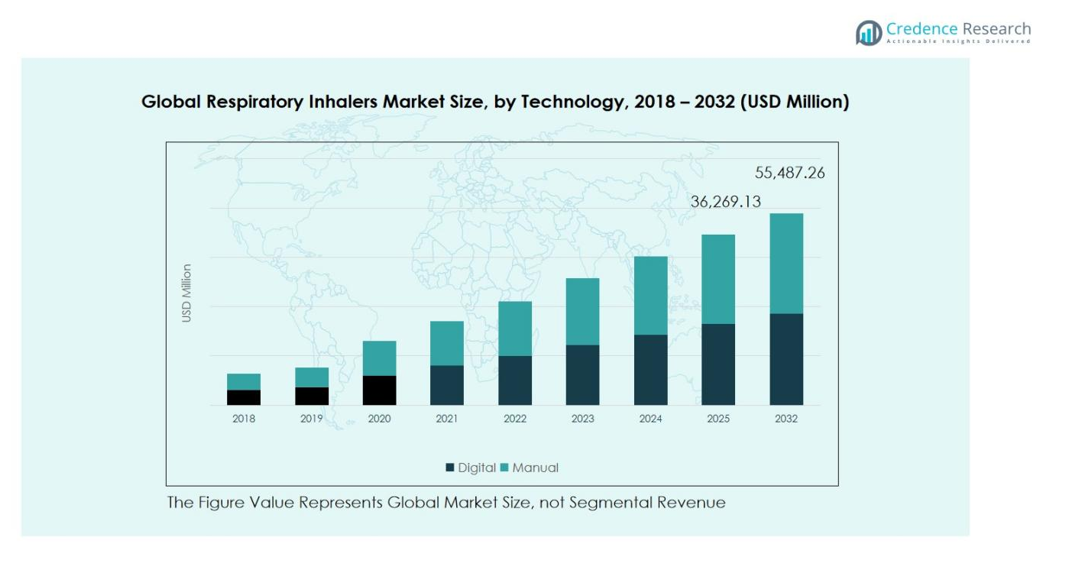
The Manual inhalers segment currently holds the largest share, accounting for nearly 50% of the market, attributed to their affordability, ease of use, and accessibility across both developed and emerging regions. However, the Digital inhalers sub-segment is the fastest-growing category, driven by the integration of smart sensors, Bluetooth connectivity, and adherence monitoring technologies. Growing emphasis on personalized medicine, remote patient management, and data-driven treatment optimization is expected to accelerate digital inhaler adoption, reshaping future market dynamics.
Key Growth Drivers
Rising Prevalence of Respiratory Disorders
The increasing incidence of asthma, COPD, and other chronic respiratory diseases is a major growth driver for the respiratory inhalers market. Rising air pollution, urbanization, and tobacco consumption have intensified the global burden of these conditions. As healthcare systems emphasize early diagnosis and long-term management, the demand for efficient and portable inhalation devices continues to expand. Public health programs promoting awareness about respiratory care and improved access to treatment options are further accelerating inhaler adoption worldwide.
- For instance, Boehringer Ingelheim’s Respimat Soft Mist inhaler offers a propellant-free alternative with a slow-moving aerosol cloud, improving drug delivery and suitability for humid climates, thus expanding treatment options for asthma and COPD patients.
Technological Advancements in Inhaler Devices
Continuous innovation in inhaler technology, including digital inhalers with dose counters, Bluetooth connectivity, and adherence tracking, is reshaping market growth. These smart devices enhance treatment accuracy, enable remote monitoring, and support patient engagement-addressing long-standing challenges in medication compliance. Manufacturers are increasingly integrating advanced sensors and data analytics to personalize therapy. Such technological improvements not only improve clinical outcomes but also create opportunities for value-based healthcare partnerships and reimbursement support.
- For instance, Aptar Pharma has developed digital dose counting inhalers with integrated sensors that provide real-time dose tracking and reminders, improving medication adherence in asthma and COPD patients.
Expansion of Home Healthcare and Self-Management Solutions
The global shift toward home healthcare is fueling the adoption of respiratory inhalers, particularly among the elderly and patients with chronic illnesses. Portable and user-friendly inhalers allow patients to manage conditions such as asthma and COPD independently, reducing hospital visits and overall treatment costs. The COVID-19 pandemic accelerated this trend, prompting healthcare providers to endorse home-based respiratory therapies. The growing preference for self-administered, cost-effective treatment options continues to strengthen market expansion.
Key Trends & Opportunities
Emergence of Digital and Connected Inhalers
The integration of connectivity features within inhaler systems has created a transformative opportunity for the market. Digital inhalers record inhalation data, monitor dosage adherence, and transmit information to healthcare providers in real time. This capability supports telehealth and remote patient management, offering improved disease control and reduced healthcare costs. Partnerships between medical device companies and digital health firms are further expanding this trend, creating a data-driven ecosystem for respiratory care management.
- For instance, Phillips Medisize has developed add-on sensing devices and integrated sensors that share real-time medication usage data across multiple healthcare providers, facilitating earlier intervention and more efficient disease management.
Sustainability and Eco-Friendly Product Development
Growing environmental concerns are driving manufacturers to develop propellant-free and recyclable inhalers. Regulatory pressure to reduce greenhouse gas emissions from hydrofluorocarbon-based inhalers has accelerated the transition toward sustainable alternatives, such as dry powder inhalers and eco-friendly propellants. This trend not only aligns with global sustainability goals but also enhances brand image and compliance readiness for manufacturers. Companies focusing on green innovation are gaining a competitive edge and expanding market presence across environmentally conscious regions.
- For instance, GSK is advancing a low carbon Ventolin inhaler that uses an innovative, low carbon propellant to reduce greenhouse gas emissions, with phase III clinical trials underway and commercial production planned at its Evreux facility in France.
Key Challenges
Stringent Regulatory Requirements and Approval Delays
The respiratory inhalers market faces challenges due to complex regulatory frameworks governing device safety, efficacy, and environmental compliance. Frequent updates in emission standards and inhalation drug formulations extend approval timelines and increase development costs. Manufacturers must adhere to evolving guidelines from agencies like the FDA and EMA, which can delay product launches and restrict market entry. These stringent regulatory processes often hinder innovation speed and limit smaller players from competing effectively.
Patient Adherence and Technique Limitations
Despite technological advancements, improper inhaler use and poor adherence remain persistent challenges in respiratory care. Many patients struggle with coordination, incorrect dosage, or inconsistent device maintenance, leading to suboptimal treatment outcomes. Lack of adequate training and awareness among users, especially in low-income regions, exacerbates this issue. To overcome this challenge, manufacturers and healthcare providers must focus on patient education, smart inhaler design, and adherence-monitoring technologies to ensure effective drug delivery and long-term disease control.
Regional Analysis
North America
North America holds a leading position in the global respiratory inhalers market due to advanced healthcare infrastructure and high disease awareness. The regional market was valued at USD 5,236.10 million in 2018 and grew to USD 7,906.64 million in 2024, projected to reach USD 12,578.96 million by 2032, expanding at a CAGR of 5.9%. The region’s strong market share is driven by technological innovations in inhaler design and increased prevalence of asthma and COPD. The U.S. dominates this growth, supported by government programs promoting chronic disease management and adoption of digital inhalers.
Europe
Europe continues to maintain a strong share in the respiratory inhalers market, supported by well-established healthcare systems and aging demographics. The market was worth USD 5,851.07 million in 2018, rising to USD 9,107.53 million in 2024, and is forecasted to reach USD 15,092.53 million by 2032, at a CAGR of 6.5%. Key markets like Germany, the U.K., and France contribute significantly to regional expansion. Increasing respiratory disorder prevalence, along with sustainable inhaler innovations and favorable reimbursement policies, enhances Europe’s market outlook and reinforces its competitive position globally.
Asia Pacific
Asia Pacific commands the largest market share in the respiratory inhalers market, driven by urbanization, pollution, and healthcare advancements. The regional market increased from USD 7,105.35 million in 2018 to USD 11,093.30 million in 2024, and is projected to reach USD 18,455.06 million by 2032, growing at a CAGR of 6.5%. Rising respiratory disease incidence in China, India, and Japan, coupled with improved healthcare access and awareness campaigns, drives demand. Increasing investment in digital healthcare technologies and local manufacturing further enhances affordability and accessibility of inhalation therapies.
Latin America
Latin America’s respiratory inhalers market shows steady progress, supported by healthcare modernization and increasing prevalence of respiratory illnesses. The market was valued at USD 2,384.67 million in 2018, reached USD 3,683.35 million in 2024, and is expected to attain USD 6,042.56 million by 2032, expanding at a CAGR of 6.3%. Brazil, Mexico, and Argentina lead regional demand through expanding healthcare infrastructure and public health initiatives. Growing awareness of chronic respiratory conditions and rising adoption of portable inhaler devices contribute to consistent market growth across the region.
Middle East
The Middle East respiratory inhalers market has been expanding gradually, supported by rising investments in healthcare infrastructure and awareness of respiratory care. The market size increased from USD 1,057.40 million in 2018 to USD 1,512.41 million in 2024, and is projected to reach USD 2,219.49 million by 2032, registering a CAGR of 4.9%. The Gulf Cooperation Council (GCC) countries dominate regional demand due to high asthma incidence and adoption of advanced medical technologies. Increasing healthcare spending and government-led screening programs are improving respiratory health outcomes and driving steady market penetration.
Africa
Africa’s respiratory inhalers market is expanding at a stable rate, driven by improved access to healthcare facilities and growing awareness of chronic respiratory diseases. Valued at USD 486.67 million in 2018, the market reached USD 716.36 million in 2024, and is projected to reach USD 1,098.65 million by 2032, with a CAGR of 5.4%. South Africa leads the market, supported by government health programs and the introduction of cost-effective generic inhalers. However, limited healthcare infrastructure in several African nations continues to constrain rapid growth, though ongoing international aid and partnerships are fostering improvement.
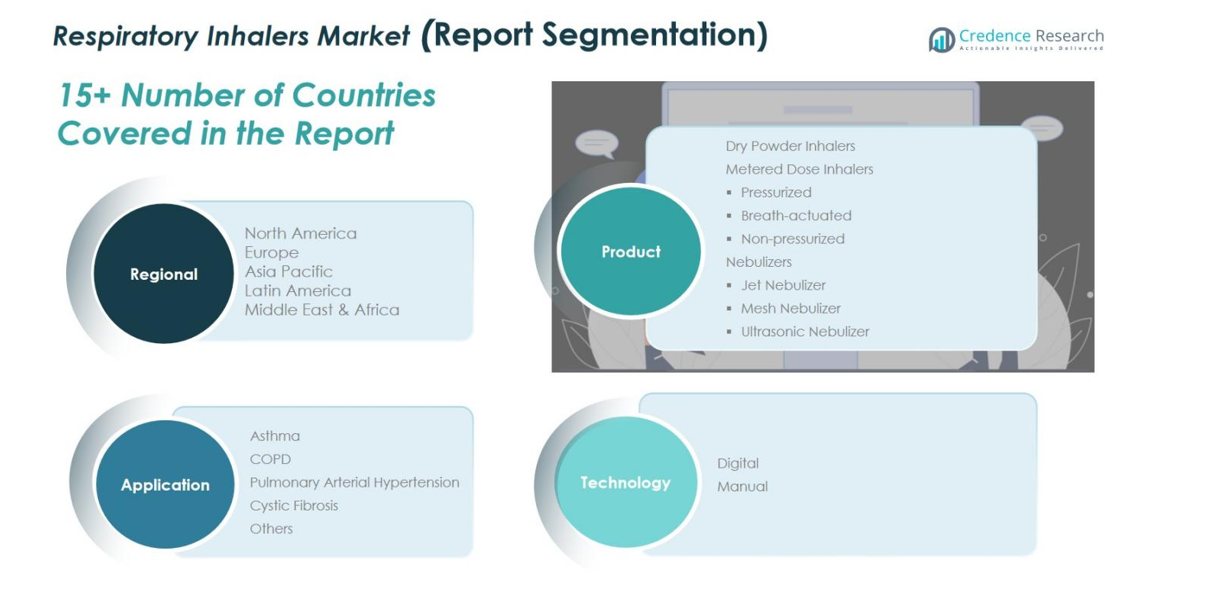
Market Segmentations:
Metered Dose Inhalers (MDIs)
- Pressurized
- Breath-actuated
- Non-pressurized
Nebulizers
- Jet Nebulizer
- Mesh Nebulizer
- Ultrasonic Nebulizer
By Application:
- Asthma
- Chronic Obstructive Pulmonary Disease (COPD)
- Pulmonary Arterial Hypertension
- Cystic Fibrosis
- Others
By Technology:
- Digital
- Manual
By Region:
- North America
- U.S.
- Canada
- Mexico
- Europe
- Germany
- France
- U.K.
- Italy
- Spain
- Rest of Europe
- Asia Pacific
- China
- Japan
- India
- South Korea
- South-east Asia
- Rest of Asia Pacific
- Latin America
- Brazil
- Argentina
- Rest of Latin America
- Middle East & Africa
- GCC Countries
- South Africa
- Rest of the Middle East and Africa
Competitive Landscape
The competitive landscape of the respiratory inhalers market features major players such as GlaxoSmithKline plc, AstraZeneca plc, Boehringer Ingelheim GmbH, Teva Pharmaceutical Industries Ltd., and Cipla Ltd. These companies dominate the market through strong product portfolios, extensive R&D investments, and strategic collaborations. Leading manufacturers are focusing on digital inhaler technologies, combination therapies, and patient-centric designs to enhance treatment adherence and clinical outcomes. For instance, companies are integrating smart sensors into inhalers for real-time monitoring and data analytics. Strategic mergers and acquisitions have also strengthened global presence, enabling access to emerging markets and advanced manufacturing capabilities. Furthermore, firms are emphasizing environmentally sustainable inhalers to comply with new regulatory standards on propellant use. The market competition remains intense, with innovation, pricing strategies, and expansion into developing economies serving as key differentiators among top players.
Key Player Analysis
- Boehringer Ingelheim GmbH
- AstraZeneca plc
- PARI Medical Holding
- Merck & Co., Inc.
- Teva Pharmaceutical Industries Ltd.
- Cipla Inc.
- GlaxoSmithKline plc
- Beximco Pharmaceuticals Ltd.
- NutraRespiro
- Wellona Pharma
Recent Developments
- In April 2024, Teva announced the discontinuation of the Digihaler product line due to commercial challenges.
- In 2023, AstraZeneca received FDA approval for Airsupra, a combination inhaler containing albuterol and budesonide for as-needed asthma treatment in adults, which became commercially available shortly after approval.
- In 2024, Aptar Pharma entered an exclusive agreement with Cambridge Healthcare Innovations to commercialize the Quattrii dry powder inhaler platform, aiming to provide a sustainable and cost-effective solution.
- In July 2025, Merck & Co. acquired Verona Pharma for approximately $10 billion, enhancing its portfolio with Verona's COPD drug, Ohtuvayre, approved in the U.S. in 2024
Report Coverage
The research report offers an in-depth analysis based on Product, Application, Technology and Region. It details leading market players, providing an overview of their business, product offerings, investments, revenue streams, and key applications. Additionally, the report includes insights into the competitive environment, SWOT analysis, current market trends, as well as the primary drivers and constraints. Furthermore, it discusses various factors that have driven market expansion in recent years. The report also explores market dynamics, regulatory scenarios, and technological advancements that are shaping the industry. It assesses the impact of external factors and global economic changes on market growth. Lastly, it provides strategic recommendations for new entrants and established companies to navigate the complexities of the market.
Future Outlook
- The respiratory inhalers market is expected to continue growing steadily due to rising prevalence of chronic respiratory diseases.
- Increasing adoption of digital and smart inhaler technologies will enhance patient adherence and remote monitoring.
- Growth in home healthcare and self-management solutions will expand demand for portable and user-friendly inhalers.
- Technological innovations in propellant-free and eco-friendly inhalers will support sustainable market development.
- Emerging markets in Asia Pacific and Latin America will offer significant growth opportunities.
- Expansion of combination therapies and advanced formulations will drive clinical adoption.
- Regulatory focus on environmental sustainability will encourage development of greener inhaler options.
- Strategic collaborations, mergers, and acquisitions will strengthen global market presence for key players.
- Awareness campaigns and government programs for asthma and COPD management will increase market penetration.
- Integration of digital health platforms and telemedicine will further transform inhaler usage and patient care.
Request a Free Sample
Fill in your details and we'll send you a free sample report.
- Sample data tables & charts
- Research methodology
Need a Custom Version of This Report?
Tailor the scope, geography, or segments to your exact requirements.
- Custom geography or segment scope
- Direct access to our analyst team
Frequently Asked Questions
What is the current market size for Respiratory Inhalers Market, and what is its projected size in 2032?
At what Compound Annual Growth Rate is the Respiratory Inhalers Market projected to grow between 2025 and 2032?
Which Respiratory Inhalers Market segment held the largest share in 2024?
What are the primary factors fueling the growth of the Respiratory Inhalers Market?
Who are the major players in this market?
Which region commanded the largest share of the Respiratory Inhalers Market in 2024?
Table of Content
Chapter 1. Report Introduction
- 1.1 Report Description & Purpose
- 1.1.1 Report Title & Market Definition
- 1.1.2 Unique Selling Propositions (USP) & Key Differentiators
- 1.1.3 Value Proposition for Stakeholders
- 1.2 Research Objectives
- 1.2.1 Market Sizing Objectives (Volume & Revenue) (Volume Where Applicable)
- 1.2.2 Segmentation Objectives
- 1.2.3 Competitive Intelligence Objectives
- 1.2.4 Forecast & Scenario Objectives
- 1.3 Report Scope
- 1.3.1 Respiratory Inhalers Scope – Segments & Subsegments Covered
- 1.3.2 Geographic Scope – Regions & Countries Covered
- 1.3.3 Historical Period, Base Year & Forecast Period (2024; forecast to 2032)
- 1.3.4 Inclusions & Exclusions
- 1.4 Industry Classification & Applicable Codes
- 1.5 Currency, Measurement Units & Valuation Basis
- 1.6 Target Stakeholders
- 1.7 Limitations & Assumptions
Chapter 2. Executive Summary
- 2.1 Global Respiratory Inhalers Market Snapshot
- 2.1.1 Market Size – Historical (2024) & Forecast (2024-2032) (2024: USD 34,019.6 million → 2032: USD 55,487.3 million)
- 2.1.2 Volume & Revenue – Global Totals (Volume Where Applicable)
- 2.1.3 Key Market Highlights – Top Five Facts
- 2.2 Respiratory Inhalers Market Segmentation Snapshot
- 2.2.1 Market Split by Region – 2024 vs. 2032
- 2.3 Competitive Snapshot
- 2.3.1 Top 10 Players by Revenue Share – 2024
- 2.3.2 Top 10 Players by Volume Share – 2024 (Volume Where Applicable)
- 2.3.3 Recent Strategic Developments (18-Month Summary)
- 2.4 Key Investment Highlights & Strategic Conclusions
Chapter 3. Respiratory Inhalers Market Dynamics & Industry Analysis
- 3.1 Market Overview & Context
- 3.1.1 Respiratory Inhalers Market Position in the Broader Industry Value Chain
- 3.1.2 Demand Structure & Purchasing Dynamics
- 3.1.3 Market Maturity & Development Stage by Region
- 3.2 Respiratory Inhalers Market Drivers
- 3.3 Respiratory Inhalers Market Restraints & Challenges
- 3.4 Respiratory Inhalers Market Opportunities
- 3.5 Porter's Five Forces Analysis
- 3.5.1 Threat of New Entrants
- 3.5.2 Bargaining Power of Suppliers
- 3.5.3 Bargaining Power of Buyers
- 3.5.4 Threat of Substitutes
- 3.5.5 Competitive Rivalry – Intensity Assessment
- 3.6 Respiratory Inhalers Value Chain Analysis
- 3.6.1 Upstream – Key Inputs, Resources & Suppliers
- 3.6.1.1 Key Input/Resource 1
- 3.6.1.2 Key Input/Resource 2
- 3.6.1.3 Key Input/Resource 3
- 3.6.2 Midstream – Core Operations & Value Creation
- 3.6.2.1 Operating Model & Process Overview
- 3.6.2.2 Key Operating Locations & Capabilities by Company
- 3.6.3 Downstream – Market Channels & End Users
- 3.6.3.1 Direct Sales & Customer Engagement Channels
- 3.6.3.2 Indirect Sales, Intermediaries & Partner Channels
- 3.6.4 Value Chain Profitability Analysis
- 3.6.1 Upstream – Key Inputs, Resources & Suppliers
- 3.7 PESTEL Analysis
- 3.7.1 Political Factors
- 3.7.2 Economic Factors
- 3.7.3 Social Factors
- 3.7.4 Technological Factors
- 3.7.5 Environmental Factors
- 3.7.6 Legal Factors
- 3.8 Respiratory Inhalers Supply Chain Analysis
- 3.8.1 Critical Input & Resource Availability Risk Assessment
- 3.8.2 Supplier & Operational Concentration Risk (Geographic Exposure)
- 3.8.3 Supply & Service Disruption Impact Analysis
- 3.9 Regulatory & Policy Landscape
Note: The regulatory and policy landscape section covers regulations based on their applicability to the market, Respiratory Inhalers category, geography, and scope of the study. Only regulatory frameworks with a material impact on operations, compliance, trade, sustainability, or market access are analyzed in detail.
Chapter 4. Key Investment Pockets & Opportunity Analysis
- 4.1 Respiratory Inhalers Market Attractiveness Analysis
- 4.1.1 By Region – Investment Attractiveness Matrix (Market Size × CAGR)
- 4.2 Absolute Revenue Growth Opportunity
- 4.2.1 By Region – Absolute Revenue Growth Through 2032
- 4.3 Incremental Demand Opportunity
- 4.3.1 By Region – Incremental Demand Through 2032
- 4.3.2 Segment – Incremental Demand
- 4.4 Emerging Submarket Opportunity Deep Dive (Subject to Applicability)
- 4.5 Priority Market Opportunity Scorecards
- 4.5.1 United States
- 4.5.2 Europe
- 4.5.3 Asia
- 4.5.4 Middle East & Africa
Note: Priority market opportunity scorecards reflect the geographic scope and strategic relevance of the study. Listed markets are indicative and may be adapted to the industry.
Chapter 5. Respiratory Inhalers Cross-Border Trade & Market Access Analysis
- 5.1 International Trade & Cross-Border Activity Overview
- 5.1.1 Global Export Value by Country (2024)
- 5.1.2 Global Export Volume by Country (2024) (Volume Where Applicable)
- 5.1.3 Global Import Value by Country (2024)
- 5.1.4 Global Import Volume by Country (2024) (Volume Where Applicable)
- 5.1.5 Net Trade Balance by Country (2024)
- 5.2 Export Analysis – Segment
- 5.2.1 Category 1 (Applicable Classification Code)
- 5.2.2 Category 2 (Applicable Classification Code)
- 5.2.3 Category 3 (Applicable Classification Code)
- 5.2.4 Category 4 (Applicable Classification Code)
- 5.2.5 Category 5 (Applicable Classification Code)
- 5.3 Import Analysis – Segment
- 5.3.1 Category 1 (Applicable Classification Code)
- 5.3.2 Category 2 (Applicable Classification Code)
- 5.3.3 Category 3 (Applicable Classification Code)
- 5.3.4 Category 4 (Applicable Classification Code)
- 5.3.5 Category 5 (Applicable Classification Code)
- 5.4 Cross-Border Pricing & Transaction Benchmarks
- 5.4.1 Export Pricing – Segment & Country
- 5.4.2 Import Pricing – Segment & Source Country
- 5.4.3 Price Trends (2024)
- 5.5 Key Cross-Border Trade & Delivery Routes
- 5.5.1 Cross-Border Trade/Delivery Route 1
- 5.5.2 Cross-Border Trade/Delivery Route 2
- 5.5.3 Cross-Border Trade/Delivery Route 3
- 5.5.4 Cross-Border Trade/Delivery Route 4
- 5.5.5 Cross-Border Trade/Delivery Route 5
- 5.6 Trade Policy & Market Access Impact Assessment
- 5.6.1 Tariff & Non-Tariff Barriers
- 5.6.2 Regional Trade & Economic Integration Frameworks
- 5.6.3 Bilateral & Multilateral Trade Agreements
- 5.6.4 Cross-Border Operating, Licensing & Localization Requirements
Note: This chapter applies where cross-border trade or delivery is relevant to Respiratory Inhalers. Goods, services, and digital offerings are assessed using applicable classifications and transaction measures. Import-export volumes, trade balances, and route analyses are included only where meaningful to the market.
Chapter 6. Competitive Landscape & Company Benchmarking
- 6.1 Respiratory Inhalers Market Concentration & Structure
- 6.1.1 Herfindahl-Hirschman Index (HHI) – vs. 2024
- 6.1.2 Leading, Mid-Sized & Emerging Player Structure
- 6.1.3 Global, Regional & Local Player Dynamics
- 6.2 Respiratory Inhalers Market Share Analysis – 2024
- 6.2.1 Global Revenue Share by Company
- 6.2.2 Global Volume Share by Company (Volume Where Applicable)
- 6.2.3 Regional Revenue Share
- 6.2.4 Market Share Evolution ( vs. 2024)
- 6.2.5 Company Market Share by Key Segment
- 6.2.6 Company Market Share by Customer Group
- 6.3 Operating Scale, Capacity & Infrastructure Analysis
- 6.3.1 Global Operating Scale & Supply Capacity
- 6.3.2 Resource Utilization & Operating Efficiency
- 6.3.3 Output, Service Delivery & Activity Metrics
- 6.3.4 Operating Footprint & Infrastructure Map
- 6.3.5 Planned Operational & Capacity Expansion
- 6.4 Respiratory Inhalers Competitive Benchmarking Matrix
- 6.4.1 Revenue, Growth, Profitability & Operating Metric Comparison
- 6.4.2 Channel Revenue Mix
- 6.4.3 Geographic Revenue Exposure
- 6.4.4 R&D Intensity
- 6.4.5 Sustainability Maturity
- 6.5 Strategic Developments in Respiratory Inhalers (Last 24 Months)
- 6.5.1 Mergers, Acquisitions & Divestments
- 6.5.2 New Products, Services & Solutions in Respiratory Inhalers
- 6.5.3 Operational & Infrastructure Expansions
- 6.5.4 Strategic Alliances, Joint Ventures & Partnerships
- 6.5.5 Distribution Expansion & Market Entry
- 6.5.6 Sustainability & ESG Initiatives
- 6.6 Competitive Strategy Mapping
- 6.6.1 Leader, Challenger, Follower & Niche Classification
- 6.6.2 Pricing Strategy Comparison
- 6.6.3 Channel Strategy Matrix
Note: Strategic developments are included based on their materiality and the availability of reliable information.
Chapter 7. Global Respiratory Inhalers Market – By Sales & Delivery Channel
- 7.1 Segment Overview
- 7.1.1 Volume & Revenue Split by Channel (2024 & 2032) (Volume Where Applicable)
- 7.1.2 Channel Mix Evolution (2024-2032)
Chapter 8. Regional Market Analysis – Global Overview
- 8.1 Global Regional Overview
- 8.1.1 Regional Volume Share (Volume Where Applicable)
- 8.1.2 Regional Revenue Share
- 8.1.3 Regional Volume by Region (Volume Where Applicable)
- 8.1.4 Regional Revenue by Region
- 8.1.5 Regional Forecast Through 2032
- 8.2 Cross-Regional Segment Analysis
- 8.2.1 By Sales & Delivery Channel
- 8.2.2 By Competitive Positioning & Price Tier
Chapter 9. North America Respiratory Inhalers Market
- 9.1 United States
- 9.2 Canada
- 9.3 Mexico
Chapter 10. Europe Respiratory Inhalers Market
- 10.1 Germany
- 10.2 France
- 10.3 Italy
- 10.4 United Kingdom
- 10.5 Spain
- 10.6 Poland
- 10.7 Russia
- 10.8 Netherlands
- 10.9 Belgium
- 10.10 Sweden
- 10.11 Denmark
- 10.12 Norway
- 10.13 Rest of Europe
Chapter 11. Asia Pacific Respiratory Inhalers Market
- 11.1 China
- 11.2 India
- 11.3 Japan
- 11.4 South Korea
- 11.5 Thailand
- 11.6 Indonesia
- 11.7 Vietnam
- 11.8 Malaysia
- 11.9 Australia
- 11.10 Rest of Asia Pacific
Chapter 12. Latin America Respiratory Inhalers Market
- 12.1 Brazil
- 12.2 Argentina
- 12.3 Colombia
- 12.4 Chile
- 12.5 Rest of Latin America
Chapter 13. Middle East Respiratory Inhalers Market
- 13.1 Saudi Arabia
- 13.2 United Arab Emirates
- 13.3 Turkey
- 13.4 Israel
- 13.5 Iran
- 13.6 Rest of the Middle East
Chapter 14. Africa Respiratory Inhalers Market
- 14.1 South Africa
- 14.2 Egypt
- 14.3 Nigeria
- 14.4 Morocco
- 14.5 Rest of Africa
Chapter 15. Respiratory Inhalers Company Profiles
- 15.1 [Company 01]
- 15.1.1 Company Overview
- 15.1.2 Key Management Personnel
- 15.1.3 Products & Services Portfolio
- 15.1.4 Financial Performance
- 15.1.5 Key Market Focus & Geographic Presence
- 15.1.6 Recent Developments & Strategic Initiatives
Note: The company profile list is preliminary and may change based on research findings, market developments, data availability, and client requirements.
Chapter 16. Appendices
- Appendix A – List of Abbreviations & Acronyms
- Appendix B – Industry Classification Code Reference – Full Series
- Appendix C – Supply, Output & Operating Capacity Data Tables
- Appendix D – End-Use & Demand Base Tables
- Appendix E – Demand, Adoption & Usage Assumptions
- Appendix F – Pricing & Revenue Metric Reference Tables
- Appendix G – Company Operations & Infrastructure Database
- Appendix H – Cross-Border Trade & Activity Data Tables (Where Applicable)
- Appendix I – Regulatory Summary Tables
- Appendix J – Primary Research Participant List (Anonymized)
- Appendix K – Primary Research Questionnaire Framework
- Appendix L – Data Sources & Bibliography
- Appendix M – Market Size Divergence & Source Comparison
Chapter 17. Research Methodology
- 17.1 Research Framework & Philosophy
- 17.2 Secondary Research – Sources, Hierarchy & Data Extraction
- 17.3 Data Modeling – Bottom-Up & Top-Down Market Sizing
- 17.4 Primary Research – Stakeholder Framework, LOI & Sample Sizes
- 17.5 Forecast Methodology – Regression, Scenario & Sensitivity Analysis
- 17.6 Quality Control – Four-Layer Validation Framework
- 17.7 Limitations & Standard Assumptions
- 17.8 Disclaimer
