
Market Overview
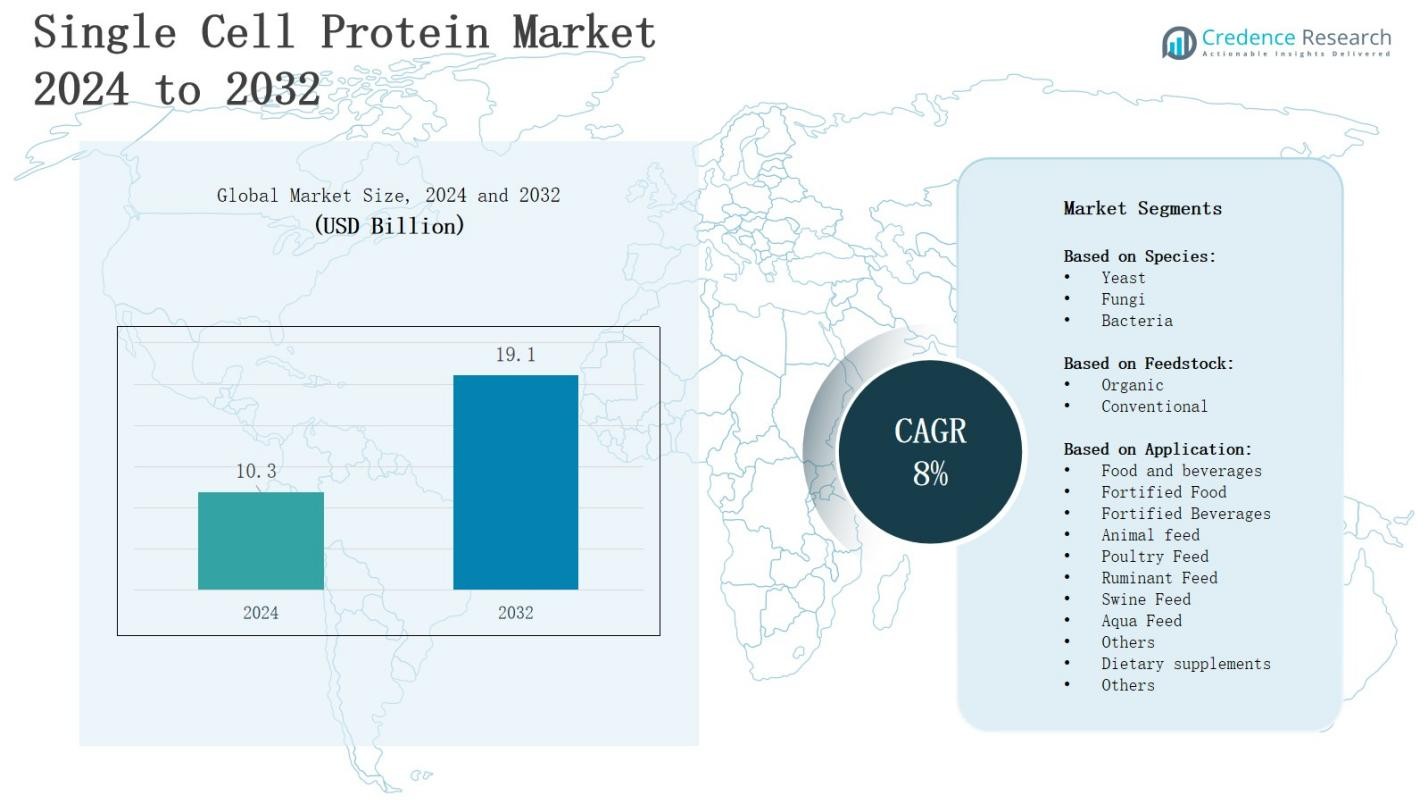
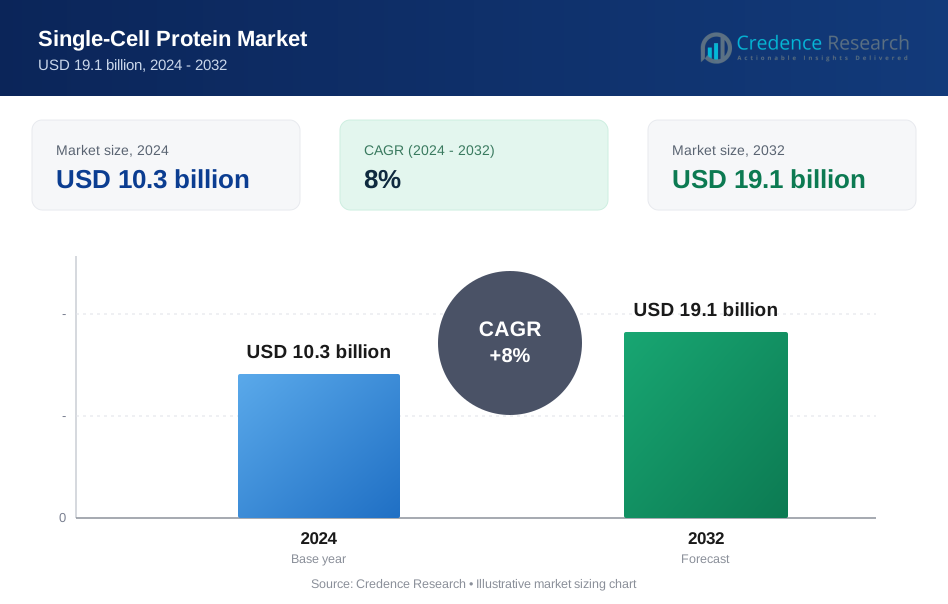
The Single Cell Protein Market is projected to grow from USD 10.3 billion in 2024 to USD 19.1 billion by 2032, registering a CAGR of 8% during the forecast period.
| REPORT ATTRIBUTE | DETAILS |
|---|---|
| Historical Period | 2020-2024 |
| Base Year | 2024 |
| Forecast Period | 2025-2032 |
| Single Cell Protein Market Size 2024 | USD 10.3 Billion |
| Single Cell Protein Market, CAGR | 8% |
| Single Cell Protein Market Size 2032 | USD 19.1 Billion |
The Single Cell Protein Market grows as rising global protein demand, sustainability concerns, and resource-efficient food production drive adoption. It benefits from increasing acceptance of alternative proteins in food, feed, and nutraceutical industries, supported by innovations in microbial fermentation and bioprocessing. Government initiatives promoting food security and environmental conservation strengthen market expansion. Trends include the integration of biotechnology for higher yield, use of renewable feedstocks, and applications in aquaculture and animal nutrition. Growing investments by food-tech startups, partnerships for large-scale production, and consumer preference for eco-friendly protein sources further position it as a critical segment in the future protein economy.
The Single cell protein market demonstrates diverse geographical presence with North America leading at 32% share, followed by Europe at 28% and Asia Pacific at 26%, while Latin America and the Middle East & Africa each account for 7%. It benefits from strong adoption in food, feed, and dietary applications across these regions. Key players include Calysta Inc., Evonik Industries AG, Biomin Holding GmbH, Unibio A/S, Charoen Pokphand Food PCL, Novus International, Church & Dwight Co. Inc., BioProcess Algae LLC, Devenish Nutrition Limited, and BEC Feed Solutions Pty Ltd.
Market Insights
- The Single Cell Protein Market is projected to grow from USD 10.3 billion in 2024 to USD 19.1 billion by 2032, registering a CAGR of 8% during the forecast period.
- Rising global demand for sustainable and resource-efficient protein sources is driving adoption in food, feed, and nutraceutical industries.
- Technological advancements in microbial fermentation and bioprocessing enable higher yields, cost efficiency, and improved scalability.
- Government initiatives promoting food security and environmental sustainability strengthen commercialization across developed and emerging economies.
- High production costs, scale-up limitations, and regulatory complexities remain key challenges, alongside consumer acceptance concerns.
- Geographically, North America leads with 32% share, followed by Europe at 28% and Asia Pacific at 26%, while Latin America and the Middle East & Africa each account for 7%.
- Key players include Calysta Inc., Evonik Industries AG, Biomin Holding GmbH, Unibio A/S, Charoen Pokphand Food PCL, Novus International, Church & Dwight Co. Inc., BioProcess Algae LLC, Devenish Nutrition Limited, and BEC Feed Solutions Pty Ltd.
Market Drivers
Rising Global Demand for Sustainable Protein Sources
The growing need for sustainable protein alternatives acts as a primary driver for the Single cell protein market. Population growth and limited availability of conventional protein sources create strong demand for microbial-based proteins. It provides high nutritional value while reducing reliance on traditional animal farming. The market gains momentum from consumer preference for eco-friendly and ethical food choices. It supports global protein security by addressing challenges in meat and plant-based production.
- For instance, Unibio has commercialized its methane-fed protein Uniprotein®, and in 2023 signed licensing agreements to establish large-scale production plants in North America.
Advancements in Bioprocessing and Fermentation Technologies
The Single cell protein market benefits from continuous improvements in fermentation and bioprocessing technologies. Innovations enable higher yields, cost efficiency, and scalability, making production commercially viable. It leverages biotechnology to optimize strain development and nutrient efficiency. Enhanced production methods lower environmental footprint compared to traditional agriculture. It strengthens applications across food, feed, and industrial sectors. Growing investments in R&D push the market toward wider adoption and technological maturity.
Government Support and Regulatory Encouragement
The Single cell protein market expands under strong government support and favorable regulations promoting sustainable food production. Policies encouraging resource-efficient protein sources align with global climate and food security goals. It benefits from funding initiatives that reduce production barriers for startups and large firms. Governments actively endorse protein diversification strategies to minimize dependency on conventional farming. It drives investment confidence and accelerates commercialization across developed and emerging economies.
- For instance, in 2023, the European Commission approved funding under its Horizon Europe program to support microbial protein research, including single-cell protein, to reduce reliance on traditional animal feed.
Expanding Applications Across Food and Feed Industries
The Single cell protein market grows with its expanding use in food, animal feed, aquaculture, and nutraceuticals. High protein content and functional properties attract food manufacturers and feed formulators. It improves animal nutrition while reducing reliance on fishmeal and soy. Demand from aquaculture and poultry industries strengthens adoption. It provides flexibility for tailored nutritional solutions across multiple end users. Rising consumer awareness of sustainable diets further boosts industrial uptake.
Market Trends
Integration of Biotechnology and Precision Fermentation in Production
The Single cell protein market is experiencing strong growth through biotechnology integration and precision fermentation. It enables enhanced strain engineering, improved nutrient conversion, and optimized scalability. Companies are focusing on tailoring microorganisms to deliver higher yields and specific amino acid profiles. Advanced fermentation lowers costs and supports consistent quality, making large-scale adoption feasible. It creates opportunities for wider industrial use and positions microbial protein as a reliable alternative to traditional food and feed proteins.
- For instance, companies using CRISPR-Cas and RNAi technologies to enhance strain engineering, optimizing protein production efficiency while using agricultural and industrial by-products as substrates.
Adoption of Renewable and Low-Cost Feedstocks
The Single cell protein market gains traction with the rising adoption of renewable, low-cost feedstocks. It utilizes agricultural residues, food waste, and industrial byproducts to improve sustainability and lower dependence on conventional inputs. This trend enhances cost competitiveness and reduces environmental impact across production chains. Companies are prioritizing circular economy models to integrate resource efficiency. It supports large-scale expansion and aligns well with global climate objectives by promoting waste-to-value strategies for protein generation.
- For instance, Calysta produces its FeedKind® protein using natural gas via microbial fermentation, reducing reliance on land and water-intensive crops while providing an alternative protein source for aquaculture.
Expansion into Animal Nutrition and Aquaculture Sectors
The Single cell protein market is diversifying its applications through expansion in animal feed and aquaculture. It offers high-quality protein that improves digestibility and nutritional balance for livestock, poultry, and fish. Aquaculture demand is accelerating due to declining fishmeal availability and rising feed costs. It provides a scalable solution to replace conventional feed sources. This trend strengthens supply chains and supports sustainable growth across global livestock and seafood production industries.
Strategic Collaborations and Investments by Food-Tech Companies
The Single cell protein market is witnessing rising collaborations and investments from food-tech firms and established corporations. It benefits from joint ventures, mergers, and funding that accelerate innovation and market reach. Startups secure financial backing to commercialize production at scale. Established players are forming partnerships to strengthen product portfolios and enter new geographies. It highlights a competitive landscape where innovation and alliances drive growth, pushing microbial protein closer to mainstream adoption globally.
Market Challenges Analysis
High Production Costs and Scale-Up Limitations
The Single cell protein market faces significant challenges from high production costs and technical barriers in scaling up operations. It requires advanced fermentation infrastructure, costly feedstocks, and skilled expertise to ensure efficiency. Limited economies of scale restrict price competitiveness with conventional protein sources. It struggles to achieve affordability for mass markets, particularly in developing economies. Companies must invest heavily in R&D to optimize strains, improve yields, and reduce energy consumption. These constraints slow down rapid commercialization despite rising demand.
Regulatory Barriers and Consumer Acceptance Issues
The Single cell protein market encounters hurdles from complex regulatory frameworks and consumer acceptance concerns. It must meet stringent safety standards before approval for human consumption or animal feed use. Regulatory variations across regions delay global market entry for producers. It also faces skepticism from consumers unfamiliar with microbial proteins or wary of biotechnology-based products. Building trust through transparent labeling, education, and product quality assurance remains critical. Overcoming these issues is essential to expand adoption and strengthen industry growth.
Market Opportunities
Rising Demand for Alternative Proteins and Sustainable Solutions
The Single cell protein market presents strong opportunities through growing global demand for sustainable and alternative protein sources. It provides high nutritional value while using less land, water, and energy compared to conventional farming. Consumer interest in eco-friendly diets and food security is driving rapid acceptance. It holds potential to replace or complement plant-based and animal proteins in multiple industries. Expanding applications in functional foods, dietary supplements, and livestock feed reinforce its commercial growth potential.
Technological Advancements and Strategic Industry Collaborations
The Single cell protein market is positioned to benefit from rapid advancements in biotechnology, fermentation, and process optimization. It creates pathways for cost reduction, enhanced scalability, and new product formulations tailored for specific nutritional needs. Strategic collaborations among food-tech startups, established corporations, and research institutions are expanding commercialization opportunities. It also opens doors to new geographic markets, especially in regions facing protein shortages. Growing investment interest and favorable policies further strengthen the prospects for long-term adoption and expansion.
Market Segmentation Analysis:
By Species
The Single cell protein market is segmented into yeast, fungi, and bacteria, each offering unique nutritional and functional benefits. Yeast dominates with its wide use in food, beverages, and dietary supplements due to rich protein and vitamin content. Fungi provide strong applications in fortified foods and animal feed, while bacteria support efficient large-scale production with higher protein yields. It benefits from ongoing research that enhances strain performance and positions microbial sources as vital alternatives to conventional proteins.
- For instance, Angel Yeast (China) produces nutritional yeast extracts widely used in plant-based meat and fortified foods, with its 2023 annual report noting strong growth in the nutrition and health sector.
By Feedstock
The Single cell protein market is divided into organic and conventional feedstock. Organic feedstock gains preference due to rising demand for natural and sustainable food production. It aligns with consumer trends toward eco-friendly diets and premium nutritional products. Conventional feedstock remains significant for cost-effective mass production, particularly in animal nutrition. It enables producers to achieve commercial scalability while maintaining product quality. The balance between organic innovation and conventional affordability drives steady adoption.
- For instance, Calysta produces protein using methane as feedstock in its proprietary fermentation process, enabling a natural protein source branded as FeedKind, which is certified for aquaculture use in Europe.
By Application
The Single cell protein market spans applications in food and beverages, animal feed, dietary supplements, and others. Fortified foods and beverages leverage microbial protein for enhanced nutrition, while animal feed remains the largest segment, covering poultry, ruminant, swine, aqua, and other categories. It ensures better digestibility and reduces dependency on fishmeal and soy. Dietary supplements benefit from its rich amino acid profile. Expanding use across industries strengthens its role in supporting sustainable nutrition solutions globally.
Segments:
Based on Species:
- Yeast
- Fungi
- Bacteria
Based on Feedstock:
- Organic
- Conventional
Based on Application:
- Food and beverages
- Fortified Food
- Fortified Beverages
- Animal feed
- Poultry Feed
- Ruminant Feed
- Swine Feed
- Aqua Feed
- Others
- Dietary supplements
- Others
Based on the Geography:
- North America
- U.S.
- Canada
- Mexico
- Europe
- Germany
- France
- U.K.
- Italy
- Spain
- Rest of Europe
- Asia Pacific
- China
- Japan
- India
- South Korea
- South-east Asia
- Rest of Asia Pacific
- Latin America
- Brazil
- Argentina
- Rest of Latin America
- Middle East & Africa
- GCC Countries
- South Africa
- Rest of the Middle East and Africa
Regional Analysis
North America
The Single cell protein market in North America holds 32% share, driven by strong adoption of alternative proteins and advanced biotechnology infrastructure. It benefits from high consumer awareness of sustainable diets and the growing preference for plant and microbial-based nutrition. The region supports commercialization through significant investments in research and development. Food-tech startups and established corporations actively collaborate to expand applications across food, beverages, and dietary supplements. It also gains support from government initiatives promoting resource-efficient food systems.
Europe
Europe accounts for 28% share of the Single cell protein market, supported by stringent sustainability policies and strong focus on food security. It demonstrates high adoption in fortified food, beverages, and animal feed industries. Consumer demand for clean-label and eco-friendly proteins enhances market growth across the region. Governments and industry stakeholders promote circular economy practices that utilize renewable feedstocks. It positions microbial protein as a strategic solution to reduce reliance on imported soy and fishmeal for feed.
Asia Pacific
The Single cell protein market in Asia Pacific commands 26% share, fueled by rapid urbanization, population growth, and protein consumption needs. It gains strong traction in aquaculture, poultry, and livestock feed sectors where demand for protein-rich feed is rising. Countries such as China, India, and Japan support adoption through investments in sustainable food technologies. It also benefits from expanding consumer awareness of alternative proteins in food and dietary supplements. The region is emerging as a critical hub for market expansion.
Latin America
Latin America represents 7% share of the Single cell protein market, supported by growing aquaculture and livestock industries. It benefits from increasing protein consumption and efforts to replace fishmeal with sustainable feed sources. Countries like Brazil and Chile show rising adoption of microbial proteins in poultry and aqua feed. It also presents opportunities in fortified foods as health-focused diets expand. Strategic partnerships with global players enhance regional accessibility and strengthen industry growth prospects.
Middle East & Africa
The Single cell protein market in the Middle East & Africa holds 7% share, with growth centered on food security initiatives and demand for affordable protein alternatives. It supports applications in animal feed to address livestock productivity challenges. Countries facing arid climates and limited agricultural land adopt microbial protein for sustainable production. It also gains traction in fortified food and dietary supplements due to rising urban populations. Partnerships with international firms foster technology transfer and market entry.
Key Player Analysis
- Calysta Inc.
- Evonik Industries AG
- Biomin Holding GmbH
- Unibio A/S
- Charoen Pokphand Food PCL
- Church & Dwight Co. Inc
- Novus International
- BioProcess Algae LLC
- Devenish Nutrition Limited
- BEC Feed Solutions Pty Ltd
Competitive Analysis
The Single cell protein market is highly competitive with a mix of established corporations and innovative biotechnology firms driving growth through product innovation, strategic partnerships, and capacity expansion. Key players such as Calysta Inc., Evonik Industries AG, Biomin Holding GmbH, Unibio A/S, and Charoen Pokphand Food PCL focus on large-scale production and diversification of applications across food, feed, and dietary supplements. Companies like Novus International, Church & Dwight Co. Inc., BioProcess Algae LLC, Devenish Nutrition Limited, and BEC Feed Solutions Pty Ltd invest in research to improve microbial strains, reduce production costs, and enhance nutritional value. It strengthens its position through collaborations with food-tech startups and joint ventures that support commercialization in global markets. Competitive strategies also include regional expansion, with strong emphasis on meeting sustainability goals and aligning with government-backed initiatives for food security. Innovation in feedstock utilization, particularly renewable resources, further shapes differentiation among competitors, positioning the market toward long-term scalability and broader acceptance across multiple end-user industries.
Recent Developments
- In January 2024, Calysta Inc. secured regulatory approval from China’s Ministry of Agriculture and Rural Affairs (MARA) for its FeedKind® single-cell protein in aquaculture feeds, enabling distribution through its Calysseo joint venture with Adisseo.
- In March 2025, Marsapet, a German pet food producer, introduced MicroBell, a dog kibble formulated with Calysta’s fermentation-derived FeedKind® protein, marking Europe’s first pet food product using single-cell protein.
- In August 2024, Calysta’s Calysseo joint venture completed its first shipment of FeedKind Pet from its Chongqing facility to a GMP+ certified warehouse in Poland, marking the entry of single-cell protein into the European pet food market.
- On May 26, 2025, Solar Foods achieved a major milestone by scaling up its Solein production technology 100-fold-from pilot to industrial scale-at its Factory 01, enabling commercial operations in the U.S.
Market Concentration & Characteristics
The Single cell protein market demonstrates moderate to high concentration, with a limited number of established players holding strong positions through technological expertise, production capacity, and global reach. It is characterized by intense focus on innovation in fermentation technologies, renewable feedstock utilization, and sustainable production practices. Companies compete through product diversification, cost optimization, and strategic partnerships to strengthen their presence across food, feed, and nutraceutical sectors. It benefits from rising collaborations between startups and large corporations that accelerate commercialization and expand regional penetration. Market characteristics highlight sustainability-driven demand, growing government support, and consumer interest in eco-friendly protein alternatives, creating an environment where research investment and regulatory alignment are critical for success. It also features a balance of competition and cooperation, as players work together on technology sharing while pursuing individual strategies to secure market share and expand their influence in the global protein economy.
Report Coverage
The research report offers an in-depth analysis based on Species, Feedstock, Application and Geography. It details leading market players, providing an overview of their business, product offerings, investments, revenue streams, and key applications. Additionally, the report includes insights into the competitive environment, SWOT analysis, current market trends, as well as the primary drivers and constraints. Furthermore, it discusses various factors that have driven market expansion in recent years. The report also explores market dynamics, regulatory scenarios, and technological advancements that are shaping the industry. It assesses the impact of external factors and global economic changes on market growth. Lastly, it provides strategic recommendations for new entrants and established companies to navigate the complexities of the market.
Future Outlook
- The market will expand with rising demand for sustainable protein alternatives across food and feed sectors.
- Biotechnology and fermentation advancements will improve efficiency and scalability of production.
- Renewable and low-cost feedstocks will gain importance to reduce costs and environmental impact.
- Applications in aquaculture and animal nutrition will strengthen due to declining reliance on fishmeal and soy.
- Consumer acceptance of microbial proteins will improve through awareness and transparent labeling.
- Strategic partnerships and collaborations will accelerate commercialization and global expansion.
- Regulatory frameworks will evolve to support faster approvals and encourage industry growth.
- Investments from food-tech startups and established corporations will increase innovation and competitiveness.
- Emerging economies will become critical markets due to population growth and protein demand.
- Sustainability goals and climate initiatives will drive adoption, positioning microbial protein as a mainstream solution.
Request a Free Sample
Fill in your details and we'll send you a free sample report.
- Sample data tables & charts
- Research methodology
Need a Custom Version of This Report?
Tailor the scope, geography, or segments to your exact requirements.
- Custom geography or segment scope
- Direct access to our analyst team
Frequently Asked Questions
What is the current market size for Single cell protein market, and what is its projected size in 2032?
At what Compound Annual Growth Rate is the Single cell protein market projected to grow between 2025 and 2032?
Which Single cell protein market segment held the largest share in 2024?
What are the primary factors fueling the growth of the Single cell protein market?
Who are the leading companies in the Single cell protein market?
Table of Content
Chapter 1. Report Introduction
- 1.1 Report Description & Purpose
- 1.1.1 Report Title & Market Definition
- 1.1.2 Unique Selling Propositions (USP) & Key Differentiators
- 1.1.3 Value Proposition for Stakeholders
- 1.2 Research Objectives
- 1.2.1 Market Sizing Objectives (Volume & Revenue) (Volume Where Applicable)
- 1.2.2 Segmentation Objectives
- 1.2.3 Competitive Intelligence Objectives
- 1.2.4 Forecast & Scenario Objectives
- 1.3 Report Scope
- 1.3.1 Single-Cell Protein Scope – Segments & Subsegments Covered
- 1.3.2 Geographic Scope – Regions & Countries Covered
- 1.3.3 Historical Period, Base Year & Forecast Period (2024; forecast to 2032)
- 1.3.4 Inclusions & Exclusions
- 1.4 Industry Classification & Applicable Codes
- 1.5 Currency, Measurement Units & Valuation Basis
- 1.6 Target Stakeholders
- 1.7 Limitations & Assumptions
Chapter 2. Executive Summary
- 2.1 Global Single-Cell Protein Market Snapshot
- 2.1.1 Market Size – Historical (2024) & Forecast (2024-2032) (2024: USD 10.3 billion → 2032: USD 19.1 billion)
- 2.1.2 Volume & Revenue – Global Totals (Volume Where Applicable)
- 2.1.3 Key Market Highlights – Top Five Facts
- 2.2 Single-Cell Protein Market Segmentation Snapshot
- 2.2.1 Market Split by Region – 2024 vs. 2032
- 2.3 Competitive Snapshot
- 2.3.1 Top 10 Players by Revenue Share – 2024
- 2.3.2 Top 10 Players by Volume Share – 2024 (Volume Where Applicable)
- 2.3.3 Recent Strategic Developments (18-Month Summary)
- 2.4 Key Investment Highlights & Strategic Conclusions
Chapter 3. Single-Cell Protein Market Dynamics & Industry Analysis
- 3.1 Market Overview & Context
- 3.1.1 Single-Cell Protein Market Position in the Broader Industry Value Chain
- 3.1.2 Demand Structure & Purchasing Dynamics
- 3.1.3 Market Maturity & Development Stage by Region
- 3.2 Single-Cell Protein Market Drivers
- 3.3 Single-Cell Protein Market Restraints & Challenges
- 3.4 Single-Cell Protein Market Opportunities
- 3.5 Porter's Five Forces Analysis
- 3.5.1 Threat of New Entrants
- 3.5.2 Bargaining Power of Suppliers
- 3.5.3 Bargaining Power of Buyers
- 3.5.4 Threat of Substitutes
- 3.5.5 Competitive Rivalry – Intensity Assessment
- 3.6 Single-Cell Protein Value Chain Analysis
- 3.6.1 Upstream – Key Inputs, Resources & Suppliers
- 3.6.1.1 Key Input/Resource 1
- 3.6.1.2 Key Input/Resource 2
- 3.6.1.3 Key Input/Resource 3
- 3.6.2 Midstream – Core Operations & Value Creation
- 3.6.2.1 Operating Model & Process Overview
- 3.6.2.2 Key Operating Locations & Capabilities by Company
- 3.6.3 Downstream – Market Channels & End Users
- 3.6.3.1 Direct Sales & Customer Engagement Channels
- 3.6.3.2 Indirect Sales, Intermediaries & Partner Channels
- 3.6.4 Value Chain Profitability Analysis
- 3.6.1 Upstream – Key Inputs, Resources & Suppliers
- 3.7 PESTEL Analysis
- 3.7.1 Political Factors
- 3.7.2 Economic Factors
- 3.7.3 Social Factors
- 3.7.4 Technological Factors
- 3.7.5 Environmental Factors
- 3.7.6 Legal Factors
- 3.8 Single-Cell Protein Supply Chain Analysis
- 3.8.1 Critical Input & Resource Availability Risk Assessment
- 3.8.2 Supplier & Operational Concentration Risk (Geographic Exposure)
- 3.8.3 Supply & Service Disruption Impact Analysis
- 3.9 Regulatory & Policy Landscape
Note: The regulatory and policy landscape section covers regulations based on their applicability to the market, Single-Cell Protein category, geography, and scope of the study. Only regulatory frameworks with a material impact on operations, compliance, trade, sustainability, or market access are analyzed in detail.
Chapter 4. Key Investment Pockets & Opportunity Analysis
- 4.1 Single-Cell Protein Market Attractiveness Analysis
- 4.1.1 By Region – Investment Attractiveness Matrix (Market Size × CAGR)
- 4.2 Absolute Revenue Growth Opportunity
- 4.2.1 By Region – Absolute Revenue Growth Through 2032
- 4.3 Incremental Demand Opportunity
- 4.3.1 By Region – Incremental Demand Through 2032
- 4.3.2 Segment – Incremental Demand
- 4.4 Emerging Submarket Opportunity Deep Dive (Subject to Applicability)
- 4.5 Priority Market Opportunity Scorecards
- 4.5.1 United States
- 4.5.2 Europe
- 4.5.3 Asia
- 4.5.4 Middle East & Africa
Note: Priority market opportunity scorecards reflect the geographic scope and strategic relevance of the study. Listed markets are indicative and may be adapted to the industry.
Chapter 5. Single-Cell Protein Cross-Border Trade & Market Access Analysis
- 5.1 International Trade & Cross-Border Activity Overview
- 5.1.1 Global Export Value by Country (2024)
- 5.1.2 Global Export Volume by Country (2024) (Volume Where Applicable)
- 5.1.3 Global Import Value by Country (2024)
- 5.1.4 Global Import Volume by Country (2024) (Volume Where Applicable)
- 5.1.5 Net Trade Balance by Country (2024)
- 5.2 Export Analysis – Segment
- 5.2.1 Category 1 (Applicable Classification Code)
- 5.2.2 Category 2 (Applicable Classification Code)
- 5.2.3 Category 3 (Applicable Classification Code)
- 5.2.4 Category 4 (Applicable Classification Code)
- 5.2.5 Category 5 (Applicable Classification Code)
- 5.3 Import Analysis – Segment
- 5.3.1 Category 1 (Applicable Classification Code)
- 5.3.2 Category 2 (Applicable Classification Code)
- 5.3.3 Category 3 (Applicable Classification Code)
- 5.3.4 Category 4 (Applicable Classification Code)
- 5.3.5 Category 5 (Applicable Classification Code)
- 5.4 Cross-Border Pricing & Transaction Benchmarks
- 5.4.1 Export Pricing – Segment & Country
- 5.4.2 Import Pricing – Segment & Source Country
- 5.4.3 Price Trends (2024)
- 5.5 Key Cross-Border Trade & Delivery Routes
- 5.5.1 Cross-Border Trade/Delivery Route 1
- 5.5.2 Cross-Border Trade/Delivery Route 2
- 5.5.3 Cross-Border Trade/Delivery Route 3
- 5.5.4 Cross-Border Trade/Delivery Route 4
- 5.5.5 Cross-Border Trade/Delivery Route 5
- 5.6 Trade Policy & Market Access Impact Assessment
- 5.6.1 Tariff & Non-Tariff Barriers
- 5.6.2 Regional Trade & Economic Integration Frameworks
- 5.6.3 Bilateral & Multilateral Trade Agreements
- 5.6.4 Cross-Border Operating, Licensing & Localization Requirements
Note: This chapter applies where cross-border trade or delivery is relevant to Single-Cell Protein. Goods, services, and digital offerings are assessed using applicable classifications and transaction measures. Import-export volumes, trade balances, and route analyses are included only where meaningful to the market.
Chapter 6. Competitive Landscape & Company Benchmarking
- 6.1 Single-Cell Protein Market Concentration & Structure
- 6.1.1 Herfindahl-Hirschman Index (HHI) – vs. 2024
- 6.1.2 Leading, Mid-Sized & Emerging Player Structure
- 6.1.3 Global, Regional & Local Player Dynamics
- 6.2 Single-Cell Protein Market Share Analysis – 2024
- 6.2.1 Global Revenue Share by Company
- 6.2.2 Global Volume Share by Company (Volume Where Applicable)
- 6.2.3 Regional Revenue Share
- 6.2.4 Market Share Evolution ( vs. 2024)
- 6.2.5 Company Market Share by Key Segment
- 6.2.6 Company Market Share by Customer Group
- 6.3 Operating Scale, Capacity & Infrastructure Analysis
- 6.3.1 Global Operating Scale & Supply Capacity
- 6.3.2 Resource Utilization & Operating Efficiency
- 6.3.3 Output, Service Delivery & Activity Metrics
- 6.3.4 Operating Footprint & Infrastructure Map
- 6.3.5 Planned Operational & Capacity Expansion
- 6.4 Single-Cell Protein Competitive Benchmarking Matrix
- 6.4.1 Revenue, Growth, Profitability & Operating Metric Comparison
- 6.4.2 Channel Revenue Mix
- 6.4.3 Geographic Revenue Exposure
- 6.4.4 R&D Intensity
- 6.4.5 Sustainability Maturity
- 6.5 Strategic Developments in Single-Cell Protein (Last 24 Months)
- 6.5.1 Mergers, Acquisitions & Divestments
- 6.5.2 New Products, Services & Solutions in Single-Cell Protein
- 6.5.3 Operational & Infrastructure Expansions
- 6.5.4 Strategic Alliances, Joint Ventures & Partnerships
- 6.5.5 Distribution Expansion & Market Entry
- 6.5.6 Sustainability & ESG Initiatives
- 6.6 Competitive Strategy Mapping
- 6.6.1 Leader, Challenger, Follower & Niche Classification
- 6.6.2 Pricing Strategy Comparison
- 6.6.3 Channel Strategy Matrix
Note: Strategic developments are included based on their materiality and the availability of reliable information.
Chapter 7. Global Single-Cell Protein Market – By Sales & Delivery Channel
- 7.1 Segment Overview
- 7.1.1 Volume & Revenue Split by Channel (2024 & 2032) (Volume Where Applicable)
- 7.1.2 Channel Mix Evolution (2024-2032)
Chapter 8. Regional Market Analysis – Global Overview
- 8.1 Global Regional Overview
- 8.1.1 Regional Volume Share (Volume Where Applicable)
- 8.1.2 Regional Revenue Share
- 8.1.3 Regional Volume by Region (Volume Where Applicable)
- 8.1.4 Regional Revenue by Region
- 8.1.5 Regional Forecast Through 2032
- 8.2 Cross-Regional Segment Analysis
- 8.2.1 By Sales & Delivery Channel
- 8.2.2 By Competitive Positioning & Price Tier
Chapter 9. North America Single-Cell Protein Market
- 9.1 United States
- 9.2 Canada
- 9.3 Mexico
Chapter 10. Europe Single-Cell Protein Market
- 10.1 Germany
- 10.2 France
- 10.3 Italy
- 10.4 United Kingdom
- 10.5 Spain
- 10.6 Poland
- 10.7 Russia
- 10.8 Netherlands
- 10.9 Belgium
- 10.10 Sweden
- 10.11 Denmark
- 10.12 Norway
- 10.13 Rest of Europe
Chapter 11. Asia Pacific Single-Cell Protein Market
- 11.1 China
- 11.2 India
- 11.3 Japan
- 11.4 South Korea
- 11.5 Thailand
- 11.6 Indonesia
- 11.7 Vietnam
- 11.8 Malaysia
- 11.9 Australia
- 11.10 Rest of Asia Pacific
Chapter 12. Latin America Single-Cell Protein Market
- 12.1 Brazil
- 12.2 Argentina
- 12.3 Colombia
- 12.4 Chile
- 12.5 Rest of Latin America
Chapter 13. Middle East Single-Cell Protein Market
- 13.1 Saudi Arabia
- 13.2 United Arab Emirates
- 13.3 Turkey
- 13.4 Israel
- 13.5 Iran
- 13.6 Rest of the Middle East
Chapter 14. Africa Single-Cell Protein Market
- 14.1 South Africa
- 14.2 Egypt
- 14.3 Nigeria
- 14.4 Morocco
- 14.5 Rest of Africa
Chapter 15. Single-Cell Protein Company Profiles
- 15.1 [Company 01]
- 15.1.1 Company Overview
- 15.1.2 Key Management Personnel
- 15.1.3 Products & Services Portfolio
- 15.1.4 Financial Performance
- 15.1.5 Key Market Focus & Geographic Presence
- 15.1.6 Recent Developments & Strategic Initiatives
Note: The company profile list is preliminary and may change based on research findings, market developments, data availability, and client requirements.
Chapter 16. Appendices
- Appendix A – List of Abbreviations & Acronyms
- Appendix B – Industry Classification Code Reference – Full Series
- Appendix C – Supply, Output & Operating Capacity Data Tables
- Appendix D – End-Use & Demand Base Tables
- Appendix E – Demand, Adoption & Usage Assumptions
- Appendix F – Pricing & Revenue Metric Reference Tables
- Appendix G – Company Operations & Infrastructure Database
- Appendix H – Cross-Border Trade & Activity Data Tables (Where Applicable)
- Appendix I – Regulatory Summary Tables
- Appendix J – Primary Research Participant List (Anonymized)
- Appendix K – Primary Research Questionnaire Framework
- Appendix L – Data Sources & Bibliography
- Appendix M – Market Size Divergence & Source Comparison
Chapter 17. Research Methodology
- 17.1 Research Framework & Philosophy
- 17.2 Secondary Research – Sources, Hierarchy & Data Extraction
- 17.3 Data Modeling – Bottom-Up & Top-Down Market Sizing
- 17.4 Primary Research – Stakeholder Framework, LOI & Sample Sizes
- 17.5 Forecast Methodology – Regression, Scenario & Sensitivity Analysis
- 17.6 Quality Control – Four-Layer Validation Framework
- 17.7 Limitations & Standard Assumptions
- 17.8 Disclaimer
